Showing posts with label history. Show all posts

Sunday, July 28, 2019

Roadie: Women's Rights National Historic Park

The Wesleyan Chapel, site of the First Women's Rights Convention in 1848. (10/8/18)
Though less than a sixty minute drive from our home in Rochester, New York, Anne and I had never been to the Women's Rights National Historic Park. During last October's Columbus Day long weekend, we took our day off from work to drive out to nearby Seneca Falls where the "park" is located. As (relative) locals, and residents of the hometown of suffragist Susan B. Anthony, it is easy to overlook local historic sites in one's own backyard, even those with such significance to Unites States History. More a series of interconnected museum displays than a traditional "park" (no hiking shoes required!), there is quite a bit to take in over relatively short square footage that comprises the Visitor's Center and nearby sites. The town of Seneca Falls, the basis for Bedford Falls from It's A Wonderful Life, includes a quaint Main Street with other tourist sites to investigate.

Inside the restored Wesleyan Chapel. (10/8/18)

Declaration Park lies between the Wesleyan Chapel and Visitor's Center. (10/8/18)

The Waterwall on which the entire text of the Declaration of Sentiments 
and it's signers are inscribed. (10/8/18)
Green space at Declaration Park. (10/8/18)
Entrance to the park Visitor's Center at 136 Fall Street
 next to the Wesleyan Church. (10/8/18)

Juliette Gordon Law (right), founder of the Girls Scouts of America. (10/8/18)
Display depicting the history of Girl Scouting. (10/8/18)
Replica of The Declaration of Sentiments. (10/8/18)
(10/8/18)
The First Wave statue exhibit inside the entrance of the visitor's center. (10/8/18)
Me with statues of Elizabeth Cady Stanton and Frederick Douglass. (10/8/18)
Displays leading to the second floor of the Visitor's Center.(10/8/18)
A myriad of images, artifacts and media representations 
documenting Women's Rights Movement. (10/8/18)
(10/8/18)
One of many engaging pieces for clarifying
necessity for equity. (10/8/18)
Incredible photography capture reality that these
historic events are not really ancient history. (10/8/18)
These pictures taken during our trip do little justice to the scope and power of the displays and sites at the Women's Rights National Historic Park. Each display includes quite a bit of great reading offering a wide range of perspectives on the Women's Rights Movement from both participants and those impacted. Having recently read and analyzed the Declaration of Sentiments with my students, it really is incredible that it took another 70+ years for women to fully gain the right to vote nationally. The images, statues and site at the Women's Rights park serve as powerful reminders of how far our nation has come relative to delivering equity, and in light of recent political environment, how far there is yet to go.

Tuesday, June 30, 2015

Summer Reading: The Sage of Waterloo

The rabbit living in our backyard, unrelated to The Sage of Waterloo except,
perhaps, in spirit. (6/17/15)
At some point in early June, while listening to public radio on my drive home from school, there was a brief commentary about a book about rabbits. Fortunately I pulled up to a stop sign when the radio program concluded and scrawled the title of the book on a loose piece of paper for future reference: The Sage of Waterloo.

As I've often written here, titles, authors and experience have a tendency to reveal themselves when the individual is ready for them. Given my current fixation on the wild bunnies that currently populate my neighborhood--and my anthropomorphic fantasies about them--I was more than ready for a novel about rabbits. Thoughtful, cultured rabbits, and more to the point, a novel written from a unique perspective on a historical locale of which I had done little previous reading. Thanks to the generous gift card bestowed upon me by a former student/recent graduate of mine, I purchased a copy of Leona Francombe's volume during the waning weeks of school and promptly dug in.

"All early memories are close-ups aren't they? A blade of grass; a clump of earth; the undersides of someone's tail. For me it was Grandmother's flank. ..." begins the first "person" tale of a William, a white rabbit whose journey begins in historic Hougoumont, near Waterloo, Belgium. Influenced by his grandmother, Old Lavender (named as such due to her scent), William's world-view is influenced greatly by the historic events that took place at Hougoumont during the Battle of Waterloo. Old Lavender was there at the 1815 battle where Napoleon met his final defeat at the hands of the Duke of Wellington and often shares her recollections of the battle with in her lagomorph charges that include Caillou the runt, Spode the elder statesman and Jonas the rebel.

Each rabbit is richly characterized by both their individual actions and their relationships with the narrator and, especially, Old Lavender. Though Old Lavender is the "Sage" of the first 90 or so pages, midway through the novel that mantle shifts to William as he moves beyond the walls of Hougoumont. A tribute to the power of place, William takes his point of origination with him to the "outside" world. Both Sages deliver historical information in the form of anecdotes and observations about historical figures who fought at Waterloo as well as about the natural terrain which still carries the scars and memories of the battle.

The wild bunny asks
"What Would William Do?"
 (6/17/15)
Francombe does not shy away from bringing to life the grisly realities of war, a harsh truth which is only slightly ameliorated by the deceit that the genteel language of rabbits is used to communicate it to the reader. Whether recalling those first "wounded stragglers" each man bearing his own unique horror written in dirt and blood" (92) or empathizing with those who bore witness to the brutality and as a result were "mute with fear. Our souls shuddered at the thougth of what he had seen;" the sadness is palpable. Throughout the narrative, modern events within the rabbit colony are also juxtaposed with those of the Battle of Waterloo; for example, when a hawk swoops taking one of the rabbits, William's guilt is described as "a musketball to the ribs." (61)

Among the more fascinating aspects of Francombe's novel is the careful creation of a belief system followed by the rabbits called the Hollow Way. Not only does this suggest the reasoning behind William's actions, but it also contributes to the allegorical feel of the novel as a whole, as the Way suggests attributes of mysticism and naturalism. Throughout the events of the story, William references the deified Moon as the center of his belief's, and the role is plays in times of challenge in his own survival in times of challenge. Early on, William reminds the reader of the power of the Way, a small part of which is clearly mindful reflection on the past, "the view behind is as clear as the view ahead and offers some valuable lessons besides."

With any luck, The Sage of Waterloo by Leona Francombe will find its way onto many book club tables at local stores. Worthy of both reading and discussion, its elegant and genteel (these two adjectives constantly came to mind as I read) exploration of the power of place in the natural world, history and the consequences of war is chock full of hooks for all interests. Like all good reads, it is so much more than a book about rabbits, despite is being really just a book about rabbits.

A highly recommended summer read!

Saturday, September 06, 2014

Roadie: Metropolitan Museum of Art in NYC

Arriving before the crowds, we quickly gained entrance. (8/31/14)
Last weekend, while returning my stepson to Columbia University for  his sophomore year, my wife and I found ourselves with some free time and used it to visit the Metropolitan Museum of Art.

Anne and I went into the experience fully aware that we would be hard pressed to see even a portion part of the museum's extensive collections in the 3 hours we had set aside to tour. The weather in New York City that day was especially humid, and with the building being air conditioned, we also recognized the likelihood of many others seeking to be both nourished by the art and to escape the heat. These factors (time and attendance did nothing to hamper our enjoyment f the pieces we did get to see, and further increased our desire to return for some other exhibits when we go back for Parents' Weekend in October.

The wide array of requires that each person's tour of the museum to be an individualized one--it would be impossible to meaningfully walk the entirety of the Met in a single walk through. For today's trip, in addition to the Delaware painting, I hoped to see the collection of European armor as well as whatever else we could take in.

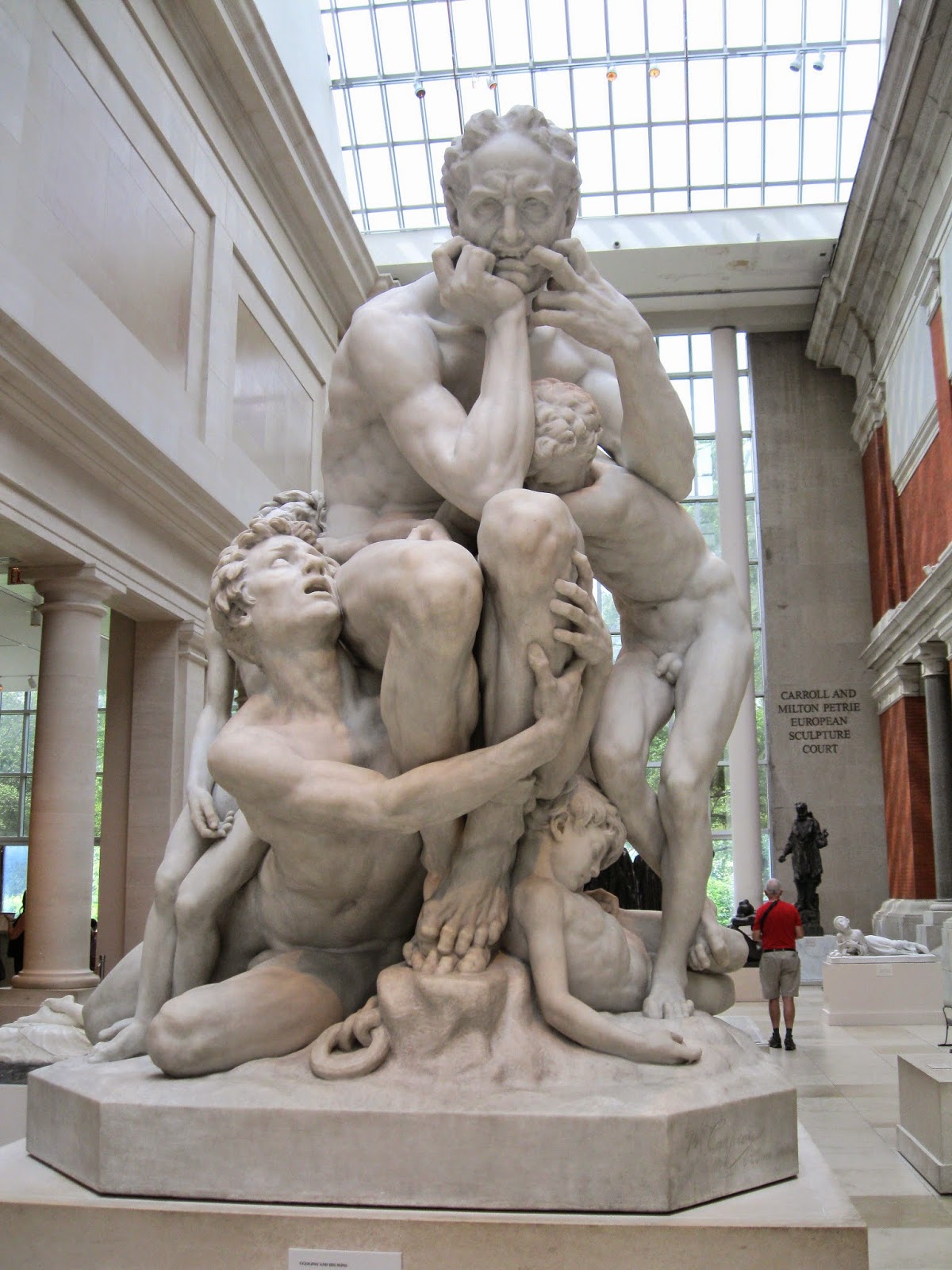
As artistic movements reflect the development of cultures as well as the ebb and flow of history, the Met is as much what one would think of as a historical museum as an art one. Despite being on a mission to see Washington Crossing the Delaware, much of our time was spent wandering exhibits that, while influential on the development of the United States and Americans, could not rightly be considered the products of either. What follows are some pictures we took of just a small portion of what we had a chance to see on our first trip to the Met. In many cases, rather than try to capture the image on film, we chose to simply take it in. Once again, much of the factual information is from Wikipedia.

No admission is required a $25 donation is suggested; the donation cost is well worth it.

The Temple of Dendur. (8/31/14)
The Temple of Dendur is an Egyptian temple that was built by the Roman governor of Egypt, Petronius, around 15 BC and dedicated to Isis, Osiris, as well as two deified sons of a local Nubian chieftain, Pediese ("he whom Isis has given") and Pihor ("he who belongs to Horus"). The temple was commissioned by Emperor Augustus of Rome and has been exhibited in the Metropolitan Museum of Art in New York since 1978.

The Temple of Dendur interior. (8/31/14)
From the Arms and Armor collection. (8/31/14)

From the Arms and Armor collection. (8/31/14)
Sallet in the shape of a lion's head.(8/31/14)
The sallet was a war helmet that replaced the bascinet in Italy, western and northern Europe and Hungary during the mid-15th century. In Italy, France and England the armet helmet was also popular, but in Germany the sallet became almost universal.

The eggplant samurai helmet from the Arms and Armor collection.(8/31/14)
The statuary at the entrance to the American Wing. (8/31/14)
Part of The American West in Bronze collection. (8/31/14)
Part of The American West in Bronze collection. (8/31/14)
(8/31/14)
(8/31/14)
View of NYC across Central Park from the Roof Garden. (8/31/14)
Close-up of Hercules with Beard. (8/31/14)
After a fantastic tour through just a floor-and-a-half of only the Northern half of the building(!), we look forward to returning soon to check out more.

Tuesday, May 13, 2014

Seen It: Young Detective Dee: The Rise of the Sea Dragon (2013)


Releasing expensive (and potentially lucrative) prequels/sequels to successful movies is a money-making creative decision common not just too Hollywood, but in other film-making markets internationally. Regardless of the country of origin, prequels/sequels often fall into certain pitfalls such as thinking bigger (more villains, larger threats, higher stakes) is better without concern for narrative quality.

Tsui Hark's 2010 Chinese-Hong Kong action hit Detective Dee and the Mystery of the Secret Flame, (a movie I reviewed previously) spawned a prequel, and unlike lesser movie fare, it proves a worthy follow-up. Returning to Young Detective Dee: The Rise of the Sea Dragon (2013) is the creative force behind the original, director/producer Tsui Hark, while Andy Lau is replaced as Detective Dee by Taiwanese-Canadian actor Mark Chao. Not surprisingly, the contrast between each film's lead actor reflects some key general differences: whereas Lau's Dee was grizzled and driven my a sense of dark foreboding, Chao's younger protagonist is quirky, confident and surprisingly romantic.

With a narrative rooted in Chinese history, providing a quick summary is difficult, and once again Barnes and Noble does so more succinctly than I ever could: "The bustling capital city of Luoyang has come under attack from a powerful force from the depths of the ocean, threatening the entire Celestial Empire. Dispatched by Minister Yan to investigate for the Da Lisi, Detective Dee (Mark Chao) quickly learns that two dragons have appeared in the capital. Meanwhile, the newly crowned Empress Wu (Carina Lau, reprising her role from Mystery of the Secret Flame) has ordered Detective Luchi to investigate as well. Later, the sea monster attacks a ceremonial procession, spreading a wave of chaos throughout the city. When Dee uncovers evidence of a conspiracy implicating the most prominent members of the Imperial Family, he is imprisoned for treason. Now Dee's only hope for exposing the truth behind the bizarre events unfolding in Luoyang is to investigate the radiant courtesan Yin (Angelababy), but in order to do that he'll first need to escape prison with a little help from Shatuo Zhong (Lin Gengxin). Once Dee is free, the race is on to save the city, and expose the treachery that threatens to topple the empire."

Actor Lin Gengxin (pictured right) plays the Robin to Mark Chao's Batman (left).
Beyond the expected wire-fu combat (once again choreographed by the legendary Sammo Hung),  Tsui conceptualizes Dee's powers of deduction (bordering on psychic abilities in the earlier movie) in a variety of ways that give our protagonist the appearance of being superhuman. Early on the film, Dee's ability to read lips is shown visually in a manner reminiscent of Spider-man's spider sense in Sam Riami's original trilogy. Quite a bit of the way objects and scenes interact with the camera (and therefore audience) also seem to suggest a movie that had been intended for release in 3D: ships splinter into the audience's face, weapons come toward the screen, and the camera pans through open porticoes. The special effects have a more obvious CGI appearance than the previous film, but this is liekly due to its use rather than its execution. In (old) Detective Dee, most of the special effects were used to depict backgrounds and architecture; in Young Detective Dee, the narrative requires more interaction by the actors with various CGI elements such as ships on the ocean under attack or giant monsters.

The performances are strong and Chao plays Dee as smart and quirky, but with a naivete playing the younger version allows; Chao's Dee always has something brewing. His relationship with impromptu sidekick Shatuo Zhong (Lin Gengxin) is presented as a respectful, collaborative one rather than for laughs, a refreshing dynamic given some action filmmakers' crutch of using minor characters for comic relief. Many of the nuanced actions and interactions between Dee and Zhong seem to reflect or suggest things that result in the older Dee character from the first film. My sense is that some of the characterization groundwork laid in Rise of the Sea Dragon will come into clearer view after a re-watch of The Secret Flame.

Young Detective Dee: Rise of the Sea Dragon is an effective and entertaining historical action film with strong performances and suitably cartoony effects that do not detract form the overall viewing experience. It is best viewed with the original, to which it is a prequel. Both are available for instant online viewing via Netflix.

Sunday, August 19, 2012

"Huzzah" for English!

Faneuil Hall and Samual Adams in Quicney Market, Boston (7/27/12).
During the past few summers, my wife and I (along with any combination of our two sons) have been fortunate enough to visit a number of historical sites. Destinations have ranged from "go to" stops such as Colonial Williamsburg in Virginia and the Pony Express Station in Gothenburg, Nebraska, all the way to the less frequented sites such as Deadwood, South Dakota. Often we'll stop along the way to other places to check out whatever Americana there is to see. While our destination may not be any specific historical site, we'll often try find a way to mix in some U.S. History. This past summer, on our college visit to Harvard for my stepson, we naturally took time to check-in on the sites in historic Boston, Massachusetts.

Purchased at Faneuil Hall.
While in Boston, we made the standard stop to the most touristy of all sites, Quincey Market. (Having been on field trips with middle schoolers to Boston, it is among the most requested sites to visit, not for the history, but for the shopping.) Part of the Freedom Trail, Faneuil Hall, has served as a marketplace and a meeting hall since 1742, and has also been the location of many inspirational speeches by significant figures in American history such as Samuel Adams, whose statue outside the Hall is seen in the picture above.

At one end of the Market, not long after exiting "The T", we stopped to look around the gift kiosk inside the Faneuil Hall. It was there that I found the small button exclaiming "Huzzah!" (left). This got me thinking...

Having employed the interjection on occasion during class, I know the blank stares of students who have no idea what you've said, so I purchased the button as a conversation starter around the changeable nature of the English language. A point further reinforced this past summer with the announcement of addition of new words to Webster's Dictionary  (like "f-bomb" and "sexting") to Webster's Dictionary, it is extremely valuable for students to recognize the at our language is continually evolving around us.

This is especially true as many of these changes, including those not included in any "respectable" dictionary, are the result of their use by the youth culture, though not many students use other new additions like "obesogenic" and "flexitarian," so there remains a role for we older cats in developing language, too. (Be prepared: It's not a stretch to project the future inclusion texting and online jargon into more common usage in the not-too-distant future.)

For those of you, like I, looking to bring an oldie-but-goody back, I invite you to continue using "huzzah." Just because a term has fallen out of common usage doesn't mean it can't be prime fro a comeback, just be sure to use it correctly let it return with a different connotation. Our friends at Wikipedia (with a touch of Dictionary.com phonetics) can define it more expediently than I:
huzzah ([huz·zah] also [h-zä])is "an archaic English interjection of joy or approbation. According to the Oxford English Dictionary it is 'apparently a mere exclamation' ...used to express joy, encouragement, or triumph. Whatever its origins, it has seen occasional literary use since at least the time of Shakespeare."
Historically , "huzzahs" were given before a bayonet charge, as a way of building morale and intimidating the enemy. The interjection can still be heard in a more modern context (tongue in cheek) at regatta's by  rowing crews to celebrate victories with a chant of "hip hip huzzah" or (where most folks, including my students) have experienced it, at Renaissance Festivals.

Huzzah for English, and for school starting soon, too!

Wednesday, August 01, 2012

Peace Amid Congestion


St. Francis of Assisi(7/27/12)?
During one of our days in Boston we did the common touristy thing of simply walking some of the streets, specifically the narrow side streets of the North End. During this time we saw many historical (The Paul Revere House) and cultural (Mike's Pastry on Hanover Street), and among the most moving was the statuary/garden outside the Saint Leonard of Port Maurice Church in Boston's North End. The question mark after the caption above is intentional. One thing I did a poor job of doing while there is writing down who each statue was of: the final picture on this post was the only one I was able to track down online. It is my understanding that Saint Leonard's is run by Franciscan friars so I'm hoping my caption above is accurate. (if someone knows otherwise, please let me know.)

The Blessed Virgin Mary (7/27/12).
The North End is Boston's oldest residential community, where people have lived continuously since it was settled in the 1630s, it is North Square area was known as Little Italy. It therefore makes sense that there would be a strong Catholic presence and the Port Maurice Church Garden is reflective of that. While not the much more frequented (and touristy) Old North Church (which I unfortunately did not take the opportunity to see), there was a serene calmness to be experienced here.

Statue of Blessed Padre Pio (7/27/12).
A likely byproduct of a lifetime of Catholicism, I can't help but find something meditative in the silence of a statuary, especially one in the heart of such a vibrant metropolitan area. After stopping by Mike's Pastry for a cannoli, we happened to wander into the garden, and found ourselves lingering for a few minutes as we took in the various saintly statues. For some reason, we never made it into the church (or the adjoining Gift Shop for that matter) though I understand it to be similarly "Old World" in its presentation.

Sometimes in Catholicism, as in many things, a little taste is enough to maintain the spirit...

Tuesday, July 31, 2012

Tracking the Spirit of JFK

The last leg of our public transit journey.
The spirit of favorite son John Fitzgerald Kennedy, the 35th President of the United States, permeates much of Boston, Massachusetts. While in staying in Harvard Square as part of a college visit, my family and I took advantage of the opportunity to visit a few tourist hot spots, among them two that celebrate and extend JFK's legacy.

The John F. Kennedy Presidential Library and Museum (7/27/12).
The John F. Kennedy Presidential Library and Museum was the first historic archives of the sort I have had the pleasure of visiting. Following the 20 minute subway/bus ride on "the T," we arrived with about ninety minutes to look through the museum before the final scheduled return bus. It was not enough time, just as my wife (who had visited previously) suggested. Her statement that "You could spend all day there" proved telling and unfortunately we did not have nearly half a day--but the time we did spend there was informative.

The Victura (7/27/12).
In addition to many displays and set pieces featuring archival footage, including the Nixon/Kennedy Debates and correspondences between he, his wife and other dignitaries, there were many items of personal importance to the president. Behind the building, positioned along the water, was JFK's beloved boat Victura (pictured above). Photographs of the Victura are present throughout the displays, so having the chance to see the actual vessel up close gave one a unique sense of being i the presence of  a small, but significant to the individual, piece of a larger historical figure's story.

The Pavilion, designed by I.M.Pei (7/27/12).
Not surprisingly, flash photography was not permitted in the museum, so I took very few pictures inside. The structure itself was stunning. Designed by I.M. Pei, one area it which it was possible to photograph was the pavilion. The pavilion is the last stop on the tour and opens into the Boston Harbor with the Victura directly outside. Despite the cloudy conditions it does offer a stunning view. Quotes from Kennedy's speeches are engraved on the wall and give the space a meditative quality. JFK's love of the nautical is illustrated throughout the museum.

A small monument in the park outside HKS with a quote
from Kennedy's Inaugural Address.
On our first evening in Cambridge we wandered the streets enjoying the architecture and history. Harvard College, like George Washington University (another school we recently toured) has elements of the campus that are interwoven into the community around it. The John F. Kennedy School of Government at Harvard University (HKS) is a public policy and public administration school, and one of Harvard's graduate and professional schools.

Because of the tremendous number of memorable speeches he gave during his lifetime, it is not unusual to see many tributes to his legacy include quotes, such as the one above.

Wannabe :)
Again, another of Kennedy's familiar lines is used in signage adorning the HKS building. More impressive than the building is to consider the significant number of intellectuals who came (and still travel) through the doorways at the HKS... excluding the individual above, of course.

It's good to be an honored guest!