Showing posts with label statues. Show all posts

Saturday, October 03, 2015

Cleveland (and J-Rock) Rocks

Part of the numerous art installations in the Daniel Burnham section of the
Cleveland Mall. (9/27/15)
I spent last weekend in the Beachwood suburb of Cleveland, Ohio, making two trips into the city. In a span of 36 hours during two trips to the North Coast Harbor district in downtown Cleveland, Ohio, on the shore of Lake Erie, we managed to take in two of the linchpins of Cleveland's shoreline redevelopment project, the Rock and Roll Hall of Fame and Cleveland Browns Stadium.

Oaktown's #1 B-Boy and I outside the Rock and Roll Hall of Fame! (9/26/15)
On the first day, the friend who I was visiting and I went to visit the Rock and Roll Hall of Fame and, though armed with our cell phones, I left my "regular" camera in the car. The following day, one on which he was working at the Cleveland Browns-Oakland Raiders NFL game, I walked around the general vicinity of the stadium parking garage and snapped a few touristy pictures of local landmarks and artwork. It was an especially gorgeous day for picture taking and football watching.

Cleveland continues to build. (9/27/15)
The Great Lakes Science Center from the Cleveland Mall. (9/27/15)
FirstEnergy Stadium, officially FirstEnergy Stadium, Home of the
Cleveland Browns as viewed from the Mall. (9/27/15)
View from my seats at FirstEnergy. (9/27/15)
A sea of Browns fans entering the stadium fro a showdown with the Raiders! (9/27/15)
The Rock and Roll Hall of Fame and Museum located on the shore of Lake Erie in
downtown Cleveland, OH, as viewed from the Mall.(9/27/15)
Pretty much the only reason we went to the Hall of Fame. (9/26/15)
Yes, the Rock and Roll Hall of Fame closes at 5:30 on Saturday night?! (9/26/15)
J-Rock identifying the Beatsie Boys! (9/26/15)
Exterior of the Cuyahoga County Courthouse in Cleveland, OH.
The frieze of the cornice includes the inscription "Cuyahoga County
Courthouse". (9/27/15)
Statue of Alexander Hamilton (1911), by Karl Bitter, outside
Main Entrance. (9/27/15)
The fact that Cuyahoga County and the winding river that runs
through it are named for the Iroquois American Indian word
meaning “crooked water” or “crooked river” may account for
the Native American visages on the doors to the court house. (9/27/15)
Close-up of door to court house. (9/27/15)
Close-up of statue of Thomas Jefferson (1911), also by Bitter,
outside the Cuyahoga County Courthouse's South Side Main
Entrance.(9/27/15)
Six stone statues, sculpted by Daniel Chester French, of historical law givers reside
above the cornice. (9/27/15)
Two statues at the center of six depicting figures associated with the development of
English and American law.(9/27/15)
(9/27/15)
View of Cuyahoga County Court House from down the street
with artwork in the foreground. (9/27/15)
Often associated only with an at-times annoying Drew Carey sitcom, it seems to me that Cleveland sometimes get's a bum rap. I found the city beautiful, the stadium fantastic and the entertainment factor of both my walks and game-day experience to be excellent. After passing the Cleveland skyline numerous times on trips elsewhere in the past, I was very pleased with my first experience there as a visitor.

Monday, September 07, 2015

Roadie: Grant's Tomb

Ulysses S. Grant and his wife Julia rest in red granite coffins in an open
crypt in the center of a circular gallery inside the memorial.(9/5/13)

Despite having visited frequently over the past three years, I am always excited by the fact that there are always new historical sites to explore when traveling to the Big Apple. While in New York City this weekend to take my stepson, Gregory, back for his junior year at Columbia, my wife and I took advantage of some down time to walk through Riverside Park and visit the General Grant National Memorial, more commonly known simply as Grant's Tomb. Designed by architect John Duncan, the memorial is the largest mausoleum in North America; a fitting tribute to this significant American military mind and Eighteenth President of the United States (1869-1877).

Tucked away in the Morningside Heights neighborhood of Upper Manhattan, the structure has gone through a number of periods of disrepair and subsequent restoration, the most recent being in 1991. Each time a restoration has been done on the tomb, new artwork has been added, including the two eagle statues (one of which I am pictured with to the left). Like many historical monuments, Grant's Tomb has had it's share of controversy from the very beginning, when the New York locale was selected as the location of he and his wife's internment.

The pathway approaching the General Grant National Memorial. (9/5/13)
The memorial is a combination of several classical styles, its lower section
supporting a rotunda surrounded by Ionic columns and surmounted by a
conical dome. (9/5/15)
On the facade of the Tomb is the epitaph, "LET US HAVE PEACE," a quote
taken from Grant's acceptance of the Republican nomination for president. Allegorical figures
representing Victory and Peace (sculpted by J. Massey Rhind) are depicted on
either side of the sign, marking Grant's importance both in war and in peace.(9/5/13)
One of two eagle statues donated following the demolition 
of the old New York City Post Office. (9/5/13)
The effect of sunlight through the amber glass, which was originally
stained glass,  while creating a solemn mood, does make
some photography difficult.(9/5/13)
Four murals of the wars Grant fought are painted on the walls. (9/5/13)
Open crypt containing the sarcophagi of the general and his wife, Julia Dent Grant. (9/5/13)
The ceiling of the rotunda directly above the sarcophagi.(9/5/13)
Niches in the walls around the coffins contain busts of Grant's best
generals, including William Tecumseh Sherman. These were designed by
artists William Mues and Jeno Juszko. (9/5/13)
One of four pendentives in the interior of the Tomb are relief sculptures, 
also by Rhind, this one an allegorical representations of Grant's military life.(9/5/13)
This unplanned detour to Grant's Tomb was surprisingly peaceful. We arrived at opening and shared the entire monument with only a few other tourists who, like I, were taking pictures of the architecture. As tends to be the case with older structures, the beautiful late-summer day made for excellent lighting for exterior shots, but the interior was dim creating challenges for indoor pics. Photography aside, the suitably somber sepia tones seemed appropriate for the building's purpose.

Sources:
General Grant National Parks Department handout
"Grant's Tomb" Wikipedia Page.

Friday, November 14, 2014

That Time I Went to See the Hut Where an Author My Students Had Never Heard Of Once Lived

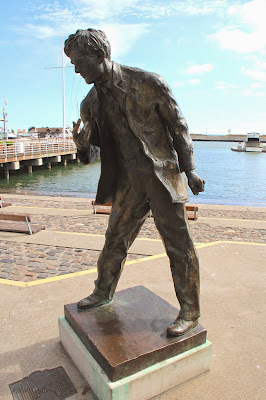
Close-up of bronze statue of Jack London created by artist Cedric Wentworth. (7/12/14)

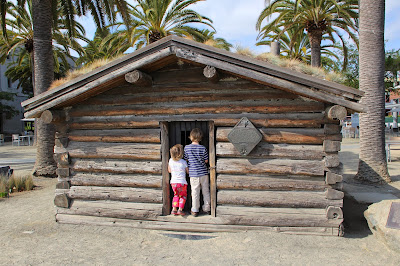
Guess where. (7/12/14)
This past week, while working with my Advanced Placement juniors in the library on a research project about American Literary Movements, I asked one student if she had read The Call of the Wild. When she looked at me as if I had three eyes I followed up with "You've read works by Jack London before, haven't you?" To that she replied, "Who is Jack London?" It was at that point that I decided we would be reading The Call of the Wild by Jack London next, despite its present location on the district's seventh grade reading list (where it has been replaced by more Common Core friendly shorter texts as part of a prescribed curriculum).

Fortunately, I have a level of  flexibility as I am working from a curriculum that is more rigorous than the Common Core (College Board approved and all that) so I can detour slightly to insure students have read authors it's difficult to understand them graduating from high school without even a passing familiarity.
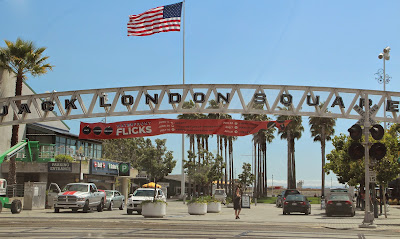
View from the road. (7/12/14)
Despite it having ended over three-and-a-half months ago, my summer trip to California is the photographic gift that continues to keep on giving. While driving home the day of "the London conversation," I recalled that my friend Jerry and I had visited a London-centric locale on my last day in California this past July. I also realized that pictures had been snapped that I hadn't really taken the time to process (it was the last day of an 8-day trip after all).

Jack London Square is one of Oakland’s most identifiable landmarks and a symbol of the city’s history as a seaport. It is also a popular entertainment and business destination on the waterfront of Oakland, California. It is named after hometown author Jack London, and is owned by the Port of Oakland. It was also our last stop before heading to the airport for my flight back East. Like many red-blooded American lads (or at least so I thought), I greatly enjoyed the Yukon adventures as a youth, so visiting the reconstruction of Jack London's Klondike Hut in Jack London Square was something of a thrill. Simple and unassuming, it was pretty neat to get a sense of the small scope from which such great adventures flowed.
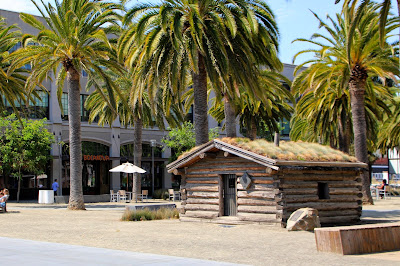
Reconstruction of Jack London's Klondike Hut in Jack London Square. (7/12/14)
John Griffith "Jack" London (born John Griffith Chaney, January 12, 1876–November 22, 1916) was born to Flora Wellman in San Francisco. Though he was raised in Oakland, and is a "Favorite Son," I'd never really associated London with California. Unlike John Steinbeck (though not quite a favorite son while alive, but the possibility of tourist dollars heals all wounds), I've always envisioned London in more frigid surroundings,  That is more a tribute to his writing and my imagination than fact, but that's how my mind always saw it.

These conflicting (mis)perceptions were made concrete by the presence of London's relocated Klondike hut on the beautiful Oakland waterfront. Creating an interesting dichotomy of visuals, the original cabin Jack London lived in in the Klondike, now rests on the California Waterfront amid palm trees. Certainly learning how to start a fire would not be nearly as life-saving as one might think in this environment...
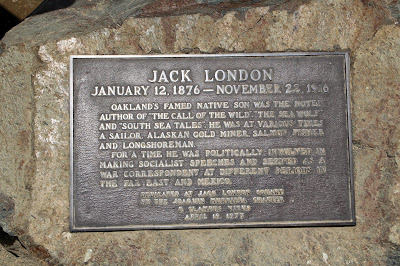
Plaque directly outside the Klondike hut. (7/12/14)

A replica of Jack London's Klondike hut. (7/12/14)
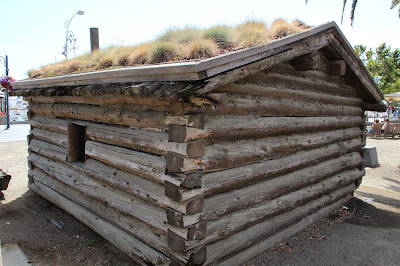
Klondike hut, rear view. (7/12/14)

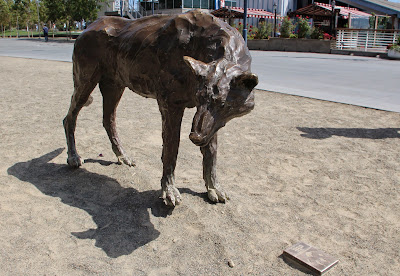
Bronze White Fang statue by Cedric Wentworth. (7/12/14)

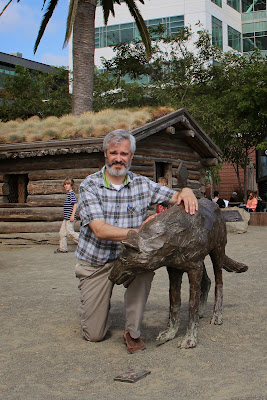
Your's truly with White Fang. (7/12/14)
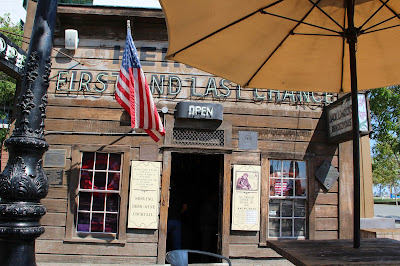
Heinold’s First and Last Chance Saloon is a historic bar in Jack London Square. It opened in 1883 in a building made from pieces of an old whaling ship. The floor is sharply tilted, resulting from pilings underneath shifting in the 1906 earthquake. During the 1920s, Alameda was a dry town. The Alameda ferry was nearby, making the bar a traveler’s last chance for a drink when going to Alameda (and first when vice-versa), it was renamed from J.M. Heinold’s Saloon. Though I attempted to get some pictures inside, poor lighting (and a weak photographer) hampered their being worthy of posting.

As a schoolboy in the late 1800s, Jack London studied at Heinold’s. Jack confided in owner John Heinold about his ambition to attend the University of California. Heinold loaned him tuition money, but Jack only lasted a year at university. He later returned to Heinold’s where he wrote his notes for The Sea Wolf and Call of the Wild. Heinold’s is referenced 17 times in John Barleycorn.
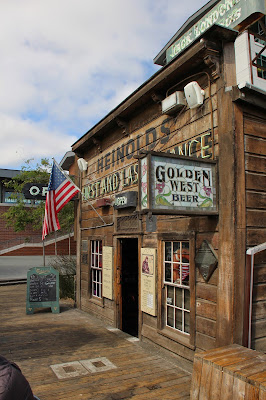
Heinold's First and Last Chance Saloon. (7/12/14)
Heinold's First and Last Chance Saloon, front view. (7/12/14)
Bronze statue of Jack London created by artist Cedric Wentworth.(7/12/14)
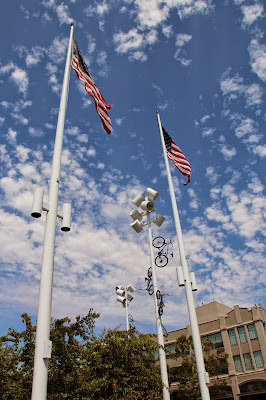
Quite a few contemporary art pieces also liven up 
Jack London Square. (7/12/14)

Sources:
Oakland Wiki
Official Jack London Square Site


Saturday, July 19, 2014

Roadie: Old Sacramento

Sun sets on Old Sacramento. (7/12/14)
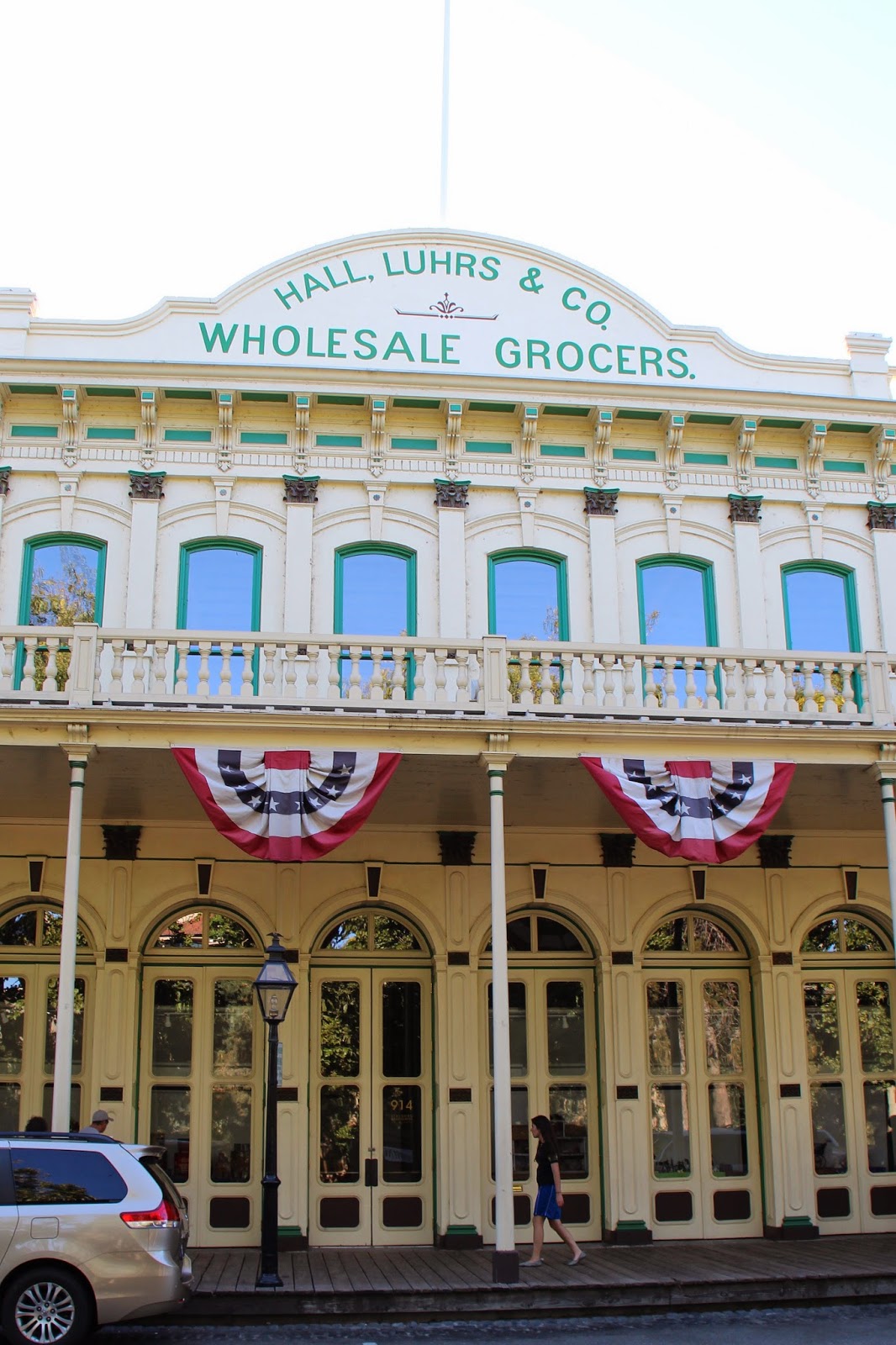
On the second day of my recent trip to California, we went to Old Sacramento, an eight block section of downtown Sacramento, as a way for me (in the words of my friend/host) to "get my cowboy on." Based on the pictures posted here, it would be understandable for you to incorrectly assume that Old Sacramento is a ghost town. While reviewing these pictures, I was surprised how poorly they reflect the pedestrian activity and foot traffic that occurred while we were there. Though it does carry a slight "tourist trap" air (always difficult to accept modern restaurants and chochki stores at historical venues), Old Sacramento is in fact a national historic landmark. Among the things to do there, in addition to checking out some great Western architecture, are shopping, eating (both of which we engaged in) and chances to ride on trains, riverboats and carriages.

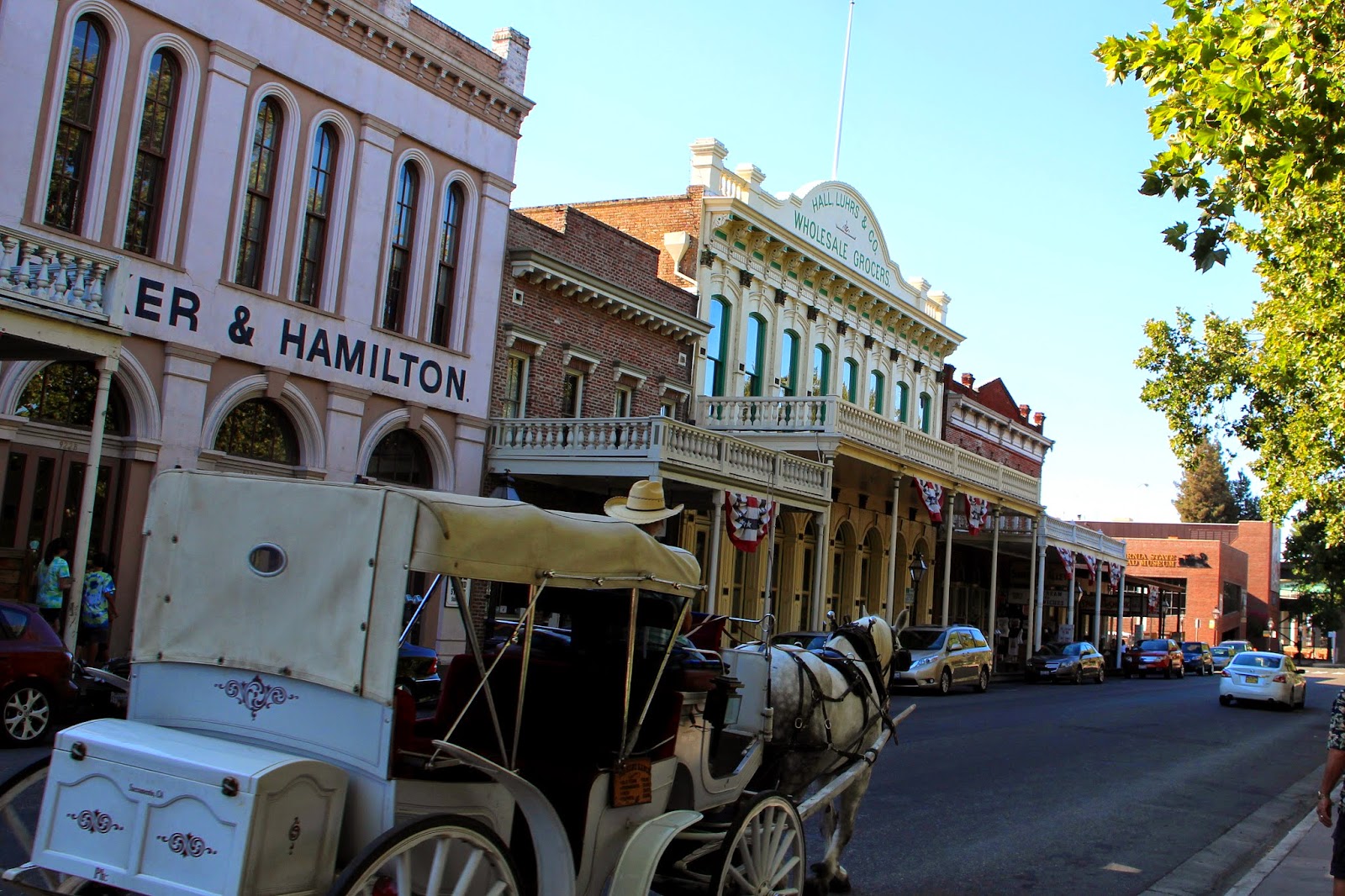
Old Sacramento. (7/12/14)
Foreground is the site of the New England Seed store, source of what would
become the state flower, camellia. (7/12/14)
Sacramento Southern in Old Sacramento (7/12/14)
It's not an official historical town without the obligatory re-enactors! (7/12/14)
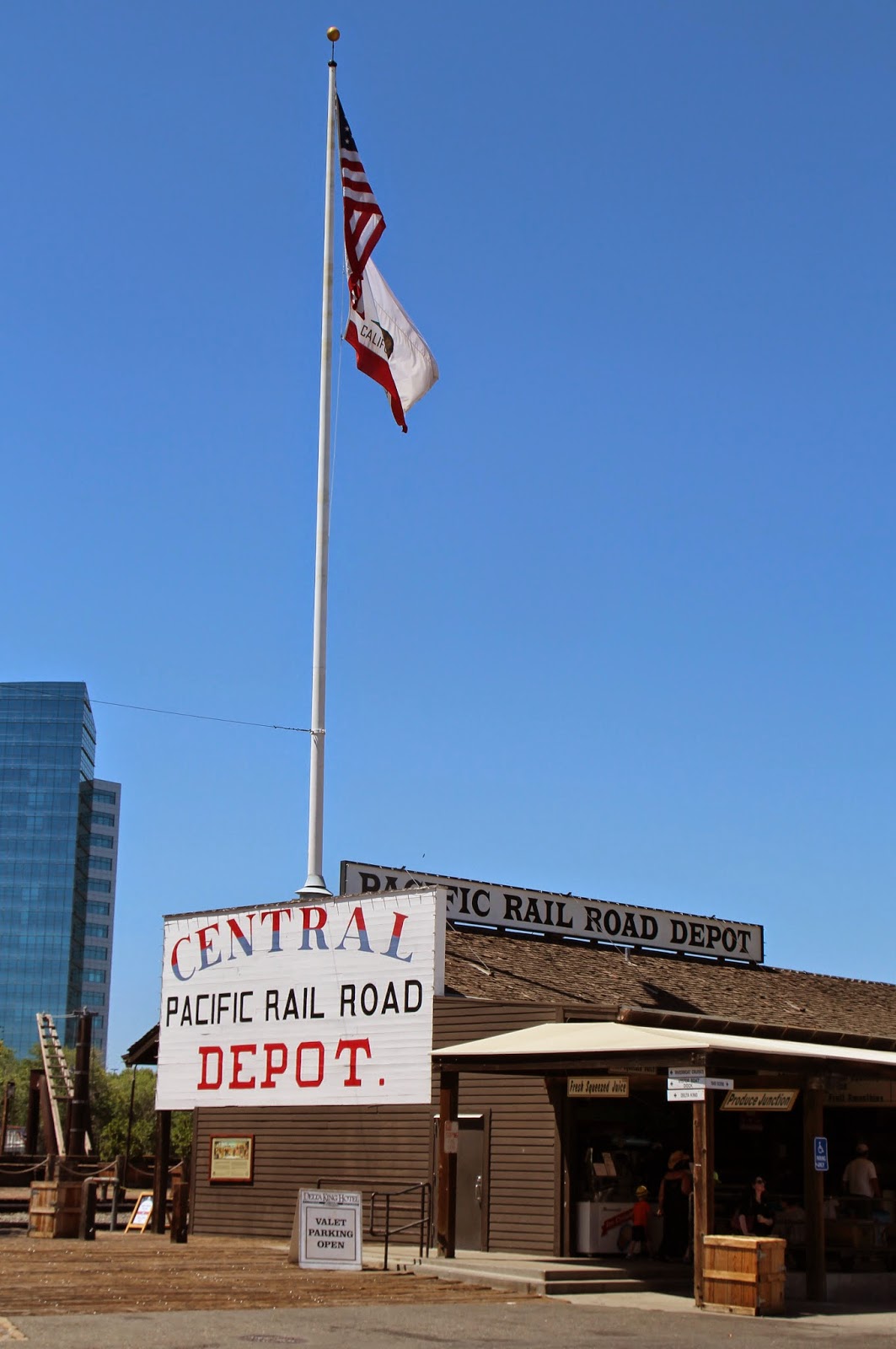
Central Pacific Rail Road depot in Old Sacramento. (7/12/14)
Myself (left), Noah and Jerry in Old Sacramento's Visitors Center. (7/12/14)
Carriage on display in Old Sacramento Visitors Center. (7/12/14)
Section of a large painting on display in Old Sacramento Visitors Center. (7/12/14)
Sign at base of Pony Express statue in Old Sacramento (7/12/14)

Interesting facts California State Parks website about the Pony Express statue sculpted by Thomas Holland: The Pony Express rider’s clothes were based on a paragraph in Mark Twain’s book Roughing It, published in 1872. Rider’s saddle and Mochilla (what they carried the mail in) were modeled after originals that are in the Santa Barbara Historical Museum. Bit and bridle were designed after military “tack” of the 1850s. The sculptor gave him a wide brimmed hat instead of a skull cap, which the riders usually wore. Statue took over 2 years to design and build, including 9 months casting and finishing by Vianello Art Bronzes.

Old Sacramento (7/12/14)
Classic coach carriage rides in Old Sacramento. (7/12/14)
Your's truly and Noah on an Old Sacramento carriage ride. (7/12/14)
And on the other side: Jerry and his wife, Angie. (7/12/14) 
Old Sacramento. (7/12/14)
Front of another statue in Old Sacramento. (7/12/14)
Old Sacramento. (7/12/14)