Showing posts with label Americana. Show all posts

Wednesday, November 27, 2019

Welcome Back (Again) John Greenleaf Whittier

A rather extraordinary individual, in addition to being a tremendous poet, John Greenleaf Whittier seems to have sadly disappeared from the public school curriculum. (Full disclosure: Though to be fair, I am unclear as to how significant a part of it he ever was.) Despite being beloved by a who's who of American poets (as evidenced by guest list of attendees at his seventieth birthday dinner in 1877: Ralph Waldo Emerson, Henry Wadsworth Longfellow, Mark Twain, and Oliver Wendell Holmes), the poet's name draws only blank stares from students when asked about his works, though I would venture to guess in the New England region he is much more well-regarded (and remembered).

My introduction to the works of Whittier was through an assignment given to my students last year. Each student was assigned an American literary movement and genre. Along with general information such as relative dates, each student was also supplied with the names of relatively familiar representative authors. For those assigned the Fireside Poets, a Northeast regional sub-genre, Whittier was one of those suggested starting point for research. Wikipedia notes that while Whittier was "[H]ighly regarded in his lifetime and for a period thereafter, he is now remembered for his poem 'Snow-Bound'..." I vividly recall students' having a difficult time finding much background information that was not clearly form a single source. I had asked students to used resources from the library as well, and while our school librarians were more than willing to assist in digging through the meager collection of poetry books available ion site, the actual hard cover sources where limited to a dusty anthology which included a single poem.

Just as his spirit was briefly conjured in my upstate New York classroom a number of year's ago, Thanksgiving gives me an opportunity to all on John Greenleaf Whittier once again. Given the subject matter, Whittier's popular poem, "The Pumpkin," lacks the political bent of his more renowned abolitionist works, but through its simple, accessible images of comfirting pumpkin pie shares with "Snow-Bound" the purpose of showing how the idyllic past can be brought briefly to the present.


Sources:
Poets.org
Poemhunter.com
Wikipedia

Thursday, July 18, 2019

Summer Reading: Backwoods Witchcraft

Backwoods Witchcraft: Conjure and Folk Magic from Appalachia by Jake Richards found its way to my desk after I came across the title while researching folk horror short story collections. Unlike those stories I initially sought, Backwoods Witchcraft is presented as a non-fiction account of the author’s own childhood growing up in Appalachia. Richards uses anecdotes, recollections and stories from his youth serve as the vehicle through which to share the charms and conjures he believes still work today.

In many ways your enjoyment of the text as a whole rests on how open you are to a friendly conversation on things that appear to be beyond belief. To his credit, Richards’s conversational style makes it a much easier sell than you might think. Reminiscent of the Justin Wilson Cajun Cooking television shows I enjoyed watching on PBS as a child, I easily accepted the invitation to enter his world. I regularly watched Wilson’s show on PBS for much the same reason I enjoyed Richards’s book; both “hosts” sprinkled in regional stories and history along with their “recipes”. Just as I never actually prepared any of the dishes Wilson colorfully prepared on his show (though as an adult I will not turn away Cajun food), in all likelihood I will not be attempting to remove warts using Quartzite as Richards’ Papaw showed him how to. Given the author’s friendly, conversational writing style, Backwoods Witchcraft reads as if you are sitting at the dining room table chatting over a cup of coffee. Richards anticipates many of the queries an outsider might have, and as a result the text works as a fascinating piece if backwoods Americana. “The stories and tricks,” as the author notes on page 33, “are passed down in families and communities, routinely offered as wives’-tale cures, or simple reminiscing of things that helped folks get along in their daily life.” Whether from Louisiana, Appalachia or Western New York, it’s these stories that bind each of us to our respective communities. Richards’ extends his own sense of belonging and community to include the reader.

For a book subtitled “Conjure and Folk Magic,” it was curious how much of the mystical qualities of stones, waters and individuals was dependent on Richards’ Christian faith. Digging deeply enough into any charm or cure and you’re likely to find a strong reliance on the brand of Christianity practiced by the residents of Appalachia. For example, when instructing the reader about gazing (a means of divining the future with a bowl of water), Richards shares that the ceremony begins with recognition of the “the Father, the Son and the Holy Spirit.” (136) Whether the reader believes the power suggested in the stories will depend greatly on one’s orthodoxy of beliefs in tenants of Christianity. Both rely on faith to have an impact. Richards Christianity is one deeply intertwined with Native American tradition and an appreciation for the power of Nature. This eclectic heritage makes for a type of Christianity that is both diverse and, in some instances, almost New Age. While one charm may have Richards invoking the Holy Trinity, the next is just as likely to point out the positive attributes of leaving pumpkins on the porch to keep the haints at bay.

Backwoods Witchcraft: Conjure and Folk Magic from Appalachia by Jake Richards is a very accessible look behind the veil of a unique set of American traditions. Unavailable at my local library, I purchased my copy from Aamzon.com, and I suspect that, much like a reference book, as I come across unfamiliar traditions and concepts in other reading, I will find myself returning to the table for a follow-up chat with Richards’s book.

Tuesday, September 06, 2016

Roadie: FDR Presidential Library & Museum

The FDR Presidential Library & Museum located in Hyde Park, New York. (9/3/16)
On Labor Day weekend, my wife and I once again made our way to New York City. Four years ago it was an anxious train ride to deliver my stepson to Columbia University for his freshmen year; this year, his final one as an undergraduate, was a much different trek. Having spent the summer in New York City, the majority of his belongings were already there, and rather than escorting him to campus, as he departed our home in Rochester, my wife and I left by car. When he arrived in town to settle in in on Saturday afternoon, we were arriving in Poughkipsee, New York, for some sightseeing before taking the train to visit the following day.

At this point Gregory really doesn't require much help moving, but we wanted to see his new dorm and decided to make a weekend out of it. Having Gregory go to college in New York City has provided Anne and I with many opportunities to visit a number of the historical sites in and around New York City, and this final September journey was no different--except that we were not solely in Gotham.

A National Historic Site, The Frederick Delano Roosevelt Presidential Library and Museum, operated by the National Park Service, is located on the grounds of Springwood, the Roosevelt family estate in neighboring Hyde Park, New York. With Poughkipsee only a manageable two-hour train ride from New York City, its location was ideal as a base of operations for a day trip to the FDR National Park prior to heading to NYC. We would have liked to have spent more time in Hyde Park, as the four hours we did spend visiting was only enough to see a small part of the park's offerings. The library was built under the President's personal direction in 1939-1940, and dedicated on June 30, 1941. It is one of the thirteen presidential libraries under the auspices of the National Archives and Records Administration.

Close-up of FDR bust outside museum. (9/3/16)
Given their four terms in office, it is not suprising how quotable
President Roosevelt and his wife turned out to be.


Not a recreation, but FDR's working study in the museum during his life. (9/3/16) 


The President's desk from his time in the Oval Office. (9/3/16)

Busts of FDR and Eleanor Roosevelt welcome visitors to the museum. (9/3/16)
Picturesque park land immediately outside the museum. (9/3/16)
Looking back through these images from our visit to the FDR Presidential Library and Museum, I am struck by how poorly they reflect how incredibly entertaining and educational this historic site is. As someone with not nearly as deep an understanding of U.S. history as he should, while visiting places I am often more focused on taking the displays in than capturing the experience on "film". In addition to the few displays seen above, there are also six-minute films for viewing prior to each section of the museum. Each included archival footage and were thoroughly engaging. Ranging from FDR's childhood and early political life to an exploration of his lasting influence on the world, narrated by President Clinton, taken as a whole they provided wonderful context and background.

When we met Gregory the following day in New York City, both Anne and I highly recommended that he take some time to visit the FDR Presidential Library and Museum in Hyde Park.

Saturday, September 12, 2015

Roadie: Liberty Island

Lady Liberty to the left and the Big Apple to the right. (9/6/15)
After multiple trips to the Big Apple, we finally made our way to Liberty Island last Saturday to see Lady Liberty. The weather was hot and humid, so the trip out on the touring boat was an especially welcome cooling event. The "airport like security" signs promised as he stepped in line to board were accurate as we, and hundreds (thousands?) of our closest friends waited in line to make our way through metal detectors.

Lady Liberty with New Jersey in the background. (9/6/15)
Like most tourist attractions in New York, however, they have been at it for many years, so what seemed like what could be a long wait went rather quickly. The number of folks visiting Liberty and Ellis Islands was staggering. It was difficult not to make the obvious observation that the experience traveling to them was very much like the experience of immigrant travelling to America through Ellis Island.

Part of the NYC skyline from the boat as we traveled to our first stop, Liberty Island. (9/6/15)
Many were on the water that day enjoying the final weekend of summer. (9/6/15)
Difficult to say much that is not readily observable: an
impressive artistic accomplishment to be sure. (9/6/15)
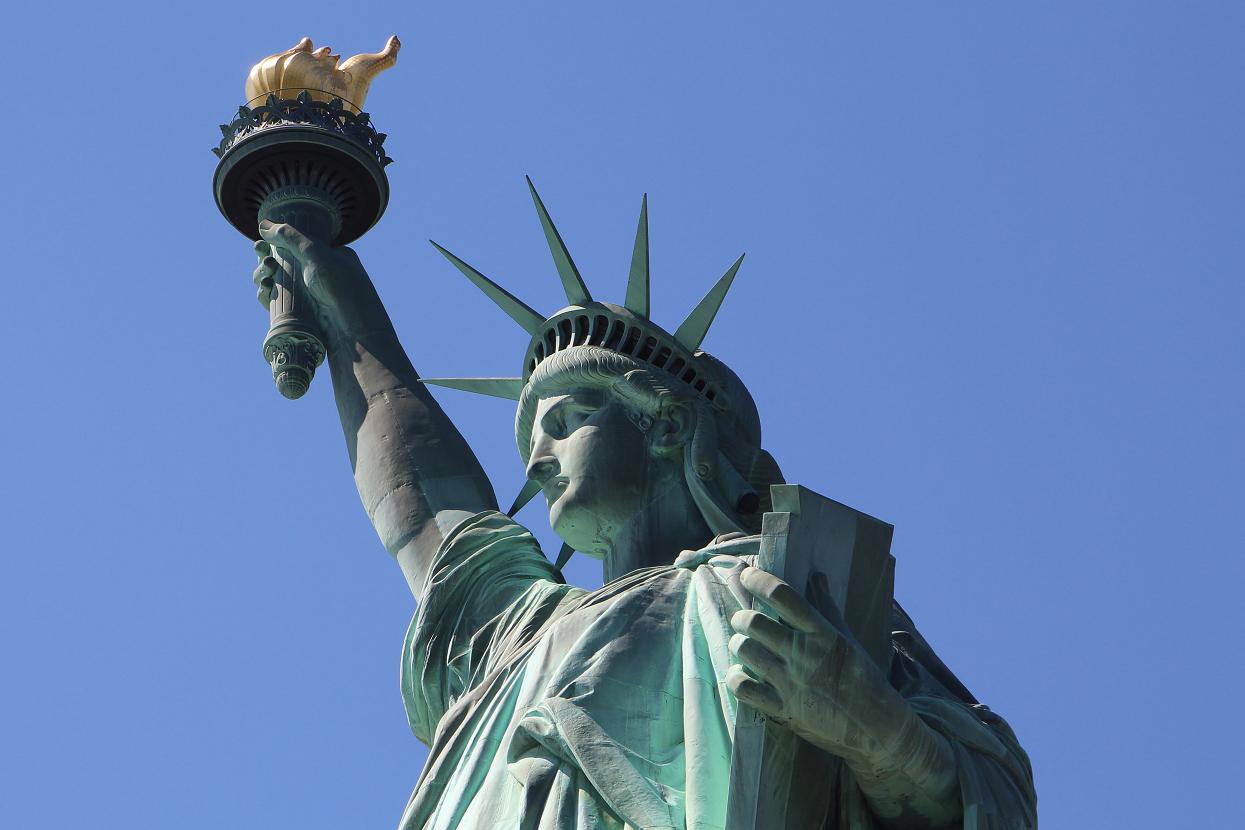
Based on the images Anne and I captured that afternoon, it is also easy to suggest it might be near impossible to take a terrible picture of the Statue of Liberty. Despite not using any filters, the color of the sky varied in the pictures taken as we made our way across New York Harbor (from the New York side). Just as when we went to South Dakota over ten years ago to tour Mt. Rushmore, the actual scale of the statue was surprising. If Mt. Rushmore seemed much smaller than expected (and it did), the Statue of Liberty was much larger.

Stopping every few steps as we walked around the base of the statue
never bored by its beauty. (9/6/15)
(9/6/15)
(9/6/15)
Elements of the Statue in view: torch, tablet, crown
and robe. (9/6/15)
The torch isolated in frame.(9/6/15)
(9/6/15)
We did not purchase passes to tour the base or top of the statue but were not that broken up about it. There was so much to take in with the just the Island and Statue, that it felt fairer to leave that for another day. After spending about 90 minutes on Liberty, we boarded the large tour boat that would take us to Ellis Island, the second leg of our journey.

The New York City skyline from the boat as we travel from Liberty
to Ellis Island. (9/6/15)

Monday, December 15, 2014

Ornament Nostalgia, Day 2

Mt. Rushmore, South Dakota.
Today our Christmas tree reminded me that it's time to go on vacation, or at least to do a better job purchasing ornaments when on the road. Judging from our tree, we haven't been out of our neighborhood in nearly six years.

Steamboat Springs,
Colorado.
This is, of course, not (entirely) the case, but it does reflect the fact that my wife and I used to do a much better job picking up Christmas-time tchotchke while away. Over the course of three summers, my family and I not only went on vacation, and while away, picked up oddly similar tree ornaments commemorating the occasions. I don't recall having done so consciously, but we had begun a homemade series of ornaments, each with a poorly drawn image (especially in Gloucester, see below) framed with inexpensive faux gold.

In August 2006, my wife, stepson and I went west, as I competed with my brother-in-law and his friends in the Wild West Relay from Laramie, Wyoming to Steamboat Springs, Colorado. While some of us were alternating legs of the 192 mile run from point A to point B, my wife and in-laws drove to Steamboat where the run concluded.

Gloucester, Virginia.
After visiting one brother, we headed south the following summer, spending part of June 2007 with my other brother-in-law in Gloucester, Virginia, where he and his wife live. As in the past, we took advantage of Gloucester's advantageous location around many historical sites to check out some US history, and I believe we picked up this ornament (right) while touring the Jamestown Settlement.

In July 2008, we drove cross-country back to Wyoming, this time taking a southern route out and going north on the way back. In addition to checking out tourist spots like the Corn Palace in Iowa, we also stopped by Mt. Rushmore and Devil's Tower. This trip turned out being one of the best we'd taken as a family and despite my brother-in-law's passing, I would love to go back that way again someday... but there are other roads to travel and unique ornaments to collect.

It's been too long since bringing back and ornament, a problem I hope to rectify as we head out and about over the next year.

Saturday, July 19, 2014

Roadie: Old Sacramento

Sun sets on Old Sacramento. (7/12/14)
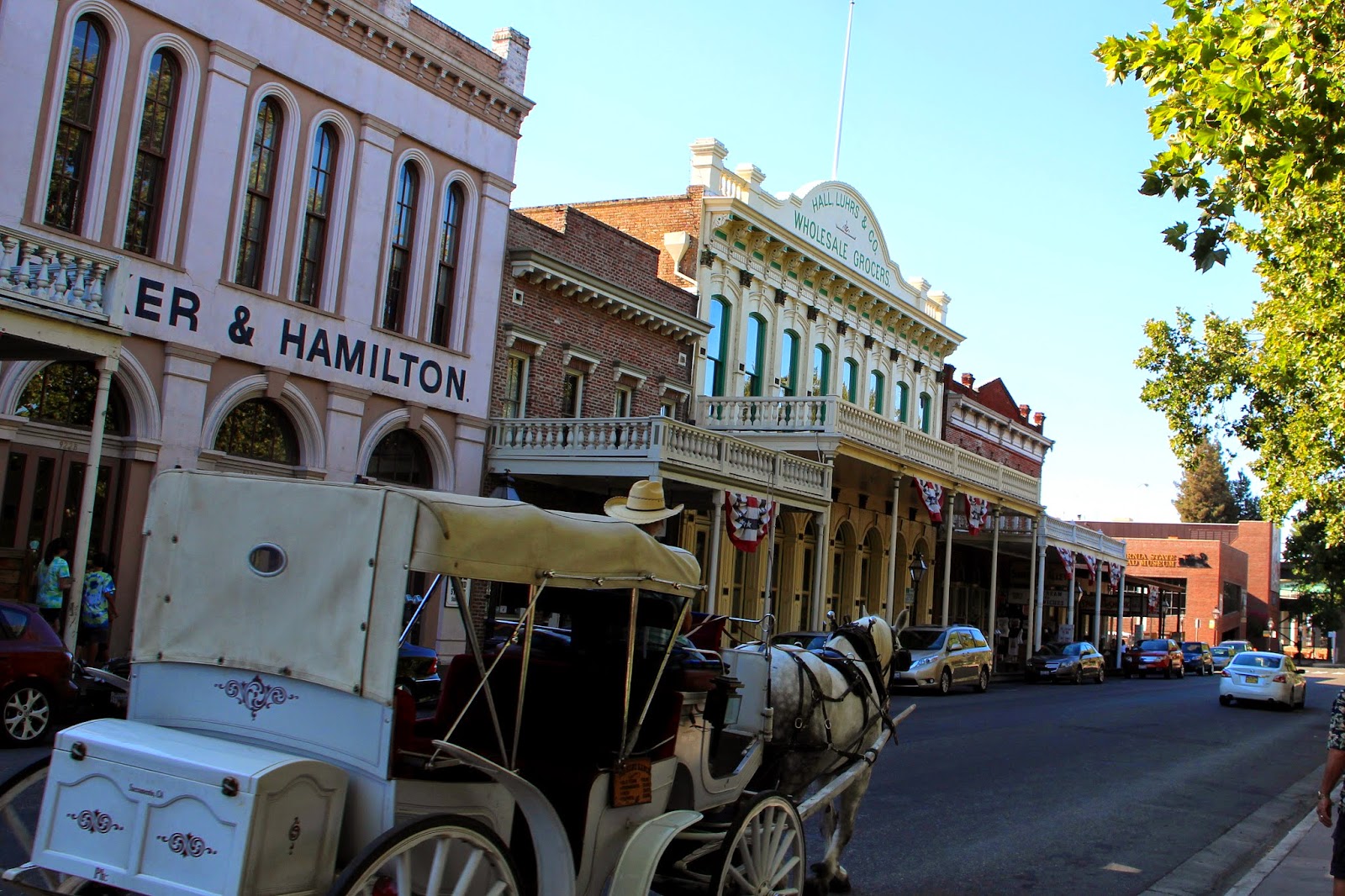
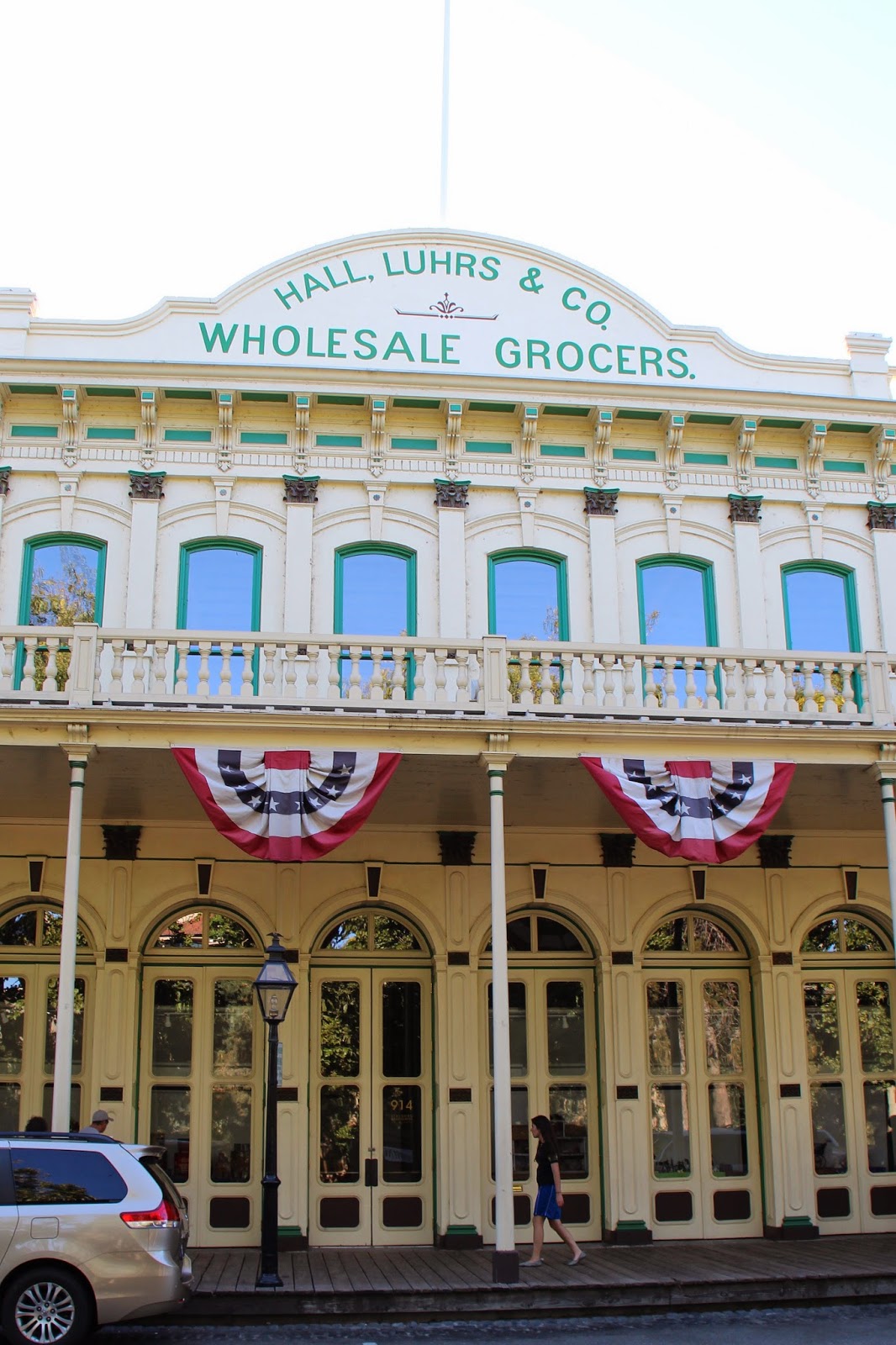
On the second day of my recent trip to California, we went to Old Sacramento, an eight block section of downtown Sacramento, as a way for me (in the words of my friend/host) to "get my cowboy on." Based on the pictures posted here, it would be understandable for you to incorrectly assume that Old Sacramento is a ghost town. While reviewing these pictures, I was surprised how poorly they reflect the pedestrian activity and foot traffic that occurred while we were there. Though it does carry a slight "tourist trap" air (always difficult to accept modern restaurants and chochki stores at historical venues), Old Sacramento is in fact a national historic landmark. Among the things to do there, in addition to checking out some great Western architecture, are shopping, eating (both of which we engaged in) and chances to ride on trains, riverboats and carriages.

Old Sacramento. (7/12/14)
Foreground is the site of the New England Seed store, source of what would
become the state flower, camellia. (7/12/14)
Sacramento Southern in Old Sacramento (7/12/14)
It's not an official historical town without the obligatory re-enactors! (7/12/14)
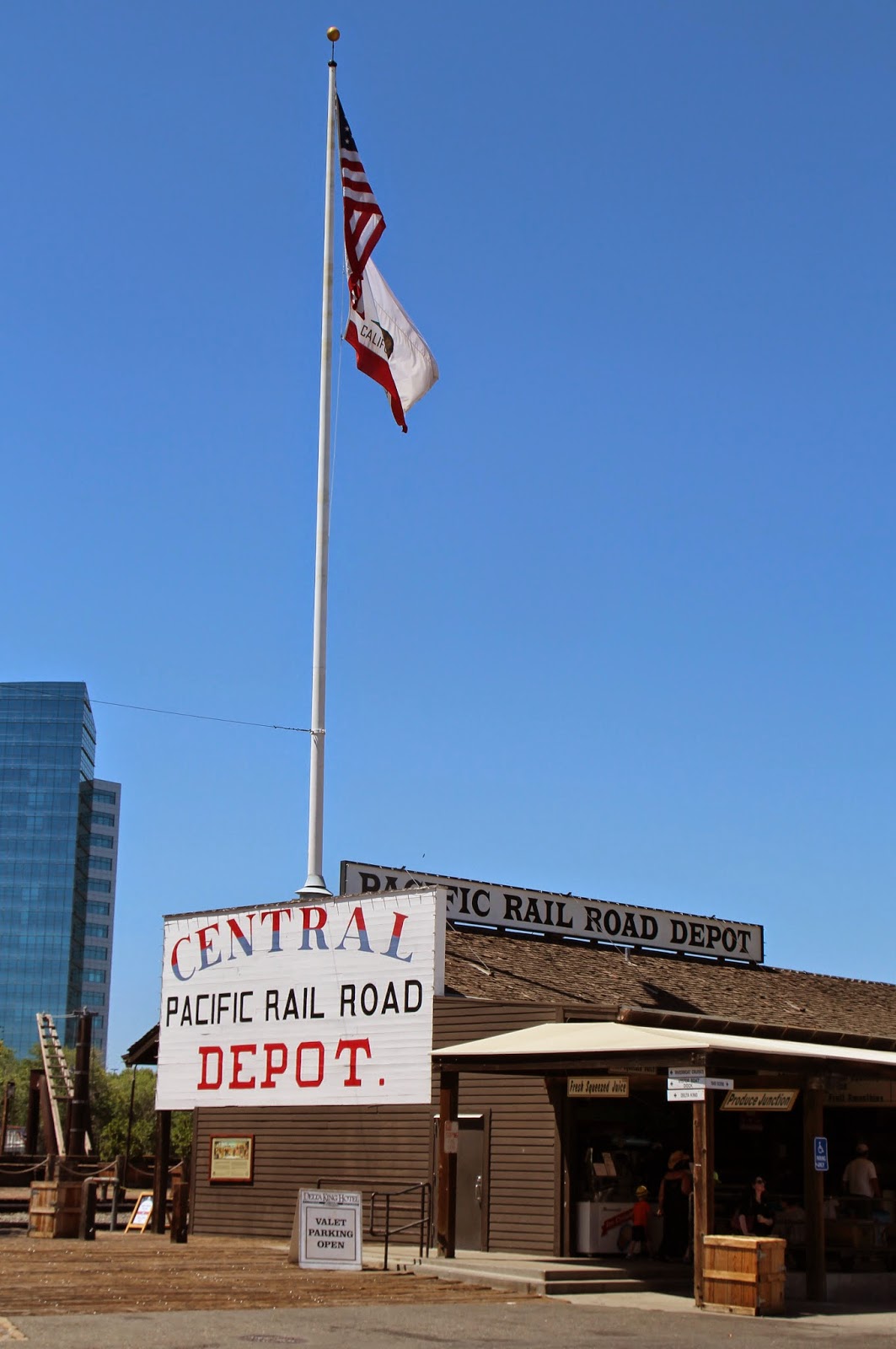
Central Pacific Rail Road depot in Old Sacramento. (7/12/14)
Myself (left), Noah and Jerry in Old Sacramento's Visitors Center. (7/12/14)
Carriage on display in Old Sacramento Visitors Center. (7/12/14)
Section of a large painting on display in Old Sacramento Visitors Center. (7/12/14)
Sign at base of Pony Express statue in Old Sacramento (7/12/14)

Interesting facts California State Parks website about the Pony Express statue sculpted by Thomas Holland: The Pony Express rider’s clothes were based on a paragraph in Mark Twain’s book Roughing It, published in 1872. Rider’s saddle and Mochilla (what they carried the mail in) were modeled after originals that are in the Santa Barbara Historical Museum. Bit and bridle were designed after military “tack” of the 1850s. The sculptor gave him a wide brimmed hat instead of a skull cap, which the riders usually wore. Statue took over 2 years to design and build, including 9 months casting and finishing by Vianello Art Bronzes.

Old Sacramento (7/12/14)
Classic coach carriage rides in Old Sacramento. (7/12/14)
Your's truly and Noah on an Old Sacramento carriage ride. (7/12/14)
And on the other side: Jerry and his wife, Angie. (7/12/14) 
Old Sacramento. (7/12/14)
Front of another statue in Old Sacramento. (7/12/14)
Old Sacramento. (7/12/14)