Showing posts with label summer. Show all posts

Thursday, July 16, 2020

Summer Re-Reading: American Monsters


A few summers ago, my interest in cryptozoology was rekindled. Initially nurtured in my childhood by a steady diet of my parents’ copies of World News and the National Enquirer, this interest has re-emerged thanks in part to a new interest in folklore as well as listening to a number of excellent crytpid and folklore related podcasts and reality television shows. Once a niche filed of ineterst, well-written and academic reading about such creatures as the Mothman, Bigfoot and others has also  become much more readily available. Though there was magic in the halcyon days of Bat Boy, the writing has also become more polished, professional and consistently entertaining.

Due to the clean writing style and accessible nature of her writing, Linda S. Godfrey has quickly found her way to my nightstand as one of my go-to cryptid informer and literary palette cleansers. “One of America’s foremost experts on mystery creatures”, Godfrey’s books take a journalistic approach to retelling anecdotes and presenting histories of a variety of “monsters”, both familiar and unfamiliar. American Monsters: A History of Monster Lore, Legends, and Sightings in America spans an extensive timeline of experiences, often relayed through first-hand accounts of a multitude of incidents with mysterious creatures. While re-reading sections this summer, I was also pleased to see the number of secondary sources from smaller publishes she references, in particular, those dealing with local or regional folklore.

"Wendigo" illustration, page 254.
The encyclopedic text is divided into three parts, Air, Sea and Land, and further organized into chapters. Each chapter is then broken into small accounts of related creatures ranging in length from one to four pages. The anecdotes also include reference to numerous sources, information from which is used so effectively I found myself keeping a small "to read" list of these small press publications. This org -group. The book opens, for example, with “Part One: Monsters by Air”, beginning with “Chapter 1. Feathered Fiends” before moving into tales of Bigclaw, the Micmac Culloo and other historical Big Birds. In a language that is conversational and a tone that is suggests a suspension of disbelief, the writer comes across as neither pandering nor naive. Godfrey clearly lays out the experiences of  individuals in a manner that evokes each the eerie mood of each encounter and evokes the historical and cultural context from which each emerged.

One of the book’s chief accomplishments, beyond being wildly entertaining, is taking advantage of opportunities to add additional layers of insight to those topics readers might incorrectly presume they have heard everything about. The expert here is clearly Godfrey and she’s come equipped with multiple approaches to each subject. An excellent example of this is the section entitled “Challenge of Chupacabres.” Having seen the X-Files episode as well as one or two short videos on YouTube, it might be easy to assume one has all the relevant information necessary to make a personal call on the existence of this “hell monkey”.  While not offering a definitive answer on the existence of chupacabres, Godfrey does provide some examples of encounters and sightings with ancillary creatures that may be related to the Chupacabra phenomenon. Throughout the text, Godfrey also provides samples of photographic evidence and illustrations that range from the evidentiary to the ornamental. (As an aside, that evidence which is referenced throughout, but not included here, is readily available via a quick online search.)

American Monsters is a very entertaining and informative summer reading selection which continues to foster a personal interest in unusual creatures and the zeitgeist from which they sprang. In so many ways, each story is telling a small piece of the American story, which I continue to find fascinating. My guess is that if you take the chance to pick-up this unique tome, you will find the same.
*Originally posted 7/23/18, Revised 7/16/2020

Tuesday, October 08, 2019

Hallow-Reading: At the Mountains of Madness: The Definitive Edition

Like many avid readers who have certain books that they enjoy, this is not the first time I've read H.P. Lovecraft's, At the Mountains of Madness, a fairly short (in terms of page count), but dense (regarding descriptive language and vocabulary) horror novella. Just as in order to consider oneself to be "well-read," a reader must have engaged with one of the Bronte sisters at some point, it would be hard to take someone seriously as a well-rounded student of literature who has not at least sampled Lovecraft if not as recreational reading, then as a student of genres. Too often, I think horror, like romance, is marginalized and compartmentalized so as to be seen as unworthy. Au contraire, mon frère!

Though I would classify AtMoM as more of a short story (albeit an extended one), the hook for my reading of this recently published "Definitive Edition" was the new introduction by British author (and occasional comic book writer of DC Comics's 2012 Dial H series) China Miéville. Beyond Lovecraft's tale, it is Miéville's analysis that this comment will focus in great part on.

Here is a brief teaser for AtMoM (BarnesandNoble.com): "The Barren, windswept interior of the Antarctic plateau was lifeless—or so the expedition from Miskatonic University thought. Then they found the strange fossils of unheard-of creatures...and the carved stones tens of millions of years old...and, finally, the mind-blasting terror of the City of the Old Ones." This is one of Lovecraft's pieces that would become integral to what is now understood as "the Cthulhu mythos."

The thing about AtMoM, and Lovecraft's work in general, is that much of the imagery contained therein has so permeated our popular culture by this point that most folks don't even know enough to recognize the original source. From the recent film Prometheus (2012), to the many video game (the Gears of War trilogy and Borderlands to name two) character designs to list, Lovecraft's detailed and dark descriptive language has been lifted to such an extensive degree that what was once perceived to be iconic can now be mistakenly thought to be common. What Miéville' introduction (which includes some spoilers for the uninitiated) does is to offer some historical context to Lovecraft's style and craft that creates an interesting gateway to deeper literary analysis of fiction writing in general, and the horror/supernatural genre in particular.

In the "real world" I am a high school English teacher, and can attest to the fact that deep literary analysis, beyond simply identifying basic literary strategies at work, and a somewhat superficial presentation as to the reasons behind the author's choice of strategies, is among the most challenging skills for students to master in an authentic voice. Unfortunately, it is also a skill that is not meaningfully tested on government mandated assessments and so is deemed unworthy of extensive effort in most classrooms.

As I read Mieville's essay, I considered how I could use it in some more advanced classes as an example of deep literary analysis as it touches on some important considerations that excellent students are capable of making, given the opportunity. In fact Mieville's thesis (from the second paragraph), points the reader in the proper direction for initial analysis: "... we must see Lovecraft as a product of his time. We can make sense of him, and his astonishing visions, only to the extent that we understand him as defined by the specific horrors, concrete and psychic, of the early twentieth century."

Also included as part of The Definitive Edition is Lovecraft's own literary analysis piece "Supernatural Horror in Literature." Whether as entertainment (for which this edition is not necessary and much of Lovecraft's stories are available in most good public libraries) or for an academic burst of analysis, I recommend At the Mountains of Madness for an eerie and breezy summer read. If you'd like to borrow this edition (or another), please let me know and I'd be happy to share.

You do think of yourself as "well-read," no?

Thursday, July 18, 2019

Summer Reading: Backwoods Witchcraft

Backwoods Witchcraft: Conjure and Folk Magic from Appalachia by Jake Richards found its way to my desk after I came across the title while researching folk horror short story collections. Unlike those stories I initially sought, Backwoods Witchcraft is presented as a non-fiction account of the author’s own childhood growing up in Appalachia. Richards uses anecdotes, recollections and stories from his youth serve as the vehicle through which to share the charms and conjures he believes still work today.

In many ways your enjoyment of the text as a whole rests on how open you are to a friendly conversation on things that appear to be beyond belief. To his credit, Richards’s conversational style makes it a much easier sell than you might think. Reminiscent of the Justin Wilson Cajun Cooking television shows I enjoyed watching on PBS as a child, I easily accepted the invitation to enter his world. I regularly watched Wilson’s show on PBS for much the same reason I enjoyed Richards’s book; both “hosts” sprinkled in regional stories and history along with their “recipes”. Just as I never actually prepared any of the dishes Wilson colorfully prepared on his show (though as an adult I will not turn away Cajun food), in all likelihood I will not be attempting to remove warts using Quartzite as Richards’ Papaw showed him how to. Given the author’s friendly, conversational writing style, Backwoods Witchcraft reads as if you are sitting at the dining room table chatting over a cup of coffee. Richards anticipates many of the queries an outsider might have, and as a result the text works as a fascinating piece if backwoods Americana. “The stories and tricks,” as the author notes on page 33, “are passed down in families and communities, routinely offered as wives’-tale cures, or simple reminiscing of things that helped folks get along in their daily life.” Whether from Louisiana, Appalachia or Western New York, it’s these stories that bind each of us to our respective communities. Richards’ extends his own sense of belonging and community to include the reader.

For a book subtitled “Conjure and Folk Magic,” it was curious how much of the mystical qualities of stones, waters and individuals was dependent on Richards’ Christian faith. Digging deeply enough into any charm or cure and you’re likely to find a strong reliance on the brand of Christianity practiced by the residents of Appalachia. For example, when instructing the reader about gazing (a means of divining the future with a bowl of water), Richards shares that the ceremony begins with recognition of the “the Father, the Son and the Holy Spirit.” (136) Whether the reader believes the power suggested in the stories will depend greatly on one’s orthodoxy of beliefs in tenants of Christianity. Both rely on faith to have an impact. Richards Christianity is one deeply intertwined with Native American tradition and an appreciation for the power of Nature. This eclectic heritage makes for a type of Christianity that is both diverse and, in some instances, almost New Age. While one charm may have Richards invoking the Holy Trinity, the next is just as likely to point out the positive attributes of leaving pumpkins on the porch to keep the haints at bay.

Backwoods Witchcraft: Conjure and Folk Magic from Appalachia by Jake Richards is a very accessible look behind the veil of a unique set of American traditions. Unavailable at my local library, I purchased my copy from Aamzon.com, and I suspect that, much like a reference book, as I come across unfamiliar traditions and concepts in other reading, I will find myself returning to the table for a follow-up chat with Richards’s book.

Monday, July 15, 2019

Roadie: Whale Watching

7:30 a.m. heading toward the Tracy Arm Fjord and the Dawes Glacier. (7/1/2019)
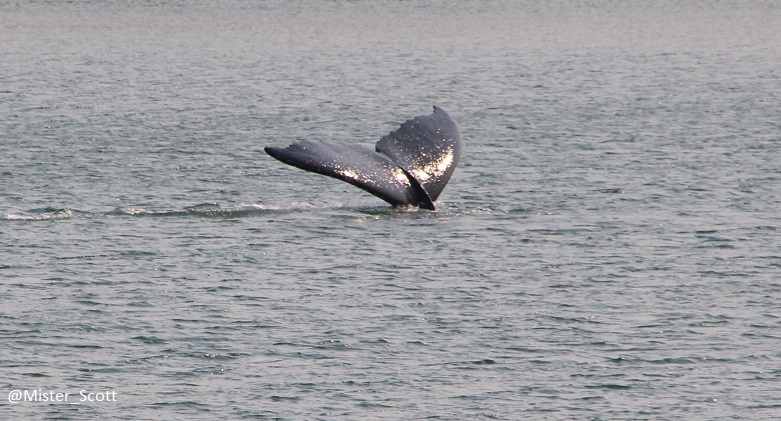
During our 7 day cruise of Alaska, we had two opportunities intended for whale watching. These were times during which we were all but promised to see humpback whales. While neither disappointed, we also numerous humpback whales while sitting on are balcony drinking coffee or simply walking on deck. The first chance was as our ship passed through the Inside Passage and took a pass by the Tracy Arm Fjord. Later tha day we took part in a three hour whale watching tour off the coast of Juneau. During this time we saw six whales including Flame (a mother) and Bunsen (her calf). Whales are identified by the notches in their fluke (shape of the tale).

The day before going to Juneau was an "at sea day" which meant there would be no leaving the vessel for about 24 hours. At 6:30 a.m. the following morning, guests were invited to go out on deck as the ship moved into the Inside Passage. In addition to getting close to the

Waiting for whales, seals and glaciers. (7/1/2019)
Seals were very common travelers on the pieces of ice--the did not 
stick around to pose too frequently though. (7/1/2019)
When whales are around, every inch of the boat including 
the heli-pad becomes a potential viewing area. (7/1/2019)
Many seals could be seen from the deck bathing in the early 
morning sun. (7/1/2019)
Lots to see... 360 degrees of beauty. (7/1/2019)
The very early morning seemed the best time to get better 
pictures of flukes! (7/1/2019)

Later that day we arrived in Juneau and headed out on a whale watching excursion. Tourism is the primary commodity of Alaska and that is never more apparent than when looking for whales. The captain of our boat chose not to crowd in with other boats of tourists so as to not startle the whales. We came across a number of groups in the same general area all awaiting a peek at the humpbacks.

In Juneau, the humpback's dorsal fin appears first followed ...  (7/1/2019)
.. soon thereafter by the fluke. (7/1/2019)
Television would have you expecting to experience a Free Willy moment wherein a whale jumps over the boat and you can raise your arm to rubs its belly. This is not whale watching but rather, fantasy. Our experience was equally rewarding but not nearly so photogenic at least my this not-so-good photographer. It was incredibly enjoyable to just watch for groups of birds close to the water (a sign of possible whale activity) and wait a glimpse of the amazing creatures.

Many tourist boats hoping to glance a whale. (7/1/2019)
Clean shot of humpback's fluke. Note the unique notching on 
the tail by which individual whales can be identified. (7/1/2019)
Humpback whale fluke just prior to turning up. (7/1/2019)
Humpback resting before diving. (7/1/2019)
Back to shore following three hours at sea... would have happily 
stayed longer! (7/1/2019)

Monday, July 08, 2019

Roadie: Tongass National Forest, Ketchikan

Canopy of Tongass National Forest. (6/30/2019)
Following Downtown Ketchikan, we headed on a guided tour of a trail in the Tongass National Forest, known by the U.S. Forest Service as the "crown jewel". The Tongass National Forest in Southeast Alaska is the largest national forest in the United States. Most of its area is part of the temperate rain forest WWF ecoregion, itself part of the larger Pacific temperate rain forest WWF ecoregion, and is remote enough to be home to many species of endangered and rare flora and fauna. The Tongass is managed by the United States Forest Service. (Wikipedia)

The hike we went on focused on the scenery of Tongass National Forest Park as part of an eco tour from Ketchikan. The entire excursion consisted of the hiking tour, a visit to the Raptor Rehabilitation Center and a conversation with a native American artist who still makes totem poles in the traditional manner. We were part of a small group of just 10 people (four of whom were part of our party) which meant we were afforded plenty of time to ask questions of our guide.

Popular among bears, the fruit of the Rubus Spectabilis is popularly referred to
as a “salmonberry” due to its resemblance to salmon eggs. (6/30/2019)
(6/30/2019)
Naturally felled trees would have of other seedlings taking root
on them resulting in a beautiful mix of seedlings coming from a
single stump. (6/30/2019)
Fungus among us. (6/30/2019)
At the base of some trees were small "caves" in which bears would
briefly hide from the elements. Contrary to what is depicted in
movies, bears like small enclosed spaces in which they can snuggle. (6/30/2019)
(6/30/2019)
Devil's club (Echinopanax horridum) is a large understory shrub common in
arboreal rainforests of the Pacific Northwest. The flowers are produced
in dense umbels, each flower small, with five greenish-white petals.
The matured fruit will be red (Wikipedia). The leaves are used by bears coming out
of hibernation as a diuretic. (6/30/2019)
Devil's club is covered with brittle yellow spines that break off easily if the
plants are handled or disturbed thus its common name. (6/30/2019)
Pine cones. (6/30/2019)
Yellow salmonberry. (6/30/2019)
Lichen the wide array of Alaskan lichen. (6/30/2019)
Snapped this pic of Mystery Bird after hearing it call a number of times;
as Alaska's only bird with ear tufts, going to guess it's a Great Horned Owl. (6/30/2019)
Bear Sign One: Scat used to mark territory. (6/30/2019)
Bear Sign Two: claws marks on tree to communicate size to other
bear thereby also marking territory. (6/30/2019)
Bear sign three: trampled trails among high grass from forest to creek. (6/30/2019)

Sunday, July 07, 2019

Roadie: Downtown Ketchikan, Alaska

Set at the southernmost entrance to Alaska's famed Inside Passage,
Ketchikan is thought of as the beginning of to "The Last Frontier."(6/30/2019)
My wife and I have not previously thought of ourselves as cruise-type travelers, but after spending five of a seven day cruise "in" Alaska (including three on port excursions to Ketchikan, Juneau and Skagway), I am unsure there is any other way to comfortably scratch the complex surface of this non-contiguous state any other way.

Each city was geographically isolated from one another by large bodies of water and lush woodlands. Cruising by ship from port-to-port was much more cost effective and efficient than taking prop planes or small water craft. This mode of travel also allowed for multiple opportunities to view the natural wonders of Alaska's temperate rain forest (as well as glaciers and the resulting mountains) from a distance. First stop, after flying out following a single one night in Seattle, Washington, Ketchikan.

Once a Tlingit fishing camp, Ketchikan is now a sleepy town
and tourist attraction. (6/30/2019)
Ketchikan is located near the southern most tip of Alaska's pan-handle on the eastern coast of Revillagideo Island at the heart of the Tongass National Forest.

"Ketchikan" is Tlingit for "Thundering Wings of an Eagle," hence the statue that greets
visitors immediately after entering town. (6/30/2019)
Numerous totem poles, some of which tell stories and others that
memorialize historic figures are plentiful throughout the village. (6/30/2019)
The majority of totems are replicas of those previously destroyed
by settlers and missionaries. (6/30/2019)
Settlers built their homes, stores and brothels on stilts which have since
been reinforced. (6/30/2019)
Original home of famed "lady of the night" Dolly Arthur. (6/30/2019)
(6/30/2019)
Two of Alaska's most significant financial forces: salmon fishing 
and tourism. (6/30/2019)
Ketchikan Creek Waterfall. (6/30/2019)
Guess what secret path husbands would use to go home following a 
night out? Married Man's Trail, of course! (6/30/2019)
It was good too see that totems were in ready 
supply. (6/29/2019)
Only about 90 minutes of our stop in Ketchikan was spent in the town. There we walked the streets took in some of the local art and partook of some famous coffee. A recurring motif that we first became aware of in these tourist towns was the pervasive presence of (too) many jewelry stores on Main Street. These are apparently owned by the companies that run the cruise ships operations). We were much more interested in the history, wildlife, and landscape than tchotchke, though we did pick-up a few odds-and-ends for family back home.

Monday, August 06, 2018

Summer Reading: Your Black Friend

From My Black Friend, page 2, panels 1-2.
After seeing the extended collection of Ben Passmore's online comic strips, Your Black Friend and Other Strangers, recommended in the past few weekends' New York Times Book Review, I took the small step toward reading the entire collection by first ordering the single issue version online, Your Black Friend. The choice of the shorter, 11 page version was two-fold. First, I was looking to read with an eye toward sharing with my junior and senior high school students this coming school year (and as such it might be more affordable for their purchase). Secondly, given the subject matter and that first purpose, a direct succinct delivery of the message might serve more useful and accessible.

More a graphic-essay than novel, what we comic book collectors might call a "one-shot", Your Black friend is best described as "sharp, informed social commentary in the form of an open letter on race and being black in America." (Goodreads) Indie publisher Silver Sprocket, in a formal description picked up by other online sources, tells us that this is Passmore‘s "necessary contribution to the dialogue around race in the United States, Your Black Friend is a letter from your black friend to you about race, racism, friendship and alienation."

Perhaps not surprisingly, despite it's brevity, Your Black Friend is very challenging reading, and experience that is very likely to be shaped by one's own background and openness to facing difficult realities. Both Passmore's contemporary, colorful and engaging art, as well as a natural, organic, writing styles combine to craft a dialogue that resonates for the reader looking to engage. At the risk of sounding like that white friend that Passmore astutely suggests "express their undying enthusiasm for 'Black Lives Matter," Passmore objectively illustrates (in words and pictures) the self-defeating thoughts by many sides of the conversation that result in meaningful communication failing before it begins.

As a 49 year-old, white male reader auditing my own experience, Passmore has me pegged. In doing so he has my attention. The missteps Passmore presents, I think, are not intended to further deepen the white guilt that he astutely notes as problematic, but rather to prompt these moments of genuine reflection. For example, as a high school teacher of a primarily white student body with a (thankfully) growing level of diversity, I do find myself sliding into 'black' presentations thoughtlessly." This is a mistake, as Passmore notes I may have been "totally unaware of." I am now.

So where does this take us? As Passmore shows in the closing pages of his essay, which mirror the events in the open, often it seems to leave us as a community and culture right where we were in the first place. In between the framing device, Passmore opines insightfully, but the commentary appears to ultimately have little impact. At the end of the day, the "nicely dressed white woman" with the "Eat, Pray, Love vibe" and the white friend reading a Yoga Book remain peacefully blind (and mute).

Oddly this reminds me of my past experiences at school district opening days. Annually, teachers start the school year with a tremendous presentation preceded by "professional development" attended by a small group of administrators and select teacher-types. The entire district takes two hours before students arrive for the school year, to set the theme for the year to follows. Smaller building level trainings are sprinkled in for the whole body of teachers to participate in... and by June little is meaningfully changed within that system. Briefly though, maybe we feel better about ourselves...

I strongly recommend this graphic essay for all audiences, but especially white folks, well-intentioned or otherwise. I don't know about you, baby, there must be a better way. As the author notes in the panels above, "What white ppl fear most is making things awkward'" and perhaps the first step is accepting the invitation to be awkward.

Monday, July 30, 2018

Summer Reading: Afterlife with Archie

A few covers from the series (from top left to right) Tim Seeley,  Dave Devries, 
and Francesco Franacvilla. 
True confession: I have never been a reader of Archie comic books. That is, until now. I, like most, have always possessed a passing familiarity with the cast: Archie Andrews, Jughead, Bettie, Veronica, Sabrina, Hot Dog and others. Without having spent much time thumbing through the Archie Digest Comics at the supermarket check-out lane, I have somehow come to know these characters. I also know that I am not alone. Thanks to the success of the current CW Riverdale television show (also streaming on Netflix) a whole new generation of viewers may well insure the Archie empire spanning for another 70+ (!) years. The television show’s success combined with the 2015 relaunch of the flagship series, Archie, likely will at the very least keep these characters within the cultural zeitgeist.

The publisher of Archie comics has long been aware of the iconic status of their characters and unlike other cape-centered comic book publishers, they have used this to their advantage for many years, the recent update notwithstanding. Whereas Batman, Spider-man and Superman are frequently being “re-made” to suit the plotting of their respective writers, “Archie-kins”, and the dynamics of his relationships with secondary characters, has been something of a constant. Which brings me to the most recent expansion of, and my first formal foray into, the Archie-verse: Afterlife with Archie.

Had never heard of Archie's dog Vegas prior to this series, 
but won't forget him now.
Afterlife with Archie is that rare comic book that is likely best read in trade (though I remain committed to the single issue format) if only for getting the complete story in one piece. The sum of the pieces might take a while to make whole though. The first issue of Afterlife with Archie was published back in 2013 and after almost five years, only nine of twelve originally solicited issues have seen publication. But what a run it has been this far!

From the first page, storytellers Roberto Aguirre-Sacasa and Francesco Francavilla craft a unique vision of the familiar Archie cast as survivors of a zombie apocalypse with its beginnings in Riverdale. Both creators are known (and respected) commodities through their individual work in other comic books, Aguirre-Sacasa as the writer of the complete 30 issue run of Marvel Knights 4 (2004—06) and artist Francavilla from a multitude of variant covers such as those for Dynamite’s Lone Ranger series as well as his own pulpy The Black Beetle (2012).

Each issue includes a secondary 
reprint of classic supernatural stories. 
The chief narrative difference between this Archie and the traditional comic book series, and one shared by other titles in the “Archie Horror” publishing family, is that no character is safe from being (literally) eaten alive. To reveal too much would ruin the surprise, but from issue 1 on, people die violently. Even those characters that one may not know well, such as Archie’s dog Vegas are given strong, if small, character moments. Because Francavilla’s stark and stylized artwork is not particularly detailed, his use of (limited color) and Aguirre-Sacasa’s dialogue is used to maximum emotional effect.

As mentioned, the inconsistent publishing schedule of Afterlife with Archie can frustrate if you are impatient, especially for single issue readers. (I avoided this by buying up the ten issues of the series over a few weeks from my local comic book shop.) The first five issues of the series are available in trade paperback entitled Escape from Riverdale. A second trade, the very-spoilery titled Betty: R.I.P., was solicited (as were issues 11 and 12) but all three have been subsequently cancelled. Based on what I have seen in issues 6 through 10, Cthulhu and Sabrina fans will not be disappointed.

Here's to hoping that Aguirre-Sacasa and Francavilla soon return to conclude the current arc. Given the easy accessibility of these iconic characters, even in a unique setting, as well as the high quality of the content, waiting patience will surely be rewarded.