Showing posts with label Gamera. Show all posts

Saturday, February 07, 2015

Seen It (Again): Pacific Rim (2013)


My son and I went to see Guillermo del Toro's Pacific Rim when it was released two summers ago, and, like many, we left the theater disappointed. We had entered with high expectations of a modern Godzilla-type movie and walked out let down. As a both a fan of Toho's Godzilla movies in youth and a parent who had shared these beloved films with his son, I was hoping for a theatrical experience over which to bond. In retrospect, much of our criticism lay with the performance of the male lead as well as the difficulty in processing the multiple visual and sound stimuli being thrown at us.

This kaiju let down did not, however, dissuade me from continuing to watch, and in some case re-watch for the umpteenth time, classic giant monster movies. In the months since seeing Pacific Rim, I have rewatched a number of relatively "modern" Japanese-produced kaiju movies from both Toho (including Godzilla: Final Wars (2004)) and Daiei (the mid-Nineties Gamera trilogy) Motion Picture Studios. While I enjoyed each of these films, with so many tonal similarities with Pacific Rim, I began to think that maybe I had been wrong in my dismissal of del Toro's giant monster movie.

This past Monday our school had a snow day, and I took advantage of the morning to re-watch Pacific Rim. The original from 1954 and the most recent American adaptation, Godzilla (2014), not withstanding, Godzilla films have never really been about serious actors and serious issues. My Godzilla was the ping-pong ball-eyed hero of Japan (1973's Godzilla vs. Megalon will always be my personal gold standard) who regularly bonded with orphans and latch-key kids while battling an assortment of mutated animals, aliens and pollutants. While the too-serious Godzilla (2014) definitely forgot that (as well as the epic battles), my hazy recollection of Pacific Rim was that it had been less about serious issues and more about simple, giant monsters and robots fighting.

My Godzilla, circa 1974.
Upon further review, Pacific Rim really did get much more right than wrong, and was a surprisingly more rewarding film experience on our 40" flat-screen than in the movie theater. Among the things I had noticed initially as negatives but appreciated later as plusses, were the flat human characters that peopled the movie. Truth is, while Charlie Hunnam as Raleigh Beckett will never be mistaken for Laurence Olivier, or even Mel Gibson, he did effectively fill the role of bland, plot-mover quite nicely. Nobody remembers the lead actors in Godzilla movies, a universal truth which Hunnam illustrates fully. (Fortunately, for those not inclined to accept the old kaiju tropes, most of the other actors such as Idris Elba and Rinko Kikuchi didn't get that memo and are surprisingly charismatic and engaging despite bringing to life broadly written characters.)

I would also suggests that the story itself is far more ambitious than given credit. Rather than setting his "giant monster movie" within an easily recognizable world, del Toro and credited co-writer Travis Beachum opt to create a modern, post-origin world already effected by the emergence of its primary threat. While Godzilla did indeed battle aliens from Planet X very early in his filmography, the primary settings always represented a presented day Japan aesthetic (Godzilla Final Wars being the most obvious departure with it's airborne battle ships and G-Force).

The bottom line: Pacific Rim is much more entertaining than I originally gave it credit for and is that unique movie that improves with repeated viewings... at least to this old school kaiju fan.

Saturday, July 05, 2014

Run Reader: Gamera #1-4

From Gamera: The Guardian of the Universe issue #1 (1995) by Mozart Couto and Mike Sellers. 
Now that the American mainstream's momentary case of kaiju-fever has been stilled, thanks to Gareth Edwards' Godzilla's quick exit from the top of the movie charts over a month ago, giant monster movie fans have probably overdosed on the re-releases of the Big G's more recent film offerings. I know I have. It is worth remembering, however, that while certainly the most prominent giant monster star, there are others worth following in both film and comic books form.

Cover to issue 2 by artist Yuji Kaida, who
 supplied beautiful covers for issues 2-4.
Which makes this the perfect time to revisit one of Godzilla's Japanese studio competitors, Gamera. While Godzilla (and Toho) have had a fairly extensive comic book history in the U.S. ranging from Marvel Comics classic late -70's run by Doug Moench and Herbe Trimpe to the current IDW series, Gamera's exposure has been limited to a single 4-issue miniseries published by Dark Horse in 1995.

Hot on the heels of the Japanese reboot by Daiei Studios of the original Gamera kaiju series of films in 1995, Gamera: The Guardian of the Universe, written by Dave Chipps with art by Mozart Couto and Mike Sellers, was published as a direct continuation of the movie of the same name. Because there were eventually sequels to the original (which in the end comprised a trilogy of excellent films, the second of which is reviewed here by moi), in terms of continuity, it acts as sort of an alternate take on the trilogy using the film as the starting point.

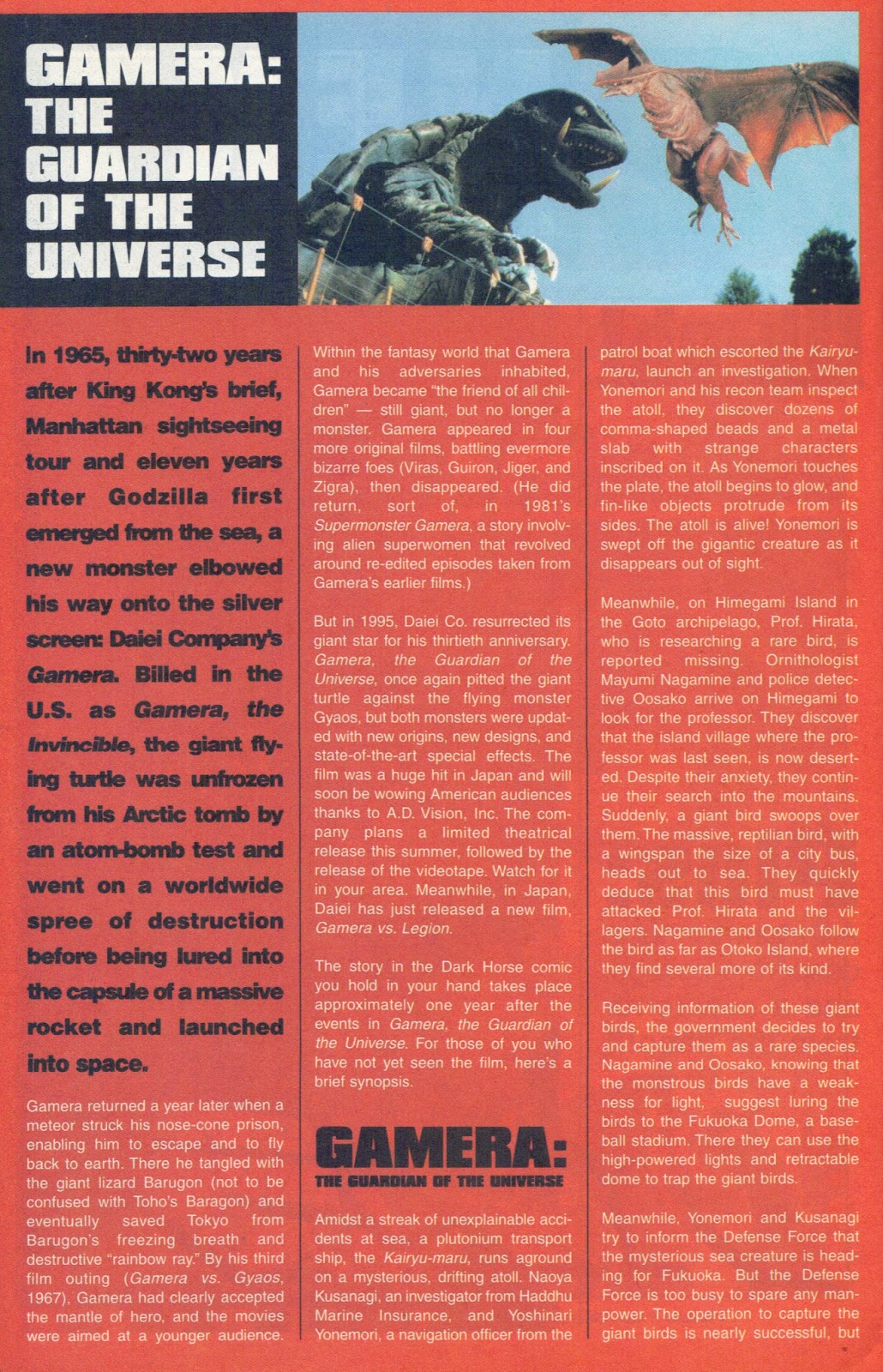
Page one of the Gamera
beginner's guide from issue 1.
For any who had not previously seen the movie, the comic book contains a two page synopsis introducing both the main characters and summation-of the relevent plot points of the movie. The comic book picks up one year following the events of the movie, though it can be read as a stand alone mini-series, the understanding of the relationship between the Gyaos (the primary "villain" in both the movie and first 2 issues of the comic book) and Gamera, as well as Asagi's connection to Gamera.

A quick search revealed that Gamera: The Guardian of the Universe writer Dave Chipps carved out a small niche in Japanese manga translations, such as Oh! My Goddesses and Gunsmith Cats, for a period of time in the 1990s. Chipps does a nice job in this series alternating between the human and monster stories, while developing the Gamera amulet mythology (it's how Asagi communicates with him). In the interest of aiding any readers new to the character, there is quote a bit of exposition provided during character interactions, but in each case it proves necessary to insure understanding of what is happening.

Gamera versus Zigra from issue #3 (1996)
by Mozart Couto and Mike Sellers.
The artwork by Mozart Couto and Mike Sellers is unremarkable but effective especially given how terribly wrong it could have gone given the era from which it comes. The colors are vibrant (Gamera never looked so green), and the panels are well composed. Whether an effort to communicate the bombastic nature of giant monster fights or not, there is a healthy use of sound words in panes depicting kaiju battles. See the panels to the left and below for examples.

I quite enjoyed the Gamera miniseries, despite (at the time) not having much backstory on the character. The consistency of the creative team and solid story-line made for a nice quick run read, and brought me back to rewatch the most recent Gamera trilogy. While not available in trade paperback, individual issues can be found at most local comic shops with a solid back issue stock or online for half-off the original cover price of $2.95. With Godzilla's recent Hollywood reboot in the books and a new take on the Teenage Mutant Ninja Turtles on the horizon, one can only hope that Gamera is not too far behind--as noted on the cover to issue #2, he was the "Original Mutant turtle!"

Gamera versus Viras from issue #4 (1996)
by Mozart Couto and Mike Sellers.

Saturday, April 05, 2014

Seen It: Gamera 2: Attack of Legion (1996)


A few weeks ago at Target I came across a discounted ($10!) triple feature Blue Ray featuring a lesser known (in America) kaiju star, Gamera. The two dsic Blue-Ray set includes all three films that are part of Gamera's Heisei cycle: Gamera: Guardian of the Universe (1995), Gamera 2: Attack of the Legion (1996), and Gamera 3: Revenge of Iris (1999). Despite long having the inferior-in-quality 6 film DVD collection Gamera War of the Monsters Collection on my movie shelf, it was this more recent iteration of the character I had been hoping to watch, due primarily to my own previous engagement with the character in the 1996 Dark Horse Comics miniseries Gamera: Guardian of the Universe (1995). The comic book series was something of a direct sequel the first of this more recent movie series.

Originally created in 1965 by the Daiei Motion Picture Company and now owned by Kadokawa Pictures, Gamera was released to rival the success of Toho Studios' Godzilla during the "monster boom" of the 1960s. Gamera is in effect a giant prehistoric turtle with tusks, fire breath and the ability to fly in a at least two different ways: one wherein his feet are replaced by thrusters, and a second during which he transforms into a whirling disc. A fan of Godzilla as a child, the only visual recognition I have of the character are from the occasional stills in Famous Monsters magazine or library books about movie monsters. Most peers who would claim fandom of Gamera when I was a teen had little actual experience with the character , and were seeking only to be contrarian of my appreciation of the King of All Monsters. Gamera's very diverse skills set (and the practical and CGI effects which bring them to life in theses newer movies) make him a suitable kaiju on par with the original Big G.

After spending a satisfying afternoon viewing the first two movies in the trilogy, the stronger of the films, Gamera 2: Attack of the Legion (1996), seems a better place to lay out some of the unique aspects of the Gamera mythos. While both movies are recommendation worthy, especially for kaiju fans, it is the sequel that really has a higher level of rewatchability. Some of the common giant monster tropes are present (pre-teen with psychic/mystic ability to communicate with hero-monster--check), though it is the small differences that make Attack of Legion so unique:
  • Despite the movie's title, Gamera is neither mentioned nor seen until nearly 40 minutes into the movie. This results in a much more character driven exposition, and when he does arrive, narrative shifts focus from quickly, his absence being noted by a soldier who comments upon seeing Gamera, "Now where the hell's he been?"
  • The use of the word "hell" is interesting. This may be the only Japanese giant monster movie to have an adversary for its star whose name is drawn from Scripture. One of the characters actually quotes Mark 9:8 in endowing the villain with the moniker Legion.
  • While Legion is comprised of a swarm of smaller bug-like creatures, there is one larger monster who serves as Gamera's primary physical adversary. Interestingly, this monster's name seems to be "The Big One." The phrasing is originally employed as a means of differentiating it from the others due to size, but it seems as though the cast settles on that as his name as the larger creature is repeatedly referred to by the moniker.
  • One of the many WTF moments involves the detonation of a nuclear device in an effort to stop the Big One. Think about it: The detonation of a nuclear device in Japan. WTF?
  • Gamera bleeds green blood. Lots of green blood. Referred to as uber-powerful upon introduction, the fact that Gamera takes a visceral and bloody beating at the hands of both Legion and the Big One raises the stakes and make his eventual victory all that more satisfying. All three films in the trilogy are considerably more brutal than your run-of-the-mill kaiju, punctuated by Gamera's self-amputation of an arm (fin?) in 1999's finale Gamera 3: Revenge of Iris.
Gamera (left) takes on the Big One (right) in the movies final battle.
Perhaps unsurprisingly, Gamera 2 shares some superficial similarities with the Godzilla film I recently reviewed, Godzilla vs. Biollante (1989) and viewing them individually in so approximate a time period does allow for some compare and contrast. Perhaps because I am less familiar with his exploits, Gamera's film seems to provide less overt characterization. Little backstory of our protagonist is offered in Gamera 2, and oddly this mystery (as well as a very appealing design and skill set) do not necessarily detract from the movie. Gamera is viewed by those humans who populate his universe as mysterious and the de facto "Guardian of the Universe," and in this context, that is somehow enough.

If you're in the mood for good-old fashioned giant monster hi-jinks with new fancy effects, I strongly recommend picking up this inexpensive, but well transferred and highly entertaining Blu Ray.