Showing posts with label Godzilla. Show all posts

Saturday, February 07, 2015

Seen It (Again): Pacific Rim (2013)


My son and I went to see Guillermo del Toro's Pacific Rim when it was released two summers ago, and, like many, we left the theater disappointed. We had entered with high expectations of a modern Godzilla-type movie and walked out let down. As a both a fan of Toho's Godzilla movies in youth and a parent who had shared these beloved films with his son, I was hoping for a theatrical experience over which to bond. In retrospect, much of our criticism lay with the performance of the male lead as well as the difficulty in processing the multiple visual and sound stimuli being thrown at us.

This kaiju let down did not, however, dissuade me from continuing to watch, and in some case re-watch for the umpteenth time, classic giant monster movies. In the months since seeing Pacific Rim, I have rewatched a number of relatively "modern" Japanese-produced kaiju movies from both Toho (including Godzilla: Final Wars (2004)) and Daiei (the mid-Nineties Gamera trilogy) Motion Picture Studios. While I enjoyed each of these films, with so many tonal similarities with Pacific Rim, I began to think that maybe I had been wrong in my dismissal of del Toro's giant monster movie.

This past Monday our school had a snow day, and I took advantage of the morning to re-watch Pacific Rim. The original from 1954 and the most recent American adaptation, Godzilla (2014), not withstanding, Godzilla films have never really been about serious actors and serious issues. My Godzilla was the ping-pong ball-eyed hero of Japan (1973's Godzilla vs. Megalon will always be my personal gold standard) who regularly bonded with orphans and latch-key kids while battling an assortment of mutated animals, aliens and pollutants. While the too-serious Godzilla (2014) definitely forgot that (as well as the epic battles), my hazy recollection of Pacific Rim was that it had been less about serious issues and more about simple, giant monsters and robots fighting.

My Godzilla, circa 1974.
Upon further review, Pacific Rim really did get much more right than wrong, and was a surprisingly more rewarding film experience on our 40" flat-screen than in the movie theater. Among the things I had noticed initially as negatives but appreciated later as plusses, were the flat human characters that peopled the movie. Truth is, while Charlie Hunnam as Raleigh Beckett will never be mistaken for Laurence Olivier, or even Mel Gibson, he did effectively fill the role of bland, plot-mover quite nicely. Nobody remembers the lead actors in Godzilla movies, a universal truth which Hunnam illustrates fully. (Fortunately, for those not inclined to accept the old kaiju tropes, most of the other actors such as Idris Elba and Rinko Kikuchi didn't get that memo and are surprisingly charismatic and engaging despite bringing to life broadly written characters.)

I would also suggests that the story itself is far more ambitious than given credit. Rather than setting his "giant monster movie" within an easily recognizable world, del Toro and credited co-writer Travis Beachum opt to create a modern, post-origin world already effected by the emergence of its primary threat. While Godzilla did indeed battle aliens from Planet X very early in his filmography, the primary settings always represented a presented day Japan aesthetic (Godzilla Final Wars being the most obvious departure with it's airborne battle ships and G-Force).

The bottom line: Pacific Rim is much more entertaining than I originally gave it credit for and is that unique movie that improves with repeated viewings... at least to this old school kaiju fan.

Saturday, July 05, 2014

Run Reader: Gamera #1-4

From Gamera: The Guardian of the Universe issue #1 (1995) by Mozart Couto and Mike Sellers. 
Now that the American mainstream's momentary case of kaiju-fever has been stilled, thanks to Gareth Edwards' Godzilla's quick exit from the top of the movie charts over a month ago, giant monster movie fans have probably overdosed on the re-releases of the Big G's more recent film offerings. I know I have. It is worth remembering, however, that while certainly the most prominent giant monster star, there are others worth following in both film and comic books form.

Cover to issue 2 by artist Yuji Kaida, who
 supplied beautiful covers for issues 2-4.
Which makes this the perfect time to revisit one of Godzilla's Japanese studio competitors, Gamera. While Godzilla (and Toho) have had a fairly extensive comic book history in the U.S. ranging from Marvel Comics classic late -70's run by Doug Moench and Herbe Trimpe to the current IDW series, Gamera's exposure has been limited to a single 4-issue miniseries published by Dark Horse in 1995.

Hot on the heels of the Japanese reboot by Daiei Studios of the original Gamera kaiju series of films in 1995, Gamera: The Guardian of the Universe, written by Dave Chipps with art by Mozart Couto and Mike Sellers, was published as a direct continuation of the movie of the same name. Because there were eventually sequels to the original (which in the end comprised a trilogy of excellent films, the second of which is reviewed here by moi), in terms of continuity, it acts as sort of an alternate take on the trilogy using the film as the starting point.

Page one of the Gamera
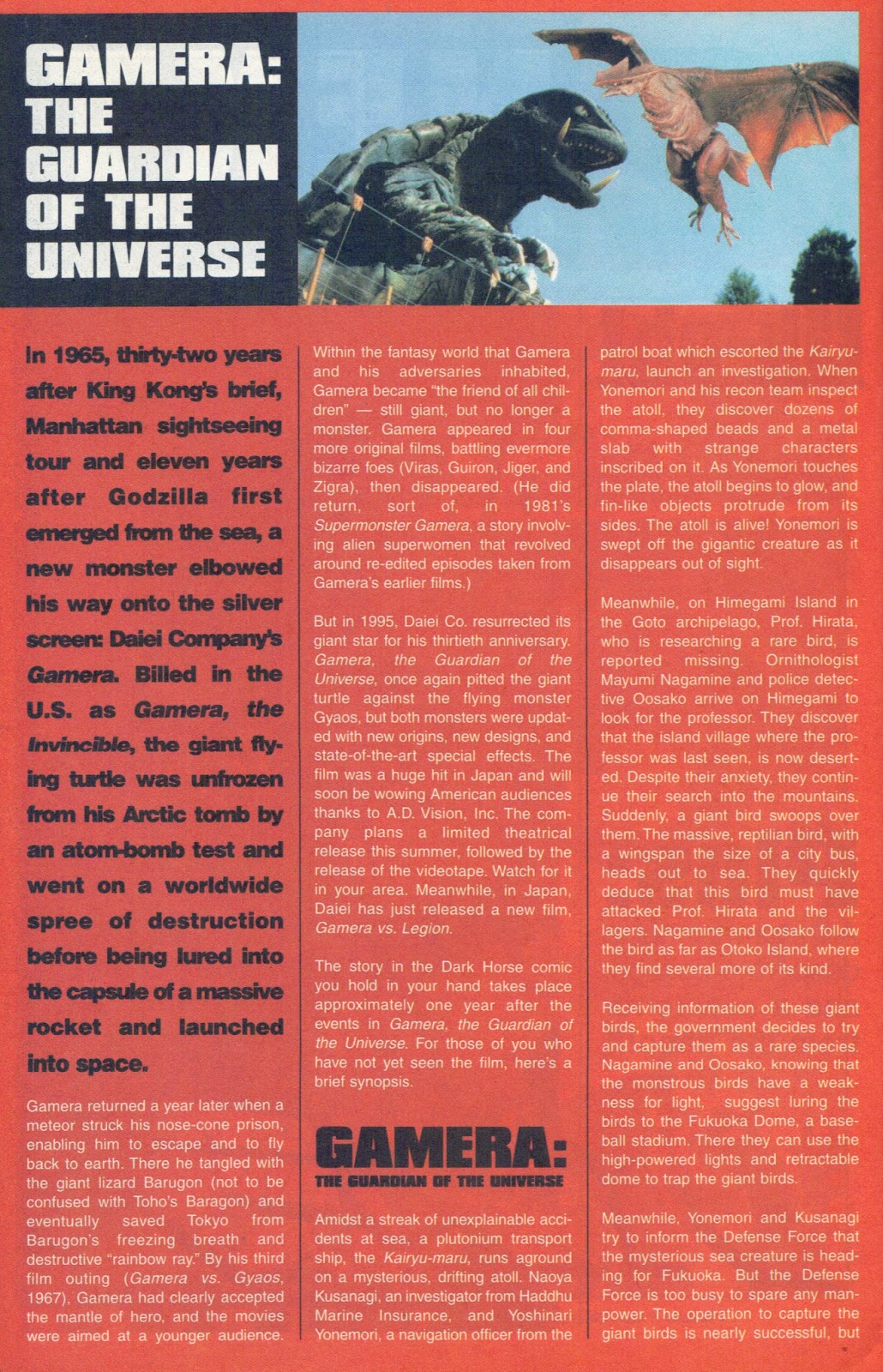
beginner's guide from issue 1.
For any who had not previously seen the movie, the comic book contains a two page synopsis introducing both the main characters and summation-of the relevent plot points of the movie. The comic book picks up one year following the events of the movie, though it can be read as a stand alone mini-series, the understanding of the relationship between the Gyaos (the primary "villain" in both the movie and first 2 issues of the comic book) and Gamera, as well as Asagi's connection to Gamera.

A quick search revealed that Gamera: The Guardian of the Universe writer Dave Chipps carved out a small niche in Japanese manga translations, such as Oh! My Goddesses and Gunsmith Cats, for a period of time in the 1990s. Chipps does a nice job in this series alternating between the human and monster stories, while developing the Gamera amulet mythology (it's how Asagi communicates with him). In the interest of aiding any readers new to the character, there is quote a bit of exposition provided during character interactions, but in each case it proves necessary to insure understanding of what is happening.

Gamera versus Zigra from issue #3 (1996)
by Mozart Couto and Mike Sellers.
The artwork by Mozart Couto and Mike Sellers is unremarkable but effective especially given how terribly wrong it could have gone given the era from which it comes. The colors are vibrant (Gamera never looked so green), and the panels are well composed. Whether an effort to communicate the bombastic nature of giant monster fights or not, there is a healthy use of sound words in panes depicting kaiju battles. See the panels to the left and below for examples.

I quite enjoyed the Gamera miniseries, despite (at the time) not having much backstory on the character. The consistency of the creative team and solid story-line made for a nice quick run read, and brought me back to rewatch the most recent Gamera trilogy. While not available in trade paperback, individual issues can be found at most local comic shops with a solid back issue stock or online for half-off the original cover price of $2.95. With Godzilla's recent Hollywood reboot in the books and a new take on the Teenage Mutant Ninja Turtles on the horizon, one can only hope that Gamera is not too far behind--as noted on the cover to issue #2, he was the "Original Mutant turtle!"

Gamera versus Viras from issue #4 (1996)
by Mozart Couto and Mike Sellers.

Wednesday, March 12, 2014

Seen It: Godzilla vs. Biollante (1989)


I would have loved to have been at yesterday's SXSW presentation of Gareth Edwards soon-to-be-released Godzilla flick. The Big G and I go way back and this May's film may go a long way to bringing him to even greater prominence (or at least an appreciation of his past greatness). It can do no worse, in most fans' eyes, than 1998 Rolan Emmerich effort. After reading about the presentation on a few fanboy sites, I decided to spend a small part of my day re-viewing 1989's Toho effort, Godzilla vs. Biollante (1989).

The seventeenth(!) installment in the Godzilla series, the film is a sequel to The Return of Godzilla from 5 years earlier (one of the series' many reboots that also fit into a larger chronology) and featured a new "monster" called Biollante. I vaguely recall the movie being released in the early Nineties and, at the time a fallen-away-fan, thought the premise of a "killer flower" sort of silly and a bit unworthy of Godzilla's attentions.

Now a decade later, and a little less jaded as evidence by being more willing to accept entertainment-for-entertainment's sake, the error of my ways is clear. Godzilla vs. Biollante is a very solid Toho kaiju flick which does not (like most good Toho flicks) require you to have seen the previous film, though there are plot points for those interested in the scope and sequence of Godzilla's adventures. Much like one of my personal childhood fave "villains," Hedorah (the Smog Monster), Biollante has some fairly noble intentions, especially given the circumstances of her creation, and goes through a series of developmental stages prior to the fighting-form metamorphosis in anticipation of the big finale (**SPOILER: Unlike Hedorah, Biollante actually has a final metamorphoses following her battle with Godzilla thus resolving the conflict END SPOILER**.) These small similarities, as well as the characterization of the King of All Monsters, help to elevate this film beyond that of a pleasurable reminiscent of one of my favorite childhood Godzilla movies.

The human characters and actors in Godzilla movies are often dismissed as being lesser talents by the uninitiated, but the human stars of Godzilla vs. Biollante put in good performances, most notably future series regular Megumi Odaka, while filling the narrative spaces between monster attacks. This movie also introduces and updates (or solidifies if these may have in fact appeared in earlier films I missed) some new Godzilla tropes. What had in my youth been random child characters who just happened to hit it off with Godzilla are now intuitive phenoms under the tutelage of the psychic teacher Miki Saegusa (Odaka). The Japanese tech used by the Japan Self-Defense Forces (JSF) also receives an upgrade from the previous film introducing the Super X II, a forerunner to what will ultimately be, I assume,  the United Nation's designed Moguera bot of later films.

One doesn't watch Godzilla movies for Shakespearean drama or comedy, though smarter fans than I may be able to make the case for that being part of the plan, but rather the be entertained. I continue being entertained by Godzilla vs. Biollante (1989), a feeling that has not been diminished greatly despite repeat viewings.

Koji Takahashi (left) as Dr. Genichiro Shiragami and
Megumi Odaka as Miki Saegusa (right).
Fun Fact: This Godzilla story was the result of Toho Studios' request for fan solicitations of potential story ideas. The contest was won by Shinichiro Kobayashi, a dentist and occasional science fiction writer!

Sources:
Godzilla vs. Biollante Wikipedia Page

Tuesday, February 12, 2013

Seen It: Godzilla vs. SpaceGodzilla (1994)


After unsuccessfully trolling through Netflix for something (anything!) to catch my interest last evening, I came across Crackle on my Blue-Ray main screen. A free, sort of "low-rent" alternative to Netflix, Crackle seemed to present some pretty pedestrian films (many movies that are readily available on small screen cable outlets), except for one: a Godzilla collection for free viewing. Though it was small, it does contain a few (relatively) modern entries into the kaiju canon that I had neither seen as a child or caught on DVD. The one drawback to the Crackle service as a whole is the pop-up ads that drop into the movie every 10-15 minutes. (These are also unable to be skipped or fast forwarded thru).

I am by no means a Godzilla expert, just a fan, but the Godzilla featured in the first film I watched, Godzilla vs. SpaceGodzilla, is neither visually or character-wise the King of Monsters I remember... not that this is a bad thing, just different. For one thing, the ping-pong eyeballs and cartoonish antics of my childhood Godzilla, who I've since learned were actually officially part of the Shōwa series of Godzilla films. These include classics such as Godzilla vs. the Smog Monster Hedorah (1971), Godzilla vs. Megalon (1973), and Terror of Mechagodzilla (1975).

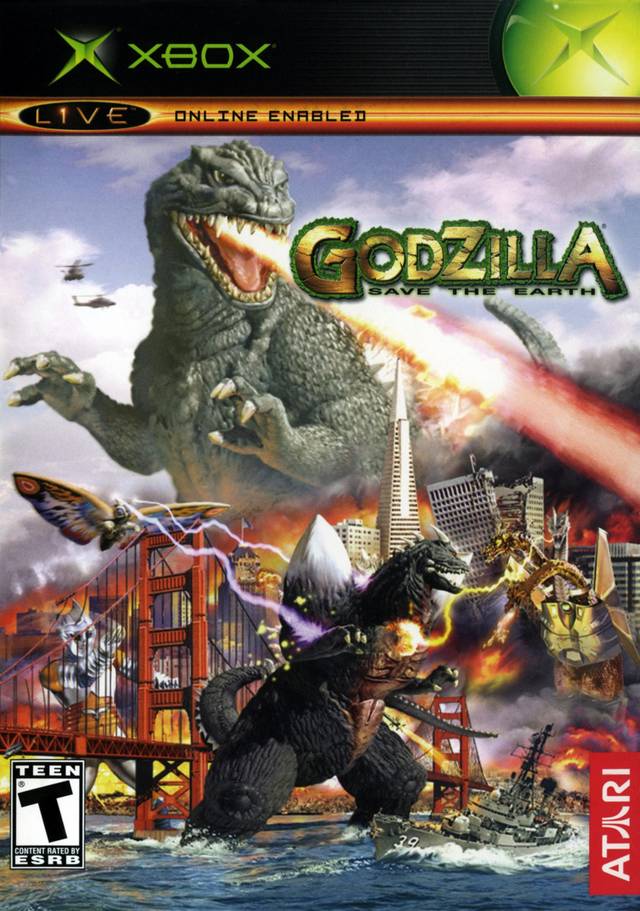
Produced (naturally) by Toho, Godzilla vs. SpaceGodzilla (1994) is directed by Kensho Yamashita and is part of the more contemporary Heisei series of films. The sixth of seven films, an important thing to know as much of the action and understanding of plot points is predicated on having at least a superficial awareness of prior films in the series. While I do possess a passing familiarity with two new characters, SpaceGodzilla and Moguera, from their appearance in X-Box's Godzilla: Save the Earth game, the intricacies of "who" and "why" were new ground for me... except of course the fact that the Big G and SpaceGodzilla somehow share some DNA simply because visually they look similair in basic design.
Minya update, Little Godzilla, sports an
interesting redesign but that does
not help against SpaceGodzilla.

Though the film had entertainment value for a Godzilla deprived, middle-aged soul such as myself, Godzilla vs. SpaceGodzilla (1994) is generally regarded as a weaker entry in the canon. Not completely blinded by fanboy love, I can understand why. For all that works well (giant monsters fighting, Little Godzilla, pretty solid acting and an extensive giant monster fight in the finale confrontation) there are some bizarre shifts in tone and editing-snafus (that can't possibly have been intended) that were just plain weird. For example, watch out for an early naked butt camera pan of the crusty old-Godzilla fighting veteran showering on Birth Island (Little Godzilla's home) as he is being watched by two other male characters. I can't make this up.

Yes, the Earth's latest defense
against Godzilla is a gigantic
robotic mole, Moguera.
According to sources online, this was one of the more poorly received Godzilla films and it is not difficult to see why. To get a taste of the kooky tonal shifts, just watch the trailer above for further evidence. You don't need to fluency in Japanese to wonder if the soundtrack got mixed up when a romantic ballad is dropped in from nowhere followed up by the Godzilla fight song. There is also one character, the one who showers naked in public apparently, who clearly has a friendly relationship with Little Godzilla (the two live alone on the island for an extended period of time) but spends stretches of the movie chasing adult Godzilla with a rifle and magic bullet made of "blood coagulants" intent on killing him. Mix in what I believe to be a "Space" Mothra character (with the space twin miniature pixies in tow), and you get the idea of what you're in for.

For any viewer for whom this is their first experience with the "real" Godzilla, one huge drawback is the apparent necessity for having seen previous films. Questions such as the identities and roles of  human characters and how the entities (G-Force?) coming into conflict with Godzilla (G-Force?) are never answered, or worse yet, even posed. It's very fair to say that one does not watch a film like this for the nuances of subtle storytelling, but to rely on so much background information is asking quite a bit of someone (unlike me) who is not already a fan on some level. If I didn't know who Mothra was in the first place, Space Mothra would have been impossible for me to figure out--heck, even so, I may be reaching to explain her inclusion in the plot.

While it was great that Crackle has given me something of an entre back to the King of Monsters, despite being entertained, actual understanding of what transpired required some online research to make this particular kaiju viewing experience is to make much sense.

Sources: Wikipedia

Tuesday, September 25, 2012

NBIM Day 25: Terror Of Godzilla #4 (1998)

Another staple of most good Godzilla vehicles: goofy comic relief characters!
Nothing quite makes up for a challenging day at work better than coming home to a UPS delivery of back issues ordered via Internet. Yesterday afternoon's delivery also doubles as today's National (Comic Book) Back Issue Month suggestion: Dark Horse Classics Terror of Godzilla #4. Published in 1998, this Dark Horse Classics is actually a recolored reprint of an original translated Godzilla manga first published by Dar Horse wa-a-a-y back in 1988, ten years earlier. The new release features a brand spanking new cover by comic book legend Arthur Adams, who, in my short time collecting Godzilla comic books, I've come to realize is something of a "go-to" Godzilla cover artist.  But, more on that later...


Arthur Adams kaiju goodness!
Dark Horse Classics Terror of Godzilla #4 features story and art by Kazuhisa Iwata, a writer who seems to get that Godzilla works best both as a plot device to tell the stories of other (human) characters and as a character himself. More  recent iterations of the big green lizard seem to emphasize one or the other, and are noticeably weaker for the missing half.

Here, Godzilla is destroying Tokyo, and the military resorts a "secret weapon" in an effort to defeat him: the Super X. The Super X amounts to a pimped out space ship[ run by the government, designed with the purpose of knocking the Big G back into dreamworld.While this issue is number four in a six part mini-series, the single issue reads well, though the cliffhanger ending (spoiled by the cover) does leave the reader (me!) wanting more.

I first came across Art Adams' Godzilla renditions on the covers of the recently concluded IDW  Godzilla Legends (2011) miniseries, and going backwards in puchasing related titles have sampled some of his work for later original Dark Horse Godzilla titles. I would have to concur with the sentiments of Toho Kingdom when it comes to Adams' Godzilla artwork: "As far as American Godzilla comics go, Arthur Adams may be the best artist at bringing Godzilla to life. His hyper-detailed work has inspired many, and due to its astounding accuracy and passionate awesomeness..."

With an original cover price $2.95, a copy of Dark Horse Classics Terror of Godzilla #4 can set you back anywhere from $6-2 depending on the quality you seek.

Tuesday, August 28, 2012

Retro Gaming: Godzilla: Save the Earth (2004)


Continuing my recent return to Godzilla super-fandom, I have been watching old Toho trailers on Youtube of the Big G in action. Two Thursday's ago, I came across the teaser for the X-Box game entitled Godzilla: Save the Earth (posted above) released in 2004 and developed by Pipeworks Inc. and Atari. I have a slight recollection of renting the game from Blockbuster when it was originally released, but I haven't played the game in nearly 7 years. After reading a a few reviews and searching for a screen grab or two, I called down to my local used game store to inquire about purchasing a copy. Apparently the game, like it's predecessor, Godzilla: Destroy All Monsters Melee (2003), is fairly hard to come by. (Online prices range anywhere from $25-$40.) Fortunately, the store had a used copy of Save the Earth for $9.99, so I went and purchased it later in the evening.

More and more frequently, I find myself enjoying the game play experience of older generation games, and Godzilla Save the Earth offered a similar pleasant surprise. The controls are not terribly complicated, while offensive/defensive moves are specialized depending on which of the 18 playable characters you choose, as well as being and fairly intuitive (move toward the opponent + "A" button for Destroyah's "Wing Destruction" blunt attack) to perform. An added bonus is that mindless button mashing is not what is necessary to move through levels.

The narrative is straight Showa era Godzilla and easily recognizable to any film fan, as all of the playable monsters (only Ebirah is unplayable) from the Toho movies, along with two of the updated versions of Godzilla, are battling alien invaders. Of course if it's aliens invading Earth, they must have unleashed King Ghidorah and his "evil" pals to bring mayhem to our populace. The aliens (and their monster minions) ultimate goal is to capture enough "G-Cells" (yes, Godzilla-cells) to develop a super-army of monsters. The option to play as either good or evil monsters insures that the loose narrative is definitely not the driving force of the game though, smashing stuff up is.

As this is a retro review, I had the opportunity to read previously written reviews prepared during the games original release. In doing so, I was surprised to read how poorly received this game was by both the gaming media and general public.

Ever heard of Moguera? I hadn't either,
but his speed and mobility makes him a
very useful character to play!
Whereas one reviewer wrote "...truth, don’t buy this, it’ll ruin your memories of Godzilla films on late-night Channel 4," I would suggest that quite the contrary is true--Save the World is full of many of the elements that made those movies so enjoyable and with, believe it or not, in many cases better visuals. One of the realities of Godzilla movies is that, while the "star," Godzilla is often little more than a plot device around which to build forgettable invasion plots and romances. Save the Earth is all the parts of the movies you really want to see: big crazy monsters beating each other up.

Even trustworthy IGN gave the game a score of 6.5 out of 10, saying: "While Save the Earth is still fun with the manic action of beating up three friends, there's still not much to do when there is just one computer controlled opponent to fight... As it is, there's barely anything that's new and even the online addition barely makes this aging game look any better." Of course, the whole thing was new to me as I had not played that game which had preceded it to market, but having had the experience of playing both Dead Rising games, and feeling similarly about that franchise, I can understand the validity of this criticism in its context.

The opportunity to hear some of the common sounds of my movie going childhood, such as Godzilla's trademark roar and Megalon's claw clank, among other nuances of the game were enough to make the $10 investment well worth it. Even better is that he game play, with three different levels and additional challenges, provide hours of mindless smashing and gamma-breath explosions.

Highly recommended!

Thursday, August 16, 2012

The Big G and Me

In the summer of 1976, Godzilla vs. Megalon was released in the U.S. and I fell in love with movie monsters.
While perusing the Recent Releases table at the local comic shop last week, I came across the cover of the first issue of IDW Publishing's Godzilla: Half Century War. Like many of the titles that I don't purchase, I have been marginally aware of the recent Godzilla resurgence that has taken place since the franchise has been placed in the capable hands of independent publisher IDW. Despite this awareness, I haven't purchased a Godzilla comic book since the Marvel Comic Group's Godzilla: King of Monsters series wa-a-ay back in 1977, and then it was because the Big G was battling the Yetrigar. Fortunately my brother, also a Godzilla devotee, did collect the entire series--all 24 issues--that I have subsequently gone back to read. In many ways, that experience with Marvel comics, as a result of my affection for Godzilla as the King of All Monsters was my entre into the world comic book collecting.

Godzilla King of Monsters #10.
Art by Herb Trimpe and Fred Kida
(1977, Marvel)
When my brother and I were eight, we and some of the kids in our neighborhood began a Godzilla Fan Club which consisted of really only three activities: seeing Godzilla movies (either on weekends at the Riviera Theater on Lake Avenue or, later, on local Saturday afternoon television) and pooling our money together to purchase whatever fanzines (Famous Monster of Filmland, Fangoria, etc.) happened to have a mention, or better yet picture, of Godzilla. Then there were the small plastic replicas of our monster heroes that would come to life on our street. Our weekly dues (50 cents) were collected in a large jar that we would bring out at our occasional club meetings at which point we would decide to purchase something. Like most of these sorts of childhood groups, there was an older kid "in charge," (I think he was the ripe old age of 15 or 16), who ultimately made the orders on our club's behalf. As a result much of our pooled funds were spent on cool models of our movie favorites such as Ghidorah the Three-Headed Monster (also known as King Ghidorah, Monster X or Monster Zero) or, especially, the Big G himself.

After impatiently waiting for the next model to arrive at a local craft store, the Presque Street Godzilla Fan Club would gather to watch the our defacto leader shave plastic nubs from freshly separated pieces and glue delicate joints. Assembly was required and it was magical. From a makeshift paint set, we were entranced as he meticulously painted the characetrs' scales and eyes: gold and red for the evil Ghidorha (or Monster X or Monster Zero) and dark green and black with white accent for Godzilla. Far too impatient and clumsy myself to build such beautiful creatures so paying a $1 to spend afternoons seeing my film idols come to life seemed an extremely fair trade at the time.

Each of us had a role. My role at the time, as it remains today, was to be the ever diligent expert fanboy. What American actor was spliced into the original Godzilla King of the Monsters! (released in 1954 Japan as Gojira) when it was released in the USA in 1956? I knew that that. Who won the epic battle in King Kong vs. Godzilla? Trick question, and I had that too!

Elementary school friendships end, movie theaters fall into disrepair (sadly, the Riviera showed x-rated movies before eventually being torn down) and hard copy magazines are pushed even further to the media margins thanks to the Internet, but in the end, some 30+ years later, for me, Godzilla carries on.