Showing posts with label childhood. Show all posts

Saturday, October 12, 2019

Hallow-Reading: Casper's Haunted Halloween

Before discovering the joys of superhero comic books as a teen, I enjoyed gorging on "funny books." As a ten year old with few pennies to spend on the fancy comic books displayed in the corner store spinner rack, my "collection" consisted of the discounted discards my brother and I would buy at the local used bookstore. Despite lacking covers (which were removed, I presume, so that they could be sold at a discount), we would buy as many as we could during each trip. The bulk of these starred Harvey Comics regulars such as Casper the Friendly Ghost, Richie Rich, and our favorite at the time (most likely because our grandfather was a proud World War 2 veteran), Sad Sack.

Though rife for an update (given that the original premise is slightly dated), new Sad Sack material has not been published for decades. Recently, though, others in the Harvey stable, most notably Casper and his spooky friends have found new, and reprinted, life in a line of titles from American Mythology Comics. All-ages titles such as Casper's Ghostland, Casper's Spooksville, and Casper the Friendly Ghost's Capers regularly find there way to my weekly pull list with good reason: they're entertaining as heck and a little well produced nostalgia goes a long way. They are also among the first books I read upon arriving home.

This past week saw Casper's Haunted Halloween arrive right on time for the holiday. Consisting of six stories from the Harvey Vault, Casper's Haunted Halloween also features fan-favorites the Ghostly Trio, Nightmare the Galloping Ghost, and "the tuff little ghost," Spooky. This holiday one-shot demonstrates the timeless nature of Casper's antics which are published monthly in the American Mythology titles. In the first of a three-part story, "Spook School", Casper is one again being pressured by the Ghostly Trio to become a "nasty ghost". The erstwhile friendly ghost agrees to attend because "education never hurt anyone!" After happily failing the first day of classes with a "minus zero," returns the following day rather than be "clobbered by the Ghostly Trio." Ultimately he and Gary Ghost, a star pupil in Spook School are abducted and taken to Goblandia in the second chapter, "Ghosts in Goblandia." Following a series of misadventures during which the kidnapped ghosts are forced into labor by the goblins, Casper [SPOILER ALERT] he saves the day, and the mean ghosts that belittle his good natured ways, through the power of friendship.

Yes, the story is simple, and, yes, the pages (on high quality paper) are clearly reproductions of classic comics, but the visuals and message remain timely. Ultimately, Casper's earnest efforts to help both those who steal he and his classmates away, and those same classmates who ridicule him, win the day and all but the most hardened and cynical readers. I enjoyed Casper's Haunted Halloween quite a bit and am thankful to American Mythology for producing such high quality reproductions and new content (though not in this particular title) monthly for new and old seasoned readers alike.

Friday, July 27, 2018

Summer Reading: Logan's Run

Like most 40-50 somethings, the 1976 movie Logan's Run starring Michael York, Jenny Agutter, and Richard Jordan (who also played favorite literary character from Frank Herbert's novel's Duncan Idaho in David Lynch's movie version of Dune (1984)!), was a very important part of my nascent science fiction fandom. Despite being the tender age of 7 at the time, between the film version, Marvel comic book (which ran seven issues in 1977), and equally short-lived television series (14 episodes), Logan and Jessica's search for Sanctuary was a big part of daily neighborhood games of "guns".  (Back-in-the-day, my friends and I would gather with all of our plastic arms, break into groups and simulate life-and-death chases of one-another throughout a three-block radius of our hood... these were very different times.)

Logan's Run #2 cover by comic book legends
cover by George Perez and Al Milgrom.
Recently a summer school colleague stopped to share his excitement at hearing that Logan's Run was once again in the Hollywood hopper for a potential blockbuster remake. After sharing memories of Logan's Runs past, I mentioned that I had heard that the new movie is to be based on the original novel rather than the more familiar iterations. I expressed a desire to read the original novel by William F. Nolan and George Clayton Johnson, but had always had difficulty finding an affordable edition. Later that day he sent me a link to a recent re-release he'd come across on Amazon. Three days later it arrived in my mailbox and I jumped right in...

Released as part of Vintage Publishing's "Vintage Movie Classics" collection of "novels that inspired great films" in 2015, this edition of Logan's Run includes a foreword Daniel H. Wilson as well as publication details for the original novel and the movie adaptation. The differences between the familiar film and the original movie are many, ranging from key characterization to the scope of the world in which the action takes place. The general plot and narrative drive remains the same in all version of the story: in a secretly dystopian future, policeman Logan "ages out" and as a result of first trying to find a mythical utopia ultimately joins another runner in seeking the right to grow old all while being followed by former partner bent on bringing both he and his lady-friend to justice.

Given that the 1976 film is so familiar, the easiest way to share thoughts on the novel are to point out two key differences between the two.
  • In the movie, when characters turn 30 years-old, an event communicated to those around them through the change in color (red to blinking red to black) of the crystal imbedded in the palm of their right hands, they are expected to participate in the Carrousel celebration. During this public display, their lives are extinguished. If one fails to participate, individuals become "runners" who are then targeted by policemen called "Sandmen." The future-cops are tasked with apprehending and killing runners on the spot, thus maintaining the social construct that no one lives past 30. This is actually a pretty significant point of deviation from the novel. In Nolan and Johnson's book, the age of termination is 21, an aspect that better communicates an important part of the novel's world controlled by youth theme. The movement through a prescribed color-themed lifespan is further developed and Logan's personal at each seven year increment are shared via flashback.
  • Just as Logan's backstory, as well as that of the culture he resides in, backstory is more fully developed, the world of the novel is much more expansive. This aspect of the novel is among the more intriguing elements. Rather than quickly moving from the Dome City to Washington, DC, with only a couple stops along the way, in the novel, we follow the runners from Los Angeles to the bottom of the Pacific Ocean and across the United States. I enjoyed the use of actual historical locales like the Crazy Horse Memorial in South Dakota as an important locales. Additionally, the inclusion of robotic Civil War re-enactors in Virginia. These touches gave the story a much broader feel and a clearer American tone. 

It is clear that most of the decisions made in adapting the novel in 1976 were made for budgetary reasons including the hiring veteran actors who could no longer pass at 21 rather than less marketable teen unknowns. For the time, the special effects in Logan's Run (1976) were very impressive, even earning an Academy Award. With the unlimited budget afforded novelists, characters and setting could be much more imaginatively depicted. A prime example is the character Box who controls the icy area called Hell. In the movie, Box is a not-so-menacing chrome robot, in the novel a grotesque combination of machine and human parts.

William F. Nolan and George Clayton Johnson's Logan's Run is a very slight volume, clocking in at a breezy 166 pages. The narrative is presented in a serialized structure using a conversational writing style that includes few creatively modernized words that are easily understandable given their context. As advertised on the back cover, this novel is indeed a "page-turner", and I read a few entertaining hours.

The challenge now would be to track down the two sequels penned by the first's co-writer, Nolan: Logan's World and Logan's Search. Published to coincide with the release of the movie, neither has been re-published since and are only available on E-Bay and Amazon for up to $60 apiece. Until I come across the for a more reasonable purchase price at a used book store or garage sale, I'll need to access the guns game brain of my childhood to envision the further adventures of Logan and Jessica...

Wednesday, March 02, 2016

Everything Old is New Again (Mostly)

Strangely, this political satire from the 2012 Presidential election
cycle is still relevant... so much for new ideas.
The 1980 United States presidential election was the first political clash of which I was even moderately aware. Through the filter of my eleven year-old mind, the contest for the job of guiding the free world could be distilled down to a competition between "the odd guy with the southern accent" (I lived in Western New York) versus "the actor guy with the one liners." Now, 36 years later. not much really seems to have changed. Given the even smaller time-frame between this current presidential election cycle and the previous one, it is probably not surprising then that many of the characters flooding the airwaves look very similar to those who shone brightly just four years ago.

This past weekend, while going through one of the pile of books stacked around my home, I came across a paper doll collection given to me by a former student. If I recall correctly, I had been given it after he returned from Washington, DC, where he had attended one of the Presidential Ball's following the re-election of Barack Obama in 2012. Flipping though the pages, it became clear that little changes in our political landscape, as many of the players have remained the same. The aptly titled 2012 Political Inaction Figures by Tim Foley remains oddly prescient in its commentary. Both of the current party front-runners were present (with he Donald warranting a YUGE spot on the back cover), and a number of the forgotten "insurgents" of yesteryear such as Herman Caine(?) are there too, soon to be joined by the current roster of never-to-be-heard-from-agains.

Who'd a thunk the back cover might predict the Republic
Party's candidate for 2016?
Maybe you've heard of this brash new political star?


Tim Foley's contribution to the Marco Rubio playbook.

The "dynamic" campaign of Herman Cain lives on as a
flat paper doll.

Don't look for him on Meet the Press... David Gregory, too,
appears to be sitting this cycle out.

Governor Huckabee's campaigns get shorter every four
years... see you in 2020!

Sunday, February 07, 2016

Spidey Goes Back to the Future

Back and front cover to Marvel Treasury Edition featuring
the Sensational Spider-Man
#22 (1979) by Bob Budiansky and Joe Sinnott.
Recently is was reported that  Marvel Comics will be reviving their long defunct Treasury Edition format for the purposes of reprinting issues of the recently released Spidey title. While I have little desire to purchase a treasury edition for a title I can still pick-up on the rack (were I so inclined) this news has caused a burst of nostalgia in many a fanboy, including yours truly, which of course was the desired effect.

For purposes of scale, left is the
Treasury Edition and to the right a
traditional comic book.
This news also prompted the recall that I actually have a copy of a Marvel Treasury Edition from 1979 piled among other odd-sized issues, mostly from independent publishers. That, in addition to the perception that you were getting 4-5 issues in a single "package", seems to me to have been the key selling point for this uniquely proportioned title. Back in the 1970's, magazines and larger editions were something of a rage. Though the $2.00 cover price would have been expensive for those of us conditioned to spend 35 cents of our allowance per comic book, it was after all larger, so it must be cooler, or at the very least better.

Though I can't recall exactly how it came into my possession, as I often find with older Marvel comic books, it has many of the attributes of a classic Marvel story--which ironically is also what is missing, in my estimation,  from most current Marvel titles. I still love Gil Kane and Sal Buscema's pencils, as well as the story-telling of Len Wein, featured in issue 22. Back-in-the-day, comic book narratives were much more tightly written, and frankly, more action oriented. Nowadays, out of the perceived necessity to reprint titles in trade paperback, every single story arc is stretched out over 5 to 6 issues, many times to the detriment of the story.

As a ten-year old, I totally bought into the
mythology of he Marvel Bullpen, and peaks
inside, such as this one drawn by Mary
Severin, were always welcome.
But Marvel Treasury Edition #22 (1979) is chock-full of classic Marvel goodness. It collects four issues of  the Marvel Team-Up title that showcased stories in which Spider-man would (Surprise!) team-up with other Marvel heroes of varying degrees of popularity. Again, way back in the late 1970's, early 1980's this was not as common an occurrence as is the case now. Also included within is a Bonus Pin-up (on which reprint editor Jim Scalrup declares "what else would you do if you had an extra page to fill up and nothing to put on it?" for what in effect is a J. Jonah Jameson poster!) as well as Stan Lee story about the famed Marvel Bullpen's prepping for an upcoming Spider-man comic strip in a three-pager entitled "Here We Go-A Plotting!".

Like many, I miss what I perceive to have been the hey-day of Marvel Comics, when super-heroing was fun and colorful, and when heroes didn't need to be "anti-" in order to be interesting. Though I am unclear as to how attractive a new Marvel Treasury Edition will be to the modern collector (let's face it, it won't fit in a long box), if the stories told in Spidey reflect this earlier style of story telling, I may just check it out. Until then, however, I have Issue 22 of Volume 1 of the Marvel Treasury Edition, and many long-boxes full of back issues, to remind me of my affection for marvel Comics.

Gil Kane drawing Stegron the Dinosaur Man?
Take my money NOW.

Saturday, August 22, 2015

Back Down Disney's Black Hole

Not quite as memorable as the Millennium Falcon, the Cygnus
 rests on the edge of a... BLACK HOLE!
Prior to enacting their modern creative approach of "If you can't beat 'em, buy 'em" that paved the way to their acquisition of Pixar then Marvel and finally the Star Wars franchise rights, Disney, then not nearly the juggernaut they are now, attempted to begin their own science-fiction, adventure franchise with The Black Hole (1979).

Following the huge success of the original Star Wars in 1977, every television and movie studio was looking to get in on the profits and the House of Mouse was no different. It probably seemed an easy enough task given the superficial formula Lucas had laid out in his film. Unique, toy-ready robots? Check. Rakish, bad-boy hunk? Check. Respected European actor in a key role? Check. Potentially iconic villain-in-mask? Check.

Disney's The Black Hole, directed by Gary Nelson (whose previous effort was the original Freaky Friday in 1976), was released in 1979 featuring performances by Oscar-winning actors Maximilian Schell (Judgement at Nuremberg, 1961) and Ernest Borgnine (Marty, 1955), as well as respected actor Anthony Perkins, best know as Norman Bates in Psycho (1956). The voices of the main robot characters are provided by Roddy McDowall and Slim Pickens.

Giant bad robot Maximilian and Dr. Hans Reinhardt played by Maximilian Schell.
A financially successful cinematic space opera was not, however, meant to be. As I came across my ancient (36 years!) 80 card complete set of trading cards released by Topps in support of the film's release, my own memories of seeing The Black Hole in theaters were neither warm nor fuzzy. Apart from the robot characters voiced by familiar genre voices, the film, like the trading cards, left me cold. Of course, many years later, the awkward tone of the film (with some rather mature philosophical ideas for a Disney film) reflected in poorly designed (repetitive images and story summaries out of order) trading cards can thank the warming effect of nostalgia for my even revisiting them. Sometimes even "bad" movies or collectibles find a place in one's heart for the period of time they fleetingly capture.

B.O.B. (BiO-sanitation Battalion), a battered early model 
robot voiced by Slim Pickens.
Our heroes led by V.I.N.CENT ("Vital Information Necessary CENTralized") 
voiced by Roddy McDowall.
V.I.N.CENT. and Captain S.T.A.R.("Special Troops/Arms Regiment") 
played by Tom McLoughlin.
Maximilian listening in on Dr. Alex Durant (Anthony Perkins) 
and scientist Dr. Kate McCrae (Yvette Mimieux).
One of three color-coded puzzles to be constructed using the backs of the trading cards.
V.I.N.CENT ("Vital Information Necessary CENTralized")
in action!
The climactic battle between Maximilian and V.I.N.CENT!
I vividly remember being weirded-out by the image (strangely not captured in the trading card set) of the movie's villain, Dr. Reinhardt, encased in the robotic shell of his chief minion, Maximilian, floating above a hellish landscape at the climax of the movie. Even reading the story summary below, suggests that the filmmakers were going for something "deeper" than a standard sci-fi action/adventure movie.perhaps. The "Or should I say the beginning?" commentary points to the intention to continue the story of the crew, a sequel that has been forever left to the imagination.

On second thought, maybe these cards aren't so bad...

Oddly, the Story Summaries on the backs of some cards are 
presented out of chronological order and therefore not aligned with 
the images on the front. The warning at the bottom 
warns you about it, too!

Saturday, October 11, 2014

Creature Feature Cards Unearthed!

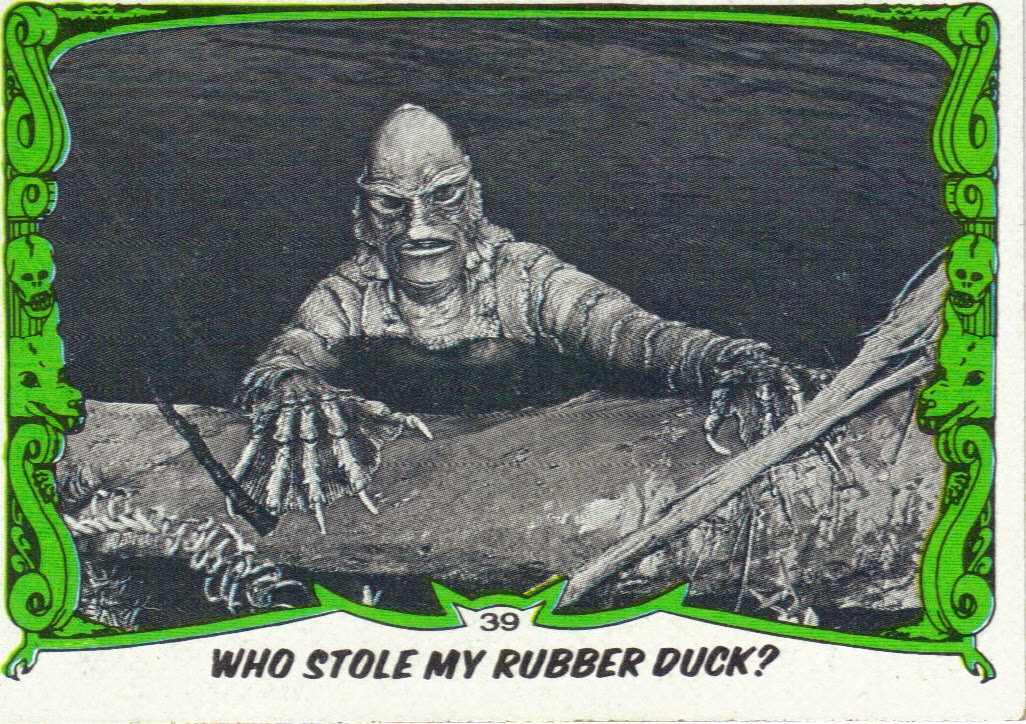
ON THE FRONT: The amphibious Gill Man from the Amazon, 
"Creature from the Black Lagoon" (1954).
Waking up at 3 a.m. I find myself digging through a stained cardboard box of old trading cards, when the time travelling begins... Though not encased in plastic sleeves, and with softened corners and some slightly discolored images, when I purchased these varied sets (most never completed and the result of only a few single packs purchased) issues of preservation or potential value speculation were of little interest. I was ten years old and it was all about the stickers, hard gum and cards.

This morning I dug past those sets (again, in varying rates of completeness) such as Buck Rogers In the 23rd Century (1979), Star Trek the Motion Picture (1979) and Moonraker (1979), for something seasonal. With autumn in the air, and  Halloween just around the corner, I was pleased to find such a large number of Topps' 1980 Creature Feature cards adrift in the box. In addition to the cover card, and two of 22 possible stickers, I cobbled together about 60 different cards with (of course) numerous doubles, While I could give background about the Topps set, I'd rather point you to others (such as Mr. Potter's Fun-time Blog) who have already done so far better than I could have.

The Masked Phantom from
"The Phantom of the Opera" (1925).
Something was clearly in the air back in 1980 as I vividly recall buying these packs up at the Quick-and Easy, our local convenience store which also introduced me to comic books (on the wire spinning rack) and coin operated video games (Space Invaders, naturally). Back then, my brother and I would walk the two blocks to the store, look through the comic books, and check on any new trading cards that may have arrived. Bitten by the collecting bug thanks to Star Wars trading cards years earlier, we were game for nearly anything that came out.

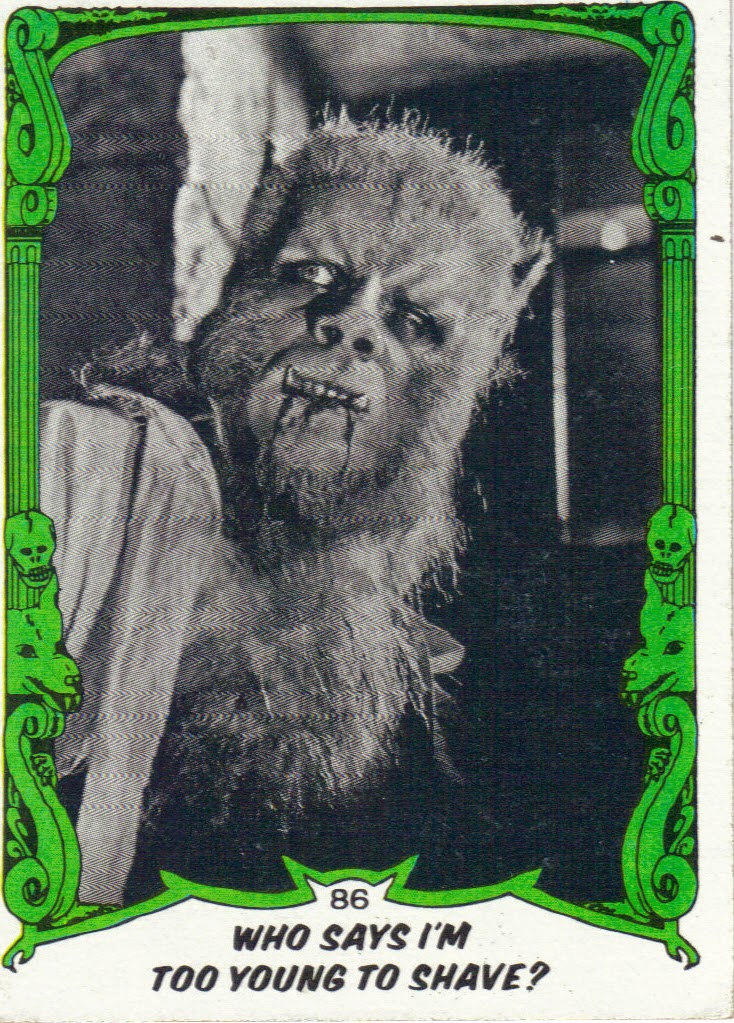
Looking back at these cards now, my response now is likely very similar to the reaction I had many years ago. Hardly as humorous, they are after all from the "You'll Die Laughing" series, as intended, the black and white stills and images of famous (Boris Karloff as the Monster) and not-so-famous (Bela Lugosi as the Monster) actors and the creatures they portrayed are beautiful. The set includes the iconic (such as the aforementioned Frankenstein's monster as well as the prominently featured Creature From the Black Lagoon films) and lesser-known but beloved (by me anyway), Oliver Reed's werewolf in Hammer Films' The Curse of the Werewolf.

On the back of each card, in addition to a lame pun, joke or anecdote, is a very brief caption describing whats "ON THE FRONT." Unfortunately, the actors in each movie still are not credited, but fortunately I watched enough afternoon chillers to figure it out, so I've added (where possible) the names of the actor(s) involved using [brackets].

The Creature from the Black Lagoon.
The 22 stickers are of "Monster Hall of Fame" members and original movie posters, or at least those that Topps had the rights to include. I loved the Creature (above) as a child, and feel the 1925 Phantom of the Opera, above, right, is still among the creepiest monster visuals in film.

ON THE FRONT: The air-breathing humanoid known as The Gilman
[Don Megowan] from "The Creature Walks Among Us" (1956).
The card above with a still from the third Creature movie refers to him as "The Gilman," (card #3 above), as opposed to "Gill Man" (card #39, top of post, and #68 below). While very likely a typo, it makes me wonder if the idea was to give him a more human name, though something more traditional might have helped him better acclimate to life on land.

These jokes still kill.
ON THE FRONT: Kharis [Lon Chaney, Jr.] the crumbling one
carries on in his third feature movie, "The Mummy's Ghost" (1944).
ON THE FRONT: A scene from the original "Frankenstein" (1931)
[starring Boris Karloff].
ON THE FRONT: A creature [Eddie Parker] from the past threatens the student
body in "Monster on the Campus" (1958).
ON THE FRONT: A fellow [Bryant Haliday] turned inside-out when an experiment went awry 
in "The Projected Man" (1964).
ON THE FRONT: The Gill Man [Tom Hennesy] was the most famous
movie monster created in the 1950's, from "Revenge of the Creature" (1955).
ON THE FRONT: Two of the screen's mightiest monsters
[played here by Bela Lugosi and Lon Chaney, Jr.] were 
featured in "Frankenstein Meets the Wolf Man" (1943).
ON THE FRONT: The hairy horror of "The Wolf Man" (1941)
iconically portrayed here by Lon Chaney, Jr..
ON THE FRONT: Only a silver bullet can end 
"The Curse of the Werewolf" (1961)
[here played by Oliver Reed].
ON THE FRONT: Kept alive for 5,700 years, it's Kharis [Tom Tyler]
from "The Mummy's Hand" (1940).
ON THE FRONT: The Cyclopean Xenomorph (got it?) from "It Came from Outer Space" (1953).
I'm definitely using this one at the next happy hour.
ON THE FRONT: Once a household pest, now 100 tons of horror, "Tarantula" (1955).
ON THE FRONT: "Feast your eyes, gut your soul,
behold my horror!" Another scene from the classic "Phantom
of the Opera". (1925) [starring Lon Chaney, Sr.]
ON THE FRONT: "The Mole People" were prehistoric creatures who lived at the
center of the earth in this 1956 chiller.
ON THE FRONT: From "This Island Earth" (1955).
All the creatures depicted in these cards are from films released in the U.S. by Universal. Given Universal Studios' current efforts to reboot their "Classic Monsters" in a shared "universe" (a' la Disney/Marvel's successful films) with the recently released Dracula Untold (2014), one wonders who may show up in future films. While Wolf-man, the Mummy and Frankenstein's monster would appear sure things (if Dracula proves financially successful) how great would it be if we also saw an update of The Mole People or  the long in development Creature from the Black Lagoon update?

Always leave 'em laughing!

Sunday, June 08, 2014

Run Reader: Red Sonja #1-9

From Red Sonja #6, written by Gail Simone with art from Walter Geovani.
"This is outrageous... what if you're not my type?"
"I'm Red Sonja. I'm everybody's type."~Red Sonja Issue #8

Just as binge watching television shows has become more common (and actually more enjoyable with many series) I have recently found myself patiently collecting runs of comic books for months at a time before delving deeply into read the connecting stories. Still a collecting slave to single issues, trades won't do, so patience is necessary. One such book that I have quietly placed away is Dynamite Publishing's Red Sonja written by Gail Simone with art from Walter Geovani. After monthly sorting through stunning covers by Jenny Frison, I could wait no longer.

Cover by Jenny Frison.
My earliest recollections of Red Sonja, like most early-Eighties F.O.O.M.-ers, was the scantily clad, silver coin bikini-ed, "She-Devil With A Sword" who somehow found her way into the Topps Marvel Superhero sticker set. A truly dynamic character design, her primary purpose seemed to be as a female counterpart (girlfriend?) for Conan the Barbarian. The piggy back production of a Red Sonja movie (with a cameo by Conan-star Arnold Schwarzenegger) did little to change my perception. I was not, at the time, a sword-and-sorcery fan, despite playing Dungeons and Dragons and loving Beastmaster. In my younger more limited collecting view, comic books were for capes not swords.

Flash forward thirty years, and the overwhelming majority of the books that comprise my current pull list consists of horror, sci-fi and titles featuring a variety of Robert E. Howard characters, including, most recently, Red Sonja. While familiar with Gail Simone's comic book work for DC, most of my practical reading of her writing consists almost solely of following (and enjoying) @GailSimone tweets. As written by Simone, Red Sonja is a conflicted heroine who carries the burden of bearing a sense of responsibility for those who need her. In each of the series arcs thus far, Sonja finds herself questing for her own, in addition to her "sister's," redemption, and later for the lives of hundred of slaves, none of whom she has met. The package through which these stories are told, the characterization and storytelling both written and depicted, is the real selling point here--though for what discriminating comic book fan is it not?

Sonja comes face-to-face with her
sister in issue #2.
The artwork by Walter Geovani and Adraino Lucas is top notch. Sonja is depicted visually as charismatic, strong and stoic while avoiding the caricature of an overtly masculine (or overdeveloped) female. The coloring palette is suitably earthy, allowing for an added subtext to Sonja's differentiating feature, her flowing red hair. Throughout the run, the reader is aware of Red Sonja's infamy (even without having previous experience with the character) in the world created therein, as her unique appearance is itself a calling card of "the Devil," a nickname she is often referred to by in whispers.

Simone's writing is excellent. Not being a previous reader of anything Sonja, I don't have much perspective on whether this has always been the case, but unlike some other books with female primary protagonists (cough--Witchblade--cough), Red Sonja is presented as powerful, sexy and intelligent, rather than oversexed and unaware (or over-aware) of the unique nature of the impact of their empowerment in a patriarchal world. The backstory provided in the first arc adds a real sense of the social challenges faced by a young Sonja who has to learn to be cunning and violent as a means of survival.

At it's heart, Red Sonja is a Sword and Sorcery property. though the emphasis is clearly on "sword." It is a violent world that Sonja inhabits, and her calculated responses to conflicts are also necessarily violent. While some minor characters, such as "fish people," that populate the world Simone has developed have an air of  fantasy about them, it is much more Game-of-Thronesy than, say, Dungeon and Dragons. The sorcery and magic is alluded to more than overtly depicted. Much of what may have been handled in previous comic book incarnations as magic-based is given scientific or potentially real world sources. Disease is explained as the creation of misguided, early scientists, and great feasts, the product of one who has devoted his life to Epicurean arts. It is an interesting approach that results in a far more grounded Red Sonja.

As you might expect by this point, Dynamite Publishing's current Red Sonja series by Simone and Geovani is my type, and I would encourage you to invite her into your reading list, too. For readers uninterested in culling the longboxes at their local comic shop, trades will soon be available.