Showing posts with label Dynamite. Show all posts

Sunday, January 20, 2019

The Old Order Changeth!

My very first short box circa 1984... and yes I was the person who actually 
bought DC's Guy Gardner Warrior!
Some comic book collectors have spinner racks (lucky!) while others have beautifully designed shelving to display their collections. I am old school, and no carpenter, so even 40 years into my fandom, I still use long, and as I have become more "seasoned", primarily short, boxes for storing and organizing my collection. This requires quite a bit of space and, fortunately, we have a sort-of finished third floor attic where I read and store them with other collectibles.

Shazam! #1 variant 
cover by Gary Frank. 
It is during these winter months when we are "trapped" inside for the majority of the day that I will shift the organization of my collection. Often it is a change in publication the prompts a change, For example, DC's recently introduced Geoff Johns and Dale Eaglesham joint, Shazam! (2019, $4.99 per) title necessitates the movement of Jerry Ordway's incredible The Power of Shazam (1995-99, cover price $1.50 per issue) series into an active box. Though represents a significant departure from the characters as depicted in Power, with all pre-New 52 continuity erased, I like having access to previous narratives.

Conversely, the conclusion of the most recent Suicide Squad (Volume 5, 2016-19, Issue #1 was $2.99 and the final issue, $4.99) series means that title will shift to an "inactive" box, stored in the back part of the attic, until the teams eventual return to action. Then, once again, the old order will changeth!

Local comic book shops organize titles on the "New Releases" table, as well as on "Recent Releases" racks and their own "Back Issues" long boxes, first by publisher (Marvel, DC, Image, Dark Horse, etc.) and then alphabetically by title (Action Comics, Aquaman and so on). Decisions regarding the specific organization of titles in collections are more personal. When it comes to "Big Two" titles (DC and Marvel for the uninitiated), putting these titles by character families (Wolverine alongside Uncanny X-Men or Justice League Dark next to Justice League Odyssey). There are families in the smaller publishers as well, most notably (and expansive) the "Mignola-verse" titles from Dark Horse. These are comic books set in the world of Hellboy, a universe of titles created by Mike Mignola that includes Abe Sapien, Lobster Johnson, Witchfinder and many others.

Zeke Deadwood: Zombie Lawman 
cover by Thomas Boatwright.
Those smaller publishers beyond the Big Two, though given quality and quantity of titles it's past time to start thinking of Image Publishing as a "Big Three", are much more willing to take creative risks with creator owned titles, especially those in the Horror, Western and Science-Fiction genres. Because of this, many of my shorts boxes are organized alphabetically by genre families rather than publisher or creator.

For example, I currently have five boxes which are organized as "Westerns" that include a wide variety of characters from large and small publishers. This means that DC's Jonah Hex extended series (2005-10, 70 issues) is organized with the now-defunct Topps Comics Lone Ranger and Tonto miniseries (1994, 4 issues), IDW's 3 Devils (2016, 4 issues) and SLG Publishing's Zeke Deadwood: Zombie Lawman (2009-11, 2 issues) series of one-shots in my short boxes.

Interestingly enough, this brief post about organizing my comic books also has me organizing y thoughts. The inclusion of Zeke Deadwood among more traditional Westerns alone has me considering my next reorganization project to further disaggregating Westerns into a Horror-Western Mash-up section. That project, however, will have to wait for the next snowstorm...

Monday, January 09, 2017

Read It: The Lone Ranger Rides North (1946)

This edition includes the erroneous character creator credit of the Lone Ranger 
to radio station manager George Trendle. Some of the basic ideas were his,
but were fleshed out to great success by Fran Striker.
Recently, I spent nearly six hours in a hospital waiting room as my mother underwent back surgery. With all the class papers graded, I turned to the pile of books I have been periodically reading on-and-off for (what turns out to be) a ve-e-e-ry long time. One book in particular provided an opportunity to escape the waiting room and travel back to those thrilling days of yesteryear...

This volume is easy to find online
at a very affordable price, though I
went to Berkeley, CA, to get mine.
Three summers ago, while visiting my best friend in California, we found ourselves in an independent used bookstore in Berkeley. There I came across an old volume entitled The Lone Ranger Rides North written by Fran Striker. Despite being a Western New Yorker myself, I had little prior understanding that Striker was not only from nearby Buffalo, New York, but was also the creator of both the Lone Ranger and the Green Hornet. Given the volume's slight price, and as a fan of both the character's classic Clayton Moore iteration (the one I, like most, are best acquainted with) as well as it's modern Dynamite comicbooks' version, it was a purchase that could not be resisted.

Published in 1946, The Lone Ranger Rides North is comprised of thirty chapters in which are developed three storylines, which when combined, read very much like one of the Clayton Moore's 169 episodes (or the 52 made with replacement Ranger John Hart). It is easy to envision these stories as some that were ultimately serialized for either radio or television. Present in the story are the familiar plot points of traditional Hollywood cowboy heroics: slick, smooth talking criminals, kind-hearted regular folk put in danger and in need of rescue, and our masked hero needing to clear his own name from the nefarious deeds committed by another.

The interesting reveal in this novel for fans is the introduction of a young boy named Danny who idolizes and feels a connection to the Lone Ranger. Long time Lone Ranger fans will recall that "Danny" is actually Dan Reid, the Ranger's long lost nephew whom he believed dead. In modern Ranger stories, including the recent box-office failure Gore Verbinski's The Lone Ranger (2013), Danny is such an integral part of our hero's origin that the reader likely connects the dots earlier than the novel's original audience. This Lone Ranger is much more mysterious here with only the most common characterization traits, including his faithful companion Tonto and their trusty steeds, in tact. Freed of the contemporary necessity for explanation of every single, minute facet of a character's background, the hero of The Lone Ranger Rides North draws much of his strength from his mysterious background. Here, he is a force of good who does not need the humanizing relationship of extended family to elicit the support of the reader.

Given Striker's professional training as a radio theater writer, the storytelling approach is dialogue heavy with most exposition taking place at the beginning of each chapter. Our narrator is so extremely third person omniscient that he frequently (and with language bordering on melo-drama) takes the reader into each character's head to reveal feelings that might otherwise be reflected in the voices of actors delivering the lines. For example, maudlin lines such as the one below saying of Danny that "there were tears in his eyes--tears of pride and gratitude" would be cringe worthy if not for the proper historical context. In 1946, in a story about the heroic Lone Ranger, this time of syrupy language seems somehow appropriate in a tale of "the resourceful masked rider of the plains."

The Lone Ranger Rides North (1946) by Fran Striker is readily available online for less than $10, a more-than-worthwhile purchase for Ranger and fans of Americana alike.

Thursday, July 07, 2016

Run Reader: Bring the Thunder (2010)

From interior of Bring the Thunder #1.
With summer break upon me, it is once again time to go back through my longboxes in search of comic book runs (both long and short) worthy of a re-read. This is not always easy as my longboxes are chock full of titles I read only briefly (not wanting to commit the finances to lesser tales) or others that, while still holding some entertainment (or continuity) value are not ready to be revisited just yet. Then, there are those titles purchased out of curiosity that ran only a limited number of issues, that were picked up just this purpose... re-readability without necessity of years of the dreaded "comic book continuity" required for enjoyment.

Issue 1 cover by
Alex Ross.
Like most fanboys of the early 2000's (and using a common lure with many of Dynamite's publishing line during this time), it was Alex Ross's fantastic cover that brought me to pick up issue 1 of Bring the Thunder. At the time I was knee-deep in Project SuperPowers, another series with which Ross had some creative control, so picking it up seemed a no-brainer. I mistakenly assumed this mini-series was somehow related to Project SuperPowers, which had a deep mythology much of which I had been previously unaware. Upon the umpteenth re-read of this four issue miniseries, I remain glad I was wrong. Bring the Thunder is the most unusual of modern comic book number ones in that it is a miniseries that introduces a brand-spanking-new character, not a legacy character or a reboot, but something previously unseen.

Issue 2 cover by Ross.
For better or worse, however, as a comic book Bring the Thunder faithfully adheres to the majority of tropes one expects from a superhero origin, especially a non-superhero-y, "grounded" one. If, like me, the reader is willing to accept that there are not too many new ways to tell this type of story, and that the quality of the read relies on the execution, then you are in luck. As scripted by Jai Nitz and visually told by artist Wilson Tortosa and colorist Marlon Hagan, Bring the Thunder is an ably (if workman-like) introduction to the character of Captain Wayne Russell, an elite para-rescue jumper in the Air Force serving in Afghanistan who is given tremendous power.

The narrative structure of the series is a very familiar one. Issue one begins as many origin stories do: we meet our "hero" in the midst of combat and reflecting back upon how he got to this point in the story. The first pages of the first issue and the final pages of the last, serve to frame the origin. Russell's voice, as written by Nitz is an accessible one for the reader. While monologuing internally, Russell explains the application of his former military experience in a variety of settings. The reader additionally witnesses Russell's power set development as he does, and is offered further insight into his motivations. There are moments though when a third-person omniscient perspective shares with us those working nefariously in the background to potentially exploit Russell's new-found abilities.

From interior of issue 2.
For the experienced comic book reader, the rest writes itself: military man gets powers, returns to home to find family member in trouble, engages community roughnecks on behalf of said family member, government wants to weaponize this new power, hero needs to battle a power-doppelgangers, and so on. What makes Bring the Thunder of interest, however, is the depiction of the twin settings of Chicago and Afghanistan and the way in which one is reflected as being similar to the other, and the characterization of the main character, Wayne Russell. Despite the military nature inherent in the proceedings, the writer also avoids the pitfalls of jingo-ism: bad men, regardless of being in Chicago or Afghanistan are not presented in as stereotypical a fashion as others might.

The real shame is that this four-issue miniseries seems to have been the entire story as no more adventures of Wayne Russell were published. The conclusion of this story left me feeling very much as I had after viewing any number of superhero origin movies: I know it's necessary to establish who the character is, but I really look forward to the next adventure when the necessary exposition is out of the way. Unfortunately, for Bring the Thunder we are left with only an interesting, if not uninspiring, introduction to a character lost to the longboxes.

The hero's "combat "costume" revealed in issue #4.

Sunday, June 08, 2014

Run Reader: Red Sonja #1-9

From Red Sonja #6, written by Gail Simone with art from Walter Geovani.
"This is outrageous... what if you're not my type?"
"I'm Red Sonja. I'm everybody's type."~Red Sonja Issue #8

Just as binge watching television shows has become more common (and actually more enjoyable with many series) I have recently found myself patiently collecting runs of comic books for months at a time before delving deeply into read the connecting stories. Still a collecting slave to single issues, trades won't do, so patience is necessary. One such book that I have quietly placed away is Dynamite Publishing's Red Sonja written by Gail Simone with art from Walter Geovani. After monthly sorting through stunning covers by Jenny Frison, I could wait no longer.

Cover by Jenny Frison.
My earliest recollections of Red Sonja, like most early-Eighties F.O.O.M.-ers, was the scantily clad, silver coin bikini-ed, "She-Devil With A Sword" who somehow found her way into the Topps Marvel Superhero sticker set. A truly dynamic character design, her primary purpose seemed to be as a female counterpart (girlfriend?) for Conan the Barbarian. The piggy back production of a Red Sonja movie (with a cameo by Conan-star Arnold Schwarzenegger) did little to change my perception. I was not, at the time, a sword-and-sorcery fan, despite playing Dungeons and Dragons and loving Beastmaster. In my younger more limited collecting view, comic books were for capes not swords.

Flash forward thirty years, and the overwhelming majority of the books that comprise my current pull list consists of horror, sci-fi and titles featuring a variety of Robert E. Howard characters, including, most recently, Red Sonja. While familiar with Gail Simone's comic book work for DC, most of my practical reading of her writing consists almost solely of following (and enjoying) @GailSimone tweets. As written by Simone, Red Sonja is a conflicted heroine who carries the burden of bearing a sense of responsibility for those who need her. In each of the series arcs thus far, Sonja finds herself questing for her own, in addition to her "sister's," redemption, and later for the lives of hundred of slaves, none of whom she has met. The package through which these stories are told, the characterization and storytelling both written and depicted, is the real selling point here--though for what discriminating comic book fan is it not?

Sonja comes face-to-face with her
sister in issue #2.
The artwork by Walter Geovani and Adraino Lucas is top notch. Sonja is depicted visually as charismatic, strong and stoic while avoiding the caricature of an overtly masculine (or overdeveloped) female. The coloring palette is suitably earthy, allowing for an added subtext to Sonja's differentiating feature, her flowing red hair. Throughout the run, the reader is aware of Red Sonja's infamy (even without having previous experience with the character) in the world created therein, as her unique appearance is itself a calling card of "the Devil," a nickname she is often referred to by in whispers.

Simone's writing is excellent. Not being a previous reader of anything Sonja, I don't have much perspective on whether this has always been the case, but unlike some other books with female primary protagonists (cough--Witchblade--cough), Red Sonja is presented as powerful, sexy and intelligent, rather than oversexed and unaware (or over-aware) of the unique nature of the impact of their empowerment in a patriarchal world. The backstory provided in the first arc adds a real sense of the social challenges faced by a young Sonja who has to learn to be cunning and violent as a means of survival.

At it's heart, Red Sonja is a Sword and Sorcery property. though the emphasis is clearly on "sword." It is a violent world that Sonja inhabits, and her calculated responses to conflicts are also necessarily violent. While some minor characters, such as "fish people," that populate the world Simone has developed have an air of  fantasy about them, it is much more Game-of-Thronesy than, say, Dungeon and Dragons. The sorcery and magic is alluded to more than overtly depicted. Much of what may have been handled in previous comic book incarnations as magic-based is given scientific or potentially real world sources. Disease is explained as the creation of misguided, early scientists, and great feasts, the product of one who has devoted his life to Epicurean arts. It is an interesting approach that results in a far more grounded Red Sonja.

As you might expect by this point, Dynamite Publishing's current Red Sonja series by Simone and Geovani is my type, and I would encourage you to invite her into your reading list, too. For readers uninterested in culling the longboxes at their local comic shop, trades will soon be available.

Wednesday, November 06, 2013

Comic Book Beard: Mighty Samson

Far left: Mighty Samson #2 (1965),
Middle and Far Right: Project Superpowers #4 (2008). 
Finding comic book characters with beards is not as easy as it sounds. In an effort to avoid posting only a variety of poses and iterations of the same two to three characters commonly shown bearded by the Big Two (DC and Marvel), I find myself digging very deeply into my collection (and memory). In addition to simply showcasing a whiskered warrior, it is also an opportunity to revisit some characters of yesteryear who may not get as much recognition on the recent "New Releases" table as he may once have. Take Mighty Samson, for example.

Cover to Project Superpowers #4
(2008) by Alex Ross.
Cover to Mighty Samson #2 (1965),
no art credits given.
Originally created wa-a-a-ay back in 1964 by writer Otto Binder and artist Frank Thorne to be a member of Gold Key Comics stable of characters, my own introduction to Mighty Samson came from the considerably more recent  2007 Dynamite Entertainment series, Project Superpowers. Project Superpowers, from artists Alex Ross, revived many Golden Age comic book characters. The visual design of the character was inspired by the Gold Key Comics version from the mid-Sixties. Less well known than other more iconic Gold Key comic book characters then and now, Mighty Samson's lack of name recognition outside a small group of fans is best attributed to the absence of any licensing featuring him to other media; he has never appeared on television, in theaters, or as an action figure.

A beardless Mighty Samson
attempted a comeback in 2010
lasting 4 issues.
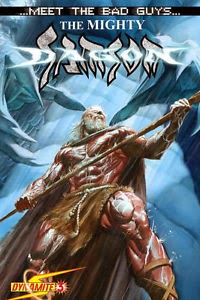
Mighty Samson as rendered
on the cover to SuperPowers:
Meet the Bad Guys
#3 (2009)
by Alex Ross.
Despite simplistic "costuming," Mighty Samson has a unique (in comic book terms, anyway) "origin." With no secret identity, Mighty Samson is a direct descendant of the biblical figure. Like his ancestor, Samson had immense strength and endurance, but could lose his powers when his hair was cut. Samson only learned about his heritage when he was a grown man, after his mother revealed his ancestry.

The Project Superpowers character (an amalgam of both Gold Key's and the even older Fox Feature Syndicate version) was the first time he is depicted with a beard. This is an older, more experienced (and completely--not just his left eye--blinded) version of the character who's beard is used to reflect the wizened perspective. As was the case with the majority of Golden Age characters re-introduced to the comic book collector with both SuperPowers' series (as well as one-shots and minis), Mighty Samson was rarely afforded the narrative spotlight but was more often than not used as background fodder. This is not to suggest the characterization was weak, just that here were so many characters vying for time in a book featuring over twenty Golden Age superheroes in any given issue.

As uncommon as unshaven super men are in comic books now, it makes sense that those published during the Golden Age would be even less likely; the negative association attributed to those with beards (as well as the adolescent comic book fans' inability to emulate any whiskered favorite character) would make such a characterization nuance difficult to make profitable. Perhaps someday, as the no-shave aesthetic becomes more mainstream, the comic book world will be ready for the first full bearded superhero!