Showing posts with label Marvel. Show all posts

Sunday, January 20, 2019

The Old Order Changeth!

My very first short box circa 1984... and yes I was the person who actually 
bought DC's Guy Gardner Warrior!
Some comic book collectors have spinner racks (lucky!) while others have beautifully designed shelving to display their collections. I am old school, and no carpenter, so even 40 years into my fandom, I still use long, and as I have become more "seasoned", primarily short, boxes for storing and organizing my collection. This requires quite a bit of space and, fortunately, we have a sort-of finished third floor attic where I read and store them with other collectibles.

Shazam! #1 variant 
cover by Gary Frank. 
It is during these winter months when we are "trapped" inside for the majority of the day that I will shift the organization of my collection. Often it is a change in publication the prompts a change, For example, DC's recently introduced Geoff Johns and Dale Eaglesham joint, Shazam! (2019, $4.99 per) title necessitates the movement of Jerry Ordway's incredible The Power of Shazam (1995-99, cover price $1.50 per issue) series into an active box. Though represents a significant departure from the characters as depicted in Power, with all pre-New 52 continuity erased, I like having access to previous narratives.

Conversely, the conclusion of the most recent Suicide Squad (Volume 5, 2016-19, Issue #1 was $2.99 and the final issue, $4.99) series means that title will shift to an "inactive" box, stored in the back part of the attic, until the teams eventual return to action. Then, once again, the old order will changeth!

Local comic book shops organize titles on the "New Releases" table, as well as on "Recent Releases" racks and their own "Back Issues" long boxes, first by publisher (Marvel, DC, Image, Dark Horse, etc.) and then alphabetically by title (Action Comics, Aquaman and so on). Decisions regarding the specific organization of titles in collections are more personal. When it comes to "Big Two" titles (DC and Marvel for the uninitiated), putting these titles by character families (Wolverine alongside Uncanny X-Men or Justice League Dark next to Justice League Odyssey). There are families in the smaller publishers as well, most notably (and expansive) the "Mignola-verse" titles from Dark Horse. These are comic books set in the world of Hellboy, a universe of titles created by Mike Mignola that includes Abe Sapien, Lobster Johnson, Witchfinder and many others.

Zeke Deadwood: Zombie Lawman 
cover by Thomas Boatwright.
Those smaller publishers beyond the Big Two, though given quality and quantity of titles it's past time to start thinking of Image Publishing as a "Big Three", are much more willing to take creative risks with creator owned titles, especially those in the Horror, Western and Science-Fiction genres. Because of this, many of my shorts boxes are organized alphabetically by genre families rather than publisher or creator.

For example, I currently have five boxes which are organized as "Westerns" that include a wide variety of characters from large and small publishers. This means that DC's Jonah Hex extended series (2005-10, 70 issues) is organized with the now-defunct Topps Comics Lone Ranger and Tonto miniseries (1994, 4 issues), IDW's 3 Devils (2016, 4 issues) and SLG Publishing's Zeke Deadwood: Zombie Lawman (2009-11, 2 issues) series of one-shots in my short boxes.

Interestingly enough, this brief post about organizing my comic books also has me organizing y thoughts. The inclusion of Zeke Deadwood among more traditional Westerns alone has me considering my next reorganization project to further disaggregating Westerns into a Horror-Western Mash-up section. That project, however, will have to wait for the next snowstorm...

Friday, February 24, 2017

Ballot Box & Long Box

As if our current political situation here in the USA hasn't created enough turmoil, NPR's new midday show, 1A, got me thinking about how my spending habits impact (positively or negatively) those who either support or oppose political parties/politicians. It was on my weekly drive to the local comic book shop for New Comic Book Day, that I listened intently as the host and guests worked through the question of "How does one respond to an administration that has no issue shaming corporation and businesses that express any disagreement with them?"

One of the guest reminded the listening audience of the Walter Reuther quote regarding the "direct relationship between the ballot box and breadbox."

Turning off the radio at the close of the interview, I headed into the shop wondering about who the publishers of my favorite comic books supported in the most recent election. The two most likely financial contributors of note would be those at the head of the Big Two, Marvel and DC. I recall hearing something in passing about an executive at Marvel Comics being involved with the Trump administration, but had not sussed out any particulars. Yet. Was there... or should there, be a direct relationship between the ballot box and the comic book long box? What practical impact would a potential buy-cott of  a company like Marvel whose chief executives contribute significant amounts of their personal financial gains (and therefore the money the consumer spend on the services provided) have? If I were to find out a Marvel bigwig was helping fund a politician I did not agree with, would my moral compass suggest I stop supporting that line and would it provide a meaningful enough message?

My initial thought is that the majority of artists (editors, writers, inkers, pencillers, letterers, etc.) in the industry, at least based on what can be inferred via Twitter, lean toward the more liberal side of the political spectrum. This group would include some of the most prominent Marvel creatives including Spider-man writer Dan Slott. My weekly pull sheet includes many titles that reflect my own (and presumably those of the creators) political leanings though such a factor has not always been a factor in my choices. (I do however purchase some titles that I don't outright "love" but recognize the need to support the artistic voice in the mainstream with my dollars.)

I am only a comic book fan with a very limited understanding of the industry beyond what can be gleaned though online reading and the tweets of a myriad of creators. (I do know that the "Marvel way" and "bullpen" was something of a ruse, albeit one I totally bought into as a youth: "Kirby, Stan and the crew hang around an office together goofing and making comics, right?")

So, what is "the story" with Marvel Comics and the 2016 Presidential candidate?

Last January, according to most news sources (whether the action was framed as a "good" or "bad" thing depends on the sources ranging from Breitbart to The Hollywood Review), "Marvel Entertainment CEO Isaac 'Ike' Perlmutter joined Republican presidential frontrunner Donald Trump by donating $1 million of his own money to America’s veterans on Thursday night in Des Moines, Iowa." (Breitbart) This was after first donating $2 million to Marco Rubio's during the primary season (THR). Following Trump's election victory, Perlmutter's wife was part of Trump's Inauguration committee.

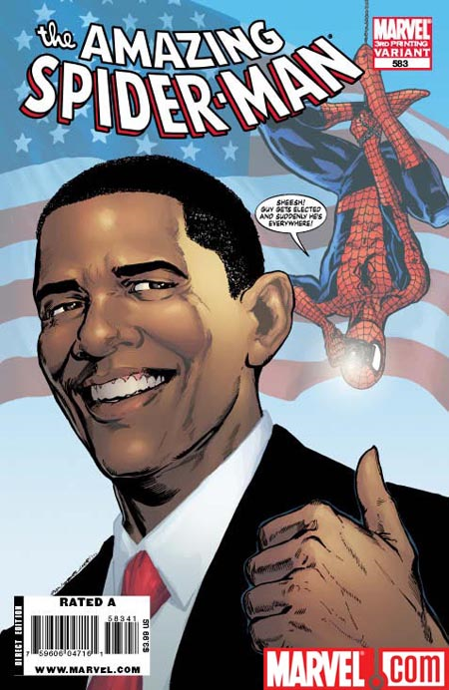
Despite this personal support of Republican candidates, Perlmutter's employer Marvel Comics has famously published reality "crossovers" that (at least superficially) are decidedly pro-Democrat. There are two obvious examples that quickly come to mind. Who can forget the Amazing Spider-man #583 variant cover that featured Spidey snapping a picture of President Obama? This stunt proved successful enough to warrant four reprint runs. More recently, issue Ms. Marvel #13 in which the book's protagonist, Kamala Khan aka Ms. Marvel, overtly throws her support behind Senator Clinton. In an unfortunate twist, the issue actually hit stands after Election Day. This is chronicled in greater detail in "Marvel Comics Superhero Uses Her Powers to Help Elect Hillary Clinton" (from an unbiased website who's mission is to "combat liberal media" so take that as you will).

Whether a calculated move for image purposes or (optimistically) because of the high quality of the product warrants it, Marvel has also been willing to publish titles reflecting a very clear political agenda. The most obvious recent example of this would be the cover to issue 8 of 2016's short-lived "ongoing" Mockingbird. (Ironically the last issue to be published as the book was canceled following it's publication.) It made quite a bit of news when the protagonist was featured on the cover wearing a t-shirt inviting readers to "Ask me about my feminist agenda".

The bottom line is while I like using my disposal entertainment dollars to be entertained, I also recognize to use these limited resources to support political/social perspectives with which I have agreement. Not buying certain comic books might make one "feel better" but ultimately only impact negatively those at the creative level. It is fair to suggest that this group includes many individuals whose ideals are consistent with my own and are giving larger voice to relevant issues.

Nothing is simple, even in the murky place where the worlds of lol it's and "funny books" overlap. The resolution to the decision of whether or not to buy-city is to remain vigilant in following the money in a way that works best for you and your conscience.

Sunday, February 07, 2016

Spidey Goes Back to the Future

Back and front cover to Marvel Treasury Edition featuring
the Sensational Spider-Man
#22 (1979) by Bob Budiansky and Joe Sinnott.
Recently is was reported that  Marvel Comics will be reviving their long defunct Treasury Edition format for the purposes of reprinting issues of the recently released Spidey title. While I have little desire to purchase a treasury edition for a title I can still pick-up on the rack (were I so inclined) this news has caused a burst of nostalgia in many a fanboy, including yours truly, which of course was the desired effect.

For purposes of scale, left is the
Treasury Edition and to the right a
traditional comic book.
This news also prompted the recall that I actually have a copy of a Marvel Treasury Edition from 1979 piled among other odd-sized issues, mostly from independent publishers. That, in addition to the perception that you were getting 4-5 issues in a single "package", seems to me to have been the key selling point for this uniquely proportioned title. Back in the 1970's, magazines and larger editions were something of a rage. Though the $2.00 cover price would have been expensive for those of us conditioned to spend 35 cents of our allowance per comic book, it was after all larger, so it must be cooler, or at the very least better.

Though I can't recall exactly how it came into my possession, as I often find with older Marvel comic books, it has many of the attributes of a classic Marvel story--which ironically is also what is missing, in my estimation,  from most current Marvel titles. I still love Gil Kane and Sal Buscema's pencils, as well as the story-telling of Len Wein, featured in issue 22. Back-in-the-day, comic book narratives were much more tightly written, and frankly, more action oriented. Nowadays, out of the perceived necessity to reprint titles in trade paperback, every single story arc is stretched out over 5 to 6 issues, many times to the detriment of the story.

As a ten-year old, I totally bought into the
mythology of he Marvel Bullpen, and peaks
inside, such as this one drawn by Mary
Severin, were always welcome.
But Marvel Treasury Edition #22 (1979) is chock-full of classic Marvel goodness. It collects four issues of  the Marvel Team-Up title that showcased stories in which Spider-man would (Surprise!) team-up with other Marvel heroes of varying degrees of popularity. Again, way back in the late 1970's, early 1980's this was not as common an occurrence as is the case now. Also included within is a Bonus Pin-up (on which reprint editor Jim Scalrup declares "what else would you do if you had an extra page to fill up and nothing to put on it?" for what in effect is a J. Jonah Jameson poster!) as well as Stan Lee story about the famed Marvel Bullpen's prepping for an upcoming Spider-man comic strip in a three-pager entitled "Here We Go-A Plotting!".

Like many, I miss what I perceive to have been the hey-day of Marvel Comics, when super-heroing was fun and colorful, and when heroes didn't need to be "anti-" in order to be interesting. Though I am unclear as to how attractive a new Marvel Treasury Edition will be to the modern collector (let's face it, it won't fit in a long box), if the stories told in Spidey reflect this earlier style of story telling, I may just check it out. Until then, however, I have Issue 22 of Volume 1 of the Marvel Treasury Edition, and many long-boxes full of back issues, to remind me of my affection for marvel Comics.

Gil Kane drawing Stegron the Dinosaur Man?
Take my money NOW.

Friday, October 23, 2015

Horror Comics Cavalcade: Marvel Chillers (1975)

Two panels from page 30 of  Marvel Chillers #2 (1975)
words by Bill Mantlo and art by Sonny Trinidad.
Most horror comic books can fit into one of three categories: those titled using traditional horror keywords such as "ghost," or "haunted," those based on traditional literary characters that inspire dread (whether true to the literary source material or not) such as Frankenstein and Dracula, while still others feature protagonists that utilize supernatural power sources such as magic. Today's Horror Comic Cavalcade selection actually fits into all three, though one requires a literary background to make the round peg fit into the square hole.

Issue #2 of Marvel Chillers (1975) is both the second, and final, appearance of one-time newbie Marvel Comics magic-based anti-hero Mordred the Mystic. Despite two issues ably scripted by industry stalwart Bill Mantlo, Mordred the Mystic's comic book career as a lead character lasted only two issues.

Mordred's origin is a simple one: he is found sleeping(!) on a throne beneath an ancient cairn on the Isle of Wight by two explorers. Through a series of events, Modred is awakened from his lengthy slumber and after mistaking one of the explorers for his long lost "milady," he (with the explorers as escort and potential romantic interest) set off to explore the modern world. As so often happens, an evil referred to only as "The Unknown" awakens at the same time intent on destroying him. Utilizing a supernatural energy source called "the darkhold," our mystical hero battles to both clear the cobwebs from his memory and end the threat of the Unknown. So much of this issue is presented as it relates to Modred's origin, it makes one wonder what issue #1 was about.

Modred certainly has
a way with words!
Due to very familiar similarities with other more popular characters, most notably Thor and Marvel's Sorcerer Supreme, Dr. Strange, Morded's quest ends abruptly at the the issue's conclusion. Though he does not speak thusly in more frequent iterations, in the past, Marvel's Thor has also spoken in a pseudo Medieval/Norse tongue. Mordred's dialogue is phrased in a very similar manner, and  lines such as "Is not the powers of the darkhold mine own?" and "Aye, milady, tis God's truth thou dost speak!" cannot be easy to write without inducing a smile. Also like the comic-book Thor (very different from the cinematic character), Mordred is found in a subterranean cavern much in the same way that the transmogrified Mjolnir was--an event that would lead to Dr. Donald Blake becoming the God of Thunder.

Now about that round peg: most readers are likely very familiar with King Arthur and the Knights of the Round-table, but lesser fans may not fully appreciate the connection between those stories and this "hero." In Arthurian legend, Modred is the illegitimate son of Arthur conceived as a result of his relations with his half-sister, Morgan le Fay. Not necessarily the stuff of popular film adaptations (which may be why the character hasn't be seen from much since), this Modred the Mystic's connection to Camelot is only hinted at. The British setting, medieval attire and references to a past golden age strongly infer a connection between Mordred and Arthurian legend, a relationship that might have been explored had the character's run lasted.

Both issue #2 of Marvel Chillers, as well as its immediate predecessor, were both written by Bill Mantlo, art by Sonny Trinidad. Rich Buckler cover pencils.The copy of Marvel Chillers #2 in my possession was just one of a pile of yellowed comic books a friend from work gave me. They had been sitting in a shopping bag in his garage for many years, though I suspect a copy can be had for only a few pennies online or even in a very deep back issue bin at your local comic shop.

Wednesday, July 29, 2015

Run Reader: Rawhide Kid (2003)

Reintroducing Rawhide Kid in Issue #1.
My introduction to the Western comic book genre came late in my collecting life in the rugged guise of the 2005 Jonah Hex, Volume 2, written by Jimmy Palmiotti and Justin Gray. The most familiar Western hero from DC Comics, I eventually found that because of its excellence, I craved more adventure from "those thrilling days of yesteryear."

Cover to Issue #2 by Terry Dodson
and Kaare Andrews... subtle, right?
My experience with Marvel Comics' Westerns began with more modern iterations of two key characters, The Rawhide Kid and the Two-Gun Kid, among others. Together they starred in the four-issue miniseries Blaze of Glory (2000), by writer John Ostrander and artist Leonardo Manco and its sequel, Apache Skies (2002). Both The Rawhide and Two-Gun Kids were presented in fairly traditional Western fashion, consistent with the earlier roots of each character. The Rawhide Kid character originally debuted in 1955 from Marvel Comics's 1950s predecessor, Atlas Comics. Described as a "diminutive yet confident, soft-spoken fast gun constantly underestimated by bullying toughs, varmints, and crooked saloon owners," the Rawhide Kid (Johnny Bart) was the template from which later super-cowboys sprang. While the Rawhide Kid of Blaze of Glory/Apache Skies was grittier than the original, both interpretations were very different than what would come next.

With a faint recollection of a news story about the Rawhide Kid being re-envisioned as homosexual in the early 2000's, I bought the individual issues of  Rawhide Kid, Volume 4 (2003) for cheap to see what the hubbub was all about. At the time, I missed the red flag that the subsequent trade paperback collection of the mini-series, bore the title of the story arc from the miniseries, "Slap Leather." From the start, the tone is sophpomric and most of the updated characterization is played for "laughs."

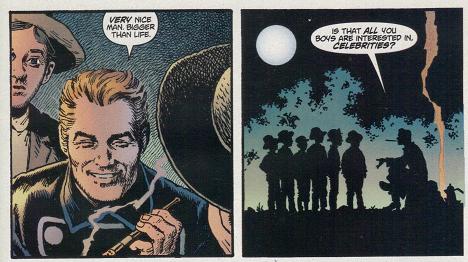
Clue 1 from Issue #1: Rawhide Kid
likes celebrity gossip!
As written by Ron Zimmerman, this Rawhide Kid (who inexplicably prefers the nickname "Trey"?!) is much more of a caricature of homosexual stereotypes than a fully realized character with a (presumably) less-than-common sexual orientation for the Old West setting. The inherent potential of exploring the challenges of such a character in the Old West are ignored for the sake of probing the intricacies of how two of the Cartwright Boys from Bonanza could be placated by alcohol and potentially tricked into "extracurriculars" with Trey. I can't make this stuff up. Zimmerman sprinkles various literary and historical figures throughout the proceedings and even creates historical analogs for modern figures (for example, the dim-witted town leader, Mayor Bush) in an effort both ground his story in history and possibly, satire.

The flirtation begins in Issue #2.
The plot is standard: gunman (The Rawhide Kid) comes to town beset by criminal types. While there, gunman teams-up with local lawman, previously humiliated by criminals, to save town, and the lawman's shaky relationship with his young son. It's in the execution and detaisl that things get awkward: gunman drops numerous romantic hints to the lawman about things like French fashion while parading around without his shirt. Lawman's son, embarrassed of his pa's failure, publicly and verbally emasculates dad while hero-worshiping the gunman who (wink-wink) is homosexual.

Though subsequently billed as "the first openly gay comic book character to star in his own magazine," the Kid's openness is almost entirely comedic in its presentation, limited to obvious campy humor, puns and double entendre.  Used as simply a way to differentiate the protagonist from those around him (and as a subtle reasoning behind his colorful attire), the Kid's homosexuality fails to add a level of depth to the characterization or by extension, the title's proceedings.

As seen here in issue #3, the Kid is
always on the cutting edge of fashion.
The artwork by John Severin, a long time comic book artist who also provided art for Image Comics' modern-Western title Desperadoes: Quiet of the Grave (2001), is excellent. While the detailed setting clearly established as Old West vibe, the accompanying story, by Ron Zimmerman, is surprisingly ham-handed and stereotypical in its reveal and depiction of the Kid's sexual orientation. It could be said to border on parody, but just what was being parodied is up for debate. The multiple references to literary (the leads of Lonesome Dove get name-checked early on) and historical Western figures, as well as the beautiful artwork were not enough to carry me past the borderline offensive stereotype's of homosexuality that drove the story.

Even typography choices made by the writer and letterers, Rich and Wes @ Comicraft, seem to purposely reinforce the stereotypical depiction of our hero. As you can see from the pane at the top of the page, wherein the Rawhide Kid makes his first appearance wit the phrase "Oh, stop..." which when read aloud with the proper emphasis applied for the bold lettering sounds somewhat affected. Upon my own internal reading an inflection was intended, as it is through out the series.

So, is it worth checking out? As a snapshot of the misguided attempt by a mainstream publisher to take an older character and re-boot him in such a way, yes. Despite the somewhat clumsy effort, Severin's art (and the ability to analyze the hell out of the whole package) is just enough to recommend it. Both The Rawhide Kid: Slap Leather (2003) and it's sequel, The Rawhide Kid: The Sensational Seven (2010) are available as trades at your local comic book store (or in the back-issue bin).

Happy trails, Trey! from Issue #5.

Wednesday, July 08, 2015

Walking Dead with the Fantastic 4

First issue covers: Fantastic Four: Foes (2005) by Jim Cheung and Before the 
Fantastic 4: The Storms (2000) by Charlie Adlard.
While reorganizing my comic book collection this summer (for the umpteenth time), I was pleasantly surprised to come across some individual earlier works by the creative team of the über-successful The Walking Dead comic book, writer Robert Kirkman and artist Charlie Adlard. The connection was made as I was chronologically filing older issues of mini-series featuring my favorite Marvel comic book characters, the Fantastic Four. While neither Kirkman nor Adlard contributed to the main team title (which was recently made "dead" by Marvel Comics), both were part of two separate creative pairings that each produced a miniseries involving the team.
Cover to The Walking Dead #50
by artist Charlie Adlard.
The timeline of The Walking Dead's ascension to cultural phenom suggests that both Fantastic Four mini-series came prior (especially in the case of Adlard's work on The Storms) to the pair's work on the popular survival/zombie series. The first issue of The Walking Dead, written by Robert Kirkman and illustrated by Tony Moore, hit comic book stands in October 2003. By the release of issue 7 in April 2004, Moore had given way to the now familiar black-and-white artistic stylings of Charlie Adlard. The Walking Dead television series premiered in the U.S. on October 31, 2010.

While Kirkman has had success on Marvel properties such as (shocker!) Marvel Zombies (2005), the real back issue find here for me was Adlard's early work on an unusual background building mini-series featuring two key members of Marvel's First Family. Other than the recent publication of his earlier online series Astronauts in Trouble (hailed in recent Image solicits as "The series that brought... artist Charlie Adlard to the attention of Robert Kirkman"), I haven't seen any other work by him, that is, until now. Both Fantastic Four: Foes, written by Kirkman, and Adlard's pencils on Before the Fantastic 4: The Storms reveal two independent creative minds that would one day cumulatively birth The Walking Dead cultural phenomenon.

Fantastic Four: Foes was released as a six issue limited series in 2005 written by Robert Kirkman with art by Cliff Rathburn. Though I have not read any of Kirkman's other superhero books (Ultimate X-Men and his creator-owned Invincible, for example), this one plays into the strengths demonstrated in both The Walking Dead comic and television show: nuanced character development, with an emphasis on smaller interpersonal character interactions. This approach works well as this miniseries seeks to show us the Fantastic Four as family; the entire traditional supporting cast is along for the ride including Alicia Masters and the Richards children. The focus of the narrative is on how two of the family's foes (get it?) team-up to use the combined powers of  nearly their entire rogues gallery to finally defeat them. In telling the story, Kirkman tries to get at what motivates individuals, in this case super powered crazy individuals, to repeatedly attempt to do that thing which they have demonstrated little ability to succeed at: defeat Marvel's First Family.
Interior art by Cliff Rathburn
from FF: Foes (2005),
issue #5.

Cliff Rathburn's artwork is also fairly clean consisting of sharp lining and bright colors giving the book a look similar to an animation cell (perhaps this pairing was intentional as by this time Kirkman and Adlard had been working together and a clearly positive stylistic synergy had been developed). In Rathburn's hands, even the Thing's crusty rock-like hide, though minimally shaded for depth and texture, is smoothed and softened for a look very much like that of the old cartoon from the 1980s. Some awkward facial expressions aside, Rathburn's art does a good job communicating the close interpersonal relationships of the characters, even during series of panels with little to no dialogue.

After reading the limited series for the first time since its publication, it surprised me how many plot and character points have since become part of of Fantastic Four cannon. As a means of holding the captured villains, Reed builds a new Vault (prison) in the Negative Zone, a vision that would eventually be seen in the mainstream Marvel comic book universe during the 2006-2007 Civil War event. (In that continuity, the prison from Foes is not referenced as the Civil War prison is code named "Project 42" because it was the 42nd project they had developed after the Stamford tragedy.) Also, this series reintroduces the possibility of a bearded Reed Richards leading the team. Though used briefly following Reed's return form being lost in the past, the current visual presentation of Mr. Fantastic with full beard in Secret Wars is a design which is now cannon.

Just like old times: In issue #1
 Johnny is back to fixing cars!
Before the Fantastic 4: The Storms was one of three mini-series published, along with Reed Richards and Ben Grimm and Logan in 2000. Each mini-series focused on the characters that would ultimately become Marvel's First Family while weaving in minor plot elements that contributed to some of the larger storylines (none too memorable following the numerous ret-cons that have followed) in the main Fantastic Four at the time. Scripted by Terry Kavanagh, The Storms is very much in the vein of a Nancy Drew or Hardy Boys novel with Sue and Johnny serving as junior suburban investigators trying to solve the mystery of a magical amulet. Kavanugh does not do this at the expense of the classic character traits of both Sue and Johnny, including their big sister-little brother dynamic. Frequent nods to character nuances (Johnny's love of cars and girls, Sue's natural leadership ability) allow for the fan to easily see this fitting into the larger continuity of the Fantastic Four mythos.

At its core, The Storms is about showing the groundwork of these two key characters that could logically result in the building of the superhero team. This set-up, of course, leads the brother, sister and friends into conflict with all sorts of creatures of the night. In addition to the monsters they battle, other recognizable plot devices turn-up throughout the proceedings. The first issue alone includes the classic Scooby-Do investigative strategy of having a character, in this case Johnny, hide in a suit of armor as others offer helpful exposition and clues. As corny as this may sound, and as familiar as the tropes being intentionally applied may be, The Storms is a whole lot of fun.

Perhaps somewhat prophetically, the Storms' adventures give Charlie Adlard perhaps his earliest opportunity to publish artwork chock full of ghouls, monsters, and... wait for it... zombies! As entertainingly structured as Kavanaugh's narrative is, it is Adlard's artwork which grounds The Storms. The creatures that pursue and battle our heroes fit neatly into the real world visuals established by the artist in the first issue. Interestingly, the mini-series doesn't feel like a "superhero comic book" until one makes a brief guest appearance in the final issue.

The elements of Adlard's work that make The Walking Dead such an engaging read are visible in this earlier work--with the notable addition of a color palette beyond blacks, white and gray tones. Dynamic action and willingness to break from panel conventions in the interest of building energy propel the action forward. In fact, while much of the action in The Walking Dead is responsive in nature (the characters are acting out of necessity to survive certain circumstances), it was nice to see this dynamic flipped as the Storms take the fight to the bad guys. This slight shift in motivation is interesting to note.

Left, original panels from The Storms #3,
right: same panels recolored in grey-scale.
It would be easy to say that the only difference is the addition of color, but as you'll note from the original color and recolored black and white panels to the right difference is subtle and runs deeper. While the similarities are obvious (Adlard was still Adlard), there is an active motivation on the part of the protagonists throughout the Storms that only occasionally comes to the surface in The Walking Dead. Thematically, this makes sense. The Walking Dead is about establishing a norm, albeit a post-apocalyptic one, and building to various narrative climaxes; The Storms follows a much more basic plot map which requires action on the part of the characters to propel the much shorter, three issue story toward a logical resolution.

Given its growing place in popular culture, I am confident that someday a graduate student somewhere will write an amazing analysis of Robert Kirkman and Charlie Adlard's Walking Dead work in contrast to their earlier efforts. With little doubt, this analysis of those creative seeds will be of interest to both fans of the product as well as fans of good literature (which Walking Dead most certainly is). Until then, I will continue to periodically comb through my longboxes, hoping to inadvertently stumble across these sorts of issues. Not only does it create the chance to re-read such excellent mini-series as Fantastic Four: Foes and Before the Fantastic 4: The Storms in light of more recent comics, but, as is the case with these two minis, it's fun top revisit a time when superhero comic books had a stronger sense of FUN.

Eventually a precursor to Ghost Rider makes an
appearance in The Storms #3.

Tuesday, May 26, 2015

Run Reader: Mighty Marvel Westerns (2006)

All four covers feature the handiwork of Goon creator Eric Powell!
In the last ten years I have become much more enamored with the Western comic book genre. Largely ignored in my previous 20+ years of reading, maybe something just happens as one gets older and the bygone days of yesteryear become more appealing. During this time, in addition to picking up modern western titles such as DC's Jonah Hex (Volume 2), I began seeking out older titles from variety of publishers. Among those were various reprints of classic Jack Kirby Rawhide Kid stories.

Not a "run" in so much as a minor event, the summer of 2006 saw Marvel Comics briefly return to its roots with a series of five one-shots published under "The Mighty Marvel Western" umbrella. Four of the five issues focused on individual characters, each headlined by one of the more recognizable characters in Marvel's stable of Western stars, such as Two-Gun Kid and Red Wolf, while including  minor characters in back-up stores via reprints and new tales. The fifth book in the series was a handbook called Marvel Westerns Outlaw Files that feature biographical information and "authentic" Wanted posters from the 1800s. Though ultimately collected in a cumulative hard cover, none ended in a return to monthly adventures for the characters that one might have hoped.

In fact, other than Marvel's Six Guns mini-series in 2012 that featured updated versions of Western characters in a modern setting and Rawhide Kid: The Sensational Seven (2010), Marvels' heroes have once again receded into the past glories of the publisher, failing to warrant much more than the occasional appearance in an in-continuity time travel story. (The Western will be making a brief comeback of sorts in the miniseries 1872 as part of Marvel's current Secret Wars event.)

Never too much Terrible Totem
by Stan Lee and Jack Kirby, reprinted 
in MMW: Two-Gun Kid.
But we do have the wonderfully entertaining Mighty Marvel Western one-shots to re-read when the desire for Marvel Western magic is desired. A quick issue-by-issue review reveals that some high profile comic book talent, especially writers, (though the artwork is consistently good, anchored by Goon creator Eric Powell, who had a hand in all covers) took advantage of the opportunity to play in the Old West sandbox when these issues were released in summer 2006:

  • Marvel Westerns: Kid Colt and Arizona Girl (2006) #1—one of the best part of these one-shot is the abundance of material one gets in each is. For example, this issue includes five(!) stories; a new Kid Colt and Arizona Annie tale written by Jonah Hex writers Justin Gray and Jimmy Palmiotti, a story introducing the Philadelphia Philly by Jim McCann and David Williams, and reprints of three classic tales by comic legends Jack Kirby and Dick Ayers.
  • Marvel Westerns: Western Legends (2006) #1—This beauty features three very solid all-new tales starring less-familiar Marvel Western characters Hurricane, Red Wolf and the Man from Fort Rango. All three stories are good, while the first "The Man Called Hurricane" by Jeff Parker and artists Tomm Coker is a personal standout, given it's earthy palette and classic story line (with a nod to the character much more flamboyant original design. I have long been a fan of writer Karl Kesel (mostly from his DC work) and his Red Wolf story doesn't fail to satisfy. With so many Kirby classics in these comic it is great to get the origin of Rawhide Kid by the King himself here, too.
  • Marvel Westerns: Strange Westerns Black Rider (2006) #1—Includes four stories, the first featuring Marvel's dark Western avenger, the Black Rider, written by Steve Englehart and Joe R. Lansdale. Lansdale, with artsist Rafa Garres also contributes a Gunhawk story, and once again the issue concludes with Marvel classic Westerns, this time two Kirby Rawhide Kid tales.
  • Marvel Westerns: Two Gun Kid (2006) #1—Features two stories, one new and one classic. The first features warp-around story set in the present with Two-Gun kid and She-Hulk written by (then She-Hulk writer and current Spider-Man scribe) Dan Slott with pencils by Eduardo Barreto. The story concludes with the promise that it was "Not the End: Two-Gun and Shulkie's adventure continues in She-Hulk #11!" (I'll have to check out those issues). The second new story stars Hugo the World's Smallest Cowboy from a bevy of talents including Keith Giffen and Mike Allred and is lots of fun answering the challenge declared in the credits box asking "how in tarnation can a li'l ol' Western yarn by th' likes'a... possibly be worth two rotten skunk eggs?" And, as with all books in this series, this one concludes with a classic Kirby tale, this one with the Rawhide Kid.
My primary takeaway from revisiting these stories (whether "new" or classic) is to reaffirm what I already knew: Western comic books can be very fun if handled by quality creators. Now that DC's All-Star Western has exited the New 52, only Dynamite regularly publishes traditional western comic books. With so many great characters, it would be tremendous if Marvel take the gamble to publish a monthly book dedicated to characters within the genre (rather than just Western takes on traditional  Marvel characters a la the aforementioned 1872). Based on this series of one-shots, the publishing giant certainly has the wherewithal to do so, now just needs the motivation to make it so.

All of these books are highly recommended as is the Marvels Westerns Hard Cover which captures them all in a single volume!

The end of Arizona Annie and Kid Colt's adventure...
and of the Mighty Marvel Western genre? Words by Justin
Gray and Jimmy Palmiotti and pencils by Federica Manfredi.

Friday, May 15, 2015

Run Reader: Fantastic Four: The World's Greatest Comic Magazine (2001)

With this alliterative splash page we return to the Marvel Universe
circa 1970 care of Erik Larsen, Eric Stephenson, Bruce Timm,
Kieth Giffen, Al Gordon, Jorge Lucas and Joe Sinnott 
With the conclusion of James Robinson's "The End is Fourever" storyline in May's Fantastic Four (issue #15 of Volume 5 or #645 in the continuous numbering), for the first time in a long time, Marvel is not publishing a comic book with the phrase "Fantastic Four" in it. As a long time fan (my first issue was Volume 1, #202 with the second part of the "There's One Iron Man Too Many!",  written by Marv Wolfman and with pencils by John Buscema when I was ten years old), it is the very real end of an era. Though with little more finality than any of the many previous "End of the FF" arcs, this one feels a tad more permanent (though nothing is fourever forever in comic books, right, Bucky Barnes and Gwen Stacey?) as far as "official" comic book endings go.

FF: WGCM #4 cover by
Bruce Timm. 
Like many fans, I will, however, continue to have copies of the FF on my reading table thanks to multiple longboxes of back issues, including many of the mini-series and one-shots that have been published in the past 40+ years. One such series that I recently completed purchasing the entire run of was the 12-issue miniseries from 2001, Fantastic Four: The World's Greatest Comic Magazine. Published during one my my hiatuses from collecting, it was only in the last week that I was able to purchase the final three issues of the series, and reread the whole run in it's entirety.

Interestingly, despite being published in 2001,  Fantastic Four: The World's Greatest Comic Magazine fits canonically between issues #100 (July, 1970) and #101 (August, 1970) of the original Fantastic Four, Volume 1.

Because legendary penciler Jack Kirby's run was unceremoniously halted after issue #102, modern superstar comic book artist Erik Larsen enlisted others to produce what Stan Lee and Jack Kirby might have put together had there run continued for 12 more issues.  While this can be seen as Larsen's formal tribute to the original World's Greatest Comic Magazine, one can rightly argue that his work as creator, writer and artist of the Savage Dragon series stands as its own homage to the Kirby aesthetic. In essence, the miniseries is one possible answer to the question of "What if Stan Lee and Jack Kirby concluded their historic run on FF with one last wild adventure?"

From FF:WGCM #5, written
by Kurt Busiek with art by
Gordon Purcell and Bruce Timm.
With Larsen's FF miniseries, the original title's iconic banner line takes center stage. As if to emphasize the prominence of the characters' and title within the Marvel Universe, the series' traditional "The World's Greatest Comic Magazine" moves from the area above the title, into the title proper.  Great effort is taken to suggest the comic books of the time with attention to details such as titling of each issue and use of time appropriate costumes for certain characters such as The Falcon's green and gold tights.

Each issue's story title also reflects Stan Lee's own penchant for alliterative names: for example issue #1 "The Baxter Building Besieged!", Issue #4's "The Merciless Menace Of MODOK!", and issue #9s "Nightmare In The Negative Zone!" I've written previously about the impact my childhood fandom had on early vocabulary development feel, especially the professorial dialogue written for Mr. Fantastic. It was wonderful to see nods to this in the editorial captions provided throughout such as in the lower right hand corner of the panel to the right declaring a "Special Note to lovers of Onomatopoeia."

It's not an FF saga without
an appearance from the Big G.
The conceit of the series is that it's firmly planted in the Fantastic Four timeline of the Lee-Kirby years, but that does not dissuade from the using certain popularized characters, most notably the X-Men and the Sentinels, in a way different than if published in the early Seventies. The inclusion of such characters is made to seem common, though in the true historical context, such drop-ins by popular characters would probably have been promoted on comic book covers as "Special Guest Appearances!" This is not a complaint, but an observation, as the fun manner in which all are used make their inclusion seem "event" worthy. Never fear, True Believers, as those characters once strongly associated with the FF, such as Galactus, the Sub-Mariner and the Black Panther, also join in the proceedings. It is also unusual that the conflict is developed through the use of the Cosmic Cube, an artifact never as connected to the FF as Captain America.

While this trip back to the 1970's Marvel Universe is co-plotted by Larsen and Eric Stephenson, the list of scripters reads like a who's who of late-Nineties stars including Chuck Dixon, Jeph Loeb, Tom DeFalco, Kurt Busiek, and Bruce Timm. Even Fantastic Four co-creator Stan "The Man" Lee receives a story credit for the final issue of the series (Issue 12, "Victor Von Doom: Emperor of Earth"). The art is suitably bright, vibrant with clean lines and a clear effort being made by the many pencillers (including Keith Giffen, Erik Larsen, Ron Frenz, and Rick Veitch) to recapture that Kirby Krackle magic.

Fantastic Four: The World's Greatest Comic Magazine was originally envisioned as a kick-off to the 2001 40th anniversary of Marvel's First Family, but it also serves as an entertaining and worthy re-read suitable for the one-time flagship title's recent cancellation.

Emperor Doom versus Fin Fang Foom in issue #12 is almost worth the price of
admission alone!

Wednesday, February 18, 2015

Run Reader: The Crew (2003)

Former Iron Man James Rhodes meets Josiah X, heir to the Super Soldier
legacy in The Crew, Issue #1.
War Machine, James Rhodes, on
the cover of issue #1 by
J.H. Williams. 
While combing through some old longboxes recently, I came across a unique take on the superhero team book from back in the early 2000's. Though I am unsure whether it is part of current continuity (then again, who is sure what is anymore), Marvel Comics' 2003 series written by Priest with pencils by Joe Bennett, The Crew, offers an untraditional take on longtime Iron Man understudy/partner James "Rhodey" Rhodes. Additionally, the series also introduces an heir to a recipient of the Super Soldier serum tests from the time immediately following the emergence of Steve Rogers as Captain American, the first Avenger. A number of iconic character-types (Captain America, Iron Man, Black Panther) and familiar Marvel tropes (heroes of color and of diverse cultural backgrounds) are tweaked here laying the groundwork for further exploration in future issues.

Josiah X's secret is exposed in
issue 6, with art by Joe Bennett.
But, in yet another case of a promising series gone-to-soon, The Crew was cancelled after only seven issues leaving the reader with only the slow-burn introduction of each individual character's in a storyline that establishes its roster and the team's basic motivations. The team's formation is put into motion when Rhodey, having lost everything after living the exciting lifestyle of a wealthy, superhero and CEO, learns that his sister has been found dead in New York City. Rhodey is characterized here as a weary, greying-at-the-temples veteran who is simply looking to move on, though just to where is uncertain. The search for justice in the death of his sister rekindles his heroic fire. While James Rhodes is the anchor that keeps the proceedings firmly planted in the street level world of Marvel's New York City (specifically a neighborhood dubbed "Little Mogadishu"), it is Josiah X's heroic arc which echoes Rhodey's journey of redemption through the entire seven issues.

In the current Marvel Comics Universe, the highly publicized change of shield-bearer from Steve Rogers to former partner Sam "The Falcon" Wilson would seem to subtly put forward the notion that he is the first African-American "Cap." Not so. Just over a decade ago, Marvel Comics fans were given some disturbing new insight into the U.S. government's efforts to recreate the project that resulted in Steve Rogers becoming Captain America.

The Crew as depicted on 
the cover of issue #6 by
J.H. Williams. 
Though Rogers was the first successful beneficiary of the Super Soldier serum, the "honor" of being the secondary recipients of the U.S.'s efforts to recreate it belonged to African-American soldiers who served as test subjects. The limited series Truth: Red, White and Black explained that while most of the test subjects ultimately died, one survived. For a short time, Isaiah Bradley served as an occasional substitute "Captain,"before facing court martial and sent to Leavenworth prison for 17 years.

The hero-in-full revealed at last
in the series final issue, #7.
In The Crew, after challenging Rhodey's sense of personal responsibility and pride, Josiah X is himself forced to evaluate his own willingness to stand up and be counted. After being revealed to be Isaiah Bradley's son, Josiah must choose whether or not to emerge from urban legend into reality as the "black Captain America." Due to the diverse backgrounds of the four Crew members, it would be fair to suggest that one of the themes Priest intended to explore here is race, but based on the seven issues that were published, that couldn't be farther from the truth. It is Priest's treatment of our multiple protagonists as complex and conflicted individuals facing relatively common concerns (in a traditionally super-heroic world) with moxy and grit in the face of adversity, regardless of ethnicity, that rings true.

Dannny "Junta" Vincent and Kasper
"White Tiger" Cole are the other two
members of the Crew, seen here in issue #4
The Crew is not a "black super-hero comic book," but rather a study in what can drive one to make the difficult, heroic choices necessary to bring light into a community where lawlessness is ingrained in the shared code of survival. As the series progresses, the more familiar artifacts of super-heroism such as costumes and code-names move to the forefront only after the characters and their intentions are firmly established. For example, in Issue #1 the only indication of Rhodey's past as a crime fighter is his misguided effort to pawn a non-working Iron Man helmet as a means of pulling together some finances. By issue #7, Justice, the name Josiah X will use as a code-name, is revealed to the community as their hero after saving children from a fire.

It should be clear that I enjoyed the plot and characterization inherent in Priest's work with The Crew, and in a medium where the artwork is an equal contributor, Joe Bennetts' work is also worthy of note. I had previously been unfamiliar with Joe Bennett's pencils. which possess a Bart Sear's vibe. Bennett's backgrounds effectively evoke the somber sadness of Little Mogadishu, while the panel blocking communicates both the frenetic energy of our more active superheros, Junta and White Tiger (above, left), as well as the stoic posturing of Rhodey and Josiah X. The infrequent splash pages also serve to establish striking iconic superhero poses for the relatively new heroes on the scene (see Josiah X below).

Though forgotten as a team following the seven issue "Big Trouble in Little Mogadishu" storyline, some events in The Crew have echoed into the current Marvel Universe, such as the later emergence of Josiah X's nephew as The Patriot of the Young Avengers, but this tale of the cast of the Crew has unfortunately fallen once again into the realm of urban myth and back issue longboxes.

The moments during which Rhodey dons armor 
exist only on the series' covers such as this one for issue #4.
The cover to issue #5 echos that of Truth: Red, White & Black,
the miniseries that first brought Josiah's, father, the "black Captain America"
into Marvel Comics continuity.

Tuesday, February 10, 2015

Run Reader: Doctor Voodoo (2009)

As Sorcerer Supreme, Doctor Voodoo is obligated to tussle with the Dread Dormammu! 
While scrolling through Twitter today, I came across Buzzfeed's well-written Black History Month post "17 Black Superheroes And Where To Read More About Them," which referenced a number of familiar (to comic book fans anyway) African-American (and in the case of the Black Panther, African) superheroes. While some of those mentioned in the Top 17 were among my favorite characters, most notably John Henry Irons from DC Comics' Steel series that ran from 1994-1998, there were some additional characters I thought worthy of mention.

The cover to issue #1
by Marko Djurdjevic.
My longbox of cancelled titles runs deep and as I read the article, mental images of forgotten covers came to mind. My intent over the next few weeks is to post some images and basic info about those not included on Buzzfeed's list. Though some characters have some fairly lengthy history in their respective comic book universes, I'll limit the pictures and comment to those in comic books I have actually read, as in a complete "run." First up, Marvel Comics' Brother Doctor Voodoo.

Though he first appeared in 1973, Brother Voodoo (Jericho Drumm) didn't come fully to my attention until he was promoted to "Doctor" Voodoo, Avenger of the Supernatural, during the five issue series of the same name in 2009. Replacing Doctor Stephen Strange as the Sorcerer Supreme in the pages of The Avengers, Dr. Voodoo's self titled series was written by then up-and-comer Rick Remender with art by Jefte Palo. Each issue featured a beautiful painted cover by Marko Djurdjevic.

Much of issue 1 deals with Dr. Voodoo asserting his newly-appointed authority with some of the Marvel Universe's magic-based heavyweights, including Dr. Strange (who appointed him in the first place), Dormammu and Dr. Doom (both of who feel it is they who should have been given the job instead)--apparently having a doctorate helps in the practice of the mystic arts. In fact a recurring theme throughout the five issue run is Voodoo dealing with various preconceptions of his worthiness. Dr. Doom in particular seems especially interested as the title come with lots of magical goodies. Beyond his existing powers derived from voodoo spirits, including the ability to call on the spirit of his deceased brother, Daniel Drumm, Voodoo also gifted with some special accouterments with the Sorcerer Supreme role. In addition to the iconic Eye of Agamotto, Strange also bestowed the Cloak of Levitation and the Books of Knowledge, upon him.

Doctor Voodoo and his brother, a spirit,
converse at the series
conlcusion. Art by Jefte Palo.
For those new fans of Dr. Voodoo, such as myself, there was also an short character biography, written by Tony Isabella, in the back of the first issue explaining the characters background with great detail. Issues 2, 3 and 4 also contain reprints of previously published back-up stories narrated by Dr. Strange recounting part of the history of the Brother Voodoo mantle, which not just a clever super-hero code-name, but rather a title and role like that of the Sorcerer Supreme that has been passed down through generations.

Marvel's editorial decision to supplement Remender's story with additional background information serves to reveal a character of much greater depth and potential than I had previously understood. Consistently atmospheric artwork by Jefte Palo grounds the proceedings in an earthy, yet suitably fantastical, setting that is (intentionally?) very different from the bright colored realms that longtime Strange are familiar with seeing their hero in. As evidenced by his action orientated approach and the visual palette through which his adventures are portrayed, this Doctor is his own man.

Though it only ran five issues before being abruptly canceled (other than the semi-terminal "End?" note in the book's final panel, the issue seems to be transitioning to a second story arc, this one with Voodoo battling Ogoun the Slayer), the series hints at some of the great potential the character holds. Perhaps this will be explored more fully, and with greater sales, as Brother Voodoo has recently resurfaced in the Marvel Universe in a big way, playing a pivotal role in last fall's AXIS event and his position as a member of a new Avengers team.

Single issuers of the five issue Doctor Voodoo: Avenger of the Supernatural are very likely still available at your local comic shop, as is the collected trade of the same name.

The cover to issue #3 by Marko Djurdjevic.
Teaming-up with Dr. Doom on the cover to
 issue #5 by Marko Djurdjevic.