Showing posts with label folk horror. Show all posts

Monday, November 25, 2019

Folklore Funko Pop: Belsnickel is NIGH!


Like many television viewers in the mid-Aughts, NBC's The Office was must-see viewing. I, however checked out of regular viewing shortly after Micheal Scott (Steve Carrell) left the show in 2011, which is when it apparently got weird. Really weird.

With Carrell's character out of the picture, the show's focus shifted to other Dunder-Mifflen employees, most notably Dwight Schrute. I recall reading somewhere that producers were hoping to successfully spin the character into his on show, set on the Schrute family beet farm. If only that had happened, who knows what kind of wacky Pennsylvania Dutch/German folklore, real and imagined, could have found its way onto our televisions! As it stands, at least we have Belsnickel who made his The Office debut in the 185th episode, "Dwight Christmas", which aired in December 2012.

Fast Forward to 2019 when Netflix and other streaming services have allowed "old" (or in the case of classic comedies such as The Office, timeless) shows find new audiences. While in one English class last week, I mentioned in passing that I had recently come across the Funko Pop! TV: The Office - Dwight As Belsnickel pop at a local Target. I shared that though I was unfamiliar with who Belsnickel was in the context of the television show, a quick check on the cell revealed him to be a holiday folk character so, naturally, I bought it. Simply mentioning "Belsnickel" to my students prompted a few to go into the character's back story as a result of their having seen The Office episode in which he had appeared. Cool!

Because my students were more much knowledgeable than I about such things, I, like Oscar in the clip above, needed to return to the internet for more info. One online article, "Yes, Belsnickel is a Real Thing, and No, it's Not Just from 'The Office'" by Helen Ehrlich, is especially illuminating, though brief, and offers some additional background information on the folk character. Given Belsnickel's renaissance in recent popular culture (apparently "Dwight Christmas" is among the series most popular), along with that of current holiday darling Krampus, perhaps a return to the old ways is not really that far off. Rudolph the Red-Nosed Reindeer, after all, first appeared in 1939, so Belsnickel and his cadre of creepy holiday tricksters have a significant head start!

Thursday, August 01, 2019

Summer Reading: Harvest Home

A few weeks ago I purchased a lovely worn copy of one of a recent current grail title: Harvest Home by Thomas Tryon. Tryon’s second novel has appeared on numerous folk horror reading lists uncovered during my dive into the genre. Despite its presence on so many lists it was surprisingly difficult to find a copy to read. After discovering that the local public library system possessed three copies, all of which were out, I decided to go online for a copy. Turns out it was the correct choice as not only did I enjoy it, but I am confident others in my circle will too.

Told as an extended flashback from the first person perspective of the novel’s protagonist, Ned Constantine, the story's structure takes us from his family’s purchase of a home in the secluded village of Cornwall Coombe in Part One entitled “Agnes Fair” through the terrifying revelation as to what exactly “Harvest Home” means in the eponymously titled Part Five. Tryon deftly places breadcrumbs such as “Viewed in the light of what occurred later, it was a fool’s Paradise” (152) and “I never got to Hartford… for it was the fateful night that saw my fall from favor” (278) to let the reader that, despite what is to occur, Ned has survived. Of course, surviving does not necessarily mean unchanged.

The aspect of the story that works best for me is Ned’s building paranoia regarding the shifting allegiance of his wife, Beth. Their relationship is further complicated when it becomes clear that she, and his daughter, are being slowly manipulated by the town’s leader, the elderly (and initially very kind and supportive of Ned), Widow Fortune. As the Widow insinuates herself into the Constantine family’s lives, Ned (and we) recognize that all is not what it appears. Equally frustrating is the pig-headedness of Ned’s decision making that ultimately result in the grim finale which begins when he feels a “shiver, like a strange paralysis, creeping up [his] body.” (386) In the end, Ned’s paranoia about having his loved ones turned against him by larger (small town) social pressures is well executed by the author.

This is, of course, a folk horror novel, and Tryon does a very credible job building this world of corn cob totems (160) and Eleusian Mysteries. The author uses a neighbor character, Robert Dodd, a former college professor who is now blind and housebound, as the primary vehicle for delivering the eerie exposition regarding the community’s rituals and pagan belief. Goddesses, fertility, psychedelic mushrooms and “corn stalk cosplay” all play a role in fully developing the system of beliefs that drive the community forward into the future by staying set firmly in its past.

When released in 1973, Harvest Home was the successful follow-up to Tryon’s debut novel The Other (1971). Quickly adapted into a popular television min-series starring Bette Davis, it demonstrated itself to have some cultural resonance too. Harvest Home, like most successful that maintains its appeal, subverts a number of horror conventions a trick made slightly more difficult to in a contemporary context due to its impact on books and movies that followed. Though some of the narrative twists and turns were expected, if you have seen The Wicker Man (1973) or Midsommar (2018) you’ll see them coming too, the sense of dread Tyron builds was surprisingly not ameliorated. The fact that my own prior reading provided clues to later reveals, speaks to the gripping nature of Tryon’s storytelling.

Everyone has experienced the disappointment and regret that comes with looking very forward to getting something that fails to live up to expectations (come to think of it that could be a theme for this book!). I am happy to share that this is not the case with Thomas Tryon’s Harvest Home, a 400 page book I breezed through in three days despite frequent stops to jot down notes and savor the storytelling. Highly recommended!

Sunday, January 27, 2019

Read It: Deathless

Each morning for a few weeks, Bertie and I would catch up with Marya Morevna, 
heroine of Catherynne M. Valente's Deathless.
Please note that is not a review in so much as some thoughts about a book. I mention very few of the characters by name, and reveal even less about the plot of Deathless by Catherynne M. Valente. It is a novel I highly recommend for those who enjoy action, adventure, romance and folk lore. Yes, it is that bountiful a text...

I am very fortunate to teach a subject, English, in a school district that allows for a degree of leeway when it come to texts covered in class. I am not obligated to teach novels, poems or stories that I myself don't have an appreciation of. Though selections do need to be approved for class instruction, I also enjoy taking suggestions from my students, as well as letting them known what I am currently reading. I even occasionally share things with them for their own enjoyment. As a result, I have begun to seek out titles from genres I like with the thought of finding texts that might also be of interest to my "Young Adult" students. Happily, this has taken my reading in some unusual directions that I might otherwise not have been taken. Recently, while looking for books in the folk horror genre, I came across Deathless by Catherynne M. Valente.

More romance than horror, I have found the reading of Deathless over the last few weeks to be an incredibly satisfying journey and one, now that I have completed it, I look forward to sharing with my students. A beautifully written story of female empowerment using characters from Russian folklore, Deathless is that rare book that begs to have sections of it re-read before moving on. The imagery crafted by Valente is so lush, and the language so delicate and descriptive, that its reading was something to be savored rather than rushed. For much the same reason I don't enjoy binge watching newly discovered television shows, Deathless benefits from taking one's time with it. The introduction of  variety of Russian folk elements both slightly familiar, Koschei and Baba Yaga for example, and unfamiliar, the leshy and domovoi, had me pausing for more history as I read. It was rewarding to meet these new-to-me folk characters who, in the context of Russian folklore, have English literary analogs that aided, along with the text, in visualizing each character. In my imagination, Deathless plays like a mash-up of Howl's Moving Castle, The Hobbit, Wuthering Heights, and a textbook about the Russian Revolution. Not a boring textbook but one that paints a picture that is equal parts light and dark.

Digital image of a domovoi (Russian
 House Spirit) by LMaize, DeviantArt.
DeviantArt, n.d. Web. 10 Feb. 2015.
Whiel reading I could not help but dog-ear pages that held lines which I wished to return to, such as "Marya [the novel's protagonist]  pinned out her childhood like a butterfly" (23) and "... the woodsmoke hung gold and thick and the snow tested the wind with white fingers..." (171). There is so much beauty in Valente's words that even in isolation they connect. As part of the expansive larger narrative which includes magic bird-men, yarn soldiers and automobile horses, Deathless quickly coaxed me into it's world. Carefully following the multitude of characters and ideas seeded early in on come back around with greater significance was as rewarding as it was inviting me to a re-read in the future.

Late in the novel Marya's housemate, Kseniya Yefremovna, recaps our heroine's journey to date while describing a house on Decembrists Street as "a house they painted with all sorts of things from fairy tales, so that it would wonderful and people would bring their children to see it, just as we brought Sofiya today. You can see there a firebird on the door, and Master Grey Wolf on the chimney, and Ivan the Fool scampering over the walls, with Yelena the Bright in his arms, and Baba Yaga running after them brandishing her spoon. And that's a leshy creeping in the garden, and a vila and vodyanoy and a domovoi with a red cap. And there--they"ve put a rusalka near the kitchen window. Kseniya turned to Marya. "And Koschei the Deathless is there , too, near the cellar. …" (265) A guiding question returned to throughout Deathless is "Who is to rule?" As a writer I had not had the previous pleasure to read, it is difficult not to suggest after thoroughly enjoying Deathless, that it might be author Catherynne M. Valente.

Sunday, October 07, 2018

Hallow-Reading: Green and Pleasant Land

Over the past few months my personal reading has taken a turn down an unusual rabbit hole resulting in a turn from fantasy and non-fiction to horror short story, "folk horror" in particular. A rainy October morning seems as good a time as nay to blog a touch about my most recent literary diversion.

Though I have long been a reader of Romantic (Mary Shelley's Frankenstein, for example) and cosmic (works of H.P. Lovecraft) horror sub-genres, folk horror is something of a new direction. Folk horror is defined by members of the Goodreads Folk Horror Revival Group as "a subgenre of horror fiction, but its roots go back at least into the 19th century. The horrific element in a folk horror story traditionally arises from a source associated with European pagan folk traditions." Think of the tropes and settings of either the original 1973 The Wicker Man or 2018's Hereditary movies (among numerous others), and you are on the right--or very wrong--track.

As with most literary genres, there is quite a bit of room for interpretation when it comes to considering what exactly meets the necessary folk nature of a text thought to meet the criteria. For example, a number of popular American folk horror reads reference the local folk lore of familiar spooky states such as Louisiana or Maine, drawing on the regional rather than the European. For my first venture into the genre, however, I went native and read Great British Horror 1: Green and Pleasant Land, a collection of modern short stories published in 2016 by Black Shuck Books and edited by Steve J. Shaw. As it announces on the back cover, the collection features "eleven previously unpublished stories of small town, rural and folk horror."

In addition to being an excellent primer for the genre, Green and Pleasant Land offers some  downright creepy reading, perfect for autumnal evenings. While I had not read any of the authors' previously, I was fascinated by their combined ability to draw me into their distinctive mythologies which remained grounded in a very discernable modern, real world context. Two personal favorites include:
  • "The Castellmarch Man" by Ray Cluley. With nods to modern elements of geo-caching and stay-cation culture this standout introduces the reader to a couple, Charlie and Lyndsey, who learn "getting romantic" in unfamiliar stables might have unintended consequences. Throughout the story, Cluley intermingles touristy information about British landscape and lore which offers possible backstory to the journey our characters are on, as well as the origin of their antagonist. I've returned to this story twice and it's eerie tone, complex characters and the ancient dread in builds to still resonate. An excellent mix of the modern and archaic and therefore a strong entry in British folk horror.
  • "Strange As Angels" by Laura Mauro. "It's a delicate little mannequin, tiny limbs curled and foetal, skin bloodless and rice paper thin." (54) And so begins the story of a broken couple who crash into a creature they refer to as an angel. As their relationship crumbles, Frankie grows closer to the creature they've adopted, while Jimmie begins to see it the angel as a competitor for his affection. While the initial encounter with the angel takes place in a natural setting ("dark and foreboding woods"), the story quickly moves to the modern confines of Frankie's apartment. A fascinating look at a fractured relationship that decays as quickly as the "angel" grows.
The other nine stories are also of high quality, each with a different approach tp transplanting the mythic or imaginative into the modern world. Small touches such as clearly British settings and nuances of spelling ("foetal", "arsehole", "programme") and grammar are the sole indicators of being British as the universal relationships reverberate throughout the collection. The collection is not necessarily for the very young reader due to the occasional expletives and mature content (none of which is gratuitous). Green and Pleasant Land has me looking very forward the next offering of Great British Horror, which should be arriving by mail soon.

Saturday, October 05, 2013

Read It: Breath of Bones

The calm before the storm in Breathe of Bones #1.
Responding to a prompt about revenge in class this past week (an activity for thematic background building during our study of Beowulf/Grendel's mother section of the epic poem), a student inquired as to the spelling of a character's name from Tolkien's Lord of the Rings trilogy: "Is Gollum spelled G-O-L-E-M?" This incorrect spelling of the ring-thirsty Sméagol prompted me to ask if anyone in the class knew what a golem (G-O-L-E-M) was.

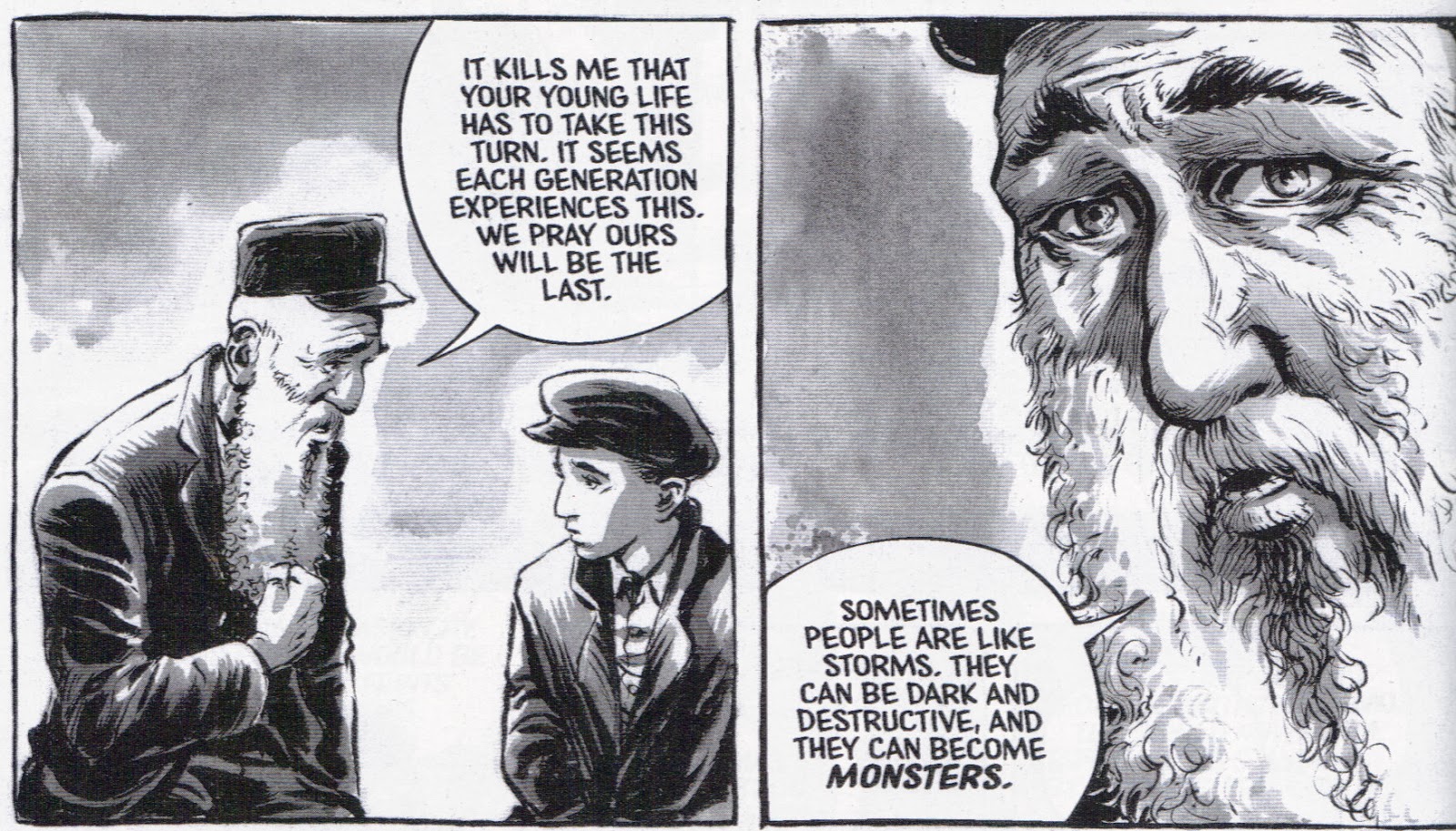
Though familiar with "Gollum", not a single student had heard of a "golem" before. Simply put (thanks to Wikipedia) "In Jewish folklore, a golem is an animated anthropomorphic being, created entirely from inanimate matter. There are many tales differing on how the Golem was brought to life and afterwards controlled." Like much of the smaller pieces of information I have trapped in my skull, the kernel of my own basic understanding of a golem was planted by my having read both books about monsters and things-that-go-bump-in-the-night as a child and from a healthy dose of comic books. Very recently there was a Dark Horse comics three issue mini-series that portrayed a fairly realistic depiction of that same creature, Breath of Bones: A Tale of the Golem.

Written by horror star Steve Niles (perhaps most well-known for creating 30 Days of Night to non-fanboys) and beautifully illustrated in blacks, whites and grays by Dave Wachter, when released, Breath of Bones came in under my comic book radar. I have made the mistake before of missing less heralded mini-series, and later being unable to catch up with them in single issues. Fortunately on this occasion, thanks to my local comic shop and a quick read of numerous glowing reviews, I was able to correct my error early on in the three issue run.

With the Nazi's closing in, grandpa and the townspeople get to work in Breath of Bones #2.
One could easily make the inaccurate assumption that Breathe of Bones is a rock'em sock'em historical super hero comic book, especially based on the beautiful covers to each of the three issues. While there is a tremendous amount of action therein, the slow burn toward the creature's reveal and origin suggests a classic monster movie. In a nutshell, from Dark Horse's own website, Breath of Bones is the story of a "giant clay monster from Jewish legend... on a Nazi-killing rampage in order to protect the inhabitants of a small Jewish stronghold and an injured British pilot." It is also a story of loss, both personal and that of innocence, sacrifice, and honor set against the back drop of World War II. Breathe of Bones is also a story about the power of storytelling, tradition, belief and family. Best of all is that there are Nazi's being pounded into submission by a monster...

From Breath of Bones #3.
Breath of Bones is a miniseries that inspires me to continue to promote the value of the genre as a viable and engaging (and teachable) text. Yes, while occasionally some works, most notably Art Spiegelman's Maus, reach a level of acceptability becoming "canon" of sorts, lesser known titles with content such as Breath of Bones would seem to be natural gateways to discussion in a variety of academic disciplines. Until then, I strongly recommend picking up the title either in individual issues (as is my collection mode of choice), trade paperback, or in the more recent beautifully executed hardcover edition. Unlikely to be read only once (or thrice) and relegated to your longbox or bookshelf, Breath of Bones is a title which bears repeated readings.