Showing posts with label Dark Horse. Show all posts

Monday, April 13, 2020

Read It: Gou Tanabe's At the Mountains of Madness

Intricately drawn splash pages add to establishing a tone of impending doom.
Gou Tanabe's graphic novel adaptation of H.P. Lovecraft's At the Mountains of Madness succeeds for two reasons. First, the manga takes a narrative that is familiar to many and makes it new, and, secondly, Tanabe deftly brings into the visual realm a novella that has, to this point, worked best in the imagination of the reader. Like most Lovecraft readers, I too, have read the classic cosmic horror story in multiple editions with a variety of well-written collection forewords, most recently At the Mountains of Madness: The Definitive Edition prefaced by an excellent introduction by China MiĆ©ville. It is difficult to discuss any version of At the Mountains of Madness without acknowledging the prior understanding (and bias) of readers as compared to those for whom this is a first time through the story.

Despite having read manga for 20+ years,
it always helps to have a reminder as
to how the panels flow, especially when
the story has multiple characters, each
of whom communicate via dialogue.
This graphic novel volume is the first of two, and serializes in short 5-7 page chapters the events of roughly the first half of Lovecraft's original text. Beginning with a prologue set in January 1931 (five months before the tale begun in Chapter 1), entitled "After the Storm," and concluding with "Chapter 12 Under Five-Pointed Mounds," The First Volume concludes on a cliffhanger with expedition team leader's, and Lovecraft's narrator Dr. Dyer, making the decision to "Fly to the Black Mountains!" The search for Gedney, the presumed lone survivor of the Lake's advance party, is where I would expect where The Second Volume  to pick-up. (I have yet to have acquired it as of this writing.)

As I read Tanabe's graphic novel, I felt as if was I was engaging the material for the first time. Tweaks to the story require those familiar with the original text to read and view the visuals carefully so as to not miss out on key character alterations. These changes deal primarily with the characterization of Dr. Lake, a Biology professor, and his relationship with geologist, Dr. Dyer. Perhaps I missed it in Lovecraft's story, but here it is very clear through the different visual depictions and interactions, that Lake, besides being the advance leader whose disappearance is the initiating factor for Dyer's deep trip into the mountains, is also intended to act as a more traditional antagonist or foil. Lake's unchecked ambition to push the boundaries of exploration are sharply contrasted by Dyer's more measured approach to the huge Antarctic undertaking they are mutually engaged in.

Tanabe includes quotes from both
historical and literary figures,
 including this rare color page
 acting as an epigram to Lovecraft's
story here.
It may surprise the new reader, especially given the obvious influences of the work on contemporary science-fiction and horror, how little the human parties actually engage with Lovecraft's cosmic creatures on the page. It is only half way through the text, with "Chapter 6: Elder Things," that a visual representation of the titular star-headed creature in fossilized form even makes its first appearance. Readers of cosmic horror don't come only to gawk at monsters though, and Tanabe's approach reflects this understanding. A modern reader unfamiliar with Lovecraft may expect more, but careful reading reveals that Tanabe has properly trusted his illustrations and storytelling to build suspense and sense of impending doom.

Beginning with the prologue depicting the remains of the original Miskatonic University Expedition led by Dr. Lake and "the manner and cause of their destruction" that Dyer and his team are seeking answers to. Using background setting and images that an organic, alien environment, not unlike that designed by H.R. Giger for use in Ridley Scott's classic film Alien (1979), Tanabe establishes a blend of natural and alien worlds. This effect is further reinforced through Tanabe's inclusion throughout of journal entries from a number of real-world explorers such as Captain James Cook. For the reader who hasn't experienced the source material, there is a subtle foreshadowing as to what to expect once this group enters the "Mountains of Madness." Once the eventual dissection  (desecration?) of a petrified Elder Thing by Lake, an act that is juxtaposed to that of the members of the first party by some heretofore unknown force, the tension amps up considerably.

With accessible language and excellent, detailed artwork, Gou Tanabe's graphic novel adaptation of H.P. Lovecraft's At the Mountains of Madness is an excellent way to introduce the young reader into Lovecraft's world. It's visual nature, as well as manga's increased popularity and acceptance among students of all ages, Tanabe's interpretation seems certain to entice the ambitious student to seek out other readily available Lovecraft horrors. (Gou Tanabe has also crafted a manga collection of the author's shorter works, H.P. Lovecraft's The Hound and Other Stories.) H.P. Lovecraft's At the Mountains of Madness would be a welcome and exciting addition to any high school library or reading list... if the adults involved dare to try something different!

Sunday, January 20, 2019

The Old Order Changeth!

My very first short box circa 1984... and yes I was the person who actually 
bought DC's Guy Gardner Warrior!
Some comic book collectors have spinner racks (lucky!) while others have beautifully designed shelving to display their collections. I am old school, and no carpenter, so even 40 years into my fandom, I still use long, and as I have become more "seasoned", primarily short, boxes for storing and organizing my collection. This requires quite a bit of space and, fortunately, we have a sort-of finished third floor attic where I read and store them with other collectibles.

Shazam! #1 variant 
cover by Gary Frank. 
It is during these winter months when we are "trapped" inside for the majority of the day that I will shift the organization of my collection. Often it is a change in publication the prompts a change, For example, DC's recently introduced Geoff Johns and Dale Eaglesham joint, Shazam! (2019, $4.99 per) title necessitates the movement of Jerry Ordway's incredible The Power of Shazam (1995-99, cover price $1.50 per issue) series into an active box. Though represents a significant departure from the characters as depicted in Power, with all pre-New 52 continuity erased, I like having access to previous narratives.

Conversely, the conclusion of the most recent Suicide Squad (Volume 5, 2016-19, Issue #1 was $2.99 and the final issue, $4.99) series means that title will shift to an "inactive" box, stored in the back part of the attic, until the teams eventual return to action. Then, once again, the old order will changeth!

Local comic book shops organize titles on the "New Releases" table, as well as on "Recent Releases" racks and their own "Back Issues" long boxes, first by publisher (Marvel, DC, Image, Dark Horse, etc.) and then alphabetically by title (Action Comics, Aquaman and so on). Decisions regarding the specific organization of titles in collections are more personal. When it comes to "Big Two" titles (DC and Marvel for the uninitiated), putting these titles by character families (Wolverine alongside Uncanny X-Men or Justice League Dark next to Justice League Odyssey). There are families in the smaller publishers as well, most notably (and expansive) the "Mignola-verse" titles from Dark Horse. These are comic books set in the world of Hellboy, a universe of titles created by Mike Mignola that includes Abe Sapien, Lobster Johnson, Witchfinder and many others.

Zeke Deadwood: Zombie Lawman 
cover by Thomas Boatwright.
Those smaller publishers beyond the Big Two, though given quality and quantity of titles it's past time to start thinking of Image Publishing as a "Big Three", are much more willing to take creative risks with creator owned titles, especially those in the Horror, Western and Science-Fiction genres. Because of this, many of my shorts boxes are organized alphabetically by genre families rather than publisher or creator.

For example, I currently have five boxes which are organized as "Westerns" that include a wide variety of characters from large and small publishers. This means that DC's Jonah Hex extended series (2005-10, 70 issues) is organized with the now-defunct Topps Comics Lone Ranger and Tonto miniseries (1994, 4 issues), IDW's 3 Devils (2016, 4 issues) and SLG Publishing's Zeke Deadwood: Zombie Lawman (2009-11, 2 issues) series of one-shots in my short boxes.

Interestingly enough, this brief post about organizing my comic books also has me organizing y thoughts. The inclusion of Zeke Deadwood among more traditional Westerns alone has me considering my next reorganization project to further disaggregating Westerns into a Horror-Western Mash-up section. That project, however, will have to wait for the next snowstorm...

Friday, February 24, 2017

Ballot Box & Long Box

As if our current political situation here in the USA hasn't created enough turmoil, NPR's new midday show, 1A, got me thinking about how my spending habits impact (positively or negatively) those who either support or oppose political parties/politicians. It was on my weekly drive to the local comic book shop for New Comic Book Day, that I listened intently as the host and guests worked through the question of "How does one respond to an administration that has no issue shaming corporation and businesses that express any disagreement with them?"

One of the guest reminded the listening audience of the Walter Reuther quote regarding the "direct relationship between the ballot box and breadbox."

Turning off the radio at the close of the interview, I headed into the shop wondering about who the publishers of my favorite comic books supported in the most recent election. The two most likely financial contributors of note would be those at the head of the Big Two, Marvel and DC. I recall hearing something in passing about an executive at Marvel Comics being involved with the Trump administration, but had not sussed out any particulars. Yet. Was there... or should there, be a direct relationship between the ballot box and the comic book long box? What practical impact would a potential buy-cott of  a company like Marvel whose chief executives contribute significant amounts of their personal financial gains (and therefore the money the consumer spend on the services provided) have? If I were to find out a Marvel bigwig was helping fund a politician I did not agree with, would my moral compass suggest I stop supporting that line and would it provide a meaningful enough message?

My initial thought is that the majority of artists (editors, writers, inkers, pencillers, letterers, etc.) in the industry, at least based on what can be inferred via Twitter, lean toward the more liberal side of the political spectrum. This group would include some of the most prominent Marvel creatives including Spider-man writer Dan Slott. My weekly pull sheet includes many titles that reflect my own (and presumably those of the creators) political leanings though such a factor has not always been a factor in my choices. (I do however purchase some titles that I don't outright "love" but recognize the need to support the artistic voice in the mainstream with my dollars.)

I am only a comic book fan with a very limited understanding of the industry beyond what can be gleaned though online reading and the tweets of a myriad of creators. (I do know that the "Marvel way" and "bullpen" was something of a ruse, albeit one I totally bought into as a youth: "Kirby, Stan and the crew hang around an office together goofing and making comics, right?")

So, what is "the story" with Marvel Comics and the 2016 Presidential candidate?

Last January, according to most news sources (whether the action was framed as a "good" or "bad" thing depends on the sources ranging from Breitbart to The Hollywood Review), "Marvel Entertainment CEO Isaac 'Ike' Perlmutter joined Republican presidential frontrunner Donald Trump by donating $1 million of his own money to America’s veterans on Thursday night in Des Moines, Iowa." (Breitbart) This was after first donating $2 million to Marco Rubio's during the primary season (THR). Following Trump's election victory, Perlmutter's wife was part of Trump's Inauguration committee.

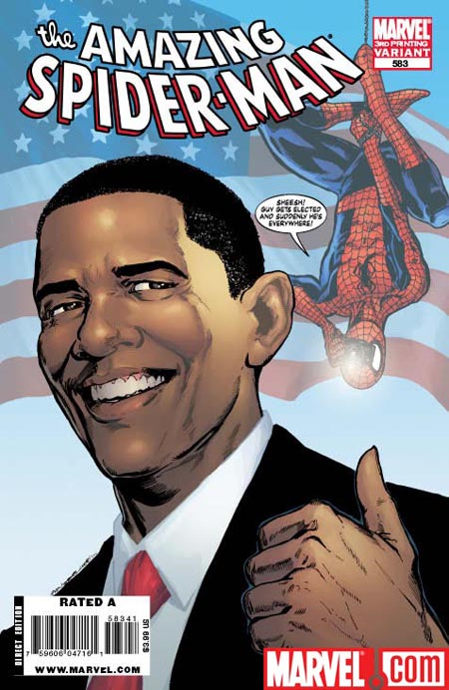
Despite this personal support of Republican candidates, Perlmutter's employer Marvel Comics has famously published reality "crossovers" that (at least superficially) are decidedly pro-Democrat. There are two obvious examples that quickly come to mind. Who can forget the Amazing Spider-man #583 variant cover that featured Spidey snapping a picture of President Obama? This stunt proved successful enough to warrant four reprint runs. More recently, issue Ms. Marvel #13 in which the book's protagonist, Kamala Khan aka Ms. Marvel, overtly throws her support behind Senator Clinton. In an unfortunate twist, the issue actually hit stands after Election Day. This is chronicled in greater detail in "Marvel Comics Superhero Uses Her Powers to Help Elect Hillary Clinton" (from an unbiased website who's mission is to "combat liberal media" so take that as you will).

Whether a calculated move for image purposes or (optimistically) because of the high quality of the product warrants it, Marvel has also been willing to publish titles reflecting a very clear political agenda. The most obvious recent example of this would be the cover to issue 8 of 2016's short-lived "ongoing" Mockingbird. (Ironically the last issue to be published as the book was canceled following it's publication.) It made quite a bit of news when the protagonist was featured on the cover wearing a t-shirt inviting readers to "Ask me about my feminist agenda".

The bottom line is while I like using my disposal entertainment dollars to be entertained, I also recognize to use these limited resources to support political/social perspectives with which I have agreement. Not buying certain comic books might make one "feel better" but ultimately only impact negatively those at the creative level. It is fair to suggest that this group includes many individuals whose ideals are consistent with my own and are giving larger voice to relevant issues.

Nothing is simple, even in the murky place where the worlds of lol it's and "funny books" overlap. The resolution to the decision of whether or not to buy-city is to remain vigilant in following the money in a way that works best for you and your conscience.

Saturday, October 15, 2016

Run Reader: Dark Ages (2014)

Capatin Hawkherst makes first contact in issue 1 of Dark Ages.
Long a sucker for genre mash-ups in both movies and comic books, Dark Horse Comics' 2014 four issue mini-series Dark Ages nicely scratches the itch by bringing together two of my fave genres, science-fiction and medieval action. Unaware of the title when it was originally published, I first came across Dark Ages on the back issue rack on a rare low new-release Wednesday.

Cover to issue 2 by
series artist
I.N.J. Culbard.
The creative team behind another excellent genre blending project, Vertigo's The New Deadwardians, writer Dan Abnett (of Marvel's Guardians of the Galaxy comic renown) and artist I.N.J. Culbard once again bring well-researched comic book action to the table. Set in 1333 Europe, an age during which God is feared and the violent skills of sell-swords are in demand, Dark Ages follows the conflict between medieval warriors come face-to-face with "demons." The twist is that the demons are not from Hell, as our character's assume, but rather alien invaders from space.

Utilizing a shifting pair of protagonists, Captain Hawkherst and his second in command, "Lucifer" Galvin, Abnett quickly establishes the world wary nature of our heroes. As Hawkherst explains, the group move from battle to battle thereby embracing the violence of their time as "A dark age [like] that will keep us fed and in steady employment. We would prosper in such an age." While Hawkherst hopes to respond to a potentially lucrative call-to-arms from French royalty, an impromptu invasion from outer space, ultimately set in an austere monastery comes calling first.

The conflict is ultimately joined on both sides by unique characters each reflecting clever twists on common genre tropes. The order of silent monks who populate the monastery are revealed to be harboring a secret understanding of what is happening, dead "rise" in support of the invading "devils," and an unlikely robotic ally (who also shares a name with an angel) keeps the proceedings fresh as all move toward a climactic final confrontation.

I.N.J. Culbard's clean and colorful artwork is very reminiscent of the style often employed to great effect in many of Dark Horse's Mignola-verse titles such as B.P.R.D and Lobster Johnson. In Dark Ages, the artwork helps to ground the intergalactic-medieval characters. After working similarly with the aforementioned New Deadwardians, Culbard, is one artists whose work I would add to my pull list sight unseen--there is a fun energy in his engaging style despite some occasionally heavy or morbid content.

Though some of the elements it chooses to mash-up, Dark Ages is incredibly well-executed and work as a self-contained action adventure sci-fi tale. Revolutionary twist and tuns are not always necessary. As a reader, sit is often enough to be drawn into a story well told (and drawn) with just enough variations on a standard (non-standard) story. Dark Ages is very likely still available in my preferred format (single issues) on your local comic shops' back issue rack in addition to being offered as a trade paperback through larger vendors.

From Dark Ages #3, the "angel" Aphrael explains to "Lucifer" their
 circumstances using spiritual tropes a sci-fi context.

Captain Hawkherst retruns, with cyber-enhancements, for the series' big finale.

Friday, April 01, 2016

Read It: Bran Mak Morn, The Last King

Title page with illustration by Gary Gianni.

Cover of 2005 edition
by Gary Gianni.
If you are unfamiliar with Bran Mak Morn, you are not alone.

While I have had the beautifully illustrated, by Gary Gianni, Del Rey edition of  Robert E. Howard's Bran Mak Morn: The Last King in my possession for a number of months, it wasn't until a six hour stop by the hospital waiting room yesterday that I let it take hold of me. It has been something of a circuitous journey to embracing this collection, but the wait was worth it.

Despite having previously read a number of Robert E. Howard's Conan the Barbarian stories, my only prior encounters with the Pict warrior was in a short comic book adaptation that appeared in issue #5 of the Dark Horse anthology Robert E. Howard's Savage Sword and as a topic of conversation in some deeper reading around the appearance of Cthulhu-elements in writers other than the H.P. Lovecraft.

Considerably less well-known than Conan the Barbarian, or even Solomon Kane, Bran Mak Morn is an especially unique Howard creation that came along late in his career as the culmination of a life-long love affair by the author with Pict history and culture. It is also in his Bran Mak Morn stories that Howard's friendship with horror icon, and contemporary, Lovecraft bleeds into his writing. A number of the stories that appear in the anthology  Bran Mak Morn: The Last King are also widely accepted as part of Lovecraft's larger Cthulhu mythos. In addition to the wonderful Gianni illustrations, this particular edition also features a fairly extensive Miscellnea complete with poetry and a draft version of arguably the most well-known Morn story, "Worms of the Earth."
Page 179.

Each story and poem presents an aspect of the titled character from a slightly different perspective, never offering a complete sense of the man in any single story. I am no expert (though after reading the informative intro by Rusty Burke, I wish I was) my guess would be that layered characterization was not one of Howard's primary goals. Each selection tells about Bran Mak Morn from the perspective of someone clearly other than Morn. For example, in "The Dark Man," Morn appears not as the Last King, but as a commemorative black stone statue imbued with the qualities of the man. The statue assists another combatant, Turlogh Dubh, by acting as a conduit to the Picts he, when alive, ruled. Perceived by the inanimate, and mystically charged, Bran-statue to be a "friend" of the Picts, Turlough is aided by the diminutive warriors in achieving his bloody goal.

"And now Bran was aware of movement in the gloom. The darkness was filled with stealthy noises not like those made by any human foot. Abruptly sparks began to flash and float in the blackness like flickering fireflies."  ("Worms of the Earth," page 113)

Two of the centerpieces of the collection, the aforementioned "Worms" and "Kings of the Night" deal with Bran's need to seek assistance in battling against his adversaries from the perspective of an omniscient third person narrator. Neither story, however, delivers characterization beyond the established mythic nature of the hero. The fact that our "hero" here seeks support in besting the antagonists is somewhat unusual though.

"I am John O'Donnel and I was Aryara, who dreamed dreams of war-glory and hunt-glory and feast-glory and who died on a red heap of his victims in some lost age." ("The Children of the Night," page 228.)

"The Children of the Night" alludes to Howard's  affection for Lovecraft's mythology, as well as his own scholarly interest in anthropology and mysticism. As seen in the quote above, the story is told from the first person perspective of a modern character, John O'Donnel. The protagonist, whose experiences travelling back in time, are intended to put the reader into the head-space of one who may have encountered the Picts personally. The twist at the end, thereby transforming him from protagonist to future antagonist, also suggests something ugly in our genetically based behavior.

In "The Dark Man," page 157.
I often tell my students that even when I read for pleasure, as is the case with this collection, it is difficult to turn-off my teacher-brain and consider how it might go over as a class read. Taken as a whole, Bran Mak Morn: The Last King reflects much of Howard's fascination with the power of one's genetic history, or race, a subtext which in modern times is rightly controversial. Without even considering the sword and sorcery violence inherent in most of the stories, this factor also makes the potential for its use in a high school literature class problematic without appropriate historical context. Within stories such as "The Children of the Night," first published in 1931, one character's appearance is described as clearly Asian, a look to which is ascribed terrible qualities (despite the narrator's repeated assertions that his appearance is a genetic anomaly.

I quite enjoyed the mix of short story and poetry, warts and all, as an introduction to this unique warrior archetype. A written by Howard this collection represents an intriguing mix of both horror and sword and sorcery tropes in a manner that is descriptive and, ultimately, extremely engaging.

Saturday, October 05, 2013

Read It: Breath of Bones

The calm before the storm in Breathe of Bones #1.
Responding to a prompt about revenge in class this past week (an activity for thematic background building during our study of Beowulf/Grendel's mother section of the epic poem), a student inquired as to the spelling of a character's name from Tolkien's Lord of the Rings trilogy: "Is Gollum spelled G-O-L-E-M?" This incorrect spelling of the ring-thirsty SmƩagol prompted me to ask if anyone in the class knew what a golem (G-O-L-E-M) was.

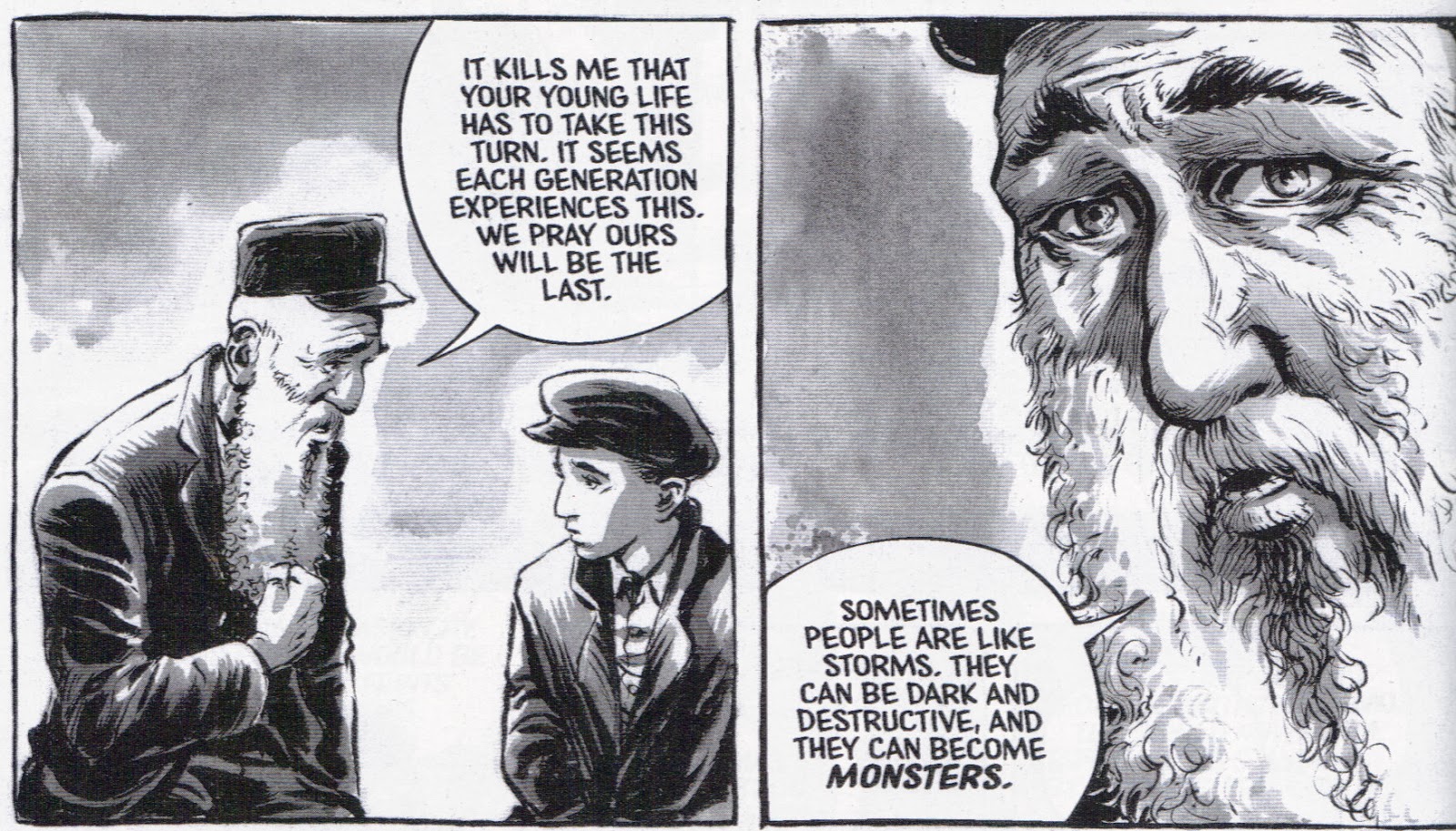
Though familiar with "Gollum", not a single student had heard of a "golem" before. Simply put (thanks to Wikipedia) "In Jewish folklore, a golem is an animated anthropomorphic being, created entirely from inanimate matter. There are many tales differing on how the Golem was brought to life and afterwards controlled." Like much of the smaller pieces of information I have trapped in my skull, the kernel of my own basic understanding of a golem was planted by my having read both books about monsters and things-that-go-bump-in-the-night as a child and from a healthy dose of comic books. Very recently there was a Dark Horse comics three issue mini-series that portrayed a fairly realistic depiction of that same creature, Breath of Bones: A Tale of the Golem.

Written by horror star Steve Niles (perhaps most well-known for creating 30 Days of Night to non-fanboys) and beautifully illustrated in blacks, whites and grays by Dave Wachter, when released, Breath of Bones came in under my comic book radar. I have made the mistake before of missing less heralded mini-series, and later being unable to catch up with them in single issues. Fortunately on this occasion, thanks to my local comic shop and a quick read of numerous glowing reviews, I was able to correct my error early on in the three issue run.

With the Nazi's closing in, grandpa and the townspeople get to work in Breath of Bones #2.
One could easily make the inaccurate assumption that Breathe of Bones is a rock'em sock'em historical super hero comic book, especially based on the beautiful covers to each of the three issues. While there is a tremendous amount of action therein, the slow burn toward the creature's reveal and origin suggests a classic monster movie. In a nutshell, from Dark Horse's own website, Breath of Bones is the story of a "giant clay monster from Jewish legend... on a Nazi-killing rampage in order to protect the inhabitants of a small Jewish stronghold and an injured British pilot." It is also a story of loss, both personal and that of innocence, sacrifice, and honor set against the back drop of World War II. Breathe of Bones is also a story about the power of storytelling, tradition, belief and family. Best of all is that there are Nazi's being pounded into submission by a monster...

From Breath of Bones #3.
Breath of Bones is a miniseries that inspires me to continue to promote the value of the genre as a viable and engaging (and teachable) text. Yes, while occasionally some works, most notably Art Spiegelman's Maus, reach a level of acceptability becoming "canon" of sorts, lesser known titles with content such as Breath of Bones would seem to be natural gateways to discussion in a variety of academic disciplines. Until then, I strongly recommend picking up the title either in individual issues (as is my collection mode of choice), trade paperback, or in the more recent beautifully executed hardcover edition. Unlikely to be read only once (or thrice) and relegated to your longbox or bookshelf, Breath of Bones is a title which bears repeated readings.

Monday, July 08, 2013

The Last of Us the First of Mine?


Historically, there is a long tradition of comic book tie-ins supporting popular television shows and movies. Sometimes they are "good," such as the current Django Unchained series being published by DC Comics, and sometimes, not so much. In the past fifteen years, there has also been a huge increase in video game tie-ins as well, some of which most mainstream gamers and comic book readers may not even be aware of. (For example, did you realize that Archie Publications has been publishing a Sonic the Hedgehog ongoing comic book since 1993?!)

As a comic book collector and gamer, sometimes these are worth picking up because of the additional narrative insight provided or simply because of the synergy between the two. The admiration of one does not necessarily lead to the collecting of the other; for example, while I enjoyed the Mortal Kombat-esque Injustice: Gods Among Us X-Box 360 game, (and a healthy appreciation of the updated character), I did not jump on board the comic book prequel which, like Django, is also a DC Comics publication.  (DC/Wildstorm had some success, I felt, with the recently concluded 24 issue run of Gears of War.)


Issue #3 cover by series artist
 and co-writer Faith Erin Hicks. 
I recently begin reading the four issue miniseries (of which issue three came out two weeks ago) The Last of Us: American Dreams, published by Dark Horse.  Co-written by the game developer's (Naughty Dog) creative director Neil Druckmann, this prequel to the highly lauded PlayStation exclusive game, The Last of Us, this four issue miniseries introduces a younger version of one of the game's main characters and establishes the narrative tone that is further developed in the game.

A game, regrettably, I may never play as I am an X-Box 360 gamer. But, if I play my cards right, The Last of Us may be the first of mine. The reviews for the game and the quality suggested by the comic book are so strong that I am considering greasing the skids with my wife to purchase a PlayStation unit, solely for the purpose of playing this game. (I have been fortunate that the better Resident Evil games have been re-worked for X-Box to this point, though there has been a wait.)

I have not previously seen the works of writer and artist Faith Erin Hicks, but she is clearly one of the creators I would now pick up at least the first issue of whatever she works on. While Hicks artistic style is clearly influenced my manga, it is not to the point where there is a "large eye" distraction--a pitfall other artists tend to fall into. The framing and execution of action "set pieces" is exquisite and worthy of multiple "re-reads." I intentionally placed "re-reads" in quotes as the series of panels in which these take place often are without words.

At a cover price $3.99, the color comic book (printed on high quality paper--unlike Marvel comic books), is a bargain, something that is not easy to type or say about much of what is published today.

Tuesday, May 14, 2013

Retro Gaming: Hellboy: Science of Evil (2008)


I can't recall wanting to like a video game as much as I had hoped to enjoy Hellboy: Science of Evil. A fairly recent convert to Mike Mignola's universe of characters (Hellboy in Hell, B.P.R.D., Witchfinder, etceteras.) published by Dark Horse Comics, and a fan of both films, I had not been aware of the previously released Hellboy movie tie-in console game.


When I came across a used copy for $9.99, I snatched it up, excited to get going. So excited was I that I did not even wait to spend the money to follow my traditional pre-purchase ritual of checking online reviews before plunking down $60 on an X-Box 360 game. This was an inexpensive used version, and was, after all Hellboy, so how bad could it me. It was only after returning home and checking online reviews that I became worried. Hellboy would appear to be a fairly reviled gaming experience. Really though, for the price, what did I have to lose?

Sometimes, reviewers are not that far off: as a gaming experience Hellboy: Science of Evil was incredibly frustrating, not just for what it was, but worse, for the potential it squandered.


Chances are great that if you're reading this, you are already familiar with the well-loved characters, and perhaps marginally curious if this game is worth picking up for a certain amount of "fan-factor", so I'll cut to the chase and simply start by mentioning positives and negatives as I experienced them:
  • Positives: the story adheres to both comic book and movie "universes," the voice work is done by the actor who portrayed Hellboy in the films (let's face it Ron Perlman, IS Hellboy!), the cut screen graphics are adequate and the characterization (movements and vocals) of Hellboy are solid.
  • Not-so-positives: repetitive game play, including some odd game play moments when jumps aren't jumps or necessary objects or paths are off screen and difficult to find, the game play is not very intuitive, repetitive game play, the other characters from the book/movie are missing from the main story (though appearing on the box), this lack of playability of other characters makes the gameplay even more... repetitive.
There are also the standard (for older-generation games) dissolving rocks and melting set pieces, ghost graphics and dead spots. The game play was VERY frustrating and were it not for a gamefaq/walkthrough, I would have given up on this game after the first chapter during which it was impossible to figure out just what I, as the player, needed to find to move onto the next chapter.

Say "goodbye" to the only video game I've ever "walked out of" before it was over...

Sunday, November 25, 2012

New Releases: The Goon #43

From "Billy the Kid's... Oddities," written by Eric Powell with art by Kyle Hotz.
Month-after-month, few comic books with a "standard" price of $3.50 pack as much into a single issue as Dark Horse Comics The Goon. This most recent issue, released this past Wednesday, November 21, is a primary example. Whereas most mainstream books published monthly will include anywhere from 16-20 pages of new content, artist/writer/creator Powell manages to produce no less than three stories in twenty-three pages (each of varying length, but consistently high quality).

Cover by Powell.
Each of the stories, all (at least) written by creator Eric Powell, build on the Goon mythos in such a way that one of Powell's other projects, Billy the Kid's Old Timey Oddities, is seamlessly brought into the same "world" as Goon and his partner Franky. As any fan would not be shocked to know, it is a misunderstood "freak," The Ossified Baby of Nuremberg, that connects these characters together. Taken as a whole, there is an implied symmetry to the stories: first is a Billy solo, the second features both Billy and Goon, and finally a penultimate Goon solo story.

The issue's first story is the Billy the Kid one, and it introduces the reader to the aforementioned Ossified Baby. (For those who enjoy this issue of The Goon, Powell and co-creator Kyle Hotz--who also provides artwork here--recently began the third miniseries of miniseries featuring  Billy and his gang, Billy the Kid's Old Timey Oddities and The Orm of Loch Nes.) The four pager serves as an introduction of sorts to both Billy's world and the Baby, closing with the ominous words "Thank the Dark God. Our burden has been lifted."

From The Goon #34 by Eric Powell.
The second feature is the primary one and features not just Powell's writing, but his gorgeous artwork (here colored with assistance from Bill Farmer). It is here that Goon and Franky cross paths with Powell's other comic book partnership, Billy and his diminutive colleague, Jeffery.  Both characters draw energy, and narrative drive, from a strong relationship with carnivals and freak shows, a dynamic that Powell uses to great effect in both books as a spring board for many unusual adventures which defy the time periods in that each book is anchored (sort of). It goes without saying that when Sproules Biological Curiosities & Wild West Extravaganza rolls into the Goon's town, the "Giant Stone Baby of Nuremberg" has somehow been returned to the groups slate of attractions and things are sure to go astray and snowball quickly... and they do. One of the many pleasures of this story in particular is having the chance t see Powell draw Billy's crew. While Holtz's style perfectly suits the dark and dank adventures Billy experiences in his own miniseries, the cleaner ("brighter"?) palette of Goon's world suit both the story,and the character's experiences within it, very well.

Many is the day I've thought this same thing... art by Mark Buckingham
The issue's final story is the concluding chapter of a three-parter that has run as a backup over the previous two issues of The Goon, entitled "The Bog That Lurked Like a Thing! A Bad Thing!" Drawn by Mark Buckingham, in a style very reminiscent of Powell's, this black and white (more of a gray and white, really) wraps up with someone getting smacked in the face with "a $#!T stained street urchin"... 'nuff said!

Though it's been out for a few days now, when you find yourself back at your local comic shop this coming Wednesday, you could do mu-u-u-uch worse than to make issue 43 of The Goon your first!

Tuesday, September 25, 2012

NBIM Day 25: Terror Of Godzilla #4 (1998)

Another staple of most good Godzilla vehicles: goofy comic relief characters!
Nothing quite makes up for a challenging day at work better than coming home to a UPS delivery of back issues ordered via Internet. Yesterday afternoon's delivery also doubles as today's National (Comic Book) Back Issue Month suggestion: Dark Horse Classics Terror of Godzilla #4. Published in 1998, this Dark Horse Classics is actually a recolored reprint of an original translated Godzilla manga first published by Dar Horse wa-a-a-y back in 1988, ten years earlier. The new release features a brand spanking new cover by comic book legend Arthur Adams, who, in my short time collecting Godzilla comic books, I've come to realize is something of a "go-to" Godzilla cover artist.  But, more on that later...


Arthur Adams kaiju goodness!
Dark Horse Classics Terror of Godzilla #4 features story and art by Kazuhisa Iwata, a writer who seems to get that Godzilla works best both as a plot device to tell the stories of other (human) characters and as a character himself. More  recent iterations of the big green lizard seem to emphasize one or the other, and are noticeably weaker for the missing half.

Here, Godzilla is destroying Tokyo, and the military resorts a "secret weapon" in an effort to defeat him: the Super X. The Super X amounts to a pimped out space ship[ run by the government, designed with the purpose of knocking the Big G back into dreamworld.While this issue is number four in a six part mini-series, the single issue reads well, though the cliffhanger ending (spoiled by the cover) does leave the reader (me!) wanting more.

I first came across Art Adams' Godzilla renditions on the covers of the recently concluded IDW  Godzilla Legends (2011) miniseries, and going backwards in puchasing related titles have sampled some of his work for later original Dark Horse Godzilla titles. I would have to concur with the sentiments of Toho Kingdom when it comes to Adams' Godzilla artwork: "As far as American Godzilla comics go, Arthur Adams may be the best artist at bringing Godzilla to life. His hyper-detailed work has inspired many, and due to its astounding accuracy and passionate awesomeness..."

With an original cover price $2.95, a copy of Dark Horse Classics Terror of Godzilla #4 can set you back anywhere from $6-2 depending on the quality you seek.

Sunday, September 16, 2012

NBIM, Day 16: Sock Monkey (1998)

Clean line work + formal, anitquated dialogue + a delusional pair of stuffed protagonists = Comic Book Gold.
There was a period of time that, as a comic book collector, I became very disenchanted by the product that was being churned out by the big two (DC and Marvel) publishers, and as result, turned to small press comics for my graphic story jones. During this time I also became much more enamored of comic book stories that didn't necessarily deal with super heroics, but rather with the common place doing heroic things. Enter: Sock Monkey.


"A Comical Adventure."
Written and drawn by Tony Millionaire, Sock Monkey follows the adventures of Uncle Gabby, the stuffed animal of the title, along with his friends, most notably the hard-drinking toy crow, suitably named simply Mr. Crow. In this first issue, together the two try to reach the "castle in the clouds" that Uncle Gabbey comes across in the library of the New York brownstone in which he somehow resides.

Though the protagonist and his world, on the surface, suggest a quaint all-ages book, things are not as they seem. As Uncle Gabby and Mr. Crow make a variety of attempts to reach the "Elysian fields" high above the room, they find themselves moving closer and closer to peril and doom. Much of their interaction with one another and the others who inhabit their world (ants freed from an ant farm, real crows who mock the artificial Mr. Crow) lead to nihilistic ends. Despite the attractive, neat black and white line work, and antiquated gentlemanly character dialogue, the darkness of the world cannot be stopped from creeping in. Even the subtitle on the cover declaring this "A Comical Adventure" is something of a misnomer--there is fun and adventure but the comedy is dry and requires deeper reading.

Wrapped in a pretense that suggests "children's book," on a deeper level, it really is more mature in its narrative. But like much good entertainment (Family Guy, and in years past The Simpsons), Sock Monkey works on both levels and would seem to have some entertainment value for even the youngest reader. One may want to assure younger readers, though, that the issue's conclusion, which implies a rather permanent end for our "heroes," is somewhat mitigated with the subsequent publication of two issue miniseries featuring the same cast of characters.

All three Sock Monkey series, as well as one-shot graphic novels, are very likely available in the deepest bowels of your community's most established local comic shop, as well as being available for purchase online in trade paperback or single issue form.

Friday, July 20, 2012

Comic Book Finds: The World Below (1999)


For your viewing pleasure, page 11 from The World Below #1 by Paul Chadwick and Ron Randall.
With the recent publication of Concrete: Three Uneasy Pieces (itself a collection of recent short stories from the most recent edition of Dark Horse Presents), it seemed like a great idea to dig back into the old lonboxes and revisit a long forgotten duo of mini-series from multiple Eisner and Harvey award-winning writer and artist Paul Chadwick. While Chadwick is most well-known for his Concrete series of stories, and more recently for his work with the online game based on the Wachowski Brothers Matrix trilogy, The World Below is one of the very few creations I came across (apart from some Deadpool issues he illustrated for Marvel) that Chadwick has seen reach publication other than Concrete.

It doesn't get anymore old school sci-fi
than giant alien head attachments.
(From the cover of Vol. 2, Issue 2)
On the surface, World Below is less overtly political than his Concrete work, initially reads as an homage to the Silver Age sensibilities of DC's Challengers of the Unknown. A team of six explorers (dubbed... wait for it... "The Team of Six") travel below the earth's crust via a sinkhole through which  millionaire businessman Charles Hoy had previously discovered a mechanical creature, the inner workings on which he based a lucrative technology business. The patent well (and therefore his money) having gone dry (and most of the "discoveries" having been replicated by Microsoft) from the initial machine creature, he sends the team down to bring back more organic-technology so that he may exploit it for profit (maybe this is not as apolitical as I originally thought!).  And so began what would ultimately be an eight issue run, consisting of two separate four issue mini-series, that comprised all that would see publication from the World Below.

Like many old school sci-fi/adventure stories, the Team of Six follows Star Trek's United Nations rule of team building by including a diverse group of men and woman from a variety of different ethnic and career backgrounds. Each also has something to prove to themselves and to the team. If the set-up sounds like a television pilot, you're not too far from the narrative structure which includes flashbacks (each issue begins mid-action then works forward from an earlier starting point).

The Team of Six are a veritable United Nations of scientific research teams.
Not surprisingly, given the subterranean setting, Chadwick creatively brings a balanced approach of creepy and strange to his character designs, often beginning with a reader-familiar basic design (for instance, a boomerang) and tweaking it slightly to give it a unique appearance ("the flock" of techno-creatures that terrorize our protagonists in the premier issue and as seen on page 11 above).

Some interesting choices are also made by Chadwick in transitioning from the first to the second series. One artistic flourish that began with Issue #3 was the inclusion of word balloons on the cover. During the late Nineties, many mainstream publishers were moving away from the more classic approach to cover design where an important scene of character interaction was teased on the cover. Chadwick's design for The World Below would seem to have flown in the face of this movement, and I for one was glad to see this--and wish that more publishers even 14 years later would revisit the practice.
Volume 1, Issue 4.

A fairly significant artistic decision was made between the first four issues and the second four issue miniseries which carried the subtitle Deeper and Stranger: gone were the vibrant color interiors replaced with black & white with gray tonal work, a style also employed in some of the Concrete series. Perhaps given the darker tone of the narrative, that dealt with the explorers quest for the origins of the World Below, and to better reflect the psychological elements which came to the forefront in the second four issues. Chadwick's decision to go with the more effective (when judiciously used) stripped down approach, predates it's more modern use that collector's will recognize in the wildly successful of Walking Dead series.

Of course, the conclusion to the series (a downer I won't spoil here), brings what appeared on the surface to begin as a comic booky exploration into wonder full circle to what Chadwick does best--(mostly) subtle political commentary. With a conclusion that would make Rod Serling proud, and squirm, as with all good serials though there remains the (extremely slim and as yet unrealized in publication) potential for a rescue team...

I recommend the entire eight issue arc as both an interesting source for analysis, and, more importantly, as an entertaining take on some familiar sci-fi/adventure comic book tropes. Both World Below and  its follow-up World Below: Deeper and Stranger are likely available at your local comic shop for cover price ($3.99 an issue), or if absolutely unable to shop a lcs, online at any number of back issue outlets.