Showing posts with label Gold Key. Show all posts

Monday, October 12, 2015

Horror Comics Cavalcade: Grimm's Ghost Stories (1975)

From the opening story of Grimm's Ghost Stories #27 (1975), written by
Arnold Drake with art by Frank Bolle. 
While recently scrolling through some previous posts, I came to the startling realization that I have unwittingly become something of a horror comic book fan. Like most fiction genres, what actually makes a comic book "horror" is up for debate. Some are titled using traditional horror keywords such as ghost, haunted house, or vampire, while others feature protagonists that utilize supernatural power sources such as magic. Still others are licensed, for the purpose of presenting tales of horror by iconic names associated with scares such as Karloff, Lugosi and Lovecraft. During the month of October, in addition to reposting earlier reviews, I am going to make my way through select titles from my back issue longboxes that fit (however sloppily in some cases) into the horror genre beginning with Gold Key Comic' Grimm's Ghost Stories.

Grimm's Ghost Stories #27
(1975) published by Gold Key.
As a youngster I remember seeing numerous Gold Key titles for sale on spinning racks at our local convenience store. Regrettably (now), I never picked up any because they lacked that thing young-me felt was integral to comic books: superheroes. Now older and wiser, I see the error of my ways and have fortunately been able to revisit many titles due to the kindness of friends cleaning out their attics and basements. Today's copy of Grimm's Ghost Stories #27 came to me in a shopping bag of old comics that had zero financial value but have allowed me that opportunity to repent my past reading sins (slightly). The 25 cent cover price provides proof enough of the issue's 1975 vintage.

Anthologies such as Grimm's Ghost Stories are a staple of the horror genre, and like others such as Creepy and Erie, each of Grimm's tales of the supernatural are "hosted" by a spooky character, in this case a long haired witch who goes by the moniker Hephzibah Grimm. (You, like I, may have initially assumed that the Grimm surname was meant to suggest the two German brothers... we're both wrong.) Hephzibah, like all ghoulish hosts, offers witticisms as a framing device for each. Perhaps unsurprisingly, the majority of stories are set in, or include significant elements of, Gothic Romantic time periods allowing for the art to easily evoke a moody, scary tone.

Issue 27's four stories of 5 to 7 pages in length each, are divided evenly between two writers, Arnold Drake and Paul S. Newman. The issue opens with both Drake's stories:
  • "Silver From A Dead Man's Eyes" written by Arnold Drake and with art by Frank Bolle, at 7 pages, is the this issue's lengthiest story. At least in death, Le Comte de Savonelle is a generous man, or so the servant who takes the two silver coins from the dead skinflint's eyes pre-burial suggests. Two lesson's are taught in this ghoulish story: 1) an eponymous truism about stealing and 2) making deals with the spirits of dead mean, rich people is not a recipe for financial stability!
  • Manny's ghostly deceased  uncle proves to
    be wa-a-ay cooler than your ghostly
    deceased uncle!
  • "Cry Uncle" written again by Arnold Drake with art by Ed Robbins is the story with the most modern setting setting, taking place in Southern California of the Seventies. This story also features a decidedly Mexican flair as the lead character, Manuel Cruz-Santos, uses phrases like "You loco?" and refers to his recently murdered uncle as "Tio Juan." When Manny is believed to be a suspect in the murder, only his uncle can save him... from beyond the grave!
While Drake's second story is set in a modern (by 1975's standards) locale, both Newman's feature strong Gothic elements.
  • Teased on this issue's cover, "Music to Die By" features art by Jose Gual. Though set in contemporary America, the "country home of an English associate" locale means, of course, there are Victorian British ghosts, too. Here, the ghost in question enjoys alarming people first with her beautiful spinet (kind of an old fashioned piano by the looks of it) music and then by disappearing. A common trope in horror stories is the discovery that the ghost may not be so guilty, a non-twist that plays into the proceedings. In a story with ghost musicians, rich British baddies and instrument tuners being hung, it is weird that perhaps the most chilling line of dialogue in this tale is delivered by the military police at the conclusion: "He fired first and missed! I didn't!"
  • "The Queen's Image," with art by Oscar Novelle, is the most genre-tweaking story of the four. Not only does the story include fictional Queen Margretta's ghost, but also the revelation that the ghosts walks the earth while Margretta is alive!
With an average of four stories per issue, I am always amazed at just how many horror anthologies reach publication. At some point there are few new stories to tell, so the issue of quality frequently lies in the execution of storytelling. As horror comics go, Grimm's Ghost Stories issue #27 was pleasantly entertaining, though not very scary (come to think of it though, fear as an emotion is difficult to evoke in this art form). Perhaps the appeal of horror comes from its sense of timelessness. Given it's reliance on using a predominately history laden backdrop, horror comics age surprisingly well; other than a few hairstyles and fashion trends, all four tales of suspense in this issue could easily be published in a modern comic book anthology and appear contemporary.

Happy reading!

Hephzibah's advice still rings true: always leaves them laughing... HEE HEE!

Wednesday, November 06, 2013

Comic Book Beard: Mighty Samson

Far left: Mighty Samson #2 (1965),
Middle and Far Right: Project Superpowers #4 (2008). 
Finding comic book characters with beards is not as easy as it sounds. In an effort to avoid posting only a variety of poses and iterations of the same two to three characters commonly shown bearded by the Big Two (DC and Marvel), I find myself digging very deeply into my collection (and memory). In addition to simply showcasing a whiskered warrior, it is also an opportunity to revisit some characters of yesteryear who may not get as much recognition on the recent "New Releases" table as he may once have. Take Mighty Samson, for example.

Cover to Project Superpowers #4
(2008) by Alex Ross.
Cover to Mighty Samson #2 (1965),
no art credits given.
Originally created wa-a-a-ay back in 1964 by writer Otto Binder and artist Frank Thorne to be a member of Gold Key Comics stable of characters, my own introduction to Mighty Samson came from the considerably more recent  2007 Dynamite Entertainment series, Project Superpowers. Project Superpowers, from artists Alex Ross, revived many Golden Age comic book characters. The visual design of the character was inspired by the Gold Key Comics version from the mid-Sixties. Less well known than other more iconic Gold Key comic book characters then and now, Mighty Samson's lack of name recognition outside a small group of fans is best attributed to the absence of any licensing featuring him to other media; he has never appeared on television, in theaters, or as an action figure.

A beardless Mighty Samson
attempted a comeback in 2010
lasting 4 issues.
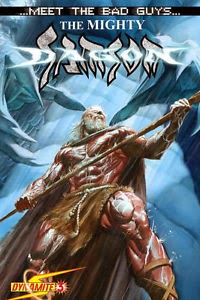
Mighty Samson as rendered
on the cover to SuperPowers:
Meet the Bad Guys
#3 (2009)
by Alex Ross.
Despite simplistic "costuming," Mighty Samson has a unique (in comic book terms, anyway) "origin." With no secret identity, Mighty Samson is a direct descendant of the biblical figure. Like his ancestor, Samson had immense strength and endurance, but could lose his powers when his hair was cut. Samson only learned about his heritage when he was a grown man, after his mother revealed his ancestry.

The Project Superpowers character (an amalgam of both Gold Key's and the even older Fox Feature Syndicate version) was the first time he is depicted with a beard. This is an older, more experienced (and completely--not just his left eye--blinded) version of the character who's beard is used to reflect the wizened perspective. As was the case with the majority of Golden Age characters re-introduced to the comic book collector with both SuperPowers' series (as well as one-shots and minis), Mighty Samson was rarely afforded the narrative spotlight but was more often than not used as background fodder. This is not to suggest the characterization was weak, just that here were so many characters vying for time in a book featuring over twenty Golden Age superheroes in any given issue.

As uncommon as unshaven super men are in comic books now, it makes sense that those published during the Golden Age would be even less likely; the negative association attributed to those with beards (as well as the adolescent comic book fans' inability to emulate any whiskered favorite character) would make such a characterization nuance difficult to make profitable. Perhaps someday, as the no-shave aesthetic becomes more mainstream, the comic book world will be ready for the first full bearded superhero!