Showing posts with label icon. Show all posts

Monday, April 06, 2020

Poem du Jour: "Old Fashioned Spaceman"

From Leonard Nimoy's poetry collection Warmed by Love,
published by Blue Mountain Press in 1983.
Apologies for slacking, but here we are already six days into National Poetry Month 2020 and I have yet to post anything. Fortunately, this error is easily rectified by digging deep into my book shelf for a poem by recently departed Star Trek actor-director-poet Leonard Nimoy.

"Old Fashioned Spaceman" is fairly representative of the collection as a whole: Nimoy's style is free form, devoid of traditional  punctuation, with occasional rhyme, and frequently self-referential. There are few writer's who can use their own careers, especially an iconic character initially brought to life on a television screen, as a means of providing cultural allusion ("logic"). As we know, though, Leonard "Mr. Spock" Nimoy was not your normal cat.
The typography and publishing elements in this collection (gold hues, New Times-Roman font, bright, chalky strokes of color) strongly suggest the Vintage Hallmark poetry editions sold at the greeting card shops of my youth. These volumes, and my weekend evenings watching Star Trek, represent the breadth and depth of my youthful poetic experience. The warm traditional presentation (the very pleasant and joyful headshot of Mr. Nimoy on the cover for example) occasionally comes into contrast with the cold (logical?) tone established in the lines of poetry. One could interpret this contradiction and  of publishing style and content to reinforce the conflict Nimoy himself once felt about his association with the character.

My hard cover of Warmed By Love is a gift from many star-dates ago, so I am unsure whether it is still in print. If you do happen across it, I recommend picking it up as it is very readable, and worthy of some consideration beyond the kitsch value. Of course my own appreciation of Mr. Nimoy's poetry may be because I, too, often feel like an "old fashioned spaceman."

Sunday, October 06, 2019

Horror Comicbook Cavalcade: Bela Lugosi's Tales From the Grave #1 (2010)

Clearly a labor of love, Kerry Gammill (as publisher, editor, writer and artist ) is all over
Tales From the Grave from the first pages.
Released in 2010 by now-defunct independent publisher Monsterverse, Tales From the Grave #1 is an old school horror anthology of stories in the classic horror comics tradition. Each story is presented by a fictionalized version of late horror film icon Bela Lugosi with assists from both his loyal (and intellectually dense) assistant, Hugo, and a sexy Elvira-esque vampire femme fatale, Nosferina.

Issue #1 cover credited
to Basil Gogos.
The first of five individual issues was released in 2010.Worthy of its hefty cover price of $4.99, Tales From the Grave delivers eight stories of varying length, utilizing a wide variety of artistic styles (including one "photo strip" featuring Lugosi and Tor Johnson action figures). Back matter consists of a collection of artist renditions of Lugosi as his most famous screen character, Dracula. Among the artists providing story and art is veteran comic creator (and personal favorite), and Monsterverse publisher and editor-in-chief, Kerry Gammill.

My own appreciation of Gammill's work began, during the hey-day of my Superman comicbooking, when he shared cover pencilling duties on Action Comics with George Perez, eventually taking the role over fully with issue around issue #565. Gammill's efforts produced some beautifully classic cover work vaguely reminiscent of the zany late 1970's runs and included the "Reign of the Superman" arc featuring the Super-stand-in who would later become the Eradicator.

Gammill's story (the first panel of which is posted above) "Unpleasant Side Effects" is book-ended in Saturday Monster Matinee fashion by Lugosi. More playful (and little "gross") than scary, it is an effective and entertaining romance, the quality of which is elevated by Gammill's pencils.


Each subsequent story, such as the Western themed "Eyes of the Prairie" by Derek McCaw and Rafael Navarro, follows a similar structure. Lugosi creeps around the corners teasing the bad things to come and returns at the narrative's conclusion to tie up loose-ends before riding of into the sunset.

What would old fashioned horror be without a little (tame) cheesecake?
It's really only in the latest "edition" of Lost Lugosi's Film Theater (teased above by Nosferina) that our star takes an active role in the story, playing his second most familiar film role, evil scientist (or "white Haitian voodoo master" as in 1932's White Zombie). Of course, it wouldn't be a Lugosi project without at least a mention of Dracula, and this fanboy need is very nicely met by the inclusion of an informative text piece by eminent Lugosi scholar and author Gary D. Rhodes.

A very entertaining piece of horror-comedy-nostalgia comic book creation, Bela Lugosi's Tales From the Grave #1, which was published in October 2012, was followed up five months later with the publication of the equally enjoyable issue 2. Both issues are very likely still available for purchase in your local comic shop and make for fine Halloween reading.

Since the post was originally published in October 11, 2012, four issues of Bela Lugosi's Tales From the Grave have been published. Each is consistently entertaining and follows the same corny, scary, goofy and high quality established by the first issue. Issue 2, published in 2013, also features a very cool cover painting by practical effects god Rick Baker, re-envisioning Popeye the Sailor as something a little more... evil. Seek it out--if you dare!

Tuesday, August 02, 2016

Summer Reading: The Cursed Earth Uncensored

Cover to 2000 A.D. Prog 85 by Mick McMahon.
Despite Judge Dredd having been part of the comic book culture for the entirety of my collecting life, I've never actually read a comic book featuring the post-apocalyptic law enforcer. Like most, my experience with the character has been limited to the two movie adaptations, the inferior 1995 Judge Dredd starring then-action star Sylvester Stallone and the superior Dredd (2015) featuring Karl Urban.

Cover by artist Brian Bolland.
Even after two Hollywood movies, Judge Dredd remains a mystery. He remains a unique figure in comic books because, though first appearing in issue #2 of 2000 AD (1977), it is possible to understand his motivations without the necessity of reader awareness of an origin story. Without the understanding that Kal-El is the lone surviving alien of a dead culture sent to Earth or that Bruce Wayne saw his parents murdered, those individuals could not become the heroes they are destined to become. Not so with Dredd. Knowing how Dredd became a judge is completely unnecessary; all that one really need to know about Judge Dredd's motivations is captured in both his job title and catchphrase: "I am the Law!"

Last week, I came across an online article that motivated me to pick up a recently published hardcover graphic novel collecting one of Dredd's more popular story lines, The Cursed Earth. Not only does this story arc illustrate the key qualities of its lead character, but it also serves as a legendary historical artifact which, in its entirety, has long been out of circulation. As a result. The Cursed Earth Uncensored, published by 200 A.D., offers insight into what was deemed controversial in the late 1970s, a status achieved here not because of violence, explicit language or sexual content, but due to its potential offense to global corporations.

Postergraph by Bolland featuring Dredd
and two key Cursed Earth secondary
characters, Spikes Harvey Rotten and
Tweak.
The stories collected therein are credited to writers Pat Mills, John Wagner and Chris Lowder with art provided by Mick McMahon and Brian Bolland. Bolland also drew the original 2000 A.D.  covers, each of which is included in a gallery along with some pin-ups, here deemed "Postergraphs". As shared in the Bleeding Cool article which prompted my purchase: "Published in 2000 AD in 1978, The Cursed Earth ... ran into trouble when two episodes – ‘Burger Wars’ and ‘Soul Food’ – featured parodies of Burger King, Ronald McDonald, the Jolly Green Giant, the Michelin Man, and a number of other prominent corporate characters in a raucous and shameless satire of American consumer culture. After concerns of legal action at the time the then publisher IPC decided collections of this classic strip would omit the satirical stories." Until now.

Suitably, as a "satire of American consumer culture," the story relies on a timeless American literary trope for structure, the road trip. The narrative context of our hero's journey across the radioactive region of America that separates Mega City One and Mega City Two on the West Coast, the eponymous "Cursed Earth", is Dredd's mission to transport an important vaccine from One to the other. Because the original source of the story, 2000 A.D., is an anthology each of the 25 episodic chapters is only 6-8 pages in length. Only the covers and splash pages are colored, resulting a story visually told in black and white.

Among those joining Dredd on his mission of mercy are criminal punk biker Spikes Harvey Rotten and Judge Jack, who are later joined by Tweak, a seemingly unintelligent rock-eater from another planet with a secret. While Dredd is clearly at the center of the story, these three secondary actors each have individual character arcs. The most dynamic of these are the stories of Spikes Harvey Rotton and Tweak, whose fates become intertwined as the crew makes its way across the Cursed Earth.

From Chapter 11 written by
Pat Mills with art by
Mike McMahon.
On their journey, Dredd and his crew become embroiled in a series of conflicts with a menagerie of characters. Among these are a pack of post-apocalyptic dinosaurs led by the vicious tyrannosaurus named Satanus, murderous robots ("meks") left over from a bygone age programmed to destroy all Judges, and the aforementioned, controversial Burger Gangs, led by Ronald MacDonald and the Burger King. Through each adventure, Dredd remains steadfast in his goal, but is always willing to deviate in the interest of upholding his guiding principle of law and order. By returning to the core of the character, each of the three writers take advantage of the opportunity to further reinforce the humanity behind the helmet as Dredd often course-corrects his comrades desires to simply move one from the problem. Despite his willingness to violently uphold the law, it is clear that Dredd is a good man who seeks to see the law as he sees it equitably distributed to everyone regardless of their status (or state of mutation).

Even more than the controversial chapters that have been returned to their places in this uncensored edition, this character trait that most subtly satirizes the American culture. While the once "lost" battles between Dredd and Colonel Sanders doppelganger Doctor Gribbons, Ronald MacDonald and the Burger King take overt shots at consumerism, the smaller moments better reinforce the point. The value of The Cursed Earth is perhaps clarified on some level through these stories inclusion, but the power of the satire is not necessarily diminished through their priro exclusion.

Judge Dredd, The Cursed Earth Uncensored is a beautiful hardcover collection with a new introduction by two of the original writers and a gallery of covers and Postergraphs. While not inexpensive at $35 U.S., it is certainly worth the price for those interested in banned books, post-apocalyptic science-fiction or satire. As an introduction to the world of Judge Dredd, this collection is a strong, effective primer.


Sunday, December 27, 2015

The Call of the Wild, Chapter 1

Yes, this is the same page as was tweeted--scroll down for another!
In the spirit of solidarity, just as I've assigned by eleventh graders to read (or re-read) and annotate Jack London's The Call of the Wild, I, too, have committed to doing the same. When I mentioned in class that I would tweet out my own annotations from the novella (doing what it was I was asking of them), one bright star said, "Does that mean we don't have to it ourselves?" Not quite. The hope is that by sharing what I saw it might spurn the student lacking the desire to be motivated to make their way through the book, too. And maybe even enjoy it in the process!

The edition I am using (and writing in) a Dover Thrift Classic which was purchased when another class of mine (many years ago) participated in The Big Read working with the same title. Most of my students are using old, hard cover copies from the mid-1980's and using post-it notes to make similar observations regarding writer's craft including syntax, diction, tone and figurative language, among others. I've read The Call of the Wild, and my annotations are by no means complete...


Friday, December 25, 2015

Accepting The Call For the First Time (Again)

The Call of the Wild begins with an unattributed epigraph:
the first stanza of "Atavism," a 1902 poem by John Myers O'Hara.
Two weeks ago, in anticipation of our impending seven-day break from classes, I asked my Advanced Placement students if any of them had a favorite book that they enjoyed re-reading for fun. The few that did, mentioned the titles that one might expect from normal eleventh graders: titles from any number of popular young adult franchises such as Harry Potter, Percy Jackson and the like. It was then that I hinted at the possibility of my asking them to read (or in some case re-read) a short novel that I enjoyed revisiting during break that they too may have become familiar with from middle school, The Call of the Wild by Jack London.

Though I teach high school English, and the reality that The Call of the Wild is firmly ensconced as a middle school title in our (like most) school districts, it became apparent a few years ago that, for whatever reason, London's classic was no longer being taught. As a result, most students had no awareness of Jack London beyond, maybe, having been assigned (and consequently dreading the experience of) reading "To Build a Fire".

As was expected, many students balked at the idea of being assigned a book to read during this time (and more than one colleague suggested to me "it is break after all"), I reminded my charges that had I any faith that they might read anything during our time apart, I might feel differently. An ulterior motive I had for assigning this particular book was the hope that some had indeed read it in middle school, and could therefor come to the realization upon re-reading it that books returned to at different points in one's experience can reveal new layers of understanding that their younger selves may have missed. (I knew some had been assigned it in the past by virtue of their names having been scrawled in the covers by their younger selves), of those few who had, none remembered it.

The task required of students' while reading was non-threatening as it mirrored one they had recently completed: as each read, she or he would annotate using either post-it notes (in the school's book) or in-text notations identifying and explaining specific literary strategies employed by London in telling Buck's story. The course was, after all, Language and Composition so our shared emphasis would be on writer's craft. For my part, I would also be re-reading the text, albeit for the upteenth time, and share select pages of annotation with the via my Twitter feed and our class blog throughout the course of our break. (Full disclosure: I could not resist the urge to begin (again) so actually began reading and annotating prior to the start of break.)

As some of my students reluctantly accept "the call" for the first time, and others willingly embrace Buck's tale for a second, I look forward to sharing together with them after break our thoughts on the journey (and process)...

Monday, October 12, 2015

Horror Comics Cavalcade: Grimm's Ghost Stories (1975)

From the opening story of Grimm's Ghost Stories #27 (1975), written by
Arnold Drake with art by Frank Bolle. 
While recently scrolling through some previous posts, I came to the startling realization that I have unwittingly become something of a horror comic book fan. Like most fiction genres, what actually makes a comic book "horror" is up for debate. Some are titled using traditional horror keywords such as ghost, haunted house, or vampire, while others feature protagonists that utilize supernatural power sources such as magic. Still others are licensed, for the purpose of presenting tales of horror by iconic names associated with scares such as Karloff, Lugosi and Lovecraft. During the month of October, in addition to reposting earlier reviews, I am going to make my way through select titles from my back issue longboxes that fit (however sloppily in some cases) into the horror genre beginning with Gold Key Comic' Grimm's Ghost Stories.

Grimm's Ghost Stories #27
(1975) published by Gold Key.
As a youngster I remember seeing numerous Gold Key titles for sale on spinning racks at our local convenience store. Regrettably (now), I never picked up any because they lacked that thing young-me felt was integral to comic books: superheroes. Now older and wiser, I see the error of my ways and have fortunately been able to revisit many titles due to the kindness of friends cleaning out their attics and basements. Today's copy of Grimm's Ghost Stories #27 came to me in a shopping bag of old comics that had zero financial value but have allowed me that opportunity to repent my past reading sins (slightly). The 25 cent cover price provides proof enough of the issue's 1975 vintage.

Anthologies such as Grimm's Ghost Stories are a staple of the horror genre, and like others such as Creepy and Erie, each of Grimm's tales of the supernatural are "hosted" by a spooky character, in this case a long haired witch who goes by the moniker Hephzibah Grimm. (You, like I, may have initially assumed that the Grimm surname was meant to suggest the two German brothers... we're both wrong.) Hephzibah, like all ghoulish hosts, offers witticisms as a framing device for each. Perhaps unsurprisingly, the majority of stories are set in, or include significant elements of, Gothic Romantic time periods allowing for the art to easily evoke a moody, scary tone.

Issue 27's four stories of 5 to 7 pages in length each, are divided evenly between two writers, Arnold Drake and Paul S. Newman. The issue opens with both Drake's stories:
  • "Silver From A Dead Man's Eyes" written by Arnold Drake and with art by Frank Bolle, at 7 pages, is the this issue's lengthiest story. At least in death, Le Comte de Savonelle is a generous man, or so the servant who takes the two silver coins from the dead skinflint's eyes pre-burial suggests. Two lesson's are taught in this ghoulish story: 1) an eponymous truism about stealing and 2) making deals with the spirits of dead mean, rich people is not a recipe for financial stability!
  • Manny's ghostly deceased  uncle proves to
    be wa-a-ay cooler than your ghostly
    deceased uncle!
  • "Cry Uncle" written again by Arnold Drake with art by Ed Robbins is the story with the most modern setting setting, taking place in Southern California of the Seventies. This story also features a decidedly Mexican flair as the lead character, Manuel Cruz-Santos, uses phrases like "You loco?" and refers to his recently murdered uncle as "Tio Juan." When Manny is believed to be a suspect in the murder, only his uncle can save him... from beyond the grave!
While Drake's second story is set in a modern (by 1975's standards) locale, both Newman's feature strong Gothic elements.
  • Teased on this issue's cover, "Music to Die By" features art by Jose Gual. Though set in contemporary America, the "country home of an English associate" locale means, of course, there are Victorian British ghosts, too. Here, the ghost in question enjoys alarming people first with her beautiful spinet (kind of an old fashioned piano by the looks of it) music and then by disappearing. A common trope in horror stories is the discovery that the ghost may not be so guilty, a non-twist that plays into the proceedings. In a story with ghost musicians, rich British baddies and instrument tuners being hung, it is weird that perhaps the most chilling line of dialogue in this tale is delivered by the military police at the conclusion: "He fired first and missed! I didn't!"
  • "The Queen's Image," with art by Oscar Novelle, is the most genre-tweaking story of the four. Not only does the story include fictional Queen Margretta's ghost, but also the revelation that the ghosts walks the earth while Margretta is alive!
With an average of four stories per issue, I am always amazed at just how many horror anthologies reach publication. At some point there are few new stories to tell, so the issue of quality frequently lies in the execution of storytelling. As horror comics go, Grimm's Ghost Stories issue #27 was pleasantly entertaining, though not very scary (come to think of it though, fear as an emotion is difficult to evoke in this art form). Perhaps the appeal of horror comes from its sense of timelessness. Given it's reliance on using a predominately history laden backdrop, horror comics age surprisingly well; other than a few hairstyles and fashion trends, all four tales of suspense in this issue could easily be published in a modern comic book anthology and appear contemporary.

Happy reading!

Hephzibah's advice still rings true: always leaves them laughing... HEE HEE!

Thursday, July 02, 2015

Extraterrestrial Encounters of the Literary Kind

I miss good used book stores. Not the shops that tear half of the covers off or only carry titles  that no one ever purchased in the first place (after all we still have the Dollar Store for those), but stores that sold previously read (and loved) books that were unusual or long out of print. I recently came across some books that had been purchased at a long closed used book store in my neighborhood, the Brown Bag Bookshop. They would carry all genres of unique and hard-to-find titles, some that were of great (intellectual) value. Among those books was one that may may prove very valuable in the alien-invasion-end-days-to-come, Barlowe's Guide to Extraterrestrials: Great Aliens from Science Fiction Literature.

Illustrated by Wayne Douglas Barlow ("the John James Audubon of otherworld creatures," or so the inside cover announces) and written by Ian Summers and Beth Meacham, Barlowe's Guide a comprehensive text and image of fifty alien creatures and worlds from science fiction literature. Drawing from the witting of prominent sci-fi authors such as Alan Dean Foster  and Ursula  K. LeGuin, the trio have crafted a beautiful collection of detailed illustrations and biographical info for a variety of literary alien species. With all the information one would find in a traditional field guide, including a gate-fold "Comparative Size Chart," this collection is a fantastic resource for fans of sci-fi literature as the drawings are based on the source documents from which they spring.

Sadly, this copy had been on my shelf during the time I actually read (or re-read) a number of the novels referenced within, and in some cases the visual would have helped by early comprehension. In other cases, the artist's visual interpretation based on his reading of the boo or story varied from my own, but it was interesting to consider just why that may have been. Looking back, there is a pretty huge spoiler for one of the novel's on the cover which I am glad not to have seen before reaching that point in my reading.With so many class pieces of science-fiction literature represented, and iconic creatures, it was a challenge to choose only of a select few favorites to share here.

Barlowe's Guide, page 68.
Barlowe's Guide, page 70.
Barlowe's Guide, page 98.

Published in 1979 by Workman Publishing, the copy I bought was only $8 in beautiful condition only six or seven years ago. A quick search online reveals that there are quite a few copies of this classic book available at the usual places, for not very much money at all, and many of the images can now be seen on the Interwebs, and a more detailed listing of the species included (along with source documents) within are viewable at it's Wikipedia entry.

Friday, May 15, 2015

Run Reader: Fantastic Four: The World's Greatest Comic Magazine (2001)

With this alliterative splash page we return to the Marvel Universe
circa 1970 care of Erik Larsen, Eric Stephenson, Bruce Timm,
Kieth Giffen, Al Gordon, Jorge Lucas and Joe Sinnott 
With the conclusion of James Robinson's "The End is Fourever" storyline in May's Fantastic Four (issue #15 of Volume 5 or #645 in the continuous numbering), for the first time in a long time, Marvel is not publishing a comic book with the phrase "Fantastic Four" in it. As a long time fan (my first issue was Volume 1, #202 with the second part of the "There's One Iron Man Too Many!",  written by Marv Wolfman and with pencils by John Buscema when I was ten years old), it is the very real end of an era. Though with little more finality than any of the many previous "End of the FF" arcs, this one feels a tad more permanent (though nothing is fourever forever in comic books, right, Bucky Barnes and Gwen Stacey?) as far as "official" comic book endings go.

FF: WGCM #4 cover by
Bruce Timm. 
Like many fans, I will, however, continue to have copies of the FF on my reading table thanks to multiple longboxes of back issues, including many of the mini-series and one-shots that have been published in the past 40+ years. One such series that I recently completed purchasing the entire run of was the 12-issue miniseries from 2001, Fantastic Four: The World's Greatest Comic Magazine. Published during one my my hiatuses from collecting, it was only in the last week that I was able to purchase the final three issues of the series, and reread the whole run in it's entirety.

Interestingly, despite being published in 2001,  Fantastic Four: The World's Greatest Comic Magazine fits canonically between issues #100 (July, 1970) and #101 (August, 1970) of the original Fantastic Four, Volume 1.

Because legendary penciler Jack Kirby's run was unceremoniously halted after issue #102, modern superstar comic book artist Erik Larsen enlisted others to produce what Stan Lee and Jack Kirby might have put together had there run continued for 12 more issues.  While this can be seen as Larsen's formal tribute to the original World's Greatest Comic Magazine, one can rightly argue that his work as creator, writer and artist of the Savage Dragon series stands as its own homage to the Kirby aesthetic. In essence, the miniseries is one possible answer to the question of "What if Stan Lee and Jack Kirby concluded their historic run on FF with one last wild adventure?"

From FF:WGCM #5, written
by Kurt Busiek with art by
Gordon Purcell and Bruce Timm.
With Larsen's FF miniseries, the original title's iconic banner line takes center stage. As if to emphasize the prominence of the characters' and title within the Marvel Universe, the series' traditional "The World's Greatest Comic Magazine" moves from the area above the title, into the title proper.  Great effort is taken to suggest the comic books of the time with attention to details such as titling of each issue and use of time appropriate costumes for certain characters such as The Falcon's green and gold tights.

Each issue's story title also reflects Stan Lee's own penchant for alliterative names: for example issue #1 "The Baxter Building Besieged!", Issue #4's "The Merciless Menace Of MODOK!", and issue #9s "Nightmare In The Negative Zone!" I've written previously about the impact my childhood fandom had on early vocabulary development feel, especially the professorial dialogue written for Mr. Fantastic. It was wonderful to see nods to this in the editorial captions provided throughout such as in the lower right hand corner of the panel to the right declaring a "Special Note to lovers of Onomatopoeia."

It's not an FF saga without
an appearance from the Big G.
The conceit of the series is that it's firmly planted in the Fantastic Four timeline of the Lee-Kirby years, but that does not dissuade from the using certain popularized characters, most notably the X-Men and the Sentinels, in a way different than if published in the early Seventies. The inclusion of such characters is made to seem common, though in the true historical context, such drop-ins by popular characters would probably have been promoted on comic book covers as "Special Guest Appearances!" This is not a complaint, but an observation, as the fun manner in which all are used make their inclusion seem "event" worthy. Never fear, True Believers, as those characters once strongly associated with the FF, such as Galactus, the Sub-Mariner and the Black Panther, also join in the proceedings. It is also unusual that the conflict is developed through the use of the Cosmic Cube, an artifact never as connected to the FF as Captain America.

While this trip back to the 1970's Marvel Universe is co-plotted by Larsen and Eric Stephenson, the list of scripters reads like a who's who of late-Nineties stars including Chuck Dixon, Jeph Loeb, Tom DeFalco, Kurt Busiek, and Bruce Timm. Even Fantastic Four co-creator Stan "The Man" Lee receives a story credit for the final issue of the series (Issue 12, "Victor Von Doom: Emperor of Earth"). The art is suitably bright, vibrant with clean lines and a clear effort being made by the many pencillers (including Keith Giffen, Erik Larsen, Ron Frenz, and Rick Veitch) to recapture that Kirby Krackle magic.

Fantastic Four: The World's Greatest Comic Magazine was originally envisioned as a kick-off to the 2001 40th anniversary of Marvel's First Family, but it also serves as an entertaining and worthy re-read suitable for the one-time flagship title's recent cancellation.

Emperor Doom versus Fin Fang Foom in issue #12 is almost worth the price of
admission alone!

Monday, January 19, 2015

Comic Bookshelf: March: Book One

The opening scene in March written by John Lewis and Andrew Aydin
with art by Nate Powell.
Though we have only been back to classes for two weeks, and that on the heels of of a two week Winter Break, today is Martin Luther King, Jr. Day, which of course means no school. Last week, in anticipation of the long weekend, when I reminded students that we would be out of class today, they were naturally excited. Sadly, those who have arguably been most positively impacted by the work of Dr. King and his contemporaries were completely unaware as to the reason for the day off. In many ways, despite good intentions many of us lose sight of the reason for recognizing the achievements of Dr. King. This may because we (and more reasonably, high school students) tend to think in the here-and-now, with little practical connection to our national history.

Occasionally, popular media reminds us of the steps that have been taken thus far, and those strides that are still being attempted, however stilted the gait, toward racial equality. One such powerful reminder that I recall picking up two years ago was the very successful, and honored, graphic novel, March written by John Lewis, Andrew Aydin with art by Eisner Award-winning illustrator Nate Powell.

March: Book One, published by Top Shelf Productions, is the first of a planned trilogy of graphic novels following the life and career of Civil Rights activist and United States Congressman John Lewis (GA, Fifth Congressional District). As the only living member of the "Big Six", Lewis's perspective is unique given his activities on behalf of Civil Rights, including the personal challenges he faced in rising from humble beginnings. Though he ultimately reached elected office and was present at the inauguration of our nation's first African-American president, it was Lewis presence at Edmund Pettus Bridge outside Selma, Alabama, on March 7.

Transition to Lewis' humble
beginnings (page 7).
Much more than a retelling of Congressman Lewis's life, March takes us through multiple historical moments during the Civil Rights Movements. Deftly moving from time period to time period, the storytelling structure allows the reader to experience both the "big" recognizable historical moments as well as the smaller, less publicized interactions with his moments that reflect Lewis personal commitment to continuing the work begun in Selma.

page 73
Though the story told is not new, the graphic novel format employed here is. While the story of Lewis's rise from sharecropper's son to U.S. Congressman has been previously told in his autobiography, Walking with the Wind (1998), Nate Powell's beautiful artwork gives added heft and weight to the visual orientated culture of today. In alternatively soft and stark blacks, whites and grays, Powell creatively uses both panels and wide splash pages to keep the kinetic energy of Lewis's life moving forward in a manner that engages and educates.

One of the challenges of commenting on such widely reviewed works such as March: Book One is that, in most cases, others have already done so in a way that better explains the work's value. If you need further convincing of March: Book One's effectiveness as either an educational tool or quality reading experience, here are a few choice reviews from websites I frequent:
March: Book One is deserving of consideration for reasons both artistic and educational, much as Art Spiegelman's Maus: A Survivor's Tale has (rightly) become the "go-to" graphic novel for high school approved book lists and libraries. Just as Maus has been successful in both connecting the horrors of the holocaust with modern readers (and extending the genre's acceptability by educators), March has the potential  to reframe in an accessible way for young readers the hardships, triumphs and individual contributions of those involved in the Civil Rights movement.

The follow up volume, March: Book Two, will be released in book stores tomorrow.

Friday, December 12, 2014

Ornament Nostalgia, Day 1

"John Wayne in The Searchers" from the
Hallmark 2012 Keepsake collection. (12/13/14)
After spending the evening hanging ornaments, and briefly considering the origination of the Christmas tradition of hanging ornaments on trees in the first place, I was reminded that most of our ornaments (like your's, I'm sure) have a story to them. While not every one carries a sleigh-load of nostalgia, each is on our family's tree for a reason.

It was then that I decided to post some quick pics and thoughts about our ornaments in the days leading up to December 24.

First up, was an ornament that I blogged about two years here. As is often the case, it was the first of what was, I believe, intended to be a longer series of Hallmark ornaments as the following Christmas I was gifted with its pardner, a second John Wayne collectible. The original ornament, as described in the aforementioned post, "John Wayne in Rio Bravo" is a Hallmark Keepsake from 2012. "John Wayne in The Searchers," from 2013 joined the tree this year after waiting for the holiday season to come back around (we never put the ornaments on the tree immediately after receiving them, but reserve them for the following year).

The affection I have for Wayne is tied to my love for my late grandfather, and I owe my appreciation for the western as a genre to him. Though I did not recognize it at the time (sadly, who really does at 10 years of age), my grandfather introduced me to numerous American archetypes familiar with his generation, the "greatest generation," indirectly as my brother and I watched with him on Sunday afternoons. While the Hallmark "series" seems to have ended as only a pair with the release of only two ornaments. Placing both on the tree again this evening, and recounting the memories they cumulatively evoke, I look forward to unwrapping them from their plastic shell casing and box each year for hanging for many years to come.

"John Wayne in Rio Bravo" from the  Hallmark 2013 Keepsake collection. (12/13/14)

Friday, November 14, 2014

That Time I Went to See the Hut Where an Author My Students Had Never Heard Of Once Lived

Close-up of bronze statue of Jack London created by artist Cedric Wentworth. (7/12/14)

Guess where. (7/12/14)
This past week, while working with my Advanced Placement juniors in the library on a research project about American Literary Movements, I asked one student if she had read The Call of the Wild. When she looked at me as if I had three eyes I followed up with "You've read works by Jack London before, haven't you?" To that she replied, "Who is Jack London?" It was at that point that I decided we would be reading The Call of the Wild by Jack London next, despite its present location on the district's seventh grade reading list (where it has been replaced by more Common Core friendly shorter texts as part of a prescribed curriculum).

Fortunately, I have a level of  flexibility as I am working from a curriculum that is more rigorous than the Common Core (College Board approved and all that) so I can detour slightly to insure students have read authors it's difficult to understand them graduating from high school without even a passing familiarity.

View from the road. (7/12/14)
Despite it having ended over three-and-a-half months ago, my summer trip to California is the photographic gift that continues to keep on giving. While driving home the day of "the London conversation," I recalled that my friend Jerry and I had visited a London-centric locale on my last day in California this past July. I also realized that pictures had been snapped that I hadn't really taken the time to process (it was the last day of an 8-day trip after all).

Jack London Square is one of Oakland’s most identifiable landmarks and a symbol of the city’s history as a seaport. It is also a popular entertainment and business destination on the waterfront of Oakland, California. It is named after hometown author Jack London, and is owned by the Port of Oakland. It was also our last stop before heading to the airport for my flight back East. Like many red-blooded American lads (or at least so I thought), I greatly enjoyed the Yukon adventures as a youth, so visiting the reconstruction of Jack London's Klondike Hut in Jack London Square was something of a thrill. Simple and unassuming, it was pretty neat to get a sense of the small scope from which such great adventures flowed.

Reconstruction of Jack London's Klondike Hut in Jack London Square. (7/12/14)
John Griffith "Jack" London (born John Griffith Chaney, January 12, 1876–November 22, 1916) was born to Flora Wellman in San Francisco. Though he was raised in Oakland, and is a "Favorite Son," I'd never really associated London with California. Unlike John Steinbeck (though not quite a favorite son while alive, but the possibility of tourist dollars heals all wounds), I've always envisioned London in more frigid surroundings,  That is more a tribute to his writing and my imagination than fact, but that's how my mind always saw it.

These conflicting (mis)perceptions were made concrete by the presence of London's relocated Klondike hut on the beautiful Oakland waterfront. Creating an interesting dichotomy of visuals, the original cabin Jack London lived in in the Klondike, now rests on the California Waterfront amid palm trees. Certainly learning how to start a fire would not be nearly as life-saving as one might think in this environment...

Plaque directly outside the Klondike hut. (7/12/14)

A replica of Jack London's Klondike hut. (7/12/14)
Klondike hut, rear view. (7/12/14)

Bronze White Fang statue by Cedric Wentworth. (7/12/14)

Your's truly with White Fang. (7/12/14)
Heinold’s First and Last Chance Saloon is a historic bar in Jack London Square. It opened in 1883 in a building made from pieces of an old whaling ship. The floor is sharply tilted, resulting from pilings underneath shifting in the 1906 earthquake. During the 1920s, Alameda was a dry town. The Alameda ferry was nearby, making the bar a traveler’s last chance for a drink when going to Alameda (and first when vice-versa), it was renamed from J.M. Heinold’s Saloon. Though I attempted to get some pictures inside, poor lighting (and a weak photographer) hampered their being worthy of posting.

As a schoolboy in the late 1800s, Jack London studied at Heinold’s. Jack confided in owner John Heinold about his ambition to attend the University of California. Heinold loaned him tuition money, but Jack only lasted a year at university. He later returned to Heinold’s where he wrote his notes for The Sea Wolf and Call of the Wild. Heinold’s is referenced 17 times in John Barleycorn.

Heinold's First and Last Chance Saloon. (7/12/14)
Heinold's First and Last Chance Saloon, front view. (7/12/14)
Bronze statue of Jack London created by artist Cedric Wentworth.(7/12/14)
Quite a few contemporary art pieces also liven up 
Jack London Square. (7/12/14)

Sources:
Oakland Wiki
Official Jack London Square Site


Tuesday, July 22, 2014

Literary Stops in San Fran

Outside the Comic Art Museum in San Francisco. (7/11/14)
Lots of cool literary things to be seen throughout California, and San Francisco is no different. Though we only had the time to visit a few interesting literary sites in my three days of touring northern California, the two that we stopped by while in San Francisco demonstrate the diversity of genres and mediums available there.

Exhibit celebrating the Teenage Mutant Ninja Turtles runs through September 14. (7/11/14)
The first place my friend Jerry and I visited was the San Francisco Comic Art Museum. A small unassuming museum (not a gallery, so artwork is not for sale), there were three exhibitions being shown. Happily, each had a personal connection or were about topics and issues of interest to me. As a child of the Seventies/Eighties, the Teenage Mutant Ninja Turtles continue to entertain. Jerry's young son is a more recent fan and it is cool to see the appreciation span generations. The artwork on display ranged from the characters' creation wa-a-a-ay back in 1984 to designs and figures for the current incarnation seen on Nickelodeon.

Jerry with art mural by TMNT creators. (7/11/14)
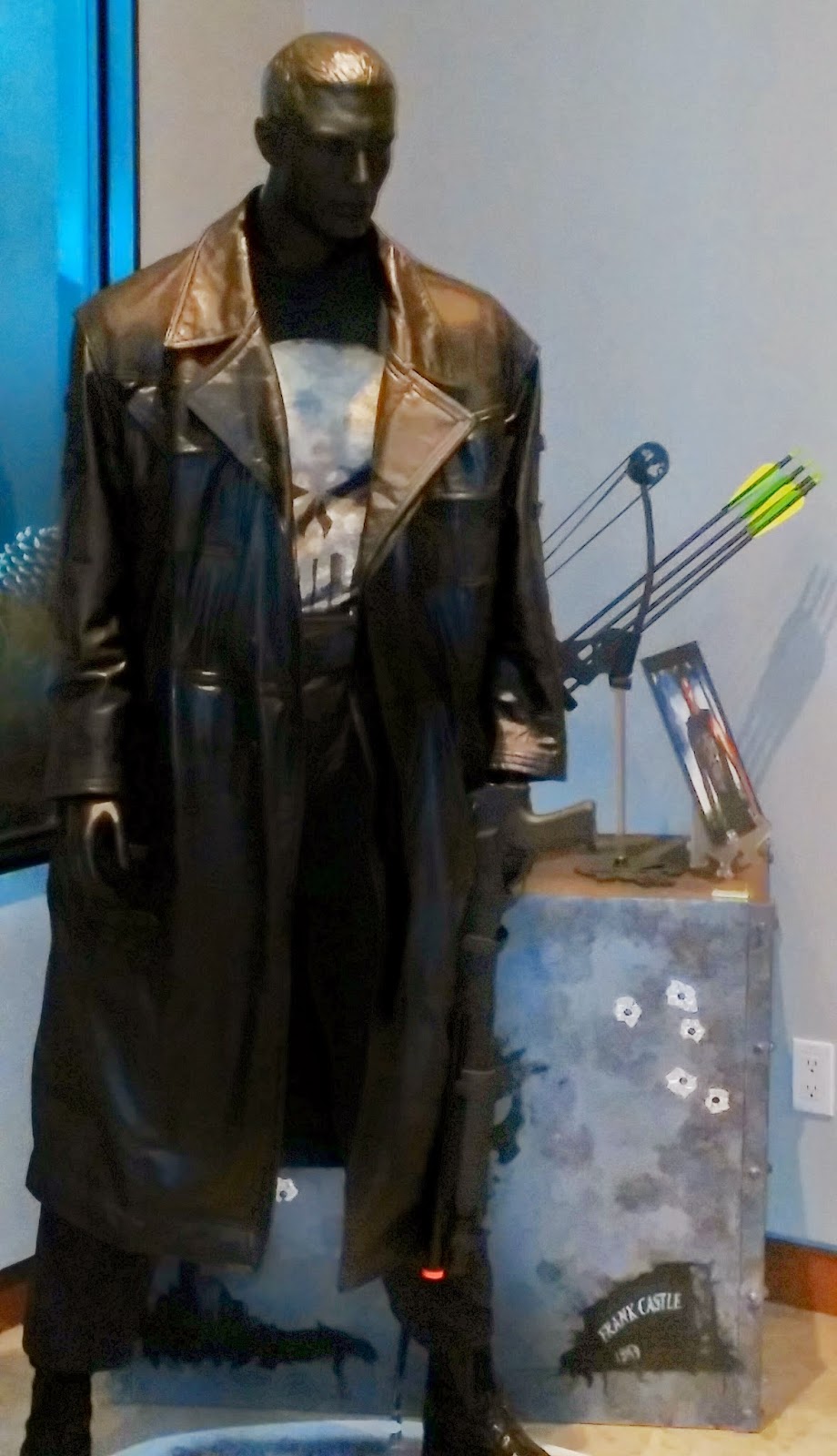
Mike Zeck is a penciller whose work I followed closely during his run on Captain America and the grand-daddy of comic book mini-series, Marvel Comics' Secret Wars, so I was glad to see a career retrospective of his time at Marvel being exhibited. There were plenty of pages and paintings from that era of his work as well as examples of his other contributions to popular Marvel characters. I especially enjoyed looking at the pages reflecting each of the stages (from sketching to inks to coloring and to final product) of production involved with comic books... I'm a fanboy, so I dig that sort of thing. It's always interesting to see the process play out in the artist head on paper.

Raw Fury: The Art of Mike Zeck runs until August 10. (7/11/14)
The costume and props used by actor Thomas Jane portraying one of Zeck's
most popular characterizations, the Punisher.(7/11/14)
There was also an exhibit of the work of North-American women comic strip artists. Long overlooked in American history (and by extension comic book history) are the contributions of women to the genre. It was cool to see original panels from stories featuring pulp character Miss Fury, as she has recently been revived by Dynamite Comics.

Pretty In Ink: The Trina Robbins Collection features highlights from
the personal collection of comic books herstorian Trina Robbins. (7/11/14)
Writer-artist John Byrne taught me to love comic books so I was compelled
to take a picture of his original cover art for Alpha Flight. (7/11/14)
Our day long walking travels through San Francisco's Chinatown ultimately led us to City Lights Bookstore. To some, I'm sure it seems silly to head to a bookstore after a cross-country flight, but as a fan of many of the artists originally embraced by City Lights (and San Francisco) including Jack Kerouac, Allen Ginsberg and Gary Snyder, visiting it had been a goal. Not nearly as commercial as it has every right to be (small bookstore owners--even landmark ones--need to eat), we found the store suitably charming, with a wide array of titles from all types of publishers.

City Lights Bookstore in San Francisco. (7/11/14)
The folks who worked there were somewhat surprisingly without the pretense one might expect at such a well know "hipster" stomping ground. We could have stayed for much longer, but found that our schedule woudl only permit us to hang out for a short time before heading back downtown.

First floor of City Lights Bookstore in San Francisco. (7/11/14)
Second floor of City Lights Bookstore in San Francisco. (7/11/14)
Second floor of City Lights Bookstore San Francisco. (7/11/14)
Jerry outside City Lights Bookstore in San Francisco. (7/11/14)
Jack Kerouac Street next in San Francisco. (7/11/14)