Continuing a summer time exploration of
contemporary folk literature, I recently picked up Silver in the Wood by Emily
Tesh. A slight 105-page volume, Silver in the Wood is a revisualization of the
Green Man motif packed with vivid imagery of ancient forests filled with
mythical creatures and love found then lost. Set in the “primeval forest” (35)
of Greenhollow Wood, our story starts when Tobias Finch, the Green Man mystically
tethered to the forest, offers shelter from a rain storm to a handsome,
affluent young man, Henry Silver. Henry is an inquisitive young man who is the
lord of a nearby village who fancies himself a “practical folklorist,” and as
such, his interest in Tobias is immediate.
One need come to the text with zero background
regarding the Green Man. I read Silver in the Wood simply as a folk tale and
found it to be a brisk, very engaging experience. Many of the archetypes one
would expect to come across in a traditional folktale are present (mother,
woodsman, etc.), but with a slight twist. Advance online reading also revealed to me
that Tesh's piece is also considered a representative of LGBTQ literature, I
would presume based upon the clear attraction between the two male leads.
The inherent loneliness experienced by both main characters (one isolated by wealth and the other by purpose) serves as the basis of their attraction. Of such circumstances, romance often blooms. The love Henry and Tobias share feels pure, and very complicated, a state of affairs that also rings true in many
relationships, romantic and otherwise. Surprisingly, despite its brief page count, the relationship between the two main characters seems earned due to the slow dance they must go through toward one another without their combined trials growing toward a traditional happy ending.
From the onset, we learn that Tobias, as the Green
Man, has become accustomed to living a solitary life, so much so that he “could
not even recognize a handsome lad suggesting a bit of mutual entertainment
anymore” (14). Eventually, Tobias warms up to Henry’s flirtations eventually
recognizing his good fortune in “be[ing] flirted with by a pretty young fellow who
wore expensive coats.” (30) The romance
in Silver in the Wood is subtle and very psychological (spiritual?), which, for this reader, heightened the level of intimacy
shared by them. Tesh vividly describes certain
character interactions in such a manner as to infer a physical attraction
between the two. Like good literature should, Tesh's fairly uncomplicated narrative offers a number of different lenses or experiences in which to
engage and enjoy the text.
I quickly
devoured the text for purely entertainment purposes (the best reason to read!), though as certain elements and characterization came into view I had to resist the urge to begin annotating and analyzing. I look forward to recommending and sharing Silver in the Wood with others.
Showing posts with label nature. Show all posts
Thursday, July 25, 2019
Sunday, July 21, 2019
Roadie: Dawes Glacier, Alaska
![]() |
| Into the Endicott Arm. (7/1/2019) |
Dawes Glacier terminates in the waters of Endicott Arm and together these two sights are classic glacier visits for those travelling to Juneau.
![]() |
Anne and I up at 6 a.m. to view scenery as the ship heads down
Endicott Arm to the Dawes Glacier. (7/1/2019)
|
![]() |
| When turning, many vantage points from all directions came into view. (7/1/2019) |
![]() |
| Seals on ice could be seen on floating ice as we approached the glacier. (7/1/2019) |
![]() |
| The deeper the blue hue, the older the ice; that is a very old piece of ice to the lower left hand corner! (7/1/2019) |
![]() |
| Former parts of the Dawes Glacier, now set adrift. (7/1/2019) |
![]() |
The water, full of varying degrees of minerals and other things due to
glacier melt, seems to change color. (7/1/2019)
|
![]() |
| Mountains and valleys without end. (7/1/2019) |
![]() |
| The Dawes Glacier. (7/1/2019) |
![]() |
| Close. (7/1/2019) |
![]() |
| Closer. (7/1/2019) |
![]() |
| Closest! (7/1/2019) |
![]() |
| Making our way back up Endicott Arm and on to Juneau. (7/1/2019) |
![]() |
| (7/1/2019) |
Monday, July 15, 2019
Roadie: Whale Watching
![]() |
| 7:30 a.m. heading toward the Tracy Arm Fjord and the Dawes Glacier. (7/1/2019) |
The day before going to Juneau was an "at sea day" which meant there would be no leaving the vessel for about 24 hours. At 6:30 a.m. the following morning, guests were invited to go out on deck as the ship moved into the Inside Passage. In addition to getting close to the
![]() |
| Waiting for whales, seals and glaciers. (7/1/2019) |
![]() |
Seals were very common travelers on the pieces of ice--the did not
stick around to pose too frequently though. (7/1/2019)
|
![]() |
When whales are around, every inch of the boat including
the heli-pad becomes a potential viewing area. (7/1/2019)
|
![]() |
Many seals could be seen from the deck bathing in the early
morning sun. (7/1/2019)
|
![]() |
| Lots to see... 360 degrees of beauty. (7/1/2019) |
![]() |
The very early morning seemed the best time to get better
pictures of flukes! (7/1/2019)
|
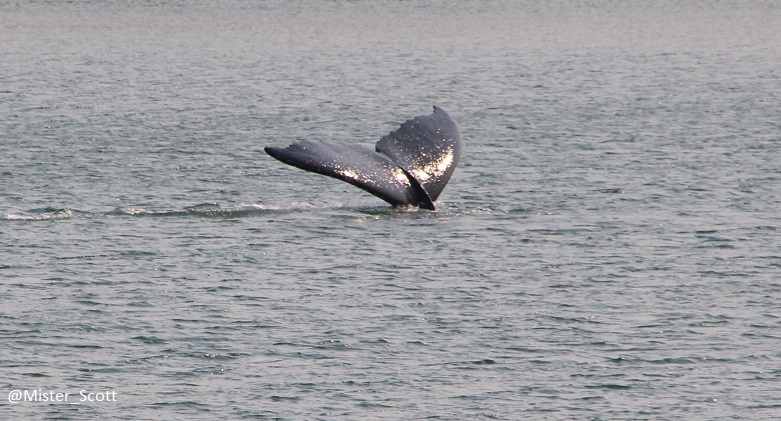
Later that day we arrived in Juneau and headed out on a whale watching excursion. Tourism is the primary commodity of Alaska and that is never more apparent than when looking for whales. The captain of our boat chose not to crowd in with other boats of tourists so as to not startle the whales. We came across a number of groups in the same general area all awaiting a peek at the humpbacks.
![]() |
| In Juneau, the humpback's dorsal fin appears first followed ... (7/1/2019) |
![]() |
| .. soon thereafter by the fluke. (7/1/2019) |
![]() |
| Many tourist boats hoping to glance a whale. (7/1/2019) |
![]() |
Clean shot of humpback's fluke. Note the unique notching on
the tail by which individual whales can be identified. (7/1/2019)
|
![]() |
| Humpback whale fluke just prior to turning up. (7/1/2019) |
![]() |
| Humpback resting before diving. (7/1/2019) |
![]() |
Back to shore following three hours at sea... would have happily
stayed longer! (7/1/2019)
|
Monday, March 13, 2017
Ubiquitous Birds Post-Windpocalypse
| American robin on tree branch. (3/10/17) |
| Emptied pond on Erie Canal. (3/10/17) |
| American robin on the ground. (3/10/17) |
| American robin keeping watch. (3/10/17) |
| Erie Canal in Winter-time. (3/10/17) |
| Pileated woodpecker doing his thing. (3/10/17) |
| Pileated woodpecker. (3/10/17) |
| American crow. (3/10/17) |
| Crows. (3/10/17) |
| Downy woodpecker. (3/10/17) |
| Duped water birds in winter. (3/10/17) |
Labels:
American Crow,
American Robin,
birding,
birds,
Downy Woodpecker,
Erie Canal,
Monroe County,
nature,
New York,
photo,
photography,
Pileated woodpecker,
public park,
Rochester,
weather,
winter,
woodpecker
Friday, September 30, 2016
Reviewing the Old Ways the Old Way
![]() |
| Original box for Gary Synder's audio book The Practice of the Wild (1991). |
Like many college English Literature majors, I was introduced to the work of Gary Snyder in an introductory poetry course, and as a young man growing up in an urban neighborhood attending Catholic elementary school, the content and perspective was exotic and new. At the time, I had not traveled beyond the freeway connecting our home to my relatives' outside Pittsburgh, Pennsylvania, and the idea of anyone espousing a belief system outside a Judeo-Christian one was unfamiliar to me. Snyder's poetry then was a gateway to the larger school of thought he represented and further (if not a touch more concretely) articulated later in a number of essay collections. If the earlier Earth House Hold (1969) or Myths and Texts (1960) appealed to the revolutionary spirit most moderately embrace in undergraduate studies, the nine essays that comprised The Practice of the Wild spoke to the adult domesticity I found myself accepting as a parent shortly after graduation.
The Practice of the Wild (1991) double cassette runs 3 hours and is a traditional book on tape in that its contents reflect those of the original text, published a year earlier in 1990. Having the text read by Snyder lends an added sense of gravitas and nobility to the its already comforting and airy message. In many ways, my experience to listening to Snyder's verbally share his work is reminiscent of listening to classic music on the way to work with my untrained ear. Both are incredibly comfortable auditory experiences that establish an educated yet grounded mood. On rare occasions some small understanding is revealed to me as the recipient.
Much like a film with many quotable lines, The Practice of the Wild has many phrases and sayings that since its initial publication have become popularized as inspirational quotes, such as “With no surroundings there can be no path, and with no path one cannot become free.” Also like a quality movie with many good lines, the parts are even stronger when taken as part of a whole. The tape (and book) both add depth and meaning to Snyder's personal philosophy of compassion for all sentient beings, a class in which he includes mountains, trees and water. Key to continuing to foster and nurture this relationship with all beings is allowing our language to grow and develop in a manner that suggests the interdependence necessary for survival. "Wild," "nature," and "place" are just three of the words that Synder's clarification of within the context of his environmental politics, serve as common entry points for those unfamiliar with his thinking. As someone who is superficially aware--and deeply appreciative of--Snyder's work, I find myself always in need of a re-engagement with his brand of deep ecology. This rewiring of our linguistic present is just a precursor to what Snyder hopes will blossom into a radical restructuring of modern living in accordance with his ideas.
I seem to recall having seen a more current version of The Practice of the Wild text with the audio book included, but was unable to find it on line. Fortunately, Snyder is such a beloved literary-cultural figure that many of his speaking appearances and interviews have been capture on video and are available for viewing on YouTube. If unable to find the book-on-tape, you could do much worse than spending a few minutes with Gary Snyder at Colorado College in 2015.
Much like a film with many quotable lines, The Practice of the Wild has many phrases and sayings that since its initial publication have become popularized as inspirational quotes, such as “With no surroundings there can be no path, and with no path one cannot become free.” Also like a quality movie with many good lines, the parts are even stronger when taken as part of a whole. The tape (and book) both add depth and meaning to Snyder's personal philosophy of compassion for all sentient beings, a class in which he includes mountains, trees and water. Key to continuing to foster and nurture this relationship with all beings is allowing our language to grow and develop in a manner that suggests the interdependence necessary for survival. "Wild," "nature," and "place" are just three of the words that Synder's clarification of within the context of his environmental politics, serve as common entry points for those unfamiliar with his thinking. As someone who is superficially aware--and deeply appreciative of--Snyder's work, I find myself always in need of a re-engagement with his brand of deep ecology. This rewiring of our linguistic present is just a precursor to what Snyder hopes will blossom into a radical restructuring of modern living in accordance with his ideas.
I seem to recall having seen a more current version of The Practice of the Wild text with the audio book included, but was unable to find it on line. Fortunately, Snyder is such a beloved literary-cultural figure that many of his speaking appearances and interviews have been capture on video and are available for viewing on YouTube. If unable to find the book-on-tape, you could do much worse than spending a few minutes with Gary Snyder at Colorado College in 2015.
Monday, August 08, 2016
What Did the Cat See?
![]() |
| Blackbeard the cat at his post. (7/26/19) |
![]() |
| Catbird and sparrow on tomato cages. (7/29/16) |
![]() |
| Common Grackles in the grass. (7/29/16) |
![]() |
| Frazzled Grackle. (7/26/19) |
![]() |
| American Robin. (7/29/16) |
![]() |
| Cottontail rabbit with gang of Common Grackles. (7/29/16) |
![]() |
| Grackle and Cottontail lunching together. (7/29/16) |
![]() |
| Cottontail in the vegetable garden. (7/29/16) |
![]() |
| Male Northern Cardinal. (7/29/16) |
![]() |
| Cautious Cottontail. (7/29/16) |
![]() |
| Male Northern Cardinal with Common Grackles. (7/29/16) |
![]() |
| Male Northern Cardinal. (7/29/16) |
![]() |
| American Robin. (7/29/16) |
![]() |
| Yakking American Robins. (7/29/16) |
![]() |
| Cottontail rabbit. (7/29/16) |
![]() |
| Black-Capped Chickadee on Nyjer feeder. (7/29/16) |
Labels:
backyard,
birding,
birds,
Blackbeard,
bunny,
cat,
garden,
gardening,
nature,
photo,
photography,
rabbit,
summer
Subscribe to:
Comments (Atom)