Showing posts with label bookshelf. Show all posts

Wednesday, December 16, 2020

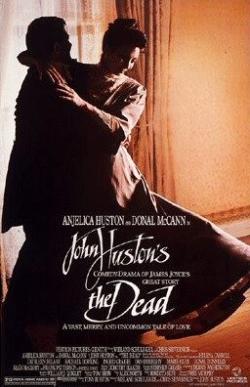
Winter Movies: James Joyce's The Dead

The first snow came early this year in Western New York. Though I may say this every year, for the first time "ever" I was shoveling in the dark in mid-November. This early December morning when I woke up in the dark, it was as I suspected: a light snowfall extending the anticipation of the holiday season had fallen again. Though it was only what amounted to a half inch or so, it was just enough to set the pavement aglow under the street lights. The pre-Christmas snowfall of winter, or more to the point, the apparent magic of it, often brings me back to a short story by Irish writer James Joyce from his collection The Dubliners, and by extension to the 1987 film adaptation of the same story directed by John Huston, James Joyce's The Dead.

The year 1987 was my first as a college undergraduate, and, like many, home from my first semester in December, I felt a sense of invincibility and wonder. It was my first time away from home for an extended period of time, and my first taste of (arrested) adulthood, code for being able to make all the dumb mistakes that first year college students do. This was also a time of little meaningful reflection allowing for the quick dismissal of mistakes with little understanding of what things really meant.

While on break, my brother and I went to a local art house to see The Dead. I was armed with one World Literature course (and the powerful understanding of the literary term "epiphany"), so, of course, I was an expert in artsy-fartsy books and movies. So away we went. For all I really knew at the time, The Dead could very well have been a Victorian era zombie movie, but what I experienced that evening (and much more powerfully so in later viewings) was a moving meditation on insecurity, nostalgia and love.

IMDB describes the film thusly: "Gabriel Conroy and wife Greta attend a Christmas dinner with friends at the home of his spinster aunts, an evening which results in an epiphany for both of them," and despite the seemingly dry set-up its the actors and director Huston who turn the subject matter into compelling viewing. The lead actors, Angelica Huston (Greta Conroy) and Donal McCann (Gabriel Conroy) bring to life the two "literate" characters with performances that are both celebratory (the dinner party) and melancholy (Michael Furey's final romantic gesture).

Those ready for a moving holiday film experience will not be disappointed. For myself, rewatching the film over the years, its themes naturally grow more meaningful to me, just as the feelings at Christmas time become grow more complex. For whatever reason this movie is very difficult to find online, so a public library may be your best bet. Even better yet read the short story in The Dubliners before seeking it out.

Monday, May 04, 2020

Striking Back With Empire Cards

The cover and a page from the hardcover book Star Wars: The Empire 
Strikes Back: The Original Topps Trading Card Series, Volume Two.
You know time has really passed when the collectibles you purchased as a child find their way to nostalgia-inducing coffee table books. That was the feeling, along with curiosity over who might actually purchase such a publication, I experienced while wandering the shelves at a local bookseller (FYI: this post was first published 8/18/2016). In a time when the demographic (white male nerds, 45-55) to which I belong are willing to part with hard cash for a nostalgic charge, it is not surprising that the hardcover "book" Star Wars: The Empire Strikes Back: The Original Topps Trading Card Series, Volume Two is now available. The book is exactly as advertised, each page consists of both the front and back of one of the 132-card base set and 33 stickers that compromised the original wax packet release back in 1980(!).

My collection of the original Empire Strikes Back Topps Picture Card Series Two.
Fortunately, I still have a complete card set (though only a partial sticker set), so can save my funds for other fanboy passions. An key aspect of trading card collecting that is lost with the transition to book form is the tactile charge of flipping each individual card over. One never knew what to expect, but it would be something exciting whether cool facts, silly quiz questions, or behind the scenes production secrets. This was, of course, prior to the advent of the internet when production info as limited to that which could be found only in magazines like Starlog or during the occasional Behind the Scenes television special. I even remember looking forward to The Price Is Right Showcase Showdowns where often one would be based on an upcoming movie and offer a clips package. Damn, those were magic days!

Here are just a few representative cards (with caption comment) from my collection:

Straight from 1980... the "title" card for my set of The Empire Strikes Back
Topps Picture Card Series 2.
Card 138: Back before any mystery was blown up by the prequel trilogy,
all things related to Boba Fett, like his ship Slave 1, were super cool!
Card 164: A suitably Eighties caption to this standard Vader shot.
Card 174: This one is interesting as it pre-dates the current practice of
referring to our robot friend by his government name R2-D2 rather than the
much more humanizing Artoo.
Card 207: Clearly the Star Quiz questions were intended to make young fanboys
like myself feel really confident in their Star Wars trivia knowledge.

Card 261: Prior to the Internet, these special cards, complete with
alliterative caption, were the best way to see any behind the
scenes shots. I still love looking at this sub-series.
Card 263: As a kid, I hated getting these cards (they lacked cool pics!) but now
appreciated knowing what cards I am trying to get when you get down to
only a few left for a complete set.
The original packs came with a single sticker so it was not so easy to get a complete set.
Sadly, I have very few of these as I used most of them spelling out cool things with
the letters, such as the word "Awesome": ah, childhood!

Thursday, April 09, 2020

Spring Break Reading: The Miraculous Journey of Edward Tulane**

Prior to saying goodbye to my eleventh graders before our ten day Spring Beak, I suggested that they find a book or two to read during our time apart. Though more than a few groaned, a few asked for suggestions to which I replied a number of titles from high school cannon, such as I know Why the Caged Bird Sings by Maya Angelou, and even a classic from middle school that most had not, surprisingly,  even heard of, The Outsiders by S. E. Hinton. At this point a couple of students began reminiscing about titles they had (shock of shocks) enjoyed reading that I had not heard of. One young lady mentioned her affection for a book read in middle school entitled The Miraculous Journey of Edward Tulane. As she began describing the book as being about a "rabbit doll that gets lost," I scribbled the title in my notebook for future reference. Maybe it was the promise of a rabbit protagonist or the recollection of my own prior devouring of the wonderful The Sage of Waterloo by Leona Francombe, also about rabbits.  These factors along with the student's passion for a book read years ago moved it to the front of my spring break reading list.

Right to the top of the pile.
A longtime high school teacher, I have often searched for "lighter" fiction for sharing with students, and as a reader I, too, struggle with finding meaningful books with slightly less angst. I continue wishing for lighter literary entres to consume. Given both these factors, in addition to considering myself a reasonably "well read" person, I am embarrassed to share that I had not heard of writer, and Newbery medalist, Kate DiCamillo previously. If The Miraculous Journey of Edward Tulane is any indication, I have been missing out by having not picked up any her many titles before. My student was telling the truth, and showing a pretty good memory in giving me a short synopsis; the book is indeed about a somewhat snooty, China rabbit (not a "doll" as he reminds us at every turn, though something he'll need to come to terms with) who goes missing. During a decades long journey, Edward comes to learn the value of loving and being loved.

This 211 page book is a joy, and like most good books, defies being placed into a box. I found this book in the children's area of my local bookstore, and after reading am going to share it with my mother who, like I, is beyond the publisher's target audience. Edward's travels take him through multiple relationships and a variety of lifetimes, but never loses a sense of the timeless. DiCamillo's narrative is further enhanced through the inclusion of illustrations by Bagram Ibatoulline. Beautifully rendered in black and white, Ibatoulline's illustrations avoid anchoring the story and character in a specific time period, and do nothing to mitigate the reader's ability to imagine the events as taking place right now. Perhaps it was my nostalgia but I found the drawing reminiscent of Beatrix Potter's Peter Rabbit art (my son's nursery had a border of the characters).

As a middle-aged high school teacher, I was impressed by DiCamillo's willingness to avoid writing down to her audience. There are heavy questions posed and big themes explored throughout, such as love, death, regret a nd patience. Lines such as "How does a China rabbit die?" (page 47), seem perfectly at home in DiCamillo's world of China rabbits and hobos. Vocabulary such as "ennui" (page 3), "discerning" (65) and "contrarian" (194), suggest an excellent opportunity for readers of all ages to add valuable words to their working vocabulary.

I am grateful for the quick conversation with one of my student's for leading me to this beautiful book. I strongly recommend The Miraculous Journey of Edward Tulane by Kate DiCamillo with illustrations by Bagram Ibatoulline to readers of all ages looking for a powerful complex read disguised as a children's book about a China rabbit!

**Originally posted March 13, 2018

Sunday, February 09, 2020

Read it: The Stone Book Quartet


"Oh, the years of Man are the looms of God
Let down from the place of the sun;
Wherein we are weaving always,
Till the mystic work is done!" 
("The Stone Book," page 35)

My ongoing reading journey through a variety of folk traditions recently brought be back around to English writer and folklorist Alan Garner, author of The Owl Service (tremendous!) and The Weirdstone of Brisingham (fun!). After looking for something new to read from Garner I came across a series of four short stories which, when published together, are titled The Stone Book Quartet. When I initially sought the book out at my local public library, the 1978 edition they had available from storage in the stacks consisted of only the first story, “The Stone Book.” While this hardcover book does include several beautiful etchings by Michael Foreman, it did not include the three stories that, published later, ultimately comprised the entire four-story sequence. As a result, I devoured “The Stone Book” and quickly ordered a more recent Harper Perennial collection which includes all four stories as well as a biographical sketch of the author, an interview and a wonderful family photograph from 1890 that inspired the author's writing ("About the Book," page 16). Taken as a whole, each extra lends additional depth to the series and only adds to the great value of the purchase.

Foreword from 1978 edition of
  The Stone Book does an
excellent job explaining
arc of all four stories.
The Stone Book Quarter consists of “The Stone Book”, “Granny Reardun”, “The Aimer Gate”, and “Tom Fobble’s Day”, clocking in at a breezy and concise 172 pages. While each story can stand alone as a look at one part of Garner’s somewhat fictionalized family history (as revealed in the book's additional matter), taken together it paints of broad and deep understanding from a multitude of generational and gender perspectives. During my first (this will find its way into my list of titles to re-read annually) read through I could not help but take notes in my 5" x 3" spiral bound as images brought up in “The Stone Book” found their way back around through the other stories. Each story takes a look at familial relationships, an individual character's search for purpose through work, while painting a vivid picture of each historical period with direct language. In addition to taking notes regarding images and plot, I also found myself looking up terms and concepts that applied to each career explored, among them stone masonry, textile and metal work. A secondary motif that runs throughout The Stone Book Quartet is the communal power of song. Each chapter includes family members young and old who find joy in their work and play through a shared tune. Despite the seemingly hard-scrabbled lives of the characters, each takes pride in being able to contribute to an occasional tune either through voice or instrument.

Back cover of 1978 edition of
  The Stone Book with Foreman
etching of Father's mason mark.
In The Owl Service and other works, Garner points to the impact of mythology and folklore as carried through landscape, but here the mythology extends to include family and work. The magic of The Stone Book Quartet lies not in supernatural dishes or stones, but rather in the connection built among family and craft through time. For Garner’s characters, the magic of existence is revealed in identifying and pursuing one’s productive passion whether in stone, iron, wood or even, in Uncle Charlie's case in "The Aimer Gate", stopping rabbits from striking. Each of these elemental pursuits create family across generations and this practical magic is often unrevealed until one looks into a small corner or behind a shadowy wall.

The Stone Book Quartet is well worth seeking out for those interested in folklore, English history and legacy.

Tuesday, October 08, 2019

Hallow-Reading: At the Mountains of Madness: The Definitive Edition

Like many avid readers who have certain books that they enjoy, this is not the first time I've read H.P. Lovecraft's, At the Mountains of Madness, a fairly short (in terms of page count), but dense (regarding descriptive language and vocabulary) horror novella. Just as in order to consider oneself to be "well-read," a reader must have engaged with one of the Bronte sisters at some point, it would be hard to take someone seriously as a well-rounded student of literature who has not at least sampled Lovecraft if not as recreational reading, then as a student of genres. Too often, I think horror, like romance, is marginalized and compartmentalized so as to be seen as unworthy. Au contraire, mon frère!

Though I would classify AtMoM as more of a short story (albeit an extended one), the hook for my reading of this recently published "Definitive Edition" was the new introduction by British author (and occasional comic book writer of DC Comics's 2012 Dial H series) China Miéville. Beyond Lovecraft's tale, it is Miéville's analysis that this comment will focus in great part on.

Here is a brief teaser for AtMoM (BarnesandNoble.com): "The Barren, windswept interior of the Antarctic plateau was lifeless—or so the expedition from Miskatonic University thought. Then they found the strange fossils of unheard-of creatures...and the carved stones tens of millions of years old...and, finally, the mind-blasting terror of the City of the Old Ones." This is one of Lovecraft's pieces that would become integral to what is now understood as "the Cthulhu mythos."

The thing about AtMoM, and Lovecraft's work in general, is that much of the imagery contained therein has so permeated our popular culture by this point that most folks don't even know enough to recognize the original source. From the recent film Prometheus (2012), to the many video game (the Gears of War trilogy and Borderlands to name two) character designs to list, Lovecraft's detailed and dark descriptive language has been lifted to such an extensive degree that what was once perceived to be iconic can now be mistakenly thought to be common. What Miéville' introduction (which includes some spoilers for the uninitiated) does is to offer some historical context to Lovecraft's style and craft that creates an interesting gateway to deeper literary analysis of fiction writing in general, and the horror/supernatural genre in particular.

In the "real world" I am a high school English teacher, and can attest to the fact that deep literary analysis, beyond simply identifying basic literary strategies at work, and a somewhat superficial presentation as to the reasons behind the author's choice of strategies, is among the most challenging skills for students to master in an authentic voice. Unfortunately, it is also a skill that is not meaningfully tested on government mandated assessments and so is deemed unworthy of extensive effort in most classrooms.

As I read Mieville's essay, I considered how I could use it in some more advanced classes as an example of deep literary analysis as it touches on some important considerations that excellent students are capable of making, given the opportunity. In fact Mieville's thesis (from the second paragraph), points the reader in the proper direction for initial analysis: "... we must see Lovecraft as a product of his time. We can make sense of him, and his astonishing visions, only to the extent that we understand him as defined by the specific horrors, concrete and psychic, of the early twentieth century."

Also included as part of The Definitive Edition is Lovecraft's own literary analysis piece "Supernatural Horror in Literature." Whether as entertainment (for which this edition is not necessary and much of Lovecraft's stories are available in most good public libraries) or for an academic burst of analysis, I recommend At the Mountains of Madness for an eerie and breezy summer read. If you'd like to borrow this edition (or another), please let me know and I'd be happy to share.

You do think of yourself as "well-read," no?

Saturday, August 10, 2019

Summer Reading: The Umbrella Conspiracy

As summer wears on into the August dog days, I find myself turning to my XBOX One console for relaxing (and admittedly mindless) gaming action. Though the missions have long been completed, I most frequently return to any of the many Resident Evil/Resident Evil Revelations titles for comfort. There is, after all, a personal Gamer Score to inflate by reaching achievements in games that are not necessarily earned by simply completing the narrative. For a number of reasons, the Resident Evil games to have a high level of re-playability for me that others don’t. Much of this is due to the deep and somewhat convoluted mythos presented throughout the game series.

Despite having read the numerous screenshots and load pages with background information—and having seen the cgi films released her in the U.S—the expansive story of Raccoon City, the Umbrella Company and Terragrigia, as well as their connections to one another from game-to-game is not always easy to discern. It is with interest in obtaining more background, as well as filling some free time with enjoyable reading, that I picked up Resident Evil: The Umbrella Conspiracy by S.D. Perry. A fairly straightforward novelization of the first Resident Evil game, The Umbrella Conspiracy combines Jill's and Chris gameplay scenarios into a singular narrative.

Bearing cover blurbs declaring the paperback as both “Volume 1” and “Based on the Bestselling Videogame by Capcom,” I anticipated getting some additional canon to help clarify some of the relationships between characters, at least at this early point in the series. While some of obvious character traits such as Albert Wesker’s villainous nature through obvious mannerisms such as his “perpetual sunglasses propped on his tanned brow” (127), new information is revealed such as Wesker’s early role in the story as a secondary henchman character. The he began as a captain in the U.S. police team STARS was not clear to gamers such as I who came late to the series (never a PlayStation player was always behind with RE early releases). This was just the kind of character development I came for. From the heroic Jill Valentine and white bread Chris Redfield to less well-known (though I dig him in his debut as a playable character in Resident Evil Revelations 2), Barry Burton, Perry uses the gameplay context to provide each an opportunity to develop.

Perry also makes the interesting choice to use the gameplay structure to drive the narrative in The Umbrella Conspiracy. Puzzles for opening doors become part of the story as Perry offers the reader into the though process characters go through in deciphering the proper way to address a variety of keys. Because this often entails characters spending pages searching for large coins which when combined allow access to parts to important the building, it is best that the reader recognize The Umbrella Conspiracy for what it is. Anyone who has played video games understands the necessity of nuanced puzzles to keep gameplay engaging. Perry is ware of his intended audience and writes it straight rather than having characters question “why would someone have use a series of cradle-to-grave paintings as a key to a secret doorway?” the STARS members demonstrate grit in simply recognizing the importance of doing what needs to be done. Even if what needs to be done is pulling levers to avoid attack crows. Requiring characters to think critically think about how to address each challenge as it occurs also offers deeper insight into what drives them. What seem like selfish moves on Barry’s part in assisting Wesker is much more forgivable given the weight of the threats made to his family should he not.

Another thought I had while reading The Umbrella Conspiracy is how Perry so effectively (and consistently) uses olfactory imagery throughout, a sensual competent obviously absent in the game beyond the visuals. Yes the zombies as computer generated characters are uniquely designed and, well, gross, I had not previously considered that they probably really stink too. Overall the level of descriptive gore present in this book is definitely on par with what one would expect from a Resident Evil product… and for this reader that is a good thing!

I breezed through the novel’s 280 pages, and look forward to picking up Volume 2: Caliban Cove which, unlike Volume 1, is an original work by Perry that bridges events between the first two games. I recommend The Umbrella Conspiracy to any readers of action/adventure/horror and would even suggest those who have not previously played Resident Evil will find something to enjoy; an ideal beach horror read.

Thursday, August 01, 2019

Summer Reading: Harvest Home

A few weeks ago I purchased a lovely worn copy of one of a recent current grail title: Harvest Home by Thomas Tryon. Tryon’s second novel has appeared on numerous folk horror reading lists uncovered during my dive into the genre. Despite its presence on so many lists it was surprisingly difficult to find a copy to read. After discovering that the local public library system possessed three copies, all of which were out, I decided to go online for a copy. Turns out it was the correct choice as not only did I enjoy it, but I am confident others in my circle will too.

Told as an extended flashback from the first person perspective of the novel’s protagonist, Ned Constantine, the story's structure takes us from his family’s purchase of a home in the secluded village of Cornwall Coombe in Part One entitled “Agnes Fair” through the terrifying revelation as to what exactly “Harvest Home” means in the eponymously titled Part Five. Tryon deftly places breadcrumbs such as “Viewed in the light of what occurred later, it was a fool’s Paradise” (152) and “I never got to Hartford… for it was the fateful night that saw my fall from favor” (278) to let the reader that, despite what is to occur, Ned has survived. Of course, surviving does not necessarily mean unchanged.

The aspect of the story that works best for me is Ned’s building paranoia regarding the shifting allegiance of his wife, Beth. Their relationship is further complicated when it becomes clear that she, and his daughter, are being slowly manipulated by the town’s leader, the elderly (and initially very kind and supportive of Ned), Widow Fortune. As the Widow insinuates herself into the Constantine family’s lives, Ned (and we) recognize that all is not what it appears. Equally frustrating is the pig-headedness of Ned’s decision making that ultimately result in the grim finale which begins when he feels a “shiver, like a strange paralysis, creeping up [his] body.” (386) In the end, Ned’s paranoia about having his loved ones turned against him by larger (small town) social pressures is well executed by the author.

This is, of course, a folk horror novel, and Tryon does a very credible job building this world of corn cob totems (160) and Eleusian Mysteries. The author uses a neighbor character, Robert Dodd, a former college professor who is now blind and housebound, as the primary vehicle for delivering the eerie exposition regarding the community’s rituals and pagan belief. Goddesses, fertility, psychedelic mushrooms and “corn stalk cosplay” all play a role in fully developing the system of beliefs that drive the community forward into the future by staying set firmly in its past.

When released in 1973, Harvest Home was the successful follow-up to Tryon’s debut novel The Other (1971). Quickly adapted into a popular television min-series starring Bette Davis, it demonstrated itself to have some cultural resonance too. Harvest Home, like most successful that maintains its appeal, subverts a number of horror conventions a trick made slightly more difficult to in a contemporary context due to its impact on books and movies that followed. Though some of the narrative twists and turns were expected, if you have seen The Wicker Man (1973) or Midsommar (2018) you’ll see them coming too, the sense of dread Tyron builds was surprisingly not ameliorated. The fact that my own prior reading provided clues to later reveals, speaks to the gripping nature of Tryon’s storytelling.

Everyone has experienced the disappointment and regret that comes with looking very forward to getting something that fails to live up to expectations (come to think of it that could be a theme for this book!). I am happy to share that this is not the case with Thomas Tryon’s Harvest Home, a 400 page book I breezed through in three days despite frequent stops to jot down notes and savor the storytelling. Highly recommended!

Thursday, July 25, 2019

Summer Reading: Silver in the Wood

Continuing a summer time exploration of contemporary folk literature, I recently picked up Silver in the Wood by Emily Tesh. A slight 105-page volume, Silver in the Wood is a revisualization of the Green Man motif packed with vivid imagery of ancient forests filled with mythical creatures and love found then lost. Set in the “primeval forest” (35) of Greenhollow Wood, our story starts when Tobias Finch, the Green Man mystically tethered to the forest, offers shelter from a rain storm to a handsome, affluent young man, Henry Silver. Henry is an inquisitive young man who is the lord of a nearby village who fancies himself a “practical folklorist,” and as such, his interest in Tobias is immediate.

One need come to the text with zero background regarding the Green Man. I read Silver in the Wood simply as a folk tale and found it to be a brisk, very engaging experience. Many of the archetypes one would expect to come across in a traditional folktale are present (mother, woodsman, etc.), but with a slight twist. Advance online reading also revealed to me that Tesh's piece is also considered a representative of LGBTQ literature, I would presume based upon the clear attraction between the two male leads.

The inherent loneliness experienced by both main characters (one isolated by wealth and the other by purpose) serves as the basis of their attraction. Of such circumstances, romance often blooms. The love Henry and Tobias share feels pure, and very complicated, a state of affairs that also rings true in many relationships, romantic and otherwise. Surprisingly, despite its brief page count, the relationship between the two main characters seems earned due to the slow dance they must go through toward one another without their combined trials growing toward a traditional happy ending.

From the onset, we learn that Tobias, as the Green Man, has become accustomed to living a solitary life, so much so that he “could not even recognize a handsome lad suggesting a bit of mutual entertainment anymore” (14). Eventually, Tobias warms up to Henry’s flirtations eventually recognizing his good fortune in “be[ing] flirted with by a pretty young fellow who wore expensive coats.” (30) The romance in Silver in the Wood is subtle and very psychological (spiritual?), which, for this reader, heightened the level of intimacy shared by them. Tesh vividly describes certain character interactions in such a manner as to infer a physical attraction between the two. Like good literature should, Tesh's fairly uncomplicated narrative offers a number of different lenses or experiences in which to engage and enjoy the text.

I quickly devoured the text for purely entertainment purposes (the best reason to read!), though as certain elements and characterization came into view I had to resist the urge to begin annotating and analyzing. I look forward to recommending and sharing Silver in the Wood with others.

Thursday, July 18, 2019

Summer Reading: Backwoods Witchcraft

Backwoods Witchcraft: Conjure and Folk Magic from Appalachia by Jake Richards found its way to my desk after I came across the title while researching folk horror short story collections. Unlike those stories I initially sought, Backwoods Witchcraft is presented as a non-fiction account of the author’s own childhood growing up in Appalachia. Richards uses anecdotes, recollections and stories from his youth serve as the vehicle through which to share the charms and conjures he believes still work today.

In many ways your enjoyment of the text as a whole rests on how open you are to a friendly conversation on things that appear to be beyond belief. To his credit, Richards’s conversational style makes it a much easier sell than you might think. Reminiscent of the Justin Wilson Cajun Cooking television shows I enjoyed watching on PBS as a child, I easily accepted the invitation to enter his world. I regularly watched Wilson’s show on PBS for much the same reason I enjoyed Richards’s book; both “hosts” sprinkled in regional stories and history along with their “recipes”. Just as I never actually prepared any of the dishes Wilson colorfully prepared on his show (though as an adult I will not turn away Cajun food), in all likelihood I will not be attempting to remove warts using Quartzite as Richards’ Papaw showed him how to. Given the author’s friendly, conversational writing style, Backwoods Witchcraft reads as if you are sitting at the dining room table chatting over a cup of coffee. Richards anticipates many of the queries an outsider might have, and as a result the text works as a fascinating piece if backwoods Americana. “The stories and tricks,” as the author notes on page 33, “are passed down in families and communities, routinely offered as wives’-tale cures, or simple reminiscing of things that helped folks get along in their daily life.” Whether from Louisiana, Appalachia or Western New York, it’s these stories that bind each of us to our respective communities. Richards’ extends his own sense of belonging and community to include the reader.

For a book subtitled “Conjure and Folk Magic,” it was curious how much of the mystical qualities of stones, waters and individuals was dependent on Richards’ Christian faith. Digging deeply enough into any charm or cure and you’re likely to find a strong reliance on the brand of Christianity practiced by the residents of Appalachia. For example, when instructing the reader about gazing (a means of divining the future with a bowl of water), Richards shares that the ceremony begins with recognition of the “the Father, the Son and the Holy Spirit.” (136) Whether the reader believes the power suggested in the stories will depend greatly on one’s orthodoxy of beliefs in tenants of Christianity. Both rely on faith to have an impact. Richards Christianity is one deeply intertwined with Native American tradition and an appreciation for the power of Nature. This eclectic heritage makes for a type of Christianity that is both diverse and, in some instances, almost New Age. While one charm may have Richards invoking the Holy Trinity, the next is just as likely to point out the positive attributes of leaving pumpkins on the porch to keep the haints at bay.

Backwoods Witchcraft: Conjure and Folk Magic from Appalachia by Jake Richards is a very accessible look behind the veil of a unique set of American traditions. Unavailable at my local library, I purchased my copy from Aamzon.com, and I suspect that, much like a reference book, as I come across unfamiliar traditions and concepts in other reading, I will find myself returning to the table for a follow-up chat with Richards’s book.

Saturday, June 22, 2019

Summer Reading: The Beautiful Thing That Awaits Us All

Thanks to a slow week administering exams and the need to close-up shop in advance of the impending summer school break, my personal summer reading season has begun early. Truth is, I live in a yearlong reading cycle, and with current events being what that are, this has never been so true or vigorously adhered to. My "Must Read" table overflows with books awaiting opening. Ironically, I continue to cleanse my mental palette of orange, homicidal, lying monsters by mixing in cosmic horror. The Beautiful Thing That Awaits Us All by Laird Barron, published in 2013, is the third of his collections, after Occultation (2010) and The Imago Sequence (2007) I've read.

Both collections of short stories were a terrifying, uncomfortable pleasure to read and The Beautiful Thing is no different. When I recommend Barron's stories to others, it is often with the with the suggestion that Barron's short story work (I've yet to read his well-regarded novels) are perfect for those who appreciate the literary stylings of H.P. Lovecraft. (I also share that the dread and discomfort that comes with Barron is much more visceral, at least for this reader.) If anything, this most recent collection brings Barron's vision into more direct alignment with Lovecraft's. There is little need for me to formally review this collection, there are plenty of reputable reviews online to be read if that is the desire. I do have a couple of thoughts however from the perspective of the "guy sitting on his porch after having been given a good fright."

Lovecraft's influence is most overt in the collection's seventh story "Vastation" (which means "the action or process of emptying or purifying someone or something, typically violently or drastically"), a collection of reminiscences from the perspective of self-ascribed "herald[s] of the Old Ones" (199). Here, a timeless entity of sorts recounts experiences from the distant past, present and future as he prepares our world for cleansing. The unique point of view shifts from the Dark Ages to the future of robot cats adding a layer not explored by Lovecraft (whose Cthulhu mythology was only made more concrete after his passing). Balancing grotesque imagery such as the Mushroom Man's mission to "liquify our insides and suck them up like a kid slobbering on a milkshake (200) with light humor in the form of the unnamed (maybe "McCoy" as in the real McCoy?) narrator's affection for Fat Elvis and his own robo-cat, Softy-Cuddles.

Beyond the fantastic imagery, cosmic horror and scary "magical realism" in The Beautiful Thing That Awaits Us All, this collection does two things I always appreciate in writing:
Saturn Devouring His Son 
by Fancisco De Goya
  1. I really dig when author's prompt me research in order to fully grasp what's happening. Each of Barron's stories includes a cultural allusion or use of diction that had me going to the smart phone, not so much for basic comprehension but for a sharpening of understanding. This especially rewards when considering the titles  The previously mentioned "Vastation" for one or the need to refresh my visual memory regarding Francisco De Goya's painting Saturn Devouring His Son. Doing so only brings into even greater clarity the creepy image created by Barron's words at the conclusion of "Jaws of Saturn". 
  2. Despite the collection nature of short stories, Barron weaves symbols and motifs throughout. In both the narratives and publishing artwork the ouroboros makes appearances. I also found it cool to come across the image of staring at a single red dot against a wall as a portal to other worlds a number of the stories. Again, this is not meant to be mind-blowing observation on my part, but a recognition of the care taken in selection and creating a tone (and message?) for the text as a whole.
I continue to enjoy the short stories of Laird Barron. My past experience with Barron suggests that he is the rare horror writer whose work benefits from re-reading (Occultation remains on my "Must Read" pile despite having been read and re-read). A quick note for any of my high school students still reading: there is R-Rated imagery and activity throughout Barron's stories. As I say in class when discussing "adult-ish" content, I can't recommend it to you yet, but as soon as you turn 18... check it out!

Monday, February 04, 2019

Never Give Up (On a Book)

I have many shelves, boxes and piles of books, magazines, and comic books throughout our home. Cumulatively, they comprise a massive "Read List". Most I begin to read upon receipt. Many I begin and read through along with two or three titles simultaneously. A few, I read cover to cover exclusively. Some I even read the first eight pages, fail to be hooked, and set them aside to eventually be plucked from the stacks at a later date. When I do begin the start-stop-start-stop dance with a title, it may go on for weeks or even years before it finally hits me (or I, it) in a way that sticks. These demonstrations of show of patience can provide the most entertaining (and rewarding) reading experiences. It often pays not to quit on a story.

Take Borne by Jeff VanderMeer for instance. After devouring his Southern Reach Trilogy in a two week binge in August 2017, I looked for another helping of VanderMeer's mix of ecology, sci-fi and thoughtful character development. Which brought me to Borne, a post-apocalyptic survival tale set in a futuristic landscape ruled by a gigantic flying bear. On a number of different occasions over the past year-and-a-half I have taken a series go at Borne. Each attempt ended in my failure to allow myself to be drawn into the narrative strongly enough to commit to it's story ahead of other books on my to-read table. Eventually, however, the student was made ready, and as foretold in countless episodes of Kung-Fu, the teacher, or in the case, novel, appeared.

A week ago, in the wake three months of folklore and comic book reading (reading for pleasure) and classic American literature (for teaching which is also pleasurable), I had a hankering for a sci-fi palette cleanser. Wandering the stacks at my local public library, I once again came found Borne waiting for me. This time I was ready and could not put it down. Turns out, Borne is that breezy, emotional follow-up to the Southern Reach Trilogy I had hoped it would be. Even if it took me a while to see (and read) it. In the afterglow of having digested a well-written story, I am especially glad that I hadn't given up on Borne. That is not to suggest I am yet ready to tackle James George Frazer's The Golden Bough, a tome that's been pecked at and thumbed through for going on 12 years...

Monday, August 06, 2018

Summer Reading: Your Black Friend

From My Black Friend, page 2, panels 1-2.
After seeing the extended collection of Ben Passmore's online comic strips, Your Black Friend and Other Strangers, recommended in the past few weekends' New York Times Book Review, I took the small step toward reading the entire collection by first ordering the single issue version online, Your Black Friend. The choice of the shorter, 11 page version was two-fold. First, I was looking to read with an eye toward sharing with my junior and senior high school students this coming school year (and as such it might be more affordable for their purchase). Secondly, given the subject matter and that first purpose, a direct succinct delivery of the message might serve more useful and accessible.

More a graphic-essay than novel, what we comic book collectors might call a "one-shot", Your Black friend is best described as "sharp, informed social commentary in the form of an open letter on race and being black in America." (Goodreads) Indie publisher Silver Sprocket, in a formal description picked up by other online sources, tells us that this is Passmore‘s "necessary contribution to the dialogue around race in the United States, Your Black Friend is a letter from your black friend to you about race, racism, friendship and alienation."

Perhaps not surprisingly, despite it's brevity, Your Black Friend is very challenging reading, and experience that is very likely to be shaped by one's own background and openness to facing difficult realities. Both Passmore's contemporary, colorful and engaging art, as well as a natural, organic, writing styles combine to craft a dialogue that resonates for the reader looking to engage. At the risk of sounding like that white friend that Passmore astutely suggests "express their undying enthusiasm for 'Black Lives Matter," Passmore objectively illustrates (in words and pictures) the self-defeating thoughts by many sides of the conversation that result in meaningful communication failing before it begins.

As a 49 year-old, white male reader auditing my own experience, Passmore has me pegged. In doing so he has my attention. The missteps Passmore presents, I think, are not intended to further deepen the white guilt that he astutely notes as problematic, but rather to prompt these moments of genuine reflection. For example, as a high school teacher of a primarily white student body with a (thankfully) growing level of diversity, I do find myself sliding into 'black' presentations thoughtlessly." This is a mistake, as Passmore notes I may have been "totally unaware of." I am now.

So where does this take us? As Passmore shows in the closing pages of his essay, which mirror the events in the open, often it seems to leave us as a community and culture right where we were in the first place. In between the framing device, Passmore opines insightfully, but the commentary appears to ultimately have little impact. At the end of the day, the "nicely dressed white woman" with the "Eat, Pray, Love vibe" and the white friend reading a Yoga Book remain peacefully blind (and mute).

Oddly this reminds me of my past experiences at school district opening days. Annually, teachers start the school year with a tremendous presentation preceded by "professional development" attended by a small group of administrators and select teacher-types. The entire district takes two hours before students arrive for the school year, to set the theme for the year to follows. Smaller building level trainings are sprinkled in for the whole body of teachers to participate in... and by June little is meaningfully changed within that system. Briefly though, maybe we feel better about ourselves...

I strongly recommend this graphic essay for all audiences, but especially white folks, well-intentioned or otherwise. I don't know about you, baby, there must be a better way. As the author notes in the panels above, "What white ppl fear most is making things awkward'" and perhaps the first step is accepting the invitation to be awkward.

Wednesday, August 01, 2018

Hallow-Reading: The Dreams in the Witch-House

Just as with certain superior recording artists there are “no B-sides”, some writers seem to hit on all cylinders regardless of the piece. While “At the Mountains of Madness” is understandably viewed as one of his masterpieces, H. P. Lovecraft wrote many other stories that despite slightly less literary love, seem, to this reader, equally impressive. More than just my restating the obvious (“Lovecraft is a great horror writer”), with each new story I read buried deep in anthologies of his work, I am sure I have not always appreciated just how “great.”

Take “The Dreams in the Witch-House,” for instance. (Note: Upon researching some information on the story, I was surprised to discover that many reputable Lovecraft scholars deem this particular story to be one of his lesser efforts.) As a fan of Lovecraft’s mythos, as well as those other works clearly influenced by his writing, I found the description of the cosmic environments to be illuminating. Perhaps it is too overt in its depiction for those who like more nuanced horror, but the “vast converging planes of a slippery-looking substance” (At the Mountains of Madness and Other Tales of Terror, page 153) populated by geometric creatures bathed in violet light and “iridescent bubble-congeries”, made concrete for this reader that which has not always been so clear. This approach is as effective as the more subtle approach, albeit in a different way. Much of the content and details in “The Dreams in the Witch-House” also provides a “Who’s Who” of Lovecraftian ideas. In some ways this is an excellent follow up to “Mountains” as it takes some of the cosmology eluded to in the first and grounds it in a more accessible folklore (witchcraft). In addition to the expected supernatural/fantastic elements inherent in the horror, familiar settings such as Arkham and Miskantonic University connect the story to the Cthulhu Mythos by grounding the action in a real-er world.

My favorite new comedic creature as
visualized by digital artist
 Carlos Garcia Rivera.
Few writers are as closely associated with their literary creations as Lovecraft is with his Great Old One, Cthulhu. In addition to vividly capturing the cosmic nature of Lovecraft’s aesthetic, “The Dreams in the Witch House” also introduces a terrifying creature, though of much smaller in cosmic and physical stature than Cthulhu, Brown Jenkin. “That shocking little horror,” Brown Jenkin, is described as being “no larger than a good-sized rat”, having “horribly anthropoid forepaws”, and a “tiny, bearded human face.” (145) Unlike some of Lovecraft’s creature creations, due in part to its rat-like nature, visualizing Brown Jenkin is much easier to do than others. The familiar of the witch of the title, Keziah Mason, Brown Jenkin enters the small room of the story’s protagonist, Walter Gilman, via a series of rat holes. As a familiar, he serves the role of Mason’s herald, visiting Gilman without his master at varying points of the story, often terrorizing Gilman in his sleep. For the reader, Brown Jenkin also plays serves as comic-relief, even if gruesomely so. “The sinister old woman and the fanged furry little animal” are quite the duo. If the evil witch is the "straight-man", Brown Jenkin is the comedic player. While requiring a leap, this dynamic is not one I generally associate with Lovecraft’s work so was pleasantly surprised by it. Perhaps it is Brown Jenkin’s tendency to “titter” maniacally throughout the proceedings that gave me a vision of the wisenheimer side-kick archetype. Of course by the story’s conclusion, no one’s laughing at Brown Jenkin or his “four tiny hands of daemonic dexterity”! So taken was I by this monstrous little creature that upon meeting him in the story, I immediately texted a friend of mine who has also read a few Lovecraft stories: “Where has Brown Jenkin been my whole life?”

The lesson here (beyond the coolness of Brown Jenkin) is that like those aforementioned B-sides, it pays to read deeper cuts by authors you enjoy. I know that as a result of this experience, I am going back through those other anthologies looking for any more gems.

Friday, July 27, 2018

Summer Reading: Logan's Run

Like most 40-50 somethings, the 1976 movie Logan's Run starring Michael York, Jenny Agutter, and Richard Jordan (who also played favorite literary character from Frank Herbert's novel's Duncan Idaho in David Lynch's movie version of Dune (1984)!), was a very important part of my nascent science fiction fandom. Despite being the tender age of 7 at the time, between the film version, Marvel comic book (which ran seven issues in 1977), and equally short-lived television series (14 episodes), Logan and Jessica's search for Sanctuary was a big part of daily neighborhood games of "guns".  (Back-in-the-day, my friends and I would gather with all of our plastic arms, break into groups and simulate life-and-death chases of one-another throughout a three-block radius of our hood... these were very different times.)

Logan's Run #2 cover by comic book legends
cover by George Perez and Al Milgrom.
Recently a summer school colleague stopped to share his excitement at hearing that Logan's Run was once again in the Hollywood hopper for a potential blockbuster remake. After sharing memories of Logan's Runs past, I mentioned that I had heard that the new movie is to be based on the original novel rather than the more familiar iterations. I expressed a desire to read the original novel by William F. Nolan and George Clayton Johnson, but had always had difficulty finding an affordable edition. Later that day he sent me a link to a recent re-release he'd come across on Amazon. Three days later it arrived in my mailbox and I jumped right in...

Released as part of Vintage Publishing's "Vintage Movie Classics" collection of "novels that inspired great films" in 2015, this edition of Logan's Run includes a foreword Daniel H. Wilson as well as publication details for the original novel and the movie adaptation. The differences between the familiar film and the original movie are many, ranging from key characterization to the scope of the world in which the action takes place. The general plot and narrative drive remains the same in all version of the story: in a secretly dystopian future, policeman Logan "ages out" and as a result of first trying to find a mythical utopia ultimately joins another runner in seeking the right to grow old all while being followed by former partner bent on bringing both he and his lady-friend to justice.

Given that the 1976 film is so familiar, the easiest way to share thoughts on the novel are to point out two key differences between the two.
  • In the movie, when characters turn 30 years-old, an event communicated to those around them through the change in color (red to blinking red to black) of the crystal imbedded in the palm of their right hands, they are expected to participate in the Carrousel celebration. During this public display, their lives are extinguished. If one fails to participate, individuals become "runners" who are then targeted by policemen called "Sandmen." The future-cops are tasked with apprehending and killing runners on the spot, thus maintaining the social construct that no one lives past 30. This is actually a pretty significant point of deviation from the novel. In Nolan and Johnson's book, the age of termination is 21, an aspect that better communicates an important part of the novel's world controlled by youth theme. The movement through a prescribed color-themed lifespan is further developed and Logan's personal at each seven year increment are shared via flashback.
  • Just as Logan's backstory, as well as that of the culture he resides in, backstory is more fully developed, the world of the novel is much more expansive. This aspect of the novel is among the more intriguing elements. Rather than quickly moving from the Dome City to Washington, DC, with only a couple stops along the way, in the novel, we follow the runners from Los Angeles to the bottom of the Pacific Ocean and across the United States. I enjoyed the use of actual historical locales like the Crazy Horse Memorial in South Dakota as an important locales. Additionally, the inclusion of robotic Civil War re-enactors in Virginia. These touches gave the story a much broader feel and a clearer American tone. 

It is clear that most of the decisions made in adapting the novel in 1976 were made for budgetary reasons including the hiring veteran actors who could no longer pass at 21 rather than less marketable teen unknowns. For the time, the special effects in Logan's Run (1976) were very impressive, even earning an Academy Award. With the unlimited budget afforded novelists, characters and setting could be much more imaginatively depicted. A prime example is the character Box who controls the icy area called Hell. In the movie, Box is a not-so-menacing chrome robot, in the novel a grotesque combination of machine and human parts.

William F. Nolan and George Clayton Johnson's Logan's Run is a very slight volume, clocking in at a breezy 166 pages. The narrative is presented in a serialized structure using a conversational writing style that includes few creatively modernized words that are easily understandable given their context. As advertised on the back cover, this novel is indeed a "page-turner", and I read a few entertaining hours.

The challenge now would be to track down the two sequels penned by the first's co-writer, Nolan: Logan's World and Logan's Search. Published to coincide with the release of the movie, neither has been re-published since and are only available on E-Bay and Amazon for up to $60 apiece. Until I come across the for a more reasonable purchase price at a used book store or garage sale, I'll need to access the guns game brain of my childhood to envision the further adventures of Logan and Jessica...

Monday, April 02, 2018

Building a Running/Jumping/Throwing Reader


Despite having coached middle and high school sports for nearly ten years, or 20+ seasons, prior to each season I still habitually purchase a variety of texts related to the sport. While some are drill-based manuals, others are fiction and nonfiction narratives set in the world of track and field. Among running readers, or reading runners, there are some clear classics such as Born to Run by Christopher McDougall, Once a Runner by John L. Parker, Jr., or even Running with Buffaloes by Chris Lear. The overwhelming majority of these are bout distance running or endurance racing. There are also some obvious sport-based magazines that include relevant human-interest or historical essays, for example Runner's World, and others, like Outside, that regularly feature well-written pieces that touch on aspects of what could be called "the track and field lifestyle."

In my primary professional role as a high school English Language Arts teacher, I relish the days when I come across books, chapters, articles or paragraphs that I sense might resonate with the student-athletes I coach--often because they do so with me. Getting high school student-athletes to actually read and reflect on such selections is not easy as not all athletes, or high-schoolers for that matter, are readers-for-pleasure. Just as in English class, motivating students to engage text is frequently a matter of trying to fit a square peg into a triangular hole. At the beginning, I did what my coaching-mentor modeled for me: attach 1-3 page articles with titles such as "You Are What You Think You Are" to weekly team updates of information and training tips. After doing so, he and I might refer to the concepts or ideas with individual students-athletes as the teachable moment presented itself. Most times there would be minimal practical impact on the team dynamic as a whole since the articles and the messages inherent in each would be lost to the sands of time.

BEWARE: Typos above!

Last week, in the two days of practice leading up to our school's ten day Spring Break, I tried something more ambitious. I assigned "homework" for the members of the Girls Track and Field team. Yes, homework that did not include self-directed fartleks or core workouts (though those would be great, too). In addition to "enjoying family time," I wanted them to read. For this reading, I selected a personally annotated 10 page chapter entitled "Probing Commitment" from the tremendous book Dirty Inspirations: Lessons from the Trenches of Extreme Endurance Sports by Terri Schneider. I first read Dirty Inspirations nearly two years ago and have waited for the right opportunity to try to use it with a team. With a relatively new squad of girls, and a solid group of returning trackletes, this year seemed the right time to go for it. With a few days prior to break, I assured that everyone on the roster had a copy and articulated the task on the weekly update posted above.

Teaching experience reminds me that simply assigning and hoping text will be read because "it is the right thing to do" is likely to lead to only the few most dedicated girls actually doing so. During our last pre-break team meeting, I let them know there would also be a test of the concepts such as "leaving your ego at the starting line gives your team its best shot" (page 61) at our next full practice upon returning from break. I also reiterated verbally that which I had written in the assignment: "If you ARE part of the TEAM and the coach asks you to READ a selection, how do YOU demonstrate your commitment?" I am confident that this current collection of jumpers, throwers and runners are up to the task of reading and learning, and ultimately acting on something new...

Saturday, March 03, 2018

Need for Lighter Literary Entrees

Just as we are what we eat, what is ingested intellectually (and let's face it, often on a spiritual level) can color one's outlook. Neither a "good" or "bad" thing, depending on the nature of what is being read, the experience can lead into some dark, though not wholly unsavory, places. This reality is further enhanced in the winter months of perceptibly shorter days and longer periods of darkness...

As a result of recent wear-and-tear that has kept me from running, I have more time. In an effort to fill this gap constructively, I have been reading quite a bit, perhaps more than usual. Though not part of some New Year's literacy resolution, since the start of the new calendar year I have been taking in numerous titles in rapid succession including The Southern Reach Trilogy (Annihilation, Authority and Acceptance) and Borne by Jeff VanderMeer, The Great Gatsby by F. Scott Fitzgerald, Roadside Picnic by Boris Strugatsky and Arkady Strugatsky, Monsters Among Us: An Exploration of Otherworldly Bigfoots, Wolfmen, Portals, Phantoms, and Odd Phenomena by Linda S. Godfrey, March Book One by John Lewis, Andrew Aydin, and Nate Powell, and Of Mice and Men by John Steinbeck.

As is always the case with new menu items, in some case I have taken one or two bites and walked away. The Breach by Patrick Lee, for example, just didn't offer enough nutritious value to warrant a full commitment. My personal reading, as has been the case for going on 35 years(!), is always supplemented by a healthy diet of 6-17 comic book titles weekly ranging from the familiar (Action Comics, Detective Comics, The Walking Dead, Black Panther) to "smaller" titles (Evolution, Atomic Robo, Saga, Hack/Slash or Bloodshot).

Each of the literary dishes on this reconstituted diet plan contained some very satisfying flavors in the moments of their enjoyment. In retrospect, however, the majority also possessed some dark and bitter tones. There is a valid argument to be made that much good reading, when considered beyond the superficial, does. Of course, this type of diet does not come without consequences, especially to a body (or mind--trying to stick to my metaphor!) already deficient in certain nutrients. Just as a lack of sunlight in one's day may require adding a Vitamin D supplement to any gustatory regimen, at some point, lighter, more uplifting literature becomes a necessity.

This is where I am at today--in dire need of some light, airy, new reading! While I have a number of books of poetry I turn to for warmth, and more than enough long boxes of past favorites from a "friendlier" time in comic books, filling this requirement in traditional longer-form narrative literature is always a challenge. Interestingly, two recent titles I have enjoyed in the past deal with anthropomorphic animals--a pattern I am unsure as to why it exists it my personal reading tastes (especially as I no longer literally "eat" animals). The first came from a recommendation made on NPR Radio. A few summers ago I read a wonderful piece of historical fiction entitled The Sage of Waterloo by Leona Francombe. It remains the rare book that is neither insultingly silly or immature, that tells a compelling story with weight in a manner that suggests joy and warmth. It also serves as a reminder of the value of expanding one's book choice as it was purchased on a lark, but was significantly rewarding. The second was first read ten years ago and (brainstorming as I write this) may very well get reread soon for purposes of sharing with my current high school juniors, Benjamin Hoff's The Tao of Pooh.

With these two titles (and a few others) in mind, the search for lighter literary entrees continues as I attempt to cleanse my intellectual and spiritual palette of some darker (albeit delicious) flavors...


Sunday, January 14, 2018

Organizing Titles: Sci-fi Books


After multiple moves and seasonal cleaning flings, what remains of my book collection are those with either a high level of re-readability or a personal connection. While some were gifts (my son bought me 10 Billion Days and 100 Billion Nights nearly six Christmases ago), others are titles acquired at different stages in my life (the original Dune series were given to me in a paper bag rescued by a co-worker cleaning her garage--and quickly devoured--during my divorce 17 years ago). It's not just the memories of each book's content, but the nostalgia provided via the tome's acquisition. It's true that even after being read and shelved and re-read, some titles continue to grow.

Remnants of fancies past still present themselves in the forms of duplicate copies of the same title by different publishers. Though this phenomena is occasionally the result of my repurchasing a title because I forget that I had it, or had lent it out when I really needed to read it, most are the product of collecting. Back when used book stores were more plentiful, I would come across editions with interesting covers or alternate forwards and pick them up for a dollar or two. The older I have grown, the less likely I am to do this, though multiple copies of Stranger in a Strange Land reveal that my forgetfulness is still a factor.

Not surprisingly, going back through titles also elicits a few pangs of regret. For example, at one point I had the complete Riverworld series by Philip Jose Farmer, where now only the first, To Your Scattered Bodies Go, remains. Fortunately, lost or misplaced titles are quickly replaced by new once as my affection for Science-Fiction as a literary genre only continues to grow...

Bookshelf Titles
  • Asimov, Isaac. Foundation.
  • Barlowe, Wayne. Barlowe’s Guide to Extraterrestrials.
  • Bradbury, Ray. The Illustrated Man.
  • Bradbury, Ray. The Martian Chronicles
  • Burroughs, Edgar Rice. A Princess of Mars.
  • Clarke, Arthur C. Childhood’s End.
  • Clarke, Arthur C. Rendezvous with Rama.
  • Dick, Philip K. Blade Runner (Do Androids Dream of Electric Sheep?).
  • Dick, Philip K. Ubik.
  • Dick, Philip K. Valis.
  • Eisler, Steven. Space Wars: Worlds and Weapons.
  • Farmer, Philip Jose. To Your Scattered Bodies Go.
  • Heinlein, Robert A. Stranger in a Strange Land. x2
  • Herbert, Brian. Dreamer of Dune (Frank Herbert Biography).
  • Herbert, Brian and Anderson, Kevin J. Dune: House Atreides.
  • Herbert, Brian and Anderson, Kevin J. Dune: House Harkonnen.
  • Herbert, Brian and Anderson, Kevin J. Dune: House Corrino.
  • Herbert, Brian and Anderson, Kevin J. Dune: The Butlerian Jihad.
  • Herbert, Brian and Anderson, Kevin J. Dune: The Machine Crusade.
  • Herbert, Frank, Herbert, Brian and Anderson, Kevin J. The Road to Dune.
  • Herbert, Frank, Herbert, Brian (Editor). The Notebooks of Frank Herbert’s Dune.
  • Herbert, Frank. The Book of Frank Herbert.
  • Herbert, Frank. Dune. x3
  • Herbert, Frank. Dune Messiah. x3 
  • Herbert, Frank. Children of Dune. x3
  • Herbert, Frank. God Emperor of Dune. x3
  • Herbert, Frank. Heretics of Dune. x2
  • Herbert, Frank. Chapterhouse: Dune. x2 
  • Herbert, Frank. The Worlds of Frank Herbert.
  • Huxley, Aldous. Brave New World.
  • Huxley, Aldous. Brave New World Revisited.
  • Kirkman, Robert and Bonansinga, Jay. The Walking Dead: Rise of the Governor.
  • Kirkman, Robert and Bonansinga, Jay. The Walking Dead: Road to Woodbury.
  • Le Guin, Ursula K. The Lathe of Heaven.
  • Lem, Stanislaw. Solaris.
  • Miller Jr., Walter M. A Canticle for Leibowitz.
  • Moorcock, Michael. The Final Programme.
  • Murakami, Haruki. Hard-Boiled Wonderland and the End of the World.
  • Mitsuse, Ryu. Smith, Alexander O. (Translator) 10 Billion Days and 100 Billion Nights.
  • VanderMeer, Jeff. Annihilation (Southern Reach Trilogy Book 1). 
  • VanderMeer, Jeff. Authority (Southern Reach Trilogy Book 2).

Monday, December 18, 2017

Inspired by Students... to Organize!

Blackbeard the cat taking a quick look at titles of zero interest to him. (11/11/17)
During class a few weeks ago, while talking with my students prior to teaching, in a segment I call "Housekeeping" on the agenda, our conversation turned to books. As this is an English Language and Composition class, I was happy, and pleasantly surprised to learn, that a number of my charges enjoy reading so much that they, like I, collect books. As one student so succinctly put it, "I like to own the books I read." I can relate.

My childhood book shelf, now
in my son's old bedroom. (11/11/17)
Over that past 35 or so years, I have purchased and been given numerous titles, and though I have occasionally purged by shelves of those without emotional connection or with little likelihood of being shared or re-read, books cover much of the space I am afforded at home. This more a source of embarrassment than pride as 1) I rarely have people over to marvel at the spines and 2) I recognize the inherent wastefulness of hording books where no one can read them but me (or my largely disinterested family). During what became a wide-ranging discussion of reading for fun, I introduced my class to the Little Library phenomenon that has long take root in my urban community and off late had begun popping up in our suburban school district (most notable with an elementary school sponsoring one just outside its entrance).

While my wife has often suggested I donate the books to the public library or some other organization like the Salvation Army, I balk at that as I know the fate awaiting them: sitting on a 50 cent shelve until eventually being discarded like so many old shoes. I can't do that to my friends, even if our relationship has grown frosty over the years... On an old cell phone somewhere are images of sadly discarded books from my school library, secretly hidden in black plastic garbage bags awaiting a trip to the dumpster after hours. That fate just doesn't seem right.

So, with my cross-country season having drawn to a close and a desire not to spend every last free, moment gaming or grading, my students have inspired me to organize my collection. The ultimate hope being that I will find away to meaningfully disseminate them to interested readers, or at the very least purge the shelves of unwanted hangers-on...

One shelf in gaming room (daughter's old bedroom). (11/11/17)

One of four shelves in the attic; my default Sanctum Sanctorum. (11/11/17)

Second attic bookshelf. (11/11/17)

Also in my daughter's old bedroom. (11/11/17)