Showing posts with label college. Show all posts

Wednesday, December 16, 2020

Winter Movies: James Joyce's The Dead

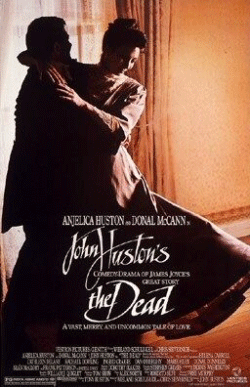
The first snow came early this year in Western New York. Though I may say this every year, for the first time "ever" I was shoveling in the dark in mid-November. This early December morning when I woke up in the dark, it was as I suspected: a light snowfall extending the anticipation of the holiday season had fallen again. Though it was only what amounted to a half inch or so, it was just enough to set the pavement aglow under the street lights. The pre-Christmas snowfall of winter, or more to the point, the apparent magic of it, often brings me back to a short story by Irish writer James Joyce from his collection The Dubliners, and by extension to the 1987 film adaptation of the same story directed by John Huston, James Joyce's The Dead.

The year 1987 was my first as a college undergraduate, and, like many, home from my first semester in December, I felt a sense of invincibility and wonder. It was my first time away from home for an extended period of time, and my first taste of (arrested) adulthood, code for being able to make all the dumb mistakes that first year college students do. This was also a time of little meaningful reflection allowing for the quick dismissal of mistakes with little understanding of what things really meant.

While on break, my brother and I went to a local art house to see The Dead. I was armed with one World Literature course (and the powerful understanding of the literary term "epiphany"), so, of course, I was an expert in artsy-fartsy books and movies. So away we went. For all I really knew at the time, The Dead could very well have been a Victorian era zombie movie, but what I experienced that evening (and much more powerfully so in later viewings) was a moving meditation on insecurity, nostalgia and love.

IMDB describes the film thusly: "Gabriel Conroy and wife Greta attend a Christmas dinner with friends at the home of his spinster aunts, an evening which results in an epiphany for both of them," and despite the seemingly dry set-up its the actors and director Huston who turn the subject matter into compelling viewing. The lead actors, Angelica Huston (Greta Conroy) and Donal McCann (Gabriel Conroy) bring to life the two "literate" characters with performances that are both celebratory (the dinner party) and melancholy (Michael Furey's final romantic gesture).

Those ready for a moving holiday film experience will not be disappointed. For myself, rewatching the film over the years, its themes naturally grow more meaningful to me, just as the feelings at Christmas time become grow more complex. For whatever reason this movie is very difficult to find online, so a public library may be your best bet. Even better yet read the short story in The Dubliners before seeking it out.

Sunday, January 14, 2018

Organizing Titles: Sci-fi Books


After multiple moves and seasonal cleaning flings, what remains of my book collection are those with either a high level of re-readability or a personal connection. While some were gifts (my son bought me 10 Billion Days and 100 Billion Nights nearly six Christmases ago), others are titles acquired at different stages in my life (the original Dune series were given to me in a paper bag rescued by a co-worker cleaning her garage--and quickly devoured--during my divorce 17 years ago). It's not just the memories of each book's content, but the nostalgia provided via the tome's acquisition. It's true that even after being read and shelved and re-read, some titles continue to grow.

Remnants of fancies past still present themselves in the forms of duplicate copies of the same title by different publishers. Though this phenomena is occasionally the result of my repurchasing a title because I forget that I had it, or had lent it out when I really needed to read it, most are the product of collecting. Back when used book stores were more plentiful, I would come across editions with interesting covers or alternate forwards and pick them up for a dollar or two. The older I have grown, the less likely I am to do this, though multiple copies of Stranger in a Strange Land reveal that my forgetfulness is still a factor.

Not surprisingly, going back through titles also elicits a few pangs of regret. For example, at one point I had the complete Riverworld series by Philip Jose Farmer, where now only the first, To Your Scattered Bodies Go, remains. Fortunately, lost or misplaced titles are quickly replaced by new once as my affection for Science-Fiction as a literary genre only continues to grow...

Bookshelf Titles
  • Asimov, Isaac. Foundation.
  • Barlowe, Wayne. Barlowe’s Guide to Extraterrestrials.
  • Bradbury, Ray. The Illustrated Man.
  • Bradbury, Ray. The Martian Chronicles
  • Burroughs, Edgar Rice. A Princess of Mars.
  • Clarke, Arthur C. Childhood’s End.
  • Clarke, Arthur C. Rendezvous with Rama.
  • Dick, Philip K. Blade Runner (Do Androids Dream of Electric Sheep?).
  • Dick, Philip K. Ubik.
  • Dick, Philip K. Valis.
  • Eisler, Steven. Space Wars: Worlds and Weapons.
  • Farmer, Philip Jose. To Your Scattered Bodies Go.
  • Heinlein, Robert A. Stranger in a Strange Land. x2
  • Herbert, Brian. Dreamer of Dune (Frank Herbert Biography).
  • Herbert, Brian and Anderson, Kevin J. Dune: House Atreides.
  • Herbert, Brian and Anderson, Kevin J. Dune: House Harkonnen.
  • Herbert, Brian and Anderson, Kevin J. Dune: House Corrino.
  • Herbert, Brian and Anderson, Kevin J. Dune: The Butlerian Jihad.
  • Herbert, Brian and Anderson, Kevin J. Dune: The Machine Crusade.
  • Herbert, Frank, Herbert, Brian and Anderson, Kevin J. The Road to Dune.
  • Herbert, Frank, Herbert, Brian (Editor). The Notebooks of Frank Herbert’s Dune.
  • Herbert, Frank. The Book of Frank Herbert.
  • Herbert, Frank. Dune. x3
  • Herbert, Frank. Dune Messiah. x3 
  • Herbert, Frank. Children of Dune. x3
  • Herbert, Frank. God Emperor of Dune. x3
  • Herbert, Frank. Heretics of Dune. x2
  • Herbert, Frank. Chapterhouse: Dune. x2 
  • Herbert, Frank. The Worlds of Frank Herbert.
  • Huxley, Aldous. Brave New World.
  • Huxley, Aldous. Brave New World Revisited.
  • Kirkman, Robert and Bonansinga, Jay. The Walking Dead: Rise of the Governor.
  • Kirkman, Robert and Bonansinga, Jay. The Walking Dead: Road to Woodbury.
  • Le Guin, Ursula K. The Lathe of Heaven.
  • Lem, Stanislaw. Solaris.
  • Miller Jr., Walter M. A Canticle for Leibowitz.
  • Moorcock, Michael. The Final Programme.
  • Murakami, Haruki. Hard-Boiled Wonderland and the End of the World.
  • Mitsuse, Ryu. Smith, Alexander O. (Translator) 10 Billion Days and 100 Billion Nights.
  • VanderMeer, Jeff. Annihilation (Southern Reach Trilogy Book 1). 
  • VanderMeer, Jeff. Authority (Southern Reach Trilogy Book 2).

Friday, September 30, 2016

Reviewing the Old Ways the Old Way

Original box for Gary Synder's audio book The Practice of the Wild (1991).
Despite his voice being a touch higher than I recall, perhaps due to the tape being too tightly wound on a long undisturbed cassette, The Practice of the Wild cassette book is very much how I recall the poet sounding back in 1991 when I heard him speak at Nazareth College. At least I think it was Nazareth College. While cleaning out the attic a few weeks ago, I came across a small collection of books-on-tape that I purchased shortly after  graduating from college with my undergraduate degree in English Literature/Secondary Education. Among them was the aforementioned double cassette. In an age of digital sound, listening to the tapes took a little effort, especially as we, like most American homes, have converted everything to CDs and digital download. After procuring my late father's Walkman, I was ready to take another walk in the woods...

Like many college English Literature majors, I was introduced to the work of Gary Snyder in an introductory poetry course, and as a young man growing up in an urban neighborhood attending Catholic elementary school, the content and perspective was exotic and new. At the time, I had not traveled beyond the freeway connecting our home to my relatives' outside Pittsburgh, Pennsylvania, and the idea of anyone espousing a belief system outside a Judeo-Christian one was unfamiliar to me. Snyder's poetry then was a gateway to the larger school of thought he represented and further (if not a touch more concretely) articulated later in a number of essay collections. If the earlier Earth House Hold (1969) or Myths and Texts (1960) appealed to the revolutionary spirit most moderately embrace in undergraduate studies, the nine essays that comprised The Practice of the Wild spoke to the adult domesticity I found myself accepting as a parent shortly after graduation.

The Practice of the Wild (1991) double cassette runs 3 hours and is a traditional book on tape in that its contents reflect those of the original text, published a year earlier in 1990. Having the text read by Snyder lends an added sense of gravitas and nobility to the its already comforting and airy message. In many ways, my experience to listening to Snyder's verbally share his work is reminiscent of listening to classic music on the way  to work with my untrained ear. Both are incredibly comfortable auditory experiences that establish an educated yet grounded mood. On rare occasions some small understanding is revealed to me as the recipient.

Much like a film with many quotable lines, The Practice of the Wild has many phrases and sayings that since its initial publication have become popularized as inspirational quotes, such as “With no surroundings there can be no path, and with no path one cannot become free.” Also like a quality movie with many good lines, the parts are even stronger when taken as part of a whole. The tape (and book) both add depth and meaning to Snyder's personal philosophy of compassion for all sentient beings, a class in which he includes mountains, trees and water. Key to continuing to foster and nurture this relationship with all beings is allowing our language to grow and develop in a manner that suggests the interdependence necessary for survival. "Wild," "nature," and "place" are just three of the words that Synder's clarification of within the context of his environmental politics, serve as common entry points for those unfamiliar with his thinking. As someone who is superficially aware--and deeply appreciative of--Snyder's work, I find myself always in need of a re-engagement with his brand of deep ecology. This rewiring of our linguistic present is just a precursor to what Snyder hopes will blossom into a radical restructuring of modern living in accordance with his ideas.

I seem to recall having seen a more current version of The Practice of the Wild text with the audio book included, but was unable to find it on line. Fortunately, Snyder is such a beloved literary-cultural figure that many of his speaking appearances and interviews have been capture on video and are available for viewing on YouTube. If unable to find the book-on-tape, you could do much worse than spending a few minutes with Gary Snyder at Colorado College in 2015. 

Tuesday, September 06, 2016

Roadie: FDR Presidential Library & Museum

The FDR Presidential Library & Museum located in Hyde Park, New York. (9/3/16)
On Labor Day weekend, my wife and I once again made our way to New York City. Four years ago it was an anxious train ride to deliver my stepson to Columbia University for his freshmen year; this year, his final one as an undergraduate, was a much different trek. Having spent the summer in New York City, the majority of his belongings were already there, and rather than escorting him to campus, as he departed our home in Rochester, my wife and I left by car. When he arrived in town to settle in in on Saturday afternoon, we were arriving in Poughkipsee, New York, for some sightseeing before taking the train to visit the following day.

At this point Gregory really doesn't require much help moving, but we wanted to see his new dorm and decided to make a weekend out of it. Having Gregory go to college in New York City has provided Anne and I with many opportunities to visit a number of the historical sites in and around New York City, and this final September journey was no different--except that we were not solely in Gotham.

A National Historic Site, The Frederick Delano Roosevelt Presidential Library and Museum, operated by the National Park Service, is located on the grounds of Springwood, the Roosevelt family estate in neighboring Hyde Park, New York. With Poughkipsee only a manageable two-hour train ride from New York City, its location was ideal as a base of operations for a day trip to the FDR National Park prior to heading to NYC. We would have liked to have spent more time in Hyde Park, as the four hours we did spend visiting was only enough to see a small part of the park's offerings. The library was built under the President's personal direction in 1939-1940, and dedicated on June 30, 1941. It is one of the thirteen presidential libraries under the auspices of the National Archives and Records Administration.

Close-up of FDR bust outside museum. (9/3/16)
Given their four terms in office, it is not suprising how quotable
President Roosevelt and his wife turned out to be.


Not a recreation, but FDR's working study in the museum during his life. (9/3/16) 


The President's desk from his time in the Oval Office. (9/3/16)

Busts of FDR and Eleanor Roosevelt welcome visitors to the museum. (9/3/16)
Picturesque park land immediately outside the museum. (9/3/16)
Looking back through these images from our visit to the FDR Presidential Library and Museum, I am struck by how poorly they reflect how incredibly entertaining and educational this historic site is. As someone with not nearly as deep an understanding of U.S. history as he should, while visiting places I am often more focused on taking the displays in than capturing the experience on "film". In addition to the few displays seen above, there are also six-minute films for viewing prior to each section of the museum. Each included archival footage and were thoroughly engaging. Ranging from FDR's childhood and early political life to an exploration of his lasting influence on the world, narrated by President Clinton, taken as a whole they provided wonderful context and background.

When we met Gregory the following day in New York City, both Anne and I highly recommended that he take some time to visit the FDR Presidential Library and Museum in Hyde Park.

Sunday, March 27, 2016

Roadie: Columbia Crew at Collins Cup


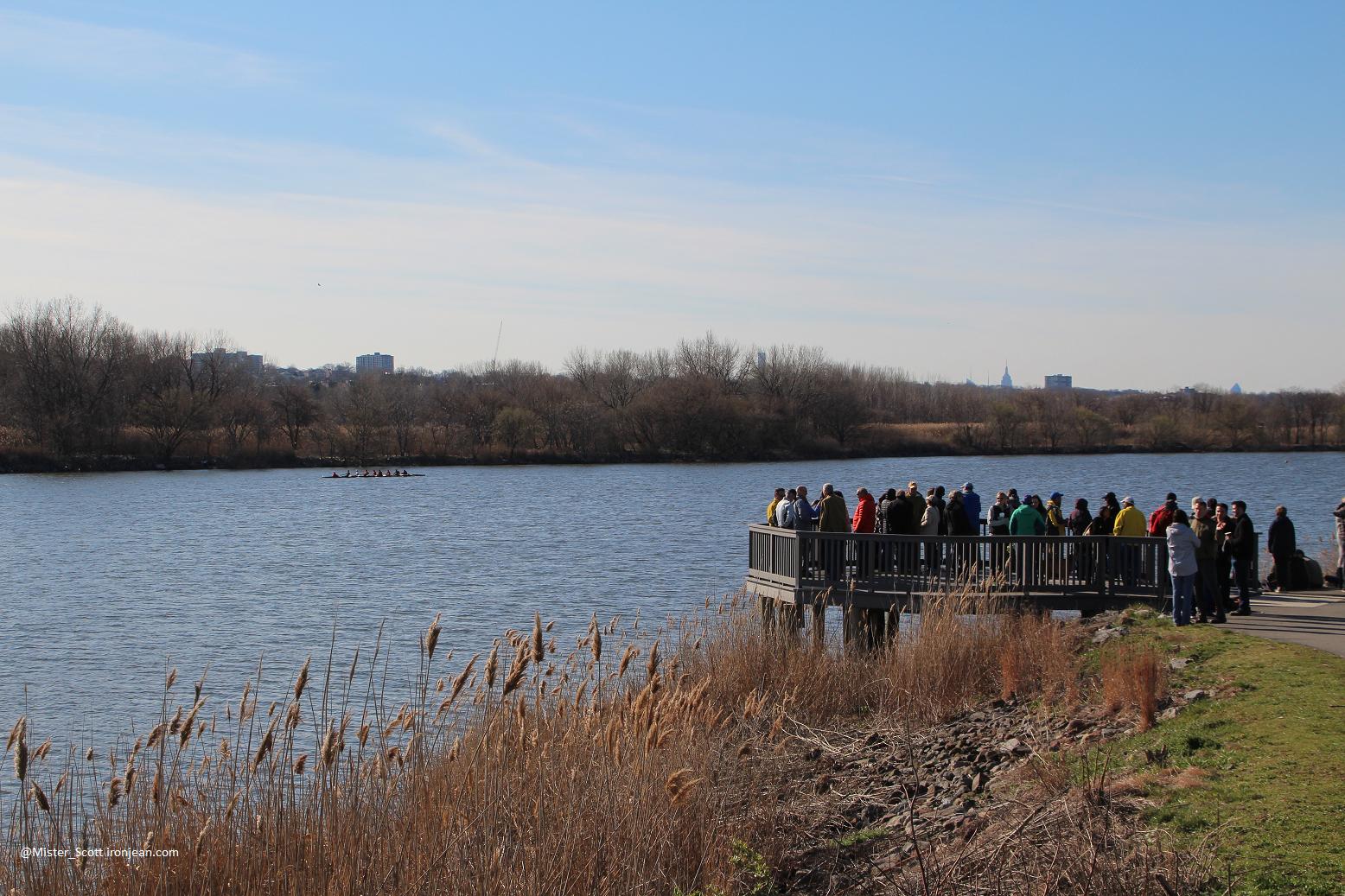
With Spring Break and a long Easter weekend looming, Anne and I made the road trip to New Jersey to watch Gregory and the Columbia Heavyweight Crew squad compete with Rutgers for the Collins Cup. Given my cross-country and Track and Field coaching schedules, this was the first opportunity I have had to see him row in a collegiate race so we took advantage of it. During the spring season, regatta's consist of "sprints," or head-to-head, match-ups which also make for a more interesting spectator experience. We stayed at a hotel near Overpeck Park, in Leonia, New Jersey, where Columbia University's Spring season practices and sprint regattas are housed at their "Boathouse West."


Monday, October 19, 2015

NYC Roadie: Chelsea Market & The High Line

Exterior signage reflects Chelsea Market's Meatpacking District location. (10/17/15)
Visiting my stepson for Columbia University's Parents Weekend, Anne and I continued looking for new parts of New York City to take-in during our time there. This past weekend, in addition to checking out a few previously untested comic book (and book) stores, we made our way to Chelsea Market and The High Line. Because one (Chelsea Market) is partially located beneath the other (High Line), the "double dip" was an easy one to accomplish. As is so often the case, there was much more to potentially experience (foods, views, people-watching) than we were able to take in during the time we had available.

Halloween decorating was in full-swing in Chelsea Market. (10/17/15)
Both locales are excellent examples of the re-use of existing (and previously out-of-use) city space. The High Line consists of a converted out-of-use railroad trestle while Chelesa Market is comprised, in part, of old Nabisco factory.

It is New York City, so naturally, someone was filming something.
What do you know, it's Edgar Allan Poe! (10/17/15)
High Line Park. (10/17/15)

Above Chelsea Market, the High Line passes through the building on the 10th Avenue side. Opening in Spring 2009, this abandoned, elevated railroad track has been converted to an urban oasis or greenway, which now forms a continuous route between the Javits Convention Center and the trendy Meatpacking District.

My wife, Anne, with a multitude of "friends," at the High Line. (10/17/15)

View from within the High Line. (10/17/15)

Public artwork adds visual flair. (10/17/15)
Pubic walkways through the park. (10/17/15)
Mt stepson, Gregory, and I. (10/17/15)

Exiting the High Line. (10/17/15)