Showing posts with label language. Show all posts

Sunday, April 05, 2020

My Notebooks & I

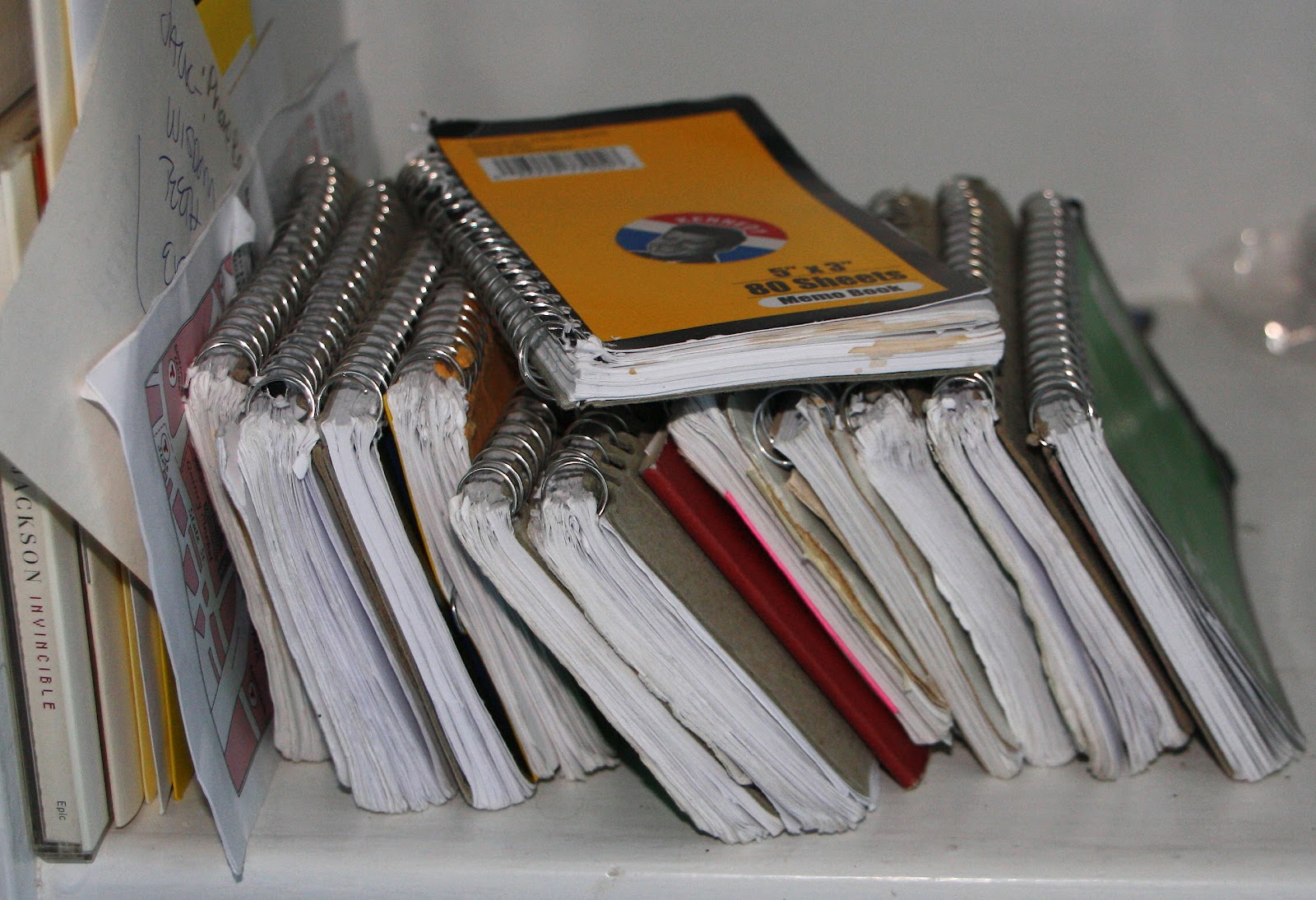
A few of my notebooks, and, yes, Michael Jackson's Invincible CD from 2001.
A basic suggestion that I have for my highschoolers who enjoy writing, but find themselves at a loss for subjects or ideas, is to carry a notebook with them during their daily travels. In the modern age, of course, you could sensibly substitute some sort of i-thing, I prefer ye ol' pen and spiral bound notebook approach. (Full disclosure: I have on occasion used the "Notes" function of my cell phone.) For times such as the current quarantine, they also provide an interesting way to look back on prior thinking and experiences as a means of mining for subject matter.

My thought process: connecting
Into Thin Air to Shakespeare
to Star Trek V.
In my estimation, this is slightly different than the Writing Journals I have my own students keep in class, though ideally the outcomes of  are similar. Those of my students who most seek to develop their skill (and love) of writing seem to understand and embrace the idea of two writing "journals': one for school that is more teacher directed and a second that is personal.

If math classes can watch Numbers
as curriculum, why not
CSI:NY for English?
In-class journaling is among the most enjoyable activities I have my students work on year long, for both of us. A subtle distinction is to be made between the two (in-class and in-pocket) writing journals. Different than a personal journal, or traditional diary, in-class writer's notebooks allow students to explore potential writing ideas at their own pace with the guidance of their teacher.

In all of my grade 11 (and in years past, 9, 10 and 12) English classes, students are asked to bring a Composition Book on the second day of school for safe keeping in our classroom. I recycle those left behind by prior students (after removing the completed original owner's entries) or purchase new ones for those who don't have access to supplies outside of school. Every few classes, students are provided with a prompt to get their writing juices flowing. While these entries are evaluated with points and feedback, the evaluation is not for content in as much as for quantity of information put forth and the quality of details provided (or whatever is is loosely prescribed by the prompt). Grammar, punctuation, consistent verb tenses are not important, I am looking for thinking.

I warned you that it was
bad imagery.
Personally, I am a proponent of the personal diary (or to confuse matters more, "personal journal") for my own purposes. While I, too, respond to the same prompts my students do as a means of modeling, I also almost always have a small spiral bound notebook with me (preferably in my shirt pocket). There, I keep notes as I fumble through my days. Some of what I scribble is related to work activities that I need to follow through on, items I need to pick up on the way home, books/artists/authors/websites that are mentioned to me in passing that I would like to learn more about, and even recipes that may be fun to make at home. Mixed in is the occasional story idea, image that has struck me, or haiku jottings.

The key for me here is that while these may seem like a disjointed collection of notes, ramblings or badly conceived poetry drafts, ultimately they may (just may) serve as fodder for some later project or piece I am moved to draft for my own pleasure. More often they just become part of a collection of notebooks that I'll thumb through for inspiration when none is to be found elsewhere.

But, for now anyway, they wait quietly on my shelf awaiting future mining...

Sunday, August 19, 2012

"Huzzah" for English!

Faneuil Hall and Samual Adams in Quicney Market, Boston (7/27/12).
During the past few summers, my wife and I (along with any combination of our two sons) have been fortunate enough to visit a number of historical sites. Destinations have ranged from "go to" stops such as Colonial Williamsburg in Virginia and the Pony Express Station in Gothenburg, Nebraska, all the way to the less frequented sites such as Deadwood, South Dakota. Often we'll stop along the way to other places to check out whatever Americana there is to see. While our destination may not be any specific historical site, we'll often try find a way to mix in some U.S. History. This past summer, on our college visit to Harvard for my stepson, we naturally took time to check-in on the sites in historic Boston, Massachusetts.

Purchased at Faneuil Hall.
While in Boston, we made the standard stop to the most touristy of all sites, Quincey Market. (Having been on field trips with middle schoolers to Boston, it is among the most requested sites to visit, not for the history, but for the shopping.) Part of the Freedom Trail, Faneuil Hall, has served as a marketplace and a meeting hall since 1742, and has also been the location of many inspirational speeches by significant figures in American history such as Samuel Adams, whose statue outside the Hall is seen in the picture above.

At one end of the Market, not long after exiting "The T", we stopped to look around the gift kiosk inside the Faneuil Hall. It was there that I found the small button exclaiming "Huzzah!" (left). This got me thinking...

Having employed the interjection on occasion during class, I know the blank stares of students who have no idea what you've said, so I purchased the button as a conversation starter around the changeable nature of the English language. A point further reinforced this past summer with the announcement of addition of new words to Webster's Dictionary  (like "f-bomb" and "sexting") to Webster's Dictionary, it is extremely valuable for students to recognize the at our language is continually evolving around us.

This is especially true as many of these changes, including those not included in any "respectable" dictionary, are the result of their use by the youth culture, though not many students use other new additions like "obesogenic" and "flexitarian," so there remains a role for we older cats in developing language, too. (Be prepared: It's not a stretch to project the future inclusion texting and online jargon into more common usage in the not-too-distant future.)

For those of you, like I, looking to bring an oldie-but-goody back, I invite you to continue using "huzzah." Just because a term has fallen out of common usage doesn't mean it can't be prime fro a comeback, just be sure to use it correctly let it return with a different connotation. Our friends at Wikipedia (with a touch of Dictionary.com phonetics) can define it more expediently than I:
huzzah ([huz·zah] also [h-zä])is "an archaic English interjection of joy or approbation. According to the Oxford English Dictionary it is 'apparently a mere exclamation' ...used to express joy, encouragement, or triumph. Whatever its origins, it has seen occasional literary use since at least the time of Shakespeare."
Historically , "huzzahs" were given before a bayonet charge, as a way of building morale and intimidating the enemy. The interjection can still be heard in a more modern context (tongue in cheek) at regatta's by  rowing crews to celebrate victories with a chant of "hip hip huzzah" or (where most folks, including my students) have experienced it, at Renaissance Festivals.

Huzzah for English, and for school starting soon, too!