Showing posts with label literary terms. Show all posts

Wednesday, December 16, 2020

Winter Movies: James Joyce's The Dead

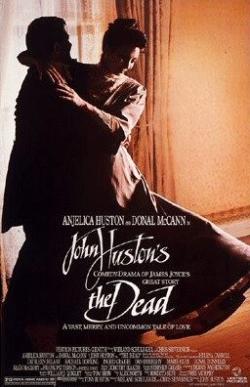
The first snow came early this year in Western New York. Though I may say this every year, for the first time "ever" I was shoveling in the dark in mid-November. This early December morning when I woke up in the dark, it was as I suspected: a light snowfall extending the anticipation of the holiday season had fallen again. Though it was only what amounted to a half inch or so, it was just enough to set the pavement aglow under the street lights. The pre-Christmas snowfall of winter, or more to the point, the apparent magic of it, often brings me back to a short story by Irish writer James Joyce from his collection The Dubliners, and by extension to the 1987 film adaptation of the same story directed by John Huston, James Joyce's The Dead.

The year 1987 was my first as a college undergraduate, and, like many, home from my first semester in December, I felt a sense of invincibility and wonder. It was my first time away from home for an extended period of time, and my first taste of (arrested) adulthood, code for being able to make all the dumb mistakes that first year college students do. This was also a time of little meaningful reflection allowing for the quick dismissal of mistakes with little understanding of what things really meant.

While on break, my brother and I went to a local art house to see The Dead. I was armed with one World Literature course (and the powerful understanding of the literary term "epiphany"), so, of course, I was an expert in artsy-fartsy books and movies. So away we went. For all I really knew at the time, The Dead could very well have been a Victorian era zombie movie, but what I experienced that evening (and much more powerfully so in later viewings) was a moving meditation on insecurity, nostalgia and love.

IMDB describes the film thusly: "Gabriel Conroy and wife Greta attend a Christmas dinner with friends at the home of his spinster aunts, an evening which results in an epiphany for both of them," and despite the seemingly dry set-up its the actors and director Huston who turn the subject matter into compelling viewing. The lead actors, Angelica Huston (Greta Conroy) and Donal McCann (Gabriel Conroy) bring to life the two "literate" characters with performances that are both celebratory (the dinner party) and melancholy (Michael Furey's final romantic gesture).

Those ready for a moving holiday film experience will not be disappointed. For myself, rewatching the film over the years, its themes naturally grow more meaningful to me, just as the feelings at Christmas time become grow more complex. For whatever reason this movie is very difficult to find online, so a public library may be your best bet. Even better yet read the short story in The Dubliners before seeking it out.

Tuesday, October 08, 2019

Hallow-Reading: At the Mountains of Madness: The Definitive Edition

Like many avid readers who have certain books that they enjoy, this is not the first time I've read H.P. Lovecraft's, At the Mountains of Madness, a fairly short (in terms of page count), but dense (regarding descriptive language and vocabulary) horror novella. Just as in order to consider oneself to be "well-read," a reader must have engaged with one of the Bronte sisters at some point, it would be hard to take someone seriously as a well-rounded student of literature who has not at least sampled Lovecraft if not as recreational reading, then as a student of genres. Too often, I think horror, like romance, is marginalized and compartmentalized so as to be seen as unworthy. Au contraire, mon frère!

Though I would classify AtMoM as more of a short story (albeit an extended one), the hook for my reading of this recently published "Definitive Edition" was the new introduction by British author (and occasional comic book writer of DC Comics's 2012 Dial H series) China Miéville. Beyond Lovecraft's tale, it is Miéville's analysis that this comment will focus in great part on.

Here is a brief teaser for AtMoM (BarnesandNoble.com): "The Barren, windswept interior of the Antarctic plateau was lifeless—or so the expedition from Miskatonic University thought. Then they found the strange fossils of unheard-of creatures...and the carved stones tens of millions of years old...and, finally, the mind-blasting terror of the City of the Old Ones." This is one of Lovecraft's pieces that would become integral to what is now understood as "the Cthulhu mythos."

The thing about AtMoM, and Lovecraft's work in general, is that much of the imagery contained therein has so permeated our popular culture by this point that most folks don't even know enough to recognize the original source. From the recent film Prometheus (2012), to the many video game (the Gears of War trilogy and Borderlands to name two) character designs to list, Lovecraft's detailed and dark descriptive language has been lifted to such an extensive degree that what was once perceived to be iconic can now be mistakenly thought to be common. What Miéville' introduction (which includes some spoilers for the uninitiated) does is to offer some historical context to Lovecraft's style and craft that creates an interesting gateway to deeper literary analysis of fiction writing in general, and the horror/supernatural genre in particular.

In the "real world" I am a high school English teacher, and can attest to the fact that deep literary analysis, beyond simply identifying basic literary strategies at work, and a somewhat superficial presentation as to the reasons behind the author's choice of strategies, is among the most challenging skills for students to master in an authentic voice. Unfortunately, it is also a skill that is not meaningfully tested on government mandated assessments and so is deemed unworthy of extensive effort in most classrooms.

As I read Mieville's essay, I considered how I could use it in some more advanced classes as an example of deep literary analysis as it touches on some important considerations that excellent students are capable of making, given the opportunity. In fact Mieville's thesis (from the second paragraph), points the reader in the proper direction for initial analysis: "... we must see Lovecraft as a product of his time. We can make sense of him, and his astonishing visions, only to the extent that we understand him as defined by the specific horrors, concrete and psychic, of the early twentieth century."

Also included as part of The Definitive Edition is Lovecraft's own literary analysis piece "Supernatural Horror in Literature." Whether as entertainment (for which this edition is not necessary and much of Lovecraft's stories are available in most good public libraries) or for an academic burst of analysis, I recommend At the Mountains of Madness for an eerie and breezy summer read. If you'd like to borrow this edition (or another), please let me know and I'd be happy to share.

You do think of yourself as "well-read," no?

Tuesday, January 07, 2014

Entertainment Archetypes

From page 47 of the November 8, 2013 issue of Entertainment Weekly.
It seems as though this year I have had literary archetypes on the brain.

This all started when reviewing potential titles for reading in AP 12 English this year (my first time with the course). To make the analysis of each piece more manageable for both myself and my students, I'll often look for some "connective tissue" between works that can be used as a gateway to deeper analysis. Given some of the potential titles (Beowulf, Frankenstein, The Hobbit, Macbeth, The Canterbury Tales), a the potential for using basic character and thematic archetypes beginning with Seamus Heaney's Beowulf and moving toward a deeper consideration of the Heroic Journey (with significant help from Joseph Campbell, naturally) with The Hobbit seemed a natural, if obvious, direction to go in.

While sitting at the doctor's office last week, I was pleased to come across some more modern examples of preliminary literary archetype analysis in a relatively recent issue of Entertainment Weekly. Not surprisingly, the cinematic Sauron (the big bad from The Lord of the Rings Trilogy that follows Tolkien's The Hobbit) makes an appearance.The brief grid also opens the possibility for legitimately sharing Toy Story 3 (courtesy of literary character Cathy Ames cinematic  ancestor Lotso) during a future flex class (just kidding... kind of)!

Sunday, December 08, 2013

Amer-OAR-can Gothic

Last week, I posted an example of a graphic "allusion" to my passion du jour, George R.R. Martin's A Game of Thrones, in an Angie's List mailer. Upon further review, I believe I chose the incorrect term to suggest what was happening. While I claimed "allusion," the cover art can better be described as an example of "appropriation." This subtle distinction is... uh... appropriate as the source which was being referenced (an iconic image associated with the television show) was graphic, rather than textual, in nature.

According to Wikipedia: "Appropriation in art is the use of pre-existing objects or images with little or no transformation applied to them... Appropriation can be understood as 'the use of borrowed elements in the creation of a new work.'" Armed with this new information, when I came across another example, one generated from a quip to my students and to be shared more formally on the next A Day, I am glad to have the correct language with which to explain.

Another Term of the Day I shared with my high school English classes recently was "Gothic." While a term they had been introduced earlier in the year while reading representative selections from both English and American literary movements, in an effort to find relevant grammar/literary terms for sharing on "G Days" (it's a somewhat complicated A through J school day rotation schedule), it seemed a more interesting class starter than "Gerund."

American Gothic (1930) by Grant Wood and cover to the 2013 Princeton 3-Mile Chase Regatta program.

In passing, the title to Grant Wood's familiar painting, American Gothic, came to me and I inquired if students were familiar with the painting. Though none could recall it by name, once I described the image of the rural American farmer in overalls with pitchfork and his dour-looking wife, more than a few hands went into the air. American Gothic by Grant Wood is one of the most familiar images in 20th-century American art. It has also been widely parodied and appropriated within American popular culture, earning I high level of visual recognition.

This past October, my stepson rowed in the Princeton 3-Mile Chase Regatta on Lake Carnegie in New Jersey. Unfortunately, work commitment precluded my going, but my wife did take the trip and returned with the event flyer. As fate would have it, the flyer featured an appropriation of American Gothic for it's cover. in  addition to a more minimalist depiction (and slightly more positive expressions on the two primaries' faces), the most signification (and appropriate) alteration was the replacement of the pitchfork with A Princeton Tigers "blade."

The layers of influence on our culture, whether "allusion" in novels, "appropriation" in art or even "sampling" in music, is dense and multi-layered. As always, however, the mantra I repeat to my students suggests how we can limit or open our analysis to observing these strategies at play: The more deeply and broadly you are read, the more these nods and influences will reveal themselves to you!

Thursday, November 21, 2013

A Game of Allusions

The cover to Angie's List recent mailer and a pormtoinal poster for season one of the HBO's series.
As I continue my literary journey through the Song of Fire and Ice series by George R. R. Martin, I can't help but have A Game of Thrones on my mind. Especially satisfying is being able to talk with students about the novels and how they relate to our recent study of Seamus Heaney's translation of Beowulf. The common archetypes present in both selections as well as in the ever-popular Tolkien novels, have been been gateways to exciting and refreshing class discussion. That talks occur with teens about story lines from the Thrones novels (interestingly, most have enjoyed the books and not yet seen the HBO series) is a tribute to the far reaching appeal of Martin's literary work, and because both fantasy works share such familiar archetypes (patterns and forms) it is not surprising that we find them resurfacing in even more unlikely places. So widely read and appreciated are the Lannisters and Starks, that even organizations and companies that one wouldn't necessarily associate with the fantasy genre can't help but make a healthy, if somewhat obvious, attempt at appealing to the audience through their promotional materials. One such allusion turned up in my mailbox earlier this month, care of Angie's List.

A concept building off a common euphemism for a toilet, Angie's List's recent mailer featured the headline, "Change of Thrones." The visual accompanying the title utilized a variation on one of the series' strongest iconographic visuals, Eddard "Ned" Stark sitting upon the Iron Throne of Westeros. The combination of both title and visual completes the allusion which at first glance is literary in nature, but given the success of the show, can properly be identified as a cultural allusion, too.

The only aspect that draws me outside the intended reference is the costumed(?) character standing in for Ned. I wonder what someone who has had no prior engagement with the Game of Thrones phenomenon would make of a superhero sitting upon a throne of plungers with toilet paper piled in the background?

Saturday, August 17, 2013

Why Flash Rhetoric Cards?

As a teacher, I realize each June that there is always something I can do to improve upon the quality of my instruction. Often these epiphanies do not result from personal reflection, but from the responses students give me on the blind surveys I periodically ask them to complete. The purpose of these surveys is to help me do a better job helping them, and this often has to do with tweaking existing processes or procedures so that they are more effective.

For many years now, I have required my Advanced Placement Language and Composition students to maintain a deck of flashcards which I call "Rhetoric Cards." This is by no means an original idea of mine, except that (at least initially) some students resist the task as they deem it elementary--at least in the context of a high school English class (his practice is very familiar to them in their foreign language studies). Once they poo-poo this strategy, I remind them that the purpose of the cards is not to promote the rote memorization of every vocabulary word but to have a tactile resource for relevant Tier 3 terminology at their disposal when reading or analysing text that they can go through. Given the thousand possible rhetoric terms that may turn up on the exam, I have chosen to focus on 100-120 that are most likely to occur or that (minimally) provide them the best opportunity to eliminate possible answer on multiple choice questions.

In my classes, we use the Rhetoric Deck as a tool for learning important Tier 3 terms. Tier 3 vocabulary consists of low-frequency words that occur in specific domains. Domains include subjects in school, hobbies, occupations, geographic regions, technology, weather, etc. Generally these terms and concepts are introduced when a specific need arises, such as learning "amino acid" during a chemistry lesson, or "litotes" in the study of rhetoric. Some common examples of the terms I required students to define and "card" during summer (in concert with reading Thank You for Arguing by Jay Heinrichs) include antithesis, tautology and decorum.

My epiphany around Rhetoric Card usage came when, last June, a few students suggested that the cards had a diminished value as the year progressed. While this can be seen as a positive (as students internalize the definition and application of the term/concept, they need the cards as a resource less), I was reminded that there are some students who never caught on to the task meaningfully in the first place. That is to say, some students failed in September to begin a deck and consequently never kept adding concepts and ideas as the class (and better students) progressed. In effort to maximize the potential value of this activity, I am committing this coming school year to insuring that I check them more frequently early on, and that as we move through the curriculum students and I physically interact with the cards more regularly through some term chunking and kinesthetic organizing.

Some interesting related articles:

Wednesday, May 29, 2013

American Sentences Redux

Two examples shaped from my own freewriting in class.

Following our recent work with the traditional 5-7-5 haiku format (albeit with subject matter that was more reminiscent of a senryu), I decided to continue an exploration of compressed language forms by introducing my AP classes to a new, less well-known play on the 17 syllable poetic form, the American Sentence. A truly Western take on the Eastern haiku, this form originated by late Beat poet Allen Ginsberg.

"Publishing" student work from class chart paper drafts.
Ginsberg saw haiku, and the American sentence, as a means of compressing poetry to get "Maximum information" with "minimum number of syllables.” This compressed form allowed for the possibility that Ginsberg's notion that poets are people who notice what they notice could be accessible to everyone.

Though some of my students struggled with writing "good" haiku, I'm hoping that the more concrete, urban bent of the American Sentence will make for more lively, dynamic drafts. I have taught this form for nearly three years now with what I have felt have been pretty good results. The move from haiku to American sentence is a natural one. While still adhering to the 17 syllable standard of the traditional haiku, the imagery included in the American sentence is presented in a linear fashion reflective of the left-to-right reading of English as opposed to the top-to-bottom approach in Japanese haiku.

The process of crafting American sentence is one that lends itself to the existing management activities in my classroom. Students know to pick up their writing journals each day upon entering the classroom. Before even revealing the form, I ask them to freewrite about the lends itself easily to classroom writing process, beginning with a free write. This will give the writer the "clay" with which to shape their lines. The prompt is straightforward: In the next 6 minutes, relax, observe and capture via free write personal sense-based observations about the world around you (our classroom). Use as descriptive a language as you are capable. While it is not incumbent on you to use figurative language strategies, you may find that they come to you—write them down.

Following this journaling exercise, I introduced the class to the form more, well, formally. Based on my own research,  I suggested to the class that an exemplary product would include at least one of the following:


After sharing my own freewrite notes, and modelling the culling of a few possible images for further development into "popping" American sentences, I share the following quick-and-easy process for crafting their own:


As a ways of making the form more collaborative, I asked students to contribute to a chain of lines, by first writing two American Sentences, then selecting the one they felt best met the criteria (evocative, imagisitc, approximately 17 syllables in length). This activity was completed for each of my three Advanced Placement Language and Composition courses, resulting in three community  poems of 20+ lines apiece.

After sharing our class collaborative American Sentence Chain, I task each student with taking the activity home to their friends and families. Students were assigned to both explain this unique poetic form to their victims volunteers and facilitate each person's development of a unique, personal American sentence. The final 17 syllable (fingers-crossed) sentence,  was to then be added to the student's own American sentence chain.

Of course, if the syllable count varies slightly, that's "all good." The American sentence was the result of Ginsberg believing that haiku in the Western tradition placed too much emphasis on counting (syllables), at the expense of developing image. The goal, as with a haiku, is to communicate and image, and if you're luck (or good) evoke a response in the reader.

Friday, May 03, 2013

Wild Turkeys On the Loose!

"Those birds are nasty s.o.b.s," says a colleague in-the-know. (4/28/13).
Stepping into my mother's backyard late Sunday afternoon, I was (for the second time this spring) greeted by a roving band of wild turkeys. They looked to be on a mission.  Quickly making their way down the neighbor's backyard hill, in single-file formation no less, they seemed unfazed by my precesne atop the incline. There seemed enough time to attempt some better shots.


"Single-file wild turkeys" must be an oxymoron, right? (4/28/13).
Picking my camera up from the kitchen table, I headed back outside. Surprisingly the turkeys were not all that startled by the inadvertent banging of the screen door. Two huddled briefly to look around before returning to the rank and file of the roaming quartet.

Wild turkeys cleverly hiding behind a tree. (4/28/13).

During the time I was observing them, about 15 minutes en total, I heard a fifth turkey calling from what seemed to tbe the trees. My mother has previously spoken about seeing them sleeping in the trees. While I looked as carefully as I could, nothing resembling a winkled old man was to be seen sitting in the bare branches overhead.


That's all folks! (4/28/13).
I was momentarily fooled by some old tires nailed to the upper branches of some trees in the distance(?), but failed to catch the sleeping, bleating bird. Clearly acclimated to some human annoyances (as their previous behavior toward mailmen and passersby, as told to me by a colleague, would seem to suggest how they generally percieve us), the four went quickly on there way beyond my mother's yard, likely to return another day...


Monday, January 07, 2013

Hobo Cookin': Chick Pea Salad

The hobbins are in order, now, lets' get to making that dry combo!
Rather than "calling in" vittles from some "bull cook," appearing a "dino" or "dynamiter", "catting in" on another's camp or eating "bullets," I've elected to take the path of a connoisseur "chronicker" and put my tools to use. The easiest way to make this happen is to "shackle- up" a "dry combo," that way, only a "gunboat" or "tomato can" is necessary at worst--no "sizzler" required. Being that I'm a vegetarian, not  a "belly robber," as some would suggest, I'll have no need for "block scrapings" just easy recipes and basic "hoppins". That is the plan at any rate.

Said without the hobo slang courtesy of the Original Hobo Nickel Society's "Dictionary of Old Hobo Slang", once again I'm trying my hand at cooking more around the house. Of course, as my skills are pretty limited (or at the very least deteriorated), I am also starting small. How small? Can-of-chick-peas-label-recipe small!

As a vegetarian, my diet is chock full of legumes. In any week I consume between 2-3 cans of Goya Chick Peas, not including hummus. This meaty little legume goes with nearly anything from salad to soup to (as I most often eat them) simply dumped from the can, rinsed and served in a cereal bowl.

During various Epicurean explorations I've sampled and enjoyed a number of Indian and Greek dishes which include the chick pea as a key ingredient, but, other than as additions to traditional leafy salads, have failed to develop a broader repertoire of use. While not exactly creative or daring, I resolved this week to expand my chick pea palette but making the Chick Pea Salad which has frequently appeared in the cans of my preferred brand of garbanzo beans, Goya.

Look at me: I CAN chop up red bell pepper, cucumber and red onion all by myself!
Add some garlic powder, oregano, balsamic vinegar and olive oil, and...
Presto--Chick Pea Salad!
Though the completed recipe was meant to serve six(!), it only served one, moi. But it did so three times, and served as a main lunch dish served on a bed of greens the first and second times around. Easily packed into two separate Tupperware type containers, and transported in my official Green Lantern lunch bag, it was a very filling and tasty meal. The flavor was tad bland immediately after preparing, but after adding the recommended "Salt and pepper to taste," it was a pleasant meal (and snack).
 As teased on the label there are indeed more Goya recipes available online, and many of them appear to be as easy to prepare as the Chick Pea Salad.

Monday, December 31, 2012

Odd Inferences & Allusions: Life of Passion?

"One's ability to find meaning in literature is dependent on how broadly and deeply read he or she is." I often share this assertion while teaching high school English literature classes. When doing so, I invite my students to do as I do: always look for literary allusions in contemporary media. Like many, though, it very often takes viewing one "thing" (television show, movie, song, etceteras) in the light of another to make the connection, make the inference or spot the allusion.

For example, during this most recent Winter Recess, I took advantage of the time to catch up on reading, television viewing and going to the movies. Despite a wide array of "sources": comic books, novels, poetry, action films, reality television and flights of fantasy, some connections--and eventually allusions--presented themselves to me.


While Krishna may have a
universe in his mouth...
...can the same be said of
Jack Passion's beard?
First came reality television. Though often depicted in the very niche reality show Whisker Wars, as self-centered and egotistical, former full-beard World Champion and multi-media icon Jack Passion, strikes me as, is if nothing else, a literate individual. (Full disclosure: I identify myself as a fan of Passion's, much to my wife's dismay.) He often alludes to ideas or quotes, whether intentionally or not, in his sound bites. One such occurrence struck me during last week's second season finale of Whisker Wars on the IFC television network. During the course of one outburst of bravado, Passions asserts that "I have the universe on my chin." When I first heard it, I tweeted it to the inter-webs (and Passion, in turn, kindly re-tweeted it, too!), but gave it little thought beyond that online interaction.

At the same time, I had began reading Yann Matrel's Life of Pi, a novel I had long intended to take in, but had lacked either the time or access to a copy. This recess, I had both.

By no means the original source for the quote, there is a small exchange in the book (and as I later observed, the movie adaptation directed by Ang Lee), that touches on a story of Krishna, the eighth incarnation of Lord Vishnu, as a youth. The set-up for the story's telling (on pages 54-55 of the novel) is this: Krishna and his foster-mother Yashoda were in the garden together. One day Krishna, as usual, was playing in sand. During this act of play he swallows, or eats the sand/dirt/mud. Krishna, like any child, denies doing so. Mother Yashoda requests to look in Krishna's mouth to better discern whether he is telling the truth. Here is the heart of the "lesson" from a more formal telling of the anecdote "A Story of Young Krishna", which in the novel is recollected by Pi and in the film by his mother to him:
And the Lord [Krishna] who had become a human child out of sport, without any loss of His divine powers, now opened His rosebud mouth. She bent forward to peer more closely and lo! she felt herself to be whirling in space, lost in time, for inside the baby mouth was seen the whole universe of moving and unmoving creation, the earth and its mountains and oceans, the moon and the stars, and all the planets and regions. She was wonderstruck to see the land of Vraja and the village of Gokula, herself standing there with the child Krishna beside her with a wide-open mouth, and within that mouth another universe, and so on and on and on.
Within Krishna's mouth is the whole universe (in fact, universes), while in a bit of hyperbole, Passion asserts that his beard (which he has also famously compared to an exploding volcano of red lava) also contains a "universe." So, is this purported (by me) allusion to Krishna's tale a stretch on the part of the reader (once again, moi)? Maybe, but the connection is there nonetheless... though the emphasis may be rightly placed on "less." If  "One's ability to find meaning in literature is dependent on how broadly and deeply read he or she is," then these moments of connection are available for identification all around us, IF we can connect those dots resulting in a (marginally) reasonable inference!


From Ang Lee's Life of Pi (2012).

Sunday, September 30, 2012

Seen It (Again): A Bullet for the General (1966)


Welcome to my second "review" of  Damiano Damiani's A Bullet for the General. I first watched, and wrote about, this film back in January 2011 a time during which I had just been bitten by the Spaghetti Western bug. This morning, after reviewing essays written by my AP Language & Composition students, and in anticipation of the afternoon's cross-country running meet, I was inspired to rewatch the DVD with a slightly different "eye" and thought perhaps it warranted some updated commentary review. In class, we have been discussing the identification of literary and rhetorical concepts at work in the real world. With a deeper look it is fairly easy to connect the dots and see them active in the reel world, too.

DVD Cover.
A Bullet for the General (1966) (also known as Quien Sabe?), was among the earliest entries on my mental "must-see" list due primarily to two significant selling points: first, its having been being hailed by more than one critic as "one of of the greatest Spaghetti Westerns of all time," and secondly, the presence of the charismatic Italian actor Gian Maria Volonté, recognizable to American film goers from Sergio Leone's A Fistful of Dollars and For a Few Dollars More.


Damiani's film is the rare Spaghetti Western that is not really a "Western" at all, given its setting South of the border in Mexico. Truth is, Bullet falls more neatly into a subgenre of the Spaghetti Western it helped to start, the Zapata Western. "Zapata Western" is a nickname given to Spaghetti Westerns which were set in and around Mexico and dealt with overtly political themes.

The film happens to star one of my favorite genre actors, Gian Maria Volonté,  here playing Mexican guerrilla bandit/arms dealer, El Chuncho. As is nearly always the case, there is a twin archetypal silent gringo character, Bill Tate, played by Lou Castel, though more frequently referred to by other characters as either "Gringo" or "El Nino." The plot deals with the American agent of the Mexican government (Castel), intervening in the Mexican Revolution of 1913, by attempting to manipulate a bandit leader (Volonte) into helping him assassinate a revolutionary general. El Chuncho is aided by his brother, El Santo, a Mexican mercenary draped in monks robes, played by actor Klaus Kinski.

El Chuncho. El Nino. El Santo. If you're getting the sense that this film plays like some crazy Mexican Hogan's Heroes, with it's eclectic cast of characters--you are not far off. At a deeper level, the subversive intentions of Colonel Hogan's gang of political prisoner's is also reflected in the overall plot of the movie, too. Each actor performs their role with such relish, that one almost buys (at least I did) that maybe Damiani, who considered this a political film rather than a genre one, was really onto something... though his "message" is intermingled with just enough gore, gun fights and exploitation-style hi jinx to allow it to pass as a Spaghetti, or nascent Zapata, Western.

What made A Bullet for the General "political" in Damiani's eyes were the overt references to the ongoing Vietnam War. It is this analogy that makes the film (and its consideration) of special interest to myself, as an AP Composition teacher. Castel's character, El Nino, representative the CIA's interventions in Latin America, is somewhat symbolic of the United States presence in Vietnam. This subtext sets the tone for future sub genre entries, though just how much of the intended political meaning reached non-European shoes is debatable as film were re-edited for markets that might be offended by the (figurative) content. The turn at the end brings home the message and reveals Damiani's possible sympathies for the Vietnamese.

For a "legitimate," albeit spoiler-laden, review originally published during the film's American release in May 1969 check out this article from the New York Times here, or a review of the recent Blue Ray re-release from DVDActive.com here.

Thursday, September 27, 2012

I, Vampire Bitten By Classic Lit Bug (Again)

An evocative combination of art, scripting and the Bard.
While it is all too common for writers of all stripes (be they comic book creators, script doctors or short story practitioners) to return to the Bard for inspiration, or flat out plot-lifting, few comics quote classic literature with the panache of DC Comics' I, Vampire. A lesser writer than Joshua Hale Fialkov could be accused of going to that well too frequently, but by craftily weaving the inclusion of Shakespeares' Sonnet 116 into the issue's most dramatic point (when our recently "turned" protagonist realizes he can no longer return to a normal life with his beloved), it remains fresh and impactful.

I, Vampire, Issue #0.
Because I, Vampire #0 is part of DC's month long "Zero Issue" initiative, and therefore traces the roots of characters we, the reader, already know well enough, the quote and image of star crossed lovers Andrew Bennett and Mary separted by both a physical doorway and figurative chasm, packs an even greater punch. It would be sad enough for Bennett to lose Mary in such a "romantic" fashion, but we have the additional insight to realize that she is destined to be bitten as well, and in being so taken, become the far more sinister Mary, Queen of Blood, Andrew's nemesis.

Adding to the impact of this issue's conclusion is Andrea Sorrentino's equally beautiful artwork. Throughout their run on this New 52 title, Fialkov and Sorrentino have made taking tired vampire tropes and lore, tweaking it just enough to make it newly compelling, look easy. The ability of a good writer to carefully choose diction and thereby have the setting of events mirror the internal emotional state of the character's is done here visually by Sorrentino, presumably from Fialkov's script. Andrew's dreams are shattered and Mary retreats, however briefly, to her cultured life. The irony is that we know this dynamic will soon shift again, and Mary will become the bestial hunter to Bennett's sophisticated vampire.

The ability to expertly call on Shakespeare to add a final exclamation to this important part of Andrew Bennett's "origin" speaks even more deeply to the delicate care Fialkov and Sorrentino have taken in building this seemingly throw-away reboot into a must buy title.

Thursday, August 30, 2012

Learning About Diction from Dark Avengers

From Dark Avengers #176, written by Jeff Parker, pencils by Kev Walker and inks by Terry Pallot.
Most likely as a way of continue building an audience on the coat-tails of Marvel's The Avengers (2012) blockbuster status, Marvel Comics (at least to me) popular team book Thunderbolts recently underwent a name change to Dark Avengers. The twist or hook for this particular superhero team, since it's inception as Thunderbolts, is even more directly implied in its new name: the Dark Avengers; the team is comprised primarily of characters who are most well known as being villainous in the Marvel Comic universe.

At nearly the same point, one of the more eccentric characters in the book also went through a fairly significant character change; the previously mute Man-Thing went from being a silent partner who served as the team's trans dimensional transportation (it is a comic book after all!) to something of a relative chatterbox when he gained the ability to communicate verbally.

Authors may use how characters perceive one
another to contribute to characterization. 
The interesting nuance added to this most basic of skills, in keeping with Man-Thing's quirky nature and superhero skill set, is that when he does "speak," what is said is interpreted differently depending on who is listening and processing the dialogue. The "comic book logic" explains this ability as Man-Thing having learned X'zelzi'ohr--the Universal Language which is heard differently by individuals based on what is common to them. (Fanboy Note: Sound out phonetically "X'zelzi'ohr" to reveal the common sign off used by the universal creator of the Marvel Universe's in ending his classic Soapbox columns.)

Simply put, characterization is the way an author presents characters. In direct presentation, a character is described by the author, the narrator or the other characters. In indirect presentation, a character's traits are revealed by action and speech. It is in Parker's use of a seemingly minor characterization point that allows him to play with diction in a way that can be both humorous and revealing. Not only does the varied diction and syntax reveal the Man-Thing's ability to communicate differently to different characters, it also adds a layer of characterization of the recipient of said message. For example, in the caption to the left, Mr. Hyde (in the bowler) notes that Man-Thing is being "lurid" in his remarks, which suggests as much about how Hyde sees (hears) the world as it does to establish man-Things newly acquired ability. Like wise, the no-nonsense Ghost hears in a way that reflects his personal waste-free, focused outlook on life.

In a meta-way, my relationship as a reader with the comic book is no different than the other Dark Avengers interaction with Man-Thing (or your with what I have written: what we take away is related to what we bring to a piece. (This IS at the heart of rhetoric, too!)Though I am a little older now, than when I began reading comic books some 30(!) years ago, I am always surprised by what (without even realising it) what comics have taught me, and what my training as a reader and writer also allows me to bring to the comic book reading experience.

Excelsior!

Sunday, August 19, 2012

"Huzzah" for English!

Faneuil Hall and Samual Adams in Quicney Market, Boston (7/27/12).
During the past few summers, my wife and I (along with any combination of our two sons) have been fortunate enough to visit a number of historical sites. Destinations have ranged from "go to" stops such as Colonial Williamsburg in Virginia and the Pony Express Station in Gothenburg, Nebraska, all the way to the less frequented sites such as Deadwood, South Dakota. Often we'll stop along the way to other places to check out whatever Americana there is to see. While our destination may not be any specific historical site, we'll often try find a way to mix in some U.S. History. This past summer, on our college visit to Harvard for my stepson, we naturally took time to check-in on the sites in historic Boston, Massachusetts.

Purchased at Faneuil Hall.
While in Boston, we made the standard stop to the most touristy of all sites, Quincey Market. (Having been on field trips with middle schoolers to Boston, it is among the most requested sites to visit, not for the history, but for the shopping.) Part of the Freedom Trail, Faneuil Hall, has served as a marketplace and a meeting hall since 1742, and has also been the location of many inspirational speeches by significant figures in American history such as Samuel Adams, whose statue outside the Hall is seen in the picture above.

At one end of the Market, not long after exiting "The T", we stopped to look around the gift kiosk inside the Faneuil Hall. It was there that I found the small button exclaiming "Huzzah!" (left). This got me thinking...

Having employed the interjection on occasion during class, I know the blank stares of students who have no idea what you've said, so I purchased the button as a conversation starter around the changeable nature of the English language. A point further reinforced this past summer with the announcement of addition of new words to Webster's Dictionary  (like "f-bomb" and "sexting") to Webster's Dictionary, it is extremely valuable for students to recognize the at our language is continually evolving around us.

This is especially true as many of these changes, including those not included in any "respectable" dictionary, are the result of their use by the youth culture, though not many students use other new additions like "obesogenic" and "flexitarian," so there remains a role for we older cats in developing language, too. (Be prepared: It's not a stretch to project the future inclusion texting and online jargon into more common usage in the not-too-distant future.)

For those of you, like I, looking to bring an oldie-but-goody back, I invite you to continue using "huzzah." Just because a term has fallen out of common usage doesn't mean it can't be prime fro a comeback, just be sure to use it correctly let it return with a different connotation. Our friends at Wikipedia (with a touch of Dictionary.com phonetics) can define it more expediently than I:
huzzah ([huz·zah] also [h-zä])is "an archaic English interjection of joy or approbation. According to the Oxford English Dictionary it is 'apparently a mere exclamation' ...used to express joy, encouragement, or triumph. Whatever its origins, it has seen occasional literary use since at least the time of Shakespeare."
Historically , "huzzahs" were given before a bayonet charge, as a way of building morale and intimidating the enemy. The interjection can still be heard in a more modern context (tongue in cheek) at regatta's by  rowing crews to celebrate victories with a chant of "hip hip huzzah" or (where most folks, including my students) have experienced it, at Renaissance Festivals.

Huzzah for English, and for school starting soon, too!

Friday, August 03, 2012

'Nuff Read: Supergods

Hardcover released in 7/19/2011.
Supergods, by comic superstar Grant Morrison, is an excellent primer for those interested in the evolution of comic book heroes from the concept's inception with the creation of Superman by Jerry Siegel and Joe Shuster through their now all-to-commonplace presence in Hollywood blockbusters. For those who think they don't know who Morrison is, if you have any sense of modern popular culture, and many of those who feel they are part of the Illiterati don't, the impact of his work in the comic book medium has been among the most influential on how characters with comic book beginnings are presented in film over the past 15 years.

This non-fiction work's subtitle (not present on the cover of either the hard or soft cover editions) offers greater clarification as to just what Morrison is attempting to do: "What Masked Vigilantes, Miraculous Mutants, and a Sun God From Smallville Can Teach Us About Being Human." Regarding the comic book industry and how the buying public wishes their heroes to be presented, Morrison knows his stuff.

Softcover A released 6/26/2012.
The various published editions also provide an interesting object lesson in marketing and media.  As a high school Advanced Placement Language and Composition teacher it seems to me that there is something to be said about the images on each cover and the persuasive message each implies to a slightly different audience.  The cover to the hardcover edition (upper left) is clearly intended to appeal to those familiar with Morrison's previous publishing efforts: there is little to convince the casual shopper that this is about anything other than comic strips and maybe "sun gods." The illustrations by longtime collaborator Frank Quitely, are likely only recognizable to those who are familiar with the duo's recently completed All-Star Superman series from which the images are taken.

Without the subtitle on the cover it would be fair to say that on a seller's Non-Fiction book shelf it could seem misplaced and belong with wither New Fiction or New Science-Fiction. Apparently there were enough fans of his genre work, or others simply hungry for deeper analysis that the cover didn't impede sales--as the softcover blares it was a "National Bestseller." The comic book fan will also be pleased to know that in addition to analyzing the role of super heroes, Morrison speaks autobiographically about his creative process and his journey from a young lad in Scotland to a comic god in his own right.

Softcover B released 6/26/2012.
The softcover editions, on the other hand, are intended for those who are comic book newbies or came to comic books primarily through their movie iterations. These individuals for the most part may not have been among those buying the hardcover edition. The (in my thinking) superior hardcover edition--which I should have bought but did not due to cost and other factors--is a more attractive tome for the previously initiated--of which I am a longtime member. We know Morrison. We recognize Quitely's distinctive artwork, and we know that Supergods is not one of their fictional collaborations.

Softcover A shows a little more artistic savvy than the straightforward B. Given the release date the cover appropriately attempts to cash in by establishing a visual connection to the recent release of The Dark Knight Rises by using a slightly pop-art Batman Cowl cutout giving the impression that the book minimally deals comic books, and suggests a primary focus being the Batman. (Arguably, Morrison has written the majority of the most popular iterations of the character in the past decade with the all-time graphic Novel bestseller Arkham Asylum and recent runs on DC's Batman and Robin comics.)

Softcover B (above, left) is simply a less subtle, though more detailed, take on Softcover A, intended likely to even more clearly draw an inference to the popular films. Given the less stylistic cowl outline, even the most peripheral "fan" of the character would recognize the Batman's scowling silhouette. As one might properly surmise, both covers taken together separately featuring Superman and Batman delineate, in Morrison's thinking, the two progenitors of all super hero comic books.

As a reading selection, Supergods does a wonderful job of making the case for comic books as literature and as a reflection of the times in which they were written. By looking back at the comic book hero during four distinct comic book movements (The Golden Age, The Silver Age, The Dark Age , and The Renaissance) and deftly aligning them with social and political movements, Morrison demonstrates how these works of literature reflect (and often predict) societal changes.

If like me you do read comics, it was interesting to see him reference many of the significant story lines and issues over the past thirty years and to be able to go back and reread them in light of the context provided. A very brisk and engaging summer read for fanboys and newbies alike, though those without much of a background in comic books may find the focus of the book a little scattered; for veteran readers, we know it's just Morrison doing that oddly structured "Morrison-thing."

Other "Summer Reading Books":
The Day of the Triffids by John Wyndham
Eating Animals by Jonathan Safran Foer
At the Mountains of Madness: The Definitive Edition by H.P. Lovecraft
The Boy Who Harnessed the Wind by William Kankwamba

Saturday, July 21, 2012

'Nuff Read: Eating Animals

Jonathan Safran Foer is an author who came to prominence for his fictional works, both of which were made into slightly (Everything is Illuminated) and terribly (Extremely Loud and Incredibly Close) inferior films by the same names. His third book, however, was a piece of non-fiction, that, despite being on my bookshelf in hardcover since its release in 2009, I had not quite taken the opportunity to read through its completion. Until this past week.

Simply put, Eating Animals is the synthesis of Foer's personal research, interviews, reflections and thoughts regarding what it means to be a "meat eater." Taking a wide view approach to "meat," Foer considers the production of poultry, seafood, and red meat in his exploration of the personal, environmental and spiritual impacts on a diet that results from such a significant degree of cruelty.

How one "feels" about what Foer has to say is likely (and unfortunately) dependent on what personal biases or Epicurean practices the reader brings to the table. As one who both loves a good conspiracy theory and has a healthy distrust of regulatory commissions, I appreciated the attempt at being objective via efforts to engage all parties in conversation. Of, course, some groups just don't want to talk, especially to an author likely viewed as a "radical" liberal.
Page 43.
I've researched two reviews, one from each end of the spectrum, which taken as a whole offer a fairly complete consideration of the books content. The first is "Flesh of Your Flesh" by Elizabth Kolbert which was previously published in The New Yorker Magazine ,and secondly, The New York Times' Michiko Kakutani's review "You Know that Chicken is Chicken, Right?"

There are enough interesting things going on with the structure and rhetorical strategies to make this book equally valuable for an analysis of its composition. Foer employs some of the same creative structural touches which were seen in Extremely Loud; first person narratives presented in the voice of the interviewees each of whom offers a first person perspective on their role in the "food chain" ("I am a Vegetarian Rancher," pages 205-219) and engaging graphics employed to offer subtle insight into otherwise potentially forgotten statistics (for example, pages 11-121, and 43, to the right). Foer also includes an extensive "Notes" section to lend creditability to his research and interviews ( pages 271-331).

Foer shows some restraint by avoiding the obvious route with works of this nature--presenting pictures from the kill floor or abused animals on their way to being "processed." The author chooses instead to let his words, and those of his interviewees, paint descriptively the horrors seen and personal conflicts faced as members of this cycle of food production.

Personal beliefs notwithstanding, I found Eating Animals to be remarkably accessible. Where some authors use the vocabulary of the industry without recognition of their readers awareness of the meaning, Foer writes as he seems to think--as an outsider seeking to understand.

Tuesday, July 10, 2012

Shopping Bag Comics: Young Love (1970)

Sometime around mid-March I inadvertently outed myself to my colleagues as a comic book fan, and of course, as a "comic book guy" I must love old comics and collect them because they are worth all kinds of crazy dollars... while there definitely are speculative collectors out there, I purchase comic books now as a 43 year-old for pretty much the same reason I did as a ten year old: their fun, fantastic, escapism.

The pile.
Following this, in early April a friend/colleague of mine gave me a shopping bags worth of older comics. Observationally I could tell immediately that they were "old," browned pages, distinctive "old comic smell," worn covers) but I offered to give him ten bucks just for his trouble and for thinking of me. He instead said I could just have them and if any are worth money to split it with him.

That's not to say that I don't have some books that have a dollar value (though nothing like a colleague--who is a Spider-man fan--who has a valuable and expensive issue of Amazing Fantasy). Most comic books, like baseball cards I suspect, have little value beyond how much each collector treasures them. If the the title is not one I've collected since childhood, like for example Marvel Comics Fantastic Four series, then the "value" I draw from them is in the insight to the times they were produced in offered by the art language and advertisements therein.

As I come across interesting titles, I will periodically share them, along with scans and comment, of your perusal. Up first? Why Young Love of course!

Young Love, #86, May-June 1971.
I am uncertain how my friend came across these books, but the pile represents is a fairly diverse set of titles primarily from DC Comics publishing, with some with characters I have followed (Superman and Batman) and others I have never read (Teen-age Love). The title pictured above, Young Love, is fairly indicative of a number of the romance anthologies of the 1960s and 70s. I can't imagine there was much of a market for this among young female readers, but somebody was buying them... maybe those folks who buy collectible Barbie dolls?

The story  depicted on the cover is the first of three in this issue.
The fact that this was issue #86, suggests that there were at least 85 previous issue in this series. It must have been incredibly challenging to write relatively fresh storylines, especially as this one seems to include all the common romance tropes, such as "the dangerous secret" and "the naive suitor." Including the two additional stories, "Never Bet on Love" and "My Sister's Lover," there would seem to be few other potential storytline's to keep a reader's interest.

You just knew an evil hippie would throw a wrench in the works!
The introduction of the hippie, and his secret past with Angel (the blond ingenue who is our story's protagonist), subtly handled as he recalls when they used to "freak out at the Dirty Dump." Using typography such as emboldening "Dirty Dump" gives us further evidence that she was into some wi-i-i-ild stuff, man! Of course, Greg, the blond boy friend, is none too happy with this newsflash. In fairness there is an earlier scene where Greg, referring to himself in third person as "Papa Greg," invites Angel to confess her iniquities, an opportunity she passes while aware that "the pedestal she's been placed on will crumble"...

As you can see, the selling of a hippie-aesthetic pre-dates the Dave Matthews Band.
Interestingly enough, the page immediately following the introduction of our vilified hippie stud, the reader is greeted with promotional material for "being a part of the great happening... Woodstock." I guess nobody told the money-grabbing capitalists at MTV that this was to be a "never-to-be-repeated -event"--further evidence of the Man's terrible lies!

First she was "impure" and then love made her "pure" again... isn't love grand?
So as fate would have it, Papa Greg shockingly turns out to be somehting of a turd who dumps Angel because of her hard partying days at the Dirty Dumpster. Read through a more modern lens I suspected this story might be about Papa Greg being a stalker type as he is characterized as being very controlling and rea-a-a-lly obsessed with not just Angel's own "purity" but the impurity of all other women, mostly because they kiss in public, and as we learn from Papa Greg, "all those other chicks come on too strong... not like you, Angel!"

Note to all fans of literary elements, Greg also uses a bit of allusion in this dandy of a line: "Angel... you're my Earth angel!" (Of course, Earth Angel (Will You Be Mine) is a doo-wop classic originally released by The Penguins in 1954.)

Fear not, romance fans, Angel does find love in the form of a jet black maned professional (not the same as the scarf wearing meany-head on the cover) who ultimately finds her pure enough to love "forever."

As teased on the cover: "Analyze His Handwriting!'... uh-oh, secrets out!
In superhero comic books of the time, filler pages were often used for pin-ups and cutaway schematics of secret hideaways, but in romance mags dating tips were used. The odd thing is that the tie and energy someone put into the throwaway handwriting analysis seen above could have been used to write some unique romance stories--that thing clearly took some energy and effort!

If you find that you've been bitten by the Young Love bug, just let me know via e-mail and I'll be happy to lend it to you. I you do find out it's worth a gazillion dollars, we'll need to split the profits three ways.

Sunday, March 25, 2012

Language, Like Weather, Changes

March rains bring April flowers? (3/25/12)
Idiom: A group of words established by usage as having a meaning not deducible from those of the individual words (e.g., raining cats and dogs).
Thanks to any number of factors (global warming? "weird" atmospheric pattens?), it would seem that some of our common meteorological idioms may eventually need to be revisited and updated. Commonly, the idiom "April showers bring May flowers" is used to remind those annoyed by spring rains that the end result (beautiful, blooming flowers), makes the brief annoyance worthwhile in the long run.

Given the extremely unusual (troubling?) spate of warm and pleasant conditions we've been experiencing in upstate New York, as well as across the country, this winter, a little "inclement" (rainy) weather had to be expected was necessary, right?

Wednesday, February 29, 2012

Alluding to Books While Left for Dead, Too

 
WARNING: The above trailer contains gratuitous zombie killing!

Following my recent fascination with Walking Dead it seemed only natural to pick up one of the many zombie first person shooters available for the X-Box 360, and following an entirely too long conversation with the electronics department representative at Target, I settled on Left for Dead 2. My son, who had come shopping with me, reminded me that we had actually ha the game briefly on our house a few years ago (a friend of his had brought it over), but that must have been during my "I don't do first person shooter games" phase which I have thankfully (?) "grown" out of.

Left for Dead 2 is an entertaining game with some good old fashioned jump scares and a great potential for replayability. Though I had been lead to believe it was a gory, I did not find it very objectionable at all--it is after all a zombie survival game, so what is one to expect?

Like any high quality video game, Left for Dead 2 has an engaging narrative and fairly dynamic playable leads whose canned voice work avoided being too caricature-y despite the potential for such a thing given their diverse backgrounds: a middle aged African American professional male, a twenty something Southern good ol' boy, a twenty-something African-American woman, and a thirty something Caucasian male grifter. After a week of occasional play, there is still much to discover and I have yet to scratch the surface of the online potential match play.

Another interesting aspect of the game is the use of puns and wordplay in titling the achievements one can master during game play. For the uninitiated, "achievements" are "games-within-the-game" that players can accomplishments during the course of play. For example, if you revive ten other players using a defibrillator during match play who earn x amount of player points which are then added to your "Gamer Score." What is not unique is the presence of achievements (all games have them), but what is rather clever are the names of the achievement, some of which allude to other sources, such as books and historical figures.

In a previous post, I wrote about coming across a similar phenomena observed while playing Rockstar Games' Red Dead Redemption.

In Left 4 Dead 2 there are 65 possible achievements. Of those, the titles that appear to have been given some extra thought seem to fall into two types of allusions to works of literature and to musical works. While nearly all of them engage in some form of wordplay, it's just that these two groups that seem to have a literary bent.

An allusion is a reference to a person, place, or thing in history or another work of literature. Allusions are often indirect or brief references to well-known characters or events. Two titles in particular seemed to most obliviously intended to allude to literary works. Just why they were chosen, other than that they just sound "cool," requires digging a little deeper:
  • "Crass Menagerie": Kill one of each Uncommon Infected. (Tennessee Williams' The Glass Menagerie; pick any single (or all) of the main characters--Amanda, Tom and, most visibly, Laura--each of whom can be said to be "infected" with one malady or another. Though the setting of Williams' play is St. Louis, Amanda is referred to as a Southern belle.)
  • "Confederacy of Crunches": Finish a campaign using only melee weapons. (A Confederacy of Dunces by John Kennedy Toole; the setting of the game is Louisiana, and the author was born and grew up in New Orleans.)
A number of allusions to classic popular music titles are also made.
  • "Bridge Over Trebled Slaughter": Cross the bridge finale in less than three minutes. (A Bridge Over Troubled Water was the fifth and final album recorded by Simon & Garfunkel; the allusion is fairly literal here given the achievement acquired.)
  • "A Spittle Help From My Friends": As the Spitter, spit on a Survivor being choked by a Smoker. ("With a Little Help from my Friends"written by John Lennon and Paul McCartney, released on The Beatles album Sgt. Pepper's Lonely Hearts Club Band in 1967. Other than being a clever play on words... nothing too deep here.)
As I reflect on what this means, the reality is that to many, these allusions mean nothing... sort of like when students get frustrate when the teacher (me) "sees" things in writing that they don't. What I try to remind them is as their own reading grows broader and deeper, they'll see things too--like literary nods and allusions in zombie video games!