Showing posts with label collecting. Show all posts

Monday, May 04, 2020

Striking Back With Empire Cards

The cover and a page from the hardcover book Star Wars: The Empire 
Strikes Back: The Original Topps Trading Card Series, Volume Two.
You know time has really passed when the collectibles you purchased as a child find their way to nostalgia-inducing coffee table books. That was the feeling, along with curiosity over who might actually purchase such a publication, I experienced while wandering the shelves at a local bookseller (FYI: this post was first published 8/18/2016). In a time when the demographic (white male nerds, 45-55) to which I belong are willing to part with hard cash for a nostalgic charge, it is not surprising that the hardcover "book" Star Wars: The Empire Strikes Back: The Original Topps Trading Card Series, Volume Two is now available. The book is exactly as advertised, each page consists of both the front and back of one of the 132-card base set and 33 stickers that compromised the original wax packet release back in 1980(!).

My collection of the original Empire Strikes Back Topps Picture Card Series Two.
Fortunately, I still have a complete card set (though only a partial sticker set), so can save my funds for other fanboy passions. An key aspect of trading card collecting that is lost with the transition to book form is the tactile charge of flipping each individual card over. One never knew what to expect, but it would be something exciting whether cool facts, silly quiz questions, or behind the scenes production secrets. This was, of course, prior to the advent of the internet when production info as limited to that which could be found only in magazines like Starlog or during the occasional Behind the Scenes television special. I even remember looking forward to The Price Is Right Showcase Showdowns where often one would be based on an upcoming movie and offer a clips package. Damn, those were magic days!

Here are just a few representative cards (with caption comment) from my collection:

Straight from 1980... the "title" card for my set of The Empire Strikes Back
Topps Picture Card Series 2.
Card 138: Back before any mystery was blown up by the prequel trilogy,
all things related to Boba Fett, like his ship Slave 1, were super cool!
Card 164: A suitably Eighties caption to this standard Vader shot.
Card 174: This one is interesting as it pre-dates the current practice of
referring to our robot friend by his government name R2-D2 rather than the
much more humanizing Artoo.
Card 207: Clearly the Star Quiz questions were intended to make young fanboys
like myself feel really confident in their Star Wars trivia knowledge.

Card 261: Prior to the Internet, these special cards, complete with
alliterative caption, were the best way to see any behind the
scenes shots. I still love looking at this sub-series.
Card 263: As a kid, I hated getting these cards (they lacked cool pics!) but now
appreciated knowing what cards I am trying to get when you get down to
only a few left for a complete set.
The original packs came with a single sticker so it was not so easy to get a complete set.
Sadly, I have very few of these as I used most of them spelling out cool things with
the letters, such as the word "Awesome": ah, childhood!

Sunday, April 05, 2020

My Notebooks & I

A few of my notebooks, and, yes, Michael Jackson's Invincible CD from 2001.
A basic suggestion that I have for my highschoolers who enjoy writing, but find themselves at a loss for subjects or ideas, is to carry a notebook with them during their daily travels. In the modern age, of course, you could sensibly substitute some sort of i-thing, I prefer ye ol' pen and spiral bound notebook approach. (Full disclosure: I have on occasion used the "Notes" function of my cell phone.) For times such as the current quarantine, they also provide an interesting way to look back on prior thinking and experiences as a means of mining for subject matter.

My thought process: connecting
Into Thin Air to Shakespeare
to Star Trek V.
In my estimation, this is slightly different than the Writing Journals I have my own students keep in class, though ideally the outcomes of  are similar. Those of my students who most seek to develop their skill (and love) of writing seem to understand and embrace the idea of two writing "journals': one for school that is more teacher directed and a second that is personal.

If math classes can watch Numbers
as curriculum, why not
CSI:NY for English?
In-class journaling is among the most enjoyable activities I have my students work on year long, for both of us. A subtle distinction is to be made between the two (in-class and in-pocket) writing journals. Different than a personal journal, or traditional diary, in-class writer's notebooks allow students to explore potential writing ideas at their own pace with the guidance of their teacher.

In all of my grade 11 (and in years past, 9, 10 and 12) English classes, students are asked to bring a Composition Book on the second day of school for safe keeping in our classroom. I recycle those left behind by prior students (after removing the completed original owner's entries) or purchase new ones for those who don't have access to supplies outside of school. Every few classes, students are provided with a prompt to get their writing juices flowing. While these entries are evaluated with points and feedback, the evaluation is not for content in as much as for quantity of information put forth and the quality of details provided (or whatever is is loosely prescribed by the prompt). Grammar, punctuation, consistent verb tenses are not important, I am looking for thinking.

I warned you that it was
bad imagery.
Personally, I am a proponent of the personal diary (or to confuse matters more, "personal journal") for my own purposes. While I, too, respond to the same prompts my students do as a means of modeling, I also almost always have a small spiral bound notebook with me (preferably in my shirt pocket). There, I keep notes as I fumble through my days. Some of what I scribble is related to work activities that I need to follow through on, items I need to pick up on the way home, books/artists/authors/websites that are mentioned to me in passing that I would like to learn more about, and even recipes that may be fun to make at home. Mixed in is the occasional story idea, image that has struck me, or haiku jottings.

The key for me here is that while these may seem like a disjointed collection of notes, ramblings or badly conceived poetry drafts, ultimately they may (just may) serve as fodder for some later project or piece I am moved to draft for my own pleasure. More often they just become part of a collection of notebooks that I'll thumb through for inspiration when none is to be found elsewhere.

But, for now anyway, they wait quietly on my shelf awaiting future mining...

Saturday, October 12, 2019

Hallow-Reading: Casper's Haunted Halloween

Before discovering the joys of superhero comic books as a teen, I enjoyed gorging on "funny books." As a ten year old with few pennies to spend on the fancy comic books displayed in the corner store spinner rack, my "collection" consisted of the discounted discards my brother and I would buy at the local used bookstore. Despite lacking covers (which were removed, I presume, so that they could be sold at a discount), we would buy as many as we could during each trip. The bulk of these starred Harvey Comics regulars such as Casper the Friendly Ghost, Richie Rich, and our favorite at the time (most likely because our grandfather was a proud World War 2 veteran), Sad Sack.

Though rife for an update (given that the original premise is slightly dated), new Sad Sack material has not been published for decades. Recently, though, others in the Harvey stable, most notably Casper and his spooky friends have found new, and reprinted, life in a line of titles from American Mythology Comics. All-ages titles such as Casper's Ghostland, Casper's Spooksville, and Casper the Friendly Ghost's Capers regularly find there way to my weekly pull list with good reason: they're entertaining as heck and a little well produced nostalgia goes a long way. They are also among the first books I read upon arriving home.

This past week saw Casper's Haunted Halloween arrive right on time for the holiday. Consisting of six stories from the Harvey Vault, Casper's Haunted Halloween also features fan-favorites the Ghostly Trio, Nightmare the Galloping Ghost, and "the tuff little ghost," Spooky. This holiday one-shot demonstrates the timeless nature of Casper's antics which are published monthly in the American Mythology titles. In the first of a three-part story, "Spook School", Casper is one again being pressured by the Ghostly Trio to become a "nasty ghost". The erstwhile friendly ghost agrees to attend because "education never hurt anyone!" After happily failing the first day of classes with a "minus zero," returns the following day rather than be "clobbered by the Ghostly Trio." Ultimately he and Gary Ghost, a star pupil in Spook School are abducted and taken to Goblandia in the second chapter, "Ghosts in Goblandia." Following a series of misadventures during which the kidnapped ghosts are forced into labor by the goblins, Casper [SPOILER ALERT] he saves the day, and the mean ghosts that belittle his good natured ways, through the power of friendship.

Yes, the story is simple, and, yes, the pages (on high quality paper) are clearly reproductions of classic comics, but the visuals and message remain timely. Ultimately, Casper's earnest efforts to help both those who steal he and his classmates away, and those same classmates who ridicule him, win the day and all but the most hardened and cynical readers. I enjoyed Casper's Haunted Halloween quite a bit and am thankful to American Mythology for producing such high quality reproductions and new content (though not in this particular title) monthly for new and old seasoned readers alike.

Monday, February 04, 2019

Never Give Up (On a Book)

I have many shelves, boxes and piles of books, magazines, and comic books throughout our home. Cumulatively, they comprise a massive "Read List". Most I begin to read upon receipt. Many I begin and read through along with two or three titles simultaneously. A few, I read cover to cover exclusively. Some I even read the first eight pages, fail to be hooked, and set them aside to eventually be plucked from the stacks at a later date. When I do begin the start-stop-start-stop dance with a title, it may go on for weeks or even years before it finally hits me (or I, it) in a way that sticks. These demonstrations of show of patience can provide the most entertaining (and rewarding) reading experiences. It often pays not to quit on a story.

Take Borne by Jeff VanderMeer for instance. After devouring his Southern Reach Trilogy in a two week binge in August 2017, I looked for another helping of VanderMeer's mix of ecology, sci-fi and thoughtful character development. Which brought me to Borne, a post-apocalyptic survival tale set in a futuristic landscape ruled by a gigantic flying bear. On a number of different occasions over the past year-and-a-half I have taken a series go at Borne. Each attempt ended in my failure to allow myself to be drawn into the narrative strongly enough to commit to it's story ahead of other books on my to-read table. Eventually, however, the student was made ready, and as foretold in countless episodes of Kung-Fu, the teacher, or in the case, novel, appeared.

A week ago, in the wake three months of folklore and comic book reading (reading for pleasure) and classic American literature (for teaching which is also pleasurable), I had a hankering for a sci-fi palette cleanser. Wandering the stacks at my local public library, I once again came found Borne waiting for me. This time I was ready and could not put it down. Turns out, Borne is that breezy, emotional follow-up to the Southern Reach Trilogy I had hoped it would be. Even if it took me a while to see (and read) it. In the afterglow of having digested a well-written story, I am especially glad that I hadn't given up on Borne. That is not to suggest I am yet ready to tackle James George Frazer's The Golden Bough, a tome that's been pecked at and thumbed through for going on 12 years...

Sunday, January 20, 2019

The Old Order Changeth!

My very first short box circa 1984... and yes I was the person who actually 
bought DC's Guy Gardner Warrior!
Some comic book collectors have spinner racks (lucky!) while others have beautifully designed shelving to display their collections. I am old school, and no carpenter, so even 40 years into my fandom, I still use long, and as I have become more "seasoned", primarily short, boxes for storing and organizing my collection. This requires quite a bit of space and, fortunately, we have a sort-of finished third floor attic where I read and store them with other collectibles.

Shazam! #1 variant 
cover by Gary Frank. 
It is during these winter months when we are "trapped" inside for the majority of the day that I will shift the organization of my collection. Often it is a change in publication the prompts a change, For example, DC's recently introduced Geoff Johns and Dale Eaglesham joint, Shazam! (2019, $4.99 per) title necessitates the movement of Jerry Ordway's incredible The Power of Shazam (1995-99, cover price $1.50 per issue) series into an active box. Though represents a significant departure from the characters as depicted in Power, with all pre-New 52 continuity erased, I like having access to previous narratives.

Conversely, the conclusion of the most recent Suicide Squad (Volume 5, 2016-19, Issue #1 was $2.99 and the final issue, $4.99) series means that title will shift to an "inactive" box, stored in the back part of the attic, until the teams eventual return to action. Then, once again, the old order will changeth!

Local comic book shops organize titles on the "New Releases" table, as well as on "Recent Releases" racks and their own "Back Issues" long boxes, first by publisher (Marvel, DC, Image, Dark Horse, etc.) and then alphabetically by title (Action Comics, Aquaman and so on). Decisions regarding the specific organization of titles in collections are more personal. When it comes to "Big Two" titles (DC and Marvel for the uninitiated), putting these titles by character families (Wolverine alongside Uncanny X-Men or Justice League Dark next to Justice League Odyssey). There are families in the smaller publishers as well, most notably (and expansive) the "Mignola-verse" titles from Dark Horse. These are comic books set in the world of Hellboy, a universe of titles created by Mike Mignola that includes Abe Sapien, Lobster Johnson, Witchfinder and many others.

Zeke Deadwood: Zombie Lawman 
cover by Thomas Boatwright.
Those smaller publishers beyond the Big Two, though given quality and quantity of titles it's past time to start thinking of Image Publishing as a "Big Three", are much more willing to take creative risks with creator owned titles, especially those in the Horror, Western and Science-Fiction genres. Because of this, many of my shorts boxes are organized alphabetically by genre families rather than publisher or creator.

For example, I currently have five boxes which are organized as "Westerns" that include a wide variety of characters from large and small publishers. This means that DC's Jonah Hex extended series (2005-10, 70 issues) is organized with the now-defunct Topps Comics Lone Ranger and Tonto miniseries (1994, 4 issues), IDW's 3 Devils (2016, 4 issues) and SLG Publishing's Zeke Deadwood: Zombie Lawman (2009-11, 2 issues) series of one-shots in my short boxes.

Interestingly enough, this brief post about organizing my comic books also has me organizing y thoughts. The inclusion of Zeke Deadwood among more traditional Westerns alone has me considering my next reorganization project to further disaggregating Westerns into a Horror-Western Mash-up section. That project, however, will have to wait for the next snowstorm...

Saturday, January 12, 2019

Random Funkos: Ni No Kuni Trio


My name is Jean-Paul and I have way too many Funko Pops. While hardcore "collectors" will argue that one can never have too many of any given collectible, I am confident that I indeed do. Just ask my wife. But that self-knowledge has yet to stop me from picking up random plastic figures that I come across.

A personal "first": individual plastic baggie 
around Tani's ponytail possibly to deter 
rubbing against the "buddy" while shipping?
For example, the trio of Ni No Kuni: Revenant Kingdom Funko Pops I recently acquired via post-holiday discount table at my local gaming shop. While visiting the store with my brother, who lives out of country, I came across these three anime characters with whom I had zero prior knowledge of them or the fantasy world from which they came. I simply liked their design, so I took them home on a lark, a decision that was aided by my brother kindly "donating" a portion of the gift certificate for the store my wife and I had gifted him the previous day to the cause. The reduced pricing, roughly 60% off retail, only increased the appeal of an impulse buy...

The initial aesthetic appeal of Tani, Evan and Roland was based solely on the Miyazaki vibe they elicited. In fact, it occurred to me that Tani might be the closest we get to a Princess Mononoke figure given the war paint and animal skin attire. A quick check of Wikipedia confirmed that I wasn't that far off.

Apparently, Ni No Kuni is a series of role-playing games set in a fantasy realm with characters that employ magical abilities during gameplay. The smaller characters that came with each Pop, dubbed “Higgedlies” on the packaging, are familiars that can be tamed for suitability during battle. The animated sequences and artwork for the games were both inspired by Studio Ghibli's other productions. Not surprisingly, "[T]he character development was intended to make children empathize with the characters and for adults to relive their adolescence." It is probably too late in a post about toys to be embarrassed about that fact that I first saw Princess Mononoke in theaters during its initial U.S. when I was in my late twenties.

In all likelihood I will never have the opportunity to experience the rpgs and videogames that spawned these beautifully designed characters, I will continue to appreciate both their Funko Pop translations as these three take their places on my rotating wall of figures.

Sunday, January 14, 2018

Organizing Titles: Sci-fi Books


After multiple moves and seasonal cleaning flings, what remains of my book collection are those with either a high level of re-readability or a personal connection. While some were gifts (my son bought me 10 Billion Days and 100 Billion Nights nearly six Christmases ago), others are titles acquired at different stages in my life (the original Dune series were given to me in a paper bag rescued by a co-worker cleaning her garage--and quickly devoured--during my divorce 17 years ago). It's not just the memories of each book's content, but the nostalgia provided via the tome's acquisition. It's true that even after being read and shelved and re-read, some titles continue to grow.

Remnants of fancies past still present themselves in the forms of duplicate copies of the same title by different publishers. Though this phenomena is occasionally the result of my repurchasing a title because I forget that I had it, or had lent it out when I really needed to read it, most are the product of collecting. Back when used book stores were more plentiful, I would come across editions with interesting covers or alternate forwards and pick them up for a dollar or two. The older I have grown, the less likely I am to do this, though multiple copies of Stranger in a Strange Land reveal that my forgetfulness is still a factor.

Not surprisingly, going back through titles also elicits a few pangs of regret. For example, at one point I had the complete Riverworld series by Philip Jose Farmer, where now only the first, To Your Scattered Bodies Go, remains. Fortunately, lost or misplaced titles are quickly replaced by new once as my affection for Science-Fiction as a literary genre only continues to grow...

Bookshelf Titles
  • Asimov, Isaac. Foundation.
  • Barlowe, Wayne. Barlowe’s Guide to Extraterrestrials.
  • Bradbury, Ray. The Illustrated Man.
  • Bradbury, Ray. The Martian Chronicles
  • Burroughs, Edgar Rice. A Princess of Mars.
  • Clarke, Arthur C. Childhood’s End.
  • Clarke, Arthur C. Rendezvous with Rama.
  • Dick, Philip K. Blade Runner (Do Androids Dream of Electric Sheep?).
  • Dick, Philip K. Ubik.
  • Dick, Philip K. Valis.
  • Eisler, Steven. Space Wars: Worlds and Weapons.
  • Farmer, Philip Jose. To Your Scattered Bodies Go.
  • Heinlein, Robert A. Stranger in a Strange Land. x2
  • Herbert, Brian. Dreamer of Dune (Frank Herbert Biography).
  • Herbert, Brian and Anderson, Kevin J. Dune: House Atreides.
  • Herbert, Brian and Anderson, Kevin J. Dune: House Harkonnen.
  • Herbert, Brian and Anderson, Kevin J. Dune: House Corrino.
  • Herbert, Brian and Anderson, Kevin J. Dune: The Butlerian Jihad.
  • Herbert, Brian and Anderson, Kevin J. Dune: The Machine Crusade.
  • Herbert, Frank, Herbert, Brian and Anderson, Kevin J. The Road to Dune.
  • Herbert, Frank, Herbert, Brian (Editor). The Notebooks of Frank Herbert’s Dune.
  • Herbert, Frank. The Book of Frank Herbert.
  • Herbert, Frank. Dune. x3
  • Herbert, Frank. Dune Messiah. x3 
  • Herbert, Frank. Children of Dune. x3
  • Herbert, Frank. God Emperor of Dune. x3
  • Herbert, Frank. Heretics of Dune. x2
  • Herbert, Frank. Chapterhouse: Dune. x2 
  • Herbert, Frank. The Worlds of Frank Herbert.
  • Huxley, Aldous. Brave New World.
  • Huxley, Aldous. Brave New World Revisited.
  • Kirkman, Robert and Bonansinga, Jay. The Walking Dead: Rise of the Governor.
  • Kirkman, Robert and Bonansinga, Jay. The Walking Dead: Road to Woodbury.
  • Le Guin, Ursula K. The Lathe of Heaven.
  • Lem, Stanislaw. Solaris.
  • Miller Jr., Walter M. A Canticle for Leibowitz.
  • Moorcock, Michael. The Final Programme.
  • Murakami, Haruki. Hard-Boiled Wonderland and the End of the World.
  • Mitsuse, Ryu. Smith, Alexander O. (Translator) 10 Billion Days and 100 Billion Nights.
  • VanderMeer, Jeff. Annihilation (Southern Reach Trilogy Book 1). 
  • VanderMeer, Jeff. Authority (Southern Reach Trilogy Book 2).

Monday, December 18, 2017

Inspired by Students... to Organize!

Blackbeard the cat taking a quick look at titles of zero interest to him. (11/11/17)
During class a few weeks ago, while talking with my students prior to teaching, in a segment I call "Housekeeping" on the agenda, our conversation turned to books. As this is an English Language and Composition class, I was happy, and pleasantly surprised to learn, that a number of my charges enjoy reading so much that they, like I, collect books. As one student so succinctly put it, "I like to own the books I read." I can relate.

My childhood book shelf, now
in my son's old bedroom. (11/11/17)
Over that past 35 or so years, I have purchased and been given numerous titles, and though I have occasionally purged by shelves of those without emotional connection or with little likelihood of being shared or re-read, books cover much of the space I am afforded at home. This more a source of embarrassment than pride as 1) I rarely have people over to marvel at the spines and 2) I recognize the inherent wastefulness of hording books where no one can read them but me (or my largely disinterested family). During what became a wide-ranging discussion of reading for fun, I introduced my class to the Little Library phenomenon that has long take root in my urban community and off late had begun popping up in our suburban school district (most notable with an elementary school sponsoring one just outside its entrance).

While my wife has often suggested I donate the books to the public library or some other organization like the Salvation Army, I balk at that as I know the fate awaiting them: sitting on a 50 cent shelve until eventually being discarded like so many old shoes. I can't do that to my friends, even if our relationship has grown frosty over the years... On an old cell phone somewhere are images of sadly discarded books from my school library, secretly hidden in black plastic garbage bags awaiting a trip to the dumpster after hours. That fate just doesn't seem right.

So, with my cross-country season having drawn to a close and a desire not to spend every last free, moment gaming or grading, my students have inspired me to organize my collection. The ultimate hope being that I will find away to meaningfully disseminate them to interested readers, or at the very least purge the shelves of unwanted hangers-on...

One shelf in gaming room (daughter's old bedroom). (11/11/17)

One of four shelves in the attic; my default Sanctum Sanctorum. (11/11/17)

Second attic bookshelf. (11/11/17)

Also in my daughter's old bedroom. (11/11/17)

Friday, February 24, 2017

Ballot Box & Long Box

As if our current political situation here in the USA hasn't created enough turmoil, NPR's new midday show, 1A, got me thinking about how my spending habits impact (positively or negatively) those who either support or oppose political parties/politicians. It was on my weekly drive to the local comic book shop for New Comic Book Day, that I listened intently as the host and guests worked through the question of "How does one respond to an administration that has no issue shaming corporation and businesses that express any disagreement with them?"

One of the guest reminded the listening audience of the Walter Reuther quote regarding the "direct relationship between the ballot box and breadbox."

Turning off the radio at the close of the interview, I headed into the shop wondering about who the publishers of my favorite comic books supported in the most recent election. The two most likely financial contributors of note would be those at the head of the Big Two, Marvel and DC. I recall hearing something in passing about an executive at Marvel Comics being involved with the Trump administration, but had not sussed out any particulars. Yet. Was there... or should there, be a direct relationship between the ballot box and the comic book long box? What practical impact would a potential buy-cott of  a company like Marvel whose chief executives contribute significant amounts of their personal financial gains (and therefore the money the consumer spend on the services provided) have? If I were to find out a Marvel bigwig was helping fund a politician I did not agree with, would my moral compass suggest I stop supporting that line and would it provide a meaningful enough message?

My initial thought is that the majority of artists (editors, writers, inkers, pencillers, letterers, etc.) in the industry, at least based on what can be inferred via Twitter, lean toward the more liberal side of the political spectrum. This group would include some of the most prominent Marvel creatives including Spider-man writer Dan Slott. My weekly pull sheet includes many titles that reflect my own (and presumably those of the creators) political leanings though such a factor has not always been a factor in my choices. (I do however purchase some titles that I don't outright "love" but recognize the need to support the artistic voice in the mainstream with my dollars.)

I am only a comic book fan with a very limited understanding of the industry beyond what can be gleaned though online reading and the tweets of a myriad of creators. (I do know that the "Marvel way" and "bullpen" was something of a ruse, albeit one I totally bought into as a youth: "Kirby, Stan and the crew hang around an office together goofing and making comics, right?")

So, what is "the story" with Marvel Comics and the 2016 Presidential candidate?

Last January, according to most news sources (whether the action was framed as a "good" or "bad" thing depends on the sources ranging from Breitbart to The Hollywood Review), "Marvel Entertainment CEO Isaac 'Ike' Perlmutter joined Republican presidential frontrunner Donald Trump by donating $1 million of his own money to America’s veterans on Thursday night in Des Moines, Iowa." (Breitbart) This was after first donating $2 million to Marco Rubio's during the primary season (THR). Following Trump's election victory, Perlmutter's wife was part of Trump's Inauguration committee.

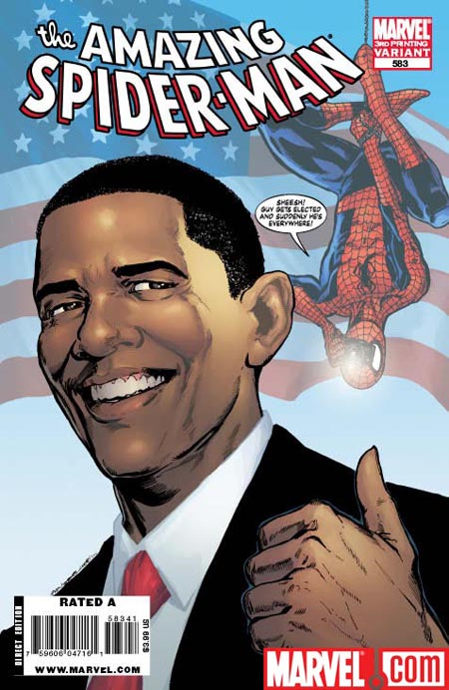
Despite this personal support of Republican candidates, Perlmutter's employer Marvel Comics has famously published reality "crossovers" that (at least superficially) are decidedly pro-Democrat. There are two obvious examples that quickly come to mind. Who can forget the Amazing Spider-man #583 variant cover that featured Spidey snapping a picture of President Obama? This stunt proved successful enough to warrant four reprint runs. More recently, issue Ms. Marvel #13 in which the book's protagonist, Kamala Khan aka Ms. Marvel, overtly throws her support behind Senator Clinton. In an unfortunate twist, the issue actually hit stands after Election Day. This is chronicled in greater detail in "Marvel Comics Superhero Uses Her Powers to Help Elect Hillary Clinton" (from an unbiased website who's mission is to "combat liberal media" so take that as you will).

Whether a calculated move for image purposes or (optimistically) because of the high quality of the product warrants it, Marvel has also been willing to publish titles reflecting a very clear political agenda. The most obvious recent example of this would be the cover to issue 8 of 2016's short-lived "ongoing" Mockingbird. (Ironically the last issue to be published as the book was canceled following it's publication.) It made quite a bit of news when the protagonist was featured on the cover wearing a t-shirt inviting readers to "Ask me about my feminist agenda".

The bottom line is while I like using my disposal entertainment dollars to be entertained, I also recognize to use these limited resources to support political/social perspectives with which I have agreement. Not buying certain comic books might make one "feel better" but ultimately only impact negatively those at the creative level. It is fair to suggest that this group includes many individuals whose ideals are consistent with my own and are giving larger voice to relevant issues.

Nothing is simple, even in the murky place where the worlds of lol it's and "funny books" overlap. The resolution to the decision of whether or not to buy-city is to remain vigilant in following the money in a way that works best for you and your conscience.

Friday, December 30, 2016

Funko POP Goes My 2016

Believe it or not, this collection is small as compared to those of
Funko POP super fans. (12/30/16)
For better or worse, 2016 was the year I further expanded my collecting interests. While I have periodically purchased action figures (dolls!?) in the past, mostly unique or unusual characters, such as Batman's Native American counterpart Man-of-Bats, Lord of the Rings Ent Treebeard and the 2003 Hulk movie's David Banner/Absorbing Man amalgam, I have until 2016 avoided falling into the seductive trap laid by figure lines. My resolve was weakened this past year, as I responded to the siren song of Funko POPs.

If the allure of Funko POPs lies in the diversity of the line, it's strength is in the power of the memories they are capable of evoking. As I am in the collectables sweet spot (40+ years old, male, some expendable income, a fanboy), there are in incredible number of relatable characters. Whether reflecting childhood movie favorites (Flash Gordon), recent superhero comicbook interests (Ms. Marvel, Batgirl), cultural icons (Ghostbusters' Patty Tolan, Mel Gibson as Braveheart), or even literary mainstays (Cthulhu from the stories of H. P. Lovecraft), Funko POPs addresses itches that can be stretched. Like comicbooks and baseball cards, the acquisition of many come with an anecdote.

My first Funko POP Holy Grail: I travelled to multiple Walgreens over the course of
weeks to find this exclusive Ms. Marvel. Kamala Khan is one of the more interesting
comicbook heroes to be introduced in years. Was very excited to come across it in
an urban store I stopped at on a lark. 

A favorite character from a favorite movie, Vultan, played by Brian Blessed,
from Flash Gordon (1980). I was 11 when my brother and I went to see this in
theaters. Purchased this on annual excursions to Nee York City to visit my stepson
at college. It kind of became thing to find a unique Funko POP on each visit. 

The first real collectible based on H.P. Lovecraft's Cthulhu mythos that I wanted was
also the first that I asked my local comic shop to find for me. Though unplanned, it
was also the first "Exclusive". Wish there were more POPs based on "Books" though.

A few months ago, I posted a picture of my POPs on Instagram. A former student wondered
in the comments, "Where are the female POPs?" She was right, at that point I had bought
only characters that were male. Ghostbusters (2016) was a movie I never expected to
like, but I was won over by the performances of the four leads, especially Leslie Jones'
portrayal as Patty Tolan. Jones' own cultural relevance has only continued to grow since.

A gift from my son this past Christmas following last Christmas' Howard the Duck.
Jack and I attended a local Sanders rally in June 2016 when the campaign
ball really began rolling, and I was excited to see his interest in politics develop.

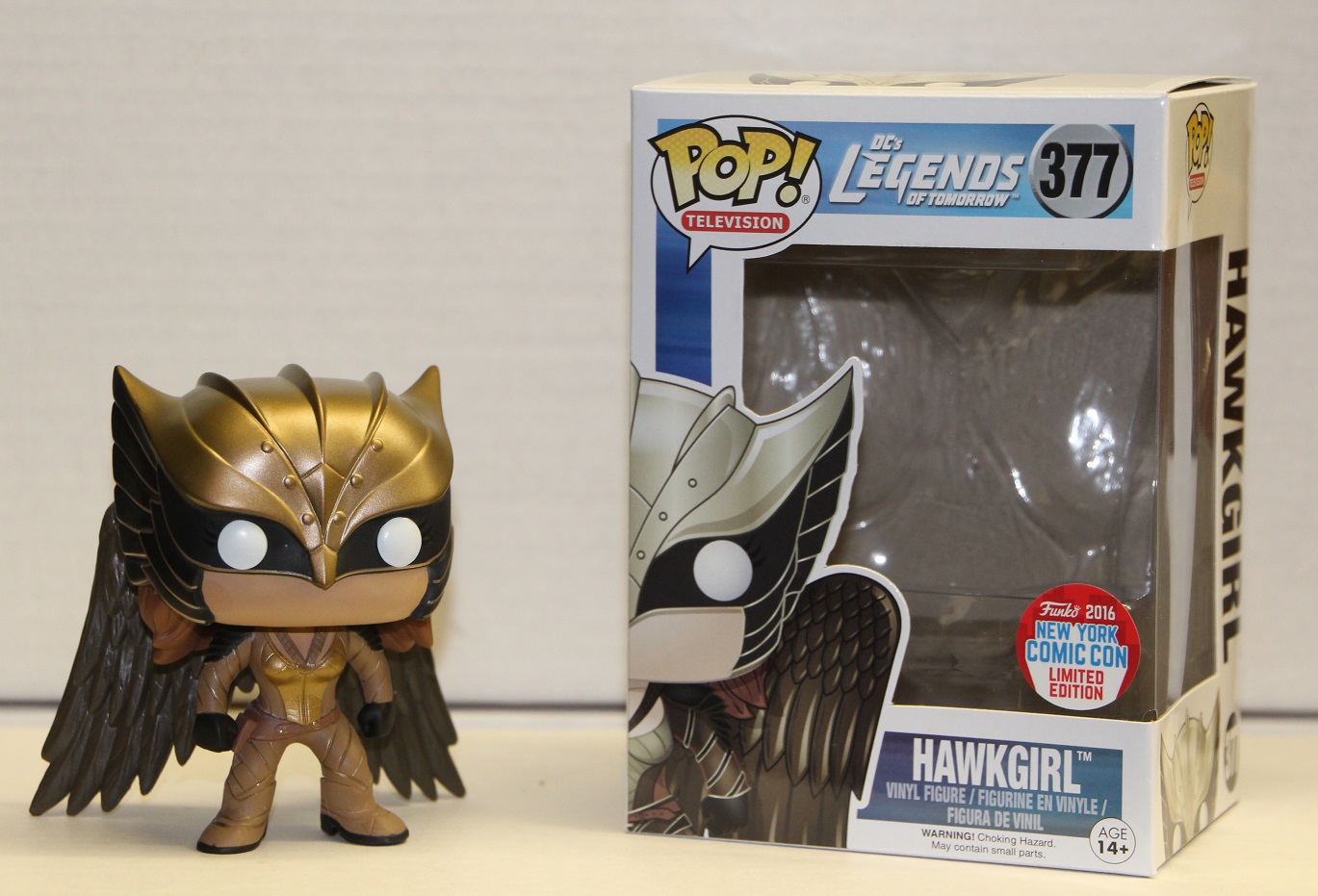
Hawkgirl was an unusual impulse purchase from Barnes & Noble, which by the
way is an excellent source of POPs! I've never seen an episode of DC's Legends
of Tomorrow television show, I do, however, love recent depictions of the
Kendra Saunders Hawkgirl character in DC Comic books over the past ten years.
Also a New York Comic Con Exclusive, an event I have yet to attend but hope to... someday.
Funko POPs tell stories. These 6" figures (and bobbleheads) that prompt me to reflect on semi-important moments in my life as a fanboy and person. To my wife and others who have not embraced the collector's life, it is difficult to explain that these $10 "dolls" are worthy parts of my fandom. As someone who's been doing "this" for 30 years, long before "geek culture" became hip, I dig what Funko is doing with this line and look forward to continue supporting it.

Thursday, July 21, 2016

Simpler Poké-times

My stepson Gregory's Poké-binder from 2004 unearthed at last!
Recently, I came across my stepson Gregory's binder containing his Pokémon card collection. The front page consists of a handwritten Table of Contents on which he listed the organization of the cards (by "type" of course). It is in a protective plastic sleeve, as are all of the cards. When I first saw the binder, I thought to myself "Now, here's something to blog about" and began noodling through the possibilities of just what cards to scan and post. I had completely forgotten just how many types of Pokémon there are, and this was back in 2004. It is a very safe bet that the Poké-stable is even more extensive now.

Fire Pokémon circa 2004.
While at a high school graduation party for one of my former students last weekend, talk turned to PokemonGO. At a party of twenty recent high school grads, nearly everyone had an opinion, and most were either glowing in their support ("it's already made more people healthy than Michelle Obama!") or at the very least respectful ("pretty impressive... Pokémon has been out forever!"). For these students, that thinking is not just hyperbole, it is fact. Surprisingly, Pokémon has been a phenomenon for much longer than most suspect, having been part of our cultural zeitgeist since before most of the teens with whom I was celebrating that day were born.

Water Pokémon.
As a forty-seven year old comic book collector, I have had a fairly long association with Poké-stuff, having read translations of the original manga to the extremely fortunate twist-of-fate that had me taking my son and his friend to see Pokémon: The First Movie-Mewtwo Strikes Back (1998). My son's "friend", later became my stepson as I met and fell in love with his mother. (The boys were in pre-school together.) In a weird way, I suppose I owe a significant portion of my awesome life to the desires of two goofy boys to see the frist Pokémon movie on the day it opened (when that concept really meant something).

Grass Pokémon.
My appreciation of these goofy pocket monsters runs deep, but not so deep that I every actually took the time to learn how to "play" with them. For the most part, my kids and I bought the cards because of the cute pictures, shiny colors and the need to "Catch 'Em All". Even now, reviewing the plastic sleeves which speak of "Melting Power", "Energy Jumps", and "Form Changes", I marvel at the mythology these creations are part of (beyond even the Ash-centric television program) and at how little I really know about how these things engage in combat. At our house, Poké-cards rarely fought, just sparked imaginary adventures to be played out in the minds of my children.

Ground Pokémon.
It strikes me that in the not-too-distant future, today's young adults will talk about Pokémon cards the way my father talked about comicbooks. Growing up, he woudl frequently remind my brother and I that "I had the very first issue of Spider-man/Batman when I was in the Army... I wish I'd held onto it!" Some aging hipster will operate under the misconception that her son's college can be fully financed with a mint condition rare Cubone variant or "Special Collector's Item" foil Lugia. Truth is, it is likely at that point that she'll realize the value in the card is not in the monetary reward, but in the memories special one's may evoke.

Psychic Pokémon.
Image with various Pokemon that accompanied my Twitter post!

Sunday, February 07, 2016

Spidey Goes Back to the Future

Back and front cover to Marvel Treasury Edition featuring
the Sensational Spider-Man
#22 (1979) by Bob Budiansky and Joe Sinnott.
Recently is was reported that  Marvel Comics will be reviving their long defunct Treasury Edition format for the purposes of reprinting issues of the recently released Spidey title. While I have little desire to purchase a treasury edition for a title I can still pick-up on the rack (were I so inclined) this news has caused a burst of nostalgia in many a fanboy, including yours truly, which of course was the desired effect.

For purposes of scale, left is the
Treasury Edition and to the right a
traditional comic book.
This news also prompted the recall that I actually have a copy of a Marvel Treasury Edition from 1979 piled among other odd-sized issues, mostly from independent publishers. That, in addition to the perception that you were getting 4-5 issues in a single "package", seems to me to have been the key selling point for this uniquely proportioned title. Back in the 1970's, magazines and larger editions were something of a rage. Though the $2.00 cover price would have been expensive for those of us conditioned to spend 35 cents of our allowance per comic book, it was after all larger, so it must be cooler, or at the very least better.

Though I can't recall exactly how it came into my possession, as I often find with older Marvel comic books, it has many of the attributes of a classic Marvel story--which ironically is also what is missing, in my estimation,  from most current Marvel titles. I still love Gil Kane and Sal Buscema's pencils, as well as the story-telling of Len Wein, featured in issue 22. Back-in-the-day, comic book narratives were much more tightly written, and frankly, more action oriented. Nowadays, out of the perceived necessity to reprint titles in trade paperback, every single story arc is stretched out over 5 to 6 issues, many times to the detriment of the story.

As a ten-year old, I totally bought into the
mythology of he Marvel Bullpen, and peaks
inside, such as this one drawn by Mary
Severin, were always welcome.
But Marvel Treasury Edition #22 (1979) is chock-full of classic Marvel goodness. It collects four issues of  the Marvel Team-Up title that showcased stories in which Spider-man would (Surprise!) team-up with other Marvel heroes of varying degrees of popularity. Again, way back in the late 1970's, early 1980's this was not as common an occurrence as is the case now. Also included within is a Bonus Pin-up (on which reprint editor Jim Scalrup declares "what else would you do if you had an extra page to fill up and nothing to put on it?" for what in effect is a J. Jonah Jameson poster!) as well as Stan Lee story about the famed Marvel Bullpen's prepping for an upcoming Spider-man comic strip in a three-pager entitled "Here We Go-A Plotting!".

Like many, I miss what I perceive to have been the hey-day of Marvel Comics, when super-heroing was fun and colorful, and when heroes didn't need to be "anti-" in order to be interesting. Though I am unclear as to how attractive a new Marvel Treasury Edition will be to the modern collector (let's face it, it won't fit in a long box), if the stories told in Spidey reflect this earlier style of story telling, I may just check it out. Until then, however, I have Issue 22 of Volume 1 of the Marvel Treasury Edition, and many long-boxes full of back issues, to remind me of my affection for marvel Comics.

Gil Kane drawing Stegron the Dinosaur Man?
Take my money NOW.