Showing posts with label vocabulary. Show all posts

Friday, February 24, 2017

Ballot Box & Long Box

As if our current political situation here in the USA hasn't created enough turmoil, NPR's new midday show, 1A, got me thinking about how my spending habits impact (positively or negatively) those who either support or oppose political parties/politicians. It was on my weekly drive to the local comic book shop for New Comic Book Day, that I listened intently as the host and guests worked through the question of "How does one respond to an administration that has no issue shaming corporation and businesses that express any disagreement with them?"

One of the guest reminded the listening audience of the Walter Reuther quote regarding the "direct relationship between the ballot box and breadbox."

Turning off the radio at the close of the interview, I headed into the shop wondering about who the publishers of my favorite comic books supported in the most recent election. The two most likely financial contributors of note would be those at the head of the Big Two, Marvel and DC. I recall hearing something in passing about an executive at Marvel Comics being involved with the Trump administration, but had not sussed out any particulars. Yet. Was there... or should there, be a direct relationship between the ballot box and the comic book long box? What practical impact would a potential buy-cott of  a company like Marvel whose chief executives contribute significant amounts of their personal financial gains (and therefore the money the consumer spend on the services provided) have? If I were to find out a Marvel bigwig was helping fund a politician I did not agree with, would my moral compass suggest I stop supporting that line and would it provide a meaningful enough message?

My initial thought is that the majority of artists (editors, writers, inkers, pencillers, letterers, etc.) in the industry, at least based on what can be inferred via Twitter, lean toward the more liberal side of the political spectrum. This group would include some of the most prominent Marvel creatives including Spider-man writer Dan Slott. My weekly pull sheet includes many titles that reflect my own (and presumably those of the creators) political leanings though such a factor has not always been a factor in my choices. (I do however purchase some titles that I don't outright "love" but recognize the need to support the artistic voice in the mainstream with my dollars.)

I am only a comic book fan with a very limited understanding of the industry beyond what can be gleaned though online reading and the tweets of a myriad of creators. (I do know that the "Marvel way" and "bullpen" was something of a ruse, albeit one I totally bought into as a youth: "Kirby, Stan and the crew hang around an office together goofing and making comics, right?")

So, what is "the story" with Marvel Comics and the 2016 Presidential candidate?

Last January, according to most news sources (whether the action was framed as a "good" or "bad" thing depends on the sources ranging from Breitbart to The Hollywood Review), "Marvel Entertainment CEO Isaac 'Ike' Perlmutter joined Republican presidential frontrunner Donald Trump by donating $1 million of his own money to America’s veterans on Thursday night in Des Moines, Iowa." (Breitbart) This was after first donating $2 million to Marco Rubio's during the primary season (THR). Following Trump's election victory, Perlmutter's wife was part of Trump's Inauguration committee.

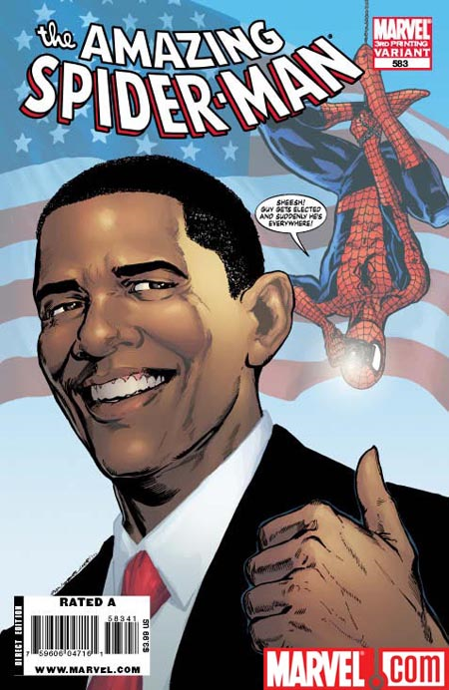
Despite this personal support of Republican candidates, Perlmutter's employer Marvel Comics has famously published reality "crossovers" that (at least superficially) are decidedly pro-Democrat. There are two obvious examples that quickly come to mind. Who can forget the Amazing Spider-man #583 variant cover that featured Spidey snapping a picture of President Obama? This stunt proved successful enough to warrant four reprint runs. More recently, issue Ms. Marvel #13 in which the book's protagonist, Kamala Khan aka Ms. Marvel, overtly throws her support behind Senator Clinton. In an unfortunate twist, the issue actually hit stands after Election Day. This is chronicled in greater detail in "Marvel Comics Superhero Uses Her Powers to Help Elect Hillary Clinton" (from an unbiased website who's mission is to "combat liberal media" so take that as you will).

Whether a calculated move for image purposes or (optimistically) because of the high quality of the product warrants it, Marvel has also been willing to publish titles reflecting a very clear political agenda. The most obvious recent example of this would be the cover to issue 8 of 2016's short-lived "ongoing" Mockingbird. (Ironically the last issue to be published as the book was canceled following it's publication.) It made quite a bit of news when the protagonist was featured on the cover wearing a t-shirt inviting readers to "Ask me about my feminist agenda".

The bottom line is while I like using my disposal entertainment dollars to be entertained, I also recognize to use these limited resources to support political/social perspectives with which I have agreement. Not buying certain comic books might make one "feel better" but ultimately only impact negatively those at the creative level. It is fair to suggest that this group includes many individuals whose ideals are consistent with my own and are giving larger voice to relevant issues.

Nothing is simple, even in the murky place where the worlds of lol it's and "funny books" overlap. The resolution to the decision of whether or not to buy-city is to remain vigilant in following the money in a way that works best for you and your conscience.

Tuesday, March 31, 2015

Running Naked?

Most weekend mornings, my neighborhood is flooded with folks of all shapes, sizes and ages "learning to run" as part of a program organized by a successful local running store/road race promoter. I applaud the energy and effort of those who attempt to finish (if not "run") organized races of all distances, and I have noticed that nearly all of them are dressed to "the nines" with the latest apparel including Garmins, aerodynamic tights, running jackets, and headlamps. Always one for minimally gearing up, I remember finishing my first road race 10+ years ago and telling my wife "I can't see myself wearing tights" which, of course, I do regularly in cold weather.

Somewhere between Laramie, Wyoming,
and Steamboat, Colorado, circa 2006.
Like any capitalist endeavor, it is in any store's best interest to promote the significance of these items, though I, a simple on-again-off-again recreational runner, might not see the need for much of it. (The only time I've worn a head lamp is when I was running alone in Rabbit Ears Pass, Colorado, at 2 a.m. way back in 2006.)

I do, however, occasionally find myself falling into the habit of relying on some tech (in the past, for example, a heart rate monitor or online mapping software) at the possible expense enjoying the run (though some might rightly suggest that my blogging about running in this goofy post is an example of over doing it with tech). This brings me back to the idea of being a retrogrouch, one which crystallized for me when I read Just Ride by Grant Peterson. Petersen (the original bicycling "retrogrouch") wrote his book with the intention of getting people to "enjoy bikes again, the way you did as a kid, before you got so serious." On a personal level, I think maybe the same sort of backwards design philosophy might benefit the recreational running world, too. In effect what I am thinking about is how one can strip down, or get naked, when it comes to jogging, running or racing. It is amazing how the dynamic of a run can change even when one leaves his watch behind...

This is not to suggest I will only be running barefoot (though I have read a number of books promoting the idea and have my cross-country athletes perform barefoot strides during practice) from here on out or that, in the spirit of Born to Run, wearing sandals for trail races. Nor am I suggesting that streaking attire would be a grand idea for my next 5k. On a completely personal level, I think it might be helpful to minimize being overladen with lamps, cumbersome hydration systems, and specialized unloosening laces, especially when the terrain, elements or course do not necessitate their use. On a much smaller scale, perhaps running occasionally without my timepiece as a pacer, just running to run guided by my internal clock.

For me, training naked means taking advantage of the opportunity to tune into one's breathing with only that equipment which is necessary to comfortably get outside. With the understanding that I am not training for the Olympics, but rather running to enjoy the moments and the environment through which I can move, the choice to  minimize, or run naked-er, is an easy (and personal) one.

Saturday, January 03, 2015

Merging Word Walls

  The AP Language and Composition word wall;
following updates since this pic was
taken in October.
Prior to the start of the current school year, I shared some plans for my classroom word walls. My primary objective was to transition from a traditional word wall ("a systematically organized collection of words displayed in large letters on a wall or other large display") as used in many elementary schools,  to a more sophisticated graphic organizer of Tier 3 vocabulary for use with my secondary Regents level and Advanced Placement courses.

The framework as designed by
Prof. Jollieffe.
The graphic organizer I chose as a structure on which to hang these concepts was developed by University of Arkansas professor David A. Jollieffe. My hope was (and remains) to craft a concrete representation of the abstract process for literary analysis. Though this initial adjustment has proven fairly successful, I continue needing to remind myself, and students, to return to the process in a way that meaningfully reinforces the concepts rather than emphasizing just the rote memorization of the terms. (I have attempted to establish our word wall in class as "the framework.")

Now, nearly halfway through the year, and after adding a few terms and concepts to each individual board, I am plotting to kick-off our return from break with a merger of both the Regents and AP level walls into a singular entity, and to re-assert the necessity of the Big 27 terms necessary (in my estimation) to handle to current Regents exam they will all be taking in a few weeks. Because the AP framework is simply the Regents one with additional concepts of import to the student of language and composition, this represents for them a slight tweaking of what each class currently has and a clarification of that which are "Need to Know."
The significantly less cumbersome Regents
word wall, which currently has 37 terms,
27 of which are "need to Know."

My intent is to take down the Regents wall, and coding those terms I've deemed the "Big 27" terms (remember they appear in both) with small red dots, and then the balance of vocabulary such as the three appeals, that I've shared with both classes with blue dots. To further reinforce this shift, I am also combining (and coding) the Tier 3 pages on my class blog to reflect the changes in the classroom version.

As of this morning, I am ready to start my day early Monday, before classes resume for me second period. By then my plan (but as Burns reminds, "the best laid plans...") is to roll out this updated board with a focus on preparedness for success on both the standardized assessment and the course work beyond...

The "new" word wall combining both previously independent leveled walls.

Thursday, July 31, 2014

Weekly Pull List: July 30

Lots of comic book goodness on the New Releases table this week!
Another Wednesday, another great New Comic Book Day!

For the uninitiated, new comic books are released for purchase every Wednesday, and in order to insure being able to purchase a copy of any given comic book, collectors will establish a "pull list" with their shop of choice. This means that the retailer orders you a copy of the books you prefer, and sets it aside (pulls it) for you to pick up at your convenience. During the summer, I have the great luxury of arriving at the comic shop at open (11 a.m.) every Wednesday, have my books pulled for me, and even have time to check out titles I did not ask for but may choose to purchase on a lark.

This week's pull list consisted of a number of new titles and the return of some older favorites who have been sidelined for a while:
  • The Goon: Occasion of Revenge #1 (Dark Horse), written and illustrated by Eric Powell and Baltimore: Witch of Harju #1 (Dark Horse), written by Mike Mignola and Christopher Golden with art by Peter Bergting. Two of Dark Horses supernatural hunters return in mini-series this week. Yes, Goon was published last week, I neglected to pick it up then, so it made this week's pull list. Both titles do not require a reader having read past issues featuring either character, so in addition to beginning new storylines, each also serves as a goo jumping on point.
  • I did not realize it until I got home, but both the Shadow Over Innsmouth One-Shot (Dynamite Publishing) and In the House of the Worm #1 (Avatar) feature art by Ivan Rodriguez. Working with very different settings, a fantastic imaginary world from the mind of Game of Thrones writer George R. R. Martin and the grounded real-world of Ron Marz's Shadow story, Rodriguez does a solid job switching genres (slightly) while maintaining a realistic (though thankfully NOT photo referenced) style that is clean and colorful. Even Shadow Over Innsmouth, set in a Lovecraftian seaside community, has a lively feel to it as presented by Rodriguez. I'm on board for at least the first arc of Worm, so I look forward to seeing more of what this artist has to offer.
  • Not surprisingly, the prolific Marz (he also wrote this week's The Adventures of Superman #15 featuring art by Declan Shavley, making it a likely pickup next week) also wrote this week's Witchblade #177. During his return to the adventures of Sara Pezinni, Marz continues tweaking the character he wrote for many issues prior to Tim Seeley's too-short run. Though at first blush, the bright, anime style of artist Laura Braga may seem odd for what has traditionally been a "dark" book, I quite enjoy her work on this title so far. Braga's style makes new some ideas that have honestly been visited previously (Sara loses the Witchblade--again, Sara is given a new partner who dies with a likely resurrection very likely next issue, again) new and fresh.
Not a disappointing book in the bunch this week... and I haven't even mentioned the continued awesomeness of Marvel's All-New Ghost Rider written by Felipe Smith with art by Tradd Moore. As long as this creative team stays with this title they'll get my cash--it's that good and the first title I read when it comes out. This week's issue concludes the series' opening arc and moves the new character closer to being part of the Marvel mainstream. (The villainous Mr. Hyde, who has previously battled the traditional Ghost Rider character, notes that protagonist Robbie Reyes is "not the Ghost Rider" because he "smells different.") I am a little afraid to become to attached to this title as it seems like one that will be cancelled should it not prove profitable quickly. This is a great title for new comers to comic books.

It's week's like that remind me that we as collectors are in the midst of a genre renaissance--it's a great time to be a fanboy!

Wednesday, August 14, 2013

New Comic Wednesday: August 14

Somethings new and a few things old(er).
Even more so than the weekend, Wednesday continues to be my favorite day of any week. There is something exciting about heading out to my local comic shop (lcs) on Wednesday afternoon (or Wednesday morning if I'm real lucky) and retrieving a stack of freshly pulled (saved) publications for reading. When a week is lighter-than-expected (translation: not as many issues that are automatically pulled from the fresh table) there is that wonderful extra time spent pouring through back issue bins.

And then there are Wednesdays like today: a New Comic Day where what I've requested my lcs friends to pull includes recent issues by classic characters that I have either never followed before or have not done so for many moons, Red Sonja, by Gail Simone and Walter Geovanni, and Vampirella: Southern Gothic, by Nathan Cosby and José Luis. Both are from the fantastic publisher, Dynamite.

As I've posted about previously (here and here), my own collecting habits have moved quite a ways away from where they were 30+ years ago when I began reading comic books. Like most, I grew up a "Big Two" (DC and Marvel) fanboy, but in the past decade my interest in those characters and the universes they exist within has ebbed and flowed until finally becoming merely a trickle. My traditional super-heroic collecting tendencies have been replaced by zombies, westerns, Cthulu-esque tales, noir and pulp. Stepping back from my longboxes, I've also recently noted that many of the comics I collect feature strong female leads (Lazarus, Sixth Gun, Sheltered and Revival, to name a few).

This week's haul is very representative of that change. In addition to sampling the aforementioned Red Sonja and Vampirella series, I also finally picked up the three issue miniseries Breath of Bones: A Tale of the Golem by Steve Niles, Matt Santoro and Dave Wachter from Dark Horse. I've read great things about it, and while having previously scanned issues as they were released, I waited until I could read the entire miniseries before  purchasing. My lcs had one copy of issues 1 and 2, so the waiting game worked out in my favor this time.

Happy reading!

Sunday, September 09, 2012

Recreational Exercise Retrogrouching

This Sunday morning, like most mornings in my urban neighborhood, it is difficult to walk anywhere without noting the significant number of folks riding bicycles. We, in Rochester, New York, are extremely fortunate (for the most part) to have a community infrastructure that is very supportive of bicyclists, especially those who are commuting.


Retrogrouch, Grant Petersen.
I have, however, noticed a shift among the majority of bicyclists in my community that mirrors one I observed (and survived) in the local running community a few years ago that continues to this day. It would seem that it is now in vogue to bicycle, not in a pair of shorts with sneakers and a t-shirt, but rather decked out with tights, form fitting spandex shirts, as if riding in the Tour de France. Stop by a local 5k and you're likely to see even the most pedestrian of "athletes" participating, similarly attired with GPS systems, hydration belts (yes, for a 5k!), and the running fashion accessory of the moment (at one point it was forearm sleeves and later, skorts).

It would seem that even the most wholesome of recreational activities of the past, such as riding a bicycle and jogging are now being turned into money-making endeavors where advertisers and specialty stores are building and developing wares for purchase that, while "cool," are not necessarily vital to performance. And are not necessary to enjoying the pure experience of the activity. While I commend the people who bicycle at a leisurely pace through the streets of River City, I struggle with the need for them to do so dressed like Lance Armstrong's less fit doppleganger.

While sitting in the doctor's office a few weeks ago I came across an article in the June 2012 issue of Men's Journal magazine, "Biking's Philosopher Crank", which gave me a term for how I feel about this, "retrogrouch." The article, written by Kolby Yarnell, focuses on bicycle builder Grant Petersen's personal movement to return to less complicated practices (diet, equipment and clothing) for bicyclist. 'The idea behind all of this, Petersen (the original "retrogrouch") writes, is to get people to 'enjoy bikes again, the way you did as a kid, before you got so serious.' He calls his disciples Unracers." The entirety of Yarnell's views on bicycling are further explored in his recent book Just Ride: A Radically Practical Guide to Riding Your Bike, which I unfortunately have not yet to have had the opportunity to read.

I would propose the same sort of backwards design philosophy might benefit the recreational running world, too.

Friday, July 27, 2012

Embracing What's Common on Racquette River

Driving over one of the many Racquette River bridges,
something caught my eye...
Yesterday I made the ten hour drive (five out and five back) to deliver my son to the Elite Distance Running Camp at the U.S. Olympic Center in Lake Placid, N.Y. Unfortunately, I did not have the luxury of stopping to hike or loiter too long as I'll be hitting the road early tomorrow morning for another college visit, this time in Boston, Ma., with my stepson. Despite the necessity of a quickened pace, and as always seems to be the case whether passing through or hiking peaks, there was much to be seen albeit primarily through the glass.

On the winding road home, I passed over the Racquette River a few times, and in doing so kept my eyes open (and on the road) for a shadow or hint of a common subject: a heron. A relatively frequent visitor to this part of the Adirondack region, I fondly recall coming across herons here in the past. My attempts to spot one again paid off when the fellow in the top image popped briefly into my peripheral vision. At that point I took the time to pull over to one of the many observation areas and snap a few pics and linger briefly.

This is what makes this bird ubiquitous...it seems to be everywhere!
Much like my habit of taking pictures of stills of American Robins in my backyard at home or photographing rabbits on the neighbor's lawn, I guess I just have an affinity for those "things" that are seemingly always around. I feel fortunate that I can add the heron (whether on the road or in my neighborhood) to the list of ubiquitous (defined as "existing or being everywhere, especially at the same time; omnipresent") creatures within my scope of living.

Monday, July 16, 2012

Cataloguing Comics: Westerns

Some of these boxes (and their contents) are almost 30 years old, and they'll have to wait
until the more recent stuff is organized and catalogued.
Of the many projects I have put into motion for myself in an effort to keep prodcutively occupied this summer, a number are intended to beautify our home, such as landscaping and painting the bathroom, while others are being taken on in an effort to alleviate my spirit, such as making healthy donations of items I no longer use or that others may find of better use.

The updated "Westerns" List; numbers to
the right of titles are gaps in each run.
Perhaps the silliest activity is one that I am most enjoying thus far: re-cataloguing my comic book collection and identifying gaps in "runs" (A "run" is a group of comics of one title where most or all of the issues are present.) in an effort to fill any storyline holes. This practice of organizing (and re-organizing) is one I've started and stopped on numerous occasions since I was, oh, I don't know--15 or so, and this summer I'm going full-bore. Unfortunately, like some other local comic book aficionados, I do not have a temperature controlled room, online cataloging software, or even display shelves; this is going to be an old school endeavor. What I lack in amenities I like to think I make up for in attitude.

As you can see from the terrible image above, this task could take some time. In an effort I have begun with those series I have most recently begun collecting (in the last 4 to 5 years), and while most local comic shops will organize by publisher first and then alphabetical by title, I will be organizing each long box by genre (relatively speaking), and ignoring alphabetization. This approach may be tweaked, but not in the too-near future.

Three boxes o' Westerns--that's better... for now, though tab separator labels are a must.
The majority of my recent collections can best fit into one of four categories: Westerns, Pulp, Horror/Science Fiction or Hero books. Where there is some obvious genre overlap, such as with Oni Press' The Sixth Gun (Western, Horror/Science Fiction), I've just made judgement calls on where they best fit based on my own frame of reference  (The Sixth Gun = Western, to me). In the end, other than whoever gives this stuff away when I've departed from this plane, the only one who will really need to "agree" to these groupings is moi.

One advantage of being a Westerns-fan is that there are very few of us out there, and therefore back issues (comic books not purchased when they were originally released) are generally easy to find and usually less expensive, often if you wait long enough. For example, when originally released, the 1993 Rawhide Kid  mini-series published by Marvel, was a little difficult to find as it had received quite a bit of mainstream publicity due to the character (rather stereotypically by most tasteful standards) "coming out." I picked up the whole run (all the issues) for a few dollars just months ago. Sometimes collecting is a waiting game, especially if you are a completest.

Over the next few days I plan on making my way through the Horror/Science Fiction genre and will share some of the processes entailed...

Monday, December 26, 2011

What Comics Taught TEACH Me: Big Words

During this past semester, I have been consciously working with my eleventh grade students on vocabulary acquisition and utilization. Because the act of only memorization sophisticated vocabulary is not enough to insure that such terms will make there way into one's working vocabulary--one must know how to use a word in their own writing to truly demonstrate its acquisition.
Vocabulary in action!
Often when I assign a list of terms to be watched for in the context of a whole class selection, such as The Scarlet Letter, I'll note for the students that "many of these terms are still in common use... maybe not with you're current acquaintances, but with those with whom you will become acquainted as educated adults." Occasionally with some words like "countenance" and "ameliorate" this comment is met with expressions of disbelief.

I feel a sense of validation when I myself come across a term that students think is "weird" or "archaic" in use in the context of recreational media. The recreational "media" I interact with most frequently is the world of comic books, a world I would attribute with much of my own teenage vocabulary acquisition. As a middle school student myself, often I would read a comic and come across a word like "nullifier" and, curious as to what it meant, look either it, or its root word, up in the dictionary until a could find a definition that made sense. (Though Stan Lee had a way of making-up pseudo-scientific phrases--"the ultimate nullifier"--there was usually something of truth or value to be gleaned from thinking it through. The "ultimate nullifier" was capable of rendering Galactus inoperative, or nullify his powers, so he feared its use.)

It's amazing what you can learn from reading comic books! Though I  now read fewer mainstream superhero books than I did 30(!) years ago when I discovered (in reprints) the ultimate nullifier, I still enjoy coming across the writer's use of sophisticated words. Now, given the minimal use of expository boxes in traditional comics, this primarily occurs if there is any high level vocabulary used in the dialogue of "educated" characters like Mr. Fantastic of the Fantastic Four, still one of my favorite characters.

Even after all these years, and issues, I am glad to report that occasionally the writers who bring these superhero/fantasy/science fiction adventures to life still send me to the dictionary for definitions...