Showing posts with label back issue. Show all posts

Monday, January 18, 2016

Run Reader: Gears of War

With his signature catch-phrase, salty language, and buckets of
gore, Marcus Fenix is back in Gears of War #1 (2008).
This past Christmas I was fortunate enough to be gifted with an XBOX One game system. The Holiday Bundle version I received came with the upgraded, "Ultimate Edition" of the original Gears of War game first released eons ago (in gaming terms) in 2006. Thanks to the wonderful world-building of the game's production team, and despite having previously bested both this game and it's subsequent titles, it was difficult not to be easily drawn back into the world of Marcus Fenix and Delta Team.

Issue #2 cover by
Brandon Badeaux.
In edition to being something of a forerunner in dramatic sci-fi/action-adventure console video gaming, the Gears of War franchise also stands as one of the rare early game titles to be successfully spun off into an ongoing comic book series. Running 24 issues from 2009 to 2012, Gears of War was published by DC Comics under the company's now defunct Wildstorm imprint. (Fun fact: SEGA stalwart Sonic the Hedgehog's comic book adventures continue to be published by Archie Comics to this day, with the the most recent issue being #279!) The synergy between game and comic book is such that issues of the series are now available with the Ultimate Edition as unlockable extras, pages of which are viewable in the Special Features.

The success of the comic book is best attributed to its consistency with the games: both are moody and violent in tone with a tightly woven narrative. A key to this consistency in characterization is the result of the comic books use of the games' writers to handle scripting duties. With artwork equally evocative of the video game series, the talents involved contribute an additional layer of humanity to those operating in the Gears universe.

From Gears of War issue #7 written by Joshua Ortega,
art Simon Bisley and Henry Flint .
While there are quieter moments of subtle characterization in each of the Gears games (if you look for them), the comic book format provides numerous opportunities throughout the 24 issue run for characters to breathe and develop even more fully. Due to his established in-game tough guy status, Gears' protagonist Marcus Fenix' is at the center of most stories, if not as the lead, than certainly as a clear influence on the character from whose perspective the story is told.

Even with an already incredibly culturally diverse character line-up in its gaming universe, the Gears comic book also fills out the ranks of those under Marcus's command. Additionally, the series takes the reader back to familiar historical points in the establish Gears historical timeline, such as the Pendulum Wars. each issue takes on the perspective of ancillary characters who at one point or another find themselves with the orbit of Marcus Fenix. In addition to adding characters that would eventually find their way into the game, such as Jace Stratton, introduced in print with issue #3 and voiced by Micheal B. Jordan in Gears of War 3, the comic book series also adds to the mythology of the game-based world. While a minor character, and major influence, in the first two Gears games, Marcus's father takes the lead in a series of flashback issues to the aforementioned Pendulum Wars.

Gears of War #10, written
by Mike Capps and Joshua
Ortega with art by Liam Sharpe.
The opening six-issue arc entitled "Hollow" is written by Joshua Ortega with pencils by Liam Sharp. The events of the arc bridges the narrative gap between the first Gears of War game and the start of the second, following the brutal adventures of Marcus Fenix and Delta Squad in the battle against the Locust. As the writer of Gears 2, Ortega has a clear familiarity with the characters and, with Sharp's command of visuals, both tell a story with minimum dialogue and maximum carnage. One potential drawback to readers unfamiliar with the franchise is a lack of familiarity with the characters by potential readers. While I benefited from having played the games, for example the motivations of both Delta team and the evil invading locust army were understood, the uninitiated might need more background than the obvious "ugly monster equals bad guy" trope.

During its 24 issue run, DC/Wildstorm's Gears of War title maintained a high quality, never deviating from the exclusive "Gears-verse" for story setting. While part of the DC's company -wide "Draw the line at $2.99" price freeze initiative, readers never (thankfully) saw a cross-over with Green Lantern or, more suitably perhaps, Lobo. Concluding with a 6 part story by writer Karen Traviss, that bridges the narrative gap between the conclusion of the second Gears game and concludes with a story which leads directly into Gears of War 3.

The series can still easily collected as individual issues (my preferred format) are still available at cover price at your local comic shop if you are willing to dig deep into the back issue bins. Of course, the series has also been collected into three trades, though the license with DC has surely lapsed by now, there may be more stories in the future as Gears of War 4, with the son of Marcus Fenix in the lead, nears its release.

Issue #13 by Liam Sharp.
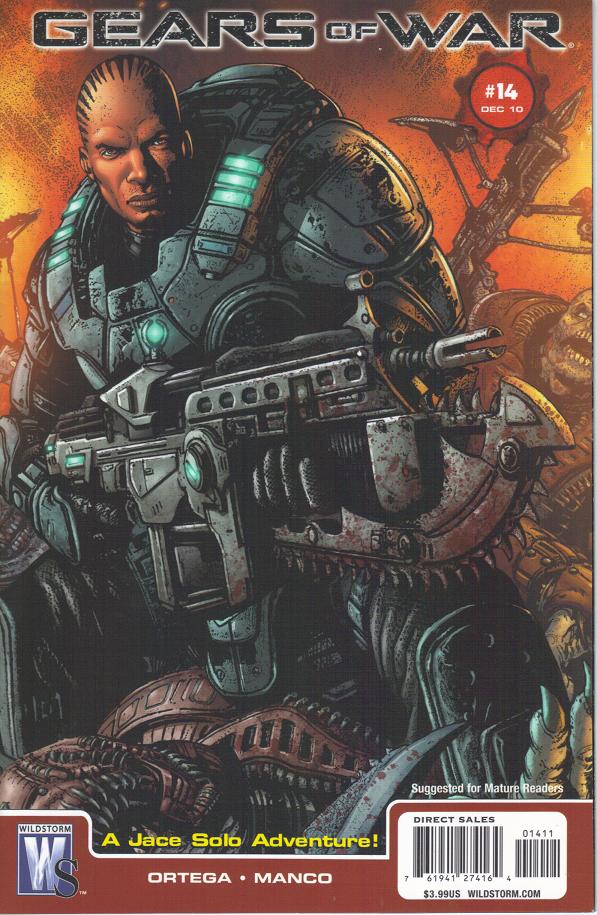
Issue #14 cover by Leonardo Manco.
Issue #19 cover by Colin Wilson.

Saturday, November 21, 2015

Late to the Party: Northlanders

From Northlanders #10 (2008), written by Brian Wood with art by Dean Ormston.
A fan of historical fantasies such as AMC's Vikings television program, I have often wished that there were more similarly conceived comic books. Though the sword-and-sorcery genre, especially in the pulpy presentation of fictionalized barbarians such as Conan and Red Sonja, have been long time staples of the comic book racks, realistic depictions often seem limited to nuanced character moments presented as small parts of larger fantasies. Recently I came across Northlanders, a DC/Vertigo series which ran for fifty issues from 2007 to 2012. Now, this is Viking action!

Written by Brian Wood (whose current Revolutionary War set series Rebels for Dark Horse, is equally well-researched and written) with a variety of different artists, the stories told in Northlanders set in and around historical events during the Viking Age. Back when it was originally published, I was in a more cape comic collecting mode, purchasing and reading stories more closely associated with the medium such as Superman, Fantastic Four and Spider-man. Though I dabbled in the occasional Vertigo-style independent title, Northlanders somehow missed my attention. Now as my own tastes have shifted, I have been fortunate to acquire most the first twenty issues of the series' run via back issue bins. (Yes, there are trade paperbacks available for purchase, but I remain a single-issue collector--which presents its own challenges!)

Rather than binge reading--plowing through the 20 issues I have in quick order--I have elected to savor each issue and arc, reading them between novels or articles for school and other more recently published titles and series. This has been a most rewarding approach as I'll often reward myself with an issue after having completed other big-boy tasks such as yard work or grading papers.

As a whole, the series reads as an anthology of tales told from a variety of perspectives through a number of historical events set during the Viking Age. While  my own grasp of the historical accuracy is limited, it is clear that Wood has done his research. (As readers of the aforementioned Rebels will attest, Wood is nothing if not not through and his sharing of his process and research is in itself fascinating.) Violence, nudity and appropriately vulgar language earn Northlanders its "Suggested for Mature Readers" labeling, but having thus far made my way through the first two story arcs, or ten issues, these adult trope are story driven rather than gratuitous.

Interior art from Northlanders #7, art by Davide Gianfelice.
The common theme of the heavy weight of inheritance in the first two arcs, "Sven the Returned" by Wood and Davide Gianfelice in issues 1-7 and "Lindesfarne" with art by Dean Ormston, that create connective tissue between stories beyond the Viking Age settings of each. In "Sven," the eponymously named protagonist returns with desire to reclaim his Viking birthright from those who usurped his father, while "Lindesfarne" tells of another young boy who rejects his father's brand of Saxon cruelty in favor of a more violent Viking one. Both characters achieve a level of success on their respective quests, but as one might expect of hard stories in an incredibly harsh world, the resolutions lack the tidiness of traditional comic books. This is a good thing and consistent with the world Wood and his accomplices bring to life.

Only ten issues in and I'm hooked for the fifty issue run that Northlanders had, which conclude in 2012, especially as Wood is a constant through the entirety of the series. The artwork is consistently solid, and though it might lack the ultra realistic shading and pencil work that stories of this ilk seem to need, in concert with the writing and coloring it is far more than serviceable. In the majority of cases, I am unfamiliar with the interior artists (the though of Becky Cloonan coming up in 35 and 36 is surely something to look forward to), but they are the capable supporting cast.

As I await the return of Vikings to the small screen sometime in 2016, the prospect of continuing to make my way through Wood's Viking landscape one arc at a time is an exciting one.

Wednesday, July 29, 2015

Run Reader: Rawhide Kid (2003)

Reintroducing Rawhide Kid in Issue #1.
My introduction to the Western comic book genre came late in my collecting life in the rugged guise of the 2005 Jonah Hex, Volume 2, written by Jimmy Palmiotti and Justin Gray. The most familiar Western hero from DC Comics, I eventually found that because of its excellence, I craved more adventure from "those thrilling days of yesteryear."

Cover to Issue #2 by Terry Dodson
and Kaare Andrews... subtle, right?
My experience with Marvel Comics' Westerns began with more modern iterations of two key characters, The Rawhide Kid and the Two-Gun Kid, among others. Together they starred in the four-issue miniseries Blaze of Glory (2000), by writer John Ostrander and artist Leonardo Manco and its sequel, Apache Skies (2002). Both The Rawhide and Two-Gun Kids were presented in fairly traditional Western fashion, consistent with the earlier roots of each character. The Rawhide Kid character originally debuted in 1955 from Marvel Comics's 1950s predecessor, Atlas Comics. Described as a "diminutive yet confident, soft-spoken fast gun constantly underestimated by bullying toughs, varmints, and crooked saloon owners," the Rawhide Kid (Johnny Bart) was the template from which later super-cowboys sprang. While the Rawhide Kid of Blaze of Glory/Apache Skies was grittier than the original, both interpretations were very different than what would come next.

With a faint recollection of a news story about the Rawhide Kid being re-envisioned as homosexual in the early 2000's, I bought the individual issues of  Rawhide Kid, Volume 4 (2003) for cheap to see what the hubbub was all about. At the time, I missed the red flag that the subsequent trade paperback collection of the mini-series, bore the title of the story arc from the miniseries, "Slap Leather." From the start, the tone is sophpomric and most of the updated characterization is played for "laughs."
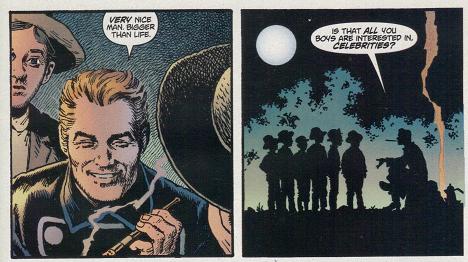
Clue 1 from Issue #1: Rawhide Kid
likes celebrity gossip!
As written by Ron Zimmerman, this Rawhide Kid (who inexplicably prefers the nickname "Trey"?!) is much more of a caricature of homosexual stereotypes than a fully realized character with a (presumably) less-than-common sexual orientation for the Old West setting. The inherent potential of exploring the challenges of such a character in the Old West are ignored for the sake of probing the intricacies of how two of the Cartwright Boys from Bonanza could be placated by alcohol and potentially tricked into "extracurriculars" with Trey. I can't make this stuff up. Zimmerman sprinkles various literary and historical figures throughout the proceedings and even creates historical analogs for modern figures (for example, the dim-witted town leader, Mayor Bush) in an effort both ground his story in history and possibly, satire.

The flirtation begins in Issue #2.
The plot is standard: gunman (The Rawhide Kid) comes to town beset by criminal types. While there, gunman teams-up with local lawman, previously humiliated by criminals, to save town, and the lawman's shaky relationship with his young son. It's in the execution and detaisl that things get awkward: gunman drops numerous romantic hints to the lawman about things like French fashion while parading around without his shirt. Lawman's son, embarrassed of his pa's failure, publicly and verbally emasculates dad while hero-worshiping the gunman who (wink-wink) is homosexual.

Though subsequently billed as "the first openly gay comic book character to star in his own magazine," the Kid's openness is almost entirely comedic in its presentation, limited to obvious campy humor, puns and double entendre.  Used as simply a way to differentiate the protagonist from those around him (and as a subtle reasoning behind his colorful attire), the Kid's homosexuality fails to add a level of depth to the characterization or by extension, the title's proceedings.

As seen here in issue #3, the Kid is
always on the cutting edge of fashion.
The artwork by John Severin, a long time comic book artist who also provided art for Image Comics' modern-Western title Desperadoes: Quiet of the Grave (2001), is excellent. While the detailed setting clearly established as Old West vibe, the accompanying story, by Ron Zimmerman, is surprisingly ham-handed and stereotypical in its reveal and depiction of the Kid's sexual orientation. It could be said to border on parody, but just what was being parodied is up for debate. The multiple references to literary (the leads of Lonesome Dove get name-checked early on) and historical Western figures, as well as the beautiful artwork were not enough to carry me past the borderline offensive stereotype's of homosexuality that drove the story.

Even typography choices made by the writer and letterers, Rich and Wes @ Comicraft, seem to purposely reinforce the stereotypical depiction of our hero. As you can see from the pane at the top of the page, wherein the Rawhide Kid makes his first appearance wit the phrase "Oh, stop..." which when read aloud with the proper emphasis applied for the bold lettering sounds somewhat affected. Upon my own internal reading an inflection was intended, as it is through out the series.

So, is it worth checking out? As a snapshot of the misguided attempt by a mainstream publisher to take an older character and re-boot him in such a way, yes. Despite the somewhat clumsy effort, Severin's art (and the ability to analyze the hell out of the whole package) is just enough to recommend it. Both The Rawhide Kid: Slap Leather (2003) and it's sequel, The Rawhide Kid: The Sensational Seven (2010) are available as trades at your local comic book store (or in the back-issue bin).
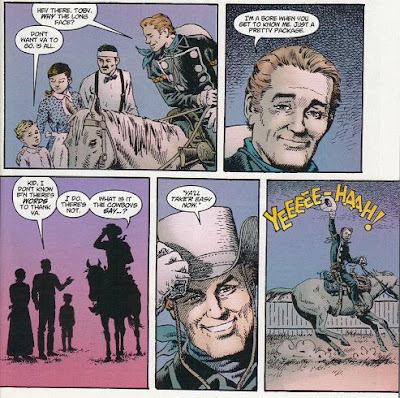
Happy trails, Trey! from Issue #5.

Wednesday, June 10, 2015

Run Reader: Giantkiller (1999)

The opening page of Giantkiller Book One by
Dan Brereton, August 1999.
I enjoy reading and collecting two comic book sub-genres that are published with little regularity or consistency: giant monster (or "kaiju") and Western titles. Beyond familiar characters with high name recognition such as Godzilla or The Lone Ranger (both of which have current or recent iterations that are thoroughly entertaining), few titles from these two comic book sub-genres regularly see publication. This is especially true of titles published by the industry's "Big Two," Marvel and DC. While each will occasionally nod to their own giant monster-cowboy past with titles like DC's Jonah Hex or Marvel's current Secret Wars mini-series Where Monsters Dwell (both solid titles), few new characters are developed and promoted. There was a time though, when the comic book industry was on life support (or so I've heard) and willing to take greater creative risks,

The cover to Book Three.
While thumbing through some ancient longboxes last week, I re-discovered a long forgotten gem that incorporates classic elements of giant monster books with a common Western archetype thrown in for good measure, the 1999 DC miniseries Giantkiller. Written and drawn by Dan Brereton (most well know for his 1998 collaboration with Howard Chaykin, Batman: Thrillkiller), Giantkiller is basic in its plotting but dynamic in its presentation.

In the far-flung future world of 2002(!), atop Mount Diablo, "across the bridge from San Francisco, past the hills of Oakland" an inter-dimensional portal has opened releasing all sorts of Lovecraftian "daikaiju" or giant monsters. In an effort to confront these horrors, our government does what years of reading sci-fi and comic books have taught all of us what the correct answer to this problem is: experiment with evil DNA in an effort to develop super-soldiers.

One of the many spectacular
splash pages in Book Four
of Giantkiller by Dan Brereton.
The first product of this experiment, who as it turns out is our story's primary narrator, is Jill, a young woman who is injured while acting as an FBI agent charged with breaking up a cult dedicated to worshiping the creatures. Found nearly dead, Jill is resurrected following a hybridization process using the monsters' DNA. Eventually Jill goes native and is labeled "a lost cause" by the lead scientist responsible for her transformation, Dr. Steven Azuma. Following this first perceived failure, the good doctor to turn his sights toward an experiment with greater potential, Project Giantkiller.

The fruit of Project Giantkiller is the hero of our tale, a human-like creature (with a claw-tipped tail) christened "Jack," though he is affectionately referred to by Dr. Azuma and his team by the nickname "Yochu." Jack is educated ("Grades K through 6 lasted exactly two weeks.") and trained following his "birth," and armed with a samurai katana fashioned from the tooth of one of his "titanic relatives" which he names "Kiba" (Fang).

A number of mysteries involving our two protagonists are introduced and resolved during the course of the series as Jack and Jill meet in the kaiju -populated zone around San Francisco, and ally themselves with one another in an effort to close the portal. In a particularly clever move, writer-artist Brereton embraces the ethical quandry inherent in Jack's role as an agent of destruction pointed at his own race, and his willingness to address the reader's questions within the context of the narrative contributes to Giantkiller's success as a story.

"Friendly" monster,
Nox, from Book Five.
Brereton allows his energetic artwork to tell the story during the monster battles, and relies heavily on characters, most notably Jill, to deliver background exposition about the fictional world they inhabit. Despite this, I never felt weighed down by the necessity of information-sharing. Brereton characterizes Jack as a no-nonsense, action-oriented hero, so the moments during which he is engaged in battle are free of witty-remarks and absent nearly all dialogue beyond monster sounds and sound effects. It is in Jack's characterization that the Loner archetype (a la Western icons such as Shane and the Man With No Name) is employed. Jack is a monster, but he is also fighting on the side of "good," despite the natural urges deep in his DNA to be alone on his quest, he does meet those with whom he connects.

I couldn't help but notice some superficial  similarities, however, with Mike Mignola's Hellboy. As I was drawn into the world Brereton was crafting, I wondered if these similarities were part of why this potentially marketable character and his world have not since been revisited in some medium. Both Hellboy and Jack the Giantkiller work with (for?) a paternal character who raised them, and both also use their "sons"to somewhat surreptitiously further personal interests. Both are supported by female counterparts that are themselves cursed with abilities that make them distinct form the world around them. Given the opportunity to develop his character, it would have been fun to see where Jack and Jill, in Brereton's skilled hands, could have taken us.

As it stands, Giantkiller remains a promising introduction to a world and characters that work well as a single, inclusive mini-series. This is due primarily to Brereton's work, both as artist and writer; together his clear affection for the genres is infectious.

Giantkiller is a comic book miniseries originally published by DC Comics, along with a one-shot handbook called Giantkiller A to Z: A Field Guide to Big Monsters (which within the context of the story was written by Jill in her early days as a monster hunter for the government). The series has since been collected in a trade-paperback format by Image Comics. Both are still available in the back issue boxes of quality local comic books shops.

Jack the Giantkiller battles Shrill in Book Two.

Tuesday, February 10, 2015

Run Reader: Doctor Voodoo (2009)

As Sorcerer Supreme, Doctor Voodoo is obligated to tussle with the Dread Dormammu! 
While scrolling through Twitter today, I came across Buzzfeed's well-written Black History Month post "17 Black Superheroes And Where To Read More About Them," which referenced a number of familiar (to comic book fans anyway) African-American (and in the case of the Black Panther, African) superheroes. While some of those mentioned in the Top 17 were among my favorite characters, most notably John Henry Irons from DC Comics' Steel series that ran from 1994-1998, there were some additional characters I thought worthy of mention.

The cover to issue #1
by Marko Djurdjevic.
My longbox of cancelled titles runs deep and as I read the article, mental images of forgotten covers came to mind. My intent over the next few weeks is to post some images and basic info about those not included on Buzzfeed's list. Though some characters have some fairly lengthy history in their respective comic book universes, I'll limit the pictures and comment to those in comic books I have actually read, as in a complete "run." First up, Marvel Comics' Brother Doctor Voodoo.

Though he first appeared in 1973, Brother Voodoo (Jericho Drumm) didn't come fully to my attention until he was promoted to "Doctor" Voodoo, Avenger of the Supernatural, during the five issue series of the same name in 2009. Replacing Doctor Stephen Strange as the Sorcerer Supreme in the pages of The Avengers, Dr. Voodoo's self titled series was written by then up-and-comer Rick Remender with art by Jefte Palo. Each issue featured a beautiful painted cover by Marko Djurdjevic.

Much of issue 1 deals with Dr. Voodoo asserting his newly-appointed authority with some of the Marvel Universe's magic-based heavyweights, including Dr. Strange (who appointed him in the first place), Dormammu and Dr. Doom (both of who feel it is they who should have been given the job instead)--apparently having a doctorate helps in the practice of the mystic arts. In fact a recurring theme throughout the five issue run is Voodoo dealing with various preconceptions of his worthiness. Dr. Doom in particular seems especially interested as the title come with lots of magical goodies. Beyond his existing powers derived from voodoo spirits, including the ability to call on the spirit of his deceased brother, Daniel Drumm, Voodoo also gifted with some special accouterments with the Sorcerer Supreme role. In addition to the iconic Eye of Agamotto, Strange also bestowed the Cloak of Levitation and the Books of Knowledge, upon him.

Doctor Voodoo and his brother, a spirit,
converse at the series
conlcusion. Art by Jefte Palo.
For those new fans of Dr. Voodoo, such as myself, there was also an short character biography, written by Tony Isabella, in the back of the first issue explaining the characters background with great detail. Issues 2, 3 and 4 also contain reprints of previously published back-up stories narrated by Dr. Strange recounting part of the history of the Brother Voodoo mantle, which not just a clever super-hero code-name, but rather a title and role like that of the Sorcerer Supreme that has been passed down through generations.

Marvel's editorial decision to supplement Remender's story with additional background information serves to reveal a character of much greater depth and potential than I had previously understood. Consistently atmospheric artwork by Jefte Palo grounds the proceedings in an earthy, yet suitably fantastical, setting that is (intentionally?) very different from the bright colored realms that longtime Strange are familiar with seeing their hero in. As evidenced by his action orientated approach and the visual palette through which his adventures are portrayed, this Doctor is his own man.

Though it only ran five issues before being abruptly canceled (other than the semi-terminal "End?" note in the book's final panel, the issue seems to be transitioning to a second story arc, this one with Voodoo battling Ogoun the Slayer), the series hints at some of the great potential the character holds. Perhaps this will be explored more fully, and with greater sales, as Brother Voodoo has recently resurfaced in the Marvel Universe in a big way, playing a pivotal role in last fall's AXIS event and his position as a member of a new Avengers team.

Single issuers of the five issue Doctor Voodoo: Avenger of the Supernatural are very likely still available at your local comic shop, as is the collected trade of the same name.

The cover to issue #3 by Marko Djurdjevic.
Teaming-up with Dr. Doom on the cover to
 issue #5 by Marko Djurdjevic.

Saturday, August 23, 2014

Comic Bookshelf: Young Blueberry 2

Though we pick up Young Lt. Blueberry's story in progress, it
does read well as a stand-alone, too.
With DC Comics' All-Star Western starring Jonah Hex facing imminent cancellation and Dynamite Publishing's solid Lone Ranger series having recently ridden off into the sunset, the traditional Western is once again becoming something of a rarity on the new comic book table. This is unfortunate as, while not many Westerns are currently being offered by readily accessible mainstream publishers, my thirst for them remains unquenched.

So like a thirsty fanboy, I have found myself digging through the online back issue bins in search of something along the lines of dusty trails and two-gun action. As fate (and fortuitous availability) would have it, I came across an English translation published by Comcat Comics in 1990 of a French graphic novel first published in 1969. Talk about a roundabout way to get at graphic novel with an Old West setting!

Young Blueberry 2: A Yankee Named Blueberry is written by Jean-Michael Charlier with art by a young Jean (Moebius/Gir) Giraud. The second in a series of English translations, this particular volume collects chapters 4 through 6 of the creative team's original story. While a fan of Moebius' more contemporary science-fiction works (such as the Eisner award-winning Marvel's Silver Surfer: Parable mini from 1988), my only previous engagement with the Lt. Blueberry character is through the mystic-Western film Renegade (2004) starring Vincent Cassel, based on the graphic novels featuring a more world-weary iteration of him.

Written as part of a larger tapestry of stories providing background for the already popular character, I had access to only the single second volume. Because of this, I read Young Blueberry 2: A Yankee Named Blueberry as an isolated adventure without the benefit of previous characterization.

Despite this disadvantage, this collection worked fine as a singular traditional adventure of Rebs and Yankees during the Civil War. Picking up "three days after successfully completing a mission" behind enemy lines, Blueberry, at this point in his military career described as being "primarily a bugler," attempts to rejoin his Yankee squadron. The first two chapters, "Death Ride" and "Man Hunt" tell the story of Blueberry's efforts to return to his squadron as well as his being hunted by an adversary introduced (I assume) in the previous volume. What follows is a tale of mistaken identity and unclear alliances wherein Blueberry finds himself once again thrust into a dangerous mission requiring he play both sides of the war.

The final chapter in the album, "Private Mike S. Blueberry", finds our protagonist still caught between the Rebs and Yankees. Given what has preceded, Blueberry is forced to prove his allegiance to the Blue Coats. (Apparently the mission that set all of this in motion was a mission so secret, no one knew that he was in fact a Blue Coat infiltrating the Confederacy ranks.) While the conclusion of this volume finds Blueberry successfully foiling the Confederacy's plans, he is also in pretty much the same predicament as at the onset: trapped behind enemy lines unable to prove his allegiance to either side.

Blueberry's character, as written by Charlier  is easily discernible without having read what preceded, especially as he is presented as an archetypal soldier, if only slightly more conscientious, attempting to fulfill his patriotic duties while staying alive. Because of this, there is always a level of narrative tension at play that allows our main character to consistently reveal (or reinforce) the traits to the reader. Within the context of a larger story, though, I could see this continuous plot strategy becoming somewhat repetitive.

This is also not the Moebius artwork of which I am familiar. Lacking the graceful clean lines and huge vistas of his later work (including the aforementioned Silver Surfer series), this Moebius is more constrained as the "camera" is pulled in tightly. According to the brief forward, the panels were also originally published in black and white, and were colored and reformatted for this edition, which may impact my reading of the art. There are, however, a few hints of the artist's style as it will eventually develop, particularly in the closing panels which feature a massive train derailment (one panel of which is spoiled on the  back cover).

Based on the level of difficulty that exists with acquiring Moebius books, even reprints such as this, with any degree of affordability, I am unsure when I might have the opportunity to take in any further adventures of Lt. Blueberry. My guess would be that some used bookstores or older local comic shops might have some hiding on their bookshelves. Some public libraries might also have a few in the Graphic Novels section. Should my travels bring me across additional editions, I would definitely continue following the adventures of Lt. Blueberry.

Saturday, August 09, 2014

Comic Bookshelf: Doctor Strange Season One

Things get serious for Stephen Strange. Words by Greg Pak and stunning artwork from Emma Rios.
"I'm not evil. Just a little bit selfish. Just like you." 
Dr. Stephen Strange to fellow student Wong in Season One.

Though I have read quite a few back issues featuring Stephen Strange's Master of the Mystic Arts, Dr. Strange has never really been a headliner for Marvel Comics. With a Marvel movie in development, it is a safe bet that interest in Dr. Strange is likely to increase, and that whatever direction is taken with the character's origin will become the accepted standard.

Cover by
Julian Totino Tedesco. 
Marvel's hardcover Doctor Strange Season One, written by writer Greg Pak (Planet Hulk among others) and rising star Emma Rios (Osborn and Pretty Deadly), is one of the publisher's more recent attempts to introduce the character in a dynamic way that sticks with readers. Published in 2012, eight years after J. Michael Straczynski and Sara Barnes' 2004 more grounded take take on the origin story, Doctor Strange Season One again takes a pass at establishing a modern, cinematic view of the story. As heralded on the back cover, this was intended to modernize "the formative first days of Marvel's Master of the Mystic Arts." Unlike other characters that received the Season One treatment, such as the Fantastic Four, Iron Man and Spider-Man, Dr. Strange has always seemed to function on the periphery of superhero-dom, a fact that for me actually increases his appeal.

Consistent with early
Marvel tropes, green is
the color of evil, in
this case Baron Mordo's
magic.
Pak wisely jumps into Strange's origin at the entrance to the Temple of the Ancient One in the Himalayas, electing to recount the events that led our protagonist to this point in his life via flashback. A successful surgeon who has lost the use of his hands to a car accident, Strange is seeking the Ancient One's special "techniques" (at this point he cannot even bring himself to say "magic") in an effort to return to the selfish life of wealth and adulation he lived previously as an American doctor of medicine. It is from this point, and within the context of a search for "three rings of tremendous power," that the reader is introduced to the most common characters and elements of Strange's backstory: the evil Baron Mordo, his future servant/partner Wong, and his true flaw (which in classic Marvel-style is mental/psychological rather than purely physical), hi won hubris.

Usually portrayed as serious and somewhat humorless, here, the characterization of Stephen Strange is more glib. As a cinematic retelling of the origin, it is difficult not to look at it in light of Marvel's most popular onscreen re-imaging in recent memory, Iron Man. While the character has always had something of a physical resemblance to Iron Man's alter ego, Tony Stark, in Season One it is hard not to see much of Robert Downey Jr.'s goateed (in the early days both Stark and Strange were mustached), wise-ass in Stephen Strange. The characterization plays much like a magic-based analog to Stark's tech based character arc, though Strange's access to power is earned while Stark's is the product of his own innate intelligence. Not surprisingly, this theme of "earned power" or "earned worthiness of power" is echoed throughout Pak's retelling and is key to avoiding too great a similarity with Stark.

Likely in part due to both the characters she's been asked to draw and the dynamic staging of action panels, Rios's work has often been deemed "Ditko-esque". (For non-fanboys, artist Steve Ditko was the original artist for Spider-man and co-creator if Doctor Strange.) Rios does had a fantastic eye for filling in the panel completely with detail and action, squeezing as much out of each moment as possible. As drawn by Rios, at the onset, Strange is a weary and broken man. As he slowly begins to regain his humanity as he makes progress on his mystical path, there is a lightness to his presence on the page that reinforces the growth suggested in Pak's dialogue.

One minor drawback (depending on your personal cash flow) to Dr. Strange Season One, and for that matter the entire series of hardcover Season One books, is the cover price. Yes, the hard cover presentation and binding is gorgeous, but for your $24.99, there are only about 100 or so new pages of content. Additionally, this particular volume, there is also a 20 page reprint of the most recent effort to restart the Dr. Strange led team book, Defenders as well as a nine page sketchbook by Rios. My own willingness to purchase the hardcover upon its initial release was based on two factors: my desire to see Dr. Strange given the "star treatment" by his publisher and the creative pairing of Rios' artwork and Pak's writing. To its credit, Doctor Strange Season One is a highly entertaining reintroduction to a character whose presence in the Marvel Universes continues to grow. It also maintains a high level of readability value, thereby making its purchase price easier to accept, and my recommendation of it as very worthwhile.

Saturday, July 05, 2014

Run Reader: Gamera #1-4

From Gamera: The Guardian of the Universe issue #1 (1995) by Mozart Couto and Mike Sellers. 
Now that the American mainstream's momentary case of kaiju-fever has been stilled, thanks to Gareth Edwards' Godzilla's quick exit from the top of the movie charts over a month ago, giant monster movie fans have probably overdosed on the re-releases of the Big G's more recent film offerings. I know I have. It is worth remembering, however, that while certainly the most prominent giant monster star, there are others worth following in both film and comic books form.

Cover to issue 2 by artist Yuji Kaida, who
 supplied beautiful covers for issues 2-4.
Which makes this the perfect time to revisit one of Godzilla's Japanese studio competitors, Gamera. While Godzilla (and Toho) have had a fairly extensive comic book history in the U.S. ranging from Marvel Comics classic late -70's run by Doug Moench and Herbe Trimpe to the current IDW series, Gamera's exposure has been limited to a single 4-issue miniseries published by Dark Horse in 1995.

Hot on the heels of the Japanese reboot by Daiei Studios of the original Gamera kaiju series of films in 1995, Gamera: The Guardian of the Universe, written by Dave Chipps with art by Mozart Couto and Mike Sellers, was published as a direct continuation of the movie of the same name. Because there were eventually sequels to the original (which in the end comprised a trilogy of excellent films, the second of which is reviewed here by moi), in terms of continuity, it acts as sort of an alternate take on the trilogy using the film as the starting point.

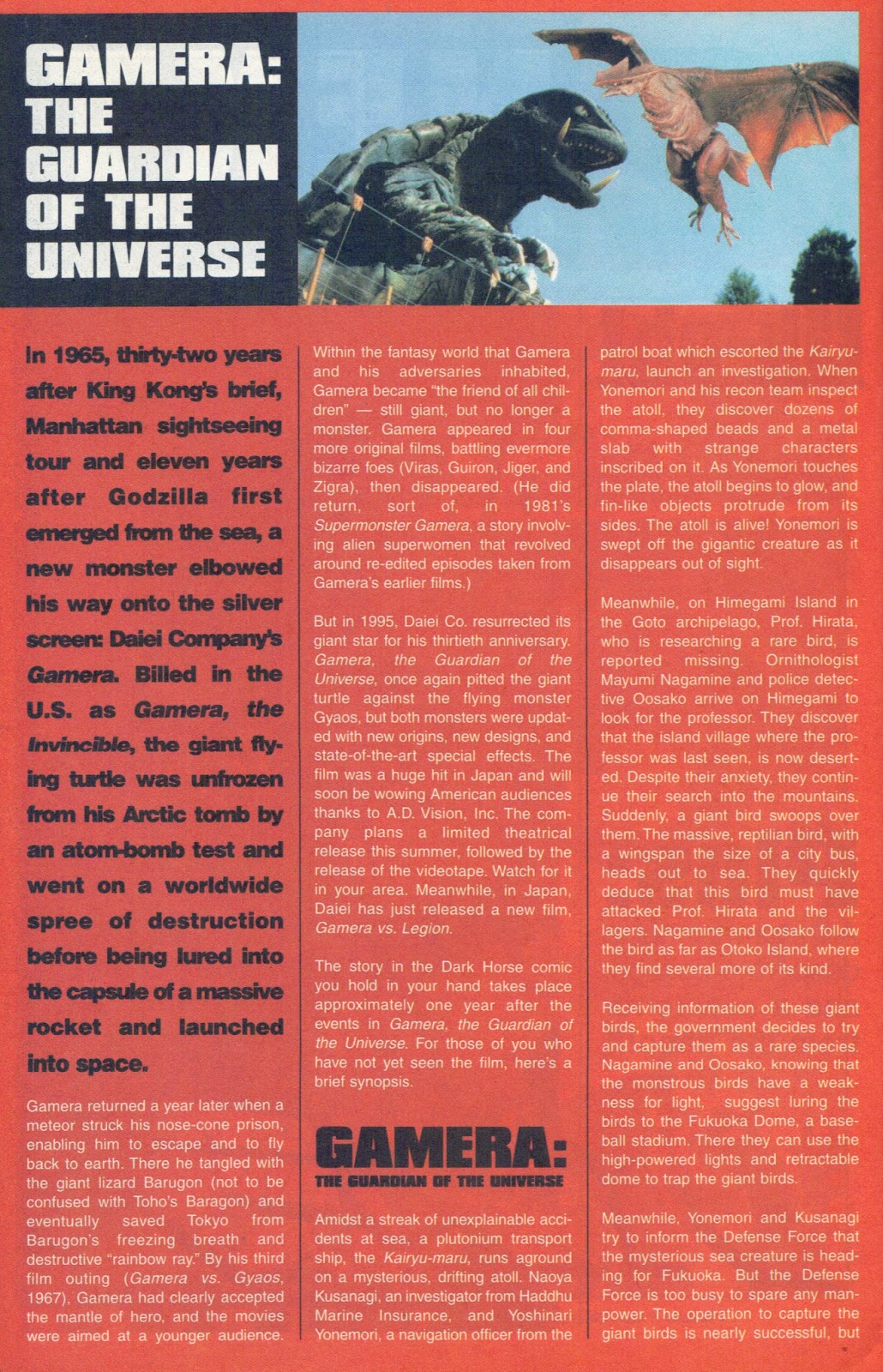
Page one of the Gamera
beginner's guide from issue 1.
For any who had not previously seen the movie, the comic book contains a two page synopsis introducing both the main characters and summation-of the relevent plot points of the movie. The comic book picks up one year following the events of the movie, though it can be read as a stand alone mini-series, the understanding of the relationship between the Gyaos (the primary "villain" in both the movie and first 2 issues of the comic book) and Gamera, as well as Asagi's connection to Gamera.

A quick search revealed that Gamera: The Guardian of the Universe writer Dave Chipps carved out a small niche in Japanese manga translations, such as Oh! My Goddesses and Gunsmith Cats, for a period of time in the 1990s. Chipps does a nice job in this series alternating between the human and monster stories, while developing the Gamera amulet mythology (it's how Asagi communicates with him). In the interest of aiding any readers new to the character, there is quote a bit of exposition provided during character interactions, but in each case it proves necessary to insure understanding of what is happening.

Gamera versus Zigra from issue #3 (1996)
by Mozart Couto and Mike Sellers.
The artwork by Mozart Couto and Mike Sellers is unremarkable but effective especially given how terribly wrong it could have gone given the era from which it comes. The colors are vibrant (Gamera never looked so green), and the panels are well composed. Whether an effort to communicate the bombastic nature of giant monster fights or not, there is a healthy use of sound words in panes depicting kaiju battles. See the panels to the left and below for examples.

I quite enjoyed the Gamera miniseries, despite (at the time) not having much backstory on the character. The consistency of the creative team and solid story-line made for a nice quick run read, and brought me back to rewatch the most recent Gamera trilogy. While not available in trade paperback, individual issues can be found at most local comic shops with a solid back issue stock or online for half-off the original cover price of $2.95. With Godzilla's recent Hollywood reboot in the books and a new take on the Teenage Mutant Ninja Turtles on the horizon, one can only hope that Gamera is not too far behind--as noted on the cover to issue #2, he was the "Original Mutant turtle!"

Gamera versus Viras from issue #4 (1996)
by Mozart Couto and Mike Sellers.

Saturday, May 31, 2014

Atomic Robo Goes West


Doc Holliday (top left panel) also appear in Atomic Robo: The Knights of the Golden Circle #1.
In the next 2-3 months, a number of the Western comic books that I have collected regularly for the past few years (Oni Press's The Sixth Gun , Dynamite Publishing's The Lone Ranger, DC Comics' All-Star Western to name three) will be concluding their current run. Fortunately, it would appear that another titles that I have occasionally dabbled with, Red 5 Comics' Atomic Robo, recently kicked off a five issue arc with a Western theme.

Atomic Robo strikes an iconic
Western pose... with poncho!
It was the Western hued pose of the title character on the cover (and a desire to show support of Western-themed comic books) that prompted me to once gain dip my toe in "The World's Greatest Science Adventure Magazine!".Created by writer Brian Clevinger and artist Scott Wegener, the series of Atomic Robo minis tell the adventure s of the eponymous main character who is a self-aware robot built by a fictional version of Nikola Tesla.

Atomic Robo and The Knights of the Atomic Circle #1 begins with our hero trapped back in 1884 Colorado, with a quickly expiring supply of nuclear fuel. When gunshots lead Atomic Robo to intervene on behalf of an elderly man, he finds himself setting off a turf war between notorious outlaws and a quiet Western town. Much like the Man With No Name (which the protagonist's outfit is clearly meant to reflect), Atomic Robo becomes the de facto leader of the town as he tries to protect them while escaping the wrath of the bad guys. There are broader plot points that contribute to Atomic Robo's larger story (apparently he or someone like him bearing the moniker Ironhide, has been "then" before), but past understanding of this greater story does not inhibit the enjoyment of the Western interlude.

As often happens in Western fiction, events transpire which place Atomic Robo in the path of far more familiar historical characters, in this case, go-to icon Doc Holliday. In addition to serving the purpose of recognizable historical figure for the reader, Holliday is also recognized by Atomic Robo, who is quick to recognize the necessity of adhering to the time honored time travel dictum of Star Trek, Sound of Thunder and Back to the Future: "Don't do anything. Preserve the timeline."

More than the start of a new adventure, the larger plot (and mystery) thickens!
While Atomic Robo and The Knights of the Atomic Circle #1 of  is primarily set-up for next issues confrontation between Atomic Robo's new acquaintances and Butcher Caldwell's gang, it remains a very entertaining all-ages read. As there is not much new ground covered here for the Western or science-fiction enthusiast, it is the clear affection and respect of Clevinger and Wegener  for both genres (and their character) that contribute greatly to the reader's enjoyment of the comic book. Best of all, in addition to having found a short-term Western to add to my pull list, I at the same time have happened upon a solid all-ages sci-fi title to both both follow and catch up with in my local comic shop's back issue bins.

Saturday, April 12, 2014

Ghost of FCBD Past: Aphrodite IX (2013)

From Top Cow's FCBD 2013 offering Aphrodite IX  #1,
written by Matt Hawkins with art by Stjepan Sejic.
Free Comic Book Day (FCBD) 2014 is fast approaching (it's the first Saturday of May), and the list of this year's FCBD offerings is available for perusal, so it's once again time to take a look back at a previous year's free comic books that have somehow lingered in my longboxes...

I've recently posted about my ongoing conversion to Top Cow fandom, a journey that began last FCBD when I picked up a previously unfamiliar-to-me title, Aphrodite IX. If the intent of the FCBD initiative is to expose new readers to the medium (and older readers to new titles) than 2013's Top Cow freebie definitely turned the trick for me in a larger way than I had imagined (or in a way my wife--wallet--surely feared). While many FCBD offerings are promotional excerpts for future releases or more expensive graphic novels, Top Cow Productions, Inc. released the first issue of it's new Aphrodite IX series last May. An existing character first introduced in their uber-successful Witchblade franchise, Aphrodite IX was a soft-reboot of sorts, taking the cyborg character (as well as a primary antagonist) into the distant future.

Written by Top Cow President/COO (and judging from his on-line bio, Jack-of-all trades) Matt Hawkins with art by painter Stjepan Sejic, Aphrodite IX is something of a mixed bag for those (such as myself at the time) unfamiliar with the character. Beautiful artwork, interesting futuristic locales, dragons, and space motorcycles are always checks in the plus column, though. If the purpose of FCBD is to generate interest in titles, than it was certainly successful in doing that with this fanboy. A slight interest in issue #1, however, is later rewarded with continued reading as the unfamiliar plot points that can be seen as somewhat confusing in the first issue are clarified in later issues.

Aphrodite IX is still being published, though another change in status quo is apparently on the horizon later this summer. This FCBD will not see Top ow releasing another freebie for Aphrodite IX, but most quality local comic shops likely have the current series available at near cover prices (at my lcs, previous FCBD books are priced at $1). If you, like I, dig sci-fi-super heroics and sweet painted-style artwork then I recommend that you quickly catch up before the next narrative shift comes--lest you find yourself combing online store for gaps in the longer Top Cow Universe story. Be warned: once you pick up one book you will likely desire all that which preceded it, and take it from me, it is extensive and, worse yet perhaps, very satisfying!

Thursday, February 06, 2014

Comic Book Finds: Cyberforce (2013)

Riplcaw does his thing in Cyberforce (Vol.4) issue #2 by Marc Silvestri and Khoi Pham.
While definitely not a new set of characters, Top Cow Production's most recent iteration of their team book Cyberforce is new to me. When the Witchblade-Darkness-Cyberforce wave of popularity hit in the 1990s, I never checked it out. As a collector, comic books had lost any sort of allure, and having been raised on the stylings of John Byrne, the "giant-gun-claw-and-pouches" product popular at the time resulted in my stepping away from collecting. Even during the past decade (as I have been wooed back to the hobby), I rarely find a "superhero" book that sustains my interest long enough to warrant a trip to the back issue bin.

Then, last year, I noticed that the Top Cow Universe books from Image Comics had experienced a line wide soft reboot titled "Rebirth". Though I had previously dismissed most books in the line-up as being too cheesecake heavy in their artistic direction, and for fear of too much back story--over a decade--I took a leap and jumped on board the reboot with Witchblade #151. My appreciation for writer Tim Seeley's Revival led me to Witchblade that then prompted a peak at Artifacts and so on down the line-up. This inevitably brought me to Cyberforce which was re-imagined and redesigned by the characters' (actually the whole Top Cow Universe's) original creator, co-founder Marc Silvestri.

Though the team and it's various members have been in publication through three previous volumes dating all the way back to 1992's first volume, I was able (through the help of the fantastic employees at my local comic shop) get my hands on the eight issues which comprise the to-date run. Even after only eight issues, it occurs to me that Cyberforce is a book that seems to read more clearly in multi-issue runs. After reading the first two issues, I was a little confused as to just what was happening, but having stayed with it, by #5, the narrative had smoothed itself out in such a way that I was in for the duration. I have zero insight into any previous characterization of the leads in this fourth volume, so any background (or baggage) is lost to me, which is probably just as well.

Some observations:

  • While reminiscent of other in line characters (Killjoy from issues 6-8 of Cyberforce (V4) possesses a very similar facial design to a recent Witchblade villain) the overall character design's are solid. 
  • The organic technology (which others suggest is reflective of artist Koi Pham's--and later Marco Turini) scratchy artistic aesthetic) which each of the heroes has integrated into their body visually makes sense. Not too "shiny-Colossus-y" metal, but something extra that distorts what would otherwise be a normal epidermis.
  • Their is action, sophisticated narrative (newbies to Top Cow such as myself just need to be patient), sensible payoffs--writer Silvestri leaves just enough dangling to prompt one to come back next issue.
  • The bargain is pretty exceptional at $2.99 an issue (the first few issues weer only $1!). Hero/sci-fi action books of this quality don't come anymore inexpensively.
From an online preview for the premier issue of Cyberforce , Volume 4.
As always seems to be the case, the highest praise I can make is that the series has motivated me to begin looking into the back issue bin for previous volumes, if only to have a broader sense of changes made in characterization. Without any of the Big Twos (though Image is beginning to make it a Big Three (qualitatively if not quantitatively) hero books on my weekly pull list, I was glad to stumble into the Top Cow's unique supernatural/sci-fi hero universe of which Cyberforce is a part.

Wednesday, August 14, 2013

New Comic Wednesday: August 14

Somethings new and a few things old(er).
Even more so than the weekend, Wednesday continues to be my favorite day of any week. There is something exciting about heading out to my local comic shop (lcs) on Wednesday afternoon (or Wednesday morning if I'm real lucky) and retrieving a stack of freshly pulled (saved) publications for reading. When a week is lighter-than-expected (translation: not as many issues that are automatically pulled from the fresh table) there is that wonderful extra time spent pouring through back issue bins.

And then there are Wednesdays like today: a New Comic Day where what I've requested my lcs friends to pull includes recent issues by classic characters that I have either never followed before or have not done so for many moons, Red Sonja, by Gail Simone and Walter Geovanni, and Vampirella: Southern Gothic, by Nathan Cosby and José Luis. Both are from the fantastic publisher, Dynamite.

As I've posted about previously (here and here), my own collecting habits have moved quite a ways away from where they were 30+ years ago when I began reading comic books. Like most, I grew up a "Big Two" (DC and Marvel) fanboy, but in the past decade my interest in those characters and the universes they exist within has ebbed and flowed until finally becoming merely a trickle. My traditional super-heroic collecting tendencies have been replaced by zombies, westerns, Cthulu-esque tales, noir and pulp. Stepping back from my longboxes, I've also recently noted that many of the comics I collect feature strong female leads (Lazarus, Sixth Gun, Sheltered and Revival, to name a few).

This week's haul is very representative of that change. In addition to sampling the aforementioned Red Sonja and Vampirella series, I also finally picked up the three issue miniseries Breath of Bones: A Tale of the Golem by Steve Niles, Matt Santoro and Dave Wachter from Dark Horse. I've read great things about it, and while having previously scanned issues as they were released, I waited until I could read the entire miniseries before  purchasing. My lcs had one copy of issues 1 and 2, so the waiting game worked out in my favor this time.

Happy reading!