Showing posts with label comic books. Show all posts

Friday, December 06, 2019

Comicbook Shelf: Krampus: The Shadow of Saint Nicholas (2015)

From "I" written by Zach Shields and Todd Casey with artwork by Christian Dibari and Mark Spicer.

Not surprisingly, the cover
by Fiona Staples is one
of the artistic high points.
Four Decembers ago, following a media-fueled folk horror-frenzy, this slender, softcover volume found its way to my comic book shelf. Released in concert with the feature length movie Krampus (2015), Legendary Publishing's Krampus: The Shadow of Saint Nicholas shares many of the same qualities that made the film entertaining. This graphic novel features stories crafted with the film's  writer/director Michael Dougherty credit with a "Stories by" credit. While Krampus the movie focuses on a single family's experience with the demon and his minions, The Shadow of St. Nicholas employs an anthology approach to broadened the primary antagonist's impact on a wider range of unrelated characters.

As with other Legendary Pictures/Publishing tie-ins for genre films (see Godzilla: Awakening (2014) and Pacific Rim: Tales from Year Zero (2013)), the formula remains the same here: include the film's original creative talent, in this case Dougherty, to develop ancillary stories that reflect signature elements of the overall narrative of the film. While thematically related to the movie, having seen the movie prior is not necessarily key to its enjoyment.
Krampus' minions are back
in "II" with art by Maan House
and Guy Major.
Given the Krampus character and perhaps Dougherty's affinity for anthology sub-genre, The Shadow of Christmas is successful in accomplishing what the filmmaker says the intention is behind this project in the collection's introduction, "to deepen your [the reader's] love of the character [Krampus]..." Visually, the artist team keeps the best visual component of the movie, the well-realized practical creature designs, in the graphic novel. Each of the four stories, titled as Roman numerals I through IV, are all written by Zach Shields and Todd Casey (Laura Shields is also a credited co-writer on "II"). Each story is grounded in a modern setting familiar to American readers that creates the opportunity for a hint of the "ancient in a modern world" dynamic that worked so well in the movie.

Splash page of Krampus from
"III" by Michael Montenat
and Mike Spicer.
The most polished of the four stories is the first and if each of the four were to be thought of as pitches for a potential Krampus sequel, "I" also makes the most sense. Simply put, "I" is a tale of redemption. A "bad" department store Santa seeks validation by combating the forces of Krampus to protect others who are more worthy than he to live on. The story is a reminiscent of other Twilight Zone-style stories and while offering no real narrative surprises, the professional execution makes for an enjoyable reading experience.

Much of your appreciation if this graphic novel as a whole will depend on your enjoyment of the burgeoning Krampus mythos in modern mainstream media. If, like me, you dig contemporary iterations of archaic folklore, The Spirit of Saint Nicholas is worth seeking out. As a fan of the movie Krampus, recommending this companion piece is easy. The inherent re-readability of a quality anthology makes the $14.99 cover price well worthwhile.

Sunday, October 20, 2019

Hallow-reading: Spook House

In recent years I have fully embraced the literary anthology, especially those that collect modern weird fiction and horror short stories. Whether it’s due to my own slightly diminished attention span or an appreciation for the impact a good writer can have over an efficiently written story, I often find myself reaching to read (or re-read) short stories and novellas when hankering for a scare. Each year around this time of year, I also find myself picking up horror comic book anthologies, too.

While I’ve shared my appreciation for the semi-annual (now defunct?) Monsterverse series Bela Lugosi's Tales from the Grave, a more recent series has supplanted it on my Halloween go-to: Albatross Funnybooks’ Spook House. Last week’s New Comic Book Day saw the release of the third volume of the series, Spook House 2019 Halloween Special. All are the brainchildren of writer-artist Eric Powell, most well know for creating and now publishing popular indie comic The Goon.

As with each of the two preceding mini-series, the 2019 Halloween Special features a variety of stand-alone stories, each influenced (story, art, editorial) by Powell. Though the banner above the title on the cover declares in all caps “SCARY STORIES FIT FOR KIDS!” this title is also for those of us who like silly, creepy, stories well past our chronological childhood. As with previous volumes of Spook House, this issue also features the return of other creations from the Albatross Funnybooks stable of characters, Megaghost and Lulu from Chimichanga.

One’s lack of familiarity with either character’s background in no way limits the fun to be had in each story they appear in. While I’ve never read an issue of Megaghost, I enjoyed the issue’s lead story, “It’s the Candy Kaiju, Megaghost.” Written by Gabe Soria with art by Gideon Kendall, “It’s the Candy Kaiju” shares some the punny, broad humor that makes the more adult Goon stories so enjoyable. If not quite so “scary”, it, like each of the four stories in the issue, is very entertaining and, most importantly, evokes a fun Halloween season spirit. If the not-so-secret secondary editorial agenda is to prompt those, like me, to give Megaghost a try, it succeeds. This back-door introduction to junior occultist Martin Magus and his supernatural super-robot Megaghost has piqued my interest… so now I need to go back to my local comic book shop and seek out their appearances, past, present and future.

The rest of the issue feels much more like an Eric Powell joint, unsurprising given his role as a contributing, or solo, writer of all three. Both Pet Sematary spoof, “Goldfish Graveyard” and the cautionary tale regarding the self-fulfilling prophesy of names, “The Grumpiest Goblin,” are a touch more humorous and indicative of the stories that appeared in the previous volumes (available in trade paperback). If Powell’s form of humor is an acquired taste, Spook House 2019 Halloween Celebration, or any previous collection, is likely to give you a hankering for more.

Saturday, October 12, 2019

Hallow-Reading: Casper's Haunted Halloween

Before discovering the joys of superhero comic books as a teen, I enjoyed gorging on "funny books." As a ten year old with few pennies to spend on the fancy comic books displayed in the corner store spinner rack, my "collection" consisted of the discounted discards my brother and I would buy at the local used bookstore. Despite lacking covers (which were removed, I presume, so that they could be sold at a discount), we would buy as many as we could during each trip. The bulk of these starred Harvey Comics regulars such as Casper the Friendly Ghost, Richie Rich, and our favorite at the time (most likely because our grandfather was a proud World War 2 veteran), Sad Sack.

Though rife for an update (given that the original premise is slightly dated), new Sad Sack material has not been published for decades. Recently, though, others in the Harvey stable, most notably Casper and his spooky friends have found new, and reprinted, life in a line of titles from American Mythology Comics. All-ages titles such as Casper's Ghostland, Casper's Spooksville, and Casper the Friendly Ghost's Capers regularly find there way to my weekly pull list with good reason: they're entertaining as heck and a little well produced nostalgia goes a long way. They are also among the first books I read upon arriving home.

This past week saw Casper's Haunted Halloween arrive right on time for the holiday. Consisting of six stories from the Harvey Vault, Casper's Haunted Halloween also features fan-favorites the Ghostly Trio, Nightmare the Galloping Ghost, and "the tuff little ghost," Spooky. This holiday one-shot demonstrates the timeless nature of Casper's antics which are published monthly in the American Mythology titles. In the first of a three-part story, "Spook School", Casper is one again being pressured by the Ghostly Trio to become a "nasty ghost". The erstwhile friendly ghost agrees to attend because "education never hurt anyone!" After happily failing the first day of classes with a "minus zero," returns the following day rather than be "clobbered by the Ghostly Trio." Ultimately he and Gary Ghost, a star pupil in Spook School are abducted and taken to Goblandia in the second chapter, "Ghosts in Goblandia." Following a series of misadventures during which the kidnapped ghosts are forced into labor by the goblins, Casper [SPOILER ALERT] he saves the day, and the mean ghosts that belittle his good natured ways, through the power of friendship.

Yes, the story is simple, and, yes, the pages (on high quality paper) are clearly reproductions of classic comics, but the visuals and message remain timely. Ultimately, Casper's earnest efforts to help both those who steal he and his classmates away, and those same classmates who ridicule him, win the day and all but the most hardened and cynical readers. I enjoyed Casper's Haunted Halloween quite a bit and am thankful to American Mythology for producing such high quality reproductions and new content (though not in this particular title) monthly for new and old seasoned readers alike.

Sunday, October 06, 2019

Horror Comicbook Cavalcade: Bela Lugosi's Tales From the Grave #1 (2010)

Clearly a labor of love, Kerry Gammill (as publisher, editor, writer and artist ) is all over
Tales From the Grave from the first pages.
Released in 2010 by now-defunct independent publisher Monsterverse, Tales From the Grave #1 is an old school horror anthology of stories in the classic horror comics tradition. Each story is presented by a fictionalized version of late horror film icon Bela Lugosi with assists from both his loyal (and intellectually dense) assistant, Hugo, and a sexy Elvira-esque vampire femme fatale, Nosferina.

Issue #1 cover credited
to Basil Gogos.
The first of five individual issues was released in 2010.Worthy of its hefty cover price of $4.99, Tales From the Grave delivers eight stories of varying length, utilizing a wide variety of artistic styles (including one "photo strip" featuring Lugosi and Tor Johnson action figures). Back matter consists of a collection of artist renditions of Lugosi as his most famous screen character, Dracula. Among the artists providing story and art is veteran comic creator (and personal favorite), and Monsterverse publisher and editor-in-chief, Kerry Gammill.

My own appreciation of Gammill's work began, during the hey-day of my Superman comicbooking, when he shared cover pencilling duties on Action Comics with George Perez, eventually taking the role over fully with issue around issue #565. Gammill's efforts produced some beautifully classic cover work vaguely reminiscent of the zany late 1970's runs and included the "Reign of the Superman" arc featuring the Super-stand-in who would later become the Eradicator.

Gammill's story (the first panel of which is posted above) "Unpleasant Side Effects" is book-ended in Saturday Monster Matinee fashion by Lugosi. More playful (and little "gross") than scary, it is an effective and entertaining romance, the quality of which is elevated by Gammill's pencils.


Each subsequent story, such as the Western themed "Eyes of the Prairie" by Derek McCaw and Rafael Navarro, follows a similar structure. Lugosi creeps around the corners teasing the bad things to come and returns at the narrative's conclusion to tie up loose-ends before riding of into the sunset.

What would old fashioned horror be without a little (tame) cheesecake?
It's really only in the latest "edition" of Lost Lugosi's Film Theater (teased above by Nosferina) that our star takes an active role in the story, playing his second most familiar film role, evil scientist (or "white Haitian voodoo master" as in 1932's White Zombie). Of course, it wouldn't be a Lugosi project without at least a mention of Dracula, and this fanboy need is very nicely met by the inclusion of an informative text piece by eminent Lugosi scholar and author Gary D. Rhodes.

A very entertaining piece of horror-comedy-nostalgia comic book creation, Bela Lugosi's Tales From the Grave #1, which was published in October 2012, was followed up five months later with the publication of the equally enjoyable issue 2. Both issues are very likely still available for purchase in your local comic shop and make for fine Halloween reading.

Since the post was originally published in October 11, 2012, four issues of Bela Lugosi's Tales From the Grave have been published. Each is consistently entertaining and follows the same corny, scary, goofy and high quality established by the first issue. Issue 2, published in 2013, also features a very cool cover painting by practical effects god Rick Baker, re-envisioning Popeye the Sailor as something a little more... evil. Seek it out--if you dare!

Sunday, January 20, 2019

The Old Order Changeth!

My very first short box circa 1984... and yes I was the person who actually 
bought DC's Guy Gardner Warrior!
Some comic book collectors have spinner racks (lucky!) while others have beautifully designed shelving to display their collections. I am old school, and no carpenter, so even 40 years into my fandom, I still use long, and as I have become more "seasoned", primarily short, boxes for storing and organizing my collection. This requires quite a bit of space and, fortunately, we have a sort-of finished third floor attic where I read and store them with other collectibles.

Shazam! #1 variant 
cover by Gary Frank. 
It is during these winter months when we are "trapped" inside for the majority of the day that I will shift the organization of my collection. Often it is a change in publication the prompts a change, For example, DC's recently introduced Geoff Johns and Dale Eaglesham joint, Shazam! (2019, $4.99 per) title necessitates the movement of Jerry Ordway's incredible The Power of Shazam (1995-99, cover price $1.50 per issue) series into an active box. Though represents a significant departure from the characters as depicted in Power, with all pre-New 52 continuity erased, I like having access to previous narratives.

Conversely, the conclusion of the most recent Suicide Squad (Volume 5, 2016-19, Issue #1 was $2.99 and the final issue, $4.99) series means that title will shift to an "inactive" box, stored in the back part of the attic, until the teams eventual return to action. Then, once again, the old order will changeth!

Local comic book shops organize titles on the "New Releases" table, as well as on "Recent Releases" racks and their own "Back Issues" long boxes, first by publisher (Marvel, DC, Image, Dark Horse, etc.) and then alphabetically by title (Action Comics, Aquaman and so on). Decisions regarding the specific organization of titles in collections are more personal. When it comes to "Big Two" titles (DC and Marvel for the uninitiated), putting these titles by character families (Wolverine alongside Uncanny X-Men or Justice League Dark next to Justice League Odyssey). There are families in the smaller publishers as well, most notably (and expansive) the "Mignola-verse" titles from Dark Horse. These are comic books set in the world of Hellboy, a universe of titles created by Mike Mignola that includes Abe Sapien, Lobster Johnson, Witchfinder and many others.

Zeke Deadwood: Zombie Lawman 
cover by Thomas Boatwright.
Those smaller publishers beyond the Big Two, though given quality and quantity of titles it's past time to start thinking of Image Publishing as a "Big Three", are much more willing to take creative risks with creator owned titles, especially those in the Horror, Western and Science-Fiction genres. Because of this, many of my shorts boxes are organized alphabetically by genre families rather than publisher or creator.

For example, I currently have five boxes which are organized as "Westerns" that include a wide variety of characters from large and small publishers. This means that DC's Jonah Hex extended series (2005-10, 70 issues) is organized with the now-defunct Topps Comics Lone Ranger and Tonto miniseries (1994, 4 issues), IDW's 3 Devils (2016, 4 issues) and SLG Publishing's Zeke Deadwood: Zombie Lawman (2009-11, 2 issues) series of one-shots in my short boxes.

Interestingly enough, this brief post about organizing my comic books also has me organizing y thoughts. The inclusion of Zeke Deadwood among more traditional Westerns alone has me considering my next reorganization project to further disaggregating Westerns into a Horror-Western Mash-up section. That project, however, will have to wait for the next snowstorm...

Monday, August 06, 2018

Summer Reading: Your Black Friend

From My Black Friend, page 2, panels 1-2.
After seeing the extended collection of Ben Passmore's online comic strips, Your Black Friend and Other Strangers, recommended in the past few weekends' New York Times Book Review, I took the small step toward reading the entire collection by first ordering the single issue version online, Your Black Friend. The choice of the shorter, 11 page version was two-fold. First, I was looking to read with an eye toward sharing with my junior and senior high school students this coming school year (and as such it might be more affordable for their purchase). Secondly, given the subject matter and that first purpose, a direct succinct delivery of the message might serve more useful and accessible.

More a graphic-essay than novel, what we comic book collectors might call a "one-shot", Your Black friend is best described as "sharp, informed social commentary in the form of an open letter on race and being black in America." (Goodreads) Indie publisher Silver Sprocket, in a formal description picked up by other online sources, tells us that this is Passmore‘s "necessary contribution to the dialogue around race in the United States, Your Black Friend is a letter from your black friend to you about race, racism, friendship and alienation."

Perhaps not surprisingly, despite it's brevity, Your Black Friend is very challenging reading, and experience that is very likely to be shaped by one's own background and openness to facing difficult realities. Both Passmore's contemporary, colorful and engaging art, as well as a natural, organic, writing styles combine to craft a dialogue that resonates for the reader looking to engage. At the risk of sounding like that white friend that Passmore astutely suggests "express their undying enthusiasm for 'Black Lives Matter," Passmore objectively illustrates (in words and pictures) the self-defeating thoughts by many sides of the conversation that result in meaningful communication failing before it begins.

As a 49 year-old, white male reader auditing my own experience, Passmore has me pegged. In doing so he has my attention. The missteps Passmore presents, I think, are not intended to further deepen the white guilt that he astutely notes as problematic, but rather to prompt these moments of genuine reflection. For example, as a high school teacher of a primarily white student body with a (thankfully) growing level of diversity, I do find myself sliding into 'black' presentations thoughtlessly." This is a mistake, as Passmore notes I may have been "totally unaware of." I am now.

So where does this take us? As Passmore shows in the closing pages of his essay, which mirror the events in the open, often it seems to leave us as a community and culture right where we were in the first place. In between the framing device, Passmore opines insightfully, but the commentary appears to ultimately have little impact. At the end of the day, the "nicely dressed white woman" with the "Eat, Pray, Love vibe" and the white friend reading a Yoga Book remain peacefully blind (and mute).

Oddly this reminds me of my past experiences at school district opening days. Annually, teachers start the school year with a tremendous presentation preceded by "professional development" attended by a small group of administrators and select teacher-types. The entire district takes two hours before students arrive for the school year, to set the theme for the year to follows. Smaller building level trainings are sprinkled in for the whole body of teachers to participate in... and by June little is meaningfully changed within that system. Briefly though, maybe we feel better about ourselves...

I strongly recommend this graphic essay for all audiences, but especially white folks, well-intentioned or otherwise. I don't know about you, baby, there must be a better way. As the author notes in the panels above, "What white ppl fear most is making things awkward'" and perhaps the first step is accepting the invitation to be awkward.

Monday, July 30, 2018

Summer Reading: Afterlife with Archie

A few covers from the series (from top left to right) Tim Seeley,  Dave Devries, 
and Francesco Franacvilla. 
True confession: I have never been a reader of Archie comic books. That is, until now. I, like most, have always possessed a passing familiarity with the cast: Archie Andrews, Jughead, Bettie, Veronica, Sabrina, Hot Dog and others. Without having spent much time thumbing through the Archie Digest Comics at the supermarket check-out lane, I have somehow come to know these characters. I also know that I am not alone. Thanks to the success of the current CW Riverdale television show (also streaming on Netflix) a whole new generation of viewers may well insure the Archie empire spanning for another 70+ (!) years. The television show’s success combined with the 2015 relaunch of the flagship series, Archie, likely will at the very least keep these characters within the cultural zeitgeist.

The publisher of Archie comics has long been aware of the iconic status of their characters and unlike other cape-centered comic book publishers, they have used this to their advantage for many years, the recent update notwithstanding. Whereas Batman, Spider-man and Superman are frequently being “re-made” to suit the plotting of their respective writers, “Archie-kins”, and the dynamics of his relationships with secondary characters, has been something of a constant. Which brings me to the most recent expansion of, and my first formal foray into, the Archie-verse: Afterlife with Archie.

Had never heard of Archie's dog Vegas prior to this series, 
but won't forget him now.
Afterlife with Archie is that rare comic book that is likely best read in trade (though I remain committed to the single issue format) if only for getting the complete story in one piece. The sum of the pieces might take a while to make whole though. The first issue of Afterlife with Archie was published back in 2013 and after almost five years, only nine of twelve originally solicited issues have seen publication. But what a run it has been this far!

From the first page, storytellers Roberto Aguirre-Sacasa and Francesco Francavilla craft a unique vision of the familiar Archie cast as survivors of a zombie apocalypse with its beginnings in Riverdale. Both creators are known (and respected) commodities through their individual work in other comic books, Aguirre-Sacasa as the writer of the complete 30 issue run of Marvel Knights 4 (2004—06) and artist Francavilla from a multitude of variant covers such as those for Dynamite’s Lone Ranger series as well as his own pulpy The Black Beetle (2012).

Each issue includes a secondary 
reprint of classic supernatural stories. 
The chief narrative difference between this Archie and the traditional comic book series, and one shared by other titles in the “Archie Horror” publishing family, is that no character is safe from being (literally) eaten alive. To reveal too much would ruin the surprise, but from issue 1 on, people die violently. Even those characters that one may not know well, such as Archie’s dog Vegas are given strong, if small, character moments. Because Francavilla’s stark and stylized artwork is not particularly detailed, his use of (limited color) and Aguirre-Sacasa’s dialogue is used to maximum emotional effect.

As mentioned, the inconsistent publishing schedule of Afterlife with Archie can frustrate if you are impatient, especially for single issue readers. (I avoided this by buying up the ten issues of the series over a few weeks from my local comic book shop.) The first five issues of the series are available in trade paperback entitled Escape from Riverdale. A second trade, the very-spoilery titled Betty: R.I.P., was solicited (as were issues 11 and 12) but all three have been subsequently cancelled. Based on what I have seen in issues 6 through 10, Cthulhu and Sabrina fans will not be disappointed.

Here's to hoping that Aguirre-Sacasa and Francavilla soon return to conclude the current arc. Given the easy accessibility of these iconic characters, even in a unique setting, as well as the high quality of the content, waiting patience will surely be rewarded.

Saturday, March 03, 2018

Need for Lighter Literary Entrees

Just as we are what we eat, what is ingested intellectually (and let's face it, often on a spiritual level) can color one's outlook. Neither a "good" or "bad" thing, depending on the nature of what is being read, the experience can lead into some dark, though not wholly unsavory, places. This reality is further enhanced in the winter months of perceptibly shorter days and longer periods of darkness...

As a result of recent wear-and-tear that has kept me from running, I have more time. In an effort to fill this gap constructively, I have been reading quite a bit, perhaps more than usual. Though not part of some New Year's literacy resolution, since the start of the new calendar year I have been taking in numerous titles in rapid succession including The Southern Reach Trilogy (Annihilation, Authority and Acceptance) and Borne by Jeff VanderMeer, The Great Gatsby by F. Scott Fitzgerald, Roadside Picnic by Boris Strugatsky and Arkady Strugatsky, Monsters Among Us: An Exploration of Otherworldly Bigfoots, Wolfmen, Portals, Phantoms, and Odd Phenomena by Linda S. Godfrey, March Book One by John Lewis, Andrew Aydin, and Nate Powell, and Of Mice and Men by John Steinbeck.

As is always the case with new menu items, in some case I have taken one or two bites and walked away. The Breach by Patrick Lee, for example, just didn't offer enough nutritious value to warrant a full commitment. My personal reading, as has been the case for going on 35 years(!), is always supplemented by a healthy diet of 6-17 comic book titles weekly ranging from the familiar (Action Comics, Detective Comics, The Walking Dead, Black Panther) to "smaller" titles (Evolution, Atomic Robo, Saga, Hack/Slash or Bloodshot).

Each of the literary dishes on this reconstituted diet plan contained some very satisfying flavors in the moments of their enjoyment. In retrospect, however, the majority also possessed some dark and bitter tones. There is a valid argument to be made that much good reading, when considered beyond the superficial, does. Of course, this type of diet does not come without consequences, especially to a body (or mind--trying to stick to my metaphor!) already deficient in certain nutrients. Just as a lack of sunlight in one's day may require adding a Vitamin D supplement to any gustatory regimen, at some point, lighter, more uplifting literature becomes a necessity.

This is where I am at today--in dire need of some light, airy, new reading! While I have a number of books of poetry I turn to for warmth, and more than enough long boxes of past favorites from a "friendlier" time in comic books, filling this requirement in traditional longer-form narrative literature is always a challenge. Interestingly, two recent titles I have enjoyed in the past deal with anthropomorphic animals--a pattern I am unsure as to why it exists it my personal reading tastes (especially as I no longer literally "eat" animals). The first came from a recommendation made on NPR Radio. A few summers ago I read a wonderful piece of historical fiction entitled The Sage of Waterloo by Leona Francombe. It remains the rare book that is neither insultingly silly or immature, that tells a compelling story with weight in a manner that suggests joy and warmth. It also serves as a reminder of the value of expanding one's book choice as it was purchased on a lark, but was significantly rewarding. The second was first read ten years ago and (brainstorming as I write this) may very well get reread soon for purposes of sharing with my current high school juniors, Benjamin Hoff's The Tao of Pooh.

With these two titles (and a few others) in mind, the search for lighter literary entrees continues as I attempt to cleanse my intellectual and spiritual palette of some darker (albeit delicious) flavors...


Friday, February 24, 2017

Ballot Box & Long Box

As if our current political situation here in the USA hasn't created enough turmoil, NPR's new midday show, 1A, got me thinking about how my spending habits impact (positively or negatively) those who either support or oppose political parties/politicians. It was on my weekly drive to the local comic book shop for New Comic Book Day, that I listened intently as the host and guests worked through the question of "How does one respond to an administration that has no issue shaming corporation and businesses that express any disagreement with them?"

One of the guest reminded the listening audience of the Walter Reuther quote regarding the "direct relationship between the ballot box and breadbox."

Turning off the radio at the close of the interview, I headed into the shop wondering about who the publishers of my favorite comic books supported in the most recent election. The two most likely financial contributors of note would be those at the head of the Big Two, Marvel and DC. I recall hearing something in passing about an executive at Marvel Comics being involved with the Trump administration, but had not sussed out any particulars. Yet. Was there... or should there, be a direct relationship between the ballot box and the comic book long box? What practical impact would a potential buy-cott of  a company like Marvel whose chief executives contribute significant amounts of their personal financial gains (and therefore the money the consumer spend on the services provided) have? If I were to find out a Marvel bigwig was helping fund a politician I did not agree with, would my moral compass suggest I stop supporting that line and would it provide a meaningful enough message?

My initial thought is that the majority of artists (editors, writers, inkers, pencillers, letterers, etc.) in the industry, at least based on what can be inferred via Twitter, lean toward the more liberal side of the political spectrum. This group would include some of the most prominent Marvel creatives including Spider-man writer Dan Slott. My weekly pull sheet includes many titles that reflect my own (and presumably those of the creators) political leanings though such a factor has not always been a factor in my choices. (I do however purchase some titles that I don't outright "love" but recognize the need to support the artistic voice in the mainstream with my dollars.)

I am only a comic book fan with a very limited understanding of the industry beyond what can be gleaned though online reading and the tweets of a myriad of creators. (I do know that the "Marvel way" and "bullpen" was something of a ruse, albeit one I totally bought into as a youth: "Kirby, Stan and the crew hang around an office together goofing and making comics, right?")

So, what is "the story" with Marvel Comics and the 2016 Presidential candidate?

Last January, according to most news sources (whether the action was framed as a "good" or "bad" thing depends on the sources ranging from Breitbart to The Hollywood Review), "Marvel Entertainment CEO Isaac 'Ike' Perlmutter joined Republican presidential frontrunner Donald Trump by donating $1 million of his own money to America’s veterans on Thursday night in Des Moines, Iowa." (Breitbart) This was after first donating $2 million to Marco Rubio's during the primary season (THR). Following Trump's election victory, Perlmutter's wife was part of Trump's Inauguration committee.

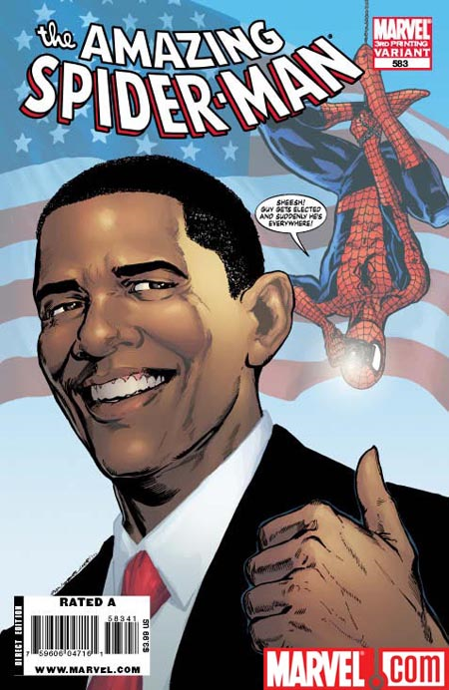
Despite this personal support of Republican candidates, Perlmutter's employer Marvel Comics has famously published reality "crossovers" that (at least superficially) are decidedly pro-Democrat. There are two obvious examples that quickly come to mind. Who can forget the Amazing Spider-man #583 variant cover that featured Spidey snapping a picture of President Obama? This stunt proved successful enough to warrant four reprint runs. More recently, issue Ms. Marvel #13 in which the book's protagonist, Kamala Khan aka Ms. Marvel, overtly throws her support behind Senator Clinton. In an unfortunate twist, the issue actually hit stands after Election Day. This is chronicled in greater detail in "Marvel Comics Superhero Uses Her Powers to Help Elect Hillary Clinton" (from an unbiased website who's mission is to "combat liberal media" so take that as you will).

Whether a calculated move for image purposes or (optimistically) because of the high quality of the product warrants it, Marvel has also been willing to publish titles reflecting a very clear political agenda. The most obvious recent example of this would be the cover to issue 8 of 2016's short-lived "ongoing" Mockingbird. (Ironically the last issue to be published as the book was canceled following it's publication.) It made quite a bit of news when the protagonist was featured on the cover wearing a t-shirt inviting readers to "Ask me about my feminist agenda".

The bottom line is while I like using my disposal entertainment dollars to be entertained, I also recognize to use these limited resources to support political/social perspectives with which I have agreement. Not buying certain comic books might make one "feel better" but ultimately only impact negatively those at the creative level. It is fair to suggest that this group includes many individuals whose ideals are consistent with my own and are giving larger voice to relevant issues.

Nothing is simple, even in the murky place where the worlds of lol it's and "funny books" overlap. The resolution to the decision of whether or not to buy-city is to remain vigilant in following the money in a way that works best for you and your conscience.

Friday, December 30, 2016

Funko POP Goes My 2016

Believe it or not, this collection is small as compared to those of
Funko POP super fans. (12/30/16)
For better or worse, 2016 was the year I further expanded my collecting interests. While I have periodically purchased action figures (dolls!?) in the past, mostly unique or unusual characters, such as Batman's Native American counterpart Man-of-Bats, Lord of the Rings Ent Treebeard and the 2003 Hulk movie's David Banner/Absorbing Man amalgam, I have until 2016 avoided falling into the seductive trap laid by figure lines. My resolve was weakened this past year, as I responded to the siren song of Funko POPs.

If the allure of Funko POPs lies in the diversity of the line, it's strength is in the power of the memories they are capable of evoking. As I am in the collectables sweet spot (40+ years old, male, some expendable income, a fanboy), there are in incredible number of relatable characters. Whether reflecting childhood movie favorites (Flash Gordon), recent superhero comicbook interests (Ms. Marvel, Batgirl), cultural icons (Ghostbusters' Patty Tolan, Mel Gibson as Braveheart), or even literary mainstays (Cthulhu from the stories of H. P. Lovecraft), Funko POPs addresses itches that can be stretched. Like comicbooks and baseball cards, the acquisition of many come with an anecdote.

My first Funko POP Holy Grail: I travelled to multiple Walgreens over the course of
weeks to find this exclusive Ms. Marvel. Kamala Khan is one of the more interesting
comicbook heroes to be introduced in years. Was very excited to come across it in
an urban store I stopped at on a lark. 

A favorite character from a favorite movie, Vultan, played by Brian Blessed,
from Flash Gordon (1980). I was 11 when my brother and I went to see this in
theaters. Purchased this on annual excursions to Nee York City to visit my stepson
at college. It kind of became thing to find a unique Funko POP on each visit. 

The first real collectible based on H.P. Lovecraft's Cthulhu mythos that I wanted was
also the first that I asked my local comic shop to find for me. Though unplanned, it
was also the first "Exclusive". Wish there were more POPs based on "Books" though.

A few months ago, I posted a picture of my POPs on Instagram. A former student wondered
in the comments, "Where are the female POPs?" She was right, at that point I had bought
only characters that were male. Ghostbusters (2016) was a movie I never expected to
like, but I was won over by the performances of the four leads, especially Leslie Jones'
portrayal as Patty Tolan. Jones' own cultural relevance has only continued to grow since.

A gift from my son this past Christmas following last Christmas' Howard the Duck.
Jack and I attended a local Sanders rally in June 2016 when the campaign
ball really began rolling, and I was excited to see his interest in politics develop.

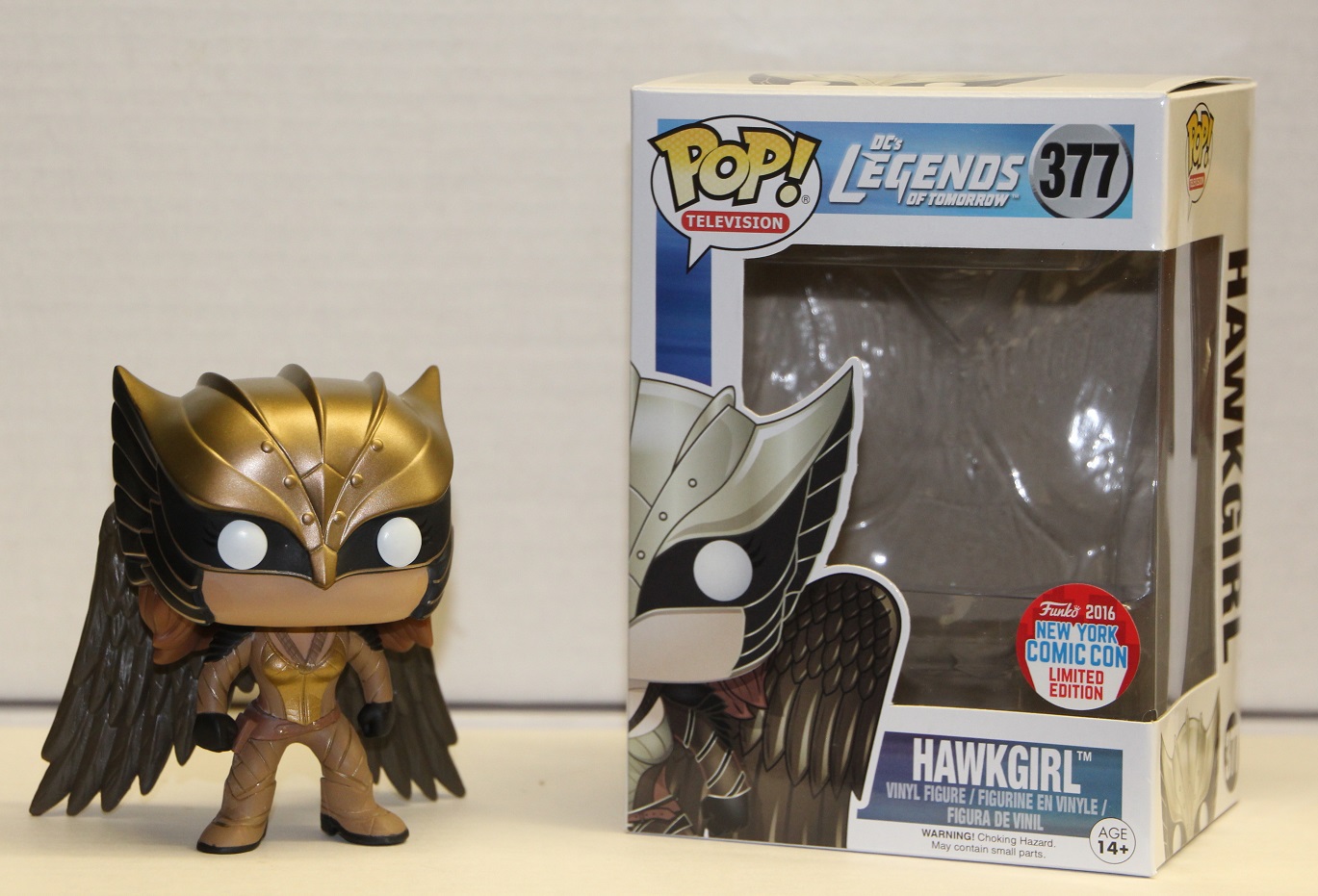
Hawkgirl was an unusual impulse purchase from Barnes & Noble, which by the
way is an excellent source of POPs! I've never seen an episode of DC's Legends
of Tomorrow television show, I do, however, love recent depictions of the
Kendra Saunders Hawkgirl character in DC Comic books over the past ten years.
Also a New York Comic Con Exclusive, an event I have yet to attend but hope to... someday.
Funko POPs tell stories. These 6" figures (and bobbleheads) that prompt me to reflect on semi-important moments in my life as a fanboy and person. To my wife and others who have not embraced the collector's life, it is difficult to explain that these $10 "dolls" are worthy parts of my fandom. As someone who's been doing "this" for 30 years, long before "geek culture" became hip, I dig what Funko is doing with this line and look forward to continue supporting it.

Saturday, October 15, 2016

Run Reader: Dark Ages (2014)

Capatin Hawkherst makes first contact in issue 1 of Dark Ages.
Long a sucker for genre mash-ups in both movies and comic books, Dark Horse Comics' 2014 four issue mini-series Dark Ages nicely scratches the itch by bringing together two of my fave genres, science-fiction and medieval action. Unaware of the title when it was originally published, I first came across Dark Ages on the back issue rack on a rare low new-release Wednesday.

Cover to issue 2 by
series artist
I.N.J. Culbard.
The creative team behind another excellent genre blending project, Vertigo's The New Deadwardians, writer Dan Abnett (of Marvel's Guardians of the Galaxy comic renown) and artist I.N.J. Culbard once again bring well-researched comic book action to the table. Set in 1333 Europe, an age during which God is feared and the violent skills of sell-swords are in demand, Dark Ages follows the conflict between medieval warriors come face-to-face with "demons." The twist is that the demons are not from Hell, as our character's assume, but rather alien invaders from space.

Utilizing a shifting pair of protagonists, Captain Hawkherst and his second in command, "Lucifer" Galvin, Abnett quickly establishes the world wary nature of our heroes. As Hawkherst explains, the group move from battle to battle thereby embracing the violence of their time as "A dark age [like] that will keep us fed and in steady employment. We would prosper in such an age." While Hawkherst hopes to respond to a potentially lucrative call-to-arms from French royalty, an impromptu invasion from outer space, ultimately set in an austere monastery comes calling first.

The conflict is ultimately joined on both sides by unique characters each reflecting clever twists on common genre tropes. The order of silent monks who populate the monastery are revealed to be harboring a secret understanding of what is happening, dead "rise" in support of the invading "devils," and an unlikely robotic ally (who also shares a name with an angel) keeps the proceedings fresh as all move toward a climactic final confrontation.

I.N.J. Culbard's clean and colorful artwork is very reminiscent of the style often employed to great effect in many of Dark Horse's Mignola-verse titles such as B.P.R.D and Lobster Johnson. In Dark Ages, the artwork helps to ground the intergalactic-medieval characters. After working similarly with the aforementioned New Deadwardians, Culbard, is one artists whose work I would add to my pull list sight unseen--there is a fun energy in his engaging style despite some occasionally heavy or morbid content.

Though some of the elements it chooses to mash-up, Dark Ages is incredibly well-executed and work as a self-contained action adventure sci-fi tale. Revolutionary twist and tuns are not always necessary. As a reader, sit is often enough to be drawn into a story well told (and drawn) with just enough variations on a standard (non-standard) story. Dark Ages is very likely still available in my preferred format (single issues) on your local comic shops' back issue rack in addition to being offered as a trade paperback through larger vendors.

From Dark Ages #3, the "angel" Aphrael explains to "Lucifer" their
 circumstances using spiritual tropes a sci-fi context.

Captain Hawkherst retruns, with cyber-enhancements, for the series' big finale.

Friday, September 02, 2016

Hallow-Reading: Blair Witch Project (1999)

Panel from "Elly Kedward's Curse" illustrated by Tommy Lee Edwards.
The time-honored practice of comic book-movie tie-ins frequently results in some interesting comci book titles being published. 1999's little-horror-film-that-hit, The Blair Witch Project, built it's artificial mythology in the "real" (and reel) worlds in an unprecedented fashion. While most are familiar with the SciFi (now "SyFy"...ugh) Channel faux documentary, The Curse of the Blair Witch, the development of the story goes much further than many suspect.

Cover to The Blair Witch
Project
#1 (First Printing)
Beyond even the commonplace novelizations that come with popular film releases, there was also a comic book one-shot. Rather than a retelling of the film's story in comic book form, Oni Press' The Blair Witch Project contributes an additional level of mythology to the key characters and events that, while important to its overall narrative, never actually appeared in the first movie.

With anticipation building for the third film in the series, Blair Witch (2016), to be released on September 16, the time seems right to rifle through some long boxes of older comic books in hopes of coming across the copy I knew I had purchased 17(!) years ago when it was first released. Filed nearby another unusual movie tie-in, Oni Press' Ghost Dog: Way of the Samurai (2000) one-shot, I was pleased to see it had not been discarded by my wife.

From "She Needs Me: Coffin Rock"
illustrated by Guy Davis.
This single issue (later followed up by a three issue mini-series entitle The Blair Witch Chronicles) contains three faux-adaptations of Cece Malvey's "Wood Witch Said" journals, "original" pages of which are shared on the last page. The unifying creative thread among these three stories is writer, or the individual hired to  "annotate and adapt" according to the credits boxes, Jennifer Van Meter. In the Foreward on the inside cover, it is revealed that Van Meter was offered the writing assignment by editor-in-chief Jamie S,. Rich because the author likes "weird crap." While not the most normal criteria for matching writer and material, here it works.

The pairing of each individual story with artist is equally impressive. The individual artistic styles of Tommy Lee Edwards, Guy Davis, and Bernie Merault are used effectively to create unique looks for each time period setting. While each of the three artists' styles vary, the common visual element of being inked solely in black and white lends cohesion to the proceedings. This combination of common writer and visual nuance, along with the varying artistic styles create a visual sense of progress that further contributes to a sense of movement through the narrative. Each short story covers Blair Witch background beginning with the origination of the curse and concluding with a glimpse at the Rustin Parr murders that are the precursor to the now iconic final shot of the Blair Witch Project film was derived.

A portion of the detailed appendix from the back
cover. Here, the numerous footnote from throughout
are explained in detail, supplying an even deeper level
of meaning to the Blair Witch mythology.
It has been a few years since I have seen the film (which is currently not available on wither Netflix or Amazon Prime for free streaming), but after reading this comic book I am confident I never watched the film in light of its mythology as fully as possible. A tribute to the story-within-a-story writing of Van Meter, as well as its carefully crafted "authenticity", it was difficult not to begin searching online through the names of the supposed writers and false historical events. Down to its footnotes and annotations, The Blair Witch Project comic book effectively reads like a visual representation of the person whose thinking it is intended to reflect--the educated and increasingly crazy Cece Malvey.

A brief synopsis (cribbed, in small part, from a promotional entry on MyComicShop.com) suggests the historical scope presented in the single comic book issue:
  • "Elly Kedward's Curse" art by Tommy Lee Edwards. In 1785, Elly Kedward was driven out of the Township of Blair in North Central Maryland. A year later, her accusers started disappearing under mysterious circumstances. Fearing Elly had cursed them all, the people of Blair fled, abandoning their town and giving birth to a legend.
  • "She Needs Me: Coffin Rock" illustrated by Guy Davis. In 1886 Burkittsville, a young girl is lured into the woods where she becomes a vehicle for a measure of graphic revenge against the men of the community levied by Elly's spirit.
  • "Left Alone: The Rustin Parr Killings" by Bernie Mireault (BEM). In a more modern setting, loner Rustin Parr is prompted by a voice in his head to kidnap and murder children from the local community. Readers are given insight into Parr;s thinking whcih reveals the familiar "voice" of the Blair Witch's guiding words.
With a new film being released, and one with ties to characters to the first, there is a good chance that the background revealed in this back issue bin survivor may increase one's level of enjoyment of the film. Even if it is not "officially" part of the new film's canon, The Blair Witch Project is both an interesting cultural artifact and an interesting example of well-researched modern myth building. The original single issue one-shot was originally priced at $2.95 and carried a "Mature Readers" label. It is very likely available in the back issue bins of your local comic shop at cover price or can be ordered online,along with other related Blair Witch titles for significantly less than cover price.

From "Left Alone: The Rustin Parr Killings" illustrated by Bernie Mireault.

Tuesday, August 02, 2016

Summer Reading: The Cursed Earth Uncensored

Cover to 2000 A.D. Prog 85 by Mick McMahon.
Despite Judge Dredd having been part of the comic book culture for the entirety of my collecting life, I've never actually read a comic book featuring the post-apocalyptic law enforcer. Like most, my experience with the character has been limited to the two movie adaptations, the inferior 1995 Judge Dredd starring then-action star Sylvester Stallone and the superior Dredd (2015) featuring Karl Urban.

Cover by artist Brian Bolland.
Even after two Hollywood movies, Judge Dredd remains a mystery. He remains a unique figure in comic books because, though first appearing in issue #2 of 2000 AD (1977), it is possible to understand his motivations without the necessity of reader awareness of an origin story. Without the understanding that Kal-El is the lone surviving alien of a dead culture sent to Earth or that Bruce Wayne saw his parents murdered, those individuals could not become the heroes they are destined to become. Not so with Dredd. Knowing how Dredd became a judge is completely unnecessary; all that one really need to know about Judge Dredd's motivations is captured in both his job title and catchphrase: "I am the Law!"

Last week, I came across an online article that motivated me to pick up a recently published hardcover graphic novel collecting one of Dredd's more popular story lines, The Cursed Earth. Not only does this story arc illustrate the key qualities of its lead character, but it also serves as a legendary historical artifact which, in its entirety, has long been out of circulation. As a result. The Cursed Earth Uncensored, published by 200 A.D., offers insight into what was deemed controversial in the late 1970s, a status achieved here not because of violence, explicit language or sexual content, but due to its potential offense to global corporations.

Postergraph by Bolland featuring Dredd
and two key Cursed Earth secondary
characters, Spikes Harvey Rotten and
Tweak.
The stories collected therein are credited to writers Pat Mills, John Wagner and Chris Lowder with art provided by Mick McMahon and Brian Bolland. Bolland also drew the original 2000 A.D.  covers, each of which is included in a gallery along with some pin-ups, here deemed "Postergraphs". As shared in the Bleeding Cool article which prompted my purchase: "Published in 2000 AD in 1978, The Cursed Earth ... ran into trouble when two episodes – ‘Burger Wars’ and ‘Soul Food’ – featured parodies of Burger King, Ronald McDonald, the Jolly Green Giant, the Michelin Man, and a number of other prominent corporate characters in a raucous and shameless satire of American consumer culture. After concerns of legal action at the time the then publisher IPC decided collections of this classic strip would omit the satirical stories." Until now.

Suitably, as a "satire of American consumer culture," the story relies on a timeless American literary trope for structure, the road trip. The narrative context of our hero's journey across the radioactive region of America that separates Mega City One and Mega City Two on the West Coast, the eponymous "Cursed Earth", is Dredd's mission to transport an important vaccine from One to the other. Because the original source of the story, 2000 A.D., is an anthology each of the 25 episodic chapters is only 6-8 pages in length. Only the covers and splash pages are colored, resulting a story visually told in black and white.

Among those joining Dredd on his mission of mercy are criminal punk biker Spikes Harvey Rotten and Judge Jack, who are later joined by Tweak, a seemingly unintelligent rock-eater from another planet with a secret. While Dredd is clearly at the center of the story, these three secondary actors each have individual character arcs. The most dynamic of these are the stories of Spikes Harvey Rotton and Tweak, whose fates become intertwined as the crew makes its way across the Cursed Earth.

From Chapter 11 written by
Pat Mills with art by
Mike McMahon.
On their journey, Dredd and his crew become embroiled in a series of conflicts with a menagerie of characters. Among these are a pack of post-apocalyptic dinosaurs led by the vicious tyrannosaurus named Satanus, murderous robots ("meks") left over from a bygone age programmed to destroy all Judges, and the aforementioned, controversial Burger Gangs, led by Ronald MacDonald and the Burger King. Through each adventure, Dredd remains steadfast in his goal, but is always willing to deviate in the interest of upholding his guiding principle of law and order. By returning to the core of the character, each of the three writers take advantage of the opportunity to further reinforce the humanity behind the helmet as Dredd often course-corrects his comrades desires to simply move one from the problem. Despite his willingness to violently uphold the law, it is clear that Dredd is a good man who seeks to see the law as he sees it equitably distributed to everyone regardless of their status (or state of mutation).

Even more than the controversial chapters that have been returned to their places in this uncensored edition, this character trait that most subtly satirizes the American culture. While the once "lost" battles between Dredd and Colonel Sanders doppelganger Doctor Gribbons, Ronald MacDonald and the Burger King take overt shots at consumerism, the smaller moments better reinforce the point. The value of The Cursed Earth is perhaps clarified on some level through these stories inclusion, but the power of the satire is not necessarily diminished through their priro exclusion.

Judge Dredd, The Cursed Earth Uncensored is a beautiful hardcover collection with a new introduction by two of the original writers and a gallery of covers and Postergraphs. While not inexpensive at $35 U.S., it is certainly worth the price for those interested in banned books, post-apocalyptic science-fiction or satire. As an introduction to the world of Judge Dredd, this collection is a strong, effective primer.


Monday, July 25, 2016

Summer Reading: The Secret History of Wonder Woman

Most of my reading of Wonder Woman in comic books has been limited to the her appearances with either the Justice League or Society titles and the John Byrne run of issues (#101-136) from the mid-1990's. Given that DC Comics recently went through a narrative soft-reboot of their comic book universe, Rebirth, I purhcased the first three issues of Wonder Woman as a means of further broaden the number of cape comics on my monthly pull list.

While I have a stronger background in the hero and her medium than the average New York Times Bestseller's list reader,  I am in no way an expert. Historically, unlike Marvel Comics, DC Comics has not perpetuated the fantasy that every character can be linked back to a single creator (for Marvel, Stan Lee), and DC's lack of a mythic bullpen of recognizable artists and writers can result in a distancing between fanboy, character, and creator. Though not one of it's purposes, The Secret Life of Wonder Woman by Jill Lepore helps to fill in a necessary gap: what was the personal and historic context in which an individual created the first popular female superhero?

Lepore does dynamic things in presenting and developing her subject, resulting in a novel that is equal parts biography, history text and comic book analysis. There are oodles of excellent reviews of the novel (including Dwight Garner's "Her Past Unchained" from the New York Times and "The Freaky, Fabulous, Feminist 'Secret History' Of Wonder Woman" by NPR's Etelka Lehoczky) that eloquently capture some excellent observations regarding the book's strengths and weaknesses. In most cases, reviewers, like I, recommend The Secret Life of Wonder Woman as a worthy summer read.

Even when reading for entertainment purposes, it can be difficult not to occasionally put on my "teacher's hat" while reading. Not surprisingly, this was also the case The Secret Life of Wonder Woman. Reflecting on this analytical angle, in addition to a couple of observations, I've clumsily identified potentially relevant New York State Common Core Learning Standards for English Language Arts & Literacy for future exploration:
  • The research on display is both deep and incredibly accessible, even to those with (I suspect) little interest in comics books or women's history. Interestingly, one anecdote Lepore shares (that is also echoed in a Wonder Woman story--Lepore gives multiple examples of Wonder Woman creator William Moulton Marston's art reflecting his life) illustrates this point. One of the many lessons Wonder Woman imparts upon men, and boys, is the untapped potential for finding excitement in the study of history... especially women's history (224). The Secret Life of Wonder Woman is a fine example of making history interesting. In its entirety, The Secret Life of Wonder Woman is an excellent illustration of standard 1 of the Reading Standards for Informational text (RI) at Grade 11 in Key Ideas and Details: "Cite the textual evidence that most strongly supports an analysis of what the text says explicitly as well as inferences drawn from the text." Reading about and researching topics of greater interest beyond the standard issues-based subjects, might be nice, and this text provides an example of how it can be done in a manner that is engaging.
  • The author objectively presents the lifestyle choices (among them two "wives" and an interest in bondage) made by Wonder Woman creator William Moulton Marston, avoiding the cheap way out by appealing to unnecessary lascivious language. While book reviews for her book seem to emphasize this facet of the story, Lepore highlights these freakier angles on Marston's story in the context of the larger Wonder Woman "origin." The author uses these facts to highlight the reasoning behind some of the creative choices Marston made in developing the character. Lepore's precise use of word choice that is not exploitative woudl be an interesting way to consider standard 4, also in Reading Standards for Informational text (RI) at Grade 11, but in Craft and Structure: #4. "Determine the meaning of words and phrases as they are used ... specific word choices on meaning and tone, including analogies or allusions to other texts."
  • The manner in which Marston's effectively developed and utilized Wonder Woman as his literary voice is explored. It is clear that more than most, writer Marston (and the experiences of he and his family) was Wonder Woman, and that the creator/author had intended to use his character as a vehicle to promote a specific social agenda. A Harvard trained psychologist, and longtime experimenter in social behavior, every aspect of Wonder Woman was crafted through the lens of promoting a specific responses from the reader. When Marston was not the one responsible for writing Wonder Woman her "power" was weakened. There are multiple examples given of how the values and qualities Marston worked to imbue Wonder Woman with are minimized in the hands of other writers. For example, as a member of Justice Society, Wonder Woman is relegated to the role of secretary, not even taken on missions, rather than the social justice warrior Marston envisioned. On multiple levels, this invutes a consideration of writer's craft, or in the language of CCLS RI #6. "Determine an author’s point of view or purpose in a text in which the rhetoric is particularly effective, analyzing how style and content contribute to the power, persuasiveness, or beauty of the text."
As either an entertaining (and informative) summer read or possible class independent read for high schoolers, The Secret Life of Wonder Woman by Jill Lepore is a winner.