Showing posts with label writers. Show all posts

Monday, April 20, 2015

Best-Laid Plans?

Three different logs for one goal...
Sometimes the literary context for the source of one of John Steinbeck's most popular novellas rings in my head. Just as the title (taken from "To A Mouse" by Robert Burns") suggested doom and gloom for Lennie and George, the echo is often not a sign of good things to come, but rather a harbinger of failure: "'the best laid plans of mice and men often go awry." I've really worked to have this particular plan come out on the positive side of the ledger...

When I began this most recent training cycle back on February 15 it was with the goal of completing next weekend's Flower City Half Marathon. At the onset, I lacked a true plan due mostly to my own waffling for a few weeks prior to actually stepping foot in the gym. The cold, icy and snowy weather pattern, that only recently broke for consecutive days, couldn't last forever.

This morning's 10 mile loop.
The thought of pacing a friend on his quest for a 2 hour half-marathon had been gestating for a few months before I my having acted upon it the morning following a Valentine's dinner party, and while many in the local running community will be realizing their lifelong dreams of running Monday's Boston Marathon, my aspirations are less lofty. Over the past nine weeks, I have been trying to chip away at four years of rust in hopes of comfortably completing a slightly less heralded (though popular) local race at a shorter (by 50%) distance.

Having survived a few weeks on the dreadmill early on (a situation I no longer dread quite so much, and one I actually seek out weekly for its variety), Sunday morning I completed my final scheduled long run, a ten-miler at what has become my only pace, between 8:20-8:30 minutes per mile. I have made efforts to consciously slow down or pick-up, but whether running 2 or 10 miles, that has where I've settled for the moment. All that remains in preparation for the race, is to taper into two rest days prior to Sunday's 7:30 a.m. start.

Now that my current plan will soon be reaching its conclusion (fingers crossed!), it will soon be time to consider next steps. I like a great deal the current plan's structure of four weekly runs, with cross-training on one day and rest on the remaining two, one of which follows the Sunday long-run that accounts for 30-40% of the overall mileage. I have put together similar plans for myself in the past in preparation for distances ranging from a 13.1 to 33 miles, so it has helped me achieve previous goals, so there remains a strong likelihood that I will stick to that organization. I am, however, leery of counting any chickens before they've hatched, so will wait until I finish one goal before setting too much of a foundation for the next.

Over the last ten days my left hamstring has been "acting up," so in some ways, I'm just trying to make it through next weekend. Taking a conscientious approach of  stretching, icing, and targeted resting, I remain confident that it will play out favorably with a finish in the two hour range. After that (and a suitable recovery period), there will be time for basking in the afterglow of having successfully followed through on one set of plans before setting some new ones in the days that follow April 26.

Tuesday, July 22, 2014

Literary Stops in San Fran

Outside the Comic Art Museum in San Francisco. (7/11/14)
Lots of cool literary things to be seen throughout California, and San Francisco is no different. Though we only had the time to visit a few interesting literary sites in my three days of touring northern California, the two that we stopped by while in San Francisco demonstrate the diversity of genres and mediums available there.

Exhibit celebrating the Teenage Mutant Ninja Turtles runs through September 14. (7/11/14)
The first place my friend Jerry and I visited was the San Francisco Comic Art Museum. A small unassuming museum (not a gallery, so artwork is not for sale), there were three exhibitions being shown. Happily, each had a personal connection or were about topics and issues of interest to me. As a child of the Seventies/Eighties, the Teenage Mutant Ninja Turtles continue to entertain. Jerry's young son is a more recent fan and it is cool to see the appreciation span generations. The artwork on display ranged from the characters' creation wa-a-a-ay back in 1984 to designs and figures for the current incarnation seen on Nickelodeon.

Jerry with art mural by TMNT creators. (7/11/14)
Mike Zeck is a penciller whose work I followed closely during his run on Captain America and the grand-daddy of comic book mini-series, Marvel Comics' Secret Wars, so I was glad to see a career retrospective of his time at Marvel being exhibited. There were plenty of pages and paintings from that era of his work as well as examples of his other contributions to popular Marvel characters. I especially enjoyed looking at the pages reflecting each of the stages (from sketching to inks to coloring and to final product) of production involved with comic books... I'm a fanboy, so I dig that sort of thing. It's always interesting to see the process play out in the artist head on paper.

Raw Fury: The Art of Mike Zeck runs until August 10. (7/11/14)
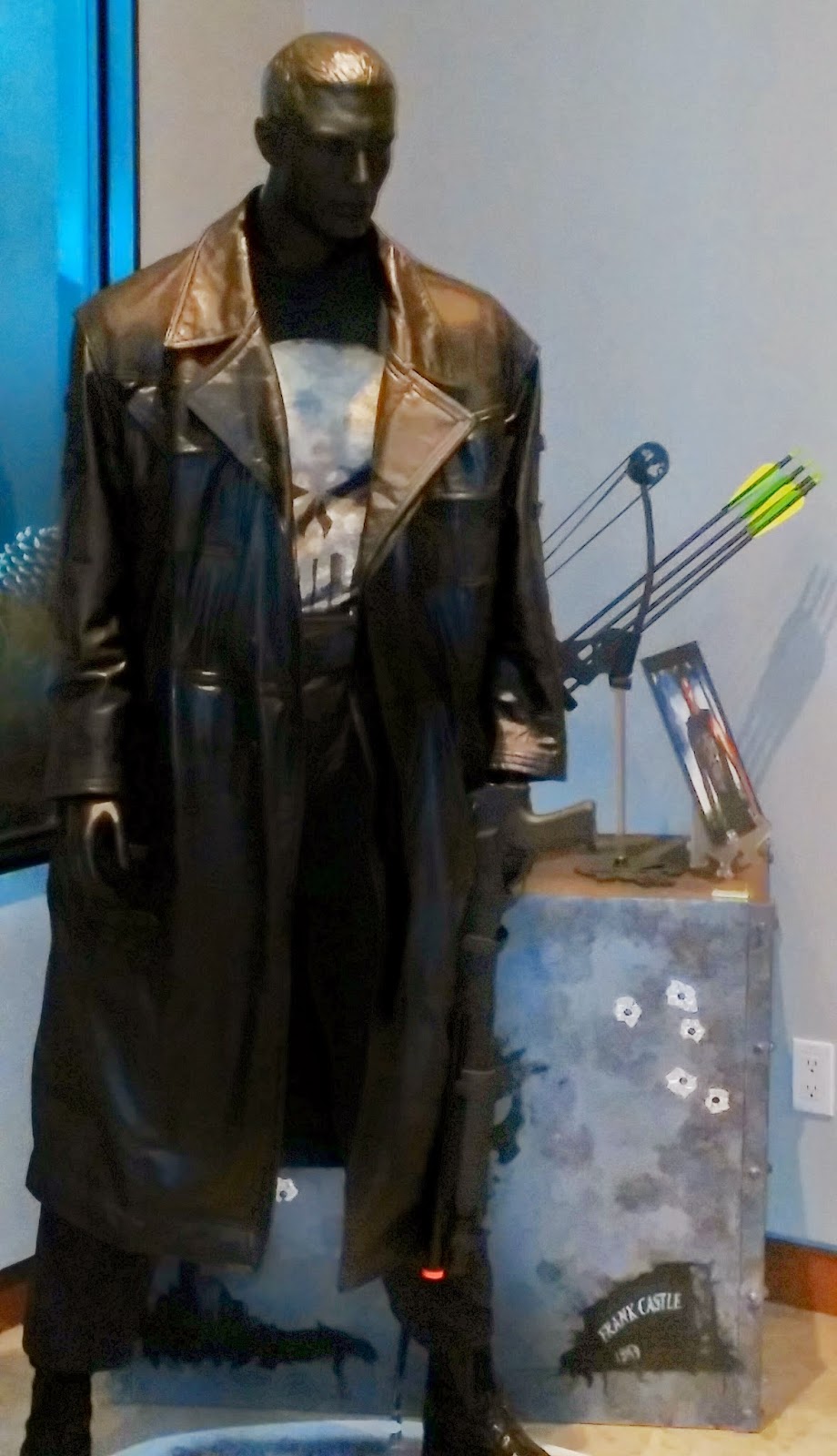
The costume and props used by actor Thomas Jane portraying one of Zeck's
most popular characterizations, the Punisher.(7/11/14)
There was also an exhibit of the work of North-American women comic strip artists. Long overlooked in American history (and by extension comic book history) are the contributions of women to the genre. It was cool to see original panels from stories featuring pulp character Miss Fury, as she has recently been revived by Dynamite Comics.

Pretty In Ink: The Trina Robbins Collection features highlights from
the personal collection of comic books herstorian Trina Robbins. (7/11/14)
Writer-artist John Byrne taught me to love comic books so I was compelled
to take a picture of his original cover art for Alpha Flight. (7/11/14)
Our day long walking travels through San Francisco's Chinatown ultimately led us to City Lights Bookstore. To some, I'm sure it seems silly to head to a bookstore after a cross-country flight, but as a fan of many of the artists originally embraced by City Lights (and San Francisco) including Jack Kerouac, Allen Ginsberg and Gary Snyder, visiting it had been a goal. Not nearly as commercial as it has every right to be (small bookstore owners--even landmark ones--need to eat), we found the store suitably charming, with a wide array of titles from all types of publishers.

City Lights Bookstore in San Francisco. (7/11/14)
The folks who worked there were somewhat surprisingly without the pretense one might expect at such a well know "hipster" stomping ground. We could have stayed for much longer, but found that our schedule woudl only permit us to hang out for a short time before heading back downtown.

First floor of City Lights Bookstore in San Francisco. (7/11/14)
Second floor of City Lights Bookstore in San Francisco. (7/11/14)
Second floor of City Lights Bookstore San Francisco. (7/11/14)
Jerry outside City Lights Bookstore in San Francisco. (7/11/14)
Jack Kerouac Street next in San Francisco. (7/11/14)

Friday, May 31, 2013

Can Kipling Sell Video Games?

As the creeper that girdles the tree trunk, the law runneth forward and back;
For the strength of the pack is the wolf, and the strength of the wolf is the pack.

While watching some video clips on Youtube recently, I came across a commerical for an upcoming video game release, Destiny. My stepson, an avid Halo fan, had mentioned this game to me previously, but as a non-Halo player myself, it held little interest.

This commerical has me curious, but not to play the game as much as to consider the poem being used by the production to promote the game. In this short clip, Giancarlo Esposito (most recently seen as Gus Fring on AMC's Breaking Bad, reciting some select lines from "The Law for the Wolves," commonly referred to as "The Law of the Jungle" due to its source, Rudyard Kipling's novel The Second Jungle Book.

In the original Jungle Book, Kipling sets forth an actual set of legal codes used by wolves and other animals in the jungles of India. It is in the Chapter Two of The Second Jungle Book, that Kipling provides a poem, featuring the Law of the Jungle as known to the Wolves, and as taught to their cubs. As an English teacher, I have on occassion used this poem as an example of a personal code of ethics set forth in literature, eventually inviting students to translate and update the tenants set forth in a more human (and modern) context.


Given the videgame pedigree of Destiny, there is little doubt that it will make money, and even less doubt that the link to Kipling will not be seen as a determining factor in its overall success. It is, however, interesting to see traditional "classic" literature (and British Lit, no less!) seep into the world of advertising. The visual translation of Kipling's "The Law for the Wolves" into such futuristic and accessible (to younger consumers) is a tremendous reminder of classic literature's ongoing relevance when presented in interesting and unique contexts.

"The Law for the Wolves" in its entirety is available for reading (and sharing) at here.

Sources:
"The Law of the Jungle" entry on Wikipedia.

Saturday, December 01, 2012

Can High School Students "Write Like Poe"?

A clever point--put the task still must be attempted:)!
Just prior to the recent Thanksgiving Break, while in the midst of reading The Scarlet Letter by Nathaniel Hawthorne, and following a review of Poe's "The Raven" and "Eldorado," my Advanced Placement Language and Composition classes embarked on a writing task I call Write Like Poe.

The task.
Like most teachers, I borrow or cherry-pick ideas and elements from other teachers online (I have found Web English Teacher to be a good source), and tweak them slightly to make them my own. This particular writing task is one I have assigned periodically over the last four years I have been teaching this course, and each year I am surprised by the quality of some of the pieces I receive. I am hoping this year will be no different.

The evaluative tool.
The Write Like Poe assignment is nothing earth shattering in it's design, it simply requires that students, after first reviewing American Romantic writers and their product, write a piece of their own utilizing some common strategies. With an emphasis on the Dark Romantics or American Gothics, students craft a piece in a modern context in such a way that the narrative poem or short story is consciously imbued with structural and content markers of Romanticism.

Not surprisingly, student success with this task is predicated on how well the instructor, in this case moi, facilitates the students background development so that they have (minimally) a superficial understanding of the key elements of American Romanticism. Some years I do a better job than others, and, often the quality of the student's product is the inherent feedback I need to let me know whether I have done enough.

Each year I raise the stakes slightly. In previous iterations of this assignment I have prescribed the use of (just which are the student's choice) specific figurative language strategies such as alliteration, simile, metaphor, onomatopoeia, etceteras. This year, I have added the expectation that students utilize at least one of three more sophisticated rhetorical strategies we have observed in The Scarlet Letter: anaphora, asyndeton (or polysyndeton) and parallelism.

The initial draft I have used in years past does not include any of those rhetorical strategies, at least intentionally so, and as a result my own annual task is to revise my draft to include at least one of these elements just as I have assigned the students to. An added bonus would also be if I did a better job with rhythm and flow...

The teacher's example (with bonus messy scanner-glass effect).
The published drafts (final products) for a grade were submitted yesterday, so with the mood set just right, given the cool air, snow dusted, frozen earth and starry skies, I prepare to hunker down for what I am confident will be a weekend of reading some fabulous student efforts. My prediction is that the result will be clear evidence that (with a little help) students can get close to permitting an affirmative answer to the question posed in the post title...

Saturday, October 13, 2012

Poem du Jour: "My Beard" by Shel Silverstein

From Where the Sidewalk Ends. Poem and drawing by Shel Silverstein.
Don't kid yourself, Shel Silverstein is much more than a "children's poet." In my experience as a high school teacher, he remains among the most popular of all poets, living in the rarefied air set aside in the hearts of middle and high school students which includes both Tupac Shakur and Dr. Seuss. Silverstein continues to be a wonderful "gateway poet" for (it would seem) at least two generations of readers. His poetry rhymes, is playful, and there is something very comforting about fun poetry that instantly makes students and adults pay attention.

"My Beard" is from his classic collection Where the Sidewalk Ends and is representative of both his playful nature and his ability to be mature for children in a manner that does not speak down to them... or me.

Friday, August 10, 2012

'Nuff Read: How to Write A Sentence...

This fall I will begin teaching my third year of Advanced Placement Language and Composition for eleventh graders at my public school of employ. Given the sometimes dry nature of the composition's particulars and, by extension, grammar, I am always on the lookout for books that are accessible to curious high schoolers with an interest in the topics of writing and grammar.

I picked up this slight tome (only 162 pages) while at The Coop in Harvard Square, subconsciously probably so I would feel smart. How to Write a Sentence and How to Read One by Stanley Fish (ISBN-13: 9780061840548, HarperCollins Publishers) is the quintessential "smart person's book." This may be why, despite being an adequate teacher of English, the detail and grammar-ese became a little confusing for this knucklehead, especially the further along I waded into it.

Despite that, there is much useful insight into the process of teaching grammar, though the sharing of this information to younger readers/writers would likely require a more adapt teacher to even further distill the concepts down. Fish's approach to teaching the art of sentences is to use those sentences that can be seen to have either artistic or structural merit as a basis for a series of activities that facilitate the reader's development of their own sentences that mirror the exceptional qualities.  The basis for this seemingly abstract approach, is Fish's assertion that, "The sentence form is King." Fish's underlying premise is that once we grasp what the different forms are, how they work and what they do–then the rest (“the rest” being the ideas we wish to communicate) falls into place. 

Makes sense, right? In fact, as I read I could not help but to consider how this approach is similar to that which coaches at all levels of competition use in training student-athletes. Through the use of models to break up apart exemplary performance into its smaller components (for example, a well run race is the product of many variables including arm carriage, leg drive, torso position, etceteras) for instructional purposes. I like to think of this as the "Miyagi-san (Pat Morita's character in the original Karate Kid films) approach", and along the same lines the deeper into Fish's book one gets the more like a foreign language (such as Miyagi's Japaneses) the diction becomes.

To this end, throughout How to Write a Sentence..., Fish guides the reader though a series of meta-writing activities intended to illustrate the processes he is suggesting. The basis for these exercise are sentence models drawn from numerous recognizable authors such as Edgar Allen Poe and Joseph Conrad. Fish relies on these types models and exercises to reveal for the reader the beauty and complexity of sentences and to invite the reader put into practice what he preaches.

The majority of the brief exercises could be easily adaptable for use in a classroom, though a less sophisticated student might find them frustrating, especially if what has been taught previously runs counter to what Fish suggests is the best way to teach. In addition to suggesting an alternative to existing grammar teaching strategies, How to Write... offer philosophical basis for a new approach to teaching writing beginning with its smallest structural building block.

While I do recommend reading (and utilizing) How to Write a Sentence and How to Read One by Stanley Fish, the purchase of the book is likely unnecessary, especially given its wide availability in local public libraries, including my local own Monroe Public Library branches. Of course, if you are a "local yokel", drop me a line and you're welcome to borrow my copy.

Other Summer Reading Books:
Supergods: What Masked Vigilantes, Miraculous Mutants, and a Sun God From Smallville Can Teach Us About Being Human by Grant Morrison
The Day of the Triffids by John Wyndham
Eating Animals by Jonathan Safran Foer
At the Mountains of Madness: The Definitive Edition by H.P. Lovecraft
The Boy Who Harnessed the Wind by William Kankwamba

Monday, August 13, 2007

Read It: This Voice in My Heart by Gilbert Tuhabonye

"When you consider yourself lucky only to have been beaten and burned, you know that the situation elsewhere is dire." (Chapter Six, page 191)
First some background: a few weeks ago, my brother was in town and as part of his irregular visits home, he and I usually go the bookstore so that he can buy a book or two to read on the flight(s) back to Monterrey, Mexico. Often, I’ll pick something up, too. More often than not, I’ll wander the racks until something peaks my fancy.

One such book I purchased while with my brother, and subsequently have been reading, is This Voice in My Heart: A Runner's Memoir of Genocide, Faith, and Forgiveness by Gilbert Tuhabonye with Gary Brozek. I’ll leave it to the back cover to give you a quickie synopsis :
Gilbert Tuhabonye is a survivor. More than ten years ago, he lay buried under a pile of burning bodies. The centuries–old battle between Hutu and Tutsi tribes had come to Gilbert's school. Fueled by hatred, the Hutus forced more than a hundred Tutsi children and teachers into a small room and used machetes to beat most of them to death. The unfortunate ones who survived the beating were doused with gasoline and set on fire. After hiding under burning bodies for over eight hours, Gilbert heard a voice inside saying, "You will be all right; you will survive."
While Gilbert's personal journey, and the role his Christian faith plays in it, is the key focus of the book, the religious themes never take center stage in such a way that this becomes an overtly "religious" book, something that is too often the case. Rather, Gilbert paints the tale of his own childhood in Africa, as well as, the political and social factors inherent in his family's station, that start him on his journey of survival. The role that his blossoming faith plays in his sorting out of the events and tragedies that transpire is significant, and his family an desire to be successful despite the barriers, eventually lead him to a happier (and safer) life here in the United States.

I would file this recommendation for both students and adults under world history and culture, immigration, faith, and biographies of athletes.

Breathe in, breathe out... YOU AND I ARE ALIVE!

Tuesday, July 24, 2007

In the News: Walk On

While perusing the news-o'-the-day last evening on Yahoo! I came across the following article of interest, Ecotourism in Thoreau's footsteps by Associated Press writer Clarke Canfield. For the uninitiated, Henry David Thoreau was an American author, naturalist, transcendentalist and philosopher (among other things!) who is best known for the book Walden, a reflection upon simple living in natural surroundings. Walden was the result of Thoreau's self-styled "experiment" in simple living during which time he moved to a small self-built house on land owned by fellow transcendentalist Emerson around the shores of Walden Pond.

Beginning in undergraduate school, and continuing through today, I had the opportunity to read a number of Thoreau's works as well as some literary essay regrdang the societal impact of Thoreau's writing on the modern "environmental/simple living" movement. What is unique about this particular tourist experience is the way (as presented in the article link above) that Thoreau's spirit and wiring are being tied back to the Native American culture which surely influenced him. This is evident in the naming of the walking tour, Thoreau-Wabanaki Trail.

Check out the article and even if you can't make it to the North Woods, simply step outside your own door and engage the natural world in which you reside...

Breathe in, breathe out... YOU AND I ARE ALIVE!

Thursday, June 28, 2007

Uncle Boo and Brautigan, Too


Just about two years ago now my Uncle Bob passed away after battling his life and demons for almost forty years. The official cause of death was complications as a result of cancer, but I know it was his life. A hedonistic Peter Pan, my favorite uncle in the end succumbed to excess: drinking, smoking, f***ing, and like most of his ilk, I guess the world was too much in him to ever live a normal life.

My uncle did, fortunately, have the chance to know and love my own children before he died. To them he was "Uncle Boo", and very much, I believe, the same type of great uncle to them that he was uncle to me: you know the type, the relative who you rarely see, but whose gregarious carefree spirit is alwasy present at family gatherings, even in the occassional absence. The relative all the other relatives complain about and call "no good." That was my uncle. To my children he was "Uncle Boo," just as to my brother and I, he would always be simply "Uncle Bob."

Maybe the only material things he ever gave me (and whether he really gave them to me or, more likely, lent them and forgot, is debatable) were a set of books by sixties author Richard Brautigan. I remember being an undergraduate English major in the early nineties and proudly, calculatedly, mentioning to Uncle Bob how I had come across an excerpt from Trout Fishing in America.

"No s**t," he said, taking a drag off his cigarette. I forget the location but we were probably in my grandparent's basement, which served as his base of operations--he lived with them until their deaths and his then his own wasting of any inheritance he received. Uncle Bob handed me a stack of well preserved volumes wrapped in a single rubber band. "Check these out."

I had an early appreciation for old books, especially those that smelled and felt of age and had been loved. I never asked where Uncle Bob had obtained these books, but I gladly accepted them from him, nonetheless. I like to think that he read them, although we never talked about what was in them, but when I think of how Richard's (Brautigan) own sadness and depression late in life is reflected in the life my Uncle lived, I like to believe that the books spoke to his own experience. That's what good books do.

Just as some of Richard's poems and anecdotes take me back to places, even now, I sense in retrospect that the feelings of sunshine and connectedness Trout Fishing returns me, too, were experienced through a much more rosie lense than those corners and shadows of experience that Uncle Boo visited and in some ways never came home from.
"Boo, Forever" by Richard Brautigan

Spinning like a ghost
on the bottom of a
top,
I'm haunted by all
the space that I
will live without
you.
Breathe in, breathe out... YOU AND I ARE ALIVE!

Wednesday, August 24, 2005

Buy This Book!: Seedfolks

The object in America is to avoid contact, to treat all as foes unless they're known to be friends. Here you have a million crabs living in a million crevices. . . . But the garden's greatest benefit, I feel, as not relief to the eyes, but to make the eyes sees our neighbors.~excerpted from Seedfolks
So I'm sitting in a teacher's professional development session today for roughly seven hours being re-taught Paula Rutherford's Instruction for All program I received when I started teaching over ten years ago. I started working in a new school district two years ago, so as far as they are concerned I might as well have just come off the pickle boat and require training... Truth is, though, that I do appreciate the opportunity to talk with my colleagues from other schools in the district and share the books we are teaching. Yesterday I selected a book from my brand spanking-new classroom library and today I decided it would be my next literary unit (right after the district mandated research project!).

Seedfolks by Newbery Medal Winner Paul Fleischman (with illustrations by Judy Pederson) is a book that I had heard of, but never read, and now that I have started it, I am so glad I did not miss the opportunity afforded me... I love this book!

Although I am very late to this party (the book is chosen as a state and citywide read in communities across the country), I strongly recommend it. Seedfolks is a simply written, delicate look at a number of issues of importance to each of us: diversity, difference, acceptance and community, as they are played out through the individual voices of thirteen very different characters--old, young, Haitian, Hispanic, tough, haunted, and hopeful. These voices, together, tell one amazing story about a garden that transforms a neighborhood.

Breathe in, breathe out... YOU AND I ARE ALIVE!