Showing posts with label video games. Show all posts

Saturday, August 10, 2019

Summer Reading: The Umbrella Conspiracy

As summer wears on into the August dog days, I find myself turning to my XBOX One console for relaxing (and admittedly mindless) gaming action. Though the missions have long been completed, I most frequently return to any of the many Resident Evil/Resident Evil Revelations titles for comfort. There is, after all, a personal Gamer Score to inflate by reaching achievements in games that are not necessarily earned by simply completing the narrative. For a number of reasons, the Resident Evil games to have a high level of re-playability for me that others don’t. Much of this is due to the deep and somewhat convoluted mythos presented throughout the game series.

Despite having read the numerous screenshots and load pages with background information—and having seen the cgi films released her in the U.S—the expansive story of Raccoon City, the Umbrella Company and Terragrigia, as well as their connections to one another from game-to-game is not always easy to discern. It is with interest in obtaining more background, as well as filling some free time with enjoyable reading, that I picked up Resident Evil: The Umbrella Conspiracy by S.D. Perry. A fairly straightforward novelization of the first Resident Evil game, The Umbrella Conspiracy combines Jill's and Chris gameplay scenarios into a singular narrative.

Bearing cover blurbs declaring the paperback as both “Volume 1” and “Based on the Bestselling Videogame by Capcom,” I anticipated getting some additional canon to help clarify some of the relationships between characters, at least at this early point in the series. While some of obvious character traits such as Albert Wesker’s villainous nature through obvious mannerisms such as his “perpetual sunglasses propped on his tanned brow” (127), new information is revealed such as Wesker’s early role in the story as a secondary henchman character. The he began as a captain in the U.S. police team STARS was not clear to gamers such as I who came late to the series (never a PlayStation player was always behind with RE early releases). This was just the kind of character development I came for. From the heroic Jill Valentine and white bread Chris Redfield to less well-known (though I dig him in his debut as a playable character in Resident Evil Revelations 2), Barry Burton, Perry uses the gameplay context to provide each an opportunity to develop.

Perry also makes the interesting choice to use the gameplay structure to drive the narrative in The Umbrella Conspiracy. Puzzles for opening doors become part of the story as Perry offers the reader into the though process characters go through in deciphering the proper way to address a variety of keys. Because this often entails characters spending pages searching for large coins which when combined allow access to parts to important the building, it is best that the reader recognize The Umbrella Conspiracy for what it is. Anyone who has played video games understands the necessity of nuanced puzzles to keep gameplay engaging. Perry is ware of his intended audience and writes it straight rather than having characters question “why would someone have use a series of cradle-to-grave paintings as a key to a secret doorway?” the STARS members demonstrate grit in simply recognizing the importance of doing what needs to be done. Even if what needs to be done is pulling levers to avoid attack crows. Requiring characters to think critically think about how to address each challenge as it occurs also offers deeper insight into what drives them. What seem like selfish moves on Barry’s part in assisting Wesker is much more forgivable given the weight of the threats made to his family should he not.

Another thought I had while reading The Umbrella Conspiracy is how Perry so effectively (and consistently) uses olfactory imagery throughout, a sensual competent obviously absent in the game beyond the visuals. Yes the zombies as computer generated characters are uniquely designed and, well, gross, I had not previously considered that they probably really stink too. Overall the level of descriptive gore present in this book is definitely on par with what one would expect from a Resident Evil product… and for this reader that is a good thing!

I breezed through the novel’s 280 pages, and look forward to picking up Volume 2: Caliban Cove which, unlike Volume 1, is an original work by Perry that bridges events between the first two games. I recommend The Umbrella Conspiracy to any readers of action/adventure/horror and would even suggest those who have not previously played Resident Evil will find something to enjoy; an ideal beach horror read.

Saturday, January 12, 2019

Random Funkos: Ni No Kuni Trio


My name is Jean-Paul and I have way too many Funko Pops. While hardcore "collectors" will argue that one can never have too many of any given collectible, I am confident that I indeed do. Just ask my wife. But that self-knowledge has yet to stop me from picking up random plastic figures that I come across.

A personal "first": individual plastic baggie 
around Tani's ponytail possibly to deter 
rubbing against the "buddy" while shipping?
For example, the trio of Ni No Kuni: Revenant Kingdom Funko Pops I recently acquired via post-holiday discount table at my local gaming shop. While visiting the store with my brother, who lives out of country, I came across these three anime characters with whom I had zero prior knowledge of them or the fantasy world from which they came. I simply liked their design, so I took them home on a lark, a decision that was aided by my brother kindly "donating" a portion of the gift certificate for the store my wife and I had gifted him the previous day to the cause. The reduced pricing, roughly 60% off retail, only increased the appeal of an impulse buy...

The initial aesthetic appeal of Tani, Evan and Roland was based solely on the Miyazaki vibe they elicited. In fact, it occurred to me that Tani might be the closest we get to a Princess Mononoke figure given the war paint and animal skin attire. A quick check of Wikipedia confirmed that I wasn't that far off.

Apparently, Ni No Kuni is a series of role-playing games set in a fantasy realm with characters that employ magical abilities during gameplay. The smaller characters that came with each Pop, dubbed “Higgedlies” on the packaging, are familiars that can be tamed for suitability during battle. The animated sequences and artwork for the games were both inspired by Studio Ghibli's other productions. Not surprisingly, "[T]he character development was intended to make children empathize with the characters and for adults to relive their adolescence." It is probably too late in a post about toys to be embarrassed about that fact that I first saw Princess Mononoke in theaters during its initial U.S. when I was in my late twenties.

In all likelihood I will never have the opportunity to experience the rpgs and videogames that spawned these beautifully designed characters, I will continue to appreciate both their Funko Pop translations as these three take their places on my rotating wall of figures.

Monday, January 18, 2016

Run Reader: Gears of War

With his signature catch-phrase, salty language, and buckets of
gore, Marcus Fenix is back in Gears of War #1 (2008).
This past Christmas I was fortunate enough to be gifted with an XBOX One game system. The Holiday Bundle version I received came with the upgraded, "Ultimate Edition" of the original Gears of War game first released eons ago (in gaming terms) in 2006. Thanks to the wonderful world-building of the game's production team, and despite having previously bested both this game and it's subsequent titles, it was difficult not to be easily drawn back into the world of Marcus Fenix and Delta Team.

Issue #2 cover by
Brandon Badeaux.
In edition to being something of a forerunner in dramatic sci-fi/action-adventure console video gaming, the Gears of War franchise also stands as one of the rare early game titles to be successfully spun off into an ongoing comic book series. Running 24 issues from 2009 to 2012, Gears of War was published by DC Comics under the company's now defunct Wildstorm imprint. (Fun fact: SEGA stalwart Sonic the Hedgehog's comic book adventures continue to be published by Archie Comics to this day, with the the most recent issue being #279!) The synergy between game and comic book is such that issues of the series are now available with the Ultimate Edition as unlockable extras, pages of which are viewable in the Special Features.

The success of the comic book is best attributed to its consistency with the games: both are moody and violent in tone with a tightly woven narrative. A key to this consistency in characterization is the result of the comic books use of the games' writers to handle scripting duties. With artwork equally evocative of the video game series, the talents involved contribute an additional layer of humanity to those operating in the Gears universe.

From Gears of War issue #7 written by Joshua Ortega,
art Simon Bisley and Henry Flint .
While there are quieter moments of subtle characterization in each of the Gears games (if you look for them), the comic book format provides numerous opportunities throughout the 24 issue run for characters to breathe and develop even more fully. Due to his established in-game tough guy status, Gears' protagonist Marcus Fenix' is at the center of most stories, if not as the lead, than certainly as a clear influence on the character from whose perspective the story is told.

Even with an already incredibly culturally diverse character line-up in its gaming universe, the Gears comic book also fills out the ranks of those under Marcus's command. Additionally, the series takes the reader back to familiar historical points in the establish Gears historical timeline, such as the Pendulum Wars. each issue takes on the perspective of ancillary characters who at one point or another find themselves with the orbit of Marcus Fenix. In addition to adding characters that would eventually find their way into the game, such as Jace Stratton, introduced in print with issue #3 and voiced by Micheal B. Jordan in Gears of War 3, the comic book series also adds to the mythology of the game-based world. While a minor character, and major influence, in the first two Gears games, Marcus's father takes the lead in a series of flashback issues to the aforementioned Pendulum Wars.

Gears of War #10, written
by Mike Capps and Joshua
Ortega with art by Liam Sharpe.
The opening six-issue arc entitled "Hollow" is written by Joshua Ortega with pencils by Liam Sharp. The events of the arc bridges the narrative gap between the first Gears of War game and the start of the second, following the brutal adventures of Marcus Fenix and Delta Squad in the battle against the Locust. As the writer of Gears 2, Ortega has a clear familiarity with the characters and, with Sharp's command of visuals, both tell a story with minimum dialogue and maximum carnage. One potential drawback to readers unfamiliar with the franchise is a lack of familiarity with the characters by potential readers. While I benefited from having played the games, for example the motivations of both Delta team and the evil invading locust army were understood, the uninitiated might need more background than the obvious "ugly monster equals bad guy" trope.

During its 24 issue run, DC/Wildstorm's Gears of War title maintained a high quality, never deviating from the exclusive "Gears-verse" for story setting. While part of the DC's company -wide "Draw the line at $2.99" price freeze initiative, readers never (thankfully) saw a cross-over with Green Lantern or, more suitably perhaps, Lobo. Concluding with a 6 part story by writer Karen Traviss, that bridges the narrative gap between the conclusion of the second Gears game and concludes with a story which leads directly into Gears of War 3.

The series can still easily collected as individual issues (my preferred format) are still available at cover price at your local comic shop if you are willing to dig deep into the back issue bins. Of course, the series has also been collected into three trades, though the license with DC has surely lapsed by now, there may be more stories in the future as Gears of War 4, with the son of Marcus Fenix in the lead, nears its release.

Issue #13 by Liam Sharp.
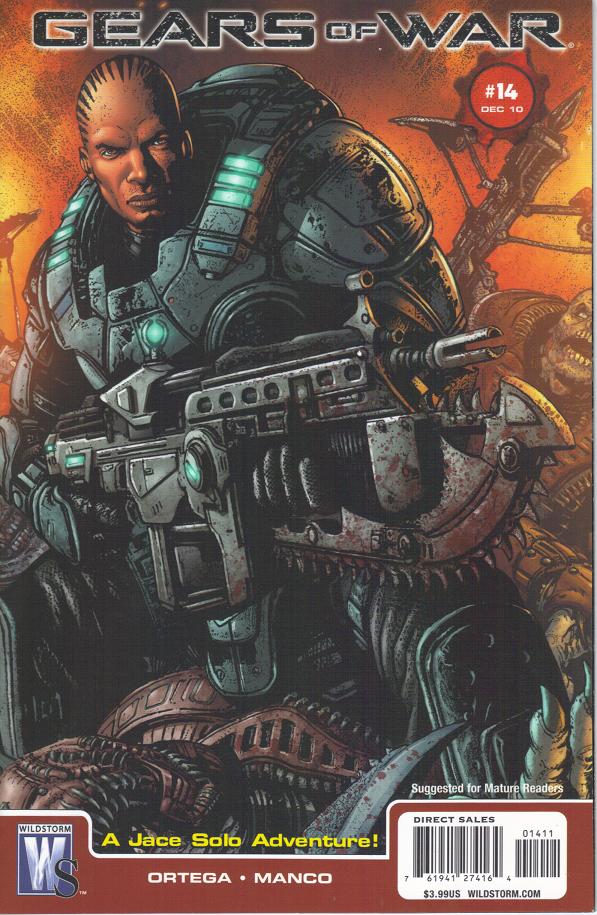
Issue #14 cover by Leonardo Manco.
Issue #19 cover by Colin Wilson.

Sunday, October 25, 2015

Fave Zombie Video Games

There are even a few stinkers I can't
part with...
I blame my parents. Or thank them, depending on how I look at it. Given that Halloween is only two weeks away, as I look for random things to blog about around my office, I can't help but notice that many of my interests include a significant subset of horror-themed items. Whether comic books, movies, novels or video games, the horror theme runs deep. I suppose, though, that's what happens when you're taken to see the original Alien in theaters at the ripe old age of ten.

Having written about a number of horror themed comic books and movies (often without intending to post them in October), I thought I'd mention a few of my very favorite console video games that include a horror theme. As easy as it would be to simply label them all "zombie games," the list of possible titles I've played include necromorphs, undead, bio-chemical creatures and hell spawns. The term "zombie" does seem a little limiting.  In my 30+ years of gaming (more frequently in some phases of my life than others), I've come across many games from the horror-survival genre, and there are three (well two, plus a throwback) that continue rating high on my personal replay-ability scale even after hours of gameplay beyond concluding their respective primary storylines. While some games are incredibly entertaining for short periods of time (2012's Lollipop Chainsaw, for example), the games that I can drop into my console every so often and continue to enjoy are those that qualify as (a few of my) "favorites." In no particular order:

Read Dead Redemption: Undead Nightmare (2010)


"Cattle rustlin' and bank robbery are at an all-time low; 
Murder, blood-drinking and psychotic episodes seem to be somewhat prevalent."

Full disclosure: the original Rockstar Games Red Dead Redemption (2010) is the answer I often give to the question of "What is your favorite video game." Originally available as downloadable content for the open-world wild west game Red Dead Redemption: Undead Nightmare is the perfect mash-up. While the base game is (in my estimation) the greatest Western game ever produced, the added zombie storyline considerably extends the game's re-playablity. The blend of Western and horror elements is brilliant. The basic premise is that you, as protagonist John Marsten, try to find a cure for the plague which is turning locals into zombies. Along the way there are opportunities to hunt mythical beasts, acquire unique weapons, and of course, eliminate oodles of zombies. As was the case with the original game, the smaller moments from the cut-scenes add an additional emotional level to the game play, but whether you experience them in their entirety depends on how far you play (go ahead, kill that last Bigfoot). Great game-play, great graphics and great narrative--an amazing downloadable expansion pack.

MediEvil (1999)


This is one favorite that I regrettable no longer am able to play (had completely forgotten I'd ever had a Playstation system!), but the memories I have of playing MediEvil are wonderful, not just because of the gameplay or Tim Burton-esque (when Burton was still cool) character design, but because I would often play with my daughter watching. An early Gothic horror-comedy action-adventure game, MediEvil has you play as the protagonist, Sir Daniel, as he seeks to redeem himself by travelling and battling to protect the medieval Kingdom of Gallowmere. At the time, and as you can tell from the trailer above it was a few system generations ago, MediEvil's graphics and gameplay were such that it was like playing a three-dimensional cartoon for the first time.

Dead Space 2 (2011)


"Isaac, we're all gonna burn for what we did to you..."

The second in a trilogy (so far) of games, Visceral Games/Electronics Arts' Dead Space 2 is an amazing sci-fi horror survival game with a strong narrative, excellent graphics and multiple levels of challenge. When I first began playing this, former high school students of mine warned me not to play the sequel as it would only pale in comparison, and they were correct. Dead Space 2 is so complete a gaming experience, requiring a wide array of skills (shooting, manual dexterity and brain games) that it always a joy to return to. Series protagonist Isaac Clarke's (as in Asimov and Arthur C.) life changes for the worse when he accepts a mission to a damaged space vessel in an effort to make contact with his girlfriend who is stationed there. Dead Space 2 picks up three years after the original and Clark, after being held captive and information retrieved from his memory by evil (are there any other kind?) industrialist and religious zealots, has to fight his way off a station/asylum infected with necromorphs. Clarke is written as a reluctant, damaged hero who begrudgingly accepts his role in a larger conflict he really wants no part of. Like all the games listed here, the voice acting is excellent and the characters well-developed. This game is a great example of why video games are often a superior entertainment experience to movies, the hours of entertainment one receives for the purchase price far outpaces any movie I've seen in recent memory.

There are of course many other games I have played and played and played that offer both amazing cinematics, tremedous voice work and gameplay experiences. including Left 4 Dead 2 (2009), Dead Island (2011), Resident Evil (pick one, except Operation Raccoon City--BLECHHH!) and the last game I'll purchase for my X-Box 360, The Evil Within.

Oh, and thanks Mom and Dad!

Resource:
Wikipedia's List of Zombie Video Games

Friday, October 11, 2013

Gaming Retro Review: Beowulf (2007)


This is my first year teaching twelfth grade literature and as such my first pass through a number of selections as a teacher, rather than for purely entertainment purposes. I am so pleased to write that much of the literature I've reread has been both educational and entertaining, something which does not always seem to be the case. First up was the classic epic poem Beowulf.

Using the popular Seamus Heaney translation as the source document for our analysis was a plus, given its accessibility to the modern reader. One other unusual benefit was the both the fairly recent 2007 Beowulf film adaptation and the recent success of A Game of Thrones television show, both providing some initial context.

Just as Ecgtheow beget Beowulf, so did the film adaptation, directed by Robert Zemeckis (Forest Gump, Cast Away), beget a video game for the most popular gaming consoles of the time, including the XBOX 360. Both the movie and video game received generally poor reviews (and neither has characterization that--for my tastes--reflect that offered in Heaney's, or nay, translation), but this fact hasn't stopped many an English teacher from showing clips of the beautifully rendered Heorot Hall and Hrothgar's kingdom to assist in establishing the poem's setting for students.

The overall quality of the game, a used copy of which I purchased for $4.99 at a local video game store, is really not that open to debate, certainly not in the eyes of the market--it was much derided and inspired little support from gamers. Those students of mine who recall having received it at the tender age of ten years-old hold no fond memories of it, telling me simply, "it sucked." This did not stop me, however, from giving it a look-see to judge what, if anything, it brought to the "original" story, much as Zemeckis'  film played with quite a few accepted plot points. As well as altering enough of the character dynamics to make my showing it in class (beyond the ten minutes at the start), unnecessary and even counter-productive to an analysis of the themes and archetypes.
Beowulf: The Game's "chant challenges" are unique,
though ultimately frustrating.

Despite a fair degree of clunky game play which made even the most basic level of difficulty frustrating, to the game designer Ubisoft's credit, there is an attempt to utilize the full spectrum of X-BOX 360's controllers in a number of unique ways, most notably to "chant challenges" which require punching in long and short "tones" in rapid succession to prompt characters to a variety of actions such as moving barriers or rowing galleys.

Just as the movie fleshed out elements of the story in the interest of shaping the narrative to modern sensibilities, The Game takes advantage of the additional time to fill in spaces in certain key character relationships rather than simply retelling the story as paced in the the movie. In the game, Breca becomes much more of a foil early on and the challenges he and Beowulf face together increase. (Unfortunately, the actualization of these challenges--"giant" sand crabs the size of small dogs?--does reduce the sense of danger inherent in the the opposition.)

You are Beowulf!
There are also small cosmetic changes to the characters designs as presented in the film The Game was released to support. For example, Beowulf is now clothed while battling Grendel: a concession that would seem to have been made to allow for a broader potential market, though the increased amount of pixellated blood drawn from each sword slash would seem to be counter intuitive to that purpose. Many of Beowulf's "kills" are brutal (in the movie and game), and The Game earns it's M Rating based on those merits alone... which begs the question: why change that aspect of the game except that it might be more marketable to play as a murdering savage warrior who is fully clothed.

Much of my appreciation of Beowulf: The Game comes from both the cost incurred for the copy I bought ($4.99) and my interest in comparing and contrasting filmmaker Zemeckis's extended vision for the character with that of Heaney. Had I plopped down $50, seven years ago, my venom toward the game might be equal to that of reviewers of the day. Now, year's removed from the hype, and neck deep in analysis and class discussion, I can think of many more wasteful ways to drop a few dollars and wile away a few hours, than Beowulf: The Game.


Thursday, September 19, 2013

(Serious) Comic Book Collecting 101

Dresser drawers full of comic booky goodness! (9/14/13)
Apparently without realizing it, I have been buying more comic books for my stepson for much longer than I had thought. I came to this conclusion a few weekends ago when, after dropping him off at Columbia University, I set about beginning the process of putting his comics in a large box with the intent of  formally boarding and boxing them. This has been common practice with my own comic book collection going on 20 years now and I thought it might be fun to do the same for him while he was away. Little did I realize (or recall) that he had so many books in need of organization!

Some did make it into a box though! (9/14/13)
He did have an opportunity to do this for himself. Last Christmas, I bought him a short box, some bags and backboards thinking he might do it himself, but he never really took to it. Due to perceived poor fit between the boards and backboards (an issue I fully understand though I thought I had checked both sizes before purchasing), he soured on the idea. Despite his absence his collection continues to grow. While he has been away to college, I have been buying new issues of the books he enjoys along with my own pull list each week, and each of the past few weeks I have picked up additional boards and bags of the correct size.

A fun evening for a fanboy: boards, bags and books. (9/14/13)
The titles of greatest interest to my step-son are primarily those adapted from science-fiction video games or television shows such as Dr. Who, Transformers and Halo. For each of those franchises, as well as others he enjoys, there has been at least two restarts of series with issue one and numerous micro-series. Some have even switched publishers over the past eight or so years, yet the beat goes on..

One of four short boxes neatly organized... but I'm NOT done yet! (9/14/13)
At this point, I have completed boarding and bagging nearly 300 comic books. These comics have been further organized by title and genre into four individual short-boxes. I have always been one to find occasional manual labor labor (mowing the grass, weeding and painting to name a few) and this process has been oddly relaxing: taking each individual board sliding it into the empty bag just enough to "catch," and then inserting the comic book, too, filling the bag. The board and bag sizes I prefer result in a tight fit, so after using Scotch tape to seal the tab on the back, I need to smooth the sealed bag out before putting the prepped book behind the appropriate labeled tab in the correct box.

Sometimes I delude myself into imagining that this repetitious activity would make Eugen Herrigel proud, but in the end hope that my stepson is appreciative, and more importantly, enjoys the comic books that have been collected in his stead.

Monday, July 08, 2013

The Last of Us the First of Mine?


Historically, there is a long tradition of comic book tie-ins supporting popular television shows and movies. Sometimes they are "good," such as the current Django Unchained series being published by DC Comics, and sometimes, not so much. In the past fifteen years, there has also been a huge increase in video game tie-ins as well, some of which most mainstream gamers and comic book readers may not even be aware of. (For example, did you realize that Archie Publications has been publishing a Sonic the Hedgehog ongoing comic book since 1993?!)

As a comic book collector and gamer, sometimes these are worth picking up because of the additional narrative insight provided or simply because of the synergy between the two. The admiration of one does not necessarily lead to the collecting of the other; for example, while I enjoyed the Mortal Kombat-esque Injustice: Gods Among Us X-Box 360 game, (and a healthy appreciation of the updated character), I did not jump on board the comic book prequel which, like Django, is also a DC Comics publication.  (DC/Wildstorm had some success, I felt, with the recently concluded 24 issue run of Gears of War.)


Issue #3 cover by series artist
 and co-writer Faith Erin Hicks. 
I recently begin reading the four issue miniseries (of which issue three came out two weeks ago) The Last of Us: American Dreams, published by Dark Horse.  Co-written by the game developer's (Naughty Dog) creative director Neil Druckmann, this prequel to the highly lauded PlayStation exclusive game, The Last of Us, this four issue miniseries introduces a younger version of one of the game's main characters and establishes the narrative tone that is further developed in the game.

A game, regrettably, I may never play as I am an X-Box 360 gamer. But, if I play my cards right, The Last of Us may be the first of mine. The reviews for the game and the quality suggested by the comic book are so strong that I am considering greasing the skids with my wife to purchase a PlayStation unit, solely for the purpose of playing this game. (I have been fortunate that the better Resident Evil games have been re-worked for X-Box to this point, though there has been a wait.)

I have not previously seen the works of writer and artist Faith Erin Hicks, but she is clearly one of the creators I would now pick up at least the first issue of whatever she works on. While Hicks artistic style is clearly influenced my manga, it is not to the point where there is a "large eye" distraction--a pitfall other artists tend to fall into. The framing and execution of action "set pieces" is exquisite and worthy of multiple "re-reads." I intentionally placed "re-reads" in quotes as the series of panels in which these take place often are without words.

At a cover price $3.99, the color comic book (printed on high quality paper--unlike Marvel comic books), is a bargain, something that is not easy to type or say about much of what is published today.

Friday, May 31, 2013

Can Kipling Sell Video Games?

As the creeper that girdles the tree trunk, the law runneth forward and back;
For the strength of the pack is the wolf, and the strength of the wolf is the pack.

While watching some video clips on Youtube recently, I came across a commerical for an upcoming video game release, Destiny. My stepson, an avid Halo fan, had mentioned this game to me previously, but as a non-Halo player myself, it held little interest.

This commerical has me curious, but not to play the game as much as to consider the poem being used by the production to promote the game. In this short clip, Giancarlo Esposito (most recently seen as Gus Fring on AMC's Breaking Bad, reciting some select lines from "The Law for the Wolves," commonly referred to as "The Law of the Jungle" due to its source, Rudyard Kipling's novel The Second Jungle Book.

In the original Jungle Book, Kipling sets forth an actual set of legal codes used by wolves and other animals in the jungles of India. It is in the Chapter Two of The Second Jungle Book, that Kipling provides a poem, featuring the Law of the Jungle as known to the Wolves, and as taught to their cubs. As an English teacher, I have on occassion used this poem as an example of a personal code of ethics set forth in literature, eventually inviting students to translate and update the tenants set forth in a more human (and modern) context.


Given the videgame pedigree of Destiny, there is little doubt that it will make money, and even less doubt that the link to Kipling will not be seen as a determining factor in its overall success. It is, however, interesting to see traditional "classic" literature (and British Lit, no less!) seep into the world of advertising. The visual translation of Kipling's "The Law for the Wolves" into such futuristic and accessible (to younger consumers) is a tremendous reminder of classic literature's ongoing relevance when presented in interesting and unique contexts.

"The Law for the Wolves" in its entirety is available for reading (and sharing) at here.

Sources:
"The Law of the Jungle" entry on Wikipedia.

Tuesday, May 14, 2013

Retro Gaming: Hellboy: Science of Evil (2008)


I can't recall wanting to like a video game as much as I had hoped to enjoy Hellboy: Science of Evil. A fairly recent convert to Mike Mignola's universe of characters (Hellboy in Hell, B.P.R.D., Witchfinder, etceteras.) published by Dark Horse Comics, and a fan of both films, I had not been aware of the previously released Hellboy movie tie-in console game.


When I came across a used copy for $9.99, I snatched it up, excited to get going. So excited was I that I did not even wait to spend the money to follow my traditional pre-purchase ritual of checking online reviews before plunking down $60 on an X-Box 360 game. This was an inexpensive used version, and was, after all Hellboy, so how bad could it me. It was only after returning home and checking online reviews that I became worried. Hellboy would appear to be a fairly reviled gaming experience. Really though, for the price, what did I have to lose?

Sometimes, reviewers are not that far off: as a gaming experience Hellboy: Science of Evil was incredibly frustrating, not just for what it was, but worse, for the potential it squandered.


Chances are great that if you're reading this, you are already familiar with the well-loved characters, and perhaps marginally curious if this game is worth picking up for a certain amount of "fan-factor", so I'll cut to the chase and simply start by mentioning positives and negatives as I experienced them:
  • Positives: the story adheres to both comic book and movie "universes," the voice work is done by the actor who portrayed Hellboy in the films (let's face it Ron Perlman, IS Hellboy!), the cut screen graphics are adequate and the characterization (movements and vocals) of Hellboy are solid.
  • Not-so-positives: repetitive game play, including some odd game play moments when jumps aren't jumps or necessary objects or paths are off screen and difficult to find, the game play is not very intuitive, repetitive game play, the other characters from the book/movie are missing from the main story (though appearing on the box), this lack of playability of other characters makes the gameplay even more... repetitive.
There are also the standard (for older-generation games) dissolving rocks and melting set pieces, ghost graphics and dead spots. The game play was VERY frustrating and were it not for a gamefaq/walkthrough, I would have given up on this game after the first chapter during which it was impossible to figure out just what I, as the player, needed to find to move onto the next chapter.

Say "goodbye" to the only video game I've ever "walked out of" before it was over...

Tuesday, February 19, 2013

Learning the Interrobang with Resident Evil 5!?


Screen capture from Chapter 1-2: Public Assembly in Resident Evil 5 on XBOX 360.
Though often unintentionally, I find that I either 1) learn something new everyday or 2) learn I've been wrong all along about something about which I should have known better. A recent case in point is the use of both the exclamation (!) and question (?) marks at the same time to punctuate a single clause. I had always been under the impression that this was poor grammar, and while I'll maintain that it is still poor to do so in more formal modes, after many years of preaching the evils of doing so, I have been wrong.

While recently playing Resident Evil 5 on X-Box 360, a cut scene came on which again caused me to question one of my existing grammar beliefs around punctuation. As the game's two protagonists, Chris and Sheva,  were entering a foreboding storage facility, the two engage in a quick conversation with helicopter pilot Kirk. During this scene, the helicopter is attacked at which point Kirk exclaims, "What the f*** are those!? Mathison to HQ, I'm under attack by flying B.O.W.'s!" In many video games, when dialogue is being delivered in-game or during cut scenes, it also appears on screen. This is also the case with the Resident Evil games I have played on my XBOX 360 system.

This is actually at least the third instance of this combination of punctuation symbols, suggesting that the exclamation-question mark combo is legit. Earlier, when Chris is attempting to communicate with another off screen character he exclaims (along with the dialogue typed-out onscreen), "DeChant! Do you copy!?" The fact that each of these grammatical instances appear in fairly close proximity to one another in a ba-jillion dollar video game franchise, caused me to (again) ask the question: is it grammatically correct to use both a question mark and an exclamation mark following a statement? Part of me knew it somehow had to be otherwise why would the producers of such a popular (and culturally influential) video game choose to go this route without some purpose. This is not the product of some hack (such as myself) writing fan-fiction in upstate New York.

T-Virus parasitic zombies from
Resident Evil 6 are probably
interrobang worthy. 
One way that I have previously imparted to my students this perceived misuse of punctuation symbols is by asking a number of the young thespians in my classes to read a statement (for example, "I like ice cream") first with each mark individually (! or ?), and then with both side by side(!?). Rarely has "I like ice cream!?" been orated in a manner that is not awkward, or at the very least non-committal or unclear.

In certain rhetorical circumstances, such as when wants to express certain questions with annoyance, excitement, surprise or frustration (among other complex feelings), it IS grammatically acceptable to use exclamation mark in conjunction with the question mark. Apparently it CAN be used, and furthermore, there is an informal name for a punctuation symbols that combines both intentions by combing the marks. This can be in protest or astonishment ("Out of all places, the toilet?!"); a few writers choose to replace the "!?" combo with a single, nonstandard punctuation mark, the interrobang, which is itself a combination of a question mark and an exclamation point. Again, this is grammatically informal.

While use of the ?! combo, or interrobang, is "okay" to the Grammar Gods, to me, it is formally uncool and, in some ways, lazy. I would equate its use in student work as similar to the tendency to needlessly lace one's creative writing drafts with profanity: if you or your characters have something to express, to do so with profanity (and now with the exclamation-question combo/interrobang) strikes me as sloppy and lazy. I'll continue to suggest that the disciplined writer challenge themselves to find a clearer way using language and punctuation to articulate just what it is you are trying to communicate. But the contrarian in me does find the interrobang slowly begin to grow on me...

Sources:
RESIDENT EVIL 5 Game Script
StackExchange

Tuesday, August 28, 2012

Retro Gaming: Godzilla: Save the Earth (2004)


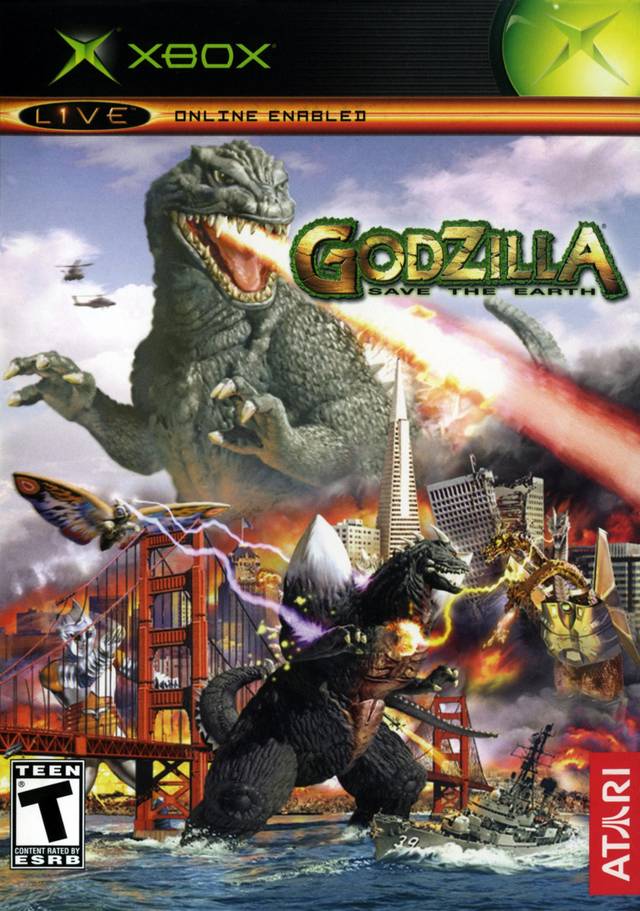
Continuing my recent return to Godzilla super-fandom, I have been watching old Toho trailers on Youtube of the Big G in action. Two Thursday's ago, I came across the teaser for the X-Box game entitled Godzilla: Save the Earth (posted above) released in 2004 and developed by Pipeworks Inc. and Atari. I have a slight recollection of renting the game from Blockbuster when it was originally released, but I haven't played the game in nearly 7 years. After reading a a few reviews and searching for a screen grab or two, I called down to my local used game store to inquire about purchasing a copy. Apparently the game, like it's predecessor, Godzilla: Destroy All Monsters Melee (2003), is fairly hard to come by. (Online prices range anywhere from $25-$40.) Fortunately, the store had a used copy of Save the Earth for $9.99, so I went and purchased it later in the evening.

More and more frequently, I find myself enjoying the game play experience of older generation games, and Godzilla Save the Earth offered a similar pleasant surprise. The controls are not terribly complicated, while offensive/defensive moves are specialized depending on which of the 18 playable characters you choose, as well as being and fairly intuitive (move toward the opponent + "A" button for Destroyah's "Wing Destruction" blunt attack) to perform. An added bonus is that mindless button mashing is not what is necessary to move through levels.

The narrative is straight Showa era Godzilla and easily recognizable to any film fan, as all of the playable monsters (only Ebirah is unplayable) from the Toho movies, along with two of the updated versions of Godzilla, are battling alien invaders. Of course if it's aliens invading Earth, they must have unleashed King Ghidorah and his "evil" pals to bring mayhem to our populace. The aliens (and their monster minions) ultimate goal is to capture enough "G-Cells" (yes, Godzilla-cells) to develop a super-army of monsters. The option to play as either good or evil monsters insures that the loose narrative is definitely not the driving force of the game though, smashing stuff up is.

As this is a retro review, I had the opportunity to read previously written reviews prepared during the games original release. In doing so, I was surprised to read how poorly received this game was by both the gaming media and general public.

Ever heard of Moguera? I hadn't either,
but his speed and mobility makes him a
very useful character to play!
Whereas one reviewer wrote "...truth, don’t buy this, it’ll ruin your memories of Godzilla films on late-night Channel 4," I would suggest that quite the contrary is true--Save the World is full of many of the elements that made those movies so enjoyable and with, believe it or not, in many cases better visuals. One of the realities of Godzilla movies is that, while the "star," Godzilla is often little more than a plot device around which to build forgettable invasion plots and romances. Save the Earth is all the parts of the movies you really want to see: big crazy monsters beating each other up.

Even trustworthy IGN gave the game a score of 6.5 out of 10, saying: "While Save the Earth is still fun with the manic action of beating up three friends, there's still not much to do when there is just one computer controlled opponent to fight... As it is, there's barely anything that's new and even the online addition barely makes this aging game look any better." Of course, the whole thing was new to me as I had not played that game which had preceded it to market, but having had the experience of playing both Dead Rising games, and feeling similarly about that franchise, I can understand the validity of this criticism in its context.

The opportunity to hear some of the common sounds of my movie going childhood, such as Godzilla's trademark roar and Megalon's claw clank, among other nuances of the game were enough to make the $10 investment well worth it. Even better is that he game play, with three different levels and additional challenges, provide hours of mindless smashing and gamma-breath explosions.

Highly recommended!

Saturday, June 30, 2012

Retro Gaming: SEGA Genesis' The Lion King (1994)


In addition to reorganizing my comic book collection this summer, I have also been trading in for credit some of the video games that I either no longer 1) play or 2) have a functional gaming console on which to play them. Despite weaker graphics (by today's standards) there are a number of games from  previous "generations" of game play that during their heyday in my system of choice were just plain "awesome."

Despite currently enjoying a XBOX360 system, and anticipating the XBOX720 or Ocho or whatever it's being teased as this month, as I packed away our old generation original XBOX, I became nostalgic about some of the games; not nostalgic like weeping, but nostalgic like "that was a cool game play experience!" or "I remember when I played this!" Perhaps not surprisingly, some games serve as reminders of yesteryear, much like songs remind one of the "old days." The bonus is that sometimes they also were well-designed or executed gaming experiences.

Similarly, as I stopped by my local video game store, and saw the ancient systems from years (and seemingly lives) gone by on display such as the Atari 2600, Sega, and Dreamcast I recalled some of the cool games I'd forgotten about. As a way of recapturing some of that magic I thought I'd briefly relive the magic of some games that though being somewhat out of favor,  were nonetheless a joy to play--great worlds to get pulled into--by retroactively reviewing and considering some older games.

Nearly 18(!) years ago, I somehow came into possession of a Sega Genesis gaming system. It's been a while, but I'm pretty sure my brother bought it for my daughter (who was 3 going on 4 at the time) and I. Well, mostly me.  Honestly, despite the responsibility (wife, children, etc.) I was pretty much a kid myself, playing at being a father, so we would often play some of the games together, most notably, and memorably, Disney's The Lion King.

As you can tell from the clip above culled from the many available on Youtube, the music and graphics were very similar to those of the film and excellent by the standards of the time. The game play was old school basic (claw, jump, roll) and the experience was very much like an arcade style game except you didn't need to pump quarters into it a 'la Ms. Pac Man. At the height of Lion King-mania, what child (and doting parent) wouldn't enjoy playing this game (especially after having seen the movie on VHS about 1,000 times)?

This "wide screen" stampede level took ma-a-a-a-ny attempts before we made it through unscathed!
The game included the voices of all the film's memorable characters: Timon, Pumbaa, Lion-o Simba, and even Skar and his hyena sidekicks. This was pre-Internet (or at least pre-at-my-house Internet), so there were no easily accessible cheat codes, so when you "died" 3 times, you began all the way back at the beginning.

Come to think of it, I think we did make it to the final boards...
Getting through an entire game was a challenge, and even set on the lowest level of difficulty, I recall doing the first board or two multiple times as we made our way to the higher (and by that time infinitely more interesting) levels that followed. I can't recall if we ever really finished the game, but I do fondly remember spending lots of hours talking and laughing while playing Disney's The Lion King game together.

Wednesday, February 29, 2012

Alluding to Books While Left for Dead, Too

 
WARNING: The above trailer contains gratuitous zombie killing!

Following my recent fascination with Walking Dead it seemed only natural to pick up one of the many zombie first person shooters available for the X-Box 360, and following an entirely too long conversation with the electronics department representative at Target, I settled on Left for Dead 2. My son, who had come shopping with me, reminded me that we had actually ha the game briefly on our house a few years ago (a friend of his had brought it over), but that must have been during my "I don't do first person shooter games" phase which I have thankfully (?) "grown" out of.

Left for Dead 2 is an entertaining game with some good old fashioned jump scares and a great potential for replayability. Though I had been lead to believe it was a gory, I did not find it very objectionable at all--it is after all a zombie survival game, so what is one to expect?

Like any high quality video game, Left for Dead 2 has an engaging narrative and fairly dynamic playable leads whose canned voice work avoided being too caricature-y despite the potential for such a thing given their diverse backgrounds: a middle aged African American professional male, a twenty something Southern good ol' boy, a twenty-something African-American woman, and a thirty something Caucasian male grifter. After a week of occasional play, there is still much to discover and I have yet to scratch the surface of the online potential match play.

Another interesting aspect of the game is the use of puns and wordplay in titling the achievements one can master during game play. For the uninitiated, "achievements" are "games-within-the-game" that players can accomplishments during the course of play. For example, if you revive ten other players using a defibrillator during match play who earn x amount of player points which are then added to your "Gamer Score." What is not unique is the presence of achievements (all games have them), but what is rather clever are the names of the achievement, some of which allude to other sources, such as books and historical figures.

In a previous post, I wrote about coming across a similar phenomena observed while playing Rockstar Games' Red Dead Redemption.

In Left 4 Dead 2 there are 65 possible achievements. Of those, the titles that appear to have been given some extra thought seem to fall into two types of allusions to works of literature and to musical works. While nearly all of them engage in some form of wordplay, it's just that these two groups that seem to have a literary bent.

An allusion is a reference to a person, place, or thing in history or another work of literature. Allusions are often indirect or brief references to well-known characters or events. Two titles in particular seemed to most obliviously intended to allude to literary works. Just why they were chosen, other than that they just sound "cool," requires digging a little deeper:
  • "Crass Menagerie": Kill one of each Uncommon Infected. (Tennessee Williams' The Glass Menagerie; pick any single (or all) of the main characters--Amanda, Tom and, most visibly, Laura--each of whom can be said to be "infected" with one malady or another. Though the setting of Williams' play is St. Louis, Amanda is referred to as a Southern belle.)
  • "Confederacy of Crunches": Finish a campaign using only melee weapons. (A Confederacy of Dunces by John Kennedy Toole; the setting of the game is Louisiana, and the author was born and grew up in New Orleans.)
A number of allusions to classic popular music titles are also made.
  • "Bridge Over Trebled Slaughter": Cross the bridge finale in less than three minutes. (A Bridge Over Troubled Water was the fifth and final album recorded by Simon & Garfunkel; the allusion is fairly literal here given the achievement acquired.)
  • "A Spittle Help From My Friends": As the Spitter, spit on a Survivor being choked by a Smoker. ("With a Little Help from my Friends"written by John Lennon and Paul McCartney, released on The Beatles album Sgt. Pepper's Lonely Hearts Club Band in 1967. Other than being a clever play on words... nothing too deep here.)
As I reflect on what this means, the reality is that to many, these allusions mean nothing... sort of like when students get frustrate when the teacher (me) "sees" things in writing that they don't. What I try to remind them is as their own reading grows broader and deeper, they'll see things too--like literary nods and allusions in zombie video games!

Thursday, April 21, 2011

Retro Gaming: Call of Juarez (2007)


Though not nearly as lucrative as that other XBOx 360 "Call of..." franchise, I have recently begun playing my way through the Western-themed first person shooter Call of Juarez series, of which there is a second sequel (or first sequel following a prequel) due this summer.

The original Call of Juarez, developed by Techland and released in 2007 (and purchased just last week by yours truly at Gamestop for $10) follows the story of both Billy, a young Mexican-American who has previously succumbed to the Gold-lust of hidden riches, herein refereed to as the call of the title, and his uncle Reverend Ray. Apparently, upon returning home to visit his mother after wandering for riches in Mexico, Billy is accused of murdering both his parents. It is at this point that Reverend Ray, with a dark secret of his own, sets out to "redeem" Billy (translation: revengin'), as well as any other evil-doer he come across, brandishing both guns and a Bible.

While the game play does not offer nearly the open environments one may have grown accustomed to with Red Dead Redemption (now the accepted becnhmark for Western-game greatness), it does offer a cinematic, if somewhat limiting, storyline. The gunfights (think "boss-battle" but with an Old West aesthetic) were not too challenging, which I would attribute, in part, to what was in 2007, very early generation approach to the mano-y-mano shootout.

Game play challenges lay in some problem solving moves which are required to advance the game, some of which were especially challenging given some visibility issues with the shading of certain scenes. I actually found myself referencing an online walkthrough after fifteen frustrating minutes attempting to work through some points in the story.

The characterization was fairly impressive and the voice acting, admirable, though Billy was played a little too "Gee Whiz" in demeanor given the character's implied rough and tumble backstory. One interesting consideration is that this game was developed by an Iceland firm, so one might safely infer that their perspective was colored and influenced by old television Westerns as much as by any indepth historical research.

For $15 this was a solid purchase--especially if you consider that one can't even see a new movie in theaters once (with popcornand soda, of course) for the same price!

Saturday, March 19, 2011

Retro Gaming: Red Dead Revolver (2004)


Though I haven't had too much time of late to watch (and comment on) any spaghetti-type films, I did recently take the opportunity to pop in an older Western-themed XBOX game.

Red Dead Revolver is the predecessor to the wildly popular (and playable) Red Dead Redemption. I have been playing Redemption, as well its numerous donwloadable updates, for nearly eight months, and though I have yet to "complete" all facets of the game, I have been hankerin' for another similar game play experience. About a month ago I came across its 2004 prequel, Revolver, on Amazon.com and purchased it for $14.

Originally developed by Capcom (a fact which can be seen in the nuanced anime-style facial expressions of the characters), it was eventually purchased and partially re-engineered by Rockstar Games prior to its release in 2004. Like most sequels/prequels, Perhaps the easiest context in which to consider Revolver is to do so in light of Redemption. Technological advances such as textured graphics and more complex environmental interaction (walking through a door into the main street in Redemption as opposed to walking to a door, cutting to a screen then magically reappearing on the street in Revolver), the storytelling and game play are remarkably similar... and to Redemption players, somewhat familiar, as some the main characters do turn up as playable characters in the XBOX 360 LIVE Mulitplayer mode.

If anything, the influence of the Spaghetti Western genre is more pronounced in Revolver. By employing a "grainy film effect" on scenes, in addition to the use of film scores by Morricone and others, Revolver plays like a more stylistic Western than the (at least to these eyes) ultra-realistic Redemption. Huge, gloppy blood spatters and appropriately broad characterization add to the Spaghetti-vibe. It is almost impossible not see the Eastwood's squinty-eyed Man With No Name, as the basis for Red Harlow, Revolver's games protagonist bounty hunter.

My only quibble is one that is likely the result of the system that I played the game. Originally released for the first XBOX system, I played Revolver on the more contemporary XBOX 360, which might be the reason that the graphics were not nearly as clear as those seen in the trailer above or in the pictures I've come across online. The high level of playability though, despite the visual inconsistencies, speaks to the overall quality of the game, offering an interesting look at the early beginnings of what woudl become the Red Dead Redemption franchise.