This edition includes the erroneous character creator credit of the Lone Ranger
to radio station manager George Trendle. Some of the basic ideas were his,
but were fleshed out to great success by Fran Striker.
Recently, I spent nearly six hours in a hospital waiting room as my mother underwent back surgery. With all the class papers graded, I turned to the pile of books I have been periodically reading on-and-off for (what turns out to be) a ve-e-e-ry long time. One book in particular provided an opportunity to escape the waiting room and travel back to those thrilling days of yesteryear...
This volume is easy to find online
at a very affordable price, though I
went to Berkeley, CA, to get mine.
Three summers ago, while visiting my best friend in California, we found ourselves in an independent used bookstore in Berkeley. There I came across an old volume entitled The Lone Ranger Rides North written by Fran Striker. Despite being a Western New Yorker myself, I had little prior understanding that Striker was not only from nearby Buffalo, New York, but was also the creator of both the Lone Ranger and the Green Hornet. Given the volume's slight price, and as a fan of both the character's classic Clayton Moore iteration (the one I, like most, are best acquainted with) as well as it's modern Dynamite comicbooks' version, it was a purchase that could not be resisted.
Published in 1946, The Lone Ranger Rides North is comprised of thirty chapters in which are developed three storylines, which when combined, read very much like one of the Clayton Moore's 169 episodes (or the 52 made with replacement Ranger John Hart). It is easy to envision these stories as some that were ultimately serialized for either radio or television. Present in the story are the familiar plot points of traditional Hollywood cowboy heroics: slick, smooth talking criminals, kind-hearted regular folk put in danger and in need of rescue, and our masked hero needing to clear his own name from the nefarious deeds committed by another.
The interesting reveal in this novel for fans is the introduction of a young boy named Danny who idolizes and feels a connection to the Lone Ranger. Long time Lone Ranger fans will recall that "Danny" is actually Dan Reid, the Ranger's long lost nephew whom he believed dead. In modern Ranger stories, including the recent box-office failure Gore Verbinski's The Lone Ranger (2013), Danny is such an integral part of our hero's origin that the reader likely connects the dots earlier than the novel's original audience. This Lone Ranger is much more mysterious here with only the most common characterization traits, including his faithful companion Tonto and their trusty steeds, in tact. Freed of the contemporary necessity for explanation of every single, minute facet of a character's background, the hero of The Lone Ranger Rides North draws much of his strength from his mysterious background. Here, he is a force of good who does not need the humanizing relationship of extended family to elicit the support of the reader.
Given Striker's professional training as a radio theater writer, the storytelling approach is dialogue heavy with most exposition taking place at the beginning of each chapter. Our narrator is so extremely third person omniscient that he frequently (and with language bordering on melo-drama) takes the reader into each character's head to reveal feelings that might otherwise be reflected in the voices of actors delivering the lines. For example, maudlin lines such as the one below saying of Danny that "there were tears in his eyes--tears of pride and gratitude" would be cringe worthy if not for the proper historical context. In 1946, in a story about the heroic Lone Ranger, this time of syrupy language seems somehow appropriate in a tale of "the resourceful masked rider of the plains."
The Lone Ranger Rides North (1946) by Fran Striker is readily available online for less than $10, a more-than-worthwhile purchase for Ranger and fans of Americana alike.
A hat came skipping down the main street of Long Grass,
propelled only by the wind, which was sharp for March.
~Opening Line, page 3.
When looking for a western to ease my way into summer, it's not surprising that I found a friend in The Last Kind Words Saloon by Larry McMurtry. While clearly echoing his great Lonesome Dove novels, this novella honors my increasingly shortened attention span. Comprised of 58 breezy snapshots of the Old West in the span of less than 200 pages, McMurtry's novella is further divided in five sections that, for the most part, suggest the settings: Long Grass, Denver, Mobetie, Tombstone and Nellie's Visits.
The Last Kind Words Saloon follows a loosely defined singular narrative whcih moves from section, as McMurtry introduces multiple fictional and non-fictional supporting characters, developing each to varying degrees. While the primary protagonists, the not-so-legendary, at least as depicted here, Wyatt Earp and his sidekick Doc Holiday, are clearly echoes of Dove's leads, the fact that we are back in McMurtry's easygoing western voice ameliorates any possible disappointment due to repetition. Additionally, the inclusion of several strong female characters for which there seem to be no easy Lonesome Dove doppelgangers, brings enough colorful newness to the proceedings.
It is also refreshing to note that McMurtry continues to avoid the pitfalls of romanticizing his Western tropes: the males, even those who are the de facto "heroes," are inclined to be a**holes and behave in a way that in a modern context would be reprehensible. Here they are presented as painfully common place, and simply part of the male code of the late 1800s, like it or not. Likewise, the women, while most definitely put-upon within the proper historical context, evoke a strength and resolve which any who have struggled will recognize as necessary ingredients in surviving and, in rare case, overcoming.
The Last Kind Words Saloon is a quick and engaging summer read, and one that lasts only as long as you wish it to: to be either savored in small pieces along with other books being simultaneously read or devour in one sitting.
For more literate review of McMurtry's The Last Kind Words Saloon, check out the following:
"Gunslingers" by Max Bird. The New York Times. June 2014.
There are even a few stinkers I can't
part with...
I blame my parents. Or thank them, depending on how I look at it. Given that Halloween is only two weeks away, as I look for random things to blog about around my office, I can't help but notice that many of my interests include a significant subset of horror-themed items. Whether comic books, movies, novels or video games, the horror theme runs deep. I suppose, though, that's what happens when you're taken to see the original Alien in theaters at the ripe old age of ten.
Having written about a number of horror themed comic books and movies (often without intending to post them in October), I thought I'd mention a few of my very favorite console video games that include a horror theme. As easy as it would be to simply label them all "zombie games," the list of possible titles I've played include necromorphs, undead, bio-chemical creatures and hell spawns. The term "zombie" does seem a little limiting. In my 30+ years of gaming (more frequently in some phases of my life than others), I've come across many games from the horror-survival genre, and there are three (well two, plus a throwback) that continue rating high on my personal replay-ability scale even after hours of gameplay beyond concluding their respective primary storylines. While some games are incredibly entertaining for short periods of time (2012's Lollipop Chainsaw, for example), the games that I can drop into my console every so often and continue to enjoy are those that qualify as (a few of my) "favorites." In no particular order:
Read Dead Redemption: Undead Nightmare (2010)
"Cattle rustlin' and bank robbery are at an all-time low;
Murder, blood-drinking and psychotic episodes seem to be somewhat prevalent."
Full disclosure: the original Rockstar Games Red Dead Redemption (2010) is the answer I often give to the question of "What is your favorite video game." Originally available as downloadable content for the open-world wild west game Red Dead Redemption: Undead Nightmare is the perfect mash-up. While the base game is (in my estimation) the greatest Western game ever produced, the added zombie storyline considerably extends the game's re-playablity. The blend of Western and horror elements is brilliant. The basic premise is that you, as protagonist John Marsten, try to find a cure for the plague which is turning locals into zombies. Along the way there are opportunities to hunt mythical beasts, acquire unique weapons, and of course, eliminate oodles of zombies. As was the case with the original game, the smaller moments from the cut-scenes add an additional emotional level to the game play, but whether you experience them in their entirety depends on how far you play (go ahead, kill that last Bigfoot). Great game-play, great graphics and great narrative--an amazing downloadable expansion pack.
MediEvil (1999)
This is one favorite that I regrettable no longer am able to play (had completely forgotten I'd ever had a Playstation system!), but the memories I have of playing MediEvilare wonderful, not just because of the gameplay or Tim Burton-esque (when Burton was still cool) character design, but because I would often play with my daughter watching. An early Gothic horror-comedy action-adventure game, MediEvil has you play as the protagonist, Sir Daniel, as he seeks to redeem himself by travelling and battling to protect the medieval Kingdom of Gallowmere. At the time, and as you can tell from the trailer above it was a few system generations ago, MediEvil's graphics and gameplay were such that it was like playing a three-dimensional cartoon for the first time.
Dead Space 2 (2011)
"Isaac, we're all gonna burn for what we did to you..."
The second in a trilogy (so far) of games, Visceral Games/Electronics Arts' Dead Space 2 is an amazing sci-fi horror survival game with a strong narrative, excellent graphics and multiple levels of challenge. When I first began playing this, former high school students of mine warned me not to play the sequel as it would only pale in comparison, and they were correct. Dead Space 2 is so complete a gaming experience, requiring a wide array of skills (shooting, manual dexterity and brain games) that it always a joy to return to. Series protagonist Isaac Clarke's (as in Asimov and Arthur C.) life changes for the worse when he accepts a mission to a damaged space vessel in an effort to make contact with his girlfriend who is stationed there. Dead Space 2 picks up three years after the original and Clark, after being held captive and information retrieved from his memory by evil (are there any other kind?) industrialist and religious zealots, has to fight his way off a station/asylum infected with necromorphs. Clarke is written as a reluctant, damaged hero who begrudgingly accepts his role in a larger conflict he really wants no part of. Like all the games listed here, the voice acting is excellent and the characters well-developed. This game is a great example of why video games are often a superior entertainment experience to movies, the hours of entertainment one receives for the purchase price far outpaces any movie I've seen in recent memory.
There are of course many other games I have played and played and played that offer both amazing cinematics, tremedous voice work and gameplay experiences. including Left 4 Dead 2 (2009), Dead Island (2011), Resident Evil (pick one, except Operation Raccoon City--BLECHHH!) and the last game I'll purchase for my X-Box 360, The Evil Within.
My introduction to the Western comic book genre came late in my collecting life in the rugged guise of the 2005 Jonah Hex, Volume 2, written by Jimmy Palmiotti and Justin Gray. The most familiar Western hero from DC Comics, I eventually found that because of its excellence, I craved more adventure from "those thrilling days of yesteryear."
Cover to Issue #2 by Terry Dodson
and Kaare Andrews... subtle, right?
My experience with Marvel Comics' Westerns began with more modern iterations of two key characters, The Rawhide Kid and the Two-Gun Kid, among others. Together they starred in the four-issue miniseries Blaze of Glory (2000),
by writer John Ostrander and artist Leonardo Manco and its sequel, Apache Skies (2002). Both The Rawhide and Two-Gun Kids were presented in fairly traditional Western fashion, consistent with the earlier roots of each character. The Rawhide Kid character originally debuted in 1955 from Marvel Comics's 1950s predecessor, Atlas Comics. Described as a "diminutive yet confident, soft-spoken fast gun constantly underestimated by bullying toughs, varmints, and crooked saloon owners," the Rawhide Kid (Johnny Bart) was the template from which later super-cowboys sprang. While the Rawhide Kid of Blaze of Glory/Apache Skies was grittier than the original, both interpretations were very different than what would come next.
With a faint recollection of a news story about the Rawhide Kid being re-envisioned as homosexual in the early 2000's, I bought the individual issues of Rawhide Kid, Volume 4 (2003) for cheap to see what the hubbub was all about. At the time, I missed the red flag that the subsequent trade paperback collection of the mini-series, bore the title of the story arc from the miniseries, "Slap Leather." From the start, the tone is sophpomric and most of the updated characterization is played for "laughs."
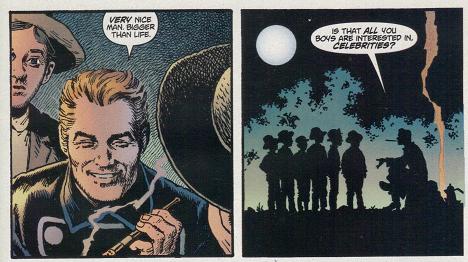
Clue 1 from Issue #1: Rawhide Kid
likes celebrity gossip!
As written by Ron Zimmerman, this Rawhide Kid (who inexplicably prefers the nickname "Trey"?!) is much more of a caricature of homosexual stereotypes than a fully realized character with a (presumably) less-than-common sexual orientation for the Old West setting. The inherent potential of exploring the challenges of such a character in the Old West are ignored for the sake of probing the intricacies of how two of the Cartwright Boys from Bonanza could be placated by alcohol and potentially tricked into "extracurriculars" with Trey. I can't make this stuff up. Zimmerman sprinkles various literary and historical figures throughout the proceedings and even creates historical analogs for modern figures (for example, the dim-witted town leader, Mayor Bush) in an effort both ground his story in history and possibly, satire.
The flirtation begins in Issue #2.
The plot is standard: gunman (The Rawhide Kid) comes to town beset by criminal types. While there, gunman teams-up with local lawman, previously humiliated by criminals, to save town, and the lawman's shaky relationship with his young son. It's in the execution and detaisl that things get awkward: gunman drops numerous romantic hints to the lawman about things like French fashion while parading around without his shirt. Lawman's son, embarrassed of his pa's failure, publicly and verbally emasculates dad while hero-worshiping the gunman who (wink-wink) is homosexual.
Though subsequently billed as "the first openly gay comic book character to star in his own magazine," the Kid's openness is almost entirely comedic in its presentation, limited to obvious campy humor, puns and double entendre. Used as simply a way to differentiate the protagonist from those around him (and as a subtle reasoning behind his colorful attire), the Kid's homosexuality fails to add a level of depth to the characterization or by extension, the title's proceedings.
As seen here in issue #3, the Kid is
always on the cutting edge of fashion.
The artwork by John Severin, a long time comic book artist who also provided art for Image Comics' modern-Western title Desperadoes: Quiet of the Grave (2001), is excellent. While the detailed setting clearly established as Old West vibe, the accompanying story, by Ron Zimmerman, is surprisingly ham-handed and stereotypical in its reveal and depiction of the Kid's sexual orientation. It could be said to border on parody, but just what was being parodied is up for debate. The multiple references to literary (the leads of Lonesome Dove get name-checked early on) and historical Western figures, as well as the beautiful artwork were not enough to carry me past the borderline offensive stereotype's of homosexuality that drove the story.
Even typography choices made by the writer and letterers, Rich and Wes @ Comicraft, seem to purposely reinforce the stereotypical depiction of our hero. As you can see from the pane at the top of the page, wherein the Rawhide Kid makes his first appearance wit the phrase "Oh, stop..." which when read aloud with the proper emphasis applied for the bold lettering sounds somewhat affected. Upon my own internal reading an inflection was intended, as it is through out the series.
So, is it worth checking out? As a snapshot of the misguided attempt by a mainstream publisher to take an older character and re-boot him in such a way, yes. Despite the somewhat clumsy effort, Severin's art (and the ability to analyze the hell out of the whole package) is just enough to recommend it. Both The Rawhide Kid: Slap Leather (2003) and it's sequel, The Rawhide Kid: The Sensational Seven (2010) are available as trades at your local comic book store (or in the back-issue bin).
All four covers feature the handiwork of Goon creator Eric Powell!
In the last ten years I have become much more enamored with the Western comic book genre. Largely ignored in my previous 20+ years of reading, maybe something just happens as one gets older and the bygone days of yesteryear become more appealing. During this time, in addition to picking up modern western titles such as DC's Jonah Hex (Volume 2), I began seeking out older titles from variety of publishers. Among those were various reprints of classic Jack Kirby Rawhide Kid stories.
Not a "run" in so much as a minor event, the summer of 2006 saw Marvel Comics briefly return to its roots with a series of five one-shots published under "The Mighty Marvel Western" umbrella. Four of the five issues focused on individual characters, each headlined by one of the more recognizable characters in Marvel's stable of Western stars, such as Two-Gun Kid and Red Wolf, while including minor characters in back-up stores via reprints and new tales. The fifth book in the series was a handbook called Marvel Westerns Outlaw Files that feature biographical information and "authentic" Wanted posters from the 1800s. Though ultimately collected in a cumulative hard cover, none ended in a return to monthly adventures for the characters that one might have hoped.
In fact, other than Marvel's Six Guns mini-series in 2012 that featured updated versions of Western characters in a modern setting and Rawhide Kid: The Sensational Seven (2010), Marvels' heroes have once again receded into the past glories of the publisher, failing to warrant much more than the occasional appearance in an in-continuity time travel story. (The Western will be making a brief comeback of sorts in the miniseries 1872as part of Marvel's current Secret Wars event.)
Never too much Terrible Totem by Stan Lee and Jack Kirby, reprinted
in MMW: Two-Gun Kid.
But we do have the wonderfully entertaining Mighty Marvel Western one-shots to re-read when the desire for Marvel Western magic is desired. A quick issue-by-issue review reveals that some high profile comic book talent, especially writers, (though the artwork is consistently good, anchored by Goon creator Eric Powell, who had a hand in all covers) took advantage of the opportunity to play in the Old West sandbox when these issues were released in summer 2006:
Marvel Westerns: Kid Colt and Arizona Girl (2006) #1—one of the best part of these one-shot is the abundance of material one gets in each is. For example, this issue includes five(!) stories; a new Kid Colt and Arizona Annie tale written by Jonah Hex writers Justin Gray and Jimmy Palmiotti, a story introducing the Philadelphia Philly by Jim McCann and David Williams, and reprints of three classic tales by comic legends Jack Kirby and Dick Ayers.
Marvel Westerns: Western Legends (2006) #1—This beauty features three very solid all-new tales starring less-familiar Marvel Western characters Hurricane, Red Wolf and the Man from Fort Rango. All three stories are good, while the first "The Man Called Hurricane" by Jeff Parker and artists Tomm Coker is a personal standout, given it's earthy palette and classic story line (with a nod to the character much more flamboyant original design. I have long been a fan of writer Karl Kesel (mostly from his DC work) and his Red Wolf story doesn't fail to satisfy. With so many Kirby classics in these comic it is great to get the origin of Rawhide Kid by the King himself here, too.
Marvel Westerns: Strange Westerns Black Rider (2006) #1—Includes four stories, the first featuring Marvel's dark Western avenger, the Black Rider, written by Steve Englehart and Joe R. Lansdale. Lansdale, with artsist Rafa Garres also contributes a Gunhawk story, and once again the issue concludes with Marvel classic Westerns, this time two Kirby Rawhide Kid tales.
Marvel Westerns: Two Gun Kid (2006) #1—Features two stories, one new and one classic. The first features warp-around story set in the present with Two-Gun kid and She-Hulk written by (then She-Hulk writer and current Spider-Man scribe) Dan Slott with pencils by Eduardo Barreto. The story concludes with the promise that it was "Not the End: Two-Gun and Shulkie's adventure continues in She-Hulk #11!" (I'll have to check out those issues). The second new story stars Hugo the World's Smallest Cowboy from a bevy of talents including Keith Giffen and Mike Allred and is lots of fun answering the challenge declared in the credits box asking "how in tarnation can a li'l ol' Western yarn by th' likes'a... possibly be worth two rotten skunk eggs?" And, as with all books in this series, this one concludes with a classic Kirby tale, this one with the Rawhide Kid.
My primary takeaway from revisiting these stories (whether "new" or classic) is to reaffirm what I already knew: Western comic books can be very fun if handled by quality creators. Now that DC's All-Star Western has exited the New 52, only Dynamite regularly publishes traditional western comic books. With so many great characters, it would be tremendous if Marvel take the gamble to publish a monthly book dedicated to characters within the genre (rather than just Western takes on traditional Marvel characters a la the aforementioned 1872). Based on this series of one-shots, the publishing giant certainly has the wherewithal to do so, now just needs the motivation to make it so.
All of these books are highly recommended as is the Marvels Westerns Hard Cover which captures them all in a single volume!
The end of Arizona Annie and Kid Colt's adventure...
and of the Mighty Marvel Western genre? Words by Justin
Gray and Jimmy Palmiotti and pencils by Federica Manfredi.
"John Wayne in The Searchers" from the Hallmark 2012 Keepsake collection. (12/13/14)
After spending the evening hanging ornaments, and briefly considering the origination of the Christmas tradition of hanging ornaments on trees in the first place, I was reminded that most of our ornaments (like your's, I'm sure) have a story to them. While not every one carries a sleigh-load of nostalgia, each is on our family's tree for a reason.
It was then that I decided to post some quick pics and thoughts about our ornaments in the days leading up to December 24.
First up, was an ornament that I blogged about two years here. As is often the case, it was the first of what was, I believe, intended to be a longer series of Hallmark ornaments as the following Christmas I was gifted with its pardner, a second John Wayne collectible. The original ornament, as described in the aforementioned post, "John Wayne in Rio Bravo" is a Hallmark Keepsake from 2012. "John Wayne in The Searchers," from 2013 joined the tree this year after waiting for the holiday season to come back around (we never put the ornaments on the tree immediately after receiving them, but reserve them for the following year).
The affection I have for Wayne is tied to my love for my late grandfather, and I owe my appreciation for the western as a genre to him. Though I did not recognize it at the time (sadly, who really does at 10 years of age), my grandfather introduced me to numerous American archetypes familiar with his generation, the "greatest generation," indirectly as my brother and I watched with him on Sunday afternoons. While the Hallmark "series" seems to have ended as only a pair with the release of only two ornaments. Placing both on the tree again this evening, and recounting the memories they cumulatively evoke, I look forward to unwrapping them from their plastic shell casing and box each year for hanging for many years to come.
"John Wayne in Rio Bravo" from the Hallmark 2013 Keepsake collection. (12/13/14)