Showing posts with label Old Ones. Show all posts

Tuesday, October 08, 2019

Hallow-Reading: At the Mountains of Madness: The Definitive Edition

Like many avid readers who have certain books that they enjoy, this is not the first time I've read H.P. Lovecraft's, At the Mountains of Madness, a fairly short (in terms of page count), but dense (regarding descriptive language and vocabulary) horror novella. Just as in order to consider oneself to be "well-read," a reader must have engaged with one of the Bronte sisters at some point, it would be hard to take someone seriously as a well-rounded student of literature who has not at least sampled Lovecraft if not as recreational reading, then as a student of genres. Too often, I think horror, like romance, is marginalized and compartmentalized so as to be seen as unworthy. Au contraire, mon frère!

Though I would classify AtMoM as more of a short story (albeit an extended one), the hook for my reading of this recently published "Definitive Edition" was the new introduction by British author (and occasional comic book writer of DC Comics's 2012 Dial H series) China Miéville. Beyond Lovecraft's tale, it is Miéville's analysis that this comment will focus in great part on.

Here is a brief teaser for AtMoM (BarnesandNoble.com): "The Barren, windswept interior of the Antarctic plateau was lifeless—or so the expedition from Miskatonic University thought. Then they found the strange fossils of unheard-of creatures...and the carved stones tens of millions of years old...and, finally, the mind-blasting terror of the City of the Old Ones." This is one of Lovecraft's pieces that would become integral to what is now understood as "the Cthulhu mythos."

The thing about AtMoM, and Lovecraft's work in general, is that much of the imagery contained therein has so permeated our popular culture by this point that most folks don't even know enough to recognize the original source. From the recent film Prometheus (2012), to the many video game (the Gears of War trilogy and Borderlands to name two) character designs to list, Lovecraft's detailed and dark descriptive language has been lifted to such an extensive degree that what was once perceived to be iconic can now be mistakenly thought to be common. What Miéville' introduction (which includes some spoilers for the uninitiated) does is to offer some historical context to Lovecraft's style and craft that creates an interesting gateway to deeper literary analysis of fiction writing in general, and the horror/supernatural genre in particular.

In the "real world" I am a high school English teacher, and can attest to the fact that deep literary analysis, beyond simply identifying basic literary strategies at work, and a somewhat superficial presentation as to the reasons behind the author's choice of strategies, is among the most challenging skills for students to master in an authentic voice. Unfortunately, it is also a skill that is not meaningfully tested on government mandated assessments and so is deemed unworthy of extensive effort in most classrooms.

As I read Mieville's essay, I considered how I could use it in some more advanced classes as an example of deep literary analysis as it touches on some important considerations that excellent students are capable of making, given the opportunity. In fact Mieville's thesis (from the second paragraph), points the reader in the proper direction for initial analysis: "... we must see Lovecraft as a product of his time. We can make sense of him, and his astonishing visions, only to the extent that we understand him as defined by the specific horrors, concrete and psychic, of the early twentieth century."

Also included as part of The Definitive Edition is Lovecraft's own literary analysis piece "Supernatural Horror in Literature." Whether as entertainment (for which this edition is not necessary and much of Lovecraft's stories are available in most good public libraries) or for an academic burst of analysis, I recommend At the Mountains of Madness for an eerie and breezy summer read. If you'd like to borrow this edition (or another), please let me know and I'd be happy to share.

You do think of yourself as "well-read," no?

Wednesday, August 01, 2018

Hallow-Reading: The Dreams in the Witch-House

Just as with certain superior recording artists there are “no B-sides”, some writers seem to hit on all cylinders regardless of the piece. While “At the Mountains of Madness” is understandably viewed as one of his masterpieces, H. P. Lovecraft wrote many other stories that despite slightly less literary love, seem, to this reader, equally impressive. More than just my restating the obvious (“Lovecraft is a great horror writer”), with each new story I read buried deep in anthologies of his work, I am sure I have not always appreciated just how “great.”

Take “The Dreams in the Witch-House,” for instance. (Note: Upon researching some information on the story, I was surprised to discover that many reputable Lovecraft scholars deem this particular story to be one of his lesser efforts.) As a fan of Lovecraft’s mythos, as well as those other works clearly influenced by his writing, I found the description of the cosmic environments to be illuminating. Perhaps it is too overt in its depiction for those who like more nuanced horror, but the “vast converging planes of a slippery-looking substance” (At the Mountains of Madness and Other Tales of Terror, page 153) populated by geometric creatures bathed in violet light and “iridescent bubble-congeries”, made concrete for this reader that which has not always been so clear. This approach is as effective as the more subtle approach, albeit in a different way. Much of the content and details in “The Dreams in the Witch-House” also provides a “Who’s Who” of Lovecraftian ideas. In some ways this is an excellent follow up to “Mountains” as it takes some of the cosmology eluded to in the first and grounds it in a more accessible folklore (witchcraft). In addition to the expected supernatural/fantastic elements inherent in the horror, familiar settings such as Arkham and Miskantonic University connect the story to the Cthulhu Mythos by grounding the action in a real-er world.

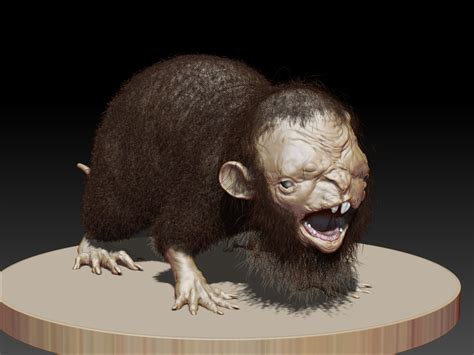
My favorite new comedic creature as
visualized by digital artist
 Carlos Garcia Rivera.
Few writers are as closely associated with their literary creations as Lovecraft is with his Great Old One, Cthulhu. In addition to vividly capturing the cosmic nature of Lovecraft’s aesthetic, “The Dreams in the Witch House” also introduces a terrifying creature, though of much smaller in cosmic and physical stature than Cthulhu, Brown Jenkin. “That shocking little horror,” Brown Jenkin, is described as being “no larger than a good-sized rat”, having “horribly anthropoid forepaws”, and a “tiny, bearded human face.” (145) Unlike some of Lovecraft’s creature creations, due in part to its rat-like nature, visualizing Brown Jenkin is much easier to do than others. The familiar of the witch of the title, Keziah Mason, Brown Jenkin enters the small room of the story’s protagonist, Walter Gilman, via a series of rat holes. As a familiar, he serves the role of Mason’s herald, visiting Gilman without his master at varying points of the story, often terrorizing Gilman in his sleep. For the reader, Brown Jenkin also plays serves as comic-relief, even if gruesomely so. “The sinister old woman and the fanged furry little animal” are quite the duo. If the evil witch is the "straight-man", Brown Jenkin is the comedic player. While requiring a leap, this dynamic is not one I generally associate with Lovecraft’s work so was pleasantly surprised by it. Perhaps it is Brown Jenkin’s tendency to “titter” maniacally throughout the proceedings that gave me a vision of the wisenheimer side-kick archetype. Of course by the story’s conclusion, no one’s laughing at Brown Jenkin or his “four tiny hands of daemonic dexterity”! So taken was I by this monstrous little creature that upon meeting him in the story, I immediately texted a friend of mine who has also read a few Lovecraft stories: “Where has Brown Jenkin been my whole life?”

The lesson here (beyond the coolness of Brown Jenkin) is that like those aforementioned B-sides, it pays to read deeper cuts by authors you enjoy. I know that as a result of this experience, I am going back through those other anthologies looking for any more gems.