Showing posts with label horror. Show all posts

Monday, April 13, 2020

Read It: Gou Tanabe's At the Mountains of Madness

Intricately drawn splash pages add to establishing a tone of impending doom.
Gou Tanabe's graphic novel adaptation of H.P. Lovecraft's At the Mountains of Madness succeeds for two reasons. First, the manga takes a narrative that is familiar to many and makes it new, and, secondly, Tanabe deftly brings into the visual realm a novella that has, to this point, worked best in the imagination of the reader. Like most Lovecraft readers, I too, have read the classic cosmic horror story in multiple editions with a variety of well-written collection forewords, most recently At the Mountains of Madness: The Definitive Edition prefaced by an excellent introduction by China MiĆ©ville. It is difficult to discuss any version of At the Mountains of Madness without acknowledging the prior understanding (and bias) of readers as compared to those for whom this is a first time through the story.

Despite having read manga for 20+ years,
it always helps to have a reminder as
to how the panels flow, especially when
the story has multiple characters, each
of whom communicate via dialogue.
This graphic novel volume is the first of two, and serializes in short 5-7 page chapters the events of roughly the first half of Lovecraft's original text. Beginning with a prologue set in January 1931 (five months before the tale begun in Chapter 1), entitled "After the Storm," and concluding with "Chapter 12 Under Five-Pointed Mounds," The First Volume concludes on a cliffhanger with expedition team leader's, and Lovecraft's narrator Dr. Dyer, making the decision to "Fly to the Black Mountains!" The search for Gedney, the presumed lone survivor of the Lake's advance party, is where I would expect where The Second Volume  to pick-up. (I have yet to have acquired it as of this writing.)

As I read Tanabe's graphic novel, I felt as if was I was engaging the material for the first time. Tweaks to the story require those familiar with the original text to read and view the visuals carefully so as to not miss out on key character alterations. These changes deal primarily with the characterization of Dr. Lake, a Biology professor, and his relationship with geologist, Dr. Dyer. Perhaps I missed it in Lovecraft's story, but here it is very clear through the different visual depictions and interactions, that Lake, besides being the advance leader whose disappearance is the initiating factor for Dyer's deep trip into the mountains, is also intended to act as a more traditional antagonist or foil. Lake's unchecked ambition to push the boundaries of exploration are sharply contrasted by Dyer's more measured approach to the huge Antarctic undertaking they are mutually engaged in.

Tanabe includes quotes from both
historical and literary figures,
 including this rare color page
 acting as an epigram to Lovecraft's
story here.
It may surprise the new reader, especially given the obvious influences of the work on contemporary science-fiction and horror, how little the human parties actually engage with Lovecraft's cosmic creatures on the page. It is only half way through the text, with "Chapter 6: Elder Things," that a visual representation of the titular star-headed creature in fossilized form even makes its first appearance. Readers of cosmic horror don't come only to gawk at monsters though, and Tanabe's approach reflects this understanding. A modern reader unfamiliar with Lovecraft may expect more, but careful reading reveals that Tanabe has properly trusted his illustrations and storytelling to build suspense and sense of impending doom.

Beginning with the prologue depicting the remains of the original Miskatonic University Expedition led by Dr. Lake and "the manner and cause of their destruction" that Dyer and his team are seeking answers to. Using background setting and images that an organic, alien environment, not unlike that designed by H.R. Giger for use in Ridley Scott's classic film Alien (1979), Tanabe establishes a blend of natural and alien worlds. This effect is further reinforced through Tanabe's inclusion throughout of journal entries from a number of real-world explorers such as Captain James Cook. For the reader who hasn't experienced the source material, there is a subtle foreshadowing as to what to expect once this group enters the "Mountains of Madness." Once the eventual dissection  (desecration?) of a petrified Elder Thing by Lake, an act that is juxtaposed to that of the members of the first party by some heretofore unknown force, the tension amps up considerably.

With accessible language and excellent, detailed artwork, Gou Tanabe's graphic novel adaptation of H.P. Lovecraft's At the Mountains of Madness is an excellent way to introduce the young reader into Lovecraft's world. It's visual nature, as well as manga's increased popularity and acceptance among students of all ages, Tanabe's interpretation seems certain to entice the ambitious student to seek out other readily available Lovecraft horrors. (Gou Tanabe has also crafted a manga collection of the author's shorter works, H.P. Lovecraft's The Hound and Other Stories.) H.P. Lovecraft's At the Mountains of Madness would be a welcome and exciting addition to any high school library or reading list... if the adults involved dare to try something different!

Sunday, October 06, 2019

Horror Comicbook Cavalcade: Bela Lugosi's Tales From the Grave #1 (2010)

Clearly a labor of love, Kerry Gammill (as publisher, editor, writer and artist ) is all over
Tales From the Grave from the first pages.
Released in 2010 by now-defunct independent publisher Monsterverse, Tales From the Grave #1 is an old school horror anthology of stories in the classic horror comics tradition. Each story is presented by a fictionalized version of late horror film icon Bela Lugosi with assists from both his loyal (and intellectually dense) assistant, Hugo, and a sexy Elvira-esque vampire femme fatale, Nosferina.

Issue #1 cover credited
to Basil Gogos.
The first of five individual issues was released in 2010.Worthy of its hefty cover price of $4.99, Tales From the Grave delivers eight stories of varying length, utilizing a wide variety of artistic styles (including one "photo strip" featuring Lugosi and Tor Johnson action figures). Back matter consists of a collection of artist renditions of Lugosi as his most famous screen character, Dracula. Among the artists providing story and art is veteran comic creator (and personal favorite), and Monsterverse publisher and editor-in-chief, Kerry Gammill.

My own appreciation of Gammill's work began, during the hey-day of my Superman comicbooking, when he shared cover pencilling duties on Action Comics with George Perez, eventually taking the role over fully with issue around issue #565. Gammill's efforts produced some beautifully classic cover work vaguely reminiscent of the zany late 1970's runs and included the "Reign of the Superman" arc featuring the Super-stand-in who would later become the Eradicator.

Gammill's story (the first panel of which is posted above) "Unpleasant Side Effects" is book-ended in Saturday Monster Matinee fashion by Lugosi. More playful (and little "gross") than scary, it is an effective and entertaining romance, the quality of which is elevated by Gammill's pencils.


Each subsequent story, such as the Western themed "Eyes of the Prairie" by Derek McCaw and Rafael Navarro, follows a similar structure. Lugosi creeps around the corners teasing the bad things to come and returns at the narrative's conclusion to tie up loose-ends before riding of into the sunset.

What would old fashioned horror be without a little (tame) cheesecake?
It's really only in the latest "edition" of Lost Lugosi's Film Theater (teased above by Nosferina) that our star takes an active role in the story, playing his second most familiar film role, evil scientist (or "white Haitian voodoo master" as in 1932's White Zombie). Of course, it wouldn't be a Lugosi project without at least a mention of Dracula, and this fanboy need is very nicely met by the inclusion of an informative text piece by eminent Lugosi scholar and author Gary D. Rhodes.

A very entertaining piece of horror-comedy-nostalgia comic book creation, Bela Lugosi's Tales From the Grave #1, which was published in October 2012, was followed up five months later with the publication of the equally enjoyable issue 2. Both issues are very likely still available for purchase in your local comic shop and make for fine Halloween reading.

Since the post was originally published in October 11, 2012, four issues of Bela Lugosi's Tales From the Grave have been published. Each is consistently entertaining and follows the same corny, scary, goofy and high quality established by the first issue. Issue 2, published in 2013, also features a very cool cover painting by practical effects god Rick Baker, re-envisioning Popeye the Sailor as something a little more... evil. Seek it out--if you dare!

Thursday, August 01, 2019

Summer Reading: Harvest Home

A few weeks ago I purchased a lovely worn copy of one of a recent current grail title: Harvest Home by Thomas Tryon. Tryon’s second novel has appeared on numerous folk horror reading lists uncovered during my dive into the genre. Despite its presence on so many lists it was surprisingly difficult to find a copy to read. After discovering that the local public library system possessed three copies, all of which were out, I decided to go online for a copy. Turns out it was the correct choice as not only did I enjoy it, but I am confident others in my circle will too.

Told as an extended flashback from the first person perspective of the novel’s protagonist, Ned Constantine, the story's structure takes us from his family’s purchase of a home in the secluded village of Cornwall Coombe in Part One entitled “Agnes Fair” through the terrifying revelation as to what exactly “Harvest Home” means in the eponymously titled Part Five. Tryon deftly places breadcrumbs such as “Viewed in the light of what occurred later, it was a fool’s Paradise” (152) and “I never got to Hartford… for it was the fateful night that saw my fall from favor” (278) to let the reader that, despite what is to occur, Ned has survived. Of course, surviving does not necessarily mean unchanged.

The aspect of the story that works best for me is Ned’s building paranoia regarding the shifting allegiance of his wife, Beth. Their relationship is further complicated when it becomes clear that she, and his daughter, are being slowly manipulated by the town’s leader, the elderly (and initially very kind and supportive of Ned), Widow Fortune. As the Widow insinuates herself into the Constantine family’s lives, Ned (and we) recognize that all is not what it appears. Equally frustrating is the pig-headedness of Ned’s decision making that ultimately result in the grim finale which begins when he feels a “shiver, like a strange paralysis, creeping up [his] body.” (386) In the end, Ned’s paranoia about having his loved ones turned against him by larger (small town) social pressures is well executed by the author.

This is, of course, a folk horror novel, and Tryon does a very credible job building this world of corn cob totems (160) and Eleusian Mysteries. The author uses a neighbor character, Robert Dodd, a former college professor who is now blind and housebound, as the primary vehicle for delivering the eerie exposition regarding the community’s rituals and pagan belief. Goddesses, fertility, psychedelic mushrooms and “corn stalk cosplay” all play a role in fully developing the system of beliefs that drive the community forward into the future by staying set firmly in its past.

When released in 1973, Harvest Home was the successful follow-up to Tryon’s debut novel The Other (1971). Quickly adapted into a popular television min-series starring Bette Davis, it demonstrated itself to have some cultural resonance too. Harvest Home, like most successful that maintains its appeal, subverts a number of horror conventions a trick made slightly more difficult to in a contemporary context due to its impact on books and movies that followed. Though some of the narrative twists and turns were expected, if you have seen The Wicker Man (1973) or Midsommar (2018) you’ll see them coming too, the sense of dread Tyron builds was surprisingly not ameliorated. The fact that my own prior reading provided clues to later reveals, speaks to the gripping nature of Tryon’s storytelling.

Everyone has experienced the disappointment and regret that comes with looking very forward to getting something that fails to live up to expectations (come to think of it that could be a theme for this book!). I am happy to share that this is not the case with Thomas Tryon’s Harvest Home, a 400 page book I breezed through in three days despite frequent stops to jot down notes and savor the storytelling. Highly recommended!

Saturday, June 22, 2019

Summer Reading: The Beautiful Thing That Awaits Us All

Thanks to a slow week administering exams and the need to close-up shop in advance of the impending summer school break, my personal summer reading season has begun early. Truth is, I live in a yearlong reading cycle, and with current events being what that are, this has never been so true or vigorously adhered to. My "Must Read" table overflows with books awaiting opening. Ironically, I continue to cleanse my mental palette of orange, homicidal, lying monsters by mixing in cosmic horror. The Beautiful Thing That Awaits Us All by Laird Barron, published in 2013, is the third of his collections, after Occultation (2010) and The Imago Sequence (2007) I've read.

Both collections of short stories were a terrifying, uncomfortable pleasure to read and The Beautiful Thing is no different. When I recommend Barron's stories to others, it is often with the with the suggestion that Barron's short story work (I've yet to read his well-regarded novels) are perfect for those who appreciate the literary stylings of H.P. Lovecraft. (I also share that the dread and discomfort that comes with Barron is much more visceral, at least for this reader.) If anything, this most recent collection brings Barron's vision into more direct alignment with Lovecraft's. There is little need for me to formally review this collection, there are plenty of reputable reviews online to be read if that is the desire. I do have a couple of thoughts however from the perspective of the "guy sitting on his porch after having been given a good fright."

Lovecraft's influence is most overt in the collection's seventh story "Vastation" (which means "the action or process of emptying or purifying someone or something, typically violently or drastically"), a collection of reminiscences from the perspective of self-ascribed "herald[s] of the Old Ones" (199). Here, a timeless entity of sorts recounts experiences from the distant past, present and future as he prepares our world for cleansing. The unique point of view shifts from the Dark Ages to the future of robot cats adding a layer not explored by Lovecraft (whose Cthulhu mythology was only made more concrete after his passing). Balancing grotesque imagery such as the Mushroom Man's mission to "liquify our insides and suck them up like a kid slobbering on a milkshake (200) with light humor in the form of the unnamed (maybe "McCoy" as in the real McCoy?) narrator's affection for Fat Elvis and his own robo-cat, Softy-Cuddles.

Beyond the fantastic imagery, cosmic horror and scary "magical realism" in The Beautiful Thing That Awaits Us All, this collection does two things I always appreciate in writing:
Saturn Devouring His Son 
by Fancisco De Goya
  1. I really dig when author's prompt me research in order to fully grasp what's happening. Each of Barron's stories includes a cultural allusion or use of diction that had me going to the smart phone, not so much for basic comprehension but for a sharpening of understanding. This especially rewards when considering the titles  The previously mentioned "Vastation" for one or the need to refresh my visual memory regarding Francisco De Goya's painting Saturn Devouring His Son. Doing so only brings into even greater clarity the creepy image created by Barron's words at the conclusion of "Jaws of Saturn". 
  2. Despite the collection nature of short stories, Barron weaves symbols and motifs throughout. In both the narratives and publishing artwork the ouroboros makes appearances. I also found it cool to come across the image of staring at a single red dot against a wall as a portal to other worlds a number of the stories. Again, this is not meant to be mind-blowing observation on my part, but a recognition of the care taken in selection and creating a tone (and message?) for the text as a whole.
I continue to enjoy the short stories of Laird Barron. My past experience with Barron suggests that he is the rare horror writer whose work benefits from re-reading (Occultation remains on my "Must Read" pile despite having been read and re-read). A quick note for any of my high school students still reading: there is R-Rated imagery and activity throughout Barron's stories. As I say in class when discussing "adult-ish" content, I can't recommend it to you yet, but as soon as you turn 18... check it out!

Sunday, January 27, 2019

Read It: Deathless

Each morning for a few weeks, Bertie and I would catch up with Marya Morevna, 
heroine of Catherynne M. Valente's Deathless.
Please note that is not a review in so much as some thoughts about a book. I mention very few of the characters by name, and reveal even less about the plot of Deathless by Catherynne M. Valente. It is a novel I highly recommend for those who enjoy action, adventure, romance and folk lore. Yes, it is that bountiful a text...

I am very fortunate to teach a subject, English, in a school district that allows for a degree of leeway when it come to texts covered in class. I am not obligated to teach novels, poems or stories that I myself don't have an appreciation of. Though selections do need to be approved for class instruction, I also enjoy taking suggestions from my students, as well as letting them known what I am currently reading. I even occasionally share things with them for their own enjoyment. As a result, I have begun to seek out titles from genres I like with the thought of finding texts that might also be of interest to my "Young Adult" students. Happily, this has taken my reading in some unusual directions that I might otherwise not have been taken. Recently, while looking for books in the folk horror genre, I came across Deathless by Catherynne M. Valente.

More romance than horror, I have found the reading of Deathless over the last few weeks to be an incredibly satisfying journey and one, now that I have completed it, I look forward to sharing with my students. A beautifully written story of female empowerment using characters from Russian folklore, Deathless is that rare book that begs to have sections of it re-read before moving on. The imagery crafted by Valente is so lush, and the language so delicate and descriptive, that its reading was something to be savored rather than rushed. For much the same reason I don't enjoy binge watching newly discovered television shows, Deathless benefits from taking one's time with it. The introduction of  variety of Russian folk elements both slightly familiar, Koschei and Baba Yaga for example, and unfamiliar, the leshy and domovoi, had me pausing for more history as I read. It was rewarding to meet these new-to-me folk characters who, in the context of Russian folklore, have English literary analogs that aided, along with the text, in visualizing each character. In my imagination, Deathless plays like a mash-up of Howl's Moving Castle, The Hobbit, Wuthering Heights, and a textbook about the Russian Revolution. Not a boring textbook but one that paints a picture that is equal parts light and dark.

Digital image of a domovoi (Russian
 House Spirit) by LMaize, DeviantArt.
DeviantArt, n.d. Web. 10 Feb. 2015.
Whiel reading I could not help but dog-ear pages that held lines which I wished to return to, such as "Marya [the novel's protagonist]  pinned out her childhood like a butterfly" (23) and "... the woodsmoke hung gold and thick and the snow tested the wind with white fingers..." (171). There is so much beauty in Valente's words that even in isolation they connect. As part of the expansive larger narrative which includes magic bird-men, yarn soldiers and automobile horses, Deathless quickly coaxed me into it's world. Carefully following the multitude of characters and ideas seeded early in on come back around with greater significance was as rewarding as it was inviting me to a re-read in the future.

Late in the novel Marya's housemate, Kseniya Yefremovna, recaps our heroine's journey to date while describing a house on Decembrists Street as "a house they painted with all sorts of things from fairy tales, so that it would wonderful and people would bring their children to see it, just as we brought Sofiya today. You can see there a firebird on the door, and Master Grey Wolf on the chimney, and Ivan the Fool scampering over the walls, with Yelena the Bright in his arms, and Baba Yaga running after them brandishing her spoon. And that's a leshy creeping in the garden, and a vila and vodyanoy and a domovoi with a red cap. And there--they"ve put a rusalka near the kitchen window. Kseniya turned to Marya. "And Koschei the Deathless is there , too, near the cellar. …" (265) A guiding question returned to throughout Deathless is "Who is to rule?" As a writer I had not had the previous pleasure to read, it is difficult not to suggest after thoroughly enjoying Deathless, that it might be author Catherynne M. Valente.

Sunday, January 20, 2019

The Old Order Changeth!

My very first short box circa 1984... and yes I was the person who actually 
bought DC's Guy Gardner Warrior!
Some comic book collectors have spinner racks (lucky!) while others have beautifully designed shelving to display their collections. I am old school, and no carpenter, so even 40 years into my fandom, I still use long, and as I have become more "seasoned", primarily short, boxes for storing and organizing my collection. This requires quite a bit of space and, fortunately, we have a sort-of finished third floor attic where I read and store them with other collectibles.

Shazam! #1 variant 
cover by Gary Frank. 
It is during these winter months when we are "trapped" inside for the majority of the day that I will shift the organization of my collection. Often it is a change in publication the prompts a change, For example, DC's recently introduced Geoff Johns and Dale Eaglesham joint, Shazam! (2019, $4.99 per) title necessitates the movement of Jerry Ordway's incredible The Power of Shazam (1995-99, cover price $1.50 per issue) series into an active box. Though represents a significant departure from the characters as depicted in Power, with all pre-New 52 continuity erased, I like having access to previous narratives.

Conversely, the conclusion of the most recent Suicide Squad (Volume 5, 2016-19, Issue #1 was $2.99 and the final issue, $4.99) series means that title will shift to an "inactive" box, stored in the back part of the attic, until the teams eventual return to action. Then, once again, the old order will changeth!

Local comic book shops organize titles on the "New Releases" table, as well as on "Recent Releases" racks and their own "Back Issues" long boxes, first by publisher (Marvel, DC, Image, Dark Horse, etc.) and then alphabetically by title (Action Comics, Aquaman and so on). Decisions regarding the specific organization of titles in collections are more personal. When it comes to "Big Two" titles (DC and Marvel for the uninitiated), putting these titles by character families (Wolverine alongside Uncanny X-Men or Justice League Dark next to Justice League Odyssey). There are families in the smaller publishers as well, most notably (and expansive) the "Mignola-verse" titles from Dark Horse. These are comic books set in the world of Hellboy, a universe of titles created by Mike Mignola that includes Abe Sapien, Lobster Johnson, Witchfinder and many others.

Zeke Deadwood: Zombie Lawman 
cover by Thomas Boatwright.
Those smaller publishers beyond the Big Two, though given quality and quantity of titles it's past time to start thinking of Image Publishing as a "Big Three", are much more willing to take creative risks with creator owned titles, especially those in the Horror, Western and Science-Fiction genres. Because of this, many of my shorts boxes are organized alphabetically by genre families rather than publisher or creator.

For example, I currently have five boxes which are organized as "Westerns" that include a wide variety of characters from large and small publishers. This means that DC's Jonah Hex extended series (2005-10, 70 issues) is organized with the now-defunct Topps Comics Lone Ranger and Tonto miniseries (1994, 4 issues), IDW's 3 Devils (2016, 4 issues) and SLG Publishing's Zeke Deadwood: Zombie Lawman (2009-11, 2 issues) series of one-shots in my short boxes.

Interestingly enough, this brief post about organizing my comic books also has me organizing y thoughts. The inclusion of Zeke Deadwood among more traditional Westerns alone has me considering my next reorganization project to further disaggregating Westerns into a Horror-Western Mash-up section. That project, however, will have to wait for the next snowstorm...

Sunday, October 07, 2018

Hallow-Reading: Green and Pleasant Land

Over the past few months my personal reading has taken a turn down an unusual rabbit hole resulting in a turn from fantasy and non-fiction to horror short story, "folk horror" in particular. A rainy October morning seems as good a time as nay to blog a touch about my most recent literary diversion.

Though I have long been a reader of Romantic (Mary Shelley's Frankenstein, for example) and cosmic (works of H.P. Lovecraft) horror sub-genres, folk horror is something of a new direction. Folk horror is defined by members of the Goodreads Folk Horror Revival Group as "a subgenre of horror fiction, but its roots go back at least into the 19th century. The horrific element in a folk horror story traditionally arises from a source associated with European pagan folk traditions." Think of the tropes and settings of either the original 1973 The Wicker Man or 2018's Hereditary movies (among numerous others), and you are on the right--or very wrong--track.

As with most literary genres, there is quite a bit of room for interpretation when it comes to considering what exactly meets the necessary folk nature of a text thought to meet the criteria. For example, a number of popular American folk horror reads reference the local folk lore of familiar spooky states such as Louisiana or Maine, drawing on the regional rather than the European. For my first venture into the genre, however, I went native and read Great British Horror 1: Green and Pleasant Land, a collection of modern short stories published in 2016 by Black Shuck Books and edited by Steve J. Shaw. As it announces on the back cover, the collection features "eleven previously unpublished stories of small town, rural and folk horror."

In addition to being an excellent primer for the genre, Green and Pleasant Land offers some  downright creepy reading, perfect for autumnal evenings. While I had not read any of the authors' previously, I was fascinated by their combined ability to draw me into their distinctive mythologies which remained grounded in a very discernable modern, real world context. Two personal favorites include:
  • "The Castellmarch Man" by Ray Cluley. With nods to modern elements of geo-caching and stay-cation culture this standout introduces the reader to a couple, Charlie and Lyndsey, who learn "getting romantic" in unfamiliar stables might have unintended consequences. Throughout the story, Cluley intermingles touristy information about British landscape and lore which offers possible backstory to the journey our characters are on, as well as the origin of their antagonist. I've returned to this story twice and it's eerie tone, complex characters and the ancient dread in builds to still resonate. An excellent mix of the modern and archaic and therefore a strong entry in British folk horror.
  • "Strange As Angels" by Laura Mauro. "It's a delicate little mannequin, tiny limbs curled and foetal, skin bloodless and rice paper thin." (54) And so begins the story of a broken couple who crash into a creature they refer to as an angel. As their relationship crumbles, Frankie grows closer to the creature they've adopted, while Jimmie begins to see it the angel as a competitor for his affection. While the initial encounter with the angel takes place in a natural setting ("dark and foreboding woods"), the story quickly moves to the modern confines of Frankie's apartment. A fascinating look at a fractured relationship that decays as quickly as the "angel" grows.
The other nine stories are also of high quality, each with a different approach tp transplanting the mythic or imaginative into the modern world. Small touches such as clearly British settings and nuances of spelling ("foetal", "arsehole", "programme") and grammar are the sole indicators of being British as the universal relationships reverberate throughout the collection. The collection is not necessarily for the very young reader due to the occasional expletives and mature content (none of which is gratuitous). Green and Pleasant Land has me looking very forward the next offering of Great British Horror, which should be arriving by mail soon.

Wednesday, August 01, 2018

Hallow-Reading: The Dreams in the Witch-House

Just as with certain superior recording artists there are “no B-sides”, some writers seem to hit on all cylinders regardless of the piece. While “At the Mountains of Madness” is understandably viewed as one of his masterpieces, H. P. Lovecraft wrote many other stories that despite slightly less literary love, seem, to this reader, equally impressive. More than just my restating the obvious (“Lovecraft is a great horror writer”), with each new story I read buried deep in anthologies of his work, I am sure I have not always appreciated just how “great.”

Take “The Dreams in the Witch-House,” for instance. (Note: Upon researching some information on the story, I was surprised to discover that many reputable Lovecraft scholars deem this particular story to be one of his lesser efforts.) As a fan of Lovecraft’s mythos, as well as those other works clearly influenced by his writing, I found the description of the cosmic environments to be illuminating. Perhaps it is too overt in its depiction for those who like more nuanced horror, but the “vast converging planes of a slippery-looking substance” (At the Mountains of Madness and Other Tales of Terror, page 153) populated by geometric creatures bathed in violet light and “iridescent bubble-congeries”, made concrete for this reader that which has not always been so clear. This approach is as effective as the more subtle approach, albeit in a different way. Much of the content and details in “The Dreams in the Witch-House” also provides a “Who’s Who” of Lovecraftian ideas. In some ways this is an excellent follow up to “Mountains” as it takes some of the cosmology eluded to in the first and grounds it in a more accessible folklore (witchcraft). In addition to the expected supernatural/fantastic elements inherent in the horror, familiar settings such as Arkham and Miskantonic University connect the story to the Cthulhu Mythos by grounding the action in a real-er world.

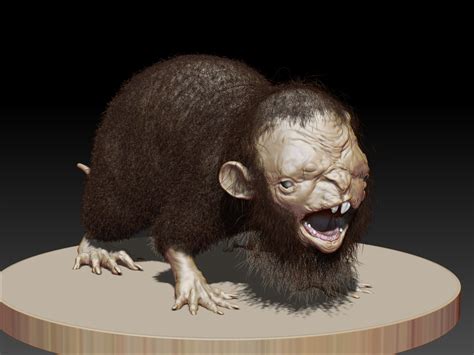
My favorite new comedic creature as
visualized by digital artist
 Carlos Garcia Rivera.
Few writers are as closely associated with their literary creations as Lovecraft is with his Great Old One, Cthulhu. In addition to vividly capturing the cosmic nature of Lovecraft’s aesthetic, “The Dreams in the Witch House” also introduces a terrifying creature, though of much smaller in cosmic and physical stature than Cthulhu, Brown Jenkin. “That shocking little horror,” Brown Jenkin, is described as being “no larger than a good-sized rat”, having “horribly anthropoid forepaws”, and a “tiny, bearded human face.” (145) Unlike some of Lovecraft’s creature creations, due in part to its rat-like nature, visualizing Brown Jenkin is much easier to do than others. The familiar of the witch of the title, Keziah Mason, Brown Jenkin enters the small room of the story’s protagonist, Walter Gilman, via a series of rat holes. As a familiar, he serves the role of Mason’s herald, visiting Gilman without his master at varying points of the story, often terrorizing Gilman in his sleep. For the reader, Brown Jenkin also plays serves as comic-relief, even if gruesomely so. “The sinister old woman and the fanged furry little animal” are quite the duo. If the evil witch is the "straight-man", Brown Jenkin is the comedic player. While requiring a leap, this dynamic is not one I generally associate with Lovecraft’s work so was pleasantly surprised by it. Perhaps it is Brown Jenkin’s tendency to “titter” maniacally throughout the proceedings that gave me a vision of the wisenheimer side-kick archetype. Of course by the story’s conclusion, no one’s laughing at Brown Jenkin or his “four tiny hands of daemonic dexterity”! So taken was I by this monstrous little creature that upon meeting him in the story, I immediately texted a friend of mine who has also read a few Lovecraft stories: “Where has Brown Jenkin been my whole life?”

The lesson here (beyond the coolness of Brown Jenkin) is that like those aforementioned B-sides, it pays to read deeper cuts by authors you enjoy. I know that as a result of this experience, I am going back through those other anthologies looking for any more gems.

Monday, July 30, 2018

Summer Reading: Afterlife with Archie

A few covers from the series (from top left to right) Tim Seeley,  Dave Devries, 
and Francesco Franacvilla. 
True confession: I have never been a reader of Archie comic books. That is, until now. I, like most, have always possessed a passing familiarity with the cast: Archie Andrews, Jughead, Bettie, Veronica, Sabrina, Hot Dog and others. Without having spent much time thumbing through the Archie Digest Comics at the supermarket check-out lane, I have somehow come to know these characters. I also know that I am not alone. Thanks to the success of the current CW Riverdale television show (also streaming on Netflix) a whole new generation of viewers may well insure the Archie empire spanning for another 70+ (!) years. The television show’s success combined with the 2015 relaunch of the flagship series, Archie, likely will at the very least keep these characters within the cultural zeitgeist.

The publisher of Archie comics has long been aware of the iconic status of their characters and unlike other cape-centered comic book publishers, they have used this to their advantage for many years, the recent update notwithstanding. Whereas Batman, Spider-man and Superman are frequently being “re-made” to suit the plotting of their respective writers, “Archie-kins”, and the dynamics of his relationships with secondary characters, has been something of a constant. Which brings me to the most recent expansion of, and my first formal foray into, the Archie-verse: Afterlife with Archie.

Had never heard of Archie's dog Vegas prior to this series, 
but won't forget him now.
Afterlife with Archie is that rare comic book that is likely best read in trade (though I remain committed to the single issue format) if only for getting the complete story in one piece. The sum of the pieces might take a while to make whole though. The first issue of Afterlife with Archie was published back in 2013 and after almost five years, only nine of twelve originally solicited issues have seen publication. But what a run it has been this far!

From the first page, storytellers Roberto Aguirre-Sacasa and Francesco Francavilla craft a unique vision of the familiar Archie cast as survivors of a zombie apocalypse with its beginnings in Riverdale. Both creators are known (and respected) commodities through their individual work in other comic books, Aguirre-Sacasa as the writer of the complete 30 issue run of Marvel Knights 4 (2004—06) and artist Francavilla from a multitude of variant covers such as those for Dynamite’s Lone Ranger series as well as his own pulpy The Black Beetle (2012).

Each issue includes a secondary 
reprint of classic supernatural stories. 
The chief narrative difference between this Archie and the traditional comic book series, and one shared by other titles in the “Archie Horror” publishing family, is that no character is safe from being (literally) eaten alive. To reveal too much would ruin the surprise, but from issue 1 on, people die violently. Even those characters that one may not know well, such as Archie’s dog Vegas are given strong, if small, character moments. Because Francavilla’s stark and stylized artwork is not particularly detailed, his use of (limited color) and Aguirre-Sacasa’s dialogue is used to maximum emotional effect.

As mentioned, the inconsistent publishing schedule of Afterlife with Archie can frustrate if you are impatient, especially for single issue readers. (I avoided this by buying up the ten issues of the series over a few weeks from my local comic book shop.) The first five issues of the series are available in trade paperback entitled Escape from Riverdale. A second trade, the very-spoilery titled Betty: R.I.P., was solicited (as were issues 11 and 12) but all three have been subsequently cancelled. Based on what I have seen in issues 6 through 10, Cthulhu and Sabrina fans will not be disappointed.

Here's to hoping that Aguirre-Sacasa and Francavilla soon return to conclude the current arc. Given the easy accessibility of these iconic characters, even in a unique setting, as well as the high quality of the content, waiting patience will surely be rewarded.

Saturday, March 03, 2018

Need for Lighter Literary Entrees

Just as we are what we eat, what is ingested intellectually (and let's face it, often on a spiritual level) can color one's outlook. Neither a "good" or "bad" thing, depending on the nature of what is being read, the experience can lead into some dark, though not wholly unsavory, places. This reality is further enhanced in the winter months of perceptibly shorter days and longer periods of darkness...

As a result of recent wear-and-tear that has kept me from running, I have more time. In an effort to fill this gap constructively, I have been reading quite a bit, perhaps more than usual. Though not part of some New Year's literacy resolution, since the start of the new calendar year I have been taking in numerous titles in rapid succession including The Southern Reach Trilogy (Annihilation, Authority and Acceptance) and Borne by Jeff VanderMeer, The Great Gatsby by F. Scott Fitzgerald, Roadside Picnic by Boris Strugatsky and Arkady Strugatsky, Monsters Among Us: An Exploration of Otherworldly Bigfoots, Wolfmen, Portals, Phantoms, and Odd Phenomena by Linda S. Godfrey, March Book One by John Lewis, Andrew Aydin, and Nate Powell, and Of Mice and Men by John Steinbeck.

As is always the case with new menu items, in some case I have taken one or two bites and walked away. The Breach by Patrick Lee, for example, just didn't offer enough nutritious value to warrant a full commitment. My personal reading, as has been the case for going on 35 years(!), is always supplemented by a healthy diet of 6-17 comic book titles weekly ranging from the familiar (Action Comics, Detective Comics, The Walking Dead, Black Panther) to "smaller" titles (Evolution, Atomic Robo, Saga, Hack/Slash or Bloodshot).

Each of the literary dishes on this reconstituted diet plan contained some very satisfying flavors in the moments of their enjoyment. In retrospect, however, the majority also possessed some dark and bitter tones. There is a valid argument to be made that much good reading, when considered beyond the superficial, does. Of course, this type of diet does not come without consequences, especially to a body (or mind--trying to stick to my metaphor!) already deficient in certain nutrients. Just as a lack of sunlight in one's day may require adding a Vitamin D supplement to any gustatory regimen, at some point, lighter, more uplifting literature becomes a necessity.

This is where I am at today--in dire need of some light, airy, new reading! While I have a number of books of poetry I turn to for warmth, and more than enough long boxes of past favorites from a "friendlier" time in comic books, filling this requirement in traditional longer-form narrative literature is always a challenge. Interestingly, two recent titles I have enjoyed in the past deal with anthropomorphic animals--a pattern I am unsure as to why it exists it my personal reading tastes (especially as I no longer literally "eat" animals). The first came from a recommendation made on NPR Radio. A few summers ago I read a wonderful piece of historical fiction entitled The Sage of Waterloo by Leona Francombe. It remains the rare book that is neither insultingly silly or immature, that tells a compelling story with weight in a manner that suggests joy and warmth. It also serves as a reminder of the value of expanding one's book choice as it was purchased on a lark, but was significantly rewarding. The second was first read ten years ago and (brainstorming as I write this) may very well get reread soon for purposes of sharing with my current high school juniors, Benjamin Hoff's The Tao of Pooh.

With these two titles (and a few others) in mind, the search for lighter literary entrees continues as I attempt to cleanse my intellectual and spiritual palette of some darker (albeit delicious) flavors...


Friday, July 07, 2017

Summer Reading: Lovecraft's Monsters

Recently I shared with an old friend my struggle finding Lovecraft-inspired material not written by the author himself. For every "Worms of the Earth" by Robert E. Howard there are a myriad of lesser attempts at aping H.P. Lovecraft's unique vision.

Given the wealth of Cthulhu mythos "fan-fic" available, the challenge is not in finding content, but rather in discovering stories that entertain without proving too derivative. A few days after this conversation, I returned to a Lovecraft anthology I had purchased many months earlier that had been repeatedly relegated to my "to be read" pile after only two of the stories had been read. Fortunately, this proved to be a mistake on my part. With a long car/train ride ahead of me, I once again picked up Lovecraft's Monsters and after enjoying the next two stories I turned to and was heartened by what I read.

The secret of quality Lovecraft inspired stories, to my personal tastes at any rate, is demonstrated by the majority of stories in this collection, edited by Hugo and Bram Stoker Award-winning editor Ellen Datlow. The challenge met by many of the pieces selected by Datlow is transferring elements of Lovecraft's work, such as mood and subtle characterization, into a setting or circumstance that, while clearly influenced by the source, extends those ideas into a new direction including culture, setting and time period. The organization of the text as a whole, including the front (Foreword by Stefan Dziemianowicz) and  back matter ("Monster Index"), contributes to a high quality presentation of the stories, even if a few fall flat for this reader.  

Each story is preceded by a single panel image that foreshadows a key event in the story to follow. While not always the case, many of the images are of the monsters encountered in the story to follow. When this is not the case,  the aforementioned "Monster Index" by Rachel Fagundes fills in the gaps by including both narrative and visual sketches of key Lovecraftian monsters that appear throughout. A  handy cross-referencing of
John Coulthart provides evocative
and creepy illustrations such
as this one that precedes "Red 
Goat Black Goat.
monsters with the stories in the anthology allows for the reader to choose those stories that feature favorites first. As an effective collection probably should, Lovecraft's Monsters is both a fine collection of ancillary stories by writers others than Lovecraft as well as a good introduction to the world of the author. When a recognizable monster, such as The King in Yellow or Azathoth, included in the back of the collections

Some stories such as "Only the End of the World Again" by Neil Gaiman and "Black As the Pit, From Pole to Pole" by the duo of Howard Waldrop and Steve Utley take a monster mash-up approach by pairing Lovecraftian creatures with more familiar ones (the Wolf Man and Frankenstein's Monster respectively). While entertaining and clever to this fan of Lawrence Talbot and the traditional horror icons, it is the more straightforward "new" tales that kept me reading. In each case, the author chooses to mix another literary genre with a dash of Lovecraft to effectively deliver compelling new takes on familiar creature. Standouts include:
  • "Bulldozer" by Laird Barron, pages 33-62. Set in the Old West, this is the story of a "Pinkerton man" on a "hunting expedition to the West." (48) As a bulldozer, a colloquialism for an investigator/security, our protagonist Jonah Koenig is on the trail of a criminal. This is not just any ordinary bad guy, however, but an individual who very clearly has taken part in rituals and dark magic related to Belphagor, one of the seven princes of Hell. Employing a contemporary narrative structure to the story (translation: unusual chronology of plot points), Barron ratchets up the tension and drama. As a fan of the neo-Western, I found this one very engaging. 
  • "That of Which We Speak When We Speak of the Unspeakable" by Nick Mamatas, pages 303-312. Mamatas' vignette is a snapshot of a trio of revelers awaiting the end of the world, beginning of a return of the old Gods, depending on how you look at it. The characters reflect this dual anticipation in that one welcomes them, acting as a self-appointed prophet, while others fear for what is to come. The contemporary setting and familiar perspectives on the nature love in modern society help to make this a particular relatable story. While some of the stories in the anthology only suggest Lovecraft's creatures (for example "Bulldozer"),"That of Which" explicitly namedrops the shoggoths who arrive to welcome the new day (night). 
Other standouts include "Red Goat Black Goat" by Nadia Bulkin (65-76) and "The Same Deep Waters As You" by Brian Hodge (79-115). Whether a Lovecraft enthusiast or seeking an introduction to his rich world of dark magic and monsters, Lovecraft's Monsters, edited by Ellen Datlow and published Tachyon is an beach read... especially at dusk.

Friday, September 02, 2016

Hallow-Reading: Blair Witch Project (1999)

Panel from "Elly Kedward's Curse" illustrated by Tommy Lee Edwards.
The time-honored practice of comic book-movie tie-ins frequently results in some interesting comci book titles being published. 1999's little-horror-film-that-hit, The Blair Witch Project, built it's artificial mythology in the "real" (and reel) worlds in an unprecedented fashion. While most are familiar with the SciFi (now "SyFy"...ugh) Channel faux documentary, The Curse of the Blair Witch, the development of the story goes much further than many suspect.

Cover to The Blair Witch
Project
#1 (First Printing)
Beyond even the commonplace novelizations that come with popular film releases, there was also a comic book one-shot. Rather than a retelling of the film's story in comic book form, Oni Press' The Blair Witch Project contributes an additional level of mythology to the key characters and events that, while important to its overall narrative, never actually appeared in the first movie.

With anticipation building for the third film in the series, Blair Witch (2016), to be released on September 16, the time seems right to rifle through some long boxes of older comic books in hopes of coming across the copy I knew I had purchased 17(!) years ago when it was first released. Filed nearby another unusual movie tie-in, Oni Press' Ghost Dog: Way of the Samurai (2000) one-shot, I was pleased to see it had not been discarded by my wife.

From "She Needs Me: Coffin Rock"
illustrated by Guy Davis.
This single issue (later followed up by a three issue mini-series entitle The Blair Witch Chronicles) contains three faux-adaptations of Cece Malvey's "Wood Witch Said" journals, "original" pages of which are shared on the last page. The unifying creative thread among these three stories is writer, or the individual hired to  "annotate and adapt" according to the credits boxes, Jennifer Van Meter. In the Foreward on the inside cover, it is revealed that Van Meter was offered the writing assignment by editor-in-chief Jamie S,. Rich because the author likes "weird crap." While not the most normal criteria for matching writer and material, here it works.

The pairing of each individual story with artist is equally impressive. The individual artistic styles of Tommy Lee Edwards, Guy Davis, and Bernie Merault are used effectively to create unique looks for each time period setting. While each of the three artists' styles vary, the common visual element of being inked solely in black and white lends cohesion to the proceedings. This combination of common writer and visual nuance, along with the varying artistic styles create a visual sense of progress that further contributes to a sense of movement through the narrative. Each short story covers Blair Witch background beginning with the origination of the curse and concluding with a glimpse at the Rustin Parr murders that are the precursor to the now iconic final shot of the Blair Witch Project film was derived.

A portion of the detailed appendix from the back
cover. Here, the numerous footnote from throughout
are explained in detail, supplying an even deeper level
of meaning to the Blair Witch mythology.
It has been a few years since I have seen the film (which is currently not available on wither Netflix or Amazon Prime for free streaming), but after reading this comic book I am confident I never watched the film in light of its mythology as fully as possible. A tribute to the story-within-a-story writing of Van Meter, as well as its carefully crafted "authenticity", it was difficult not to begin searching online through the names of the supposed writers and false historical events. Down to its footnotes and annotations, The Blair Witch Project comic book effectively reads like a visual representation of the person whose thinking it is intended to reflect--the educated and increasingly crazy Cece Malvey.

A brief synopsis (cribbed, in small part, from a promotional entry on MyComicShop.com) suggests the historical scope presented in the single comic book issue:
  • "Elly Kedward's Curse" art by Tommy Lee Edwards. In 1785, Elly Kedward was driven out of the Township of Blair in North Central Maryland. A year later, her accusers started disappearing under mysterious circumstances. Fearing Elly had cursed them all, the people of Blair fled, abandoning their town and giving birth to a legend.
  • "She Needs Me: Coffin Rock" illustrated by Guy Davis. In 1886 Burkittsville, a young girl is lured into the woods where she becomes a vehicle for a measure of graphic revenge against the men of the community levied by Elly's spirit.
  • "Left Alone: The Rustin Parr Killings" by Bernie Mireault (BEM). In a more modern setting, loner Rustin Parr is prompted by a voice in his head to kidnap and murder children from the local community. Readers are given insight into Parr;s thinking whcih reveals the familiar "voice" of the Blair Witch's guiding words.
With a new film being released, and one with ties to characters to the first, there is a good chance that the background revealed in this back issue bin survivor may increase one's level of enjoyment of the film. Even if it is not "officially" part of the new film's canon, The Blair Witch Project is both an interesting cultural artifact and an interesting example of well-researched modern myth building. The original single issue one-shot was originally priced at $2.95 and carried a "Mature Readers" label. It is very likely available in the back issue bins of your local comic shop at cover price or can be ordered online,along with other related Blair Witch titles for significantly less than cover price.

From "Left Alone: The Rustin Parr Killings" illustrated by Bernie Mireault.

Sunday, October 25, 2015

Fave Zombie Video Games

There are even a few stinkers I can't
part with...
I blame my parents. Or thank them, depending on how I look at it. Given that Halloween is only two weeks away, as I look for random things to blog about around my office, I can't help but notice that many of my interests include a significant subset of horror-themed items. Whether comic books, movies, novels or video games, the horror theme runs deep. I suppose, though, that's what happens when you're taken to see the original Alien in theaters at the ripe old age of ten.

Having written about a number of horror themed comic books and movies (often without intending to post them in October), I thought I'd mention a few of my very favorite console video games that include a horror theme. As easy as it would be to simply label them all "zombie games," the list of possible titles I've played include necromorphs, undead, bio-chemical creatures and hell spawns. The term "zombie" does seem a little limiting.  In my 30+ years of gaming (more frequently in some phases of my life than others), I've come across many games from the horror-survival genre, and there are three (well two, plus a throwback) that continue rating high on my personal replay-ability scale even after hours of gameplay beyond concluding their respective primary storylines. While some games are incredibly entertaining for short periods of time (2012's Lollipop Chainsaw, for example), the games that I can drop into my console every so often and continue to enjoy are those that qualify as (a few of my) "favorites." In no particular order:

Read Dead Redemption: Undead Nightmare (2010)


"Cattle rustlin' and bank robbery are at an all-time low; 
Murder, blood-drinking and psychotic episodes seem to be somewhat prevalent."

Full disclosure: the original Rockstar Games Red Dead Redemption (2010) is the answer I often give to the question of "What is your favorite video game." Originally available as downloadable content for the open-world wild west game Red Dead Redemption: Undead Nightmare is the perfect mash-up. While the base game is (in my estimation) the greatest Western game ever produced, the added zombie storyline considerably extends the game's re-playablity. The blend of Western and horror elements is brilliant. The basic premise is that you, as protagonist John Marsten, try to find a cure for the plague which is turning locals into zombies. Along the way there are opportunities to hunt mythical beasts, acquire unique weapons, and of course, eliminate oodles of zombies. As was the case with the original game, the smaller moments from the cut-scenes add an additional emotional level to the game play, but whether you experience them in their entirety depends on how far you play (go ahead, kill that last Bigfoot). Great game-play, great graphics and great narrative--an amazing downloadable expansion pack.

MediEvil (1999)


This is one favorite that I regrettable no longer am able to play (had completely forgotten I'd ever had a Playstation system!), but the memories I have of playing MediEvil are wonderful, not just because of the gameplay or Tim Burton-esque (when Burton was still cool) character design, but because I would often play with my daughter watching. An early Gothic horror-comedy action-adventure game, MediEvil has you play as the protagonist, Sir Daniel, as he seeks to redeem himself by travelling and battling to protect the medieval Kingdom of Gallowmere. At the time, and as you can tell from the trailer above it was a few system generations ago, MediEvil's graphics and gameplay were such that it was like playing a three-dimensional cartoon for the first time.

Dead Space 2 (2011)


"Isaac, we're all gonna burn for what we did to you..."

The second in a trilogy (so far) of games, Visceral Games/Electronics Arts' Dead Space 2 is an amazing sci-fi horror survival game with a strong narrative, excellent graphics and multiple levels of challenge. When I first began playing this, former high school students of mine warned me not to play the sequel as it would only pale in comparison, and they were correct. Dead Space 2 is so complete a gaming experience, requiring a wide array of skills (shooting, manual dexterity and brain games) that it always a joy to return to. Series protagonist Isaac Clarke's (as in Asimov and Arthur C.) life changes for the worse when he accepts a mission to a damaged space vessel in an effort to make contact with his girlfriend who is stationed there. Dead Space 2 picks up three years after the original and Clark, after being held captive and information retrieved from his memory by evil (are there any other kind?) industrialist and religious zealots, has to fight his way off a station/asylum infected with necromorphs. Clarke is written as a reluctant, damaged hero who begrudgingly accepts his role in a larger conflict he really wants no part of. Like all the games listed here, the voice acting is excellent and the characters well-developed. This game is a great example of why video games are often a superior entertainment experience to movies, the hours of entertainment one receives for the purchase price far outpaces any movie I've seen in recent memory.

There are of course many other games I have played and played and played that offer both amazing cinematics, tremedous voice work and gameplay experiences. including Left 4 Dead 2 (2009), Dead Island (2011), Resident Evil (pick one, except Operation Raccoon City--BLECHHH!) and the last game I'll purchase for my X-Box 360, The Evil Within.

Oh, and thanks Mom and Dad!

Resource:
Wikipedia's List of Zombie Video Games

Friday, October 23, 2015

Horror Comics Cavalcade: Marvel Chillers (1975)

Two panels from page 30 of  Marvel Chillers #2 (1975)
words by Bill Mantlo and art by Sonny Trinidad.
Most horror comic books can fit into one of three categories: those titled using traditional horror keywords such as "ghost," or "haunted," those based on traditional literary characters that inspire dread (whether true to the literary source material or not) such as Frankenstein and Dracula, while still others feature protagonists that utilize supernatural power sources such as magic. Today's Horror Comic Cavalcade selection actually fits into all three, though one requires a literary background to make the round peg fit into the square hole.

Issue #2 of Marvel Chillers (1975) is both the second, and final, appearance of one-time newbie Marvel Comics magic-based anti-hero Mordred the Mystic. Despite two issues ably scripted by industry stalwart Bill Mantlo, Mordred the Mystic's comic book career as a lead character lasted only two issues.

Mordred's origin is a simple one: he is found sleeping(!) on a throne beneath an ancient cairn on the Isle of Wight by two explorers. Through a series of events, Modred is awakened from his lengthy slumber and after mistaking one of the explorers for his long lost "milady," he (with the explorers as escort and potential romantic interest) set off to explore the modern world. As so often happens, an evil referred to only as "The Unknown" awakens at the same time intent on destroying him. Utilizing a supernatural energy source called "the darkhold," our mystical hero battles to both clear the cobwebs from his memory and end the threat of the Unknown. So much of this issue is presented as it relates to Modred's origin, it makes one wonder what issue #1 was about.

Modred certainly has
a way with words!
Due to very familiar similarities with other more popular characters, most notably Thor and Marvel's Sorcerer Supreme, Dr. Strange, Morded's quest ends abruptly at the the issue's conclusion. Though he does not speak thusly in more frequent iterations, in the past, Marvel's Thor has also spoken in a pseudo Medieval/Norse tongue. Mordred's dialogue is phrased in a very similar manner, and  lines such as "Is not the powers of the darkhold mine own?" and "Aye, milady, tis God's truth thou dost speak!" cannot be easy to write without inducing a smile. Also like the comic-book Thor (very different from the cinematic character), Mordred is found in a subterranean cavern much in the same way that the transmogrified Mjolnir was--an event that would lead to Dr. Donald Blake becoming the God of Thunder.

Now about that round peg: most readers are likely very familiar with King Arthur and the Knights of the Round-table, but lesser fans may not fully appreciate the connection between those stories and this "hero." In Arthurian legend, Modred is the illegitimate son of Arthur conceived as a result of his relations with his half-sister, Morgan le Fay. Not necessarily the stuff of popular film adaptations (which may be why the character hasn't be seen from much since), this Modred the Mystic's connection to Camelot is only hinted at. The British setting, medieval attire and references to a past golden age strongly infer a connection between Mordred and Arthurian legend, a relationship that might have been explored had the character's run lasted.

Both issue #2 of Marvel Chillers, as well as its immediate predecessor, were both written by Bill Mantlo, art by Sonny Trinidad. Rich Buckler cover pencils.The copy of Marvel Chillers #2 in my possession was just one of a pile of yellowed comic books a friend from work gave me. They had been sitting in a shopping bag in his garage for many years, though I suspect a copy can be had for only a few pennies online or even in a very deep back issue bin at your local comic shop.

Monday, October 12, 2015

Horror Comics Cavalcade: Grimm's Ghost Stories (1975)

From the opening story of Grimm's Ghost Stories #27 (1975), written by
Arnold Drake with art by Frank Bolle. 
While recently scrolling through some previous posts, I came to the startling realization that I have unwittingly become something of a horror comic book fan. Like most fiction genres, what actually makes a comic book "horror" is up for debate. Some are titled using traditional horror keywords such as ghost, haunted house, or vampire, while others feature protagonists that utilize supernatural power sources such as magic. Still others are licensed, for the purpose of presenting tales of horror by iconic names associated with scares such as Karloff, Lugosi and Lovecraft. During the month of October, in addition to reposting earlier reviews, I am going to make my way through select titles from my back issue longboxes that fit (however sloppily in some cases) into the horror genre beginning with Gold Key Comic' Grimm's Ghost Stories.

Grimm's Ghost Stories #27
(1975) published by Gold Key.
As a youngster I remember seeing numerous Gold Key titles for sale on spinning racks at our local convenience store. Regrettably (now), I never picked up any because they lacked that thing young-me felt was integral to comic books: superheroes. Now older and wiser, I see the error of my ways and have fortunately been able to revisit many titles due to the kindness of friends cleaning out their attics and basements. Today's copy of Grimm's Ghost Stories #27 came to me in a shopping bag of old comics that had zero financial value but have allowed me that opportunity to repent my past reading sins (slightly). The 25 cent cover price provides proof enough of the issue's 1975 vintage.

Anthologies such as Grimm's Ghost Stories are a staple of the horror genre, and like others such as Creepy and Erie, each of Grimm's tales of the supernatural are "hosted" by a spooky character, in this case a long haired witch who goes by the moniker Hephzibah Grimm. (You, like I, may have initially assumed that the Grimm surname was meant to suggest the two German brothers... we're both wrong.) Hephzibah, like all ghoulish hosts, offers witticisms as a framing device for each. Perhaps unsurprisingly, the majority of stories are set in, or include significant elements of, Gothic Romantic time periods allowing for the art to easily evoke a moody, scary tone.

Issue 27's four stories of 5 to 7 pages in length each, are divided evenly between two writers, Arnold Drake and Paul S. Newman. The issue opens with both Drake's stories:
  • "Silver From A Dead Man's Eyes" written by Arnold Drake and with art by Frank Bolle, at 7 pages, is the this issue's lengthiest story. At least in death, Le Comte de Savonelle is a generous man, or so the servant who takes the two silver coins from the dead skinflint's eyes pre-burial suggests. Two lesson's are taught in this ghoulish story: 1) an eponymous truism about stealing and 2) making deals with the spirits of dead mean, rich people is not a recipe for financial stability!
  • Manny's ghostly deceased  uncle proves to
    be wa-a-ay cooler than your ghostly
    deceased uncle!
  • "Cry Uncle" written again by Arnold Drake with art by Ed Robbins is the story with the most modern setting setting, taking place in Southern California of the Seventies. This story also features a decidedly Mexican flair as the lead character, Manuel Cruz-Santos, uses phrases like "You loco?" and refers to his recently murdered uncle as "Tio Juan." When Manny is believed to be a suspect in the murder, only his uncle can save him... from beyond the grave!
While Drake's second story is set in a modern (by 1975's standards) locale, both Newman's feature strong Gothic elements.
  • Teased on this issue's cover, "Music to Die By" features art by Jose Gual. Though set in contemporary America, the "country home of an English associate" locale means, of course, there are Victorian British ghosts, too. Here, the ghost in question enjoys alarming people first with her beautiful spinet (kind of an old fashioned piano by the looks of it) music and then by disappearing. A common trope in horror stories is the discovery that the ghost may not be so guilty, a non-twist that plays into the proceedings. In a story with ghost musicians, rich British baddies and instrument tuners being hung, it is weird that perhaps the most chilling line of dialogue in this tale is delivered by the military police at the conclusion: "He fired first and missed! I didn't!"
  • "The Queen's Image," with art by Oscar Novelle, is the most genre-tweaking story of the four. Not only does the story include fictional Queen Margretta's ghost, but also the revelation that the ghosts walks the earth while Margretta is alive!
With an average of four stories per issue, I am always amazed at just how many horror anthologies reach publication. At some point there are few new stories to tell, so the issue of quality frequently lies in the execution of storytelling. As horror comics go, Grimm's Ghost Stories issue #27 was pleasantly entertaining, though not very scary (come to think of it though, fear as an emotion is difficult to evoke in this art form). Perhaps the appeal of horror comes from its sense of timelessness. Given it's reliance on using a predominately history laden backdrop, horror comics age surprisingly well; other than a few hairstyles and fashion trends, all four tales of suspense in this issue could easily be published in a modern comic book anthology and appear contemporary.

Happy reading!

Hephzibah's advice still rings true: always leaves them laughing... HEE HEE!