Showing posts with label folklore. Show all posts

Sunday, February 16, 2020

Read it: The Wanderer’s Hávamál

Despite having read contemporary translations of Beowulf and Gilgamesh, as well as having the entirety of History Channel's Vikings under my viewing belt, I only recently became aware of the Hávamál. A Norse term that translates into "sayings of the high one" and possibly "sayings of the one-eyed", the Hávamál is a single extensive poem in the Codex Regius, a collection of Old Norse poems from the Viking age. Attributed to Odin, the poem lays out practical advice for living.

The Wanderer’s Hávamál is a modern translation of the text prepared by Dr. Jackson Crawford, a Youtube celebrity of sorts, who's online channel "features expert information on all aspects of Old Norse language, myth, culture, and sagas, plus related subjects and some other things just for fun." (Jackson Crawford's Old Norse Channel). My own awareness of his expertise and celebrity was inversely obtained: I came across the title online, ordered and read it, before realizing there even was a YouTube channel. While the Dr. Crawford envisioned while reading the book is slightly different than the "character" presented in the videos, both make Norse mythology incredibly accessible to the common joe like your's truly. Not surprisingly, however, that which is communicated verbally is a little more readily understandable than the text. In this case though, the text is insightful and challenging, in a good way, and rewards the reader who engages it either before (as in my case) or after the benefit of Dr. Crawford's very well produced and orated YouTube content.

Dr. Crawford on YouTube.
Using the familiar introduction-original text-translated text-commentary structure of many contemporary translated works, The Wanderer’s Hávamál, is a highly readable work wherein the coolest stuff (at least for this reader) lies in the commentary and explanation Dr. Crawford offers regarding his translation process and practice. The Hávamál translation, including original text, comprises less than 50% of the book (roughly 85 of 220 pages) and is laid out on the pages as 164 stanzas, some connected by repeated lines and others more randomly placed. Confident Dr. Crawford's placement of stanzas is very intentional rather than "random," to my uneducated perception of the organization, the transitions--if they exist--are less-than-clear.

Some of my favorite translated stanzas from The Wanderer’s Hávamál include the following:


While the majority of stanzas (such as 15 and 31 above) bear truth that resonates in a contemporary context, a few are not surprising a little dated, such as 84 which suggests that “no man should trust the words of a girl… Faithlessness is planted at their core.” These are after all the product of Old Norse culture so some sexist nuances are to be expected. Either as result of Crawford's choice of words in translation or the emphasis on male life in general, the overwhelming majority of The Wanderer’s Hávamál avoids overtly misogynistic advice.

Occasionally we are reminded of our original speaker of the poems as Óđin is addressed within the text. For example, in stanza 98 wherein “Billing’s daughter” suggests that “You should come back/in the evening, Óđin…”. While the deceit is that Óđin is communicating these suggestions for living

A number of stanzas throughout (especially beginning right around 97) are also directly tied to Old Norse mythology and culture through the inclusion of specific names or objects. For example, the giant’s daughter, Gunnlođ, appears in stanza 105 to offer drink to the narrator sitting upon a golden chair. Of course, her(?) name is also dropped much earlier in stanza 14 but without an identified relation to the giant. As a result, Gunnlođ's gender remains unclear to me (assuming they’re the same individual). Challenging inconsistencies of this nature only make the overall text more interesting for this reader as it invites one to actively engage in the text by researching the answers to such questions in both the edition's commentary or online.

Like Beowulf, Gilgamesh, or even the Hagakure (Book of the Samurai), Dr, Crawford's The Wanderer’s Hávamál reminds how valuable, and relatable, ancient wisdom remains in a modern context. In edition to recommending The Wanderer’s Hávamál, I would also recommend stopping by his aforementioned YouTube channel which is chock full of additional insight... both vehicles of education complement one another very well, so where you choose to begin is up to you!

Sunday, February 09, 2020

Read it: The Stone Book Quartet


"Oh, the years of Man are the looms of God
Let down from the place of the sun;
Wherein we are weaving always,
Till the mystic work is done!" 
("The Stone Book," page 35)

My ongoing reading journey through a variety of folk traditions recently brought be back around to English writer and folklorist Alan Garner, author of The Owl Service (tremendous!) and The Weirdstone of Brisingham (fun!). After looking for something new to read from Garner I came across a series of four short stories which, when published together, are titled The Stone Book Quartet. When I initially sought the book out at my local public library, the 1978 edition they had available from storage in the stacks consisted of only the first story, “The Stone Book.” While this hardcover book does include several beautiful etchings by Michael Foreman, it did not include the three stories that, published later, ultimately comprised the entire four-story sequence. As a result, I devoured “The Stone Book” and quickly ordered a more recent Harper Perennial collection which includes all four stories as well as a biographical sketch of the author, an interview and a wonderful family photograph from 1890 that inspired the author's writing ("About the Book," page 16). Taken as a whole, each extra lends additional depth to the series and only adds to the great value of the purchase.

Foreword from 1978 edition of
  The Stone Book does an
excellent job explaining
arc of all four stories.
The Stone Book Quarter consists of “The Stone Book”, “Granny Reardun”, “The Aimer Gate”, and “Tom Fobble’s Day”, clocking in at a breezy and concise 172 pages. While each story can stand alone as a look at one part of Garner’s somewhat fictionalized family history (as revealed in the book's additional matter), taken together it paints of broad and deep understanding from a multitude of generational and gender perspectives. During my first (this will find its way into my list of titles to re-read annually) read through I could not help but take notes in my 5" x 3" spiral bound as images brought up in “The Stone Book” found their way back around through the other stories. Each story takes a look at familial relationships, an individual character's search for purpose through work, while painting a vivid picture of each historical period with direct language. In addition to taking notes regarding images and plot, I also found myself looking up terms and concepts that applied to each career explored, among them stone masonry, textile and metal work. A secondary motif that runs throughout The Stone Book Quartet is the communal power of song. Each chapter includes family members young and old who find joy in their work and play through a shared tune. Despite the seemingly hard-scrabbled lives of the characters, each takes pride in being able to contribute to an occasional tune either through voice or instrument.

Back cover of 1978 edition of
  The Stone Book with Foreman
etching of Father's mason mark.
In The Owl Service and other works, Garner points to the impact of mythology and folklore as carried through landscape, but here the mythology extends to include family and work. The magic of The Stone Book Quartet lies not in supernatural dishes or stones, but rather in the connection built among family and craft through time. For Garner’s characters, the magic of existence is revealed in identifying and pursuing one’s productive passion whether in stone, iron, wood or even, in Uncle Charlie's case in "The Aimer Gate", stopping rabbits from striking. Each of these elemental pursuits create family across generations and this practical magic is often unrevealed until one looks into a small corner or behind a shadowy wall.

The Stone Book Quartet is well worth seeking out for those interested in folklore, English history and legacy.

Monday, November 25, 2019

Folklore Funko Pop: Belsnickel is NIGH!


Like many television viewers in the mid-Aughts, NBC's The Office was must-see viewing. I, however checked out of regular viewing shortly after Micheal Scott (Steve Carrell) left the show in 2011, which is when it apparently got weird. Really weird.

With Carrell's character out of the picture, the show's focus shifted to other Dunder-Mifflen employees, most notably Dwight Schrute. I recall reading somewhere that producers were hoping to successfully spin the character into his on show, set on the Schrute family beet farm. If only that had happened, who knows what kind of wacky Pennsylvania Dutch/German folklore, real and imagined, could have found its way onto our televisions! As it stands, at least we have Belsnickel who made his The Office debut in the 185th episode, "Dwight Christmas", which aired in December 2012.

Fast Forward to 2019 when Netflix and other streaming services have allowed "old" (or in the case of classic comedies such as The Office, timeless) shows find new audiences. While in one English class last week, I mentioned in passing that I had recently come across the Funko Pop! TV: The Office - Dwight As Belsnickel pop at a local Target. I shared that though I was unfamiliar with who Belsnickel was in the context of the television show, a quick check on the cell revealed him to be a holiday folk character so, naturally, I bought it. Simply mentioning "Belsnickel" to my students prompted a few to go into the character's back story as a result of their having seen The Office episode in which he had appeared. Cool!

Because my students were more much knowledgeable than I about such things, I, like Oscar in the clip above, needed to return to the internet for more info. One online article, "Yes, Belsnickel is a Real Thing, and No, it's Not Just from 'The Office'" by Helen Ehrlich, is especially illuminating, though brief, and offers some additional background information on the folk character. Given Belsnickel's renaissance in recent popular culture (apparently "Dwight Christmas" is among the series most popular), along with that of current holiday darling Krampus, perhaps a return to the old ways is not really that far off. Rudolph the Red-Nosed Reindeer, after all, first appeared in 1939, so Belsnickel and his cadre of creepy holiday tricksters have a significant head start!

Thursday, August 01, 2019

Summer Reading: Harvest Home

A few weeks ago I purchased a lovely worn copy of one of a recent current grail title: Harvest Home by Thomas Tryon. Tryon’s second novel has appeared on numerous folk horror reading lists uncovered during my dive into the genre. Despite its presence on so many lists it was surprisingly difficult to find a copy to read. After discovering that the local public library system possessed three copies, all of which were out, I decided to go online for a copy. Turns out it was the correct choice as not only did I enjoy it, but I am confident others in my circle will too.

Told as an extended flashback from the first person perspective of the novel’s protagonist, Ned Constantine, the story's structure takes us from his family’s purchase of a home in the secluded village of Cornwall Coombe in Part One entitled “Agnes Fair” through the terrifying revelation as to what exactly “Harvest Home” means in the eponymously titled Part Five. Tryon deftly places breadcrumbs such as “Viewed in the light of what occurred later, it was a fool’s Paradise” (152) and “I never got to Hartford… for it was the fateful night that saw my fall from favor” (278) to let the reader that, despite what is to occur, Ned has survived. Of course, surviving does not necessarily mean unchanged.

The aspect of the story that works best for me is Ned’s building paranoia regarding the shifting allegiance of his wife, Beth. Their relationship is further complicated when it becomes clear that she, and his daughter, are being slowly manipulated by the town’s leader, the elderly (and initially very kind and supportive of Ned), Widow Fortune. As the Widow insinuates herself into the Constantine family’s lives, Ned (and we) recognize that all is not what it appears. Equally frustrating is the pig-headedness of Ned’s decision making that ultimately result in the grim finale which begins when he feels a “shiver, like a strange paralysis, creeping up [his] body.” (386) In the end, Ned’s paranoia about having his loved ones turned against him by larger (small town) social pressures is well executed by the author.

This is, of course, a folk horror novel, and Tryon does a very credible job building this world of corn cob totems (160) and Eleusian Mysteries. The author uses a neighbor character, Robert Dodd, a former college professor who is now blind and housebound, as the primary vehicle for delivering the eerie exposition regarding the community’s rituals and pagan belief. Goddesses, fertility, psychedelic mushrooms and “corn stalk cosplay” all play a role in fully developing the system of beliefs that drive the community forward into the future by staying set firmly in its past.

When released in 1973, Harvest Home was the successful follow-up to Tryon’s debut novel The Other (1971). Quickly adapted into a popular television min-series starring Bette Davis, it demonstrated itself to have some cultural resonance too. Harvest Home, like most successful that maintains its appeal, subverts a number of horror conventions a trick made slightly more difficult to in a contemporary context due to its impact on books and movies that followed. Though some of the narrative twists and turns were expected, if you have seen The Wicker Man (1973) or Midsommar (2018) you’ll see them coming too, the sense of dread Tyron builds was surprisingly not ameliorated. The fact that my own prior reading provided clues to later reveals, speaks to the gripping nature of Tryon’s storytelling.

Everyone has experienced the disappointment and regret that comes with looking very forward to getting something that fails to live up to expectations (come to think of it that could be a theme for this book!). I am happy to share that this is not the case with Thomas Tryon’s Harvest Home, a 400 page book I breezed through in three days despite frequent stops to jot down notes and savor the storytelling. Highly recommended!

Thursday, July 25, 2019

Summer Reading: Silver in the Wood

Continuing a summer time exploration of contemporary folk literature, I recently picked up Silver in the Wood by Emily Tesh. A slight 105-page volume, Silver in the Wood is a revisualization of the Green Man motif packed with vivid imagery of ancient forests filled with mythical creatures and love found then lost. Set in the “primeval forest” (35) of Greenhollow Wood, our story starts when Tobias Finch, the Green Man mystically tethered to the forest, offers shelter from a rain storm to a handsome, affluent young man, Henry Silver. Henry is an inquisitive young man who is the lord of a nearby village who fancies himself a “practical folklorist,” and as such, his interest in Tobias is immediate.

One need come to the text with zero background regarding the Green Man. I read Silver in the Wood simply as a folk tale and found it to be a brisk, very engaging experience. Many of the archetypes one would expect to come across in a traditional folktale are present (mother, woodsman, etc.), but with a slight twist. Advance online reading also revealed to me that Tesh's piece is also considered a representative of LGBTQ literature, I would presume based upon the clear attraction between the two male leads.

The inherent loneliness experienced by both main characters (one isolated by wealth and the other by purpose) serves as the basis of their attraction. Of such circumstances, romance often blooms. The love Henry and Tobias share feels pure, and very complicated, a state of affairs that also rings true in many relationships, romantic and otherwise. Surprisingly, despite its brief page count, the relationship between the two main characters seems earned due to the slow dance they must go through toward one another without their combined trials growing toward a traditional happy ending.

From the onset, we learn that Tobias, as the Green Man, has become accustomed to living a solitary life, so much so that he “could not even recognize a handsome lad suggesting a bit of mutual entertainment anymore” (14). Eventually, Tobias warms up to Henry’s flirtations eventually recognizing his good fortune in “be[ing] flirted with by a pretty young fellow who wore expensive coats.” (30) The romance in Silver in the Wood is subtle and very psychological (spiritual?), which, for this reader, heightened the level of intimacy shared by them. Tesh vividly describes certain character interactions in such a manner as to infer a physical attraction between the two. Like good literature should, Tesh's fairly uncomplicated narrative offers a number of different lenses or experiences in which to engage and enjoy the text.

I quickly devoured the text for purely entertainment purposes (the best reason to read!), though as certain elements and characterization came into view I had to resist the urge to begin annotating and analyzing. I look forward to recommending and sharing Silver in the Wood with others.

Wednesday, August 01, 2018

Hallow-Reading: The Dreams in the Witch-House

Just as with certain superior recording artists there are “no B-sides”, some writers seem to hit on all cylinders regardless of the piece. While “At the Mountains of Madness” is understandably viewed as one of his masterpieces, H. P. Lovecraft wrote many other stories that despite slightly less literary love, seem, to this reader, equally impressive. More than just my restating the obvious (“Lovecraft is a great horror writer”), with each new story I read buried deep in anthologies of his work, I am sure I have not always appreciated just how “great.”

Take “The Dreams in the Witch-House,” for instance. (Note: Upon researching some information on the story, I was surprised to discover that many reputable Lovecraft scholars deem this particular story to be one of his lesser efforts.) As a fan of Lovecraft’s mythos, as well as those other works clearly influenced by his writing, I found the description of the cosmic environments to be illuminating. Perhaps it is too overt in its depiction for those who like more nuanced horror, but the “vast converging planes of a slippery-looking substance” (At the Mountains of Madness and Other Tales of Terror, page 153) populated by geometric creatures bathed in violet light and “iridescent bubble-congeries”, made concrete for this reader that which has not always been so clear. This approach is as effective as the more subtle approach, albeit in a different way. Much of the content and details in “The Dreams in the Witch-House” also provides a “Who’s Who” of Lovecraftian ideas. In some ways this is an excellent follow up to “Mountains” as it takes some of the cosmology eluded to in the first and grounds it in a more accessible folklore (witchcraft). In addition to the expected supernatural/fantastic elements inherent in the horror, familiar settings such as Arkham and Miskantonic University connect the story to the Cthulhu Mythos by grounding the action in a real-er world.

My favorite new comedic creature as
visualized by digital artist
 Carlos Garcia Rivera.
Few writers are as closely associated with their literary creations as Lovecraft is with his Great Old One, Cthulhu. In addition to vividly capturing the cosmic nature of Lovecraft’s aesthetic, “The Dreams in the Witch House” also introduces a terrifying creature, though of much smaller in cosmic and physical stature than Cthulhu, Brown Jenkin. “That shocking little horror,” Brown Jenkin, is described as being “no larger than a good-sized rat”, having “horribly anthropoid forepaws”, and a “tiny, bearded human face.” (145) Unlike some of Lovecraft’s creature creations, due in part to its rat-like nature, visualizing Brown Jenkin is much easier to do than others. The familiar of the witch of the title, Keziah Mason, Brown Jenkin enters the small room of the story’s protagonist, Walter Gilman, via a series of rat holes. As a familiar, he serves the role of Mason’s herald, visiting Gilman without his master at varying points of the story, often terrorizing Gilman in his sleep. For the reader, Brown Jenkin also plays serves as comic-relief, even if gruesomely so. “The sinister old woman and the fanged furry little animal” are quite the duo. If the evil witch is the "straight-man", Brown Jenkin is the comedic player. While requiring a leap, this dynamic is not one I generally associate with Lovecraft’s work so was pleasantly surprised by it. Perhaps it is Brown Jenkin’s tendency to “titter” maniacally throughout the proceedings that gave me a vision of the wisenheimer side-kick archetype. Of course by the story’s conclusion, no one’s laughing at Brown Jenkin or his “four tiny hands of daemonic dexterity”! So taken was I by this monstrous little creature that upon meeting him in the story, I immediately texted a friend of mine who has also read a few Lovecraft stories: “Where has Brown Jenkin been my whole life?”

The lesson here (beyond the coolness of Brown Jenkin) is that like those aforementioned B-sides, it pays to read deeper cuts by authors you enjoy. I know that as a result of this experience, I am going back through those other anthologies looking for any more gems.

Wednesday, February 19, 2014

Seen It: The Secret of Kells (2009)


While I vaguely recall The Secret of Kells (2009) having a brief run at my local art film theater, I regrettably never had the chance to see it on the big screen. Like so many movies that after seeing the trailer I eventually forget having had a desire to see it, my piqued interest in Kells was eventually lost to the sands of time. Fortunately for those of us with poor memories, Netflix continues to be the gift that keeps on giving. I came across the title as a "Top Picks For You" on the first day of Presidents Week Recess and began my Monday with it, happy to discuss what tremendous treasure it is.

The rarest of all animated movies (independent, multinational financing, hand drawn, and without over-the-top pop music production numbers), The Secret of Kells (2009) is directed by Tomm Moore, who also receives a story credit, from a screenplay by Fabrice Ziolkowski. Based on the story of the origin of the Book of Kells, an illuminated manuscript Gospel book in Latin, containing the four Gospels of the New Testament located in Dublin, Ireland, the film also draws upon Celtic mythology.

The story, with help from Netflix, is simple: "When Vikings attack an Irish abbey, the monks must stop work on the legendary Book of Kells and protect their home. So Brendan (voiced by Evan McGuire), the 12-year-old nephew of Abbott Cellach (Brendan Gleeson), is tasked by visiting "illuminater" Brother Aidan (Mick Lally) with assisting in the completion of the magnificent work. With Brother Aidan's cat, Pangur Bán, as a partner in crime, Brendan's joins forces with Aisling (Christen Mooney), a fairy living in the woods outside of Kells. Rest assured that the execution of the director and animators assures that the story does not play out in an obvious a manner as the brief synopsis suggests.

Brendan and Aisling.
Though the easiest way of singing the praises of any animated film NOT by Disney/Pixar/Dreamworks is by contrasting it with the deficiencies of those same company's films, that would only serve to focus on the negatives of the latter rather then the fabulous positives of the former.
  • The voice cast is excellent, and to my ear, comprised of relative unknowns, the most recognizable voice being that of actor being Brendan Gleeson (Braveheart and the Harry Potter films among others) who plays Abbot Cellach.
  • The traditional (really "old fashioned" nowadays) animation is gorgeous yet somehow "edgy." When the opportunity to go the "big battle" route with the visual storytelling, the choice is made to get metaphorical (or metaphysical). 
  • The romance is real. Of course the romance here is between man and the written word. Though the story and its religious trappings intimates the Word (capitalization intentional), much of the dialogue suggests the world of reading, writing and imagination. When it comes to books, Kells reminds us to "the cover is not the real treasure... open it." The movies core is developed around the completion and saving of "the most incredible book in the whole world capable of turning darkness into light."
If it reads as if the superlatives used here are over the top, you're reading correctly. Tonally, The Secret of Kells owes much more to the works of quiet, magic of Hayao Miyazaka (think Spirited Away)  than with the more common loud and garish assembly line animated movies of recent years. For yours truly, that is more than enough reason to recommend checking it out. My only regret is not having taken the opportunity to support this time of animation/storytelling when it was given its brief theatrical release.

Pangur Bán, Brendan and Brother Aidan in the scriptorium.

Saturday, October 05, 2013

Read It: Breath of Bones

The calm before the storm in Breathe of Bones #1.
Responding to a prompt about revenge in class this past week (an activity for thematic background building during our study of Beowulf/Grendel's mother section of the epic poem), a student inquired as to the spelling of a character's name from Tolkien's Lord of the Rings trilogy: "Is Gollum spelled G-O-L-E-M?" This incorrect spelling of the ring-thirsty Sméagol prompted me to ask if anyone in the class knew what a golem (G-O-L-E-M) was.

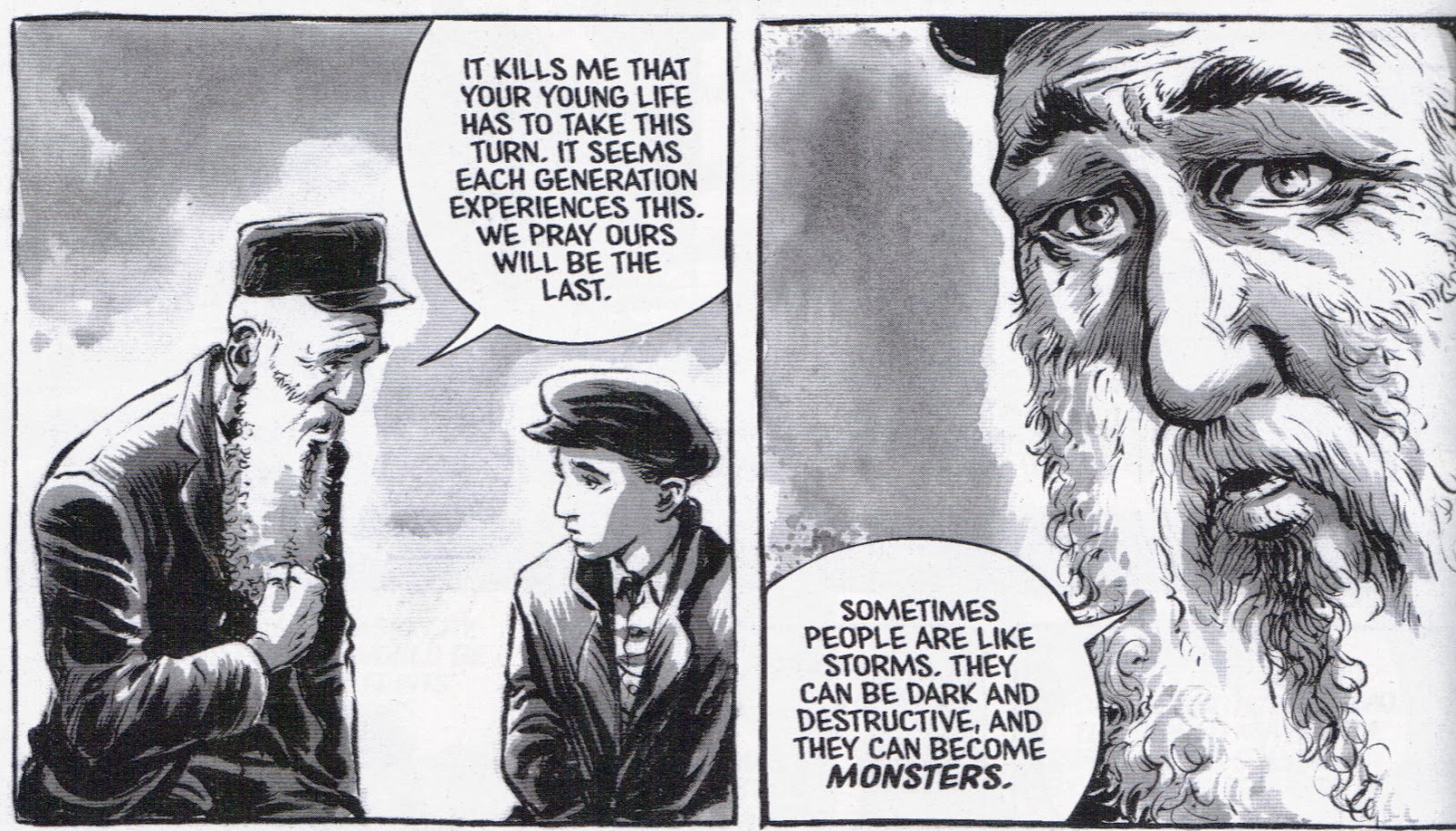
Though familiar with "Gollum", not a single student had heard of a "golem" before. Simply put (thanks to Wikipedia) "In Jewish folklore, a golem is an animated anthropomorphic being, created entirely from inanimate matter. There are many tales differing on how the Golem was brought to life and afterwards controlled." Like much of the smaller pieces of information I have trapped in my skull, the kernel of my own basic understanding of a golem was planted by my having read both books about monsters and things-that-go-bump-in-the-night as a child and from a healthy dose of comic books. Very recently there was a Dark Horse comics three issue mini-series that portrayed a fairly realistic depiction of that same creature, Breath of Bones: A Tale of the Golem.

Written by horror star Steve Niles (perhaps most well-known for creating 30 Days of Night to non-fanboys) and beautifully illustrated in blacks, whites and grays by Dave Wachter, when released, Breath of Bones came in under my comic book radar. I have made the mistake before of missing less heralded mini-series, and later being unable to catch up with them in single issues. Fortunately on this occasion, thanks to my local comic shop and a quick read of numerous glowing reviews, I was able to correct my error early on in the three issue run.

With the Nazi's closing in, grandpa and the townspeople get to work in Breath of Bones #2.
One could easily make the inaccurate assumption that Breathe of Bones is a rock'em sock'em historical super hero comic book, especially based on the beautiful covers to each of the three issues. While there is a tremendous amount of action therein, the slow burn toward the creature's reveal and origin suggests a classic monster movie. In a nutshell, from Dark Horse's own website, Breath of Bones is the story of a "giant clay monster from Jewish legend... on a Nazi-killing rampage in order to protect the inhabitants of a small Jewish stronghold and an injured British pilot." It is also a story of loss, both personal and that of innocence, sacrifice, and honor set against the back drop of World War II. Breathe of Bones is also a story about the power of storytelling, tradition, belief and family. Best of all is that there are Nazi's being pounded into submission by a monster...

From Breath of Bones #3.
Breath of Bones is a miniseries that inspires me to continue to promote the value of the genre as a viable and engaging (and teachable) text. Yes, while occasionally some works, most notably Art Spiegelman's Maus, reach a level of acceptability becoming "canon" of sorts, lesser known titles with content such as Breath of Bones would seem to be natural gateways to discussion in a variety of academic disciplines. Until then, I strongly recommend picking up the title either in individual issues (as is my collection mode of choice), trade paperback, or in the more recent beautifully executed hardcover edition. Unlikely to be read only once (or thrice) and relegated to your longbox or bookshelf, Breath of Bones is a title which bears repeated readings.