Showing posts with label 2008. Show all posts

Monday, January 18, 2016

Run Reader: Gears of War

With his signature catch-phrase, salty language, and buckets of
gore, Marcus Fenix is back in Gears of War #1 (2008).
This past Christmas I was fortunate enough to be gifted with an XBOX One game system. The Holiday Bundle version I received came with the upgraded, "Ultimate Edition" of the original Gears of War game first released eons ago (in gaming terms) in 2006. Thanks to the wonderful world-building of the game's production team, and despite having previously bested both this game and it's subsequent titles, it was difficult not to be easily drawn back into the world of Marcus Fenix and Delta Team.

Issue #2 cover by
Brandon Badeaux.
In edition to being something of a forerunner in dramatic sci-fi/action-adventure console video gaming, the Gears of War franchise also stands as one of the rare early game titles to be successfully spun off into an ongoing comic book series. Running 24 issues from 2009 to 2012, Gears of War was published by DC Comics under the company's now defunct Wildstorm imprint. (Fun fact: SEGA stalwart Sonic the Hedgehog's comic book adventures continue to be published by Archie Comics to this day, with the the most recent issue being #279!) The synergy between game and comic book is such that issues of the series are now available with the Ultimate Edition as unlockable extras, pages of which are viewable in the Special Features.

The success of the comic book is best attributed to its consistency with the games: both are moody and violent in tone with a tightly woven narrative. A key to this consistency in characterization is the result of the comic books use of the games' writers to handle scripting duties. With artwork equally evocative of the video game series, the talents involved contribute an additional layer of humanity to those operating in the Gears universe.

From Gears of War issue #7 written by Joshua Ortega,
art Simon Bisley and Henry Flint .
While there are quieter moments of subtle characterization in each of the Gears games (if you look for them), the comic book format provides numerous opportunities throughout the 24 issue run for characters to breathe and develop even more fully. Due to his established in-game tough guy status, Gears' protagonist Marcus Fenix' is at the center of most stories, if not as the lead, than certainly as a clear influence on the character from whose perspective the story is told.

Even with an already incredibly culturally diverse character line-up in its gaming universe, the Gears comic book also fills out the ranks of those under Marcus's command. Additionally, the series takes the reader back to familiar historical points in the establish Gears historical timeline, such as the Pendulum Wars. each issue takes on the perspective of ancillary characters who at one point or another find themselves with the orbit of Marcus Fenix. In addition to adding characters that would eventually find their way into the game, such as Jace Stratton, introduced in print with issue #3 and voiced by Micheal B. Jordan in Gears of War 3, the comic book series also adds to the mythology of the game-based world. While a minor character, and major influence, in the first two Gears games, Marcus's father takes the lead in a series of flashback issues to the aforementioned Pendulum Wars.

Gears of War #10, written
by Mike Capps and Joshua
Ortega with art by Liam Sharpe.
The opening six-issue arc entitled "Hollow" is written by Joshua Ortega with pencils by Liam Sharp. The events of the arc bridges the narrative gap between the first Gears of War game and the start of the second, following the brutal adventures of Marcus Fenix and Delta Squad in the battle against the Locust. As the writer of Gears 2, Ortega has a clear familiarity with the characters and, with Sharp's command of visuals, both tell a story with minimum dialogue and maximum carnage. One potential drawback to readers unfamiliar with the franchise is a lack of familiarity with the characters by potential readers. While I benefited from having played the games, for example the motivations of both Delta team and the evil invading locust army were understood, the uninitiated might need more background than the obvious "ugly monster equals bad guy" trope.

During its 24 issue run, DC/Wildstorm's Gears of War title maintained a high quality, never deviating from the exclusive "Gears-verse" for story setting. While part of the DC's company -wide "Draw the line at $2.99" price freeze initiative, readers never (thankfully) saw a cross-over with Green Lantern or, more suitably perhaps, Lobo. Concluding with a 6 part story by writer Karen Traviss, that bridges the narrative gap between the conclusion of the second Gears game and concludes with a story which leads directly into Gears of War 3.

The series can still easily collected as individual issues (my preferred format) are still available at cover price at your local comic shop if you are willing to dig deep into the back issue bins. Of course, the series has also been collected into three trades, though the license with DC has surely lapsed by now, there may be more stories in the future as Gears of War 4, with the son of Marcus Fenix in the lead, nears its release.

Issue #13 by Liam Sharp.
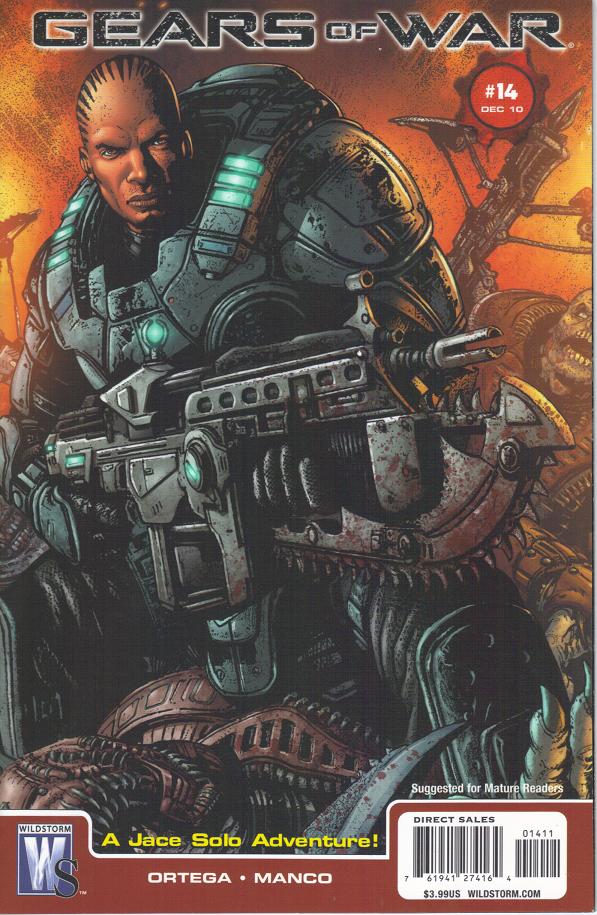
Issue #14 cover by Leonardo Manco.
Issue #19 cover by Colin Wilson.

Tuesday, November 05, 2013

Neophyte Urban Arborist: Harvest of Stink 2013

Many very mature gingko fruit pile up at the base of the tree. (11/3/13)
It has been four autumns (2008) since I last posted about the stink that occasionally emanates in fall from the narrow strip of lawn between our house and our neighbors. After having determined the source of the smell (and happily realizing it was neither our neighbor nor the dog poo I religiously pick up and deposit into the garbage can): a large ginkgo tree. The ginkgo borders both yards and is in the area under which we park our vehicles each day and when it "blooms" it grows fruit. And when the fruit falls to the ground it lays there until being either stepped or run over by our cars... and then they STINK. The fruit releases its odor when it is bruised or crushed (triggering the decay process).

The gingko in fall; note the fruits swept
 off the driveway to avoid bruising...
and smelling. (11/3/13)
Upon first experiencing the phenomena of this "stink fruit," I was particularly surprised to learn that that trees can come in “genders,” being either male or female. Because it does bear fruit, it was not too much of a leap to surmise that our tree was female.

This conclusion was not confirmed by checking under its leaves. According to one website, “…female trees will bear yellowish plum-shaped fruit with a somewhat foul smelling meat (like rancid butter some say) whose outer skin is mildly toxic. Fallen fruits will usually burst open their fleshy coating, thus releasing the odor. In an outdoor setting, the smell is not too overpowering, but avoid planting near car ports or along roads as some people have reported paint damage from the fruits juices…” Stupendous!

Even after 10+ years living in our home, it does not surprise me is that the previous owners would plant such tree especially given its unique (albeit noxious) nature. When we first moved in, every room was a different shade of grey (including the exterior), and because they had been recreational bonsaists(?), shelves cobbled together with cinder blocks and boards were a central component of the garden. And guess what... the ginkgo tree is a favorite of Bonsai enthusiasts, but they usually know it as the Maidenhair Tree, as the small, bonsai trained leaves turn to a striking gold hue in the Fall.

Because ginkgo's will take about 20 years of growth before they start to reproduce, we can deduce that the tree has been here for at least two decades, and being the first time in our four years here that the fruits have appeared, we had not previously noticed the scent. Where we go from here is unclear, and while the fruit can be harvested and the nuts removed from the pungent smelling meat of the fruit roasted for eating, given the height of the tree, and my cowardice in the face of scaling it, this is unlikely. In some ways it is neat to have such an ususal tree (one landscaper we had come a few years ago to trim some other trees in our yard was very enthusiastic to find it in the city), as according to an online blog post I came across by a former "street tree program manager" (forester?), "Many cities no longer plant the female ginkgo."

So while we will not be collecting fruit, we will continue to harvest the stink and continue to make the best of it while attempting to come to terms with our smelly, unique ginkgo!

"Fallen fruits usually burst open their fleshy coating releasing the odor"... uh-oh! (11/3/13)

Thursday, December 27, 2012

Seen It (Again): The Class (2008)


The second of the five documentaries I offered for my students to view and briefly analyze is The Class (Entre les murs) (2008). Based on the 2006 novel of the same name by François Bégaudeau, this film is a semi-autobiographical "sort-of-documentary" account of a year in the author's life as a middle school French teacher in an urban Parisian school. (When I say "French," think your English class.)

I was struck by how similarly the experiences of students, teachers and parents in French public schools mirror those of individuals in American public schools. The majority of the challenges that François encountered were very reminiscent of my own experiences regarding classroom behavior, parent-teacher conferences and exhausted colleagues.

A unique facet of the film is that there are few black and white "characters." I'd go so far as to suggest that François is, himself, (though a seemingly good-natured soul if not always so toward his students) a fairly poor educator who shows little ability to reflect on his weakness as a facilitator of learning... like I mentioned, this film is very realistic. Interestingly, the film, HIS film, does not paint him as a savior to the urban culture... which in the day and age of superhero teacher fantasy films such as the manipulative Freedom Writers, is in itself refreshing.

A compelling film for anyone interested in our (The US of A) educational system, or those who are interested in seeing that despite being in a distant part of the world how similar the human experience among like nations can be despite perceived differences.

Viewing Suggestion: Avoid the dubbed version like the plague... the dubbed voice performances are terrible. It is well worth training yourself to read and watch to get the full experience.

The Class (Entre les murs) (2008) is available locally for rent through both the Monroe County (NY) Public Library System and Netflix.

Wednesday, December 26, 2012

Seen It (Again): The Garden (2008)


With our seven day Winter Recess taking place this last week of December, and having recently completed an extensive exemplification essay, I invited my AP students to earn some additional credit by taking in one of five prescribed documentary films.

The Task: while viewing one fop the films, students are being asked to track instances in whicc the filmmaker attempted to engage one of the three appeals (ethos, pathos, logos) through the use of music, imagery, and dialogue. After completing a graphic organizer of their observations, students are then being asked to develop three high level questions for use in testing one another regrading the use of the three appeals in documentary film making. Though I had already seen four of the five--with Waiting for Superman (2011) being the lone exception--it was time for me to revisit these films for myself.

I first came across the trailer for The Garden while perusing the online home of Oscilloscope Laboratories, the small film distribution company founded by the Late Adam Yauch (aka MCA) of the music group The Beastie Boys. After seeing the trailer I immediately connected it with the book Seedfolks by Paul Fleischman, a book I had previously taught in eighth grade. Both the film and the book deal with a community garden. Unlike Fleischman's book, however, The Garden is a true story, and as Ernest Hemingway famously said, "All  true stories end in death." This film is not about the death of any one individual, but the passing of an ideal.

In the wake of the 1992 Los Angeles riots, hundreds of mostly Mexican-American families came together and turned a blighted corner of South Central Los Angeles into a 14 acre urban oasis—complete with guavas, papayas and enough fruit and vegetables to feed hundreds of families.

Directed by Scott Hamilton Kennedy, The Garden (2008) is the unflinching look at the struggle between urban farmers and the City of Los Angeles and a powerful developer who wants to evict them and build warehouses. The urban farmers consist primarily of immigrants from Latin American countries where they feared for their lives if they were to speak out. The film follows them as they organize, fight back, and demand a response to the question of, "Where is our 'Justice for all'?"

As aptly summarized on to the film's Facebook page, "The Garden explores the fault lines in American Society. It is the story of the country’s largest urban farm, backroom politics, land developers, money, poverty and power. If everyone told you nothing more could be done, would you give up?"

The Garden is currently available for instant viewing and rental via Netflix, or to be purchased on DVD.