Showing posts with label XBOX. Show all posts

Saturday, August 10, 2019

Summer Reading: The Umbrella Conspiracy

As summer wears on into the August dog days, I find myself turning to my XBOX One console for relaxing (and admittedly mindless) gaming action. Though the missions have long been completed, I most frequently return to any of the many Resident Evil/Resident Evil Revelations titles for comfort. There is, after all, a personal Gamer Score to inflate by reaching achievements in games that are not necessarily earned by simply completing the narrative. For a number of reasons, the Resident Evil games to have a high level of re-playability for me that others don’t. Much of this is due to the deep and somewhat convoluted mythos presented throughout the game series.

Despite having read the numerous screenshots and load pages with background information—and having seen the cgi films released her in the U.S—the expansive story of Raccoon City, the Umbrella Company and Terragrigia, as well as their connections to one another from game-to-game is not always easy to discern. It is with interest in obtaining more background, as well as filling some free time with enjoyable reading, that I picked up Resident Evil: The Umbrella Conspiracy by S.D. Perry. A fairly straightforward novelization of the first Resident Evil game, The Umbrella Conspiracy combines Jill's and Chris gameplay scenarios into a singular narrative.

Bearing cover blurbs declaring the paperback as both “Volume 1” and “Based on the Bestselling Videogame by Capcom,” I anticipated getting some additional canon to help clarify some of the relationships between characters, at least at this early point in the series. While some of obvious character traits such as Albert Wesker’s villainous nature through obvious mannerisms such as his “perpetual sunglasses propped on his tanned brow” (127), new information is revealed such as Wesker’s early role in the story as a secondary henchman character. The he began as a captain in the U.S. police team STARS was not clear to gamers such as I who came late to the series (never a PlayStation player was always behind with RE early releases). This was just the kind of character development I came for. From the heroic Jill Valentine and white bread Chris Redfield to less well-known (though I dig him in his debut as a playable character in Resident Evil Revelations 2), Barry Burton, Perry uses the gameplay context to provide each an opportunity to develop.

Perry also makes the interesting choice to use the gameplay structure to drive the narrative in The Umbrella Conspiracy. Puzzles for opening doors become part of the story as Perry offers the reader into the though process characters go through in deciphering the proper way to address a variety of keys. Because this often entails characters spending pages searching for large coins which when combined allow access to parts to important the building, it is best that the reader recognize The Umbrella Conspiracy for what it is. Anyone who has played video games understands the necessity of nuanced puzzles to keep gameplay engaging. Perry is ware of his intended audience and writes it straight rather than having characters question “why would someone have use a series of cradle-to-grave paintings as a key to a secret doorway?” the STARS members demonstrate grit in simply recognizing the importance of doing what needs to be done. Even if what needs to be done is pulling levers to avoid attack crows. Requiring characters to think critically think about how to address each challenge as it occurs also offers deeper insight into what drives them. What seem like selfish moves on Barry’s part in assisting Wesker is much more forgivable given the weight of the threats made to his family should he not.

Another thought I had while reading The Umbrella Conspiracy is how Perry so effectively (and consistently) uses olfactory imagery throughout, a sensual competent obviously absent in the game beyond the visuals. Yes the zombies as computer generated characters are uniquely designed and, well, gross, I had not previously considered that they probably really stink too. Overall the level of descriptive gore present in this book is definitely on par with what one would expect from a Resident Evil product… and for this reader that is a good thing!

I breezed through the novel’s 280 pages, and look forward to picking up Volume 2: Caliban Cove which, unlike Volume 1, is an original work by Perry that bridges events between the first two games. I recommend The Umbrella Conspiracy to any readers of action/adventure/horror and would even suggest those who have not previously played Resident Evil will find something to enjoy; an ideal beach horror read.

Monday, January 18, 2016

Run Reader: Gears of War

With his signature catch-phrase, salty language, and buckets of
gore, Marcus Fenix is back in Gears of War #1 (2008).
This past Christmas I was fortunate enough to be gifted with an XBOX One game system. The Holiday Bundle version I received came with the upgraded, "Ultimate Edition" of the original Gears of War game first released eons ago (in gaming terms) in 2006. Thanks to the wonderful world-building of the game's production team, and despite having previously bested both this game and it's subsequent titles, it was difficult not to be easily drawn back into the world of Marcus Fenix and Delta Team.

Issue #2 cover by
Brandon Badeaux.
In edition to being something of a forerunner in dramatic sci-fi/action-adventure console video gaming, the Gears of War franchise also stands as one of the rare early game titles to be successfully spun off into an ongoing comic book series. Running 24 issues from 2009 to 2012, Gears of War was published by DC Comics under the company's now defunct Wildstorm imprint. (Fun fact: SEGA stalwart Sonic the Hedgehog's comic book adventures continue to be published by Archie Comics to this day, with the the most recent issue being #279!) The synergy between game and comic book is such that issues of the series are now available with the Ultimate Edition as unlockable extras, pages of which are viewable in the Special Features.

The success of the comic book is best attributed to its consistency with the games: both are moody and violent in tone with a tightly woven narrative. A key to this consistency in characterization is the result of the comic books use of the games' writers to handle scripting duties. With artwork equally evocative of the video game series, the talents involved contribute an additional layer of humanity to those operating in the Gears universe.

From Gears of War issue #7 written by Joshua Ortega,
art Simon Bisley and Henry Flint .
While there are quieter moments of subtle characterization in each of the Gears games (if you look for them), the comic book format provides numerous opportunities throughout the 24 issue run for characters to breathe and develop even more fully. Due to his established in-game tough guy status, Gears' protagonist Marcus Fenix' is at the center of most stories, if not as the lead, than certainly as a clear influence on the character from whose perspective the story is told.

Even with an already incredibly culturally diverse character line-up in its gaming universe, the Gears comic book also fills out the ranks of those under Marcus's command. Additionally, the series takes the reader back to familiar historical points in the establish Gears historical timeline, such as the Pendulum Wars. each issue takes on the perspective of ancillary characters who at one point or another find themselves with the orbit of Marcus Fenix. In addition to adding characters that would eventually find their way into the game, such as Jace Stratton, introduced in print with issue #3 and voiced by Micheal B. Jordan in Gears of War 3, the comic book series also adds to the mythology of the game-based world. While a minor character, and major influence, in the first two Gears games, Marcus's father takes the lead in a series of flashback issues to the aforementioned Pendulum Wars.

Gears of War #10, written
by Mike Capps and Joshua
Ortega with art by Liam Sharpe.
The opening six-issue arc entitled "Hollow" is written by Joshua Ortega with pencils by Liam Sharp. The events of the arc bridges the narrative gap between the first Gears of War game and the start of the second, following the brutal adventures of Marcus Fenix and Delta Squad in the battle against the Locust. As the writer of Gears 2, Ortega has a clear familiarity with the characters and, with Sharp's command of visuals, both tell a story with minimum dialogue and maximum carnage. One potential drawback to readers unfamiliar with the franchise is a lack of familiarity with the characters by potential readers. While I benefited from having played the games, for example the motivations of both Delta team and the evil invading locust army were understood, the uninitiated might need more background than the obvious "ugly monster equals bad guy" trope.

During its 24 issue run, DC/Wildstorm's Gears of War title maintained a high quality, never deviating from the exclusive "Gears-verse" for story setting. While part of the DC's company -wide "Draw the line at $2.99" price freeze initiative, readers never (thankfully) saw a cross-over with Green Lantern or, more suitably perhaps, Lobo. Concluding with a 6 part story by writer Karen Traviss, that bridges the narrative gap between the conclusion of the second Gears game and concludes with a story which leads directly into Gears of War 3.

The series can still easily collected as individual issues (my preferred format) are still available at cover price at your local comic shop if you are willing to dig deep into the back issue bins. Of course, the series has also been collected into three trades, though the license with DC has surely lapsed by now, there may be more stories in the future as Gears of War 4, with the son of Marcus Fenix in the lead, nears its release.

Issue #13 by Liam Sharp.
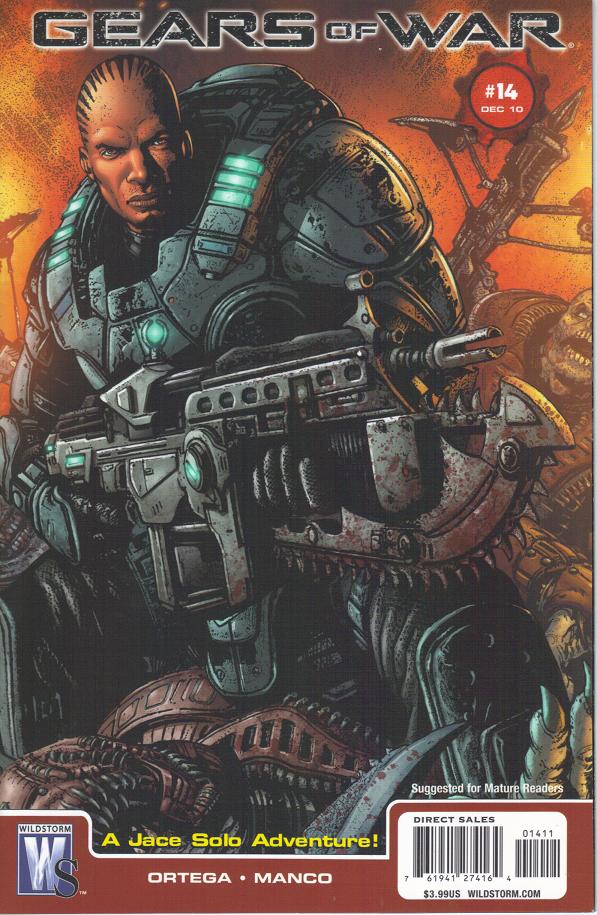
Issue #14 cover by Leonardo Manco.
Issue #19 cover by Colin Wilson.

Sunday, October 25, 2015

Fave Zombie Video Games

There are even a few stinkers I can't
part with...
I blame my parents. Or thank them, depending on how I look at it. Given that Halloween is only two weeks away, as I look for random things to blog about around my office, I can't help but notice that many of my interests include a significant subset of horror-themed items. Whether comic books, movies, novels or video games, the horror theme runs deep. I suppose, though, that's what happens when you're taken to see the original Alien in theaters at the ripe old age of ten.

Having written about a number of horror themed comic books and movies (often without intending to post them in October), I thought I'd mention a few of my very favorite console video games that include a horror theme. As easy as it would be to simply label them all "zombie games," the list of possible titles I've played include necromorphs, undead, bio-chemical creatures and hell spawns. The term "zombie" does seem a little limiting.  In my 30+ years of gaming (more frequently in some phases of my life than others), I've come across many games from the horror-survival genre, and there are three (well two, plus a throwback) that continue rating high on my personal replay-ability scale even after hours of gameplay beyond concluding their respective primary storylines. While some games are incredibly entertaining for short periods of time (2012's Lollipop Chainsaw, for example), the games that I can drop into my console every so often and continue to enjoy are those that qualify as (a few of my) "favorites." In no particular order:

Read Dead Redemption: Undead Nightmare (2010)


"Cattle rustlin' and bank robbery are at an all-time low; 
Murder, blood-drinking and psychotic episodes seem to be somewhat prevalent."

Full disclosure: the original Rockstar Games Red Dead Redemption (2010) is the answer I often give to the question of "What is your favorite video game." Originally available as downloadable content for the open-world wild west game Red Dead Redemption: Undead Nightmare is the perfect mash-up. While the base game is (in my estimation) the greatest Western game ever produced, the added zombie storyline considerably extends the game's re-playablity. The blend of Western and horror elements is brilliant. The basic premise is that you, as protagonist John Marsten, try to find a cure for the plague which is turning locals into zombies. Along the way there are opportunities to hunt mythical beasts, acquire unique weapons, and of course, eliminate oodles of zombies. As was the case with the original game, the smaller moments from the cut-scenes add an additional emotional level to the game play, but whether you experience them in their entirety depends on how far you play (go ahead, kill that last Bigfoot). Great game-play, great graphics and great narrative--an amazing downloadable expansion pack.

MediEvil (1999)


This is one favorite that I regrettable no longer am able to play (had completely forgotten I'd ever had a Playstation system!), but the memories I have of playing MediEvil are wonderful, not just because of the gameplay or Tim Burton-esque (when Burton was still cool) character design, but because I would often play with my daughter watching. An early Gothic horror-comedy action-adventure game, MediEvil has you play as the protagonist, Sir Daniel, as he seeks to redeem himself by travelling and battling to protect the medieval Kingdom of Gallowmere. At the time, and as you can tell from the trailer above it was a few system generations ago, MediEvil's graphics and gameplay were such that it was like playing a three-dimensional cartoon for the first time.

Dead Space 2 (2011)


"Isaac, we're all gonna burn for what we did to you..."

The second in a trilogy (so far) of games, Visceral Games/Electronics Arts' Dead Space 2 is an amazing sci-fi horror survival game with a strong narrative, excellent graphics and multiple levels of challenge. When I first began playing this, former high school students of mine warned me not to play the sequel as it would only pale in comparison, and they were correct. Dead Space 2 is so complete a gaming experience, requiring a wide array of skills (shooting, manual dexterity and brain games) that it always a joy to return to. Series protagonist Isaac Clarke's (as in Asimov and Arthur C.) life changes for the worse when he accepts a mission to a damaged space vessel in an effort to make contact with his girlfriend who is stationed there. Dead Space 2 picks up three years after the original and Clark, after being held captive and information retrieved from his memory by evil (are there any other kind?) industrialist and religious zealots, has to fight his way off a station/asylum infected with necromorphs. Clarke is written as a reluctant, damaged hero who begrudgingly accepts his role in a larger conflict he really wants no part of. Like all the games listed here, the voice acting is excellent and the characters well-developed. This game is a great example of why video games are often a superior entertainment experience to movies, the hours of entertainment one receives for the purchase price far outpaces any movie I've seen in recent memory.

There are of course many other games I have played and played and played that offer both amazing cinematics, tremedous voice work and gameplay experiences. including Left 4 Dead 2 (2009), Dead Island (2011), Resident Evil (pick one, except Operation Raccoon City--BLECHHH!) and the last game I'll purchase for my X-Box 360, The Evil Within.

Oh, and thanks Mom and Dad!

Resource:
Wikipedia's List of Zombie Video Games

Friday, October 11, 2013

Gaming Retro Review: Beowulf (2007)


This is my first year teaching twelfth grade literature and as such my first pass through a number of selections as a teacher, rather than for purely entertainment purposes. I am so pleased to write that much of the literature I've reread has been both educational and entertaining, something which does not always seem to be the case. First up was the classic epic poem Beowulf.

Using the popular Seamus Heaney translation as the source document for our analysis was a plus, given its accessibility to the modern reader. One other unusual benefit was the both the fairly recent 2007 Beowulf film adaptation and the recent success of A Game of Thrones television show, both providing some initial context.

Just as Ecgtheow beget Beowulf, so did the film adaptation, directed by Robert Zemeckis (Forest Gump, Cast Away), beget a video game for the most popular gaming consoles of the time, including the XBOX 360. Both the movie and video game received generally poor reviews (and neither has characterization that--for my tastes--reflect that offered in Heaney's, or nay, translation), but this fact hasn't stopped many an English teacher from showing clips of the beautifully rendered Heorot Hall and Hrothgar's kingdom to assist in establishing the poem's setting for students.

The overall quality of the game, a used copy of which I purchased for $4.99 at a local video game store, is really not that open to debate, certainly not in the eyes of the market--it was much derided and inspired little support from gamers. Those students of mine who recall having received it at the tender age of ten years-old hold no fond memories of it, telling me simply, "it sucked." This did not stop me, however, from giving it a look-see to judge what, if anything, it brought to the "original" story, much as Zemeckis'  film played with quite a few accepted plot points. As well as altering enough of the character dynamics to make my showing it in class (beyond the ten minutes at the start), unnecessary and even counter-productive to an analysis of the themes and archetypes.
Beowulf: The Game's "chant challenges" are unique,
though ultimately frustrating.

Despite a fair degree of clunky game play which made even the most basic level of difficulty frustrating, to the game designer Ubisoft's credit, there is an attempt to utilize the full spectrum of X-BOX 360's controllers in a number of unique ways, most notably to "chant challenges" which require punching in long and short "tones" in rapid succession to prompt characters to a variety of actions such as moving barriers or rowing galleys.

Just as the movie fleshed out elements of the story in the interest of shaping the narrative to modern sensibilities, The Game takes advantage of the additional time to fill in spaces in certain key character relationships rather than simply retelling the story as paced in the the movie. In the game, Breca becomes much more of a foil early on and the challenges he and Beowulf face together increase. (Unfortunately, the actualization of these challenges--"giant" sand crabs the size of small dogs?--does reduce the sense of danger inherent in the the opposition.)

You are Beowulf!
There are also small cosmetic changes to the characters designs as presented in the film The Game was released to support. For example, Beowulf is now clothed while battling Grendel: a concession that would seem to have been made to allow for a broader potential market, though the increased amount of pixellated blood drawn from each sword slash would seem to be counter intuitive to that purpose. Many of Beowulf's "kills" are brutal (in the movie and game), and The Game earns it's M Rating based on those merits alone... which begs the question: why change that aspect of the game except that it might be more marketable to play as a murdering savage warrior who is fully clothed.

Much of my appreciation of Beowulf: The Game comes from both the cost incurred for the copy I bought ($4.99) and my interest in comparing and contrasting filmmaker Zemeckis's extended vision for the character with that of Heaney. Had I plopped down $50, seven years ago, my venom toward the game might be equal to that of reviewers of the day. Now, year's removed from the hype, and neck deep in analysis and class discussion, I can think of many more wasteful ways to drop a few dollars and wile away a few hours, than Beowulf: The Game.