The cover and a page from the hardcover book Star Wars: The Empire Strikes Back: The Original Topps Trading Card Series, Volume Two.
You know time has really passed when the collectibles you purchased as a child find their way to nostalgia-inducing coffee table books. That was the feeling, along with curiosity over who might actually purchase such a publication, I experienced while wandering the shelves at a local bookseller (FYI: this post was first published 8/18/2016). In a time when the demographic (white male nerds, 45-55) to which I belong are willing to part with hard cash for a nostalgic charge, it is not surprising that the hardcover "book" Star Wars: The Empire Strikes Back: The Original Topps Trading Card Series, Volume Two is now available. The book is exactly as advertised, each page consists of both the front and back of one of the 132-card base set and 33 stickers that compromised the original wax packet release back in 1980(!).
My collection of the original Empire Strikes Back Topps Picture Card Series Two.
Fortunately, I still have a complete card set (though only a partial sticker set), so can save my funds for other fanboy passions. An key aspect of trading card collecting that is lost with the transition to book form is the tactile charge of flipping each individual card over. One never knew what to expect, but it would be something exciting whether cool facts, silly quiz questions, or behind the scenes production secrets. This was, of course, prior to the advent of the internet when production info as limited to that which could be found only in magazines like Starlog or during the occasional Behind the Scenes television special. I even remember looking forward to The Price Is Right Showcase Showdowns where often one would be based on an upcoming movie and offer a clips package. Damn, those were magic days!
Here are just a few representative cards (with caption comment) from my collection:
Straight from 1980... the "title" card for my set of The Empire Strikes Back
Topps Picture Card Series 2.
Card 138: Back before any mystery was blown up by the prequel trilogy,
all things related to Boba Fett, like his ship Slave 1, were super cool!
Card 164: A suitably Eighties caption to this standard Vader shot.
Card 174: This one is interesting as it pre-dates the current practice of
referring to our robot friend by his government name R2-D2 rather than the
much more humanizing Artoo.
Card 207: Clearly the Star Quiz questions were intended to make young fanboys
like myself feel really confident in their Star Wars trivia knowledge.
Card 261: Prior to the Internet, these special cards, complete with
alliterative caption, were the best way to see any behind the
scenes shots. I still love looking at this sub-series.
Card 263: As a kid, I hated getting these cards (they lacked cool pics!) but now
appreciated knowing what cards I am trying to get when you get down to
only a few left for a complete set.
The original packs came with a single sticker so it was not so easy to get a complete set.
Sadly, I have very few of these as I used most of them spelling out cool things with
the letters, such as the word "Awesome": ah, childhood!
From Leonard Nimoy's poetry collection Warmed by Love,
published by Blue Mountain Press in 1983.
Apologies for slacking, but here we are already six days into National Poetry Month 2020 and I have yet to post anything. Fortunately, this error is easily rectified by digging deep into my book shelf for a poem by recently departed Star Trek actor-director-poet Leonard Nimoy.
"Old Fashioned Spaceman" is fairly representative of the collection as a whole: Nimoy's style is free form, devoid of traditional punctuation, with occasional rhyme, and frequently self-referential. There are few writer's who can use their own careers, especially an iconic character initially brought to life on a television screen, as a means of providing cultural allusion ("logic"). As we know, though, Leonard "Mr. Spock" Nimoy was not your normal cat.
The typography and publishing elements in this collection (gold hues, New Times-Roman font, bright, chalky strokes of color) strongly suggest the Vintage Hallmark poetry editions sold at the greeting card shops of my youth. These volumes, and my weekend evenings watching Star Trek, represent the breadth and depth of my youthful poetic experience. The warm traditional presentation (the very pleasant and joyful headshot of Mr. Nimoy on the cover for example) occasionally comes into contrast with the cold (logical?) tone established in the lines of poetry. One could interpret this contradiction and of publishing style and content to reinforce the conflict Nimoy himself once felt about his association with the character.
My hard cover of Warmed By Love is a gift from many star-dates ago, so I am unsure whether it is still in print. If you do happen across it, I recommend picking it up as it is very readable, and worthy of some consideration beyond the kitsch value. Of course my own appreciation of Mr. Nimoy's poetry may be because I, too, often feel like an "old fashioned spaceman."
Thanks to a slow week
administering exams and the need to close-up shop in advance of the impending
summer school break, my personal summer reading season has begun early. Truth
is, I live in a yearlong reading cycle, and with current events being what that
are, this has never been so true or vigorously adhered to. My "Must
Read" table overflows with books awaiting opening. Ironically, I continue
to cleanse my mental palette of orange, homicidal, lying monsters by mixing in
cosmic horror. The Beautiful Thing That Awaits Us All by Laird Barron,
published in 2013, is the third of his collections, after Occultation
(2010) and The Imago Sequence (2007) I've read.
Both collections of
short stories were a terrifying, uncomfortable pleasure to read and The
Beautiful Thing is no different. When I recommend Barron's stories
to others, it is often with the with the suggestion that Barron's short story
work (I've yet to read his well-regarded novels) are perfect for those who
appreciate the literary stylings of H.P. Lovecraft. (I also share that the dread and discomfort that comes with Barron is much more visceral, at least for this reader.) If anything, this most recent
collection brings Barron's vision into more direct alignment with Lovecraft's.
There is little need for me to formally review this collection, there are plenty of
reputable reviews online to be read if that is the desire. I do have a couple
of thoughts however from the perspective of the "guy sitting on his porch
after having been given a good fright."
Lovecraft's influence
is most overt in the collection's seventh story "Vastation" (which
means "the action or process of emptying or purifying someone or
something, typically violently or drastically"), a collection of
reminiscences from the perspective of self-ascribed "herald[s] of the Old Ones" (199). Here, a timeless entity of
sorts recounts experiences from the distant past, present and future as he
prepares our world for cleansing. The unique point of view shifts from the Dark Ages to the future of robot cats adding a layer not
explored by Lovecraft (whose Cthulhu mythology was only made more concrete
after his passing). Balancing grotesque imagery such as the Mushroom Man's
mission to "liquify our insides and suck them up like a kid slobbering on
a milkshake (200) with light humor in the form of the unnamed (maybe
"McCoy" as in the real McCoy?) narrator's affection for Fat Elvis and
his own robo-cat, Softy-Cuddles.
Beyond the fantastic
imagery, cosmic horror and scary "magical realism" in The
Beautiful Thing That Awaits Us All, this collection does two things I always appreciate in writing:
Saturn Devouring His Son
by Fancisco De Goya
I really dig when author's prompt me research in order to fully grasp what's happening. Each of Barron's stories includes a cultural allusion or use of diction that had me going to the smart phone, not so much for basic comprehension but for a sharpening of understanding. This especially rewards when considering the titles The previously mentioned "Vastation" for one or the need to refresh my visual memory regarding Francisco De Goya's painting Saturn Devouring His Son. Doing so only brings into even greater clarity the creepy image created by Barron's words at the conclusion of "Jaws of Saturn".
Despite the collection nature of short stories, Barron weaves symbols and motifs throughout. In both the narratives and publishing artwork the ouroboros makes appearances. I also found it cool to come across the image of staring at a single red dot against a wall as a portal to other worlds a number of the stories. Again, this is not meant to be mind-blowing observation on my part, but a recognition of the care taken in selection and creating a tone (and message?) for the text as a whole.
I continue to enjoy the
short stories of Laird Barron. My past experience with Barron suggests that he
is the rare horror writer whose work benefits from re-reading (Occultation
remains on my "Must Read" pile despite having been read and re-read).
A quick note for any of my high school students still reading: there is R-Rated
imagery and activity throughout Barron's stories. As I say in class when
discussing "adult-ish" content, I can't recommend it to you yet, but
as soon as you turn 18... check it out!
I have many shelves, boxes and piles of books, magazines, and comic books throughout our home. Cumulatively, they comprise a massive "Read List". Most I begin to read upon receipt. Many I begin and read through along with two or three titles simultaneously. A few, I read cover to cover exclusively. Some I even read the first eight pages, fail to be hooked, and set them aside to eventually be plucked from the stacks at a later date. When I do begin the start-stop-start-stop dance with a title, it may go on for weeks or even years before it finally hits me (or I, it) in a way that sticks. These demonstrations of show of patience can provide the most entertaining (and rewarding) reading experiences. It often pays not to quit on a story.
Take Borne by Jeff VanderMeer for instance. After devouring his Southern Reach Trilogy in a two week binge in August 2017, I looked for another helping of VanderMeer's mix of ecology, sci-fi and thoughtful character development. Which brought me to Borne, a post-apocalyptic survival tale set in a futuristic landscape ruled by a gigantic flying bear. On a number of different occasions over the past year-and-a-half I have taken a series go at Borne. Each attempt ended in my failure to allow myself to be drawn into the narrative strongly enough to commit to it's story ahead of other books on my to-read table. Eventually, however, the student was made ready, and as foretold in countless episodes of Kung-Fu, the teacher, or in the case, novel, appeared.
A week ago, in the wake three months of folklore and comic book reading (reading for pleasure) and classic American literature (for teaching which is also pleasurable), I had a hankering for a sci-fi palette cleanser. Wandering the stacks at my local public library, I once again came found Borne waiting for me. This time I was ready and could not put it down. Turns out, Borne is that breezy, emotional follow-up to the Southern Reach Trilogy I had hoped it would be. Even if it took me a while to see (and read) it. In the afterglow of having digested a well-written story, I am especially glad that I hadn't given up on Borne. That is not to suggest I am yet ready to tackle James George Frazer's The Golden Bough, a tome that's been pecked at and thumbed through for going on 12 years...
My very first short box circa 1984... and yes I was the person who actually
bought DC's Guy Gardner Warrior!
Some comic book collectors have spinner racks (lucky!) while others have beautifully designed shelving to display their collections. I am old school, and no carpenter, so even 40 years into my fandom, I still use long, and as I have become more "seasoned", primarily short, boxes for storing and organizing my collection. This requires quite a bit of space and, fortunately, we have a sort-of finished third floor attic where I read and store them with other collectibles.
Shazam! #1 variant
cover by Gary Frank.
It is during these winter months when we are "trapped" inside for the majority of the day that I will shift the organization of my collection. Often it is a change in publication the prompts a change, For example, DC's recently introduced Geoff Johns and Dale Eaglesham joint, Shazam! (2019, $4.99 per) title necessitates the movement of Jerry Ordway's incredible The Power of Shazam (1995-99, cover price $1.50 per issue) series into an active box. Though represents a significant departure from the characters as depicted in Power, with all pre-New 52 continuity erased, I like having access to previous narratives.
Conversely, the conclusion of the most recent Suicide Squad (Volume 5, 2016-19, Issue #1 was $2.99 and the final issue, $4.99) series means that title will shift to an "inactive" box, stored in the back part of the attic, until the teams eventual return to action. Then, once again, the old order will changeth!
Local comic book shops organize titles on the "New Releases" table, as well as on "Recent Releases" racks and their own "Back Issues" long boxes, first by publisher (Marvel, DC, Image, Dark Horse, etc.) and then alphabetically by title (Action Comics, Aquaman and so on). Decisions regarding the specific organization of titles in collections are more personal. When it comes to "Big Two" titles (DC and Marvel for the uninitiated), putting these titles by character families (Wolverine alongside Uncanny X-Men or Justice League Dark next to Justice League Odyssey). There are families in the smaller publishers as well, most notably (and expansive) the "Mignola-verse" titles from Dark Horse. These are comic books set in the world of Hellboy, a universe of titles created by Mike Mignola that includes Abe Sapien, Lobster Johnson, Witchfinder and many others.
Zeke Deadwood: Zombie Lawman
cover by Thomas Boatwright.
Those smaller publishers beyond the Big Two, though given quality and quantity of titles it's past time to start thinking of Image Publishing as a "Big Three", are much more willing to take creative risks with creator owned titles, especially those in the Horror, Western and Science-Fiction genres. Because of this, many of my shorts boxes are organized alphabetically by genre families rather than publisher or creator.
For example, I currently have five boxes which are organized as "Westerns" that include a wide variety of characters from large and small publishers. This means that DC's Jonah Hex extended series (2005-10, 70 issues) is organized with the now-defunct Topps Comics Lone Ranger and Tonto miniseries (1994, 4 issues), IDW's 3 Devils (2016, 4 issues) and SLG Publishing's Zeke Deadwood: Zombie Lawman (2009-11, 2 issues) series of one-shots in my short boxes.
Interestingly enough, this brief post about organizing my comic books also has me organizing y thoughts. The inclusion of Zeke Deadwood among more traditional Westerns alone has me considering my next reorganization project to further disaggregating Westerns into a Horror-Western Mash-up section. That project, however, will have to wait for the next snowstorm...
Like most 40-50 somethings, the 1976 movie Logan's Run starring Michael York, Jenny Agutter, and Richard Jordan (who also played favorite literary character from Frank Herbert's novel's Duncan Idaho in David Lynch's movie version of Dune (1984)!), was a very important part of my nascent science fiction fandom. Despite being the tender age of 7 at the time, between the film version, Marvel comic book (which ran seven issues in 1977), and equally short-lived television series (14 episodes), Logan and Jessica's search for Sanctuary was a big part of daily neighborhood games of "guns". (Back-in-the-day, my friends and I would gather with all of our plastic arms, break into groups and simulate life-and-death chases of one-another throughout a three-block radius of our hood... these were very different times.)
Logan's Run #2 cover by comic book legends
cover by George Perez and Al Milgrom.
Recently a summer school colleague stopped to share his excitement at hearing that Logan's Run was once again in the Hollywood hopper for a potential blockbuster remake. After sharing memories of Logan's Runs past, I mentioned that I had heard that the new movie is to be based on the original novel rather than the more familiar iterations. I expressed a desire to read the original novel by William F. Nolan and George Clayton Johnson, but had always had difficulty finding an affordable edition. Later that day he sent me a link to a recent re-release he'd come across on Amazon. Three days later it arrived in my mailbox and I jumped right in...
Released as part of Vintage Publishing's "Vintage Movie Classics" collection of "novels that inspired great films" in 2015, this edition of Logan's Run includes a foreword Daniel H. Wilson as well as publication details for the original novel and the movie adaptation. The differences between the familiar film and the original movie are many, ranging from key characterization to the scope of the world in which the action takes place. The general plot and narrative drive remains the same in all version of the story: in a secretly dystopian future, policeman Logan "ages out" and as a result of first trying to find a mythical utopia ultimately joins another runner in seeking the right to grow old all while being followed by former partner bent on bringing both he and his lady-friend to justice.
Given that the 1976 film is so familiar, the easiest way to share thoughts on the novel are to point out two key differences between the two.
In the movie, when characters turn 30 years-old, an event communicated to those around them through the change in color (red to blinking red to black) of the crystal imbedded in the palm of their right hands, they are expected to participate in the Carrousel celebration. During this public display, their lives are extinguished. If one fails to participate, individuals become "runners" who are then targeted by policemen called "Sandmen." The future-cops are tasked with apprehending and killing runners on the spot, thus maintaining the social construct that no one lives past 30. This is actually a pretty significant point of deviation from the novel. In Nolan and Johnson's book, the age of termination is 21, an aspect that better communicates an important part of the novel's world controlled by youth theme. The movement through a prescribed color-themed lifespan is further developed and Logan's personal at each seven year increment are shared via flashback.
Just as Logan's backstory, as well as that of the culture he resides in, backstory is more fully developed, the world of the novel is much more expansive. This aspect of the novel is among the more intriguing elements. Rather than quickly moving from the Dome City to Washington, DC, with only a couple stops along the way, in the novel, we follow the runners from Los Angeles to the bottom of the Pacific Ocean and across the United States. I enjoyed the use of actual historical locales like the Crazy Horse Memorial in South Dakota as an important locales. Additionally, the inclusion of robotic Civil War re-enactors in Virginia. These touches gave the story a much broader feel and a clearer American tone.
It is clear that most of the decisions made in adapting the novel in 1976 were made for budgetary reasons including the hiring veteran actors who could no longer pass at 21 rather than less marketable teen unknowns. For the time, the special effects in Logan's Run (1976) were very impressive, even earning an Academy Award. With the unlimited budget afforded novelists, characters and setting could be much more imaginatively depicted. A prime example is the character Box who controls the icy area called Hell. In the movie, Box is a not-so-menacing chrome robot, in the novel a grotesque combination of machine and human parts.
William F. Nolan and George Clayton Johnson's Logan's Run is a very slight volume, clocking in at a breezy 166 pages. The narrative is presented in a serialized structure using a conversational writing style that includes few creatively modernized words that are easily understandable given their context. As advertised on the back cover, this novel is indeed a "page-turner", and I read a few entertaining hours.
The challenge now would be to track down the two sequels penned by the first's co-writer, Nolan: Logan's World and Logan's Search. Published to coincide with the release of the movie, neither has been re-published since and are only available on E-Bay and Amazon for up to $60 apiece. Until I come across the for a more reasonable purchase price at a used book store or garage sale, I'll need to access the guns game brain of my childhood to envision the further adventures of Logan and Jessica...
Just as we are what we eat, what is ingested intellectually (and let's face it, often on a spiritual level) can color one's outlook. Neither a "good" or "bad" thing, depending on the nature of what is being read, the experience can lead into some dark, though not wholly unsavory, places. This reality is further enhanced in the winter months of perceptibly shorter days and longer periods of darkness...
As a result of recent wear-and-tear that has kept me from running, I have more time. In an effort to fill this gap constructively, I have been reading quite a bit, perhaps more than usual. Though not part of some New Year's literacy resolution, since the start of the new calendar year I have been taking in numerous titles in rapid succession including The Southern Reach Trilogy (Annihilation, Authority and Acceptance) and Borne by Jeff VanderMeer, The Great Gatsby by F. Scott Fitzgerald, Roadside Picnic by Boris Strugatsky and Arkady Strugatsky, Monsters Among Us: An Exploration of Otherworldly Bigfoots, Wolfmen, Portals, Phantoms, and Odd Phenomena by Linda S. Godfrey, March Book One by John Lewis, Andrew Aydin, and Nate Powell, and Of Mice and Men by John Steinbeck.
As is always the case with new menu items, in some case I have taken one or two bites and walked away. The Breach by Patrick Lee, for example, just didn't offer enough nutritious value to warrant a full commitment. My personal reading, as has been the case for going on 35 years(!), is always supplemented by a healthy diet of 6-17 comic book titles weekly ranging from the familiar (Action Comics, Detective Comics, The Walking Dead, Black Panther) to "smaller" titles (Evolution, Atomic Robo, Saga, Hack/Slash or Bloodshot).
Each of the literary dishes on this reconstituted diet plan contained some very satisfying flavors in the moments of their enjoyment. In retrospect, however, the majority also possessed some dark and bitter tones. There is a valid argument to be made that much good reading, when considered beyond the superficial, does. Of course, this type of diet does not come without consequences, especially to a body (or mind--trying to stick to my metaphor!) already deficient in certain nutrients. Just as a lack of sunlight in one's day may require adding a Vitamin D supplement to any gustatory regimen, at some point, lighter, more uplifting literature becomes a necessity.
This is where I am at today--in dire need of some light, airy, new reading! While I have a number of books of poetry I turn to for warmth, and more than enough long boxes of past favorites from a "friendlier" time in comic books, filling this requirement in traditional longer-form narrative literature is always a challenge. Interestingly, two recent titles I have enjoyed in the past deal with anthropomorphic animals--a pattern I am unsure as to why it exists it my personal reading tastes (especially as I no longer literally "eat" animals). The first came from a recommendation made on NPR Radio. A few summers ago I read a wonderful piece of historical fiction entitled The Sage of Waterloo by Leona Francombe. It remains the rare book that is neither insultingly silly or immature, that tells a compelling story with weight in a manner that suggests joy and warmth. It also serves as a reminder of the value of expanding one's book choice as it was purchased on a lark, but was significantly rewarding. The second was first read ten years ago and (brainstorming as I write this) may very well get reread soon for purposes of sharing with my current high school juniors, Benjamin Hoff's The Tao of Pooh.
With these two titles (and a few others) in mind, the search for lighter literary entrees continues as I attempt to cleanse my intellectual and spiritual palette of some darker (albeit delicious) flavors...
After multiple moves and seasonal cleaning flings, what remains of my book collection are those with either a high level of re-readability or a personal connection. While some were gifts (my son bought me 10 Billion Days and 100 Billion Nights nearly six Christmases ago), others are titles acquired at different stages in my life (the original Dune series were given to me in a paper bag rescued by a co-worker cleaning her garage--and quickly devoured--during my divorce 17 years ago). It's not just the memories of each book's content, but the nostalgia provided via the tome's acquisition. It's true that even after being read and shelved and re-read, some titles continue to grow.
Remnants of fancies past still present themselves in the forms of duplicate copies of the same title by different publishers. Though this phenomena is occasionally the result of my repurchasing a title because I forget that I had it, or had lent it out when I really needed to read it, most are the product of collecting. Back when used book stores were more plentiful, I would come across editions with interesting covers or alternate forwards and pick them up for a dollar or two. The older I have grown, the less likely I am to do this, though multiple copies of Stranger in a Strange Land reveal that my forgetfulness is still a factor.
Not surprisingly, going back through titles also elicits a few pangs of regret. For example, at one point I had the complete Riverworld series by Philip Jose Farmer, where now only the first, To Your Scattered Bodies Go, remains. Fortunately, lost or misplaced titles are quickly replaced by new once as my affection for Science-Fiction as a literary genre only continues to grow...
Bookshelf Titles
Asimov, Isaac. Foundation.
Barlowe, Wayne. Barlowe’s Guide to Extraterrestrials.
Bradbury, Ray. The Illustrated Man.
Bradbury, Ray. The Martian Chronicles.
Burroughs, Edgar Rice. A Princess of Mars.
Clarke, Arthur C. Childhood’s End.
Clarke, Arthur C. Rendezvous with Rama.
Dick, Philip K. Blade Runner (Do Androids Dream of Electric Sheep?).
Dick, Philip K. Ubik.
Dick, Philip K. Valis.
Eisler, Steven. Space Wars: Worlds and Weapons.
Farmer, Philip Jose. To Your Scattered Bodies Go.
Heinlein, Robert A. Stranger in a Strange Land. x2
Herbert, Brian. Dreamer of Dune (Frank Herbert Biography).
Herbert, Brian and Anderson, Kevin J. Dune: House Atreides.
Herbert, Brian and Anderson, Kevin J. Dune: House Harkonnen.
Herbert, Brian and Anderson, Kevin J. Dune: House Corrino.
Herbert, Brian and Anderson, Kevin J. Dune: The Butlerian Jihad.
Herbert, Brian and Anderson, Kevin J. Dune: The Machine Crusade.
Herbert, Frank, Herbert, Brian and Anderson, Kevin J. The Road to Dune.
Herbert, Frank, Herbert, Brian (Editor). The Notebooks of Frank Herbert’s Dune.
Herbert, Frank. The Book of Frank Herbert.
Herbert, Frank. Dune. x3
Herbert, Frank. Dune Messiah. x3
Herbert, Frank. Children of Dune. x3
Herbert, Frank. God Emperor of Dune. x3
Herbert, Frank. Heretics of Dune. x2
Herbert, Frank. Chapterhouse: Dune. x2
Herbert, Frank. The Worlds of Frank Herbert.
Huxley, Aldous. Brave New World.
Huxley, Aldous. Brave New World Revisited.
Kirkman, Robert and Bonansinga, Jay. The Walking Dead: Rise of the Governor.
Kirkman, Robert and Bonansinga, Jay. The Walking Dead: Road to Woodbury.
Le Guin, Ursula K. The Lathe of Heaven.
Lem, Stanislaw. Solaris.
Miller Jr., Walter M. A Canticle for Leibowitz.
Moorcock, Michael. The Final Programme.
Murakami, Haruki. Hard-Boiled Wonderland and the End of the World.
Mitsuse, Ryu. Smith, Alexander O. (Translator) 10 Billion Days and 100 Billion Nights.
VanderMeer, Jeff. Annihilation (Southern Reach Trilogy Book 1).
VanderMeer, Jeff. Authority (Southern Reach Trilogy Book 2).
Capatin Hawkherst makes first contact in issue 1 of Dark Ages.
Long a sucker for genre mash-ups in both movies and comic books, Dark Horse Comics' 2014 four issue mini-series Dark Ages nicely scratches the itch by bringing together two of my fave genres, science-fiction and medieval action. Unaware of the title when it was originally published, I first came across Dark Ages on the back issue rack on a rare low new-release Wednesday.
Cover to issue 2 by
series artist
I.N.J. Culbard.
The creative team behind another excellent genre blending project, Vertigo's The New Deadwardians, writer Dan Abnett (of Marvel's Guardians of the Galaxy comic renown) and artist I.N.J. Culbard once again bring well-researched comic book action to the table. Set in 1333 Europe, an age during which God is feared and the violent skills of sell-swords are in demand, Dark Ages follows the conflict between medieval warriors come face-to-face with "demons." The twist is that the demons are not from Hell, as our character's assume, but rather alien invaders from space.
Utilizing a shifting pair of protagonists, Captain Hawkherst and his second in command, "Lucifer" Galvin, Abnett quickly establishes the world wary nature of our heroes. As Hawkherst explains, the group move from battle to battle thereby embracing the violence of their time as "A dark age [like] that will keep us fed and in steady employment. We would prosper in such an age." While Hawkherst hopes to respond to a potentially lucrative call-to-arms from French royalty, an impromptu invasion from outer space, ultimately set in an austere monastery comes calling first.
The conflict is ultimately joined on both sides by unique characters each reflecting clever twists on common genre tropes. The order of silent monks who populate the monastery are revealed to be harboring a secret understanding of what is happening, dead "rise" in support of the invading "devils," and an unlikely robotic ally (who also shares a name with an angel) keeps the proceedings fresh as all move toward a climactic final confrontation.
I.N.J. Culbard's clean and colorful artwork is very reminiscent of the style often employed to great effect in many of Dark Horse's Mignola-verse titles such as B.P.R.D and Lobster Johnson. In Dark Ages, the artwork helps to ground the intergalactic-medieval characters. After working similarly with the aforementioned New Deadwardians, Culbard, is one artists whose work I would add to my pull list sight unseen--there is a fun energy in his engaging style despite some occasionally heavy or morbid content.
Though some of the elements it chooses to mash-up, Dark Ages is incredibly well-executed and work as a self-contained action adventure sci-fi tale. Revolutionary twist and tuns are not always necessary. As a reader, sit is often enough to be drawn into a story well told (and drawn) with just enough variations on a standard (non-standard) story. Dark Ages is very likely still available in my preferred format (single issues) on your local comic shops' back issue rack in addition to being offered as a trade paperback through larger vendors.
From Dark Ages #3, the "angel" Aphrael explains to "Lucifer" their
circumstances using spiritual tropes a sci-fi context.
Captain Hawkherst retruns, with cyber-enhancements, for the series' big finale.
Despite Judge Dredd having been part of the comic book culture for the entirety of my collecting life, I've never actually read a comic book featuring the post-apocalyptic law enforcer. Like most, my experience with the character has been limited to the two movie adaptations, the inferior 1995 Judge Dredd starring then-action star Sylvester Stallone and the superior Dredd (2015) featuring Karl Urban.
Cover by artist Brian Bolland.
Even after two Hollywood movies, Judge Dredd remains a mystery. He remains a unique figure in comic books because, though first appearing in issue #2 of 2000 AD (1977), it is possible to understand his motivations without the necessity of reader awareness of an origin story. Without the understanding that Kal-El is the lone surviving alien of a dead culture sent to Earth or that Bruce Wayne saw his parents murdered, those individuals could not become the heroes they are destined to become. Not so with Dredd. Knowing how Dredd became a judge is completely unnecessary; all that one really need to know about Judge Dredd's motivations is captured in both his job title and catchphrase: "I am the Law!"
Last week, I came across an online article that motivated me to pick up a recently published hardcover graphic novel collecting one of Dredd's more popular story lines, The Cursed Earth. Not only does this story arc illustrate the key qualities of its lead character, but it also serves as a legendary historical artifact which, in its entirety, has long been out of circulation. As a result. The Cursed Earth Uncensored, published by 200 A.D., offers insight into what was deemed controversial in the late 1970s, a status achieved here not because of violence, explicit language or sexual content, but due to its potential offense to global corporations.
Postergraph by Bolland featuring Dredd
and two key Cursed Earth secondary
characters, Spikes Harvey Rotten and
Tweak.
The stories collected therein are credited to writers Pat Mills, John Wagner and Chris Lowder with art provided by Mick McMahon and Brian Bolland. Bolland also drew the original 2000 A.D. covers, each of which is included in a gallery along with some pin-ups, here deemed "Postergraphs". As shared in the Bleeding Cool article which prompted my purchase: "Published in 2000 AD in 1978, The Cursed Earth ... ran into trouble when two episodes – ‘Burger Wars’ and ‘Soul Food’ – featured parodies of Burger King, Ronald McDonald, the Jolly Green Giant, the Michelin Man, and a number of other prominent corporate characters in a raucous and shameless satire of American consumer culture. After concerns of legal action at the time the then publisher IPC decided collections of this classic strip would omit the satirical stories." Until now.
Suitably, as a "satire of American consumer culture," the story relies on a timeless American literary trope for structure, the road trip. The narrative context of our hero's journey across the radioactive region of America that separates Mega City One and Mega City Two on the West Coast, the eponymous "Cursed Earth", is Dredd's mission to transport an important vaccine from One to the other. Because the original source of the story, 2000 A.D., is an anthology each of the 25 episodic chapters is only 6-8 pages in length. Only the covers and splash pages are colored, resulting a story visually told in black and white.
Among those joining Dredd on his mission of mercy are criminal punk biker Spikes Harvey Rotten and Judge Jack, who are later joined by Tweak, a seemingly unintelligent rock-eater from another planet with a secret. While Dredd is clearly at the center of the story, these three secondary actors each have individual character arcs. The most dynamic of these are the stories of Spikes Harvey Rotton and Tweak, whose fates become intertwined as the crew makes its way across the Cursed Earth.
From Chapter 11 written by
Pat Mills with art by
Mike McMahon.
On their journey, Dredd and his crew become embroiled in a series of conflicts with a menagerie of characters. Among these are a pack of post-apocalyptic dinosaurs led by the vicious tyrannosaurus named Satanus, murderous robots ("meks") left over from a bygone age programmed to destroy all Judges, and the aforementioned, controversial Burger Gangs, led by Ronald MacDonald and the Burger King. Through each adventure, Dredd remains steadfast in his goal, but is always willing to deviate in the interest of upholding his guiding principle of law and order. By returning to the core of the character, each of the three writers take advantage of the opportunity to further reinforce the humanity behind the helmet as Dredd often course-corrects his comrades desires to simply move one from the problem. Despite his willingness to violently uphold the law, it is clear that Dredd is a good man who seeks to see the law as he sees it equitably distributed to everyone regardless of their status (or state of mutation).
Even more than the controversial chapters that have been returned to their places in this uncensored edition, this character trait that most subtly satirizes the American culture. While the once "lost" battles between Dredd and Colonel Sanders doppelganger Doctor Gribbons, Ronald MacDonald and the Burger King take overt shots at consumerism, the smaller moments better reinforce the point. The value of The Cursed Earth is perhaps clarified on some level through these stories inclusion, but the power of the satire is not necessarily diminished through their priro exclusion.
Judge Dredd, The Cursed Earth Uncensored is a beautiful hardcover collection with a new introduction by two of the original writers and a gallery of covers and Postergraphs. While not inexpensive at $35 U.S., it is certainly worth the price for those interested in banned books, post-apocalyptic science-fiction or satire. As an introduction to the world of Judge Dredd, this collection is a strong, effective primer.
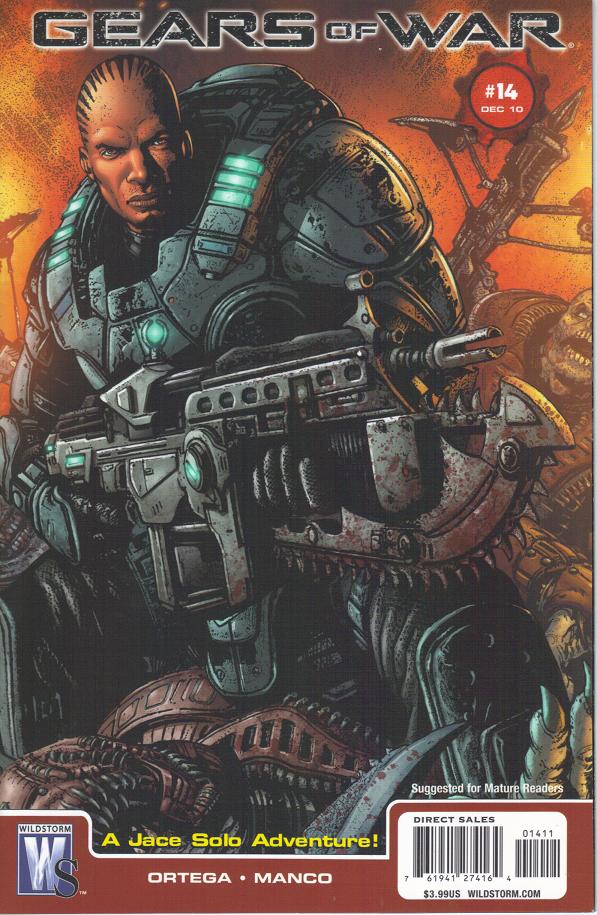
With his signature catch-phrase, salty language, and buckets of
gore, Marcus Fenix is back in Gears of War #1 (2008).
This past Christmas I was fortunate enough to be gifted with an XBOX One game system. The Holiday Bundle version I received came with the upgraded, "Ultimate Edition" of the original Gears of War game first released eons ago (in gaming terms) in 2006. Thanks to the wonderful world-building of the game's production team, and despite having previously bested both this game and it's subsequent titles, it was difficult not to be easily drawn back into the world of Marcus Fenix and Delta Team.
Issue #2 cover by
Brandon Badeaux.
In edition to being something of a forerunner in dramatic sci-fi/action-adventure console video gaming, the Gears of War franchise also stands as one of the rare early game titles to be successfully spun off into an ongoing comic book series. Running 24 issues from 2009 to 2012, Gears of War was published by DC Comics under the company's now defunct Wildstorm imprint. (Fun fact: SEGA stalwart Sonic the Hedgehog's comic book adventures continue to be published by Archie Comics to this day, with the the most recent issue being #279!) The synergy between game and comic book is such that issues of the series are now available with the Ultimate Edition as unlockable extras, pages of which are viewable in the Special Features.
The success of the comic book is best attributed to its consistency with the games: both are moody and violent in tone with a tightly woven narrative. A key to this consistency in characterization is the result of the comic books use of the games' writers to handle scripting duties. With artwork equally evocative of the video game series, the talents involved contribute an additional layer of humanity to those operating in the Gears universe.
From Gears of War issue #7 written by Joshua Ortega,
art Simon Bisley and Henry Flint .
While there are quieter moments of subtle characterization in each of the Gears games (if you look for them), the comic book format provides numerous opportunities throughout the 24 issue run for characters to breathe and develop even more fully. Due to his established in-game tough guy status, Gears' protagonist Marcus Fenix' is at the center of most stories, if not as the lead, than certainly as a clear influence on the character from whose perspective the story is told.
Even with an already incredibly culturally diverse character line-up in its gaming universe, the Gears comic book also fills out the ranks of those under Marcus's command. Additionally, the series takes the reader back to familiar historical points in the establish Gears historical timeline, such as the Pendulum Wars. each issue takes on the perspective of ancillary characters who at one point or another find themselves with the orbit of Marcus Fenix. In addition to adding characters that would eventually find their way into the game, such as Jace Stratton, introduced in print with issue #3 and voiced by Micheal B. Jordan in Gears of War 3, the comic book series also adds to the mythology of the game-based world. While a minor character, and major influence, in the first two Gears games, Marcus's father takes the lead in a series of flashback issues to the aforementioned Pendulum Wars.
Gears of War #10, written
by Mike Capps and Joshua
Ortega with art by Liam Sharpe.
The opening six-issue arc entitled "Hollow" is written by Joshua Ortega with pencils by Liam Sharp. The events of the arc bridges the narrative gap between the first Gears of War game and the start of the second, following the brutal adventures of Marcus Fenix and Delta Squad in the battle against the Locust. As the writer of Gears 2, Ortega has a clear familiarity with the characters and, with Sharp's command of visuals, both tell a story with minimum dialogue and maximum carnage. One potential drawback to readers unfamiliar with the franchise is a lack of familiarity with the characters by potential readers. While I benefited from having played the games, for example the motivations of both Delta team and the evil invading locust army were understood, the uninitiated might need more background than the obvious "ugly monster equals bad guy" trope.
During its 24 issue run, DC/Wildstorm's Gears of War title maintained a high quality, never deviating from the exclusive "Gears-verse" for story setting. While part of the DC's company -wide "Draw the line at $2.99" price freeze initiative, readers never (thankfully) saw a cross-over with Green Lantern or, more suitably perhaps, Lobo. Concluding with a 6 part story by writer Karen Traviss, that bridges the narrative gap between the conclusion of the second Gears game and concludes with a story which leads directly into Gears of War 3.
The series can still easily collected as individual issues (my preferred format) are still available at cover price at your local comic shop if you are willing to dig deep into the back issue bins. Of course, the series has also been collected into three trades, though the license with DC has surely lapsed by now, there may be more stories in the future as Gears of War 4, with the son of Marcus Fenix in the lead, nears its release.
There are even a few stinkers I can't
part with...
I blame my parents. Or thank them, depending on how I look at it. Given that Halloween is only two weeks away, as I look for random things to blog about around my office, I can't help but notice that many of my interests include a significant subset of horror-themed items. Whether comic books, movies, novels or video games, the horror theme runs deep. I suppose, though, that's what happens when you're taken to see the original Alien in theaters at the ripe old age of ten.
Having written about a number of horror themed comic books and movies (often without intending to post them in October), I thought I'd mention a few of my very favorite console video games that include a horror theme. As easy as it would be to simply label them all "zombie games," the list of possible titles I've played include necromorphs, undead, bio-chemical creatures and hell spawns. The term "zombie" does seem a little limiting. In my 30+ years of gaming (more frequently in some phases of my life than others), I've come across many games from the horror-survival genre, and there are three (well two, plus a throwback) that continue rating high on my personal replay-ability scale even after hours of gameplay beyond concluding their respective primary storylines. While some games are incredibly entertaining for short periods of time (2012's Lollipop Chainsaw, for example), the games that I can drop into my console every so often and continue to enjoy are those that qualify as (a few of my) "favorites." In no particular order:
Read Dead Redemption: Undead Nightmare (2010)
"Cattle rustlin' and bank robbery are at an all-time low;
Murder, blood-drinking and psychotic episodes seem to be somewhat prevalent."
Full disclosure: the original Rockstar Games Red Dead Redemption (2010) is the answer I often give to the question of "What is your favorite video game." Originally available as downloadable content for the open-world wild west game Red Dead Redemption: Undead Nightmare is the perfect mash-up. While the base game is (in my estimation) the greatest Western game ever produced, the added zombie storyline considerably extends the game's re-playablity. The blend of Western and horror elements is brilliant. The basic premise is that you, as protagonist John Marsten, try to find a cure for the plague which is turning locals into zombies. Along the way there are opportunities to hunt mythical beasts, acquire unique weapons, and of course, eliminate oodles of zombies. As was the case with the original game, the smaller moments from the cut-scenes add an additional emotional level to the game play, but whether you experience them in their entirety depends on how far you play (go ahead, kill that last Bigfoot). Great game-play, great graphics and great narrative--an amazing downloadable expansion pack.
MediEvil (1999)
This is one favorite that I regrettable no longer am able to play (had completely forgotten I'd ever had a Playstation system!), but the memories I have of playing MediEvilare wonderful, not just because of the gameplay or Tim Burton-esque (when Burton was still cool) character design, but because I would often play with my daughter watching. An early Gothic horror-comedy action-adventure game, MediEvil has you play as the protagonist, Sir Daniel, as he seeks to redeem himself by travelling and battling to protect the medieval Kingdom of Gallowmere. At the time, and as you can tell from the trailer above it was a few system generations ago, MediEvil's graphics and gameplay were such that it was like playing a three-dimensional cartoon for the first time.
Dead Space 2 (2011)
"Isaac, we're all gonna burn for what we did to you..."
The second in a trilogy (so far) of games, Visceral Games/Electronics Arts' Dead Space 2 is an amazing sci-fi horror survival game with a strong narrative, excellent graphics and multiple levels of challenge. When I first began playing this, former high school students of mine warned me not to play the sequel as it would only pale in comparison, and they were correct. Dead Space 2 is so complete a gaming experience, requiring a wide array of skills (shooting, manual dexterity and brain games) that it always a joy to return to. Series protagonist Isaac Clarke's (as in Asimov and Arthur C.) life changes for the worse when he accepts a mission to a damaged space vessel in an effort to make contact with his girlfriend who is stationed there. Dead Space 2 picks up three years after the original and Clark, after being held captive and information retrieved from his memory by evil (are there any other kind?) industrialist and religious zealots, has to fight his way off a station/asylum infected with necromorphs. Clarke is written as a reluctant, damaged hero who begrudgingly accepts his role in a larger conflict he really wants no part of. Like all the games listed here, the voice acting is excellent and the characters well-developed. This game is a great example of why video games are often a superior entertainment experience to movies, the hours of entertainment one receives for the purchase price far outpaces any movie I've seen in recent memory.
There are of course many other games I have played and played and played that offer both amazing cinematics, tremedous voice work and gameplay experiences. including Left 4 Dead 2 (2009), Dead Island (2011), Resident Evil (pick one, except Operation Raccoon City--BLECHHH!) and the last game I'll purchase for my X-Box 360, The Evil Within.
Not quite as memorable as the Millennium Falcon, the Cygnus
rests on the edge of a... BLACK HOLE!
Prior to enacting their modern creative approach of "If you can't beat 'em, buy 'em" that paved the way to their acquisition of Pixar then Marvel and finally the Star Wars franchise rights, Disney, then not nearly the juggernaut they are now, attempted to begin their own science-fiction, adventure franchise with The Black Hole (1979).
Following the huge success of the original Star Wars in 1977, every television and movie studio was looking to get in on the profits and the House of Mouse was no different. It probably seemed an easy enough task given the superficial formula Lucas had laid out in his film. Unique, toy-ready robots? Check. Rakish, bad-boy hunk? Check. Respected European actor in a key role? Check. Potentially iconic villain-in-mask? Check.
Disney's The Black Hole, directed by Gary Nelson (whose previous effort was the original Freaky Friday in 1976), was released in 1979 featuring performances by Oscar-winning actors Maximilian Schell (Judgement at Nuremberg, 1961) and Ernest Borgnine (Marty, 1955), as well as respected actor Anthony Perkins, best know as Norman Bates in Psycho (1956). The voices of the main robot characters are provided by Roddy McDowall and Slim Pickens.
Giant bad robot Maximilian and Dr. Hans Reinhardt played by Maximilian Schell.
A financially successful cinematic space opera was not, however, meant to be. As I came across my ancient (36 years!) 80 card complete set of trading cards released by Topps in support of the film's release, my own memories of seeing The Black Hole in theaters were neither warm nor fuzzy. Apart from the robot characters voiced by familiar genre voices, the film, like the trading cards, left me cold. Of course, many years later, the awkward tone of the film (with some rather mature philosophical ideas for a Disney film) reflected in poorly designed (repetitive images and story summaries out of order) trading cards can thank the warming effect of nostalgia for my even revisiting them. Sometimes even "bad" movies or collectibles find a place in one's heart for the period of time they fleetingly capture.
B.O.B. (BiO-sanitation Battalion), a battered early model robot voiced by Slim Pickens.
Our heroes led by V.I.N.CENT ("Vital Information Necessary CENTralized") voiced by Roddy McDowall.
V.I.N.CENT. and Captain S.T.A.R.("Special Troops/Arms Regiment") played by Tom McLoughlin.
Maximilian listening in on Dr. Alex Durant (Anthony Perkins) and scientist Dr. Kate McCrae (Yvette Mimieux).
One of three color-coded puzzles to be constructed using the backs of the trading cards.
V.I.N.CENT ("Vital Information Necessary CENTralized") in action!
The climactic battle between Maximilian and V.I.N.CENT!
I vividly remember being weirded-out by the image (strangely not captured in the trading card set) of the movie's villain, Dr. Reinhardt, encased in the robotic shell of his chief minion, Maximilian, floating above a hellish landscape at the climax of the movie. Even reading the story summary below, suggests that the filmmakers were going for something "deeper" than a standard sci-fi action/adventure movie.perhaps. The "Or should I say the beginning?" commentary points to the intention to continue the story of the crew, a sequel that has been forever left to the imagination.
On second thought, maybe these cards aren't so bad...
Oddly, the Story Summaries on the backs of some cards are presented out of chronological order and therefore not aligned with the images on the front. The warning at the bottom warns you about it, too!