Showing posts with label brother. Show all posts

Wednesday, December 16, 2020

Winter Movies: James Joyce's The Dead

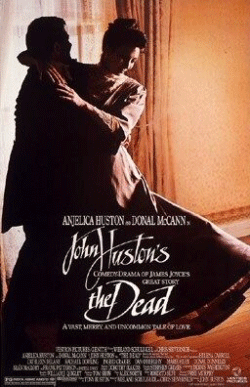
The first snow came early this year in Western New York. Though I may say this every year, for the first time "ever" I was shoveling in the dark in mid-November. This early December morning when I woke up in the dark, it was as I suspected: a light snowfall extending the anticipation of the holiday season had fallen again. Though it was only what amounted to a half inch or so, it was just enough to set the pavement aglow under the street lights. The pre-Christmas snowfall of winter, or more to the point, the apparent magic of it, often brings me back to a short story by Irish writer James Joyce from his collection The Dubliners, and by extension to the 1987 film adaptation of the same story directed by John Huston, James Joyce's The Dead.

The year 1987 was my first as a college undergraduate, and, like many, home from my first semester in December, I felt a sense of invincibility and wonder. It was my first time away from home for an extended period of time, and my first taste of (arrested) adulthood, code for being able to make all the dumb mistakes that first year college students do. This was also a time of little meaningful reflection allowing for the quick dismissal of mistakes with little understanding of what things really meant.

While on break, my brother and I went to a local art house to see The Dead. I was armed with one World Literature course (and the powerful understanding of the literary term "epiphany"), so, of course, I was an expert in artsy-fartsy books and movies. So away we went. For all I really knew at the time, The Dead could very well have been a Victorian era zombie movie, but what I experienced that evening (and much more powerfully so in later viewings) was a moving meditation on insecurity, nostalgia and love.

IMDB describes the film thusly: "Gabriel Conroy and wife Greta attend a Christmas dinner with friends at the home of his spinster aunts, an evening which results in an epiphany for both of them," and despite the seemingly dry set-up its the actors and director Huston who turn the subject matter into compelling viewing. The lead actors, Angelica Huston (Greta Conroy) and Donal McCann (Gabriel Conroy) bring to life the two "literate" characters with performances that are both celebratory (the dinner party) and melancholy (Michael Furey's final romantic gesture).

Those ready for a moving holiday film experience will not be disappointed. For myself, rewatching the film over the years, its themes naturally grow more meaningful to me, just as the feelings at Christmas time become grow more complex. For whatever reason this movie is very difficult to find online, so a public library may be your best bet. Even better yet read the short story in The Dubliners before seeking it out.

Monday, August 12, 2013

Roadie: Tecnológico de Monterrey

The CETEC towers, or "The Napkin Holder," at the Monterrey Campus. (7/30/13)
Though I've been back home for nearly a week, I have yet to share all the pictures of places my mother and I visited while in Monterrey, Mexico, and Houston, Texas. The pictures and reflections in this post reflect our sixth day in Monterrey. After lying low for a day following our return from Zacatecus and La Quemada, we headed to the Monterrey Campus of Instituto Tecnológico y de Estudios Superiores de Monterrey (ITESM), commonly referred to simply as “TEC.” As part of his responsibilities on staff at TEC, he teaches classes on the main campus as well as facilitates research at the off-campus medical facility.

As the Institute is a multiple campus university, most programs and general academic policies are shared among them. However, the Monterrey Campus is significantly more selective in its admissions, requiring a grade average of 80 or 90 in high school (on a 100-point scale) for those willing to transfer or apply as a freshman since 2007. As of January 2008, 50% of its freshman class had an average grade of 90 and 25% had an average grade of 95 out of 100 at high school level.


The Rectorate at the Monterrey Campus. (7/30/13)
The Old Library Building, and current Rectorate (above), was designed by Enrique de la Mora, displays a bas relief by Jorge González Camarena and holds one of the largest collections of Don Quixote incunabula, an original edition of L'Encyclopédie and other bibliographical treasures.


Duck. (7/30/13)
My rbotera nd mother know of my affinity for photographing birds, and the TEC campus turned out to be a wonderful location at which to do so. A number of different water fowl have the run of the campus, and being very socialized, are easy targets for my prying lens.

Dos ducks. (7/30/13)

Cactus Garden. (7/30/13)
The campus i beautifully maintained with wonderful gardens and arrangements throughout. This is true of many of the places we visited in Monterrey, and really, all of Mexico: where there are nice "things" (buildings, gardens, streets), they are impeccably maintained.

Classrooms. (7/30/13)


Statue of school mascot, Borregos Salvajes. (7/30/13)


Many pieces of art, including sculptures from a variety of medium, grace the campus. Birds (and deer, too, though we did not see any) mingle and interact with the artwork freely. The peacock pictured below was a surprise as I came across it without notice. It was surprisingly large, about the size of the larger wild turkeys that often cut through my mother's back yard back home.

Peacocks also roam the campus grounds. (7/30/13)

Flags representing the countries of origin for students are updated each
academic year based upon enrollment. (7/30/13)
As of January 2008, some 1,100 foreign students from 56 countries were studying at the Monterrey Campus, half of them as regular students.

Large artificial pond on campus. (7/30/13)

Muscovy ducks beside the artificial campus pond. (7/30/13)
One exciting outcome of our visit to TEC was my being able to see and photograph a type of duck I had not previously seen, the Muscovy duck! The Muscovy Duck (Cairina moschata) is a large duck native to Mexico, Central, and South America. (I actually took quite a few pictures that I'll post at a later time.)


Security is strict at the campus. (7/30/13)
While digging around the Internet looking for information about TEC, I came across an article (in Spanish) about two students murdered on campus in 2010. That might account for the incredible level of security on campus. While most American colleges declare that they are "secure", rarely, in my experience, do they actually follow through all procedures with every visitor. For example, in America when you go through a checkpoint you often don't need an ID. At TEC, we needed to show our driver's licenses to gain access with my brother who also needed to show his faculty ID.

Secured paths beneath the public roads ensure a degree of safety. (7/30/13)
The TEC Campus at Monterrey is immaculately designed and very well maintained. It was also clearly for those who could afford the security and safety of an excellent secondary (and post-secondary) education in Monterrey. Aesthetically soothing to the eye, it would be easy to see how students of many ages would be inspired to learn (and relax) on such a fantastic looking campus.

Saturday, August 10, 2013

Roadie: La Quemada

Our tour guide, who spoke only Spanish, midway up La Quemada. (7/27/13)
On the second day in Zacatecas, Mexico, we left the city, and eponymous state capital, to venture further south to “Zona Arqueológica La Quemada.” The hope with this 40 minute excursion was to see mountainside colonial ruins, including a "pyramid." Actually an "altar (votive) pyramid", the scope of the pyramid at La Quemada is nowhere near that of, the more familiar Egyptian ones. Like much of this trip to Mexico, the preconceived notions and associative connotations varied from teh reality, but not in a negative way. From the "Americanized" Monterrey to colonial Zacatecus, and now to La Quemada, we had seen three very distinct sides of Norhtern and Southern Mexican architecture. La Quemada, like the other locales, also procved a vista from whcih one could see for miles around.

La Quemada is made up of numerous different size masonry platforms built onto the hill, these were foundations for structures built over them. On the south and southeastern sides is a high concentration of ceremonial constructions, some of which are complexes made up of sunken patio platforms and altar-pyramid, a typical Mesoamerican architectonic attribute.

Cactus. (7/27/13)
Prior to embarking on our hike, we were guided into a gift shop which held three glass small glass enclosures. In each was a different type of snake we could potentially encounter on our walk. Our tour was delivered in Spanish, so our friends who were with us told me that the guide suggested there may be more snakes than usual at the mountain top as the region had recently (within the month) experienced some rainfall. The moisture at the base of the mountain had driven many of the snakes upward toward the more arid areas of the mountain. Fortunately, while we did cross paths with one rather large (and fat) snake, following this meeting most of us stayed toward the centre of paths while walking in areas with longer grass on either side.

The Muralla, or Wall," visible from below. (7/27/13)
If the total elements of this site are considered, from the extensive roads and the numerous smaller sites linked to La Quemada, this is a singular archaeological site in the context of mesoamerican sites.

More cactus. (7/27/13)
I took quite many pictures of local flora while at La Quemada. This was not because the cactus were not visible through the car window at almost every point on our 5 hour drive from Zacatecas, but because here I did not need to worry about offending the federales or attracting local peddlers on the roadside--both realities of travel in rural Mexico.

Close-up on the Muralla. (7/27/13)
This wall (Muralla is the protective perimeter wall) is emphasized, by its dimensions (four metres high by three metres thick) as well as by its location on edges of the cliffs surrounding the north and northeast parts of the site. Apparently this structure was constructed towards the end of the occupation of La Quemada and, perhaps, it represents one of the best indicators of the problems faced by city residents as well as their perseverance to remain there.

At the highest point in La Quemada is the Ciudadela. (7/27/13)
Ciudadela is located at the highest part of the site, several buildings have been identified, possibly used for ceremonial and defensive purposes.


Mexican big sky. (7/27/13)

The Columns Hall consists of ancient building columns at La Quemada. (7/27/13)
Salón de las Columnas (Columns Hall) is a 41 by 32 metre enclosure, probably reached a height of more than five metres before the fire that caused its destruction. In their interior eleven columns supported the roof. Until now its specific function is not known. Although works made in the 1950s indicate a ceremonial use possibly related to human sacrifice.

Escalinata. (7/27/13)
At about 30 metres west of the Votive Pyramid this stairway (Escalinata) was discovered. Used as main access to the top levels of the site, it was constructed in two stages; the first, that approximately reached the middle of the height now observed, apparently it was round shape, and can be associated with shapes of now missing structures; the second, built over the former and with greater height, it reached the walkway on the second level, evidence shows ties with a two ramp stairway that ascended to the third level. At a point in time the main stairway was cancelled, by defence reasons by means of the retaining wall, limiting access.

Your's truly on Pirámide Votiva . (7/27/13)
Pirámide Votiva (Votive Pyramid) is more than 10 metres high and is highlighted by the angle of its slopes. During Corona Nuñez works, in 1995, slope vestiges with remains of a stairway were found, that ascended the south side of the pyramid. With time the middle and top parts crumbled to the ground, where they can be seen at the present time. Originally, the stairway reached the top of the pyramid where a room or temple constructed with perishable materials apparently existed.

Pirámide Votiva. (7/27/13)

Hector on Pirámide Votiva. (7/27/13)

Pirámide Votiva from a higher elevation. (7/27/13)

Juego de Pelota or ball game court. (7/27/13)
This structure, of mesoamerican features, was constructed on an enormous platform that extends from the north of the Votive Pyramid throughout the access stairway at the south slope of the court. It measures 70 by 15 metres and it displays the characteristic letter “I” shape; the side walls are as wide as those of the Columns Hall (2.70 meters) and assumed a height of between three and five meters.

Architectural remains. (7/27/13)
The structures pictured below were likely houses. Reportedly, the roof caught fire and collapsed leaving only skeletal architectural remains. It was at this point our guide told us that the Mexicans who lived here were very "dark skinned" due to their proximity to the sun. At least that is was I was told when Miguel chuckled at the guide's commentary and I inquired as to why.


Homes. (7/27/13)

The only real "wildlife, other than sankes, a small lizard. (7/27/13)

Heading back down. (7/27/13)

Water column. (7/27/13)
The only running water at Zona Arqueológica La Quemada was modern in its source. The "water column" pictured above was located at the end of the tour. Following the 60 minute hike at high elevations,  it and the nearby bathrooms, were welcome sights.

Primary Infromational Source:
Wikipedia Entry: La Quemada

Wednesday, August 07, 2013

Roadie: Zacatecas, Mexico

 
 Street level skyline, Zacatecus-style. (7/26/13)
Only one day after arriving in Monterrey, Mexico, and spending a single night at my brother’s guest room, my mother and I were on the road to Zacatecas. Two friends of my brother were kind of enough to take the trip with us which was a very good thing: we needed to drive through a number of “federale” (police) and military security checkpoints. It was key to travel with those who were either Mexican or knowledgeable in the regional dialect of Spanish.

Fortunately, our guides were both. I was very tempted to take some pictures along the way because I did not want to inadvertently offend any interaction with the federale or motorcycle club members who seemed to be the majority of those sharing the route to Zacatecas during the five hour drive south. While the federales all seemed to be very young (under thirty years of age), most of the motorcycle club members were older.

The view of Cerro de la Bufa (Bufa Hill) from "Main Street.". (7/26/13)
Whereas Monterrey is a fine example of a modern, "Americanized" city, the mining city of Zacatecas, in Central Mexico, is more representative of a colonial town. It also more closely resembles what most American tourists preconceived notions of how cities in Mexico look.

Bust of General Miguel Auza. (7/26/13)
Arches. (7/26/13)
Street vendor outside Zacatecus Cathedral. (7/26/13)
One thing of which there is no shortage in Mexico are churches. The city of Zacatecas is no different. Our hotel was almost directly across the street from one of the more significant churches in town, Zacatecas Cathedral. Built between 1729 and 1753, and regarded by many as the last, and greatest, expression of the churrigueresque (Mexican Baroque) style, Zacatecas Cathedral was a fantastic subject for pictures and location for reflection.

The Zacatecas Cathedral, dedicated to Our Lady of the Assumption, is
the head temple of the Diocese of Zacatecas.(7/26/13)
The central altar designed by artist Javier Marín from Michoacan,
is covered with gold leaf 24 carat. (7/26/13)
An altar image of the martyr San Mateo Correa. (7/26/13)

When the Zacatecas Cathedral opens for business it fills up quickly with
both tourists and locals. (7/26/13)
Candles are lit in church for grace. (7/26/13)

The pink-hued sand stone is prevelant in the colonial churches and buildings. (7/26/13)
Zacatecus is called "con rostro de cantera rosa y corazón de plata" (face of pink stone and heart of silver) because of the pink stone that many of its iconic buildings are made of and the silver that has spurred its development and history. Like other mining cities in Mexico, such as Guanajuato and Taxco, the city was built near the mines on very rough terrain.

Hilly and narrow streets make tourist driving--and on-street parking--challening.(7/26/13)

Zacatecus from the Cerro de la Bufa (Bufa Hill), 8,770 feet above sea level. (7/26/13)


Equestrian statue of Pancho Villa, atop Cerro de la Bufa, site of his greatest victory. (7/26/13)
We stayed in Zacatecus for three days and two nights. The streets became very crowded once the sun set, so I did not take too many pictures at that time. In addtion to a festival takine placeint own, there was some sort of Mexcian motorcycle club event. The streets were chocl full of locals and club memebers (being a fan of Sons of Anarchy, I was pleased to notice a few "Prospectos" among them, and knowing what irt meant.) My brother and I did, however, head over to a McDonald's one evening for a late evening snack, and I snapped a few quick picks of the cathedral, though I failed to capture the beauty of the facade bathed in light.

The cathedral at night. (7/28/13)
Zacatecus was a second side of Mexico I was pleased to experience--different than Monterrey, but beautiful nonetheless...

Source:
Zacatecus Wikipedia Entry (embedded link)