Showing posts with label mom. Show all posts

Sunday, October 25, 2015

Fave Zombie Video Games

There are even a few stinkers I can't
part with...
I blame my parents. Or thank them, depending on how I look at it. Given that Halloween is only two weeks away, as I look for random things to blog about around my office, I can't help but notice that many of my interests include a significant subset of horror-themed items. Whether comic books, movies, novels or video games, the horror theme runs deep. I suppose, though, that's what happens when you're taken to see the original Alien in theaters at the ripe old age of ten.

Having written about a number of horror themed comic books and movies (often without intending to post them in October), I thought I'd mention a few of my very favorite console video games that include a horror theme. As easy as it would be to simply label them all "zombie games," the list of possible titles I've played include necromorphs, undead, bio-chemical creatures and hell spawns. The term "zombie" does seem a little limiting.  In my 30+ years of gaming (more frequently in some phases of my life than others), I've come across many games from the horror-survival genre, and there are three (well two, plus a throwback) that continue rating high on my personal replay-ability scale even after hours of gameplay beyond concluding their respective primary storylines. While some games are incredibly entertaining for short periods of time (2012's Lollipop Chainsaw, for example), the games that I can drop into my console every so often and continue to enjoy are those that qualify as (a few of my) "favorites." In no particular order:

Read Dead Redemption: Undead Nightmare (2010)


"Cattle rustlin' and bank robbery are at an all-time low; 
Murder, blood-drinking and psychotic episodes seem to be somewhat prevalent."

Full disclosure: the original Rockstar Games Red Dead Redemption (2010) is the answer I often give to the question of "What is your favorite video game." Originally available as downloadable content for the open-world wild west game Red Dead Redemption: Undead Nightmare is the perfect mash-up. While the base game is (in my estimation) the greatest Western game ever produced, the added zombie storyline considerably extends the game's re-playablity. The blend of Western and horror elements is brilliant. The basic premise is that you, as protagonist John Marsten, try to find a cure for the plague which is turning locals into zombies. Along the way there are opportunities to hunt mythical beasts, acquire unique weapons, and of course, eliminate oodles of zombies. As was the case with the original game, the smaller moments from the cut-scenes add an additional emotional level to the game play, but whether you experience them in their entirety depends on how far you play (go ahead, kill that last Bigfoot). Great game-play, great graphics and great narrative--an amazing downloadable expansion pack.

MediEvil (1999)


This is one favorite that I regrettable no longer am able to play (had completely forgotten I'd ever had a Playstation system!), but the memories I have of playing MediEvil are wonderful, not just because of the gameplay or Tim Burton-esque (when Burton was still cool) character design, but because I would often play with my daughter watching. An early Gothic horror-comedy action-adventure game, MediEvil has you play as the protagonist, Sir Daniel, as he seeks to redeem himself by travelling and battling to protect the medieval Kingdom of Gallowmere. At the time, and as you can tell from the trailer above it was a few system generations ago, MediEvil's graphics and gameplay were such that it was like playing a three-dimensional cartoon for the first time.

Dead Space 2 (2011)


"Isaac, we're all gonna burn for what we did to you..."

The second in a trilogy (so far) of games, Visceral Games/Electronics Arts' Dead Space 2 is an amazing sci-fi horror survival game with a strong narrative, excellent graphics and multiple levels of challenge. When I first began playing this, former high school students of mine warned me not to play the sequel as it would only pale in comparison, and they were correct. Dead Space 2 is so complete a gaming experience, requiring a wide array of skills (shooting, manual dexterity and brain games) that it always a joy to return to. Series protagonist Isaac Clarke's (as in Asimov and Arthur C.) life changes for the worse when he accepts a mission to a damaged space vessel in an effort to make contact with his girlfriend who is stationed there. Dead Space 2 picks up three years after the original and Clark, after being held captive and information retrieved from his memory by evil (are there any other kind?) industrialist and religious zealots, has to fight his way off a station/asylum infected with necromorphs. Clarke is written as a reluctant, damaged hero who begrudgingly accepts his role in a larger conflict he really wants no part of. Like all the games listed here, the voice acting is excellent and the characters well-developed. This game is a great example of why video games are often a superior entertainment experience to movies, the hours of entertainment one receives for the purchase price far outpaces any movie I've seen in recent memory.

There are of course many other games I have played and played and played that offer both amazing cinematics, tremedous voice work and gameplay experiences. including Left 4 Dead 2 (2009), Dead Island (2011), Resident Evil (pick one, except Operation Raccoon City--BLECHHH!) and the last game I'll purchase for my X-Box 360, The Evil Within.

Oh, and thanks Mom and Dad!

Resource:
Wikipedia's List of Zombie Video Games

Sunday, January 26, 2014

Cha-Cha-Cha-Chia!

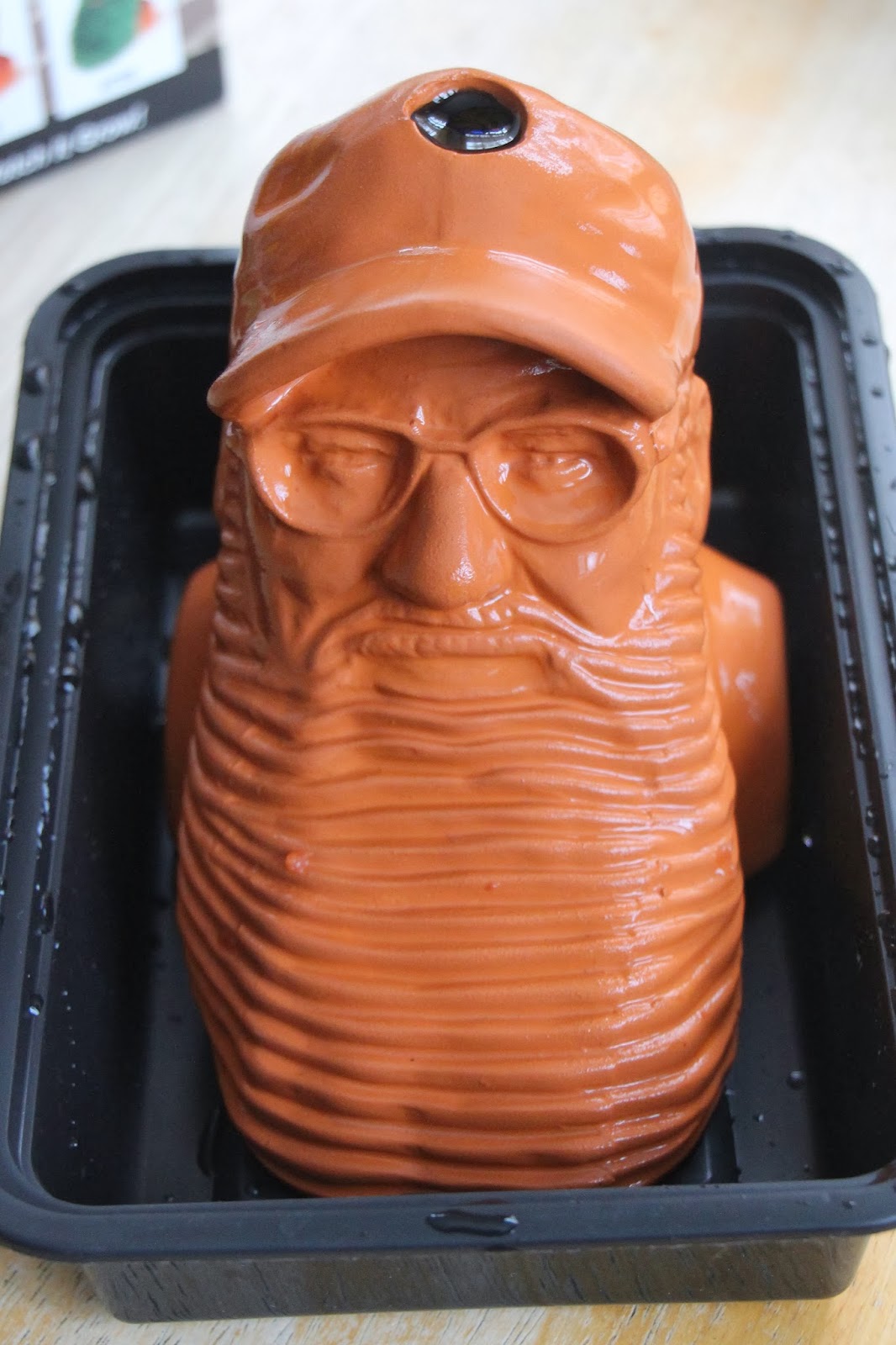
Best-selling author Uncle Si!? (1/26/14)
This past Christmas my mother gifted me with a Chia Pet. Not just any old Chia Pet but a Duck Dynasty one. I have only seen about 5 minutes of Duck Dynasty (which was more than enough to determine I need never watch it again) but my mother thought I might think it was funny to have one as I have a beard. I'm not very familiar with the "cast" of Duck Dynasty but I'm fairly certain this is not the one who caught heat for insensitive comments in a recent interview. Believe it or not (and I really have a hard time believing it--but props to him), Uncle Si is the best-selling author of the book Si-cology 1: Tales and Wisdom from Duck Dynasty's Favorite Uncle.

I have wanted a Chia Pet since I was a child and this wintry afternoon seems like as good a one as any to embark on my Chia-dventure (like Uncle Si, I too like puns)!

Step 1a. "Soak your Chia Planter in water for 1 hour." (1/26/14)

Step 1b. Leave it there for 1 hour. (1/26/14)

"Step 3. Fill Chia Planter with water and place in drip tray provided." (1/26/14)

"Apply seed mixture to the grooved surfaces of your planter..." (1/26/14)
I am a little hesitant to predict the "lush coat" promised in Step 6, and am really crossing my fingers that this afternoon project yields better results than the ill-fated Sea Monkeys farm back in 1976. I will definitely share Chia Si's progress one way or another...

Monday, October 07, 2013

Roadie: Space Center Houston

Saturn V at Rocket Park.--USA! USA! USA! (8/3/13)
After taking a brief hiatus from posting pictures from this past July/August's roadie south, I now present some photos from one of our last stops. One of the final touristy activities we took part in before returning home to New York in early August was to take the short drive from downtown, Houston, to Space Center Houston, the official visitors center for NASA's Johnson Space Center.

Space Shuttle Model. (8/3/13)

Apollo Lunar Module. (8/3/13)

A life size model of the real Enterprise's shuttle, Galileo. (8/3/13)

Astronaut space suit on display. (8/3/13)

SSME Propellant Flow. (8/3/13)

A model of the International Space Station. (8/3/13)

A very unassuming Mission Control building. (8/3/13)

Mission Control for the upcoming Mars Mission. (8/3/13)

Touring the grounds on the NASA Tram Tour. (8/3/13)

NASA Rocket Park. (8/3/13)

Saturn V Rocket Hall from the  NASA Tram Tour. (8/3/13)

Saturn V rocket detail. (8/3/13)
The Saturn V rocket on display is made up of the first stage from SA-514, the second stage from SA-515 and the third stage from SA-513 (replaced for flight by the Skylab workshop). With stages arriving between 1977 and 1979, this was displayed in the open until its 2005 restoration when a structure was built around it for protection.

Saturn V at Rocket Park. (8/3/13)

Saturn V at Rocket Park. (8/3/13)

Banners commemorating each space mission. (8/3/13)

Saturn V at Rocket Park. (8/3/13)

Saturn V rocket detail. (8/3/13)
Though I knew we had been busy (whirlwind-y, really), it's only now, a few months removed, that I'm realizing just how much my other, I and my brother had a chance to see of the Houston area in three short days!

Monday, August 12, 2013

Roadie: Tecnológico de Monterrey

The CETEC towers, or "The Napkin Holder," at the Monterrey Campus. (7/30/13)
Though I've been back home for nearly a week, I have yet to share all the pictures of places my mother and I visited while in Monterrey, Mexico, and Houston, Texas. The pictures and reflections in this post reflect our sixth day in Monterrey. After lying low for a day following our return from Zacatecus and La Quemada, we headed to the Monterrey Campus of Instituto Tecnológico y de Estudios Superiores de Monterrey (ITESM), commonly referred to simply as “TEC.” As part of his responsibilities on staff at TEC, he teaches classes on the main campus as well as facilitates research at the off-campus medical facility.

As the Institute is a multiple campus university, most programs and general academic policies are shared among them. However, the Monterrey Campus is significantly more selective in its admissions, requiring a grade average of 80 or 90 in high school (on a 100-point scale) for those willing to transfer or apply as a freshman since 2007. As of January 2008, 50% of its freshman class had an average grade of 90 and 25% had an average grade of 95 out of 100 at high school level.


The Rectorate at the Monterrey Campus. (7/30/13)
The Old Library Building, and current Rectorate (above), was designed by Enrique de la Mora, displays a bas relief by Jorge González Camarena and holds one of the largest collections of Don Quixote incunabula, an original edition of L'Encyclopédie and other bibliographical treasures.


Duck. (7/30/13)
My rbotera nd mother know of my affinity for photographing birds, and the TEC campus turned out to be a wonderful location at which to do so. A number of different water fowl have the run of the campus, and being very socialized, are easy targets for my prying lens.

Dos ducks. (7/30/13)

Cactus Garden. (7/30/13)
The campus i beautifully maintained with wonderful gardens and arrangements throughout. This is true of many of the places we visited in Monterrey, and really, all of Mexico: where there are nice "things" (buildings, gardens, streets), they are impeccably maintained.

Classrooms. (7/30/13)


Statue of school mascot, Borregos Salvajes. (7/30/13)


Many pieces of art, including sculptures from a variety of medium, grace the campus. Birds (and deer, too, though we did not see any) mingle and interact with the artwork freely. The peacock pictured below was a surprise as I came across it without notice. It was surprisingly large, about the size of the larger wild turkeys that often cut through my mother's back yard back home.

Peacocks also roam the campus grounds. (7/30/13)

Flags representing the countries of origin for students are updated each
academic year based upon enrollment. (7/30/13)
As of January 2008, some 1,100 foreign students from 56 countries were studying at the Monterrey Campus, half of them as regular students.

Large artificial pond on campus. (7/30/13)

Muscovy ducks beside the artificial campus pond. (7/30/13)
One exciting outcome of our visit to TEC was my being able to see and photograph a type of duck I had not previously seen, the Muscovy duck! The Muscovy Duck (Cairina moschata) is a large duck native to Mexico, Central, and South America. (I actually took quite a few pictures that I'll post at a later time.)


Security is strict at the campus. (7/30/13)
While digging around the Internet looking for information about TEC, I came across an article (in Spanish) about two students murdered on campus in 2010. That might account for the incredible level of security on campus. While most American colleges declare that they are "secure", rarely, in my experience, do they actually follow through all procedures with every visitor. For example, in America when you go through a checkpoint you often don't need an ID. At TEC, we needed to show our driver's licenses to gain access with my brother who also needed to show his faculty ID.

Secured paths beneath the public roads ensure a degree of safety. (7/30/13)
The TEC Campus at Monterrey is immaculately designed and very well maintained. It was also clearly for those who could afford the security and safety of an excellent secondary (and post-secondary) education in Monterrey. Aesthetically soothing to the eye, it would be easy to see how students of many ages would be inspired to learn (and relax) on such a fantastic looking campus.

Saturday, August 10, 2013

Roadie: La Quemada

Our tour guide, who spoke only Spanish, midway up La Quemada. (7/27/13)
On the second day in Zacatecas, Mexico, we left the city, and eponymous state capital, to venture further south to “Zona Arqueológica La Quemada.” The hope with this 40 minute excursion was to see mountainside colonial ruins, including a "pyramid." Actually an "altar (votive) pyramid", the scope of the pyramid at La Quemada is nowhere near that of, the more familiar Egyptian ones. Like much of this trip to Mexico, the preconceived notions and associative connotations varied from teh reality, but not in a negative way. From the "Americanized" Monterrey to colonial Zacatecus, and now to La Quemada, we had seen three very distinct sides of Norhtern and Southern Mexican architecture. La Quemada, like the other locales, also procved a vista from whcih one could see for miles around.

La Quemada is made up of numerous different size masonry platforms built onto the hill, these were foundations for structures built over them. On the south and southeastern sides is a high concentration of ceremonial constructions, some of which are complexes made up of sunken patio platforms and altar-pyramid, a typical Mesoamerican architectonic attribute.

Cactus. (7/27/13)
Prior to embarking on our hike, we were guided into a gift shop which held three glass small glass enclosures. In each was a different type of snake we could potentially encounter on our walk. Our tour was delivered in Spanish, so our friends who were with us told me that the guide suggested there may be more snakes than usual at the mountain top as the region had recently (within the month) experienced some rainfall. The moisture at the base of the mountain had driven many of the snakes upward toward the more arid areas of the mountain. Fortunately, while we did cross paths with one rather large (and fat) snake, following this meeting most of us stayed toward the centre of paths while walking in areas with longer grass on either side.

The Muralla, or Wall," visible from below. (7/27/13)
If the total elements of this site are considered, from the extensive roads and the numerous smaller sites linked to La Quemada, this is a singular archaeological site in the context of mesoamerican sites.

More cactus. (7/27/13)
I took quite many pictures of local flora while at La Quemada. This was not because the cactus were not visible through the car window at almost every point on our 5 hour drive from Zacatecas, but because here I did not need to worry about offending the federales or attracting local peddlers on the roadside--both realities of travel in rural Mexico.

Close-up on the Muralla. (7/27/13)
This wall (Muralla is the protective perimeter wall) is emphasized, by its dimensions (four metres high by three metres thick) as well as by its location on edges of the cliffs surrounding the north and northeast parts of the site. Apparently this structure was constructed towards the end of the occupation of La Quemada and, perhaps, it represents one of the best indicators of the problems faced by city residents as well as their perseverance to remain there.

At the highest point in La Quemada is the Ciudadela. (7/27/13)
Ciudadela is located at the highest part of the site, several buildings have been identified, possibly used for ceremonial and defensive purposes.


Mexican big sky. (7/27/13)

The Columns Hall consists of ancient building columns at La Quemada. (7/27/13)
Salón de las Columnas (Columns Hall) is a 41 by 32 metre enclosure, probably reached a height of more than five metres before the fire that caused its destruction. In their interior eleven columns supported the roof. Until now its specific function is not known. Although works made in the 1950s indicate a ceremonial use possibly related to human sacrifice.

Escalinata. (7/27/13)
At about 30 metres west of the Votive Pyramid this stairway (Escalinata) was discovered. Used as main access to the top levels of the site, it was constructed in two stages; the first, that approximately reached the middle of the height now observed, apparently it was round shape, and can be associated with shapes of now missing structures; the second, built over the former and with greater height, it reached the walkway on the second level, evidence shows ties with a two ramp stairway that ascended to the third level. At a point in time the main stairway was cancelled, by defence reasons by means of the retaining wall, limiting access.

Your's truly on Pirámide Votiva . (7/27/13)
Pirámide Votiva (Votive Pyramid) is more than 10 metres high and is highlighted by the angle of its slopes. During Corona Nuñez works, in 1995, slope vestiges with remains of a stairway were found, that ascended the south side of the pyramid. With time the middle and top parts crumbled to the ground, where they can be seen at the present time. Originally, the stairway reached the top of the pyramid where a room or temple constructed with perishable materials apparently existed.

Pirámide Votiva. (7/27/13)

Hector on Pirámide Votiva. (7/27/13)

Pirámide Votiva from a higher elevation. (7/27/13)

Juego de Pelota or ball game court. (7/27/13)
This structure, of mesoamerican features, was constructed on an enormous platform that extends from the north of the Votive Pyramid throughout the access stairway at the south slope of the court. It measures 70 by 15 metres and it displays the characteristic letter “I” shape; the side walls are as wide as those of the Columns Hall (2.70 meters) and assumed a height of between three and five meters.

Architectural remains. (7/27/13)
The structures pictured below were likely houses. Reportedly, the roof caught fire and collapsed leaving only skeletal architectural remains. It was at this point our guide told us that the Mexicans who lived here were very "dark skinned" due to their proximity to the sun. At least that is was I was told when Miguel chuckled at the guide's commentary and I inquired as to why.


Homes. (7/27/13)

The only real "wildlife, other than sankes, a small lizard. (7/27/13)

Heading back down. (7/27/13)

Water column. (7/27/13)
The only running water at Zona Arqueológica La Quemada was modern in its source. The "water column" pictured above was located at the end of the tour. Following the 60 minute hike at high elevations,  it and the nearby bathrooms, were welcome sights.

Primary Infromational Source:
Wikipedia Entry: La Quemada