Weather: Intermittent Clouds, 32°F (feels like 19°F), 50% Humidity, Winds ENE @ 14 mph. Route: 11 miles; south through Highland Park, past Mt. Hope Cemetery, through UR River Campus, into downtown past War Memorial at Blue Cross Arena, thru East End. Time (Pace): Approx. 1:39.45 (9:03 min/mile)
Close-up of Douglass statue location map
from Frederick Douglass: No Soil Better.
While "quarantined" in our home for the foreseeable future, I am trying to make my four times weekly runs more interesting by routing them through some interesting community "landmarks". During long slow weekend runs in the past, I have often found myself passing (and noting) the locations of a number of the Frederick Douglass statues that pepper our city of Rochester, New York.
This morning, with a leisurely 10-or-so-mile run on tap, I decided to make it "official" and planned to pass as many of the statues that run south of the city that I could find. Never much of a social runner, self-guided tours at 7:30 a.m. Sunday morning definitely allow for appropriate social distancing while offering reprieve from at home isolation. (BONUS: flights of fancy such as this also gives me something to blog about, thus keeping my writing "chops" active.)
The locations of each of the 13 statues, actually replicas of the original made by local sculptor Olivia Kim, is available at the excellent Frederick Douglass: No Soil Better. I used this well curated website as my personal guide while pre-planning a loose running route, with some promising results...
"999 South Avenue, currently the site of Anna Murray Douglass Academy
(School #12)
This is the former site of the Douglass Family farm." (No Soil Better)
Frederick Douglass Monument by sculptor Stanley Edwards at Highland
Bowl. While not part of the set, worth checking out.
"Washington Square Park bordered by Woodbury Blvd., Court Street,
St. Mary’s Place and S. Clinton Avenue Site of Civil War “Soldiers and
Sailors” monument." (No Soil Better)
“300 Alexander Street, at the corner of East Avenue. Near the site
of Douglass’ first home in Rochester at 297 Alexander Street.” (No Soil Better)
While I picked-up three this morning (plus one extra at Highland Park Bowl), three elusive beauties remain unlocated for now. A few loops through Highland Park and onto the eerily empty UR River Campus both came up empty, though contributing to my overall mileage and supplying some beautiful scenery. Another statue reportedly located at intersection of Alexander Street and Tracy Street, the site of the Seward School, attended by Douglass’ children, also was undetected as I jogged by. Though a slightly less picturesque detour, it is always interesting to turn down slightly less familiar streets to get a flavor of neighborhood. Though I have (yet) to see the Douglass statues located therein, I'll count each count each missed opportunity as "wins"... and look forward to picking each up eventually.
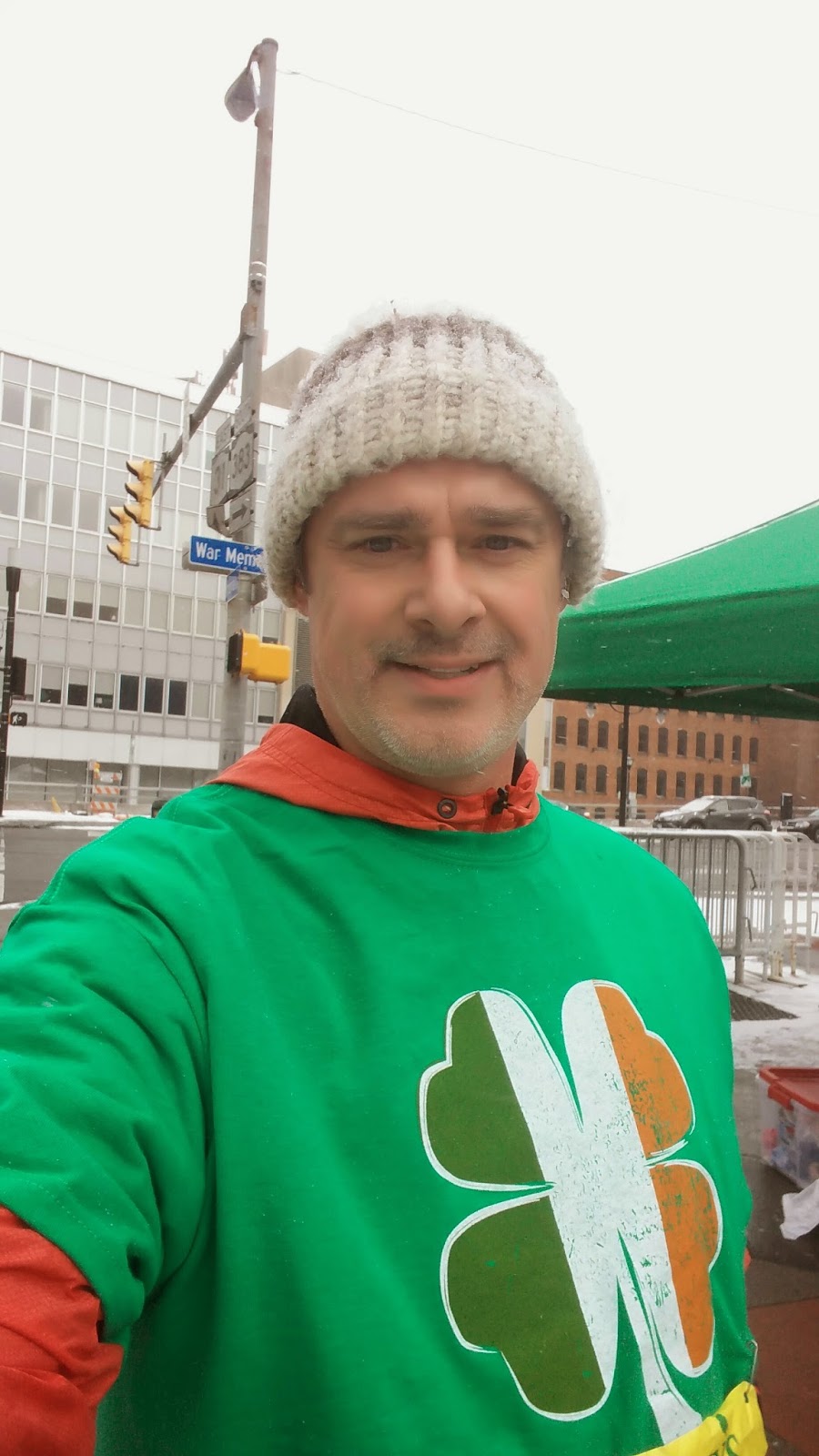
Weather: Cloudy, 12°F (feels like 0°F) , 70% Humidity, Wind: NNW @ 8 mph. Route:Johnny's Running of the Green, an out-and-back course. Time (Pace): 38:33 (7:42 min/mile) Pre-Race Observations: Windpocalypse be damned!Despite calls to postpone the St. Patrick's Day Parade which sets off hours following, the Johnny's Runnin' of the Green is going to go off as planned. Brutal winds, cold temps and a lack of electrical power to 40,000 citizens (including myself) are not enough to stop the hardy weakened warriors and Irish revelers of Upstate New York.
My goal in running this morning is to have a fast pace run as I begin to taper for the Syracuse Half-marathon in two weeks. Last weekend was my longest training run (12.3 miles) in this most recent training cycle, so I am hoping for a fast pace today. Reviewing last year's run, I am surprised by just how fast (7:40 per mile, finishing time of 38:20) my pace was last year, making me unsure of bettering it this year. I have come close to that pace in my faster paced training runs and am hoping that my competitive nature (if not a desire to more quickly get to the warmth of the nearby War Memorial) may push me to go faster...
Post-Run Reflections: The temps were cold (as advertised), but it wasn't as much of an impediment as one might think. The roads were clear and though the winds picked up in a few spots, with 876 other people running there were plenty of opportunities to share drafting duties.
I finished the race in 115th place with a time of 38:33, which while admirable given the conditions (which, other than the wind, were not really favorable) just missed bettering my time from the previous year by only 13 seconds. I felt strong and confident coming down the final 1/2 mile but did not finish as spent as I could (should?) have. Despite not improving upon my time this year, my age group place was better than last year as I finished tenth (of 65 finishers) in the M45-49 age group. Likely due to fewer participants, I bettered last year's place by 16 positions in my age/gender group and 140(!) slots overall.
All-in-all another solid run for fun and a step in the right direction. There is a good chance that the weather will be similar in Syracuse in a few weeks so this shorter distance dry run did yield some valuable information about just how much to wear (that Turkey trot sweatshirt was not really necessary) and how effective the running mantra/breathing I've been working with in training. I'm excited to run Syracuse in two weeks with my son, who because, he was under-the-weather, gave me the honor of being the first finisher... name Jean-Paul.
My twin brother, son, Jack, and I following the 2016 Utica Boilermaker 15k in July.
During the build up to New Year's Day tomorrow, many of my friends on Facebook and Twitter have been posting some pretty impressive annual running accomplishments. Whether cumulative mileage (1900 miles!) or number of competitive races, I continue to be impressed by the dedication and training acumen of those within my local running community. While I have always had an awareness of the commitment of local runners, the quantifying of performance that comes with year-end reflections makes concrete that which I have always suspected.
My wife, Anne, and I immediately
following the 2016 Winter Warrior
Half Marathon.
My own numbers for 2016 are less impressive, but I remain very proud of the small achievements I have accomplished. My cumulative mileage (including training and "racing") comes to just over 427 miles, the majority of which were accrued during roughly 30 weeks of training. I ran in only six races this year, covering a wide range of distances ranging from a 5k to two half marathons. It is interesting to note that I started the year with the 2016 Winter Warrior Half Marathon in January and concluded with the Reindeer Run 5k just three weeks ago. In between I revisited a few old favorites (such as my fourth Utica Boilermaker 15k) and found some challenges to embrace, like my first Phelps Sauerkraut 20k.
Although there was a lack of PR (Personal Records) performances for me in 2016, it was the most enjoyable year running I have had in many years. Having the opportunity to go to events with members of my family made the race experience much more satisfying. Whether spectating or running it was motivational to know I had someone with whom to celebrate the finish with.
In 2017, I'm looking forward to continuing the "something old/something new" balance struck in 2016. I will be returning to give the Winter Warrior another go (with slightly slower expectations) next weekend, and Jack and I have signed up to run a new (to us) half marathon together. After 10+ years, I am still learning more about running. The challenge of refining my training in light of other responsibilities (teaching, coaching, falling) has me excited to try some new things this year with a more intentionally consistent approach.
My stepson, Gregory, and I prior to the 2016 Webster Turkey Trot.
Using a popular structural approach, the tone and message
of each chapter is established with a quote.
In my roles as both a weekend warrior and high school coach, I am always on the lookout for books that can provide motivation to the athlete-in-me, as well as break down challenging sports-psychology concepts for those interested student-athletes with whom I work. Dirty Inspirations: Lessons From the Trenches of Extreme Endurance Sports by Terri Schneider is that rare collection of essays that is capable of doing both. A champion endurance athlete turned sports psychologist, Schneider draws on her broad array of competitive experiences (ranging from Ironman tri-athlete to Eco-Challenge team member).
A world-class athlete, Schneider has personal experience battling the mental demons that come with endurance sports. Endurance sports, as defined by the Farlax Free Dictionary, are activities performed primarily by an individual "in which key muscles are exercised at submaximal intensity for prolonged periods of time," and within this competitive arena, the author finds multiple anecdotes illustrating a practical psychological approach.
What Schneider's anecdotes and experiences do so effectively is to add meaningful meat to the bones of tired coaching code such as "Hang in here" and "You can do this if you try." Anyone who has engaged in athletics at any level (from recreational to professional) have heard ad nauseum, further reinforcing the reality that for many coaches (myself included), the real sports psychology employed is limited to motivational phrases. In the spirit of "physician, heal thyself," Schneider shows how her own application of these theories has resulted in both personal competitive successes and failures.
The text is broken into sixteen easily digestible chapters, each illustrating a different psychological training principle through the lens of the author's personal experience. This stricture allows time for the reader to intellectually breathe and reflect upon the insights offered in each chapter. While chapter titles such as "Afraid of Fear" and "Painting Your Authentic Self" have whiff of self-help pop psychology, given the practical experiences behind each principle, Schneider avoids the potential pitfall of celebrity how-to book. In addition to being an exceptional endurance athlete, Schneider is also an academic who has pursued education in sport psychology. Interestingly, the author often refers to her motivations for pursuing such training as events in her competitive life give rise to the possible need for it. If anything, it is her academic writer's voice that puts this text in the realm of psychology and training literature rather than purely adventure biography. This is not to suggest the words lack passion, but to remind that this really is, I believe, intended to introduce valuable ideas within the exciting context of adventure racing. It is one thing to run a 10k or half-marathon and describe what it is like to work through discomfort, and another thing entirely to address the subject having successfully completed a 100 mile foot race.
Author Terri Schneider.
Two chapters I found of especially meaningfully, given my own current state of affairs were "Probing Commitment" (pages 58-68) and "Finding Comfort in Discomfort" (pages 138-155). Next week, I will be embarking on my sixth (!) season as a high school Varsity Cross-Country coach, in all likelihood with a team comprised of young women with little prior experience at running the 5k distance competitively. Additionally, I very recently participated in a 20k that frankly did not go as planned, and during whcih I sustained an injury, that had me questioning whether to continue or not. In both instances, "professional" and personal, the necessity of commitment, to the individual as well as to those who rely upon them, is significant. Both chapters spoke specifically to questions I had around internal motivation and the necessity of powerful self-talk in persevering.
Dirty Inspirations: Lessons From the Trenches of Extreme Endurance Sports by Terri Schneider is worthy reading for both the competitor and coach. Unlike similar books which speak to sports psychology in a specific athletic endeavor (basketball coaching books for basketball coaches for example), the anecdotes and information in Schneider's text are readily transferable to any sport, especially as the athletic feats of the author imbue her words with instant credibility. I look forward to sharing parts of this text implicitly through some decisions I make this seasons and explicitly by sharing an excerpt (or two) with the team.
When comic books hit issue 700 of a single continuous run, it is a tremendous accomplishment. It is an especially rare occurrence nowadays for industry deeply enamored of the potential financial windfall of frequent #1's; as a result, every title seems to hit the reset almost annually.
Seven-hundred sounds like a lot. This morning when I scrawled "709" in my hard copy training journal as the to-date cumulative mileage since March, it seems like I've come a long way. In addition to comfortably completing a 12.5 mile training run, the 700 miles(tone) is a personal accomplishment. To 35 year-old me, 700 miles might have represented a rare year marred by injury. To 46 year-old me, it is thrilling, especially with a few more weeks to go in the calendar year.
This morning's surprisingly frosty (31°F, but felt like 26°F at 7 a.m.) and foggy early morning run also reminded me why I once preferred cold weather running--something I've avoided for most of the past 4 years. Though I have continued to register and train for the occasional road race, most have been limited to early summer or late fall events where I could train outside of my teaching/coaching schedule and in warm(er) temps. This current calendar year, I began much earlier (albeit on treadmill) than in recent history (February) and am registered to run a half marathon the first weekend of January 2016. While we have yet to have had measurable snowfall in Western New York just yet, it is a very real possibility for January 9, and I am almost assured that the temps will not be much higher than a balmy 40°F.
Now that I've reached the unanticipated 700 mile mark, it's time to continue moving forward toward other benchmarks. Like comic books, I too will hit the numbering reset button in January and begin with a brand new #1. Ultimately, the primary goal, one for which I am most thankful, is simply getting up and out every once and a while, regardless of how fast or slow or far I go.
In most matters, I am what can best be described as a "planner." For my work (teaching) it is a fine attribute, especially as I am willing to quickly deviate from a lesson plan if the situation (or class) necessitates it. While a willingness to map out goals, whether personal or educational, appears to be a mostly positive trait, the most significant drawback can be that on occasion I spend too much time planning and not enough time acting: it allows me the out that "I am working on it." Such has been my on-again-off-again love affair with recreational running.
Past best laid plans.
In September, my previous plan culminated in my successfully completing a half marathon, a race that was perfectly scheduled for my purposes as the taper came during the start of the school year and the recovery afterwards was positioned during a period of intense coaching and teaching. But now, weeks later, I find myself saying at the the end each work week, "This weekend I begin a new plan," even going so far as to jot down a course for the following morning.
This morning, after waking up early at the dawn of the second-to-last meet of the high school girls' cross-country meet of the season, I acted. The past three years it has become increasingly difficult to get outside on the streets in "the cold." Years ago I loved running in the hard pact snow at 5 a.m., an experience which, of late and in much kinder conditions, held little allure. Today was a cool, damp, autumnal one and it was glorious. Inspired (deluded?) by the short, easy three miles I put in, I decided to blog about it here (thus inspiring accountability) and begin to put in action another plan for a future race. In a little over two months I will be running another local half marathon with other more lofty goals crystallizing in the ether beyond January. For now, it has to be first things first.
Books about running fall into a number of different categories. Some are fictional, such as the classic Once a Runner by John L. Parker, Jr., while others are autobiographical/adventure tomes, such as the uber successful Born to Run by Christopher McDougall. As both a recreational runner, track coach and English teacher it is not uncommon for me to pick up topical fiction and nonfiction when I come across it, especially when it speaks to my situation at the moment. Like the aforementioned Born to Run, Running with the Mind of Meditation by Sakyong Mipham was a book that I had on my bookshelf for a number of years before really digging into it. As the old addage goes "when the student is ready (me), the teacher (or a relevant book anyway), appears." Over the past few months I have embarked on a return to fitness and Mipham's book articulates a few of the thoughts I myself have been noodling through.
While something of a primer on movement meditation, my initial interest in this particular title (besides reading about the author in Runner's World magazine shared to the right) were Mipham's observations regarding the application of breathing practice and visualization to ameliorating (or at least managing) the aches and pains that come with distance training. Since starting back up with a training plan, I have dealt with a left hamstring issue that has troubled me since the fall. In the past, I have used mantras to maintain focus during long runs, and continue to be interested in new thoughts.
From the August 2014 Runner's World.
For any with a rudimentary understanding of meditation, there is some familiar ground covered though from a more Tibetan perspective than I have read previously. Because of this new-to-me perspective,what could have been redundant is kept unique and fresh with the inclusion of some new Tibetan vocabulary. Mipham structures his book in such a way that the reader progresses with the author through the stages of meditation practice that mirrors initiating a new running plan. Starting with Part 1, Chapter 2. "Building a Base," Mipham establishes the significance of the mind-body connection, a relationship that can benefit from the collaborative practice of running and meditation: "Unless we train it,the mind does the minimum necessary to fulfill a function. In that way it is like the body." (24)
After using a series of personal anecdotes including conversations with other runners and observations from personal experience, Mipham bring us through "Tiger" (Part II) and "Lion" (Part III) levels or stages before concluding with Part IV. In establishing his terms, Mipham explains that "Garudu" is both a meditation technique for "moving forward with a health balance of mindfulness and awareness" and a "mythical bird with human arms hatching ready to fly." (135) In the context of the book, Garuda takes on the symbolic role of we, as runners and humans, faced with the challenge to go beyond one's comfort zone. I had not previously been ware of the Garuda concept, but given the propensity of many recreational runners (especially me!) to either 1. deviate from running due to boredom or 2. continue along a progression of distances in an effort to go farther, faster.
Mipham's accessible and conversational writing style, with excellent explanations of new and unfamiliar terms, make Running with the Mind of Meditation a brisk and informative read. Regardless of where you find yourself in your training: whether with mediation or running, Mipham's clear articulation of progressively more sophisticated facets of both practices suggest a book that will reward with re-reading too. Recommended as a vital re-framing and focused presentation of the practice of meditation as a means of enriching the possibilities of the running mind-body connection.
Given the current state of my personal training (which is to say, I'm not doing anything other than resting), I have taken to following the racing of others on-line and in person (sort of). On a personal level, this means taking my son to and from practice and following the successes of some of the folks I teach summer school with. Also, unbeknownst to me until I happened upon it online, the "king of all American Ultras," The Badwater Ultramarathon began yesterday, July 13 [Note: this post was originally published in 2009].
The race website (linked above) provides a variety of resources (Twitter, webcam, etc.) helpful in following the 83 individuals who are attempting to compete the "135 miles (217km) non-stop (run) from Death Valley to Mt. Whitney, CA." This is a very bad-ass run, that only the incredibly fit and mentally ironclad athletes FINISH.
My introduction to the Badwater Ultra came, as things often do nowadays, via a documentary I purchased on a lark from Amazon.com about eight(!) years ago when I first began running (sort-of) seriously again. At that point in my life, I had a goal of running first a 5k, then a 10k and eventually planned to run a 50k, something I recently did for the second time.
Running On The Sun: The Badwater 135 (2000), this film is a documentary about one of the world's most infamous ultra-marathons. The "135" in the title refers to the race's one-hundred and thirty five mile distance! This intriguing, and often difficult (crazy grueling experience) to watch, documentary follows thirteen participants and their support teams as they train and compete in the most grueling ultra-marathon, the Badwater 135, which goes through Death Valley to the peaks of Mount Whitney. If this film is any indication it was as painful to run as one might suspect. The film, by director Mel Stuart, follows male and female athletes who each have taken very different paths to to this race, where finishing IS the accomplishment.
A mailman, a fitness instructor, a member of the Armed Forces, an amputee and others all start the race, while only a few finish. This film, in parts, becomes something of a horror movie: the intrigue is in watching to see how the runner's attempt to avoid (while eventually succumbing) to the film's "protagonist", the course itself. Turns and twists in the story are around every corner. One would imagine that the director had to make many difficult choices while editing the film, given the runners he chose to follow most closely, as they were not always the ones who emerged as finishers.
Those whom you would think at the start have the greatest chance, fall by the wayside, devastated by their failure to finish. But the overall sense of community these runners share triumphs in the end as those who have failed themselves, rally to support the runners who, though dehydrated, blistered, and psychologically battered, make their to the top of the mountain, both literally and figuratively.
Running On the Sun provides both an excellent introduction to the race and an entertaining diversion for those who do not participate in adventure racing, and a must-see for those who currently run, or have in the past, and are seeking to re-ignite their internal flames of motivation. I reckon I'll pop it into the DVD over the next two days, in addition to following the race online.
With visions of my own eventual return to training, dancing, sweating and bleeding in my head...