Showing posts with label spaghetti western. Show all posts

Friday, November 28, 2014

Seen It: And God Said to Cain (1970)


Waking up at 5 a.m. this morning with nothing worth watching (as near as I could find) on Netflix, I dug back into the deep discount Spaghetti Western 44 Movie Collection I've been viewing my way through over the past two years. It's been a while since sampling, but I chose And God Said to Cain (1970) starring genre icon Klaus Kinski. This was mt second time veiwing the movie, but this time (there's that time-to-burn again) I decided to comment.

Given his uniquely angular facial structure, Kinski was most frequently cast as a villain or psychotic bit player in most Spaghetti Westerns. However, here Kinski takes center stage as Gray Hamilton, a wrongly convicted (and recently released) inmate out for revenge against the man who allowed for him to be sent up the river for a decade, Acombar (Peter Carsten). Direted by Antonio Margheriti, and credited as Anthony Dawson, And God Said to Cain is hot in a way that reflects its nontraditional lead, And God Said to Cain is atmospheric and understated--at least as understated as a bloody, European western can be said to be.

On its own merit Margheriti's film stands as something of a classic of the genre. God Said does demonstrates an understanding of the genre, offering the familiar tropes in a manner that is masterful. (This conclusion is better reached viewing a high quality transfers than many the inexpensive versions available as part of most collections.)  It's no secret that the aesthetic nature of the traditional Spaghetti Western played into the strengths of those European and American actors who helped define the genre.

Though less well know on American shores, Kinski, like Clint Eastwood in Sergio Leone's movies, capably breathes lief into his character with few lines and a lot of mileage out of his sullen eyes and somber facade. In terms of flat-out acting, Kinksi took Eastwood's wooden emoting with few lines of dialogue, to another level: even in the Italian and German movie trailers, Kinski reveals a hurt and depth to the role that Eastwood could never touch.

An entertaining movie (Spaghetti Western or otherwise), And God Said Cain also benefits from a higher degree of re-watchability, thanks in great part to Kinki's performance. While not quite on par with Gian Maria Volante's charismatic starring turn in A Bullet for the General (1966), Kinski's performance her further demonstrates that with the right story, direction, and actor, even those characters on the periphary of their traditionally more handsome Western star vehicles have story's that are worth telling, asepcially as is the case with these two films, if the story is told well.

Monday, August 19, 2013

Run Reader: The Man with No Name (2008)

From The Man with No Name #1 by Christos Gage and Wellington Diaz.
It has been almost two years(!) since I last wrote about a complete run of issues I have in my comic book collection. Veteran fanboys will  recall that a "complete run" occurs when a collector has all issues of a specific comic book title. In recent years, having a complete run of any given title is not as unusual as it once was, due to titles regularly being started over with a new issue 1, and therefore, a new volume. While I would not confider myself an ultra serious collector, mostly because I don't spend too much money on rare and unusual titles, I do have that OCD that requires me to do my best top acquire all issue in a series that I really enjoy, especially those with a high re-readability level.

Cover to MwNN #8 (2008)
by Richard Isanove.
About three years ago, I was bitten by the "Western-comic book bug," and found myself searching through back issue racks for modern series with a Western bent. In digging through longboxes at my local comic shop I came across the short lived Dynamite series, The Man with No Name (MwNN). Based upon the character and film aesthetic developed by Clint Eastwood and Sergio Leone in their collaborative Spaghetti Western series of films, this series lasted only eleven issues that follows the continuing adventures of the characters and plots of the original MGM film series, serving as a sequel of sorts. This link is even clearer when I looked into purchasing the issues online and realized that they often bear the subtitle The Good, The Bad and the Uglier, added following a title ending colon. Despite the short length of the run (it was eventually continued as a follow-up series entitled with the likely more recognizable title of The Good, The Bad and The Ugly), completing it did take some doing.

From MwNN #5 by
Christos Gage and Wellington Diaz.
Unlike more visually recognizable (and therefore more marketable) characters such as the Lone Ranger and Zorro, both of whom have current or recent series published by Dynamite, MwNN was not as highly ordered in its initial run and therefore not all the back issues were easily available at my local comic shop. Another "challenge" was the fact that many issues had variant covers, most with pin-up style depictions, so I had to be sure not to purchase too many duplicates of existing issues already in possession. (I know it would make sense to maintain a list of numbered issues, but one never knows when they may come across a stack in some small shop without a the list in hand.)

The entire run consists of two storylines, both by different  creative teams. Issues 1-6, entitled "Saints and Sinners," is a direct sequel to the original film that follows "Blondie" (the name by which the original Eastwood charter was referred to in The Good, The Bad and The Ugly (1966)) as he deals with the repercussions of his actions in the classic Spaghetti Western. Written by Christos Gage with art from Wellington Diaz, these dangling plot threads are tied up in comic book and woven into another redemptive opportunity for the character.

The second arc introduces to an earlier adventure of Blondie and Tuco Ramirez, "The Ugly" of the film's title, brought to life so memorably by the late Eli Wallach. "Holiday in the Sun," this five-issue arc was written by Luke Lieberman and Matt Wolpert, with art by Diego Bernard.

Both arcs attempt to duplicate some of Leone's film-making style by employing a slightly more minimalist approach to dialogue as exposition. Blondie does, however, "speak" more in a single issue than in any single Leone film, a concession that must be made for a medium that, while highly visual in nature, does require a degree of expediency. Both Bernard and Diaz offer depictions of the characters in a way that is consistent with the films, though much of the reader's ability to discern Blondie from other similar characters is dependent on his iconic poncho and not-so-iconic mullet-style hair. As a fan of Wallach's Tucco, it is good to see the character brought back to life. Tucco (along with Van Cleef's Angel Eyes) did not appear in any other of Leon's Eastwood movies, so the back and post stories provide the reader and fan a chance to revisit the character. (Angel Eyes does not make an appearance in either, though *SPOILER* the character's death at the end of The Good, The Bad and The Ugly would have made that difficult.

Dynamite's The Man with No Name was followed up immediately after issue 11 the following year with another eight issue miniseries featuring the Man With No Name character. Both series, The Man with No Name (2008) and The Good, The Bad and The Ugly (2009) are available in trade paperback at fine local comic shops everywhere. If you're a fan of single issues (as I am), I'd bet if you were diligent you could collect a complete run of both series for yourself.

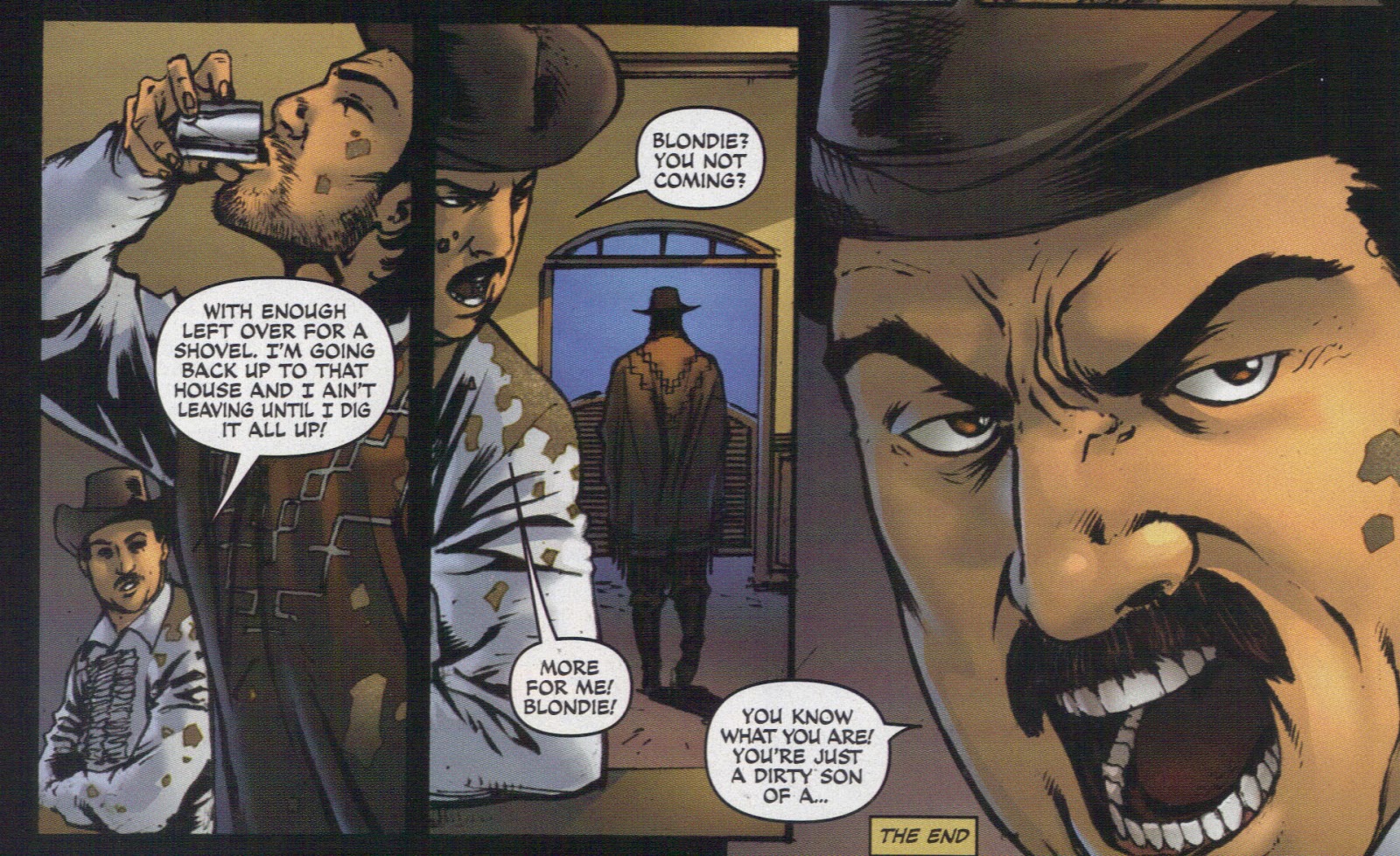
The final panels from MwNN #11 (2008) by Luke Lieberman and Matt Wolpert,
with art by Diego Bernard.

Saturday, March 02, 2013

Seen It: Vengeance (2009)


Recently the unusual sub-genre of film that is the Asian (Korean/Japanese/Thai/Chinese) thriller has joined the (Spaghetti) Western as one of my favorites. Once in a blue moon, I get lucky and come across a movie which actually draws on elements of both "genres" effectively. How can can a Chinese movie starring a Frenchman set in modern Hong Kong be a "Western"? While a film such as Vengeance (2009) has a very definite Eastern setting, the movie's tone, characterization and aesthetic are, to this viewer, have an unmistakeably Western flair.

Directed by Johnnie To, from a script by Wai Ka-Fai, Vengeance (2009) stars French music icon Johnny Hallyday as Francis Costello, a grieving (and brooding) father who's daughter is victimized by three home invaders. To add to the trauma, his son-in-law and two young grandsons are also murdered in the pre-title assault.

A chef and restaurateur from France, Hallyday's character, with a suitably "secret past," is very much a fish out of water in the Chinese cities of Macau and Hong Kong. Relying on help from some unlikely allies, Costello seeks revenge for the senseless and brutal attack on his family. Further adding to the outsider dynamic, common in the majority of spaghetti westerns, is the revelation that Costello suffers from periodic memory-loss, a condition that necessitates his taking Polaroid pictures of the faces he needs to remember lest he forget them completely--and therefore re-meeting them throughout the film. Cognisant of his health condition which is the result of a previous "secret" activity, Costello acknowledges that at some point in the near future he will not even remember his daughter even as avenging her pain and loss becomes the focus of his existence.

As teased in the film trailer above, Chicago Sun-Times film critic Roger Ebert has called Vengeance "A Classic Western," and further wrote that the film had "certain parallels" with Clint Eastwood's 1992 film Unforgiven. The film has just as many parallels with some of Eastwood's much earlier westerns. Very much a "Man With No Name," Costello, as played by Hallyday (who at one point was culturally seen as France's equivalent to Elvis Presley), says little while ingratiating himself to the "locals" (translation: Chinese hit men) with whom he develops a deep bond. This bond is further developed when their shared history, and code, are revealed toward the middle of the film. Later, Hallyday is also befriended and assisted by a young women with many children who sees the good in his hear, despite his grisly mission of vengeance.

One thematic cornerstone of the Western present in Vengeance is the depiction of a society organized around codes of honor and personal, direct or private justice. Some other important production choices seem influenced by a desired western motif such as the dramatic staging of key showdowns, as well as the accompanying soundtrack written by Lo Tayu.

Part Western, part Asian Thriller, part character study, more than anything, Vengeance is a well-produced thriller with a number of twists, none of which are novelties, as each further enhances the story of Costello's drive toward revenge. This film is currently available for on-demand viewing on Netflix.

Sources:
Wikipedia

Thursday, December 27, 2012

Seen & Read It: Django Unchained (2012)

I may have missed this small exchange in the movie, but its inclusion in the comic book adds
a level of depth to both Dr. King Schultz's characterization and Django's comment later in the film that has
been widely featured in the television ads.
As a Spaghetti Western fan and appreciator of Quentin Tarantino's film aesthetic, I have been awaiting the Christmas Day release of Django Unchained (2012) for quite some time. After seeing the reviews (both positive and negative) there is not much else to say that hasn't already been offered by more cultured reviewers worldwide, though I will say that among Django Unchained's greatest accomplishments is that it made me like both Jamie Foxx, Leonardo Dicaprio and Samuel L. Jackson as incredibly gifted actors, rather than as simply celebrities. I also appreciated the bravery Tarantino showed in adhering to his vision of the film, which given overly sensitive studio (and societal) tastes, cannot have been easy. The film is violent, bloody, angry, raw, and thoroughly engaging as a piece of visual art. That being said, it is also definitely NOT for children or those who are unwillingly to see a filmmaker at his unflinching best.

Django Unchained is an unabashedly irreverent homage to the old school Spaghetti Westerns and, as such, it is only right that it, like many old traditional Western television shows of the past, have a comic book adaptation hitting the stands at the time of its release. Given the content of the film, and therefore the comic book, it is safe to say that few publishers could offer to present a "Director's Cut" of the film in comic book form like DC Comic's Vertigo imprint.

Featuring art by RM Guera (who recently concluded his run on the popular neo-Western-tinged Vertigo series Scalped), The first issue of the comic book came out two week's ago and has been sitting in my "To Read" pile until after I could see the film. In his foreword to the comic, Tarantino reminds the reader of his love of Western comic books and that the ability to do a comic book adaptation allows him to share with the fan the "ENTIRE SCRIPT," which if it were to be filmed would be almost "four hours in length. For fans of the film, Tarantino and just the editorial process, Django Unchained the comic book offers a view "the very first draft of the script." An excellent companion to the film, I enjoyed reading what Tarantino had not included in the film, but suspect some of it may turn up in a Director's Cut or as a Special Feature in some future Blue Ray release.

Sunday, December 02, 2012

Seen It: Django Kill... If You Live, Shoot! (1967)


Given the upcoming Christmas release of Quentin Tarantino's Django Unchained (2012), one hopes that the classic Spaghetti Westerns which influenced the writer /director will be seen by a new generation of fans. What better time to continue reviewing the films as I come across them? Though considered the first "sequel" to the original Django starring Franco Nero, Django Kill... If You Live, Shoot! (1967) has exactly nothing, save the genre it inhabits, to do with any of the other films bearing the recognizable name.

There is one word to describe this film jewel: weird. Not exactly El Topo weird (despite the appearance of a naked child in the first 15 minutes as in Alejandro Jodorowsky's 1973 mind-trip classic), but just odd enough to wonder what could have happened had the co-writer/director, Giulio Questi, had gone the extra mile.

Django Kill... If You Live, Shoot! (Se sei vivo spara) stars genre-staple Tomas Milian (Run Man Run) as an unnamed anti-hero, referred to only as "Stranger" who travels from loosely related interactions and events through a brutal Mexican setting. Despite the lack of a traditionally coherent narrative, there is quite a bit of interesting activity going on, and, not surprisingly to those familiar with his screen work, the whole thing is very ably grounded by the charismatic Milian. The actor's relatively dark features helped him corner a niche for, shall we say "exotic" genre roles, and here plays the self-ascribed "half-breed,"the Stranger, as a directionless sort. With almost no background, save the flashback events (such as his initial "murder") which set the his present circumstances in motion, he is a clean slate off which Questi bounces unusual ideas.

Beyond the familiar Spaghetti Western trope of the unnamed hero/anti-hero wandering an unforgiving world, there are a number of eccentricities which make Django Kill a worthy viewing for aficionados of the genre. After watching the film the first time, it occurs to me that there is plenty of fodder therein for a college student looking to write an in depth film analysis deconstructing it. Some key points of interest are:
  • Two clearly Italian actors portraying the Native American "guides" who first save the Stranger then from certain death using what appears to be a magic rabbit pelt and then agree to come with him if he'll tell them what was on "the other side" (death).
  • Seemingly out of left field, two scenes have the characters begin speaking Italian with subtitles at the bottom of the screen. Both scenes, referred to as "gold digging" (cutting gold bullets out of a criminals stomach) and "scalping" (take a wild guess), were cut from the Italian original for the US and UK markets due most likely to the gore level. The "gold digging" is . As these scenes were never dubbed into English, they were reinserted with their original Italian dialogue and English subtitles.
  • This film also turns the common casting of a ragtag gang of grotesque, toothless locals in the roles of "bad gang" on its ear. In an usual move which screams "subtext," Django Kill features a veritable parade of male models wearing entire outfits of black with the same white stitching on the shoulders as the bad guys. The lead villain, Mr. Sorrow played by Roberto Camardiel, even gleefully notes when trying to recruit the Stranger to his gang of muchachos that "They make me so happy in their black uniforms."
The terrifying and villainous Muchachos propose a drinking challenge... no, seriously!
  • To make matters even worse, there is an implied molestation of another character (an effeminate young man played by Ray Lovelock who begs to leave town with the Stranger because it is "so evil") by the models-in-black. In a series of cut scenes, the boy is first kidnapped, released, then forced to drink. After having his hair tousled by the gang, he awakes the next day, walks into the dining area (where the mostly half-dressed gang have all fallen asleep on the floor after a night of drinking), steals a gun and commits suicide. 
  • In a later scene during which the Stranger has been captured by the same group, he is tied to a large wooden t-shaped table (yes, like a cross) wearing only a loincloth. His arms and legs (akimbo) are in chains while he is gleefully watched by two of the fellas being "tortured" into revealing a location of hidden gold. The torture is seemingly exacted by the villains deadly creatures: a deadly vamp[ire bat and an iguana. We as the audience only view these terrifying monsters in stock footage but are told they were so terrible he had to talk. Uh-huh.
Next come the very persuasive iguanas and vampire bats!
As with most Spaghetti Westerns, the music plays a key role, though here, the film's primary music consists of random variations on the main theme composed by Ivan Vandor, and heard in the trailer above.

Don't worry about entering the film with too much information based on this post. It would be impossible to "spoil" this film entirely as there is so much weirdness to be seen. (I haven't even mentioned the woman who waves to the Stranger for 3/4ths of the film from her barred second-story window of the film before we are formally even told who she is, or the talking parrot.) As mentioned earlier, it is Milian who keeps it the whole; thing together hurtling toward its bizarre conclusion.

This movie is widely available in any number of genre collections. I viewed it as part of the Spaghetti Western 44 Movie Collection released by Mill Creek Entertainment that was purchased for $9.99 at a local supermarket. I was very pleased to realize the movie included was the remastered version with the previously deleted scenes, too. As both a Spaghetti Western and a "cult classic" it is worth seeking out for a few hours of bizarre viewing.

Sunday, September 30, 2012

Seen It (Again): A Bullet for the General (1966)


Welcome to my second "review" of  Damiano Damiani's A Bullet for the General. I first watched, and wrote about, this film back in January 2011 a time during which I had just been bitten by the Spaghetti Western bug. This morning, after reviewing essays written by my AP Language & Composition students, and in anticipation of the afternoon's cross-country running meet, I was inspired to rewatch the DVD with a slightly different "eye" and thought perhaps it warranted some updated commentary review. In class, we have been discussing the identification of literary and rhetorical concepts at work in the real world. With a deeper look it is fairly easy to connect the dots and see them active in the reel world, too.

DVD Cover.
A Bullet for the General (1966) (also known as Quien Sabe?), was among the earliest entries on my mental "must-see" list due primarily to two significant selling points: first, its having been being hailed by more than one critic as "one of of the greatest Spaghetti Westerns of all time," and secondly, the presence of the charismatic Italian actor Gian Maria Volonté, recognizable to American film goers from Sergio Leone's A Fistful of Dollars and For a Few Dollars More.


Damiani's film is the rare Spaghetti Western that is not really a "Western" at all, given its setting South of the border in Mexico. Truth is, Bullet falls more neatly into a subgenre of the Spaghetti Western it helped to start, the Zapata Western. "Zapata Western" is a nickname given to Spaghetti Westerns which were set in and around Mexico and dealt with overtly political themes.

The film happens to star one of my favorite genre actors, Gian Maria Volonté,  here playing Mexican guerrilla bandit/arms dealer, El Chuncho. As is nearly always the case, there is a twin archetypal silent gringo character, Bill Tate, played by Lou Castel, though more frequently referred to by other characters as either "Gringo" or "El Nino." The plot deals with the American agent of the Mexican government (Castel), intervening in the Mexican Revolution of 1913, by attempting to manipulate a bandit leader (Volonte) into helping him assassinate a revolutionary general. El Chuncho is aided by his brother, El Santo, a Mexican mercenary draped in monks robes, played by actor Klaus Kinski.

El Chuncho. El Nino. El Santo. If you're getting the sense that this film plays like some crazy Mexican Hogan's Heroes, with it's eclectic cast of characters--you are not far off. At a deeper level, the subversive intentions of Colonel Hogan's gang of political prisoner's is also reflected in the overall plot of the movie, too. Each actor performs their role with such relish, that one almost buys (at least I did) that maybe Damiani, who considered this a political film rather than a genre one, was really onto something... though his "message" is intermingled with just enough gore, gun fights and exploitation-style hi jinx to allow it to pass as a Spaghetti, or nascent Zapata, Western.

What made A Bullet for the General "political" in Damiani's eyes were the overt references to the ongoing Vietnam War. It is this analogy that makes the film (and its consideration) of special interest to myself, as an AP Composition teacher. Castel's character, El Nino, representative the CIA's interventions in Latin America, is somewhat symbolic of the United States presence in Vietnam. This subtext sets the tone for future sub genre entries, though just how much of the intended political meaning reached non-European shoes is debatable as film were re-edited for markets that might be offended by the (figurative) content. The turn at the end brings home the message and reveals Damiani's possible sympathies for the Vietnamese.

For a "legitimate," albeit spoiler-laden, review originally published during the film's American release in May 1969 check out this article from the New York Times here, or a review of the recent Blue Ray re-release from DVDActive.com here.

Sunday, April 01, 2012

Seen It: Captain Apache (1971)


Five years after a young Burt Reynolds donned the red face makeup and fright wig to play the heroic Navajo Joe (1966), veteran Spaghetti Western icon, Lee Van Cleef of The Good, The Bad and the Ugly (1967) fame, also took to dressing as an Indian warrior in the "classic" Captain Apache (1971). Of course, Lee did Burt one better by also contributing "vocals" to a happenin' theme song--though the singing appeared to be little more than spoken word clips from the movie.

In the film, directed by Alexander Singer, Van Cleef stars as the "redskin in cavalry blue" who bungles upon a presidential assassination plot. Few movie summaries sell a film as well as this one from The Spaghetti Western database: "Captain Apache wears a funky coat, trips on psychedelics, beats up twin gay gunslingers and constantly gets called red ass, all while trying to find out what the words 'April morning' mean."

A fan of Van Cleef, I have actually watched this film a few times as it allows the actor the chance (of which there must have been very few for a character actor--a bad guy one at that) to showcase his considerable, and under-appreciated, chops. It was also the rare role for which Van Cleef did not wear his iconic mustache; a facial hair configuration that had done more than it's share of twirling above an evilly laughing smirk.

Traditionally against as the villain, Van Cleef played up his anti-hero role here with humor and gravitas, taking advantage of the chance to indignantly decry the treatment of Native Americans in the days following the Civil War. While that may be overstating the intentions of the film, much like Reynold's aforementioned turn in Navajo Joe many years earlier, there is a sense of dignity in Van Cleef's performance, but I cannot recall when, even in the most ridiculous of roles, Van Cleef was not able to draw on his inner spirit to find dignity in the characters he played.

If you can't find Captain Apache as one of the features on any number of Spaghetti Western DVD collections (it was on two that I purchased for $10 a piece), it is available for free viewing online at Bmovies.com.

Thursday, March 22, 2012

Seen It: Navajo Joe (1966)


Just as Italian directors like Sergio Leone hired American actors such as Clint Eastwood and Charles Bronson to play clearly "American" drifter-gunman, some "before-they-were stars" actors got their starts playing Native American (Indian) leads. One such example is the Burt Reynolds starrer, Navajo Joe (1966) directed by Sergio Corbucci; who would follow up this film with the genre defining Django (1966). Because Reynolds was a rising star who was himself part-Cherokee, he made the perfect choice for producer Dino De Laurentis' follow up to the Eastwood/Leone collaboration A Fistful of Dollars.

It's always worth mentioning that along for the ride was Ennio Morricone who scored the film but is credited under the name Leo Nichols. As is often the case with Morricone's scores, Navajo Joe's beats have been lifted for many later films, most noticeably (as always seems to be the case) by Quentin Tarentino in his  Kill Bill (2003) movies.

The story is standard for the genre: after being wronged by a band of scalp hunters, Joe hunts down the gang and in the process uncovers a plot to rob a train. Despite being leery of the Indian, the townspeople who receive the money hire Joe to stop the robbery. Check out an interesting (and brief) Turner Classic Movies article about Navajo Joe here for some more educated insight regarding the film.

The layman's review? Navajo Joe is not nearly as offensive as its un-PC title might have you believe--there is quite a bit of subtle reverence paid to Joe's non-descript heritage--and the young Reynolds is quite charismatic in an early role that he would later disavow. As far as Netflix films go, you could spend evenings in much less entertaining ways than with this strong Spaghetti Western. At worst, it can provide a gateway film experience to stronger films it is influenced by (as well as influencing).

Wednesday, February 15, 2012

Seen It: Keoma the Avenger (1976)


No, that is NOT Dan Haggerty... it's Spaghetti Western icon Franco Nero as Keoma!

Also known as simply Keoma or by any number of Django-inspired titles such as Django Rides Again or The Return of Django, due to the fact that its star, Franco Nero, originated the role in the original (and as yet unseen by this film buff) classic Django (1966). This is the first film I have seen with Nero, who upon first viewing strikes me as a slightly more wooden Gianni Garko. Fortunately, this film also features William Berger, who just keeps popping up in what are quickly becoming the most usual places... like nearly every other Spaghetti Western I choose to watch!
Spaghetti Western Database Synopsis: Franco Nero plays Keoma, a half-Indian, who returns home from the Civil War. He discovers that the town nearby is plague ridden and unscrupulous types are using this as an excuse to keep the town under their tyrannical control. Keoma rescues a pregnant woman from being sent to the camp with all the plague victims, which makes him somewhat unpopular with the town's more evil elements. Additionally, he comes into conflict with his brothers who are siding with the aforementioned evil elements.
This is a much more bleak and dark Spaghetti Western than most I have seen, unique both in some of thematic content as well as the tone. This is perhaps due to its being produced and distributed during the final gasp of the genre was being choked by parodies. Using a grey and brown palette to paint a visual picture of a plague ridden community, this film is almost absent the trademark comedic relief of any sort, save maybe the characterization of the town doctor who, along with Koema's childhood hero, a freed Slave named George played by Woody Strode. But, really none of it is played for laughs.

The seriousness of the procedural is further enhanced by the performance of a very stoic (and thickly European accented) Nero as half-breed Keoma, trying to return to the last place he's known as "home" following years wandering after the Civil War. The story is further developed by exploring Keoma's own daddy issues with the father who raised him and (according to the three half-brothers) showered him with the type of affection that resulted in Keoma becoming only "the second person alive" who could hit a target without looking--the first being Keoma's dad, played here under old age make-up by the aforementioned William Berger. It's no wonder Kemoa's brothers are just a tad jealous--Keoma grew up to be a bad a** drifter and crack marksman and the three of them became a sort of Western three stooges who have their own father turn on them!

Director Enzo G. Castellari also adds a touch of Shakespearean flair through the inclusion of a character referred to simply as "The Witch," played by Gabriella Giacobbe. The Witch is the first to greet Keoma upon his return and pops up throughout, usually signalling some sort of negative event which forces Keoma to respond bravely. She also has a secretive link to the avenger's...

Keoma the Avenger (1976) is a slightly above average late-era Spaghetti Western which offers some unique refinements making it well worth an initial viewing, as well as a strong candidate for e re-watch in the future. Though no relation to the currently "hot" Avenger's properties Thor, Captain America, or Iron Man, this dark Spaghetti Western was at the very least slightly more entaining than Iron Man 2 :)

Sunday, May 22, 2011

Seen It: Django (1966)


New, ruthless, violent and armed with both a Gatling gun and
a catchy adult contemporary theme song!

With the recent announcement of Quentin Tarrentino's script "Django Unleashed" moving into pre-production and casting (Big Willie Smith, really?), there is likely to be renewed fan interest in all things "Django." Despite the fact that there are many, MANY movies that carry the moniker "Django" as part of their titles, there is only one ear-cutting, blood-letting, finger-smashing, coffin-toting, Gatling-wielding Spaghetti Western icon worthy of the name, the one introduced in Sergio Corbucci's genre-classic Django starring Franco Nero.

Ranked fifth on the Spaghetti Western Databases Essential Top 20 Films, Dajngo, is described in the following way: "Violence is a trademark of the genre. Corbucci upped the anti with ears bitten off priests and citizens slaughtered with a machine gun, but the skilled pistolero with the army coat and the coffin are what makes this a cult favorite."

Though I had previously described Nero as a "more wooden Gianno Garko" in my consideration of Keoma the Warrior (1976), that presence actually works to great effect in Nero's portrayal of the world weary gunman in this film. Partially set in a dank, muddy border town, Django plays both sides of the Mexican-American feud, using each against he other in a revenge shell-game that often sees our (anti-)hero facing tremendous odds, a number of which he fails to overcome without first suffering a great deal.

Online scuttlebutt has it that Franco Nero will be returning in some capacity to the screen with a role in Tarrentino's film, so there is no better time to check out the real deal. Available as a downloadable film on Netflix, Django has all the earmarks of a classic, entertaining Spaghetti Western: violence, brooding leading man, poor dialogue overdub, and gritty action.

Sunday, April 24, 2011

Unwanted: Four Rode Out (1970)


Yawwwwn--believe it or not, this theme from the opening of Four Rode Out (1970),
written and performed by Janis Ian, is actually the high point of the film.

Like many, if I'm not drawn into, or "hooked," on a television show in the first 5 to 10 minutes I will either turn it off or move on to another station. My viewing habits are no different when it comes to watching a Spaghetti Western.

Given that there are sixty or so movies in total on the two "box" sets of films that I am working through, it stands to reason that there are going to be a few clunkers among them, though the term "few" might be overly optimistic. Not only are these films, to my sensibilities, nearly unwatchable, they are also (to put a spin on a classic Western motif) "Unwanted."

The first of these is the slow moving (and somewhat incoherent) Four Rode Out (1970) starring Pernell Roberts (Bonanza and Trapper John, MD) and Leslie Nielsen (The Naked Gun and Airplane films) and appears to be a prime example of a "Hollywood" movie attempting to successfully duplicate the Italian-produced Western aesthetic... poorly. Interestingly, it is not included on SWDB's list of films, so may not actually be a true Spaghetti Western... it may just be "bad."

Though Four Rode Out may have improved after the first eleven minutes, I will likely never know... you are welcome, however, to check it out for yourself as this beauty is actually available for viewing on Youtube.

Friday, April 22, 2011

Seen It: They Call Him Cemetery (1971)


Believe it or not, a Spaghetti Western trailer in... wait for it... Italian!

Gianni (Johnny) Garko and William Berger, two actors who previously squared off in If You Meet Sartana Pray For Your Death (among other films) are at it again in They Call Him Cemetery...
Spaghetti Western Database Synopsis: The two McIntre brothers return to their home in the west. They soon find that a band of mysterious masked men are controlling the county and extorting the ranchers. The brothers are helped by a gunman called Cemetery to combat the bandits, while the bandits hire Cemetery's old friend, Duke.
I'm beginning to understand why Gianni Garko is a Spaghetti Western icon. His calm, cool and collected attitude, combined with a squinty-eyed haggardness allow him to evoke a sympathy, and to quickly transition to projecting a dusty bad-a** quality. In this film (which in a tribute to high quality box-collections of old films, is oddly entitled They Call Him Graveyard on the disk from the same box set it was referred to as by the other title!), Garko is once again teamed up with his frequent opposite number, Berger.

Both Berger, as Duke, and Garko, as Cemetery, have surprisingly similar "looks" in this film (right down to their facial hair) and world weary approach to the jobs that they take on for both personal (Garko) and financial (Berger) reasons. Though not fully revealed, there is a definite shared back story to these two gun fighters and if not for Berger's death in nearly every film (he is generally cast as a villain after all) this film could easily be viewed as just another chapter in an ongoing series of adventures during which these two characters cross paths.

Despite the dramatic performances of Berger and Garko, They... Cemetery does include the overtly comedic elements (goofy sons raised in the East and ill-equipped to deal with the tough guys of the West, for example) indicative of later Spaghetti Westerns it does (mercifully) stop short of spiralling into lampoon. This is thanks in great part to the grounded performances of the two leads.

Sunday, February 20, 2011

Seen It: Run, Man, Run (1968)

Another trend emerges... the actor (in this case, star Thomas Milian) voiced title song.

Though set on the verge of the Mexican Revolution, director Sergio Sollima's Run, Man, Run (Corri, Uomo, Corri) only touches the usual Zapata western themes in favor of an adventurous treasure hunt story. I selected this film due to its online status as an "underrated classic of the genre," as well as its star, Cuban-born actor Tomas Milian, here billed as "Thomas", about whom I had read good things.

While the movie was mildly entertaining (the aforementioned title song, some intriguing political threads), I must confess to having had to start (and re-start) it a number of times and was never able to watch the whole thing through without failing asleep. It's not that the elements of a satisfactory Spaghetti Western weren't there, it was just that the overall inconsistent tone of the film was poorly executed. Picturesque vistas? Check. Soft-spoken gringo foil? Check. Goofy primary protagonist? Uh... check?

While certainly not unusual for the genre, Thomas Milian's Sanchez 'Cuchillo' Detto, was just a little too goofy for my tastes. In fact the mercurial tone of his performance was much more reminiscent of (and suitable for) the "old coffin maker" role, a performance usually set-aside for minor character serving as comic relief. Had I been prepared going in with for the comedic tone perhaps Milian's mugging would not have seemed so off.

Perhaps, were I to attempt to rewatch Run, Man, Run in the future I might see more of the elements that resulted in the high praise that initially brought me to it, but given the other films out there, that is unlikely to happen anytime soon.

Saturday, February 05, 2011

Seen It: If You Meet Sartana Pray for Your Death (1968)


This past week's near-miss of a snowstorm, and the unnecessary "snow day" that came with it, allowed my the free time to crack into my Spaghetti Westerns 44 Movie Collection and check out director Gianfranco Parolini's If You Meet Sartana Pray for Your Death (1968) starring Gianni Garko aka John Garko with "The Special Participation of" Klaus Kinski. I am trying to vary the actors with each spaghetti western I watch and though this is my first Sartana film (there four other official Sartana films) starring John Garko, that kooky Klaus Kinski keeps popping of like a bad penny.... in fact, true to typecasting, he once again plays hired-gun, accept this time one who's weapons of choice are throwing knives.

If You Meet Sartana... was also my introduction to William Berger, a smirky Kinski-esque American character actor, who plays the antagonist to Garko's protagonist--though these roles become increasingly more confused as the movie hurtles toward it's inevitable "final showdown" towards the end of the film wherein everyone seems to turn on one another making for a somewhat confusing final reel.

Berger's Lasky comes across as a roguish man-at-arms who, thanks to the actor's performance, is slightly sympathetic despite initiating a number of gunfights. One especially clever scene has Lasky being pursued into a cabin by a rival gang, only to have him sneak out though a window as the camera closes in on a box of dynamite inconspicuously hidden on the porch. Once a safe distance away, Lasky fires at the box thereby intentionally detonating all of the dynamite with the "bad guys" inside. Classic!

All of the tropes of a traditional Spaghetti Westerns are present, including one of my emerging favorites, the old-timer/casket maker who serves as both the hero's confidant and comic relief. This time his name is Dusty, played by Franco Pesce, and in a nuanced addition to the character we learn that he is also an artist of sorts who works as casket maker only through chance.

While If You Meet Sartana... contains a solid story with a number of such character flourishes which tweak the genre, the film's score leaves much to be desired. For better or worse, much of a Spaghetti Western's re-watchability can be attributed to the quality of the score and the manner in which it (when done well) enhance the story being told. Unfortunately, this film's score, by Piero Piccioni, is filled with much too much clanging saloon piano music and some truly odd silences. Ultimately, it is the simple sound of the musical pocket watch Santana employs to spook Lasky throughout, that makes the only positive impression on the viewer. (Though the same thing was done to greater effect in Leone's Fistful of Dollars).

Despite some weakness, I can recommend If You Meet Sartana Pray for Your Death (1968) as a perfectly serviceable, though with slightly better execution than the run-of-the-mill equivalents. There are many worse ways to spend a snow day...

Friday, January 28, 2011

Seen It: God's Gun (1976)


Lee Van Cleef is an Anglo Spaghetti Western Superstar of the highest order. Following his star turns in both For A Few Dollars More and The Good, The Bad and the Ugly, Van Cleef became something of an industry unto himself in Europe when it came to churning out successful genre films.

Released at the tail end of the genre's heyday (generally accepted to have been between 1960 and 1975),and directed with little panache by Gianfranco Parolini, God's Gun is just one of the many, many starring vehicles for the American Tough guy produced in Europe, and currently available on inexpensive, poor quality, pan-and-scan Western DVD collections. Though viewed by many as one of the worst in the genre, I think it also serves as an excellent example of Van Cleef's relative greatness as a character actor.

Part of the appeal of any genre film, be it Spaghetti Western or Romantic Comedy, is the implied understanding on the part of the viewer that there are things (in the case of Spaghetti Westerns , events such as gunfights and the redemption of a character perceived to be "bad") that will happen. No doubt about it. It is in the context of these standard plot points and story beats that some actors find the room within which to develop a role for whom the trajectory of the character arc is already known by the audience.

When I do have the opportunity to view a Van Cleef film, it is fascinating to watch him stretch his acting skills in these "standard" roles, parts that in the hands of lesser craftsmen would be simply cash-grabs. Van Cleef takes what could be cash-grab roles like many of those portrayed by fading stars (like the many recent performances of Christopher Walken and Anthony Hopkins)and imbues them with dignity--well as much dignity as any role of this nature is capable of being given.

Van Cleef's narrative wiggle-room is provided by God's Gun's inclusion of the forever popular "opposite twins" element. Because of this, Van Cleef has the opportunity to portray not just the friendly community priest, Father John, but also his previously gun-totin' but now reformed twin brother Lewis who lives South of the Border until, that is, returning home to disguise himself as the previously murdered priest... thereby transforming into "God's Gun" as a means of exacting revenge.

The other notables in the cast play familiar roles: Jack Palance (looking somehow older and more worn than he did some twenty years later winning an Academy Award for City Slickers) is Clayton, the leader of the gang, and teen pop-star-turned-Spaghetti-Western actor, Leif Garrett plays Johnny the altar boy who travels (walks?) South to find him. Both are serviceable in their respective roles, and Palance, like Van Cleef, is an old pro who doesn't fail to help in elevating (slightly) the overall watch-ability of this film. This is no no easy task with implausible scenes during which Clayton recalls having sexually assaulted Johnny's mother, and as a result fathering Johnny!

If you choose to view this film yourself, be aware that, being a movie which was widely released (and re-released) throughout the world, it is also called both Diamante Lobo and A Bullet from God, depending on where you look.