Showing posts with label independents. Show all posts

Friday, December 06, 2019

Comicbook Shelf: Krampus: The Shadow of Saint Nicholas (2015)

From "I" written by Zach Shields and Todd Casey with artwork by Christian Dibari and Mark Spicer.

Not surprisingly, the cover
by Fiona Staples is one
of the artistic high points.
Four Decembers ago, following a media-fueled folk horror-frenzy, this slender, softcover volume found its way to my comic book shelf. Released in concert with the feature length movie Krampus (2015), Legendary Publishing's Krampus: The Shadow of Saint Nicholas shares many of the same qualities that made the film entertaining. This graphic novel features stories crafted with the film's  writer/director Michael Dougherty credit with a "Stories by" credit. While Krampus the movie focuses on a single family's experience with the demon and his minions, The Shadow of St. Nicholas employs an anthology approach to broadened the primary antagonist's impact on a wider range of unrelated characters.

As with other Legendary Pictures/Publishing tie-ins for genre films (see Godzilla: Awakening (2014) and Pacific Rim: Tales from Year Zero (2013)), the formula remains the same here: include the film's original creative talent, in this case Dougherty, to develop ancillary stories that reflect signature elements of the overall narrative of the film. While thematically related to the movie, having seen the movie prior is not necessarily key to its enjoyment.
Krampus' minions are back
in "II" with art by Maan House
and Guy Major.
Given the Krampus character and perhaps Dougherty's affinity for anthology sub-genre, The Shadow of Christmas is successful in accomplishing what the filmmaker says the intention is behind this project in the collection's introduction, "to deepen your [the reader's] love of the character [Krampus]..." Visually, the artist team keeps the best visual component of the movie, the well-realized practical creature designs, in the graphic novel. Each of the four stories, titled as Roman numerals I through IV, are all written by Zach Shields and Todd Casey (Laura Shields is also a credited co-writer on "II"). Each story is grounded in a modern setting familiar to American readers that creates the opportunity for a hint of the "ancient in a modern world" dynamic that worked so well in the movie.

Splash page of Krampus from
"III" by Michael Montenat
and Mike Spicer.
The most polished of the four stories is the first and if each of the four were to be thought of as pitches for a potential Krampus sequel, "I" also makes the most sense. Simply put, "I" is a tale of redemption. A "bad" department store Santa seeks validation by combating the forces of Krampus to protect others who are more worthy than he to live on. The story is a reminiscent of other Twilight Zone-style stories and while offering no real narrative surprises, the professional execution makes for an enjoyable reading experience.

Much of your appreciation if this graphic novel as a whole will depend on your enjoyment of the burgeoning Krampus mythos in modern mainstream media. If, like me, you dig contemporary iterations of archaic folklore, The Spirit of Saint Nicholas is worth seeking out. As a fan of the movie Krampus, recommending this companion piece is easy. The inherent re-readability of a quality anthology makes the $14.99 cover price well worthwhile.

Sunday, October 20, 2019

Hallow-reading: Spook House

In recent years I have fully embraced the literary anthology, especially those that collect modern weird fiction and horror short stories. Whether it’s due to my own slightly diminished attention span or an appreciation for the impact a good writer can have over an efficiently written story, I often find myself reaching to read (or re-read) short stories and novellas when hankering for a scare. Each year around this time of year, I also find myself picking up horror comic book anthologies, too.

While I’ve shared my appreciation for the semi-annual (now defunct?) Monsterverse series Bela Lugosi's Tales from the Grave, a more recent series has supplanted it on my Halloween go-to: Albatross Funnybooks’ Spook House. Last week’s New Comic Book Day saw the release of the third volume of the series, Spook House 2019 Halloween Special. All are the brainchildren of writer-artist Eric Powell, most well know for creating and now publishing popular indie comic The Goon.

As with each of the two preceding mini-series, the 2019 Halloween Special features a variety of stand-alone stories, each influenced (story, art, editorial) by Powell. Though the banner above the title on the cover declares in all caps “SCARY STORIES FIT FOR KIDS!” this title is also for those of us who like silly, creepy, stories well past our chronological childhood. As with previous volumes of Spook House, this issue also features the return of other creations from the Albatross Funnybooks stable of characters, Megaghost and Lulu from Chimichanga.

One’s lack of familiarity with either character’s background in no way limits the fun to be had in each story they appear in. While I’ve never read an issue of Megaghost, I enjoyed the issue’s lead story, “It’s the Candy Kaiju, Megaghost.” Written by Gabe Soria with art by Gideon Kendall, “It’s the Candy Kaiju” shares some the punny, broad humor that makes the more adult Goon stories so enjoyable. If not quite so “scary”, it, like each of the four stories in the issue, is very entertaining and, most importantly, evokes a fun Halloween season spirit. If the not-so-secret secondary editorial agenda is to prompt those, like me, to give Megaghost a try, it succeeds. This back-door introduction to junior occultist Martin Magus and his supernatural super-robot Megaghost has piqued my interest… so now I need to go back to my local comic book shop and seek out their appearances, past, present and future.

The rest of the issue feels much more like an Eric Powell joint, unsurprising given his role as a contributing, or solo, writer of all three. Both Pet Sematary spoof, “Goldfish Graveyard” and the cautionary tale regarding the self-fulfilling prophesy of names, “The Grumpiest Goblin,” are a touch more humorous and indicative of the stories that appeared in the previous volumes (available in trade paperback). If Powell’s form of humor is an acquired taste, Spook House 2019 Halloween Celebration, or any previous collection, is likely to give you a hankering for more.

Sunday, October 06, 2019

Horror Comicbook Cavalcade: Bela Lugosi's Tales From the Grave #1 (2010)

Clearly a labor of love, Kerry Gammill (as publisher, editor, writer and artist ) is all over
Tales From the Grave from the first pages.
Released in 2010 by now-defunct independent publisher Monsterverse, Tales From the Grave #1 is an old school horror anthology of stories in the classic horror comics tradition. Each story is presented by a fictionalized version of late horror film icon Bela Lugosi with assists from both his loyal (and intellectually dense) assistant, Hugo, and a sexy Elvira-esque vampire femme fatale, Nosferina.

Issue #1 cover credited
to Basil Gogos.
The first of five individual issues was released in 2010.Worthy of its hefty cover price of $4.99, Tales From the Grave delivers eight stories of varying length, utilizing a wide variety of artistic styles (including one "photo strip" featuring Lugosi and Tor Johnson action figures). Back matter consists of a collection of artist renditions of Lugosi as his most famous screen character, Dracula. Among the artists providing story and art is veteran comic creator (and personal favorite), and Monsterverse publisher and editor-in-chief, Kerry Gammill.

My own appreciation of Gammill's work began, during the hey-day of my Superman comicbooking, when he shared cover pencilling duties on Action Comics with George Perez, eventually taking the role over fully with issue around issue #565. Gammill's efforts produced some beautifully classic cover work vaguely reminiscent of the zany late 1970's runs and included the "Reign of the Superman" arc featuring the Super-stand-in who would later become the Eradicator.

Gammill's story (the first panel of which is posted above) "Unpleasant Side Effects" is book-ended in Saturday Monster Matinee fashion by Lugosi. More playful (and little "gross") than scary, it is an effective and entertaining romance, the quality of which is elevated by Gammill's pencils.


Each subsequent story, such as the Western themed "Eyes of the Prairie" by Derek McCaw and Rafael Navarro, follows a similar structure. Lugosi creeps around the corners teasing the bad things to come and returns at the narrative's conclusion to tie up loose-ends before riding of into the sunset.

What would old fashioned horror be without a little (tame) cheesecake?
It's really only in the latest "edition" of Lost Lugosi's Film Theater (teased above by Nosferina) that our star takes an active role in the story, playing his second most familiar film role, evil scientist (or "white Haitian voodoo master" as in 1932's White Zombie). Of course, it wouldn't be a Lugosi project without at least a mention of Dracula, and this fanboy need is very nicely met by the inclusion of an informative text piece by eminent Lugosi scholar and author Gary D. Rhodes.

A very entertaining piece of horror-comedy-nostalgia comic book creation, Bela Lugosi's Tales From the Grave #1, which was published in October 2012, was followed up five months later with the publication of the equally enjoyable issue 2. Both issues are very likely still available for purchase in your local comic shop and make for fine Halloween reading.

Since the post was originally published in October 11, 2012, four issues of Bela Lugosi's Tales From the Grave have been published. Each is consistently entertaining and follows the same corny, scary, goofy and high quality established by the first issue. Issue 2, published in 2013, also features a very cool cover painting by practical effects god Rick Baker, re-envisioning Popeye the Sailor as something a little more... evil. Seek it out--if you dare!

Sunday, January 20, 2019

The Old Order Changeth!

My very first short box circa 1984... and yes I was the person who actually 
bought DC's Guy Gardner Warrior!
Some comic book collectors have spinner racks (lucky!) while others have beautifully designed shelving to display their collections. I am old school, and no carpenter, so even 40 years into my fandom, I still use long, and as I have become more "seasoned", primarily short, boxes for storing and organizing my collection. This requires quite a bit of space and, fortunately, we have a sort-of finished third floor attic where I read and store them with other collectibles.

Shazam! #1 variant 
cover by Gary Frank. 
It is during these winter months when we are "trapped" inside for the majority of the day that I will shift the organization of my collection. Often it is a change in publication the prompts a change, For example, DC's recently introduced Geoff Johns and Dale Eaglesham joint, Shazam! (2019, $4.99 per) title necessitates the movement of Jerry Ordway's incredible The Power of Shazam (1995-99, cover price $1.50 per issue) series into an active box. Though represents a significant departure from the characters as depicted in Power, with all pre-New 52 continuity erased, I like having access to previous narratives.

Conversely, the conclusion of the most recent Suicide Squad (Volume 5, 2016-19, Issue #1 was $2.99 and the final issue, $4.99) series means that title will shift to an "inactive" box, stored in the back part of the attic, until the teams eventual return to action. Then, once again, the old order will changeth!

Local comic book shops organize titles on the "New Releases" table, as well as on "Recent Releases" racks and their own "Back Issues" long boxes, first by publisher (Marvel, DC, Image, Dark Horse, etc.) and then alphabetically by title (Action Comics, Aquaman and so on). Decisions regarding the specific organization of titles in collections are more personal. When it comes to "Big Two" titles (DC and Marvel for the uninitiated), putting these titles by character families (Wolverine alongside Uncanny X-Men or Justice League Dark next to Justice League Odyssey). There are families in the smaller publishers as well, most notably (and expansive) the "Mignola-verse" titles from Dark Horse. These are comic books set in the world of Hellboy, a universe of titles created by Mike Mignola that includes Abe Sapien, Lobster Johnson, Witchfinder and many others.

Zeke Deadwood: Zombie Lawman 
cover by Thomas Boatwright.
Those smaller publishers beyond the Big Two, though given quality and quantity of titles it's past time to start thinking of Image Publishing as a "Big Three", are much more willing to take creative risks with creator owned titles, especially those in the Horror, Western and Science-Fiction genres. Because of this, many of my shorts boxes are organized alphabetically by genre families rather than publisher or creator.

For example, I currently have five boxes which are organized as "Westerns" that include a wide variety of characters from large and small publishers. This means that DC's Jonah Hex extended series (2005-10, 70 issues) is organized with the now-defunct Topps Comics Lone Ranger and Tonto miniseries (1994, 4 issues), IDW's 3 Devils (2016, 4 issues) and SLG Publishing's Zeke Deadwood: Zombie Lawman (2009-11, 2 issues) series of one-shots in my short boxes.

Interestingly enough, this brief post about organizing my comic books also has me organizing y thoughts. The inclusion of Zeke Deadwood among more traditional Westerns alone has me considering my next reorganization project to further disaggregating Westerns into a Horror-Western Mash-up section. That project, however, will have to wait for the next snowstorm...

Saturday, October 15, 2016

Run Reader: Dark Ages (2014)

Capatin Hawkherst makes first contact in issue 1 of Dark Ages.
Long a sucker for genre mash-ups in both movies and comic books, Dark Horse Comics' 2014 four issue mini-series Dark Ages nicely scratches the itch by bringing together two of my fave genres, science-fiction and medieval action. Unaware of the title when it was originally published, I first came across Dark Ages on the back issue rack on a rare low new-release Wednesday.

Cover to issue 2 by
series artist
I.N.J. Culbard.
The creative team behind another excellent genre blending project, Vertigo's The New Deadwardians, writer Dan Abnett (of Marvel's Guardians of the Galaxy comic renown) and artist I.N.J. Culbard once again bring well-researched comic book action to the table. Set in 1333 Europe, an age during which God is feared and the violent skills of sell-swords are in demand, Dark Ages follows the conflict between medieval warriors come face-to-face with "demons." The twist is that the demons are not from Hell, as our character's assume, but rather alien invaders from space.

Utilizing a shifting pair of protagonists, Captain Hawkherst and his second in command, "Lucifer" Galvin, Abnett quickly establishes the world wary nature of our heroes. As Hawkherst explains, the group move from battle to battle thereby embracing the violence of their time as "A dark age [like] that will keep us fed and in steady employment. We would prosper in such an age." While Hawkherst hopes to respond to a potentially lucrative call-to-arms from French royalty, an impromptu invasion from outer space, ultimately set in an austere monastery comes calling first.

The conflict is ultimately joined on both sides by unique characters each reflecting clever twists on common genre tropes. The order of silent monks who populate the monastery are revealed to be harboring a secret understanding of what is happening, dead "rise" in support of the invading "devils," and an unlikely robotic ally (who also shares a name with an angel) keeps the proceedings fresh as all move toward a climactic final confrontation.

I.N.J. Culbard's clean and colorful artwork is very reminiscent of the style often employed to great effect in many of Dark Horse's Mignola-verse titles such as B.P.R.D and Lobster Johnson. In Dark Ages, the artwork helps to ground the intergalactic-medieval characters. After working similarly with the aforementioned New Deadwardians, Culbard, is one artists whose work I would add to my pull list sight unseen--there is a fun energy in his engaging style despite some occasionally heavy or morbid content.

Though some of the elements it chooses to mash-up, Dark Ages is incredibly well-executed and work as a self-contained action adventure sci-fi tale. Revolutionary twist and tuns are not always necessary. As a reader, sit is often enough to be drawn into a story well told (and drawn) with just enough variations on a standard (non-standard) story. Dark Ages is very likely still available in my preferred format (single issues) on your local comic shops' back issue rack in addition to being offered as a trade paperback through larger vendors.

From Dark Ages #3, the "angel" Aphrael explains to "Lucifer" their
 circumstances using spiritual tropes a sci-fi context.

Captain Hawkherst retruns, with cyber-enhancements, for the series' big finale.

Friday, September 02, 2016

Hallow-Reading: Blair Witch Project (1999)

Panel from "Elly Kedward's Curse" illustrated by Tommy Lee Edwards.
The time-honored practice of comic book-movie tie-ins frequently results in some interesting comci book titles being published. 1999's little-horror-film-that-hit, The Blair Witch Project, built it's artificial mythology in the "real" (and reel) worlds in an unprecedented fashion. While most are familiar with the SciFi (now "SyFy"...ugh) Channel faux documentary, The Curse of the Blair Witch, the development of the story goes much further than many suspect.

Cover to The Blair Witch
Project
#1 (First Printing)
Beyond even the commonplace novelizations that come with popular film releases, there was also a comic book one-shot. Rather than a retelling of the film's story in comic book form, Oni Press' The Blair Witch Project contributes an additional level of mythology to the key characters and events that, while important to its overall narrative, never actually appeared in the first movie.

With anticipation building for the third film in the series, Blair Witch (2016), to be released on September 16, the time seems right to rifle through some long boxes of older comic books in hopes of coming across the copy I knew I had purchased 17(!) years ago when it was first released. Filed nearby another unusual movie tie-in, Oni Press' Ghost Dog: Way of the Samurai (2000) one-shot, I was pleased to see it had not been discarded by my wife.

From "She Needs Me: Coffin Rock"
illustrated by Guy Davis.
This single issue (later followed up by a three issue mini-series entitle The Blair Witch Chronicles) contains three faux-adaptations of Cece Malvey's "Wood Witch Said" journals, "original" pages of which are shared on the last page. The unifying creative thread among these three stories is writer, or the individual hired to  "annotate and adapt" according to the credits boxes, Jennifer Van Meter. In the Foreward on the inside cover, it is revealed that Van Meter was offered the writing assignment by editor-in-chief Jamie S,. Rich because the author likes "weird crap." While not the most normal criteria for matching writer and material, here it works.

The pairing of each individual story with artist is equally impressive. The individual artistic styles of Tommy Lee Edwards, Guy Davis, and Bernie Merault are used effectively to create unique looks for each time period setting. While each of the three artists' styles vary, the common visual element of being inked solely in black and white lends cohesion to the proceedings. This combination of common writer and visual nuance, along with the varying artistic styles create a visual sense of progress that further contributes to a sense of movement through the narrative. Each short story covers Blair Witch background beginning with the origination of the curse and concluding with a glimpse at the Rustin Parr murders that are the precursor to the now iconic final shot of the Blair Witch Project film was derived.

A portion of the detailed appendix from the back
cover. Here, the numerous footnote from throughout
are explained in detail, supplying an even deeper level
of meaning to the Blair Witch mythology.
It has been a few years since I have seen the film (which is currently not available on wither Netflix or Amazon Prime for free streaming), but after reading this comic book I am confident I never watched the film in light of its mythology as fully as possible. A tribute to the story-within-a-story writing of Van Meter, as well as its carefully crafted "authenticity", it was difficult not to begin searching online through the names of the supposed writers and false historical events. Down to its footnotes and annotations, The Blair Witch Project comic book effectively reads like a visual representation of the person whose thinking it is intended to reflect--the educated and increasingly crazy Cece Malvey.

A brief synopsis (cribbed, in small part, from a promotional entry on MyComicShop.com) suggests the historical scope presented in the single comic book issue:
  • "Elly Kedward's Curse" art by Tommy Lee Edwards. In 1785, Elly Kedward was driven out of the Township of Blair in North Central Maryland. A year later, her accusers started disappearing under mysterious circumstances. Fearing Elly had cursed them all, the people of Blair fled, abandoning their town and giving birth to a legend.
  • "She Needs Me: Coffin Rock" illustrated by Guy Davis. In 1886 Burkittsville, a young girl is lured into the woods where she becomes a vehicle for a measure of graphic revenge against the men of the community levied by Elly's spirit.
  • "Left Alone: The Rustin Parr Killings" by Bernie Mireault (BEM). In a more modern setting, loner Rustin Parr is prompted by a voice in his head to kidnap and murder children from the local community. Readers are given insight into Parr;s thinking whcih reveals the familiar "voice" of the Blair Witch's guiding words.
With a new film being released, and one with ties to characters to the first, there is a good chance that the background revealed in this back issue bin survivor may increase one's level of enjoyment of the film. Even if it is not "officially" part of the new film's canon, The Blair Witch Project is both an interesting cultural artifact and an interesting example of well-researched modern myth building. The original single issue one-shot was originally priced at $2.95 and carried a "Mature Readers" label. It is very likely available in the back issue bins of your local comic shop at cover price or can be ordered online,along with other related Blair Witch titles for significantly less than cover price.

From "Left Alone: The Rustin Parr Killings" illustrated by Bernie Mireault.

Thursday, July 07, 2016

Run Reader: Bring the Thunder (2010)

From interior of Bring the Thunder #1.
With summer break upon me, it is once again time to go back through my longboxes in search of comic book runs (both long and short) worthy of a re-read. This is not always easy as my longboxes are chock full of titles I read only briefly (not wanting to commit the finances to lesser tales) or others that, while still holding some entertainment (or continuity) value are not ready to be revisited just yet. Then, there are those titles purchased out of curiosity that ran only a limited number of issues, that were picked up just this purpose... re-readability without necessity of years of the dreaded "comic book continuity" required for enjoyment.

Issue 1 cover by
Alex Ross.
Like most fanboys of the early 2000's (and using a common lure with many of Dynamite's publishing line during this time), it was Alex Ross's fantastic cover that brought me to pick up issue 1 of Bring the Thunder. At the time I was knee-deep in Project SuperPowers, another series with which Ross had some creative control, so picking it up seemed a no-brainer. I mistakenly assumed this mini-series was somehow related to Project SuperPowers, which had a deep mythology much of which I had been previously unaware. Upon the umpteenth re-read of this four issue miniseries, I remain glad I was wrong. Bring the Thunder is the most unusual of modern comic book number ones in that it is a miniseries that introduces a brand-spanking-new character, not a legacy character or a reboot, but something previously unseen.

Issue 2 cover by Ross.
For better or worse, however, as a comic book Bring the Thunder faithfully adheres to the majority of tropes one expects from a superhero origin, especially a non-superhero-y, "grounded" one. If, like me, the reader is willing to accept that there are not too many new ways to tell this type of story, and that the quality of the read relies on the execution, then you are in luck. As scripted by Jai Nitz and visually told by artist Wilson Tortosa and colorist Marlon Hagan, Bring the Thunder is an ably (if workman-like) introduction to the character of Captain Wayne Russell, an elite para-rescue jumper in the Air Force serving in Afghanistan who is given tremendous power.

The narrative structure of the series is a very familiar one. Issue one begins as many origin stories do: we meet our "hero" in the midst of combat and reflecting back upon how he got to this point in the story. The first pages of the first issue and the final pages of the last, serve to frame the origin. Russell's voice, as written by Nitz is an accessible one for the reader. While monologuing internally, Russell explains the application of his former military experience in a variety of settings. The reader additionally witnesses Russell's power set development as he does, and is offered further insight into his motivations. There are moments though when a third-person omniscient perspective shares with us those working nefariously in the background to potentially exploit Russell's new-found abilities.

From interior of issue 2.
For the experienced comic book reader, the rest writes itself: military man gets powers, returns to home to find family member in trouble, engages community roughnecks on behalf of said family member, government wants to weaponize this new power, hero needs to battle a power-doppelgangers, and so on. What makes Bring the Thunder of interest, however, is the depiction of the twin settings of Chicago and Afghanistan and the way in which one is reflected as being similar to the other, and the characterization of the main character, Wayne Russell. Despite the military nature inherent in the proceedings, the writer also avoids the pitfalls of jingo-ism: bad men, regardless of being in Chicago or Afghanistan are not presented in as stereotypical a fashion as others might.

The real shame is that this four-issue miniseries seems to have been the entire story as no more adventures of Wayne Russell were published. The conclusion of this story left me feeling very much as I had after viewing any number of superhero origin movies: I know it's necessary to establish who the character is, but I really look forward to the next adventure when the necessary exposition is out of the way. Unfortunately, for Bring the Thunder we are left with only an interesting, if not uninspiring, introduction to a character lost to the longboxes.

The hero's "combat "costume" revealed in issue #4.

Saturday, April 23, 2016

Run Reader: Toil and Trouble (2015)

The influence of the Fates is foreshadowed early in Toil and Trouble, 
written by Mairghread Scott featuring art by Kelly and Nichole Mathhews.
Cover to Toil and Trouble #1
by Kyla Vanderklugt
Despite being properly schooled in the works of William Shakespeare as an undergraduate at SUNY Brockport, as an educator, I am a little late-to-the-party with a passion for the Bard. While I have dutifully worked with required grade-level plays, it is only the last few years that I have grown convinced of its potential for opening intellectual doors for my lower-level readers. A re-read of The Tragedy of Macbeth, and some accompanying literary analysis was the initiating factor in this growth two summers ago. Much like one sees a certain make of car everywhere once they become familiar with it, it would seem as though Macbeth seems to be popping up more frequently, or at least my level of awareness has been raised. While comic book storylines have always reflected classic literary tropes, recently I re-read a recent miniseries that, more than just reflecting Shakespeare's plot points, made an effort to embellish them.

Yes, there are boiling
cauldrons, as seen here in
issue #2.
Based on important, though underdeveloped, characters created by William Shakespeare, Toil and Trouble fleshes out a potential backstory for the Weird Sisters, or witches, who put into motion, via prophesy and apparition, the events depicted in The Tragedy of Macbeth. Set in and around the familiar story points of the source, this six-issue mini-series from Boom! Studios/Archaia, in the spirit of Tom Stoppard's Rosencrantz and Guildenstern Are Dead, presents a slightly different take on the events of the play. Smartly re-purposed more fully as "Fates," rather than witches, by writer Mairghread Scott, the three fates, now named Riata, Cait, and Smertae, are presented as having always guided and protected Scotland unseen, indirectly controlling the line of kings according to the old religion. Macbeth's role is shifted to being that of a pawn (albeit a beloved one by protagonist Smertae) in a much more ancient conflict between the Fates.

In the interest of creating a circumstance during which the spoiled future king Malcolm can strengthen his military credentials, the sisters hatch a scheme led by alpha-Fate Riata, to place Malcolm in a battle that allows this growth. A key aspect of this plan, however, requires that brave Macbeth be cut down in his prime. Though recently returned from exile because of her own past indiscretions at the story's start, Smertae deviates from the plan when it is revealed that she has followed Macbeth since his birth and disagrees with the scheme as laid out. That is the initiating action that set's in motion the events of Toil and Trouble. These narrative nuances periodically dovetail into the more familiar plot, though by the series' final issue, titled "Act 6," an alternate conclusion of sorts reaches fruitiotn that ameliorates the tragic element of the The Tragedy of Macbeth.

While Lady Macbeth is once
again "unsexed" this time she
has a push from Fate in Issue #3. 
Though most readers already know how the story is supposed to end (SPOILER ALERT: it's Macbeth's tragedy, so take a guess), like many works of literature, it is the journey bridging the new with the familiar that creates the tension through all six issues. Because Scott develops Macbeth here as an even more honorable and brave soldier, and therefore a more sympathetic character, his pre-ordained fall in Shakespeare's play is even more tragic... and it is the expectation of that fall on the part of the reader with which Scott plays in revealing a different resolution to the story.

The deceptive actions of key characters throughout the story, most notable Lady Macbeth, is now attributed to the Fates possessing or taking on their appearance at key moments, thereby more actively guiding the chess pieces toward their ultimate station: first placing Macbeth on the throne and then correcting their error by setting up Malcolm as the successor. As the story unfolds there are significantly more allusions to the Scottish setting of the story, especially in developing the "old ways", as represented by the Fates, and their slow recession out of the culture.

The visuals, by Kelly and Nichole Mathhews, includes nods to our characters' Scottish background, and utilizes an appropriately earthy color palette. The figure-work and structure of pages is laid out in a clean style, suggesting an appreciation for mango on the part of the artists. The characters are especially expressive, suggesting an animated storyboard, but not so much that it negates the necessary tone of the books. Fortunately, the words and pictures mesh in a very complimentary fashion that evokes medieval Scotland in a way that is accessibility to modern comic book sensibilities. Of course, as one would expect, the comic book medium allows for more fantastic visuals than could have even been imagined in 1606 England, when Macbeth was written. Were this a movie, the "special effects" quotient would be significantly higher, which is why this medium is so wonderful at visualizing that would be cost prohibitive to produce in another.

In my own collecting of comics, I am much less married to the characters and continuity of the Big Two, so Toil and Trouble fit extremely well in my budget and, more importantly, my desire for well-crafted reading with a literary bent. (Let's face it, Marvel's Deadpool Killustrated from 2013 will only carry you so far.)  It also strikes as making a solid addition to a school library (it is available as a trade paperback). Valuable as both an secondary read, accompanying The Tragedy Macbeth, as well as providing hard evidence for suspicious minds of the vibrancy of Shakespeare's cultural relevance.


Monday, October 12, 2015

Horror Comics Cavalcade: Grimm's Ghost Stories (1975)

From the opening story of Grimm's Ghost Stories #27 (1975), written by
Arnold Drake with art by Frank Bolle. 
While recently scrolling through some previous posts, I came to the startling realization that I have unwittingly become something of a horror comic book fan. Like most fiction genres, what actually makes a comic book "horror" is up for debate. Some are titled using traditional horror keywords such as ghost, haunted house, or vampire, while others feature protagonists that utilize supernatural power sources such as magic. Still others are licensed, for the purpose of presenting tales of horror by iconic names associated with scares such as Karloff, Lugosi and Lovecraft. During the month of October, in addition to reposting earlier reviews, I am going to make my way through select titles from my back issue longboxes that fit (however sloppily in some cases) into the horror genre beginning with Gold Key Comic' Grimm's Ghost Stories.

Grimm's Ghost Stories #27
(1975) published by Gold Key.
As a youngster I remember seeing numerous Gold Key titles for sale on spinning racks at our local convenience store. Regrettably (now), I never picked up any because they lacked that thing young-me felt was integral to comic books: superheroes. Now older and wiser, I see the error of my ways and have fortunately been able to revisit many titles due to the kindness of friends cleaning out their attics and basements. Today's copy of Grimm's Ghost Stories #27 came to me in a shopping bag of old comics that had zero financial value but have allowed me that opportunity to repent my past reading sins (slightly). The 25 cent cover price provides proof enough of the issue's 1975 vintage.

Anthologies such as Grimm's Ghost Stories are a staple of the horror genre, and like others such as Creepy and Erie, each of Grimm's tales of the supernatural are "hosted" by a spooky character, in this case a long haired witch who goes by the moniker Hephzibah Grimm. (You, like I, may have initially assumed that the Grimm surname was meant to suggest the two German brothers... we're both wrong.) Hephzibah, like all ghoulish hosts, offers witticisms as a framing device for each. Perhaps unsurprisingly, the majority of stories are set in, or include significant elements of, Gothic Romantic time periods allowing for the art to easily evoke a moody, scary tone.

Issue 27's four stories of 5 to 7 pages in length each, are divided evenly between two writers, Arnold Drake and Paul S. Newman. The issue opens with both Drake's stories:
  • "Silver From A Dead Man's Eyes" written by Arnold Drake and with art by Frank Bolle, at 7 pages, is the this issue's lengthiest story. At least in death, Le Comte de Savonelle is a generous man, or so the servant who takes the two silver coins from the dead skinflint's eyes pre-burial suggests. Two lesson's are taught in this ghoulish story: 1) an eponymous truism about stealing and 2) making deals with the spirits of dead mean, rich people is not a recipe for financial stability!
  • Manny's ghostly deceased  uncle proves to
    be wa-a-ay cooler than your ghostly
    deceased uncle!
  • "Cry Uncle" written again by Arnold Drake with art by Ed Robbins is the story with the most modern setting setting, taking place in Southern California of the Seventies. This story also features a decidedly Mexican flair as the lead character, Manuel Cruz-Santos, uses phrases like "You loco?" and refers to his recently murdered uncle as "Tio Juan." When Manny is believed to be a suspect in the murder, only his uncle can save him... from beyond the grave!
While Drake's second story is set in a modern (by 1975's standards) locale, both Newman's feature strong Gothic elements.
  • Teased on this issue's cover, "Music to Die By" features art by Jose Gual. Though set in contemporary America, the "country home of an English associate" locale means, of course, there are Victorian British ghosts, too. Here, the ghost in question enjoys alarming people first with her beautiful spinet (kind of an old fashioned piano by the looks of it) music and then by disappearing. A common trope in horror stories is the discovery that the ghost may not be so guilty, a non-twist that plays into the proceedings. In a story with ghost musicians, rich British baddies and instrument tuners being hung, it is weird that perhaps the most chilling line of dialogue in this tale is delivered by the military police at the conclusion: "He fired first and missed! I didn't!"
  • "The Queen's Image," with art by Oscar Novelle, is the most genre-tweaking story of the four. Not only does the story include fictional Queen Margretta's ghost, but also the revelation that the ghosts walks the earth while Margretta is alive!
With an average of four stories per issue, I am always amazed at just how many horror anthologies reach publication. At some point there are few new stories to tell, so the issue of quality frequently lies in the execution of storytelling. As horror comics go, Grimm's Ghost Stories issue #27 was pleasantly entertaining, though not very scary (come to think of it though, fear as an emotion is difficult to evoke in this art form). Perhaps the appeal of horror comes from its sense of timelessness. Given it's reliance on using a predominately history laden backdrop, horror comics age surprisingly well; other than a few hairstyles and fashion trends, all four tales of suspense in this issue could easily be published in a modern comic book anthology and appear contemporary.

Happy reading!

Hephzibah's advice still rings true: always leaves them laughing... HEE HEE!

Wednesday, July 08, 2015

Walking Dead with the Fantastic 4

First issue covers: Fantastic Four: Foes (2005) by Jim Cheung and Before the 
Fantastic 4: The Storms (2000) by Charlie Adlard.
While reorganizing my comic book collection this summer (for the umpteenth time), I was pleasantly surprised to come across some individual earlier works by the creative team of the über-successful The Walking Dead comic book, writer Robert Kirkman and artist Charlie Adlard. The connection was made as I was chronologically filing older issues of mini-series featuring my favorite Marvel comic book characters, the Fantastic Four. While neither Kirkman nor Adlard contributed to the main team title (which was recently made "dead" by Marvel Comics), both were part of two separate creative pairings that each produced a miniseries involving the team.
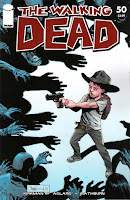
Cover to The Walking Dead #50
by artist Charlie Adlard.
The timeline of The Walking Dead's ascension to cultural phenom suggests that both Fantastic Four mini-series came prior (especially in the case of Adlard's work on The Storms) to the pair's work on the popular survival/zombie series. The first issue of The Walking Dead, written by Robert Kirkman and illustrated by Tony Moore, hit comic book stands in October 2003. By the release of issue 7 in April 2004, Moore had given way to the now familiar black-and-white artistic stylings of Charlie Adlard. The Walking Dead television series premiered in the U.S. on October 31, 2010.

While Kirkman has had success on Marvel properties such as (shocker!) Marvel Zombies (2005), the real back issue find here for me was Adlard's early work on an unusual background building mini-series featuring two key members of Marvel's First Family. Other than the recent publication of his earlier online series Astronauts in Trouble (hailed in recent Image solicits as "The series that brought... artist Charlie Adlard to the attention of Robert Kirkman"), I haven't seen any other work by him, that is, until now. Both Fantastic Four: Foes, written by Kirkman, and Adlard's pencils on Before the Fantastic 4: The Storms reveal two independent creative minds that would one day cumulatively birth The Walking Dead cultural phenomenon.

Fantastic Four: Foes was released as a six issue limited series in 2005 written by Robert Kirkman with art by Cliff Rathburn. Though I have not read any of Kirkman's other superhero books (Ultimate X-Men and his creator-owned Invincible, for example), this one plays into the strengths demonstrated in both The Walking Dead comic and television show: nuanced character development, with an emphasis on smaller interpersonal character interactions. This approach works well as this miniseries seeks to show us the Fantastic Four as family; the entire traditional supporting cast is along for the ride including Alicia Masters and the Richards children. The focus of the narrative is on how two of the family's foes (get it?) team-up to use the combined powers of  nearly their entire rogues gallery to finally defeat them. In telling the story, Kirkman tries to get at what motivates individuals, in this case super powered crazy individuals, to repeatedly attempt to do that thing which they have demonstrated little ability to succeed at: defeat Marvel's First Family.
Interior art by Cliff Rathburn
from FF: Foes (2005),
issue #5.

Cliff Rathburn's artwork is also fairly clean consisting of sharp lining and bright colors giving the book a look similar to an animation cell (perhaps this pairing was intentional as by this time Kirkman and Adlard had been working together and a clearly positive stylistic synergy had been developed). In Rathburn's hands, even the Thing's crusty rock-like hide, though minimally shaded for depth and texture, is smoothed and softened for a look very much like that of the old cartoon from the 1980s. Some awkward facial expressions aside, Rathburn's art does a good job communicating the close interpersonal relationships of the characters, even during series of panels with little to no dialogue.

After reading the limited series for the first time since its publication, it surprised me how many plot and character points have since become part of of Fantastic Four cannon. As a means of holding the captured villains, Reed builds a new Vault (prison) in the Negative Zone, a vision that would eventually be seen in the mainstream Marvel comic book universe during the 2006-2007 Civil War event. (In that continuity, the prison from Foes is not referenced as the Civil War prison is code named "Project 42" because it was the 42nd project they had developed after the Stamford tragedy.) Also, this series reintroduces the possibility of a bearded Reed Richards leading the team. Though used briefly following Reed's return form being lost in the past, the current visual presentation of Mr. Fantastic with full beard in Secret Wars is a design which is now cannon.

Just like old times: In issue #1
 Johnny is back to fixing cars!
Before the Fantastic 4: The Storms was one of three mini-series published, along with Reed Richards and Ben Grimm and Logan in 2000. Each mini-series focused on the characters that would ultimately become Marvel's First Family while weaving in minor plot elements that contributed to some of the larger storylines (none too memorable following the numerous ret-cons that have followed) in the main Fantastic Four at the time. Scripted by Terry Kavanagh, The Storms is very much in the vein of a Nancy Drew or Hardy Boys novel with Sue and Johnny serving as junior suburban investigators trying to solve the mystery of a magical amulet. Kavanugh does not do this at the expense of the classic character traits of both Sue and Johnny, including their big sister-little brother dynamic. Frequent nods to character nuances (Johnny's love of cars and girls, Sue's natural leadership ability) allow for the fan to easily see this fitting into the larger continuity of the Fantastic Four mythos.

At its core, The Storms is about showing the groundwork of these two key characters that could logically result in the building of the superhero team. This set-up, of course, leads the brother, sister and friends into conflict with all sorts of creatures of the night. In addition to the monsters they battle, other recognizable plot devices turn-up throughout the proceedings. The first issue alone includes the classic Scooby-Do investigative strategy of having a character, in this case Johnny, hide in a suit of armor as others offer helpful exposition and clues. As corny as this may sound, and as familiar as the tropes being intentionally applied may be, The Storms is a whole lot of fun.

Perhaps somewhat prophetically, the Storms' adventures give Charlie Adlard perhaps his earliest opportunity to publish artwork chock full of ghouls, monsters, and... wait for it... zombies! As entertainingly structured as Kavanaugh's narrative is, it is Adlard's artwork which grounds The Storms. The creatures that pursue and battle our heroes fit neatly into the real world visuals established by the artist in the first issue. Interestingly, the mini-series doesn't feel like a "superhero comic book" until one makes a brief guest appearance in the final issue.

The elements of Adlard's work that make The Walking Dead such an engaging read are visible in this earlier work--with the notable addition of a color palette beyond blacks, white and gray tones. Dynamic action and willingness to break from panel conventions in the interest of building energy propel the action forward. In fact, while much of the action in The Walking Dead is responsive in nature (the characters are acting out of necessity to survive certain circumstances), it was nice to see this dynamic flipped as the Storms take the fight to the bad guys. This slight shift in motivation is interesting to note.

Left, original panels from The Storms #3,
right: same panels recolored in grey-scale.
It would be easy to say that the only difference is the addition of color, but as you'll note from the original color and recolored black and white panels to the right difference is subtle and runs deeper. While the similarities are obvious (Adlard was still Adlard), there is an active motivation on the part of the protagonists throughout the Storms that only occasionally comes to the surface in The Walking Dead. Thematically, this makes sense. The Walking Dead is about establishing a norm, albeit a post-apocalyptic one, and building to various narrative climaxes; The Storms follows a much more basic plot map which requires action on the part of the characters to propel the much shorter, three issue story toward a logical resolution.

Given its growing place in popular culture, I am confident that someday a graduate student somewhere will write an amazing analysis of Robert Kirkman and Charlie Adlard's Walking Dead work in contrast to their earlier efforts. With little doubt, this analysis of those creative seeds will be of interest to both fans of the product as well as fans of good literature (which Walking Dead most certainly is). Until then, I will continue to periodically comb through my longboxes, hoping to inadvertently stumble across these sorts of issues. Not only does it create the chance to re-read such excellent mini-series as Fantastic Four: Foes and Before the Fantastic 4: The Storms in light of more recent comics, but, as is the case with these two minis, it's fun top revisit a time when superhero comic books had a stronger sense of FUN.

Eventually a precursor to Ghost Rider makes an
appearance in The Storms #3.

Saturday, December 20, 2014

Comic Bookshelf: Royal Blood (2014)

Knights of Christendom making a Prince & the Pauper style switch (page 10).
The sword-and-sorcery fantasy comic book is far from dead. In fact, it has seen something of a revival thanks to the re-emergence of old stars Conan and Red Sonja in series from Dark Horse Comics, combined with newer independent titles such Image Comics' Rat Queens and Helheim from Oni Press, not too forget an ongoing adaptation of George R. R. Martin's Game of Thrones from Dynamite Publishing.

While not the first graphic novel I've read by ionic Chilean-French filmmaker, and frequent dabbler in the sequential art medium, Alejandro Jodorowsky, Royal Blood is the first that was purchased and consumed immediately following it's American release. Very different in tone from my previous Jodorowsky reading experience, the neo-western Bouncer: Cain's Eye (reviewed here), Royal Blood also offers a decidedly different visual take, thanks primarily to the artwork from Chinese artist Dongzi Liu.

The "eccentric" storytelling most film fans are familiar with from the avant-garde Jodorowsky remains. Having seen his "acid Western" El Topo (1970), I knew to expect a level of philosophical and sexual subtext and Royal Blood delivers though with some inconsistency. No taboo is safe. As rendered by Lui's fantastic artwork and editorial choices as to what to depict visually, and that which is better left off-panel, the gritty tale of royal betrayal, amnesia, and incest is as elegantly portrayed as could be expected given the content. There was quite a bit to take in visually, due to Liu's beautifully rendered panels, but as a narrative, I had difficulty finding a character with which to empathize for more than 3-4 pages at a time.

In Joffrey-esque fashion young Prince Rador is revealed to be knd of a jerk (page 27).
In a story that is not nearly as taboo as it might have seemed prior to the mainstream success of the aforementioned Game of Thrones novels and cable show, Royal Blood follows King Alvar's loss of his kingdom and eventual quest to regain his stolen throne. It is a weird place in fantasy literature when incest (thanks to GoT?) is somehow so old-hat that a writer needs to up the ante to such extremes as Jodorowsky does here, in an effort to shock. Of course, Jodorowsky does "shock" as well as anyone, so if one incestuous relationship doesn't surprise, how about the suggestion of two?

Jodorwosky seems to have an awareness of this, as he includes a throwaway line in a ghostly monologue that ameliorates the impact of the on-panel incestuous pairing, while the second is merely suggested. Perhaps mutilation is the new taboo. Jodorowsky raises the stakes by putting his character through no less than three individual acts of mutilation., ranging from the commonplace (guess what happens to those whop talk too much?) to an act of self-mutilation on the part of the "protagonist" intended to ensure he has no more children.

Royal Blood is most definitely not an all-ages book and certainly not for the squeamish, though the art is so darn lovely...

It really is much easier to validate a marriage to your daughter if her bear agrees to serve
as the maid-of-honor when your king (page 49).
Despite the handsome artwork, and execution of fairly common narrative tropes, the challenge continues to be actually caring about any of the characters involved. As the primary character, noble King Aldar is just about to receive a level of sympathy from the reader, his characterization takes a turn for the worse by belittling and humiliating the woman who saved him. As one begins to empathize with her plight she reveals information that lessens her morel character too. And so it goes, each character throwing away any empathy afforded them by the reader until there is no one left to root for. I'll be darned though if I didn't find a level of an enjoyment in reading Royal Blood, enough so that I read it again a few days later.

Rador's sadism takes a very unnerving turn (page 63).
Coming in at 112 pages, the quality of the hard cover packaging of this novel, published by Titan Comics is impressive. As, for all intent and purpose, a stand-alone comic book issue, the paper quality, and binding are top notch. I've come to learn when purchasing graphic novels of this nature that the $16.99 price tag is very reasonable, especially given the high level of re-readability of the story. And that artwork... wow. Whereas, the 16 year-old fanboy in me would have balked at such a price for a single issue, the 45 year-old reader ordered it from his local comic shop sight unseen. Though I felt the storytelling and characterization was inconsistent, on Jodorowsky's name alone, and based on a few preview pages online was a no-brainer that, in terms of entertainment value, paid off.

While Alvar is not haunted by his wife/daughter's mother, Batia,
 she does appear frequently to laugh at his (many) misfortunes (page 86).

Saturday, May 31, 2014

Atomic Robo Goes West


Doc Holliday (top left panel) also appear in Atomic Robo: The Knights of the Golden Circle #1.
In the next 2-3 months, a number of the Western comic books that I have collected regularly for the past few years (Oni Press's The Sixth Gun , Dynamite Publishing's The Lone Ranger, DC Comics' All-Star Western to name three) will be concluding their current run. Fortunately, it would appear that another titles that I have occasionally dabbled with, Red 5 Comics' Atomic Robo, recently kicked off a five issue arc with a Western theme.

Atomic Robo strikes an iconic
Western pose... with poncho!
It was the Western hued pose of the title character on the cover (and a desire to show support of Western-themed comic books) that prompted me to once gain dip my toe in "The World's Greatest Science Adventure Magazine!".Created by writer Brian Clevinger and artist Scott Wegener, the series of Atomic Robo minis tell the adventure s of the eponymous main character who is a self-aware robot built by a fictional version of Nikola Tesla.

Atomic Robo and The Knights of the Atomic Circle #1 begins with our hero trapped back in 1884 Colorado, with a quickly expiring supply of nuclear fuel. When gunshots lead Atomic Robo to intervene on behalf of an elderly man, he finds himself setting off a turf war between notorious outlaws and a quiet Western town. Much like the Man With No Name (which the protagonist's outfit is clearly meant to reflect), Atomic Robo becomes the de facto leader of the town as he tries to protect them while escaping the wrath of the bad guys. There are broader plot points that contribute to Atomic Robo's larger story (apparently he or someone like him bearing the moniker Ironhide, has been "then" before), but past understanding of this greater story does not inhibit the enjoyment of the Western interlude.

As often happens in Western fiction, events transpire which place Atomic Robo in the path of far more familiar historical characters, in this case, go-to icon Doc Holliday. In addition to serving the purpose of recognizable historical figure for the reader, Holliday is also recognized by Atomic Robo, who is quick to recognize the necessity of adhering to the time honored time travel dictum of Star Trek, Sound of Thunder and Back to the Future: "Don't do anything. Preserve the timeline."

More than the start of a new adventure, the larger plot (and mystery) thickens!
While Atomic Robo and The Knights of the Atomic Circle #1 of  is primarily set-up for next issues confrontation between Atomic Robo's new acquaintances and Butcher Caldwell's gang, it remains a very entertaining all-ages read. As there is not much new ground covered here for the Western or science-fiction enthusiast, it is the clear affection and respect of Clevinger and Wegener  for both genres (and their character) that contribute greatly to the reader's enjoyment of the comic book. Best of all, in addition to having found a short-term Western to add to my pull list, I at the same time have happened upon a solid all-ages sci-fi title to both both follow and catch up with in my local comic shop's back issue bins.