Showing posts with label monsters. Show all posts

Thursday, July 16, 2020

Summer Re-Reading: American Monsters


A few summers ago, my interest in cryptozoology was rekindled. Initially nurtured in my childhood by a steady diet of my parents’ copies of World News and the National Enquirer, this interest has re-emerged thanks in part to a new interest in folklore as well as listening to a number of excellent crytpid and folklore related podcasts and reality television shows. Once a niche filed of ineterst, well-written and academic reading about such creatures as the Mothman, Bigfoot and others has also  become much more readily available. Though there was magic in the halcyon days of Bat Boy, the writing has also become more polished, professional and consistently entertaining.

Due to the clean writing style and accessible nature of her writing, Linda S. Godfrey has quickly found her way to my nightstand as one of my go-to cryptid informer and literary palette cleansers. “One of America’s foremost experts on mystery creatures”, Godfrey’s books take a journalistic approach to retelling anecdotes and presenting histories of a variety of “monsters”, both familiar and unfamiliar. American Monsters: A History of Monster Lore, Legends, and Sightings in America spans an extensive timeline of experiences, often relayed through first-hand accounts of a multitude of incidents with mysterious creatures. While re-reading sections this summer, I was also pleased to see the number of secondary sources from smaller publishes she references, in particular, those dealing with local or regional folklore.

"Wendigo" illustration, page 254.
The encyclopedic text is divided into three parts, Air, Sea and Land, and further organized into chapters. Each chapter is then broken into small accounts of related creatures ranging in length from one to four pages. The anecdotes also include reference to numerous sources, information from which is used so effectively I found myself keeping a small "to read" list of these small press publications. This org -group. The book opens, for example, with “Part One: Monsters by Air”, beginning with “Chapter 1. Feathered Fiends” before moving into tales of Bigclaw, the Micmac Culloo and other historical Big Birds. In a language that is conversational and a tone that is suggests a suspension of disbelief, the writer comes across as neither pandering nor naive. Godfrey clearly lays out the experiences of  individuals in a manner that evokes each the eerie mood of each encounter and evokes the historical and cultural context from which each emerged.

One of the book’s chief accomplishments, beyond being wildly entertaining, is taking advantage of opportunities to add additional layers of insight to those topics readers might incorrectly presume they have heard everything about. The expert here is clearly Godfrey and she’s come equipped with multiple approaches to each subject. An excellent example of this is the section entitled “Challenge of Chupacabres.” Having seen the X-Files episode as well as one or two short videos on YouTube, it might be easy to assume one has all the relevant information necessary to make a personal call on the existence of this “hell monkey”.  While not offering a definitive answer on the existence of chupacabres, Godfrey does provide some examples of encounters and sightings with ancillary creatures that may be related to the Chupacabra phenomenon. Throughout the text, Godfrey also provides samples of photographic evidence and illustrations that range from the evidentiary to the ornamental. (As an aside, that evidence which is referenced throughout, but not included here, is readily available via a quick online search.)

American Monsters is a very entertaining and informative summer reading selection which continues to foster a personal interest in unusual creatures and the zeitgeist from which they sprang. In so many ways, each story is telling a small piece of the American story, which I continue to find fascinating. My guess is that if you take the chance to pick-up this unique tome, you will find the same.
*Originally posted 7/23/18, Revised 7/16/2020

Friday, December 06, 2019

Comicbook Shelf: Krampus: The Shadow of Saint Nicholas (2015)

From "I" written by Zach Shields and Todd Casey with artwork by Christian Dibari and Mark Spicer.

Not surprisingly, the cover
by Fiona Staples is one
of the artistic high points.
Four Decembers ago, following a media-fueled folk horror-frenzy, this slender, softcover volume found its way to my comic book shelf. Released in concert with the feature length movie Krampus (2015), Legendary Publishing's Krampus: The Shadow of Saint Nicholas shares many of the same qualities that made the film entertaining. This graphic novel features stories crafted with the film's  writer/director Michael Dougherty credit with a "Stories by" credit. While Krampus the movie focuses on a single family's experience with the demon and his minions, The Shadow of St. Nicholas employs an anthology approach to broadened the primary antagonist's impact on a wider range of unrelated characters.

As with other Legendary Pictures/Publishing tie-ins for genre films (see Godzilla: Awakening (2014) and Pacific Rim: Tales from Year Zero (2013)), the formula remains the same here: include the film's original creative talent, in this case Dougherty, to develop ancillary stories that reflect signature elements of the overall narrative of the film. While thematically related to the movie, having seen the movie prior is not necessarily key to its enjoyment.
Krampus' minions are back
in "II" with art by Maan House
and Guy Major.
Given the Krampus character and perhaps Dougherty's affinity for anthology sub-genre, The Shadow of Christmas is successful in accomplishing what the filmmaker says the intention is behind this project in the collection's introduction, "to deepen your [the reader's] love of the character [Krampus]..." Visually, the artist team keeps the best visual component of the movie, the well-realized practical creature designs, in the graphic novel. Each of the four stories, titled as Roman numerals I through IV, are all written by Zach Shields and Todd Casey (Laura Shields is also a credited co-writer on "II"). Each story is grounded in a modern setting familiar to American readers that creates the opportunity for a hint of the "ancient in a modern world" dynamic that worked so well in the movie.

Splash page of Krampus from
"III" by Michael Montenat
and Mike Spicer.
The most polished of the four stories is the first and if each of the four were to be thought of as pitches for a potential Krampus sequel, "I" also makes the most sense. Simply put, "I" is a tale of redemption. A "bad" department store Santa seeks validation by combating the forces of Krampus to protect others who are more worthy than he to live on. The story is a reminiscent of other Twilight Zone-style stories and while offering no real narrative surprises, the professional execution makes for an enjoyable reading experience.

Much of your appreciation if this graphic novel as a whole will depend on your enjoyment of the burgeoning Krampus mythos in modern mainstream media. If, like me, you dig contemporary iterations of archaic folklore, The Spirit of Saint Nicholas is worth seeking out. As a fan of the movie Krampus, recommending this companion piece is easy. The inherent re-readability of a quality anthology makes the $14.99 cover price well worthwhile.

Thursday, July 02, 2015

Extraterrestrial Encounters of the Literary Kind

I miss good used book stores. Not the shops that tear half of the covers off or only carry titles  that no one ever purchased in the first place (after all we still have the Dollar Store for those), but stores that sold previously read (and loved) books that were unusual or long out of print. I recently came across some books that had been purchased at a long closed used book store in my neighborhood, the Brown Bag Bookshop. They would carry all genres of unique and hard-to-find titles, some that were of great (intellectual) value. Among those books was one that may may prove very valuable in the alien-invasion-end-days-to-come, Barlowe's Guide to Extraterrestrials: Great Aliens from Science Fiction Literature.

Illustrated by Wayne Douglas Barlow ("the John James Audubon of otherworld creatures," or so the inside cover announces) and written by Ian Summers and Beth Meacham, Barlowe's Guide a comprehensive text and image of fifty alien creatures and worlds from science fiction literature. Drawing from the witting of prominent sci-fi authors such as Alan Dean Foster  and Ursula  K. LeGuin, the trio have crafted a beautiful collection of detailed illustrations and biographical info for a variety of literary alien species. With all the information one would find in a traditional field guide, including a gate-fold "Comparative Size Chart," this collection is a fantastic resource for fans of sci-fi literature as the drawings are based on the source documents from which they spring.

Sadly, this copy had been on my shelf during the time I actually read (or re-read) a number of the novels referenced within, and in some cases the visual would have helped by early comprehension. In other cases, the artist's visual interpretation based on his reading of the boo or story varied from my own, but it was interesting to consider just why that may have been. Looking back, there is a pretty huge spoiler for one of the novel's on the cover which I am glad not to have seen before reaching that point in my reading.With so many class pieces of science-fiction literature represented, and iconic creatures, it was a challenge to choose only of a select few favorites to share here.

Barlowe's Guide, page 68.
Barlowe's Guide, page 70.
Barlowe's Guide, page 98.

Published in 1979 by Workman Publishing, the copy I bought was only $8 in beautiful condition only six or seven years ago. A quick search online reveals that there are quite a few copies of this classic book available at the usual places, for not very much money at all, and many of the images can now be seen on the Interwebs, and a more detailed listing of the species included (along with source documents) within are viewable at it's Wikipedia entry.

Wednesday, June 10, 2015

Run Reader: Giantkiller (1999)

The opening page of Giantkiller Book One by
Dan Brereton, August 1999.
I enjoy reading and collecting two comic book sub-genres that are published with little regularity or consistency: giant monster (or "kaiju") and Western titles. Beyond familiar characters with high name recognition such as Godzilla or The Lone Ranger (both of which have current or recent iterations that are thoroughly entertaining), few titles from these two comic book sub-genres regularly see publication. This is especially true of titles published by the industry's "Big Two," Marvel and DC. While each will occasionally nod to their own giant monster-cowboy past with titles like DC's Jonah Hex or Marvel's current Secret Wars mini-series Where Monsters Dwell (both solid titles), few new characters are developed and promoted. There was a time though, when the comic book industry was on life support (or so I've heard) and willing to take greater creative risks,

The cover to Book Three.
While thumbing through some ancient longboxes last week, I re-discovered a long forgotten gem that incorporates classic elements of giant monster books with a common Western archetype thrown in for good measure, the 1999 DC miniseries Giantkiller. Written and drawn by Dan Brereton (most well know for his 1998 collaboration with Howard Chaykin, Batman: Thrillkiller), Giantkiller is basic in its plotting but dynamic in its presentation.

In the far-flung future world of 2002(!), atop Mount Diablo, "across the bridge from San Francisco, past the hills of Oakland" an inter-dimensional portal has opened releasing all sorts of Lovecraftian "daikaiju" or giant monsters. In an effort to confront these horrors, our government does what years of reading sci-fi and comic books have taught all of us what the correct answer to this problem is: experiment with evil DNA in an effort to develop super-soldiers.

One of the many spectacular
splash pages in Book Four
of Giantkiller by Dan Brereton.
The first product of this experiment, who as it turns out is our story's primary narrator, is Jill, a young woman who is injured while acting as an FBI agent charged with breaking up a cult dedicated to worshiping the creatures. Found nearly dead, Jill is resurrected following a hybridization process using the monsters' DNA. Eventually Jill goes native and is labeled "a lost cause" by the lead scientist responsible for her transformation, Dr. Steven Azuma. Following this first perceived failure, the good doctor to turn his sights toward an experiment with greater potential, Project Giantkiller.

The fruit of Project Giantkiller is the hero of our tale, a human-like creature (with a claw-tipped tail) christened "Jack," though he is affectionately referred to by Dr. Azuma and his team by the nickname "Yochu." Jack is educated ("Grades K through 6 lasted exactly two weeks.") and trained following his "birth," and armed with a samurai katana fashioned from the tooth of one of his "titanic relatives" which he names "Kiba" (Fang).

A number of mysteries involving our two protagonists are introduced and resolved during the course of the series as Jack and Jill meet in the kaiju -populated zone around San Francisco, and ally themselves with one another in an effort to close the portal. In a particularly clever move, writer-artist Brereton embraces the ethical quandry inherent in Jack's role as an agent of destruction pointed at his own race, and his willingness to address the reader's questions within the context of the narrative contributes to Giantkiller's success as a story.

"Friendly" monster,
Nox, from Book Five.
Brereton allows his energetic artwork to tell the story during the monster battles, and relies heavily on characters, most notably Jill, to deliver background exposition about the fictional world they inhabit. Despite this, I never felt weighed down by the necessity of information-sharing. Brereton characterizes Jack as a no-nonsense, action-oriented hero, so the moments during which he is engaged in battle are free of witty-remarks and absent nearly all dialogue beyond monster sounds and sound effects. It is in Jack's characterization that the Loner archetype (a la Western icons such as Shane and the Man With No Name) is employed. Jack is a monster, but he is also fighting on the side of "good," despite the natural urges deep in his DNA to be alone on his quest, he does meet those with whom he connects.

I couldn't help but notice some superficial  similarities, however, with Mike Mignola's Hellboy. As I was drawn into the world Brereton was crafting, I wondered if these similarities were part of why this potentially marketable character and his world have not since been revisited in some medium. Both Hellboy and Jack the Giantkiller work with (for?) a paternal character who raised them, and both also use their "sons"to somewhat surreptitiously further personal interests. Both are supported by female counterparts that are themselves cursed with abilities that make them distinct form the world around them. Given the opportunity to develop his character, it would have been fun to see where Jack and Jill, in Brereton's skilled hands, could have taken us.

As it stands, Giantkiller remains a promising introduction to a world and characters that work well as a single, inclusive mini-series. This is due primarily to Brereton's work, both as artist and writer; together his clear affection for the genres is infectious.

Giantkiller is a comic book miniseries originally published by DC Comics, along with a one-shot handbook called Giantkiller A to Z: A Field Guide to Big Monsters (which within the context of the story was written by Jill in her early days as a monster hunter for the government). The series has since been collected in a trade-paperback format by Image Comics. Both are still available in the back issue boxes of quality local comic books shops.

Jack the Giantkiller battles Shrill in Book Two.

Saturday, February 07, 2015

Seen It (Again): Pacific Rim (2013)


My son and I went to see Guillermo del Toro's Pacific Rim when it was released two summers ago, and, like many, we left the theater disappointed. We had entered with high expectations of a modern Godzilla-type movie and walked out let down. As a both a fan of Toho's Godzilla movies in youth and a parent who had shared these beloved films with his son, I was hoping for a theatrical experience over which to bond. In retrospect, much of our criticism lay with the performance of the male lead as well as the difficulty in processing the multiple visual and sound stimuli being thrown at us.

This kaiju let down did not, however, dissuade me from continuing to watch, and in some case re-watch for the umpteenth time, classic giant monster movies. In the months since seeing Pacific Rim, I have rewatched a number of relatively "modern" Japanese-produced kaiju movies from both Toho (including Godzilla: Final Wars (2004)) and Daiei (the mid-Nineties Gamera trilogy) Motion Picture Studios. While I enjoyed each of these films, with so many tonal similarities with Pacific Rim, I began to think that maybe I had been wrong in my dismissal of del Toro's giant monster movie.

This past Monday our school had a snow day, and I took advantage of the morning to re-watch Pacific Rim. The original from 1954 and the most recent American adaptation, Godzilla (2014), not withstanding, Godzilla films have never really been about serious actors and serious issues. My Godzilla was the ping-pong ball-eyed hero of Japan (1973's Godzilla vs. Megalon will always be my personal gold standard) who regularly bonded with orphans and latch-key kids while battling an assortment of mutated animals, aliens and pollutants. While the too-serious Godzilla (2014) definitely forgot that (as well as the epic battles), my hazy recollection of Pacific Rim was that it had been less about serious issues and more about simple, giant monsters and robots fighting.

My Godzilla, circa 1974.
Upon further review, Pacific Rim really did get much more right than wrong, and was a surprisingly more rewarding film experience on our 40" flat-screen than in the movie theater. Among the things I had noticed initially as negatives but appreciated later as plusses, were the flat human characters that peopled the movie. Truth is, while Charlie Hunnam as Raleigh Beckett will never be mistaken for Laurence Olivier, or even Mel Gibson, he did effectively fill the role of bland, plot-mover quite nicely. Nobody remembers the lead actors in Godzilla movies, a universal truth which Hunnam illustrates fully. (Fortunately, for those not inclined to accept the old kaiju tropes, most of the other actors such as Idris Elba and Rinko Kikuchi didn't get that memo and are surprisingly charismatic and engaging despite bringing to life broadly written characters.)

I would also suggests that the story itself is far more ambitious than given credit. Rather than setting his "giant monster movie" within an easily recognizable world, del Toro and credited co-writer Travis Beachum opt to create a modern, post-origin world already effected by the emergence of its primary threat. While Godzilla did indeed battle aliens from Planet X very early in his filmography, the primary settings always represented a presented day Japan aesthetic (Godzilla Final Wars being the most obvious departure with it's airborne battle ships and G-Force).

The bottom line: Pacific Rim is much more entertaining than I originally gave it credit for and is that unique movie that improves with repeated viewings... at least to this old school kaiju fan.

Saturday, October 11, 2014

Creature Feature Cards Unearthed!

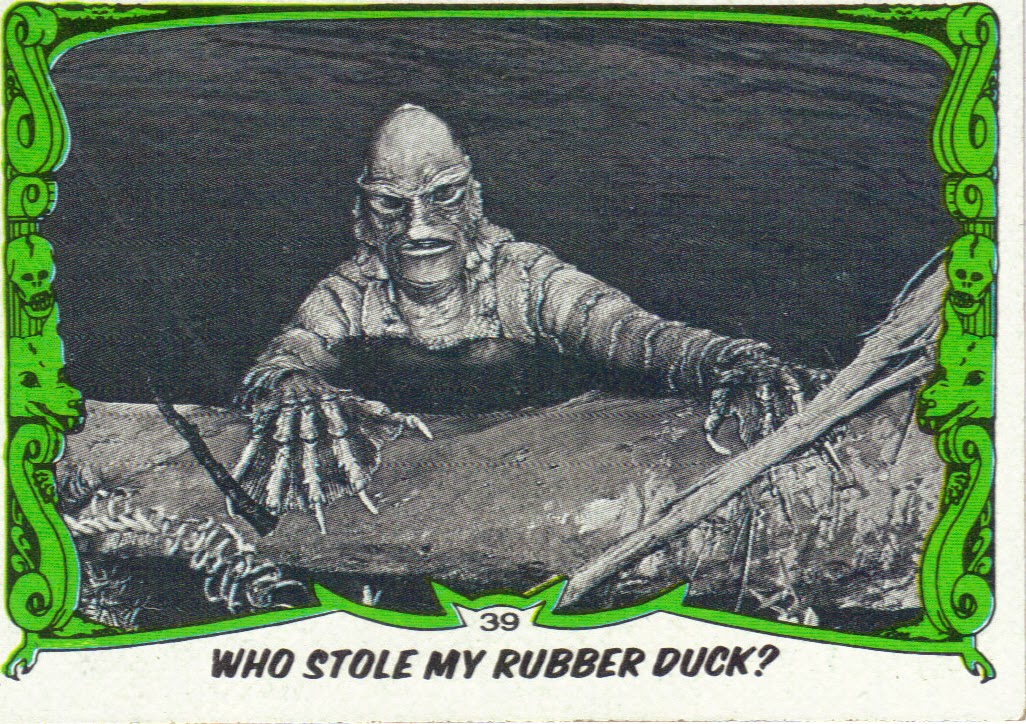
ON THE FRONT: The amphibious Gill Man from the Amazon, 
"Creature from the Black Lagoon" (1954).
Waking up at 3 a.m. I find myself digging through a stained cardboard box of old trading cards, when the time travelling begins... Though not encased in plastic sleeves, and with softened corners and some slightly discolored images, when I purchased these varied sets (most never completed and the result of only a few single packs purchased) issues of preservation or potential value speculation were of little interest. I was ten years old and it was all about the stickers, hard gum and cards.

This morning I dug past those sets (again, in varying rates of completeness) such as Buck Rogers In the 23rd Century (1979), Star Trek the Motion Picture (1979) and Moonraker (1979), for something seasonal. With autumn in the air, and  Halloween just around the corner, I was pleased to find such a large number of Topps' 1980 Creature Feature cards adrift in the box. In addition to the cover card, and two of 22 possible stickers, I cobbled together about 60 different cards with (of course) numerous doubles, While I could give background about the Topps set, I'd rather point you to others (such as Mr. Potter's Fun-time Blog) who have already done so far better than I could have.

The Masked Phantom from
"The Phantom of the Opera" (1925).
Something was clearly in the air back in 1980 as I vividly recall buying these packs up at the Quick-and Easy, our local convenience store which also introduced me to comic books (on the wire spinning rack) and coin operated video games (Space Invaders, naturally). Back then, my brother and I would walk the two blocks to the store, look through the comic books, and check on any new trading cards that may have arrived. Bitten by the collecting bug thanks to Star Wars trading cards years earlier, we were game for nearly anything that came out.

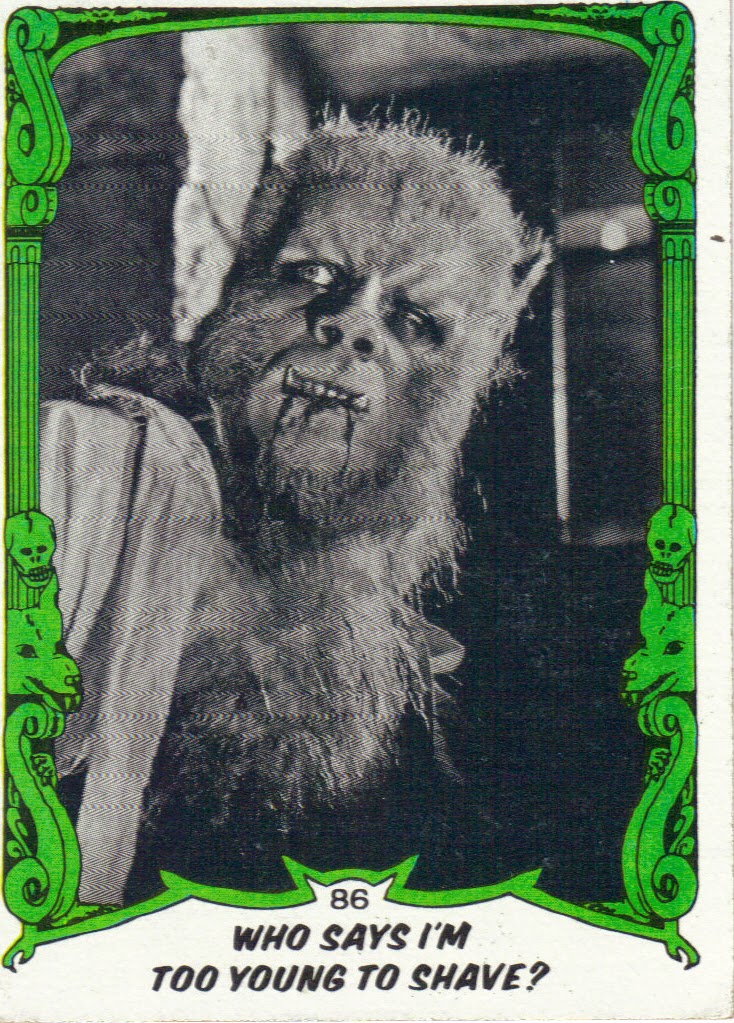
Looking back at these cards now, my response now is likely very similar to the reaction I had many years ago. Hardly as humorous, they are after all from the "You'll Die Laughing" series, as intended, the black and white stills and images of famous (Boris Karloff as the Monster) and not-so-famous (Bela Lugosi as the Monster) actors and the creatures they portrayed are beautiful. The set includes the iconic (such as the aforementioned Frankenstein's monster as well as the prominently featured Creature From the Black Lagoon films) and lesser-known but beloved (by me anyway), Oliver Reed's werewolf in Hammer Films' The Curse of the Werewolf.

On the back of each card, in addition to a lame pun, joke or anecdote, is a very brief caption describing whats "ON THE FRONT." Unfortunately, the actors in each movie still are not credited, but fortunately I watched enough afternoon chillers to figure it out, so I've added (where possible) the names of the actor(s) involved using [brackets].

The Creature from the Black Lagoon.
The 22 stickers are of "Monster Hall of Fame" members and original movie posters, or at least those that Topps had the rights to include. I loved the Creature (above) as a child, and feel the 1925 Phantom of the Opera, above, right, is still among the creepiest monster visuals in film.

ON THE FRONT: The air-breathing humanoid known as The Gilman
[Don Megowan] from "The Creature Walks Among Us" (1956).
The card above with a still from the third Creature movie refers to him as "The Gilman," (card #3 above), as opposed to "Gill Man" (card #39, top of post, and #68 below). While very likely a typo, it makes me wonder if the idea was to give him a more human name, though something more traditional might have helped him better acclimate to life on land.

These jokes still kill.
ON THE FRONT: Kharis [Lon Chaney, Jr.] the crumbling one
carries on in his third feature movie, "The Mummy's Ghost" (1944).
ON THE FRONT: A scene from the original "Frankenstein" (1931)
[starring Boris Karloff].
ON THE FRONT: A creature [Eddie Parker] from the past threatens the student
body in "Monster on the Campus" (1958).
ON THE FRONT: A fellow [Bryant Haliday] turned inside-out when an experiment went awry 
in "The Projected Man" (1964).
ON THE FRONT: The Gill Man [Tom Hennesy] was the most famous
movie monster created in the 1950's, from "Revenge of the Creature" (1955).
ON THE FRONT: Two of the screen's mightiest monsters
[played here by Bela Lugosi and Lon Chaney, Jr.] were 
featured in "Frankenstein Meets the Wolf Man" (1943).
ON THE FRONT: The hairy horror of "The Wolf Man" (1941)
iconically portrayed here by Lon Chaney, Jr..
ON THE FRONT: Only a silver bullet can end 
"The Curse of the Werewolf" (1961)
[here played by Oliver Reed].
ON THE FRONT: Kept alive for 5,700 years, it's Kharis [Tom Tyler]
from "The Mummy's Hand" (1940).
ON THE FRONT: The Cyclopean Xenomorph (got it?) from "It Came from Outer Space" (1953).
I'm definitely using this one at the next happy hour.
ON THE FRONT: Once a household pest, now 100 tons of horror, "Tarantula" (1955).
ON THE FRONT: "Feast your eyes, gut your soul,
behold my horror!" Another scene from the classic "Phantom
of the Opera". (1925) [starring Lon Chaney, Sr.]
ON THE FRONT: "The Mole People" were prehistoric creatures who lived at the
center of the earth in this 1956 chiller.
ON THE FRONT: From "This Island Earth" (1955).
All the creatures depicted in these cards are from films released in the U.S. by Universal. Given Universal Studios' current efforts to reboot their "Classic Monsters" in a shared "universe" (a' la Disney/Marvel's successful films) with the recently released Dracula Untold (2014), one wonders who may show up in future films. While Wolf-man, the Mummy and Frankenstein's monster would appear sure things (if Dracula proves financially successful) how great would it be if we also saw an update of The Mole People or  the long in development Creature from the Black Lagoon update?

Always leave 'em laughing!

Saturday, July 05, 2014

Run Reader: Gamera #1-4

From Gamera: The Guardian of the Universe issue #1 (1995) by Mozart Couto and Mike Sellers. 
Now that the American mainstream's momentary case of kaiju-fever has been stilled, thanks to Gareth Edwards' Godzilla's quick exit from the top of the movie charts over a month ago, giant monster movie fans have probably overdosed on the re-releases of the Big G's more recent film offerings. I know I have. It is worth remembering, however, that while certainly the most prominent giant monster star, there are others worth following in both film and comic books form.

Cover to issue 2 by artist Yuji Kaida, who
 supplied beautiful covers for issues 2-4.
Which makes this the perfect time to revisit one of Godzilla's Japanese studio competitors, Gamera. While Godzilla (and Toho) have had a fairly extensive comic book history in the U.S. ranging from Marvel Comics classic late -70's run by Doug Moench and Herbe Trimpe to the current IDW series, Gamera's exposure has been limited to a single 4-issue miniseries published by Dark Horse in 1995.

Hot on the heels of the Japanese reboot by Daiei Studios of the original Gamera kaiju series of films in 1995, Gamera: The Guardian of the Universe, written by Dave Chipps with art by Mozart Couto and Mike Sellers, was published as a direct continuation of the movie of the same name. Because there were eventually sequels to the original (which in the end comprised a trilogy of excellent films, the second of which is reviewed here by moi), in terms of continuity, it acts as sort of an alternate take on the trilogy using the film as the starting point.

Page one of the Gamera
beginner's guide from issue 1.
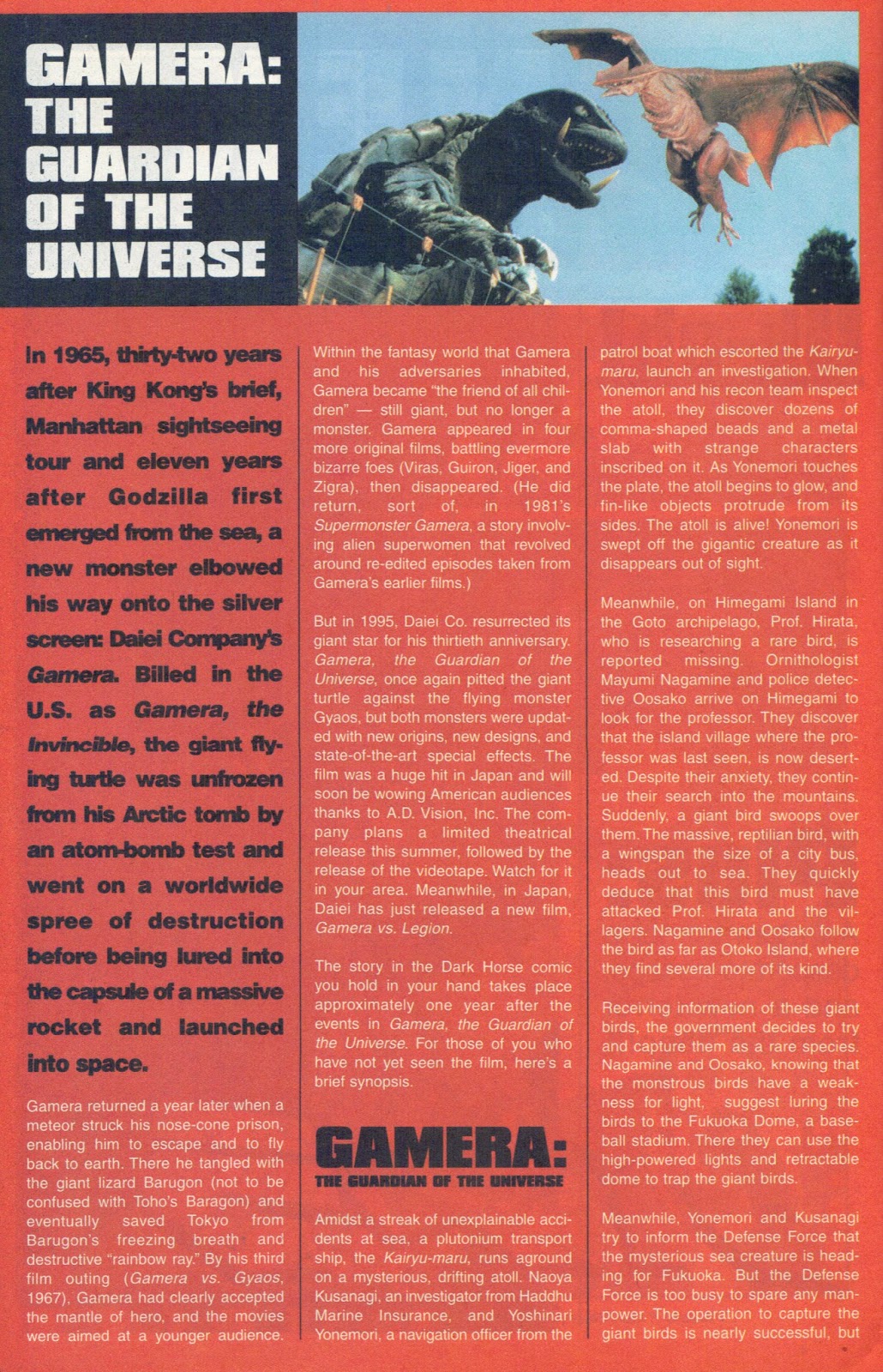
For any who had not previously seen the movie, the comic book contains a two page synopsis introducing both the main characters and summation-of the relevent plot points of the movie. The comic book picks up one year following the events of the movie, though it can be read as a stand alone mini-series, the understanding of the relationship between the Gyaos (the primary "villain" in both the movie and first 2 issues of the comic book) and Gamera, as well as Asagi's connection to Gamera.

A quick search revealed that Gamera: The Guardian of the Universe writer Dave Chipps carved out a small niche in Japanese manga translations, such as Oh! My Goddesses and Gunsmith Cats, for a period of time in the 1990s. Chipps does a nice job in this series alternating between the human and monster stories, while developing the Gamera amulet mythology (it's how Asagi communicates with him). In the interest of aiding any readers new to the character, there is quote a bit of exposition provided during character interactions, but in each case it proves necessary to insure understanding of what is happening.

Gamera versus Zigra from issue #3 (1996)
by Mozart Couto and Mike Sellers.
The artwork by Mozart Couto and Mike Sellers is unremarkable but effective especially given how terribly wrong it could have gone given the era from which it comes. The colors are vibrant (Gamera never looked so green), and the panels are well composed. Whether an effort to communicate the bombastic nature of giant monster fights or not, there is a healthy use of sound words in panes depicting kaiju battles. See the panels to the left and below for examples.

I quite enjoyed the Gamera miniseries, despite (at the time) not having much backstory on the character. The consistency of the creative team and solid story-line made for a nice quick run read, and brought me back to rewatch the most recent Gamera trilogy. While not available in trade paperback, individual issues can be found at most local comic shops with a solid back issue stock or online for half-off the original cover price of $2.95. With Godzilla's recent Hollywood reboot in the books and a new take on the Teenage Mutant Ninja Turtles on the horizon, one can only hope that Gamera is not too far behind--as noted on the cover to issue #2, he was the "Original Mutant turtle!"

Gamera versus Viras from issue #4 (1996)
by Mozart Couto and Mike Sellers.

Monday, April 28, 2014

Seen It: Cannibal Holocaust (1980)


A fan of both spaghetti westerns and horror it was probably only a matter of time before the unrated Cannibal Holocaust found its way into by DVD player. Unfortunately, as Cher once hoped, I, too, wish I could turn back time. After having my nineteen year old son beg out of a viewing this with his [juvenile] old man after seeing the trailer ("I don't think this is my thing, Dad.") his apprehension proved to be justified. Watching what I knew was intended to be shocking, I had a variety of feelings, most of which ultimately led to regret.

Directed by Ruggero Deodato, from a screenplay by Gianfranco Clerici, Cannibal Holocaust  features a collection of incredibly unlikable protagonists played by actors who were rightly never heard from again. While unfortunate for the careers of the actors involved, their anonymity thereafter actually contributes to the movie's faux-reality set-up: they (or the characters they play) are, after-all, presumed "dead."

The most appropriate movie poster
I could find online.
As summarized by Wikipedia, Cannibal Holocaust "tells the story of a missing documentary film crew who had gone to the Amazon to film cannibal tribes. A rescue mission, led by the New York University anthropologist Harold Monroe, recovers the film crew's lost cans of film, which an American television station wishes to broadcast." What Monroe views on those recovered reels prompts him to question not just the perceived heroic nature of the film crew, but also the scruples of the broadcast company which seeks to profit from the footage.

The gore so prominently featured in most of the advertising associated with the movie serves to cement the antagonistic and base qualities of those same characters who are initially presented to we, the viewer, as it's "heroes." The fate of the documentary crew is clear from the onset (and the DVD cover art): they will be eaten by cannibals and it will be graphic. What is not clear until the end is that [SPOILER] their grisly fate is more of a comeuppance for their base and degrading behavior toward the environment and peoples they come across while tramping through the "Green Inferno" [END SPOILER] than the result of random fate.  In the pervasive not-too-subtle irony on display here, they fall victim to the same natives who's death and loss they hope will bring them the fame they intend their footage to gain them.

Some other points of interest include:
  • The inclusion of real animal cruelty. Real live animals from the jungle are slaughtered on film in a manner that can be a little disconcerting. That is not an animatronic turtle being dismembered and eaten by the would be documentarians. The charge of animal cruelty was just one of the reasons Cannibal Holocaust  has had a long (proud?) history of being banned. On the DVD I watched there was a "Cruelty-Free" version of the film for viewing in addition to the original edit.
  • Never have the Eighties (the movie was originally released in 1980) had such a late-Sixties/ early-Seventies vibe to it. The hairstyles, attitudes, visual hues and music on display have an anachronistic quality. This does however add to the time-capsule tone of the movie. The most memorable line in the movie is when the lone female--in the midst of chaos and mayhem--breaks the fourth wall to her cameraman and suggests "You know if this were New York, I'd probably be shopping right now!" Odd? Yes, but the line's possible comedic delivery loses all humor when taken in the context of the worst part of the movie.
  • With a title like Cannibal Holocaust one would reasonably expect the gore and violence to be rough. Surprisingly, though, by far the most offensive part of the movie is not the phony, staged cannibal-feasting scenes or even the real examples of animal cruelty, but rather the truly ugly treatment of women. While I am certain some college student can (and I'd bet dollars-to-donuts many have) write a dissertation on the symbolic nature of the treatment (the most chilling and degrading acts against women all stem from the behavior of the three idiotic Anglo male filmmakers) it plays as unnecessary. While I can stomach stupid, fake horror, the acts perpetrated against the female characters in Cannibal Holocaust are in shockingly bad-taste, even for a grindhouse flick. 
So is Cannibal Holocaust worth seeking out? As an entertainment it falls very flat. As a time-capsule consideration of late-Seventies shock film--or even as an exercise in how Italians viewed American culture--there is some small value to be had, most of which would be better left to hipsters and college students. The likelihood of my ever watching this again (a personal indicator of a movie's appeal for me) is nil, and I am both pleased and grateful that my son had the good sense to walk away from the Cannibal Holocaust experience when given the opportunity.

Wednesday, March 12, 2014

Seen It: Godzilla vs. Biollante (1989)


I would have loved to have been at yesterday's SXSW presentation of Gareth Edwards soon-to-be-released Godzilla flick. The Big G and I go way back and this May's film may go a long way to bringing him to even greater prominence (or at least an appreciation of his past greatness). It can do no worse, in most fans' eyes, than 1998 Rolan Emmerich effort. After reading about the presentation on a few fanboy sites, I decided to spend a small part of my day re-viewing 1989's Toho effort, Godzilla vs. Biollante (1989).

The seventeenth(!) installment in the Godzilla series, the film is a sequel to The Return of Godzilla from 5 years earlier (one of the series' many reboots that also fit into a larger chronology) and featured a new "monster" called Biollante. I vaguely recall the movie being released in the early Nineties and, at the time a fallen-away-fan, thought the premise of a "killer flower" sort of silly and a bit unworthy of Godzilla's attentions.

Now a decade later, and a little less jaded as evidence by being more willing to accept entertainment-for-entertainment's sake, the error of my ways is clear. Godzilla vs. Biollante is a very solid Toho kaiju flick which does not (like most good Toho flicks) require you to have seen the previous film, though there are plot points for those interested in the scope and sequence of Godzilla's adventures. Much like one of my personal childhood fave "villains," Hedorah (the Smog Monster), Biollante has some fairly noble intentions, especially given the circumstances of her creation, and goes through a series of developmental stages prior to the fighting-form metamorphosis in anticipation of the big finale (**SPOILER: Unlike Hedorah, Biollante actually has a final metamorphoses following her battle with Godzilla thus resolving the conflict END SPOILER**.) These small similarities, as well as the characterization of the King of All Monsters, help to elevate this film beyond that of a pleasurable reminiscent of one of my favorite childhood Godzilla movies.

The human characters and actors in Godzilla movies are often dismissed as being lesser talents by the uninitiated, but the human stars of Godzilla vs. Biollante put in good performances, most notably future series regular Megumi Odaka, while filling the narrative spaces between monster attacks. This movie also introduces and updates (or solidifies if these may have in fact appeared in earlier films I missed) some new Godzilla tropes. What had in my youth been random child characters who just happened to hit it off with Godzilla are now intuitive phenoms under the tutelage of the psychic teacher Miki Saegusa (Odaka). The Japanese tech used by the Japan Self-Defense Forces (JSF) also receives an upgrade from the previous film introducing the Super X II, a forerunner to what will ultimately be, I assume,  the United Nation's designed Moguera bot of later films.

One doesn't watch Godzilla movies for Shakespearean drama or comedy, though smarter fans than I may be able to make the case for that being part of the plan, but rather the be entertained. I continue being entertained by Godzilla vs. Biollante (1989), a feeling that has not been diminished greatly despite repeat viewings.

Koji Takahashi (left) as Dr. Genichiro Shiragami and
Megumi Odaka as Miki Saegusa (right).
Fun Fact: This Godzilla story was the result of Toho Studios' request for fan solicitations of potential story ideas. The contest was won by Shinichiro Kobayashi, a dentist and occasional science fiction writer!

Sources:
Godzilla vs. Biollante Wikipedia Page

Saturday, October 05, 2013

Read It: Breath of Bones

The calm before the storm in Breathe of Bones #1.
Responding to a prompt about revenge in class this past week (an activity for thematic background building during our study of Beowulf/Grendel's mother section of the epic poem), a student inquired as to the spelling of a character's name from Tolkien's Lord of the Rings trilogy: "Is Gollum spelled G-O-L-E-M?" This incorrect spelling of the ring-thirsty Sméagol prompted me to ask if anyone in the class knew what a golem (G-O-L-E-M) was.

Though familiar with "Gollum", not a single student had heard of a "golem" before. Simply put (thanks to Wikipedia) "In Jewish folklore, a golem is an animated anthropomorphic being, created entirely from inanimate matter. There are many tales differing on how the Golem was brought to life and afterwards controlled." Like much of the smaller pieces of information I have trapped in my skull, the kernel of my own basic understanding of a golem was planted by my having read both books about monsters and things-that-go-bump-in-the-night as a child and from a healthy dose of comic books. Very recently there was a Dark Horse comics three issue mini-series that portrayed a fairly realistic depiction of that same creature, Breath of Bones: A Tale of the Golem.

Written by horror star Steve Niles (perhaps most well-known for creating 30 Days of Night to non-fanboys) and beautifully illustrated in blacks, whites and grays by Dave Wachter, when released, Breath of Bones came in under my comic book radar. I have made the mistake before of missing less heralded mini-series, and later being unable to catch up with them in single issues. Fortunately on this occasion, thanks to my local comic shop and a quick read of numerous glowing reviews, I was able to correct my error early on in the three issue run.

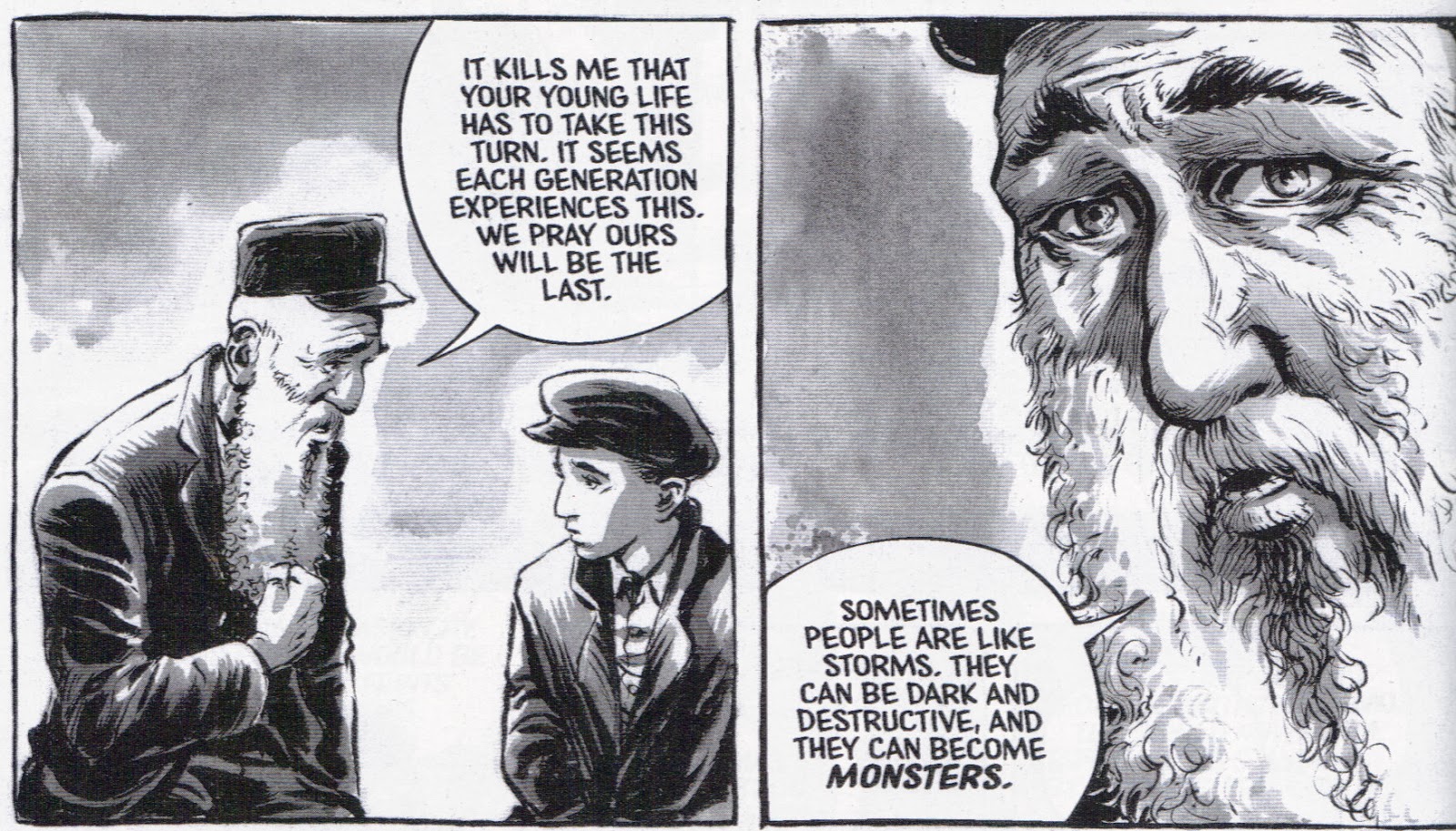
With the Nazi's closing in, grandpa and the townspeople get to work in Breath of Bones #2.
One could easily make the inaccurate assumption that Breathe of Bones is a rock'em sock'em historical super hero comic book, especially based on the beautiful covers to each of the three issues. While there is a tremendous amount of action therein, the slow burn toward the creature's reveal and origin suggests a classic monster movie. In a nutshell, from Dark Horse's own website, Breath of Bones is the story of a "giant clay monster from Jewish legend... on a Nazi-killing rampage in order to protect the inhabitants of a small Jewish stronghold and an injured British pilot." It is also a story of loss, both personal and that of innocence, sacrifice, and honor set against the back drop of World War II. Breathe of Bones is also a story about the power of storytelling, tradition, belief and family. Best of all is that there are Nazi's being pounded into submission by a monster...

From Breath of Bones #3.
Breath of Bones is a miniseries that inspires me to continue to promote the value of the genre as a viable and engaging (and teachable) text. Yes, while occasionally some works, most notably Art Spiegelman's Maus, reach a level of acceptability becoming "canon" of sorts, lesser known titles with content such as Breath of Bones would seem to be natural gateways to discussion in a variety of academic disciplines. Until then, I strongly recommend picking up the title either in individual issues (as is my collection mode of choice), trade paperback, or in the more recent beautifully executed hardcover edition. Unlikely to be read only once (or thrice) and relegated to your longbox or bookshelf, Breath of Bones is a title which bears repeated readings.