Showing posts with label local comic shop. Show all posts

Sunday, October 20, 2019

Hallow-reading: Spook House

In recent years I have fully embraced the literary anthology, especially those that collect modern weird fiction and horror short stories. Whether it’s due to my own slightly diminished attention span or an appreciation for the impact a good writer can have over an efficiently written story, I often find myself reaching to read (or re-read) short stories and novellas when hankering for a scare. Each year around this time of year, I also find myself picking up horror comic book anthologies, too.

While I’ve shared my appreciation for the semi-annual (now defunct?) Monsterverse series Bela Lugosi's Tales from the Grave, a more recent series has supplanted it on my Halloween go-to: Albatross Funnybooks’ Spook House. Last week’s New Comic Book Day saw the release of the third volume of the series, Spook House 2019 Halloween Special. All are the brainchildren of writer-artist Eric Powell, most well know for creating and now publishing popular indie comic The Goon.

As with each of the two preceding mini-series, the 2019 Halloween Special features a variety of stand-alone stories, each influenced (story, art, editorial) by Powell. Though the banner above the title on the cover declares in all caps “SCARY STORIES FIT FOR KIDS!” this title is also for those of us who like silly, creepy, stories well past our chronological childhood. As with previous volumes of Spook House, this issue also features the return of other creations from the Albatross Funnybooks stable of characters, Megaghost and Lulu from Chimichanga.

One’s lack of familiarity with either character’s background in no way limits the fun to be had in each story they appear in. While I’ve never read an issue of Megaghost, I enjoyed the issue’s lead story, “It’s the Candy Kaiju, Megaghost.” Written by Gabe Soria with art by Gideon Kendall, “It’s the Candy Kaiju” shares some the punny, broad humor that makes the more adult Goon stories so enjoyable. If not quite so “scary”, it, like each of the four stories in the issue, is very entertaining and, most importantly, evokes a fun Halloween season spirit. If the not-so-secret secondary editorial agenda is to prompt those, like me, to give Megaghost a try, it succeeds. This back-door introduction to junior occultist Martin Magus and his supernatural super-robot Megaghost has piqued my interest… so now I need to go back to my local comic book shop and seek out their appearances, past, present and future.

The rest of the issue feels much more like an Eric Powell joint, unsurprising given his role as a contributing, or solo, writer of all three. Both Pet Sematary spoof, “Goldfish Graveyard” and the cautionary tale regarding the self-fulfilling prophesy of names, “The Grumpiest Goblin,” are a touch more humorous and indicative of the stories that appeared in the previous volumes (available in trade paperback). If Powell’s form of humor is an acquired taste, Spook House 2019 Halloween Celebration, or any previous collection, is likely to give you a hankering for more.

Saturday, October 12, 2019

Hallow-Reading: Casper's Haunted Halloween

Before discovering the joys of superhero comic books as a teen, I enjoyed gorging on "funny books." As a ten year old with few pennies to spend on the fancy comic books displayed in the corner store spinner rack, my "collection" consisted of the discounted discards my brother and I would buy at the local used bookstore. Despite lacking covers (which were removed, I presume, so that they could be sold at a discount), we would buy as many as we could during each trip. The bulk of these starred Harvey Comics regulars such as Casper the Friendly Ghost, Richie Rich, and our favorite at the time (most likely because our grandfather was a proud World War 2 veteran), Sad Sack.

Though rife for an update (given that the original premise is slightly dated), new Sad Sack material has not been published for decades. Recently, though, others in the Harvey stable, most notably Casper and his spooky friends have found new, and reprinted, life in a line of titles from American Mythology Comics. All-ages titles such as Casper's Ghostland, Casper's Spooksville, and Casper the Friendly Ghost's Capers regularly find there way to my weekly pull list with good reason: they're entertaining as heck and a little well produced nostalgia goes a long way. They are also among the first books I read upon arriving home.

This past week saw Casper's Haunted Halloween arrive right on time for the holiday. Consisting of six stories from the Harvey Vault, Casper's Haunted Halloween also features fan-favorites the Ghostly Trio, Nightmare the Galloping Ghost, and "the tuff little ghost," Spooky. This holiday one-shot demonstrates the timeless nature of Casper's antics which are published monthly in the American Mythology titles. In the first of a three-part story, "Spook School", Casper is one again being pressured by the Ghostly Trio to become a "nasty ghost". The erstwhile friendly ghost agrees to attend because "education never hurt anyone!" After happily failing the first day of classes with a "minus zero," returns the following day rather than be "clobbered by the Ghostly Trio." Ultimately he and Gary Ghost, a star pupil in Spook School are abducted and taken to Goblandia in the second chapter, "Ghosts in Goblandia." Following a series of misadventures during which the kidnapped ghosts are forced into labor by the goblins, Casper [SPOILER ALERT] he saves the day, and the mean ghosts that belittle his good natured ways, through the power of friendship.

Yes, the story is simple, and, yes, the pages (on high quality paper) are clearly reproductions of classic comics, but the visuals and message remain timely. Ultimately, Casper's earnest efforts to help both those who steal he and his classmates away, and those same classmates who ridicule him, win the day and all but the most hardened and cynical readers. I enjoyed Casper's Haunted Halloween quite a bit and am thankful to American Mythology for producing such high quality reproductions and new content (though not in this particular title) monthly for new and old seasoned readers alike.

Sunday, January 20, 2019

The Old Order Changeth!

My very first short box circa 1984... and yes I was the person who actually 
bought DC's Guy Gardner Warrior!
Some comic book collectors have spinner racks (lucky!) while others have beautifully designed shelving to display their collections. I am old school, and no carpenter, so even 40 years into my fandom, I still use long, and as I have become more "seasoned", primarily short, boxes for storing and organizing my collection. This requires quite a bit of space and, fortunately, we have a sort-of finished third floor attic where I read and store them with other collectibles.

Shazam! #1 variant 
cover by Gary Frank. 
It is during these winter months when we are "trapped" inside for the majority of the day that I will shift the organization of my collection. Often it is a change in publication the prompts a change, For example, DC's recently introduced Geoff Johns and Dale Eaglesham joint, Shazam! (2019, $4.99 per) title necessitates the movement of Jerry Ordway's incredible The Power of Shazam (1995-99, cover price $1.50 per issue) series into an active box. Though represents a significant departure from the characters as depicted in Power, with all pre-New 52 continuity erased, I like having access to previous narratives.

Conversely, the conclusion of the most recent Suicide Squad (Volume 5, 2016-19, Issue #1 was $2.99 and the final issue, $4.99) series means that title will shift to an "inactive" box, stored in the back part of the attic, until the teams eventual return to action. Then, once again, the old order will changeth!

Local comic book shops organize titles on the "New Releases" table, as well as on "Recent Releases" racks and their own "Back Issues" long boxes, first by publisher (Marvel, DC, Image, Dark Horse, etc.) and then alphabetically by title (Action Comics, Aquaman and so on). Decisions regarding the specific organization of titles in collections are more personal. When it comes to "Big Two" titles (DC and Marvel for the uninitiated), putting these titles by character families (Wolverine alongside Uncanny X-Men or Justice League Dark next to Justice League Odyssey). There are families in the smaller publishers as well, most notably (and expansive) the "Mignola-verse" titles from Dark Horse. These are comic books set in the world of Hellboy, a universe of titles created by Mike Mignola that includes Abe Sapien, Lobster Johnson, Witchfinder and many others.

Zeke Deadwood: Zombie Lawman 
cover by Thomas Boatwright.
Those smaller publishers beyond the Big Two, though given quality and quantity of titles it's past time to start thinking of Image Publishing as a "Big Three", are much more willing to take creative risks with creator owned titles, especially those in the Horror, Western and Science-Fiction genres. Because of this, many of my shorts boxes are organized alphabetically by genre families rather than publisher or creator.

For example, I currently have five boxes which are organized as "Westerns" that include a wide variety of characters from large and small publishers. This means that DC's Jonah Hex extended series (2005-10, 70 issues) is organized with the now-defunct Topps Comics Lone Ranger and Tonto miniseries (1994, 4 issues), IDW's 3 Devils (2016, 4 issues) and SLG Publishing's Zeke Deadwood: Zombie Lawman (2009-11, 2 issues) series of one-shots in my short boxes.

Interestingly enough, this brief post about organizing my comic books also has me organizing y thoughts. The inclusion of Zeke Deadwood among more traditional Westerns alone has me considering my next reorganization project to further disaggregating Westerns into a Horror-Western Mash-up section. That project, however, will have to wait for the next snowstorm...

Monday, July 30, 2018

Summer Reading: Afterlife with Archie

A few covers from the series (from top left to right) Tim Seeley,  Dave Devries, 
and Francesco Franacvilla. 
True confession: I have never been a reader of Archie comic books. That is, until now. I, like most, have always possessed a passing familiarity with the cast: Archie Andrews, Jughead, Bettie, Veronica, Sabrina, Hot Dog and others. Without having spent much time thumbing through the Archie Digest Comics at the supermarket check-out lane, I have somehow come to know these characters. I also know that I am not alone. Thanks to the success of the current CW Riverdale television show (also streaming on Netflix) a whole new generation of viewers may well insure the Archie empire spanning for another 70+ (!) years. The television show’s success combined with the 2015 relaunch of the flagship series, Archie, likely will at the very least keep these characters within the cultural zeitgeist.

The publisher of Archie comics has long been aware of the iconic status of their characters and unlike other cape-centered comic book publishers, they have used this to their advantage for many years, the recent update notwithstanding. Whereas Batman, Spider-man and Superman are frequently being “re-made” to suit the plotting of their respective writers, “Archie-kins”, and the dynamics of his relationships with secondary characters, has been something of a constant. Which brings me to the most recent expansion of, and my first formal foray into, the Archie-verse: Afterlife with Archie.

Had never heard of Archie's dog Vegas prior to this series, 
but won't forget him now.
Afterlife with Archie is that rare comic book that is likely best read in trade (though I remain committed to the single issue format) if only for getting the complete story in one piece. The sum of the pieces might take a while to make whole though. The first issue of Afterlife with Archie was published back in 2013 and after almost five years, only nine of twelve originally solicited issues have seen publication. But what a run it has been this far!

From the first page, storytellers Roberto Aguirre-Sacasa and Francesco Francavilla craft a unique vision of the familiar Archie cast as survivors of a zombie apocalypse with its beginnings in Riverdale. Both creators are known (and respected) commodities through their individual work in other comic books, Aguirre-Sacasa as the writer of the complete 30 issue run of Marvel Knights 4 (2004—06) and artist Francavilla from a multitude of variant covers such as those for Dynamite’s Lone Ranger series as well as his own pulpy The Black Beetle (2012).

Each issue includes a secondary 
reprint of classic supernatural stories. 
The chief narrative difference between this Archie and the traditional comic book series, and one shared by other titles in the “Archie Horror” publishing family, is that no character is safe from being (literally) eaten alive. To reveal too much would ruin the surprise, but from issue 1 on, people die violently. Even those characters that one may not know well, such as Archie’s dog Vegas are given strong, if small, character moments. Because Francavilla’s stark and stylized artwork is not particularly detailed, his use of (limited color) and Aguirre-Sacasa’s dialogue is used to maximum emotional effect.

As mentioned, the inconsistent publishing schedule of Afterlife with Archie can frustrate if you are impatient, especially for single issue readers. (I avoided this by buying up the ten issues of the series over a few weeks from my local comic book shop.) The first five issues of the series are available in trade paperback entitled Escape from Riverdale. A second trade, the very-spoilery titled Betty: R.I.P., was solicited (as were issues 11 and 12) but all three have been subsequently cancelled. Based on what I have seen in issues 6 through 10, Cthulhu and Sabrina fans will not be disappointed.

Here's to hoping that Aguirre-Sacasa and Francavilla soon return to conclude the current arc. Given the easy accessibility of these iconic characters, even in a unique setting, as well as the high quality of the content, waiting patience will surely be rewarded.

Wednesday, July 29, 2015

Run Reader: Rawhide Kid (2003)

Reintroducing Rawhide Kid in Issue #1.
My introduction to the Western comic book genre came late in my collecting life in the rugged guise of the 2005 Jonah Hex, Volume 2, written by Jimmy Palmiotti and Justin Gray. The most familiar Western hero from DC Comics, I eventually found that because of its excellence, I craved more adventure from "those thrilling days of yesteryear."

Cover to Issue #2 by Terry Dodson
and Kaare Andrews... subtle, right?
My experience with Marvel Comics' Westerns began with more modern iterations of two key characters, The Rawhide Kid and the Two-Gun Kid, among others. Together they starred in the four-issue miniseries Blaze of Glory (2000), by writer John Ostrander and artist Leonardo Manco and its sequel, Apache Skies (2002). Both The Rawhide and Two-Gun Kids were presented in fairly traditional Western fashion, consistent with the earlier roots of each character. The Rawhide Kid character originally debuted in 1955 from Marvel Comics's 1950s predecessor, Atlas Comics. Described as a "diminutive yet confident, soft-spoken fast gun constantly underestimated by bullying toughs, varmints, and crooked saloon owners," the Rawhide Kid (Johnny Bart) was the template from which later super-cowboys sprang. While the Rawhide Kid of Blaze of Glory/Apache Skies was grittier than the original, both interpretations were very different than what would come next.

With a faint recollection of a news story about the Rawhide Kid being re-envisioned as homosexual in the early 2000's, I bought the individual issues of  Rawhide Kid, Volume 4 (2003) for cheap to see what the hubbub was all about. At the time, I missed the red flag that the subsequent trade paperback collection of the mini-series, bore the title of the story arc from the miniseries, "Slap Leather." From the start, the tone is sophpomric and most of the updated characterization is played for "laughs."
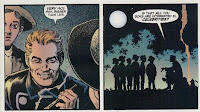
Clue 1 from Issue #1: Rawhide Kid
likes celebrity gossip!
As written by Ron Zimmerman, this Rawhide Kid (who inexplicably prefers the nickname "Trey"?!) is much more of a caricature of homosexual stereotypes than a fully realized character with a (presumably) less-than-common sexual orientation for the Old West setting. The inherent potential of exploring the challenges of such a character in the Old West are ignored for the sake of probing the intricacies of how two of the Cartwright Boys from Bonanza could be placated by alcohol and potentially tricked into "extracurriculars" with Trey. I can't make this stuff up. Zimmerman sprinkles various literary and historical figures throughout the proceedings and even creates historical analogs for modern figures (for example, the dim-witted town leader, Mayor Bush) in an effort both ground his story in history and possibly, satire.

The flirtation begins in Issue #2.
The plot is standard: gunman (The Rawhide Kid) comes to town beset by criminal types. While there, gunman teams-up with local lawman, previously humiliated by criminals, to save town, and the lawman's shaky relationship with his young son. It's in the execution and detaisl that things get awkward: gunman drops numerous romantic hints to the lawman about things like French fashion while parading around without his shirt. Lawman's son, embarrassed of his pa's failure, publicly and verbally emasculates dad while hero-worshiping the gunman who (wink-wink) is homosexual.

Though subsequently billed as "the first openly gay comic book character to star in his own magazine," the Kid's openness is almost entirely comedic in its presentation, limited to obvious campy humor, puns and double entendre.  Used as simply a way to differentiate the protagonist from those around him (and as a subtle reasoning behind his colorful attire), the Kid's homosexuality fails to add a level of depth to the characterization or by extension, the title's proceedings.

As seen here in issue #3, the Kid is
always on the cutting edge of fashion.
The artwork by John Severin, a long time comic book artist who also provided art for Image Comics' modern-Western title Desperadoes: Quiet of the Grave (2001), is excellent. While the detailed setting clearly established as Old West vibe, the accompanying story, by Ron Zimmerman, is surprisingly ham-handed and stereotypical in its reveal and depiction of the Kid's sexual orientation. It could be said to border on parody, but just what was being parodied is up for debate. The multiple references to literary (the leads of Lonesome Dove get name-checked early on) and historical Western figures, as well as the beautiful artwork were not enough to carry me past the borderline offensive stereotype's of homosexuality that drove the story.

Even typography choices made by the writer and letterers, Rich and Wes @ Comicraft, seem to purposely reinforce the stereotypical depiction of our hero. As you can see from the pane at the top of the page, wherein the Rawhide Kid makes his first appearance wit the phrase "Oh, stop..." which when read aloud with the proper emphasis applied for the bold lettering sounds somewhat affected. Upon my own internal reading an inflection was intended, as it is through out the series.

So, is it worth checking out? As a snapshot of the misguided attempt by a mainstream publisher to take an older character and re-boot him in such a way, yes. Despite the somewhat clumsy effort, Severin's art (and the ability to analyze the hell out of the whole package) is just enough to recommend it. Both The Rawhide Kid: Slap Leather (2003) and it's sequel, The Rawhide Kid: The Sensational Seven (2010) are available as trades at your local comic book store (or in the back-issue bin).
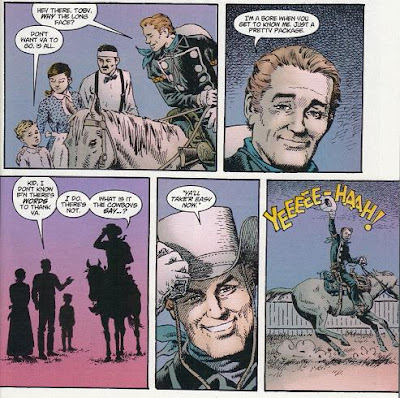
Happy trails, Trey! from Issue #5.

Wednesday, June 10, 2015

Run Reader: Giantkiller (1999)

The opening page of Giantkiller Book One by
Dan Brereton, August 1999.
I enjoy reading and collecting two comic book sub-genres that are published with little regularity or consistency: giant monster (or "kaiju") and Western titles. Beyond familiar characters with high name recognition such as Godzilla or The Lone Ranger (both of which have current or recent iterations that are thoroughly entertaining), few titles from these two comic book sub-genres regularly see publication. This is especially true of titles published by the industry's "Big Two," Marvel and DC. While each will occasionally nod to their own giant monster-cowboy past with titles like DC's Jonah Hex or Marvel's current Secret Wars mini-series Where Monsters Dwell (both solid titles), few new characters are developed and promoted. There was a time though, when the comic book industry was on life support (or so I've heard) and willing to take greater creative risks,

The cover to Book Three.
While thumbing through some ancient longboxes last week, I re-discovered a long forgotten gem that incorporates classic elements of giant monster books with a common Western archetype thrown in for good measure, the 1999 DC miniseries Giantkiller. Written and drawn by Dan Brereton (most well know for his 1998 collaboration with Howard Chaykin, Batman: Thrillkiller), Giantkiller is basic in its plotting but dynamic in its presentation.

In the far-flung future world of 2002(!), atop Mount Diablo, "across the bridge from San Francisco, past the hills of Oakland" an inter-dimensional portal has opened releasing all sorts of Lovecraftian "daikaiju" or giant monsters. In an effort to confront these horrors, our government does what years of reading sci-fi and comic books have taught all of us what the correct answer to this problem is: experiment with evil DNA in an effort to develop super-soldiers.

One of the many spectacular
splash pages in Book Four
of Giantkiller by Dan Brereton.
The first product of this experiment, who as it turns out is our story's primary narrator, is Jill, a young woman who is injured while acting as an FBI agent charged with breaking up a cult dedicated to worshiping the creatures. Found nearly dead, Jill is resurrected following a hybridization process using the monsters' DNA. Eventually Jill goes native and is labeled "a lost cause" by the lead scientist responsible for her transformation, Dr. Steven Azuma. Following this first perceived failure, the good doctor to turn his sights toward an experiment with greater potential, Project Giantkiller.

The fruit of Project Giantkiller is the hero of our tale, a human-like creature (with a claw-tipped tail) christened "Jack," though he is affectionately referred to by Dr. Azuma and his team by the nickname "Yochu." Jack is educated ("Grades K through 6 lasted exactly two weeks.") and trained following his "birth," and armed with a samurai katana fashioned from the tooth of one of his "titanic relatives" which he names "Kiba" (Fang).

A number of mysteries involving our two protagonists are introduced and resolved during the course of the series as Jack and Jill meet in the kaiju -populated zone around San Francisco, and ally themselves with one another in an effort to close the portal. In a particularly clever move, writer-artist Brereton embraces the ethical quandry inherent in Jack's role as an agent of destruction pointed at his own race, and his willingness to address the reader's questions within the context of the narrative contributes to Giantkiller's success as a story.

"Friendly" monster,
Nox, from Book Five.
Brereton allows his energetic artwork to tell the story during the monster battles, and relies heavily on characters, most notably Jill, to deliver background exposition about the fictional world they inhabit. Despite this, I never felt weighed down by the necessity of information-sharing. Brereton characterizes Jack as a no-nonsense, action-oriented hero, so the moments during which he is engaged in battle are free of witty-remarks and absent nearly all dialogue beyond monster sounds and sound effects. It is in Jack's characterization that the Loner archetype (a la Western icons such as Shane and the Man With No Name) is employed. Jack is a monster, but he is also fighting on the side of "good," despite the natural urges deep in his DNA to be alone on his quest, he does meet those with whom he connects.

I couldn't help but notice some superficial  similarities, however, with Mike Mignola's Hellboy. As I was drawn into the world Brereton was crafting, I wondered if these similarities were part of why this potentially marketable character and his world have not since been revisited in some medium. Both Hellboy and Jack the Giantkiller work with (for?) a paternal character who raised them, and both also use their "sons"to somewhat surreptitiously further personal interests. Both are supported by female counterparts that are themselves cursed with abilities that make them distinct form the world around them. Given the opportunity to develop his character, it would have been fun to see where Jack and Jill, in Brereton's skilled hands, could have taken us.

As it stands, Giantkiller remains a promising introduction to a world and characters that work well as a single, inclusive mini-series. This is due primarily to Brereton's work, both as artist and writer; together his clear affection for the genres is infectious.

Giantkiller is a comic book miniseries originally published by DC Comics, along with a one-shot handbook called Giantkiller A to Z: A Field Guide to Big Monsters (which within the context of the story was written by Jill in her early days as a monster hunter for the government). The series has since been collected in a trade-paperback format by Image Comics. Both are still available in the back issue boxes of quality local comic books shops.

Jack the Giantkiller battles Shrill in Book Two.

Sunday, December 29, 2013

Comic Book Finds: Revival


Issue 8 finds "embedded" reporter,  May Tao, attempting to go undercover in one of Revival's many character arcs.
I collect quite a few comic books. While some beg to be read immediately after being purchased, I find the enjoyment of other titles enhanced by waiting for a few issues to be published before sitting down to read them. These types of titles would seem to be good candidates for my purchase as trade paperback collections (a practice called "trade-waiting"), but I and my "dark purchaser" are slaves to my childhood urge to collect comics as single issues if humanly possible. This strategy seems to work best with series that build a broad character driven narrative, especially one with multiple character arcs. This is much the same reason I prefer to watch some television series (American Horror Story, for example) when they have been released in their entirety on DVD.

Cover Revival #14
by Jenny Frison.
Fortunately, I jumped on this title early as the first issue, released in July 2012, sold out quickly and I happened to pick one up as it appeared tonally to be at the very least a distant cousin of Image Comics's recently concluded horror thriller Severed. Image Comics' Revival is a series I have been saving up issues of for reading over the past year and, interestingly enough, the television show of which is most reminiscent is the aforementioned American Horror Story particularly the Season Two arc, Asylum. With two weeks off from school, in addition to catching up with a few novels that have been awaiting attention, I've also begun making my way through series I have been holding onto.

The cover of each issue declares Revival to be "A  Rural Noir by (writer) Tim Seeley + (artist) Mike Norton," just above the stunning cover work by artist Jenny Frison; Issue 12 is the only issue thus far to not feature Frison's artwork, that honor going to the popular Skottie Young. While the book does contain elements of "rural noir"--it is indeed the bleak setting of wintry Wausau, Wisconsin, and each issue contributes to an intricately woven story of cynical, broken characters--it offers much. Weaving sci-fi and horror (including instances best described as body horror, gore and torture), writer Seeley keeps the reader engaged by subtly shifting genres and characters without losing sight of the larger story, one that as of the recently released issue 16, has not yet come fully into focus.
From Revival Issue #1.

The initiating event of the primary action of the comic is seen off-page and precedes the vents of Issue #1. Apparently one day, only in the town of Wausau, a select number of the recently deceased were "revived." Touching on a range of political issues (the town's mayor establishes internet camps for the revived) and social (both left and right wing media vie for the proper angle on the story), the comic book methodically established a broad tapestry of characters neither of whom are particularity good or evil, but all of whom struggle with the events shaping the world around them. The 'good guys" brutalize the deserving "villains" and the bad guys experience conflicts of conscience as they in turn plot against the "heroes."

Other than briefly explaining the set-up, to say much more would ruin the enjoyment of reading Revival. The highest praise I can give it is that after 30+ years of reading comic books and enjoying horror books and films, I have little idea where the story is going. Best of all, the trip looks to continue to be an entertaining ride!

Issue 16 of Revival is probably still on stands at better shops, and if you're lucky, your local comic shops may have individual issues on the racks (though I doubt #1 and 2 are readily available). Your best bet in getting on the Revival bandwagon is likely... wait for it... picking up the recently released trade paperbacks which can also be bought at your local comic shop--just ask.

Sunday, May 05, 2013

Free Comic Book Day 2013 Swag

4 + 4 = 8; eight free comic books collected by my son and I.
My son and I arrived at Comic Etc., my local comic book shop of choice for almost 20 (!) years now, almost 30 minutes early to wait in line for yesterday's 2013 Free Comic Book Day. Given the four-comics-per-customer policy (without which crazy comic speculators would have seized with The Walking Dead in five minutes), having my son come with me was key to maximizing our "take."

This is Comics Etc. first FCBD at their new location on Main Street, and the improved access from the parking lot, nice fellow fanboys around us, and the incredible weather, made waiting go by quickly. It was also my first weekend in May without an early morning track meet to coach in many years, so I was able attend.

Using descriptions taken from NPR's Monkey See online article entitled "Which Comics Should I Get? Your Free Comic Book Day Cheat Sheet" by Glen Weldon here's a breakdown of what Jack and I walked away with:
  1. Marble Season – An excerpt from the great Gilbert Hernandez's new semiautobiographical graphic novel. When your kids are done with it, read it for yourself.
  2. Dragon Ball and Rurouni Kenshen Restoration – The Viz Comics sampler looks to be the only manga represented on FCBD, which makes precisely no sense, but these two series are hugely popular in Japan, having spawned anime series, films, video games, etc. Don't know if these specific stories make for particularly good jumping-on points, but at the very least you and your kids might get a sense of what all the fuss is about.
  3. Bongo Free For All Comics – Dependably great Simpsons/Futurama comics.
  4. Atomic Robo and Friends – This is your best bet on Free Comic Book Day. Ask for it if you don't see it. It's great. Fun and funny. Both at once.
  5. Aphrodite IX – In a post-apocalyptic world, there be dragons. If you need to know more than that before committing, this probably isn't for you.
  6. Kellerman/L'Amour Sampler – Two excerpts from upcoming comics adaptations – an Alex Delaware thriller by Joe Kellerman, and a "Louis L'Amour" Western yarn that's actually a new story. The
  7. Walking Dead – You've seen the show and wished they'd stop wringing their hands and maybe kill a freaking zombie already. Now read the book.
  8. Mass Effect/Killjoys/RIPD – If you go by the cover, this looks like just another adaptation of a video game, which would mean it belongs up with licensed tie-ins. But it also includes two other stories, Killjoys and RIPD, both of which – but especially RIPD, about a police force that enforces supernatural law – show a bit more promise.
After getting back to the car my son supplied the quote of the day, providing provided a telling point about the intentions of my FCBD--exposing veteran collectors and newbies alike to previously unsampled independent(er) titles: "I notice we didn't get anything from Marvel or DC."

The tables at Comics Etc. were set... for excitement and action!

Sunday, January 13, 2013

Late to the Party: B.P.R.D.

Cthulhu-esque, supernatural creatures such as the one referenced in B.P.R.D. Hell on Earth: Russia #1,
with story by Mike Mignola and John Arcudi with art by Tyler Crook, are always a threat to appear! 
With greater frequency than in year's past, likely due to some discontent with the Big Two's reboots and events, I have found myself coming late to the party on some "smaller" titles which have been in publication for, in some cases, many years.  While it is very unlikely I'll have the financial resources (too many years and issues have passed) to reasonably catch up completely on individual back issues, there are fortunately often more recent jumping on points.

One title that I had previously missed out on, that was singled out as #24 in this CBR end-of-year "Top Comics," is Dark Horse's B.P.R.D. A spin-off from Mike Mignola's Hellboy, B.P.R.D. the continuing adventures of the organization which took Hellboy in, the The Bureau for Paranormal Research and Defense. Charged with protecting America and the world from the occult, paranormal and supernatural, the B.P.R.D. employs the services of several "enhanced talent" (supernaturally powered persons), most notably the aforementioned Hellboy. While Hellboy quit the B.P.R.D. years ago, and subsequently, "died", Abe Sapien and Johann Krauss, both recognizable from the successful Guillermo del Toro films, remain central to the stories. Additionally, there are a number of human agents featured.

No character is safe from occult body-horror mutations;
from B.P.R.D. Hell on Earth: The Pickens County Horror #1.
A unique (and ultimately favorable to the late-comer such as myself) facet of B.P.R.D's publication is that each series, of which more than one may be on the stands at any given time, are presented as 3 to 5 issue miniseries. While each builds on the story that preceded it, each story arc can be at least superficially enjoyed on it's own merits. I will warn you, however, it is VERY difficult not to be pulled in and to start desiring to dig through your local comic shops back issue long boxes.

Another advantage for newer fans is that in 2010 the primary B.P.R.D. series and all ancillary titles (as well as the entire world of Hellboy, for that matter) completed its first cycle. Eventually, this entire initial run of related sixty-eight issues was rebranded as "The Plague of Frogs" cycle.
This was followed by a second cycle, which we are still in. Titles in this most recent cycle bear the subtitle "Hell on Earth." Beginning with what would be the one hundredth issue of the series, B.P.R.D. returned to traditional sequential numbering, therefore issue 3 of the B.P.R.D. Hell on Earth: The Return of the Master #3 is in actuality #100. In an age when the big two continue to run away from their extensive continuity, it is wonderful to see Dark Horse and Hellboy creator and mastermind Mike Mignola embrace the scope of their characters' existence.

From B.P.R.D. Hell on Earth: The Long Death #1 story by Mike Mignola and
John Arcudi with art by James Harren. 
The biggest draw, as should be the case with any comic book purchase, is the storytelling. Guided by Hellboy creator Mike Magnolia and writer James Arcudi (among others), B.P.R.D. is as much about characterization as it is Cthulhu-esque creatures. After only having reading just three of the recent arcs from Hell on Earth, Johann Krauss (featured in the panels above) has quickly become one of my favorite comic book characters.The storytelling is very visual in nature and the consistently excellent artwork by James Haren, Tyler Crooks and others gives the authors a visually cohesive world within to play.

Most B.P.R.D series are currently available in trade paperback, as well as individual issues at most solid local comic shops.

Saturday, September 15, 2012

NBIM, Day 15: Bat Lash #2 (2007)

Bat Lash #2, Cover art by the legendary Walt Simonson.
Sorry for missing a few days of National Back Issue Month postings, but with school back in sessions it's not nearly as easy to sit down and write. For today's grand return, I've selected the second issue of the six issue Bat Lash miniseries published by DC Comics back in 2007. Like many of the Western titles I know have as part of my collection, it was one that I came to many years after its initial release, fortunate that the Western genre has not seen a bump in back issue costs.

One of the draws beyond the genre for me in purchasing this title, which more and more seems to be the case, was the creative team involved: co-writers Western novelist Peter Brandvold (Rogue Lawman, .45-Caliber Deathtrap) and Sergio Aragones (Mad Magazine, Groo), cover artist Walter Simonson (Thor, Fantastic Four), and interiors artist John Severin (Mad Magazine, Cracked, Sgt. Fury and His Howling Commandoes, to name just a few).
Mark off another box on the "Why does he...?" checklist.
The purpose of the miniseries was to  retell for a new generation the origin story of the most unusual cowboy of them all, a tough but tender young Bat Lash braves a corrupt sheriff and a greedy rancher just to woo a rancher's lovely daughter. Issue two provides the backstory for why Bat Lash wears a bright red flower in his hat band. This little character detail is also symbolic of Bat's romance fueled adventures in a comic book world of rough riders, tough guys and drunks. Despite his flowery hat, he he has a tendency to kick butt and take names wit the best of them... especially when there is an act of chivalry involved!

All six issues of the Bat Lash (2007) miniseries are likely available at cover price ($2.99) at your local comics store or at about a third of the price online. If you are a Western fan or simply an appreciator of fine comic book craftsmanship, you won't be disappointed.

Tuesday, September 04, 2012

NBIM, Day 4: Franklin Richards, Son of a Genius (2006)

Cover to Franklin Richards, Son of a Genius #1 by Chris Eliopoulos and Marc Sumerak.
A Fantastic Four fan since childhood, there were periods of time where I would purchase nearly any book even remotely associated with the cast. Among those myriad, miniseries, one-shots and team-ups were more than a few "misses" when it came to quality. Fantastic Four Presents: Franklin Richards, Son of a Genius Everybody Loves Franklin, despite it's somewhat cumbersome title, however stands as one of the most pleasant surprises. The second in a series of one-shots devoted to Chris Eliopoulos and Marc Sumerak's Calvin and Hobbes-esque interpretation of Mr. Fantastic and the Invisible Woman's youngest child, Everybody Loves Franklin sets the character loose in a less-than-dangerous Marvel Universe.

The one-shot includes three stories, "Christmas Time Warp", "My Dinner with Doom(bots)", "Frankie, My Dear...", and "Now You See Me..." With a surprisingly cool iteration of H.E.R.B.I.E. the robot playing babysitter and straight man, Franklin travels through time, interacts with the evil Doctor Doom and, worst of all, needs to deal with Katie Power--who has a hu-u-u-ge crush on him.

The Calvin and Hobbes comparisons are easy to see in these panels from page 5.
This issue strikes me as a great back issue buy for a number of reasons. First, it is the rare true one-shot which requires no previous reading of the character to gain maximum enjoyment from the reading experience. Though the "real" Franklin has decades of complex back story, Eliopoulos and Sumerak's clean slate approach winks and nods at canon, but offers storytelling that appeals to even the uninitiated. Secondly, it is the (unfortunately) rare all-ages book that will have appeal to youngsters (and adults) who, unaware of Fantastic Four continuity, will enjoy the goofy action and wonderful visuals. It may also serve as a gateway comic to some of Marvel's recent, more common all-ages books tied into their film universe.

Fantastic Four Presents: Franklin Richards, Son of a Genius Everybody Loves Franklin is very likely available among the stacks at your local comic store at the $2.99 original cover price, or for much less in reduced price bins and longboxes.

Sunday, September 02, 2012

Welcome to National Back Issue Month 2012!

Devil Dinosaur #1 (1978) edited, written and drawn by Jack "The King" Kirby.
It's ba-a-a-ack: September is once again National Back Issue Month! I'm unclear as to just how "official" this is in terms of comic book industry support, one of the folks who frequents the same lcs (local comic shop) as I has set up a NBIM Facebook group, and as I'm always looking or subjects on which to post I thought I'd go with it. Last year, I had hoped to post an issue each day of the month, but petered out about five days in; day 5 from last year can be seen here.

Begun last year as an anti-celebration of the Fall 2011 relaunch/reboot/redux of the DC Universe, it is just as relevant this year with the impending soft relaunch/reboot/reduxof the Marvel 616 Universe, Marvel NOW! The idea is that tthroughout September, when collector's new and old go into your local comic book store, they should add to the purchase of their new releases some goodies from the back issue boxes.  Often there are a great many comics that can be purchased for prices often the same (or less!) than a modern comic. The first issue of my NBIM celebration was culled from my own longboxes, Devil Dinosaur #1.
 

Devil Dinosaur was first released in early 1978 when I was nine years old. I had just begun collecting comic books, starting with another Kirby-infused classic, Fantastic Four (long after Kirby and Stan Lee had departed, of course). While I never did purchase Devil when it was originally released, I was glad to see it appear in a pile of older comics given to me by a colleague. Just the heading "NOW! The fantastic FIRST ISSUE," reminds the fanboy how, before incessant renumbering and rebooting, "first issues" used to mean something.

Devil Dinosaur co-starred Moon Boy, a characetr whose design was clearly influenced by
Kirby's work on an earlier  Marvel 2001: A Space Odyssey  comic book.
My first real Devil Dinosaur story was his brief appearance in Marvel's Godzilla issue 21 which came out right around the same time. Dinosaur's never seem to have much luck with ongoing series, Devil Dinosaur lasted only nine months and Godzilla went only 24 issues. Even the more current Runaways series was short lived despite being deemed a hit. (One character, Old Lace, is a genetically modified, human-sized dino, but that's close enough to be in the conversation.)

Devil Dinosaur is the perfect NBIM book: great visuals by a legendary creator doing fine work on one of his lesser, and therefore more affordable, works.

Saturday, August 18, 2012

Binging & Purging

It has been a fantastic summer break, but now that I have spent much time filling gaps in comic runs and reorganizing (most of) my collection it is time to get back to "work." Not surprisingly, the process of organizing was not inexpensive. To do it well, I felt it was necessary to  purchase backboards and bags for each book, cardboard dividers for each newly purchased  longbox, and, most expensively, filling in some gaps in runs that I had wanted to see bridged. of course these "gaps" are filled by purchasing back issues of older comic runs.

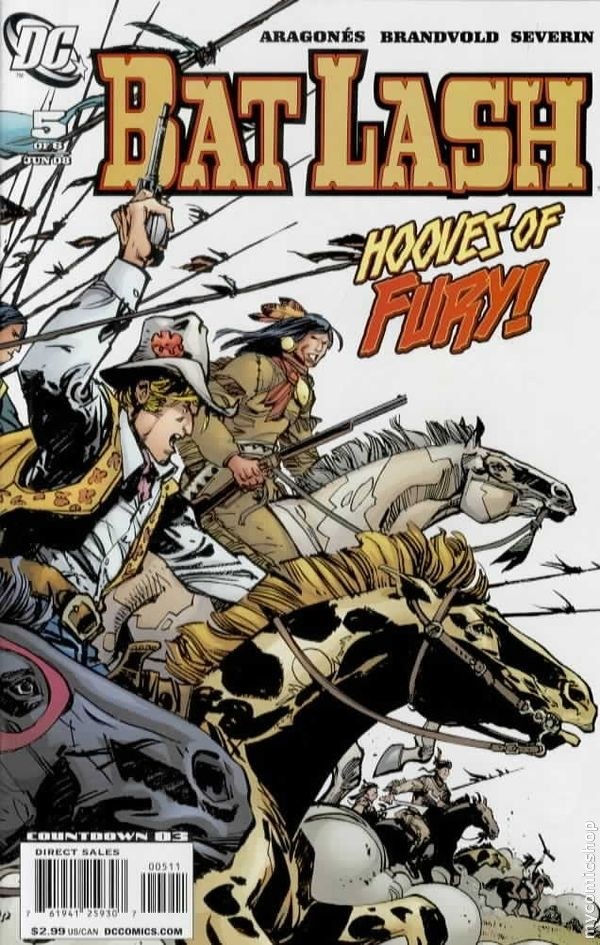
Price of Bat Lash #5? 90 cents.
Value of a completed run to a fanboy?
Priceless!
The expense was not in the individual cost of each comic (all of which were cover price or cheaper) but in the volume of acquisitions. Sometimes this required unusually odd purchases from the Internet that were (after checking) unavailable at my local comic shop, such as issue 5 of DC's 2007 mini-series Bat Lash featuring art from the legendary (and recently deceased)  John Severin. This little jewel of a series also boasts a script by Peter Brandvold and Sergio Aragones, with a sharp cover Walter Simonson. For those of you who are not "in the know" that (with the exception of co-writer Branvold) is an extraordinary cast of creators!

But, now that I have spent some the my free time binging on comic book from the past, I need to update my weekly pull list and purge myself of some titles I have recently picked up am no longer willing to purchase regularly. It is a vicious circle. It is possible that next summer one of the titles I drop this month will fall back into my favor (new creative team, new direction) and I'll search for the issue to bridge the gap. As fate would have it, some titles I have enjoyed have recently wrapped up (iZombie and Gears of War), so some losses are through attrition. Truth is, I enjoy streamlining my pulls in such a way that I can focus the significantly reduced time I have to fewer titles and enjoy them more fully.

It's been a blast... see you in the trades (maybe)!
So it is au revoir to the following titles for the foreseeable future: Dark Avengers, X-Force, The Massive, Animal Man, Swamp Thing, G.I. Combat, Frankenstein Agent of Shade, '68 Scars, Batman, Fatale, Debris, PlanetoidMind MGT, Planet of the Apes, Conan the Barbarian, Warlord of Mars, Mind the Gap, Warriors of Mars and Rachel Rising.  To be fair, some of these books have only been purchased this summer (idle hands and blah-blah-blah), so the only real regret is not stopping sooner (though each did have a quality which endeared it to me in the first place. FYI: Action Comics may also soon join these titles, once Grant Morrison wraps up his run on the title.

Allowing a day or two to recover from the hangover my collecting binge, and eventual purge, has left me with, I'm looking forward to getting back to school and getting back to weekly trips to the local comic shop to catch up with those titles which have made the cut...

Thursday, August 02, 2012

Cataloguing Comics, Continued


Updated long boxes always being added to.
A few weeks ago I began the task of cataloguing my comic book collection, an activity for which the small details continue. Where as my initial goal was to get my 25+ year collection into order by genre (Western, Horror/Sci-Fi, Pulp and Hero), I eventually set about separating the "Hero" books by publisher (overwhelmingly DC and Marvel), and then further classify them by publishing company "universes" (DC has original continuity and New 52, Marvel has 616 and Ultimate). While I briefly experienced a degree of comic book overload, it has been an enjoyable experience going back through books I haven't read (in some cases) in decades.

"The Vault" contains copies of titles that no longer actively collect: but never say never!
Each time I stop at my local comic shop (lcs), I have habitually been purchasing cardboard dividers for use in separating each long box further by title. As I continue to acquire card board separators, I have been using post-it notes as temporary placeholders. Because many of the comics I have collected o late have been mini (3-8 issues) or maxi (9-12 issue) series titles, there is the need for quite a few dividers. As I have done since I was in high school (at first with pen and masking tape, and now with computer labels), I will further organize each long box by adhering to each divider a label in which I've recorded with the title, publisher, publication dates, and inclusive issues (if not an entire run).

As I've suggested previously, much like some folks may collect baseball cards, crochet, scarpbook or  or consume illegal substances to "stay sane," collecting comic books helps me stay focused and engaged in a way that I find very relaxing.

Sunday, July 29, 2012

4 Shops in 4 Days

Quite a bit to read this week!
This past week, I had the rare (for me anyway) opportunity to shop in four different (relatively) local comic shops (lcs) over the span of roughly four days. The first was my go-to, hometown joint, Comics Etc. in the Village Gate Mall. I have been shopping there on-and-off for the past 20+ years. The other two shops were part of larger regional chains of shops in the New England area: Newbury Comics (we actually stopped in two separate locations in the greater Boston area) and New England Comics. As a run-of-the-mill fanboy, the best way for me to quickly share thoughts about each is to start with what I purchased there. So as to remain (only slightly) unbiased, I brought a willing accomplice with me (my stepson) as a gauge.
Without a doubt, the shop(s) my stepson was most interested in sharing with me was Newbury Comics. We visited both the shop in Harvard Square, as well as the larger (3 stories) location in the Quincey Market. My stepson was very excited to bring me there, and while I could definitely see why he liked it (and were I his age, I suspect I might too) for the middle-age collector who specializes (ie. can only afford) comic books and not the other chachki, it was a letdown.

There were indeed comic book themed merchandise, mixed in with much more video game and movie/television stuff, but remarkably few actual comic books for a place with the descriptors in its name. It was as if I'd entered hipster paradise with Notorious B.I.G. memorabilia mixed with Adventure Time tees, with a splash of OBEY goodies. What was primarily for sale was anime, action figures, posters, t-shirts, CDs, DVDs, and clothing for the wannabe fanboy or cool hipster. I was however excited to see my stepson excited about the Dr. Who collectibles and Walking Dead stuff (of which he bought a couple things), but he is also aware of these things being available at our lcs; a place he is always glad the time to come visit with me when his busy schedule allows.

Recent releases (books that came out this and last Wednesday) were displayed on racks, as well as trade paperback volumes for popular series', but there was not a longbox or back issue to be seen. We spent cumulatively about two hours in both places combined and I made a grand total purchase of nothing.

The second place we checked out, and this one was completely on a lark, was the Harvard Square location of New England Comics. It was located across the street from the hotel we were staying in and I had noticed the unassuming sign hanging in the window on our way into the Square. After the first day in Boston and being disappointed by Newbury, we decided to give it a go. I was pleasantly surprised to see that it was an actual comic shop with books (new and old), a smattering of collectibles, and a healthy rack of recent back issues at cover price (or less if you're willing to dig).

Maybe it was because it had much more of that lcs character that collectors know when they enter: new and old promo posters, stacks of books seemingly in disarray (but not really), and friendly folks working the counter (but not hounding you to buy-buy-buy). I had not been previously aware until later looking online, but NE Comics, like Newbury, is something of a megalo-mart for comic books, which is neither a good or bad thing but what is interesting is that NE Comics does a much better job either 1) masking its corporate nature or 2) staying true to its comic book collector roots. I'm going to suggest it's #2, as I did purchase the first three issues of the New 52 Action Comics (DC) to peruse on the ride home.

Comics Etc., despite the other shops being in and around the huge metropolitan area of Boston, Massachusetts, had the largest available collection, better accessibility to back issues and friendly customer service. I guess I had been wrongly seduced by the idea that larger cities would have better more complete stock available, but that was far from the case. I have a "pull list" at Comics Etc which means that each week the store pulls, or sets aside certain issues for my purchase. Most shops do this, and this past Wednesday was a particularly "heavy" one for me as many titles that I currently follow were released:

All Star Western #11 (DC)
American Vampire #29 (Vertigo)
Dark Avengers #178 (Marvel)
Debris #1 (Image)
ERB John Carter The Gods of Mars #5
Exile on the Planet of the Apes #4 (Boom Studios)
The Goon #40 (Dark Horse)
Hawken #5 (IDW)
I, Vampire (DC) #11
Justice League Dark #11 (DC)
Legend of Oz: The Wicked West #5 (Big Dog Ink)
New Edwardians #5 (Vertigo)
Planet of the Apes #16 (Boom Studios)
Prophet #27 (Image)
Transformers: More Than Meets the Eye #7 (IDW)
Ultimates #13 (Marvel)
Uncanny X-Force #28 (Marvel)
As evidenced by the HUGE list above, the overwhelming majority of my weekly comic book expenditures were used at the hometown shop--clearly the best of the four I visited in the past four days! Like Norm on Cheers, it is good to have a place to go where everyone (or at least the guys working the counter) know your name...

Wednesday, April 04, 2012

Weekly Reading: April 4

Yippee-ky-ay! Grrrrr! Westerns and horror have taken over my pull list!
Heading down to Washington, DC, this weekend to tour/visit colleges with my stepson, but (of course),not without first swinging by my local comic shop. For the first time in weeks I refrained from purchasing any back issues, electing instead to use my trip, and the impending Spring Break which follows, to catch up on some  reading of issues recently brought home but as of yet unopened. This week's selection is horror and western heavy in its content--a change in my collecting habits that continues to become more apparent.
Swamp Thing #8 (DC)
The Legend of Oz: The Wicked West #3 (Big Dog Ink)
The Lone Ranger #4 (Dynamite)
Animal Man #8 (DC)
Dead or Alive #3 (Red 5 Comics)
iZombie #24 (Vertigo)
Sweet Tooth #23 (Vertigo)
O.M.A.C. #8 (DC)
Fatale #4 (Image)
With the announcement this week that iZombie will be drawing to a close in September, and O.M.A.C.'s cancellation (this week's issue being its last), the whittling down of my pull list  has officially begun. This is not necessarily a bad development with summer (and the decrease in pay that comes with it) on the horizon.

Wednesday, March 28, 2012

Weekly Reading: March 28

(Nearly) equal parts "something old and something new."
This week, due to commitments after work (and long after the official work day ends), I hustled to the comic shop during my lunch break. This is a rare occurrence during the work/school year. Because the likelihood of the stars aligning in just such a way wherein I could attempt a mid-day "comic book run" during the school year are unlikely, I figured I would risk it.

When I shared with my wife my conundrum of being unable to get to the shop on Wednesday because of being busy, she suggested I simply "wait until Thursday and go." Ha! With my stepson backing me up (who himself was looking forward to the most recent Transformers issue), I declared that option unacceptable and was determined to find away to get to the shop without missing meaningful work time or my after school activities. Fortunately, utilizing daredevil (yet safe) driving skills I was able to make the trek to the city and back in 35 minutes--no time for browsing the racks, this week!

There were a large number of new release this week that I was looking forward to--and even a few more that did not find their way onto my list and into my bag that may warrant another detour later this week. (I'm looking at you Dead Edwardians...) This week I once again dipped into the Barsoomian bucket and extracted some back issue from  the battling publication runs of John Carter comics.

This week's booty consisted of:
All Star Western (DC) #7
American Vampire (Vertigo) #25
Hawken (IDW) #3
I, Vampire (DC) #7
John Carter: A Princess of Mars (Marvel) #1, 3, 4
Justice League Dark (DC) #7
Ultimate Comics The Ultimates (Marvel) #8
The Walking Dead (Image) #95

Wednesday, March 14, 2012

Weekly Reading: March 14, Pie Day Purchases!

Another new week of barbarian treasure!
For the first time in a number of weeks I only came home from the comic shop with what was set aside for me. This week there were no trade paperbacks of sought after oldies purchased. No new titles picked up for sampling. Not even any cardboard separators for better organizing my long boxes. Just what I had on my pull sheet (and what I had Facebooked the shop at the last minute). This is not for lack of trying on my part, I did pour over the New Releases table, and jotted down some titles for future consideration (including Dynamite's Warlord of Mars), but nothing appealed enough to be an impulse buy.

As was the case last week, a few of the titles I did pick up were "last issues", either because the mini-series had ended (The Strange Talent of Luther Strode) or I had grown weary of waiting for a quality upgrade (Fantastic Four), but as with all mediocre things that draw to a close, the endings came with a promise of possible new beginnings ("Coming in 2012...The Legend of Luther Strode").

Sitting at my desk typing this post, my wife came in and asked what I was up to. Looking at the perfectly atrocious pin-up style Fantastic Four cover, I said to her that "I think I'm going to stop buying this comic." After pausing she replied, "Isn't that the comic you've been buying since you were ten. You know you'll just end up buying all the issues you miss someday anyway."

She's probably right, and that's how they keep pulling me (back) in.

This week's purchases consisted of:
The Strange Talent of Luther Strode #6 (Image)
Conan the Barbarian #2 (Dark Horse Comics)
The Transfromers: More Than Meets the Eye #3 (IDW)
Exile on the Planet of the Apes #1 (Boom! Studios)
Reed Gunther #9 (Image)
Dark Matter #3 (Dark Horse Comics)
Frankenstein: Agent of S.H.A.D.E. #7 (DC)
Doctor Who #15 (IDW)
Fantastic Four #604 (Marvel)
As an aside, it is worth noting that both Dr. Who and Transformers: MTMTE were purchased for my stepson, the only one of my "children" I have had success turning on to comic books (despite many efforts to draw the rest into the light), though like most lower tiered "fans," my son is a enjoys the movies and general iconography...